
BigCommerce vs Shopify (2026) — The Sales Cap That Decides It
List prices are now identical on both. What differs is that BigCommerce caps how much you can sell on each plan and Shopify does not — and that neither platform can reach a single resale marketplace.
7 days for £1, then from £9/month.



- “BigCommerce has no transaction fees” is no longer true. BigCommerce now charges an Open Payment Provider fee of 2.0% on Core, 1.0% on Growth and 0.6% on Scale for orders taken through a gateway outside its embedded list. Every comparison still leading with “zero transaction fees” is out of date.
- BigCommerce caps your sales; Shopify does not. Core stops at $30,000 trailing-twelve-month GMV and auto-upgrades you to Growth; Growth stops at $100,000 and auto-upgrades to Scale; Scale bills 0.9% of anything above $33,333 a month. Shopify has no sales threshold on any plan.
- That cap is the single biggest cost difference. A store doing £100,000 a year pays roughly £230 in platform fees on Shopify Basic and roughly £2,660 on BigCommerce, purely because the volume forces the plan.
- The companies are on different trajectories. In the quarter to 30 June 2026 Shopify did $115.6bn of GMV, up 32%, on revenue of $3.58bn, up 34%. Commerce.com — BigCommerce’s parent — did $8.8bn of GMV, up 14%, on revenue of $84.5m, up 0.1%, and cut its full-year guidance.
- Neither platform can reach resale. Depop, Vinted, Vestiaire Collective, Poshmark, Grailed and Mercari have no first-party integration on either. Both solved Amazon, eBay and Walmart years ago and neither has touched the resale marketplaces.
- Shopify’s own Etsy connection is closed to new stores. Marketplace Connect states that new Etsy connections cannot be made at this time; existing ones keep running.
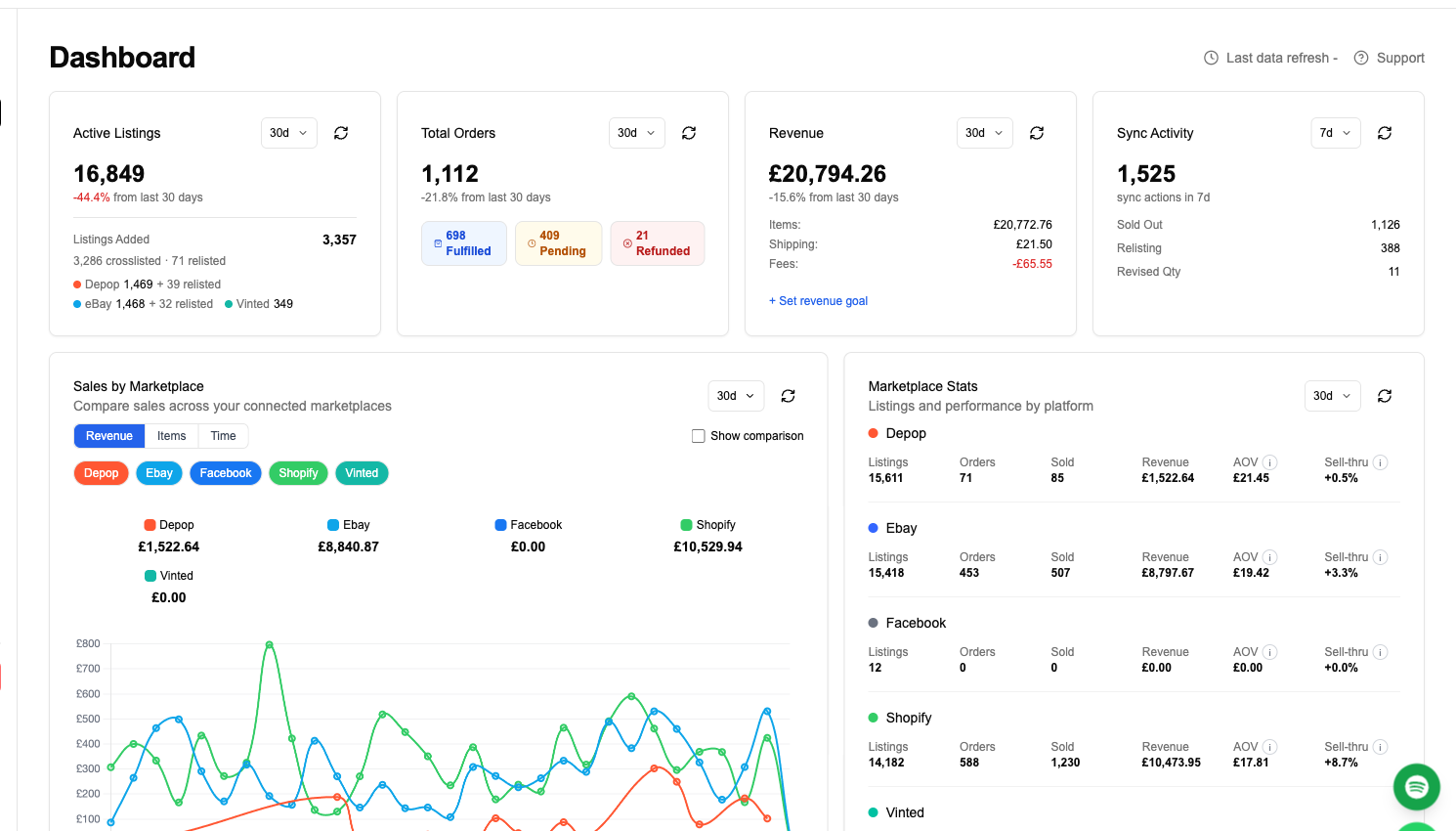
- Cost: FLUF Connect crosslists to 60+ marketplaces from one dashboard, including every resale marketplace above. £1 for 7 days, then plans from £9/month (Starter). There is no free plan.
The short answer
Pick Shopify unless you have a specific reason not to. The pricing is now identical at list — $39, $105 and $399 a month, or $29, $79 and $299 annually, on both platforms — but BigCommerce attaches a trailing-twelve-month sales ceiling to each tier and Shopify does not. That single structural difference means a growing store gets pushed up BigCommerce’s ladder by success rather than by need.
Pick BigCommerce if your catalogue is genuinely large and complex, you want an open checkout you can rewrite without an enterprise plan, or you are already invested in Feedonomics for feed management. Its platform limits are more generous in almost every dimension, and its checkout is less locked down.
Neither answers the question a resale seller actually has, which is how to get one inventory onto Depop, Vinted, Vestiaire, eBay and a storefront at once. We will come back to that, because it is the honest limit of this comparison rather than a sales pitch: both platforms are storefront software, and marketplaces are somebody else’s problem on both.
Pricing, and the sales cap that decides it
BigCommerce renamed its plans in 2026 — Standard became Core, Plus became Growth, Pro became Scale, Enterprise became Performance. If a guide still says Standard/Plus/Pro, it predates the change.
| BigCommerce plan | Monthly | Annual, per month | Sales ceiling | What happens at the ceiling |
|---|---|---|---|---|
| Core | $39 | $29 | $30,000 TTM inclusive GMV | Auto-upgrades to Growth |
| Growth | $105 | $79 | $100,000 TTM | Auto-upgrades to Scale |
| Scale | $399 | $299 | $33,333 per month | 0.9% of GMV above the cap |
| Performance | from $1,499/month, custom | $250,000 per month | Negotiated | |
“Inclusive GMV” is gross order value less 10% — a deduction that was 3% before the 2026 repricing, so the effective ceiling loosened slightly even as the structure tightened. Unlimited staff accounts, products, storage and bandwidth come on every plan. Additional storefronts cost $30 a month on Core to a maximum of three, $50 on Growth to a maximum of five, and $100 on Scale to a maximum of eight.
| Shopify plan | Annual, per month | Monthly | Staff accounts | Sales ceiling |
|---|---|---|---|---|
| Basic | £19 | £25 | 0 | None |
| Grow | £49 | £65 | 5 | None |
| Advanced | £259 | £344 | 15 | None |
| Plus | £1,800/month on a three-year term, £1,950 on one year | Unlimited | None | |
The absence in that last column is the most important thing on this page, and it is easy to skim past because absences do not advertise themselves. Shopify’s pricing comparison has no GMV row and no upgrade trigger. You move up Shopify’s tiers to buy features — staff seats, reporting, lower card rates — and you move up BigCommerce’s tiers because you sold too much on the one you were on.
Two smaller asymmetries worth knowing. Shopify Basic includes zero staff accounts, which surprises people running a two-person business; you need Grow for five. And BigCommerce prices in US dollars with no sterling option on its pricing page, so a UK merchant carries the exchange rate as an unhedged cost.
Transaction fees and payment processing
Both platforms charge you for not using their preferred payment rails. The mechanisms differ.
Shopify charges a third-party gateway fee on top of whatever the gateway itself takes: 2% on Basic, 1% on Grow, 0.6% on Advanced and 0.2% on Plus. It is not charged on manual methods such as cash on delivery, bank transfer or cheque, and not on PayPal where Shopify Payments is active. Shopify Payments itself costs, in the UK, 2% + 25p online on Basic, 1.7% + 25p on Grow and 1.5% + 25p on Advanced, with in-person rates of 1.7%, 1.6% and 1.5%.
BigCommerce now charges an Open Payment Provider fee of 2.0% on Core, 1.0% on Growth, 0.6% on Scale and nothing on Performance for orders taken through a gateway outside its embedded list. The embedded list includes Adyen, Stripe, PayPal variants, Klarna and BigCommerce Payments. So the long-standing marketing line about zero transaction fees now means “zero if you use a gateway from our list” — which is precisely what Shopify’s policy has always meant.
BigCommerce Payments, powered by PayPal, runs 2.89% + $0.30 on Core, 2.59% + $0.30 on Growth and 2.39% + $0.30 on Scale and Performance. It was announced in October 2025 and launched to US merchants in May 2026; it is not available in the UK.
Note the symmetry that emerges once you read both carefully: the two fee ladders are within a rounding error of each other at every tier. This used to be a genuine point of difference between the platforms and, as of 2026, it is not.
A £100,000 store, costed on both
Take a store turning over £100,000 a year across 2,500 orders at a £40 average, billed annually, using its own payment gateway rather than the platform’s.
| Shopify Basic | BigCommerce | |
|---|---|---|
| Plan forced by this volume | Basic — no threshold exists | £100k ≈ $135k gross ≈ $121.5k inclusive GMV, over the $100k Growth cap → Scale |
| Subscription | £228/year | $3,588/year ≈ £2,657 |
| Platform payment fee on an outside gateway | 2% ≈ £2,000 | 0.6% ≈ £540 |
| GMV overage | None | None — monthly volume is under $33,333 |
| Platform cost, excluding card processing | ≈ £2,228 | ≈ £3,197 |
Two honest caveats on that table. First, it assumes an outside gateway; move to Shopify Payments and the £2,000 line disappears entirely, taking Shopify’s platform cost down to about £228 while BigCommerce’s subscription stays where it is. That is the version of the comparison most stores actually live in, and the gap becomes roughly £230 against £2,660. Second, it assumes $1.35 to the pound; BigCommerce bills UK merchants in dollars, so your real number moves with the rate.
The general shape holds regardless of the assumptions. Below about £25,000 a year the two are close. Above it, BigCommerce’s ceilings do the work, and the platform gets materially more expensive at exactly the point a growing store can least afford surprises.
Company health: why this is not a fair fight in 2026
Platform choice is a multi-year commitment, so the financial trajectory of the vendor is a legitimate input, not gossip. Both companies are public and both reported the quarter to 30 June 2026 in early August.
| Quarter to 30 June 2026 | Shopify (SHOP) | Commerce.com (CMRC) |
|---|---|---|
| Revenue | $3,583m, up 34% | $84.5m, up 0.1% |
| Merchant GMV | $115.6bn, up 32% | $8.8bn, up 14% |
| Free cash flow | $654m, an 18% margin | $0.1m |
| Operating income | $488m, up 68% | $2.7m GAAP, $8.1m non-GAAP |
| Net revenue retention | Not reported in these terms | 95.8% |
| Full-year guidance | Low-thirties percent revenue growth | Cut to $336.5–344.5m |
Shopify is compounding at 32% GMV growth on a base thirteen times larger. BigCommerce is growing GMV at 14% while revenue is flat, which means its merchants are selling more but the company is not capturing more from them — net revenue retention below 100% says the same thing from the other direction.
Two structural notes. BigCommerce Holdings renamed itself Commerce.com, Inc. around 1 August 2025 and the ticker moved from BIGC to CMRC; BigCommerce is now one brand under it alongside Feedonomics and Makeswift. And in April 2026 Rezolve AI made an unsolicited exchange offer — one Rezolve share for every two Commerce shares, a 47% discount to the market at the time — which the board rejected, adopting a shareholder rights plan on 13 April 2026 that expires on 12 April 2027. There is no agreed strategic review or take-private in the filings. But a poison pill is a fact about the next twelve months of a platform you might be building on, and it belongs in the decision.
None of this means BigCommerce is going away. It means the two vendors are investing at very different rates, and platform features compound the same way revenue does.
Catalogue limits, variants and multi-storefront
Here BigCommerce wins on most measures, and it is the strongest argument for choosing it.
| Limit | BigCommerce | Shopify |
|---|---|---|
| Variants per product | 600 SKUs | 2,048, raised from 100 on 15 October 2025 |
| Options per product | 250 values per option | 3 options — unchanged |
| Images per product | 1,000 | 250 media items, images and video and 3D combined |
| Custom fields / metafields | 200 custom fields at 255 characters; 250 metafields per product, variant, category, brand and channel | 256 metafield definitions per resource per app, plus 256 per merchant, 64KB values |
| Categories | 16,000 | Collections, no comparable published cap |
| Catalogue ceiling | 250,000 products / 1m SKUs on Stencil; 500,000 / 2m on Catalyst | Stores above 500,000 variants throttle to 10,000 new variants a day, waived on Plus |
| Storefronts | Up to 8 on Stencil, 15 on Catalyst | 9 expansion stores, Plus only |
| API rate limit | 20,000/hour on Core and Growth, 60,000/hour on Scale, unlimited on Performance | Admin GraphQL 100 / 200 / 1,000 / 2,000 points per second by tier |
Shopify’s three-option ceiling is the one that catches people, because the variant limit gets all the attention. You may have 2,048 variants, but they can only be composed from three dimensions — size, colour, material, and then you are out of axes. BigCommerce’s 600-SKU limit is lower in total but does not constrain the number of option types the same way.
For a resale or one-of-one seller, none of this binds. Every item is a single SKU with no variants at all, so both platforms have limits several orders of magnitude beyond what you will use. The real constraint in that business is per-item listing workflow — photographing, describing, pricing and publishing each unique piece — and neither platform addresses it, because neither was built for it.
Themes, apps, checkout and headless
Ecosystem. Shopify’s App Store advertises over 16,000 apps and its Theme Store carries 1,243 themes — 24 free, 1,219 paid between $150 and $500. This is not close: whatever integration you need, Shopify probably has three of them and BigCommerce may have none.
Checkout. This is where BigCommerce’s openness looks like a genuine advantage, with one caveat we should be honest about: its Open Checkout, built on the Checkout SDK, carries no documented plan restriction in either direction — BigCommerce’s tutorial simply does not say which plans it applies to, so read that as an absence of a stated gate rather than a confirmed entitlement, and check before you buy on the strength of it. Shopify is unambiguous in the other direction: checkout.liquid was deprecated with an upgrade deadline of 28 August 2025, and from January 2026 automatic upgrades discard remaining customisations. Its replacement, Checkout Extensibility, has since widened — the checkout and accounts editor now reaches Basic and Advanced — but the deep customisation path remains Plus-scoped, and custom apps containing Shopify Functions are Plus-only outright. If bespoke checkout logic is central to your business, Shopify’s answer is £1,800 a month and BigCommerce’s is an SDK with no published price attached to it.
Headless. Both have a modern answer. BigCommerce ships Catalyst, an MIT-licensed Next.js stack. Shopify has Hydrogen and Oxygen. Catalyst being permissively licensed matters if you want to own the frontend outright rather than run it on the vendor’s hosting.
One quiet indicator of investment pace: BigCommerce’s own developer documentation still refers to plans by their pre-2026 names in places. That is a small thing, and it is the kind of small thing that accumulates.
Marketplaces: what each platform can and cannot reach
For most sellers reading a storefront comparison, this section decides it — because the storefront is rarely the whole business.
Shopify Marketplace Connect is first-party, descended from the Codisto acquisition, and supports Amazon, eBay, Walmart (US only) and Target Plus (US only). It is free to install, the first 60+ marketplace-synced orders a month are free, and after that it costs 1% per synced order, capped at $99 a month. It rates 4.2 out of 5 across 1,958 reviews.
Its notable gap is Etsy. Shopify’s own documentation states that “New connections to Etsy can’t be made at this time” — existing connections continue to work, with no restoration date given. If your plan was Shopify plus Etsy, that plan needs a third-party tool.
BigCommerce Channel Manager supports Amazon, eBay and Walmart on all four plans, plus Google, Meta, TikTok, Microsoft and Pinterest through Feedonomics Surface, free up to 100,000 SKUs. BigCommerce’s omnichannel marketing page additionally names Etsy, Wish, Mercado Libre and Target Plus — but those are reached through Feedonomics, not through Channel Manager.
Feedonomics deserves a note, because it is often presented as BigCommerce’s trump card. It publishes no pricing — the rate “varies by SKU count, channel type, number of channels, and service level”, with a twelve-month minimum term and an explicit promise never to take a percentage of revenue. And it is platform-agnostic: since 5 November 2025 it has shipped apps in the Shopify App Store. Owning it is a good business for Commerce.com; it is not an advantage that a BigCommerce merchant has and a Shopify merchant does not.
The resale gap neither platform fills
Here is the finding that surprised us when we checked it properly, and it is worth stating precisely because it cuts against both vendors equally.
Neither Shopify nor BigCommerce has any first-party integration with Depop, Vinted, Vestiaire Collective, Poshmark, Grailed or Mercari. Not one of the six appears in Shopify’s sales-channel list, in Marketplace Connect’s supported set, or in BigCommerce’s Channel Manager and plan feature lists.
The third-party position is thin too. On Shopify, ExportYourStore claims Depop, Mercari, Vinted, Grailed and Poshmark at $29 to $249 a month and rates 4.2 from 38 reviews. TrackNList covers Depop, eBay, Grailed, Mercari, Poshmark and StockX, is free, and carries a single one-star review. Vestiaire Collective has no Shopify app at all; searching for Vinted returns review-importer apps rather than listing tools. On BigCommerce, the Marketplaces and Multichannel Listings categories return zero results for all six.
The reason is structural rather than negligent. Amazon, eBay and Walmart publish stable seller APIs designed for catalogue-scale integration; the resale marketplaces largely do not, and several require a browser session on the seller’s own machine to act on their account at all. Building that is a different kind of engineering from building a product feed, and neither storefront vendor has judged it worth doing.
Which is where FLUF Connect sits: 60+ channels including all six of those, driven from one product list, with the storefront — Shopify, BigCommerce, WooCommerce or none — as just another connection. If your business is one-of-one stock across resale marketplaces plus a storefront, the storefront choice matters less than you think, because it is not the thing standing between you and your channels.
International selling and migration
Currency. Shopify charges a currency conversion fee of 1.5% in the United States and 2% in France and all other regions, and 3% for PayPal Wallet payments through Shopify Payments. Cross-border card fees sit on top and are not published. Plus merchants using Shopify Payments exclusively have third-party transaction fees waived.
Markets. Shopify Markets allows up to three active B2B catalogues on Basic, Grow and Advanced; retail market customisation requires POS Pro or Plus; multiple business entities are Plus-only. BigCommerce’s multi-storefront model is the counterpart, and is available from Core upward at $30 a month per extra storefront.
Migration. One practical asymmetry: Shopify’s own store importer supports Amazon, Clover, Etsy, eBay, GoDaddy, Lightspeed, Square, Squarespace, Wix and WooCommerce — and does not list BigCommerce as a source. Products can be moved by CSV either way, but historical orders, gift cards, blog posts and content pages have no CSV path and need an app or direct API work. Budget for that rather than assuming a button exists.
SEO and page speed — one clear win each
URL structure goes to BigCommerce, and it is not marginal. BigCommerce’s admin offers a choice of URL structures in Settings › URL Structure: SEO Optimized (Short) gives yourdomain.com/product-name, (Long) gives /products/product-name, (Category) gives /category/product-name, and Custom accepts placeholders including %productname%, %category%, %sku% and %upc% — with an option to auto-create 301 redirects when you change it. Root-level product URLs are the default. On Shopify, the /products/, /collections/, /pages/ and /blogs/ prefixes are fixed in observed practice; we phrase it that way deliberately, because we could not find a Shopify document that states they cannot be removed.
Page speed goes to Shopify, and that is not marginal either. The HTTP Archive technology report for the July 2026 crawl puts the share of origins passing all Core Web Vitals at 76.9% on mobile and 79.3% on desktop for Shopify, against 63.2% and 55.4% for BigCommerce. BigCommerce’s desktop shortfall is concentrated in cumulative layout shift — 58.4% good against Shopify’s 84.1%. Read it with the sample sizes in mind: roughly 431,000 Shopify mobile origins against 11,700 BigCommerce ones, a difference of about 35 times, which makes the Shopify figure the more stable of the two.
Smaller mechanics: Shopify allows editing robots.txt.liquid while warning that it is an unsupported customisation which can cost you all your traffic, generates sitemap.xml automatically with no way to edit it, and caps URL redirects at 100,000, or 20 million on Plus. BigCommerce exposes robots.txt directly in the admin under Settings › Website, permits URLs up to 1,024 characters and allows 4,000 web content pages.
Verdict: who should pick which
Choose Shopify if you are under about £250,000 a year, you want the largest app and theme ecosystem, you value not being repriced by your own growth, or you need staff seats and reporting without an enterprise conversation. For most sellers most of the time, this is the answer, and the sales-ceiling difference alone justifies it.
Choose BigCommerce if checkout customisation on a low-cost plan is central to your business, your catalogue genuinely needs 16,000 categories or 1,000 images per product, you want an MIT-licensed headless stack you fully own, or you are already committed to Feedonomics and want the vendor relationship consolidated.
Choose neither as the answer to the marketplace question, because it is not one either can answer. Both handle Amazon, eBay and Walmart adequately. Both are silent on Etsy in different ways — Shopify by closing new connections, BigCommerce by routing it through a feed product with unpublished pricing. And both are entirely absent from resale. A seller whose inventory lives on Vinted, Depop and Vestiaire as well as their own site is choosing a storefront, not a channel strategy, and should not confuse the two decisions.
Sources and verification
- BigCommerce pricing and the 2026 plan pricing updates — Core, Growth, Scale and Performance prices, the trailing-twelve-month GMV ceilings, the inclusive-GMV definition and the Open Payment Provider fee.
- BigCommerce Payments rates — 2.89%, 2.59% and 2.39% plus $0.30 by plan, US merchants only.
- BigCommerce platform limits — 600 SKUs per product, 250 option values, 200 custom fields, 250 metafields, 16,000 categories, 1,000 images per product, and the Stencil and Catalyst catalogue ceilings.
- Shopify UK pricing and Plus pricing — plan prices, staff accounts, locations, the third-party gateway fee and Shopify Payments UK card rates.
- Shopify third-party transaction fees and international fees — the exemptions and the currency conversion rates.
- Shopify variant limit changelog — 2,048 variants for all merchants from 15 October 2025, with the three-option limit unchanged.
- Shopify checkout upgrade — the
checkout.liquiddeprecation, the 28 August 2025 deadline and the January 2026 automatic upgrades. - Shopify Marketplace Connect and its app listing — supported marketplaces, the closed Etsy connections, and the 1%-per-synced-order pricing capped at $99 a month.
- BigCommerce omnichannel and Channel Manager — Amazon, eBay and Walmart natively, everything else through Feedonomics.
- Feedonomics pricing policy and the Shopify app launch of 5 November 2025 — unpublished pricing, twelve-month minimum, platform-agnostic.
- Shopify Q2 2026 results and Form 10-Q — revenue, GMV, free cash flow and Shopify Payments penetration.
- Commerce.com Q2 2026 results — revenue, ARR, GMV, net revenue retention, free cash flow and the guidance cut.
- The Commerce parent-brand announcement — the BIGC to CMRC ticker change.
- The board’s response to the Rezolve AI proposal and the 13 April 2026 8-K — the rejected offer and the rights plan expiring 12 April 2027.
- Shopify store importer — the supported source platforms, and BigCommerce’s absence from them.
- Shopify sales-channel documentation, the Shopify App Store and the BigCommerce App Marketplace, searched individually for Depop, Vinted, Vestiaire Collective, Poshmark, Grailed and Mercari, 30 August 2026.
What we could not verify, and therefore left out. The number of live stores on each platform: BuiltWith serves a bot-verification interstitial to every client we tried, and the figures circulating in blogs could not be confirmed at source, so we have quoted none. BigCommerce’s app and theme counts, which it does not publish in a form we could read. The claim that Shopify forces /products/ and /collections/ URL prefixes — widely repeated, but we found no Shopify document stating it. The date Marketplace Connect closed new Etsy connections, which the page does not give. And third-party migration tool pricing.
Related guides
- Sell on BigCommerce — the complete seller guide
- Sell on Shopify — the complete seller guide
- Crosslist from BigCommerce to eBay
- Crosslist from BigCommerce to Etsy
- Square vs Shopify compared
- All crosslisting routes
- Crosslist from BigCommerce to Amazon
- BigCommerce vs Amazon
- Crosslist from eBay to BigCommerce
Frequently Asked Questions
At list price they are now identical — $39, $105 and $399 a month, or $29, $79 and $299 annually, on both. What differs is that BigCommerce attaches a trailing-twelve-month sales ceiling to each tier and Shopify does not. Core stops at $30,000 and auto-upgrades you to Growth; Growth stops at $100,000 and auto-upgrades to Scale; Scale bills 0.9% of anything above $33,333 a month. A store doing £100,000 a year on Shopify Payments pays roughly £230 a year in platform fees on Shopify Basic and roughly £2,660 on BigCommerce, purely because the volume forces the plan.
No. As of 2026 BigCommerce charges an Open Payment Provider fee on orders taken through a gateway outside its embedded list — 2.0% on Core, 1.0% on Growth, 0.6% on Scale and nothing on Performance. The embedded list includes Adyen, Stripe, PayPal variants, Klarna and BigCommerce Payments. That is the same structure Shopify has always used, where a third-party gateway costs 2% on Basic, 1% on Grow, 0.6% on Advanced and 0.2% on Plus. Any comparison still leading with "BigCommerce has no transaction fees" is out of date.
Not on a new connection. Shopify's own Marketplace Connect documentation states that new connections to Etsy cannot be made at this time; existing connections continue to work, and no restoration date is given. Marketplace Connect currently supports Amazon, eBay, Walmart in the United States and Target Plus in the United States. If your plan was Shopify plus Etsy, you need a third-party tool for the Etsy side.
Neither has any first-party integration with Depop, Vinted, Vestiaire Collective, Poshmark, Grailed or Mercari. None of the six appears in Shopify's sales-channel list, in Marketplace Connect's supported set, or in BigCommerce's Channel Manager. The third-party position is thin as well: on BigCommerce the Marketplaces and Multichannel Listings app categories return no results for any of them, and on Shopify the handful of apps that claim coverage have very small review counts. The reason is structural — resale marketplaces largely lack the stable catalogue-scale seller APIs that Amazon, eBay and Walmart publish.
Shopify allows 2,048 variants per product, raised from 100 on 15 October 2025, but still only three options per product — so size, colour, material, and then you are out of axes. BigCommerce allows 600 SKUs per product with 250 values per option, which is a lower total but a looser constraint on how many option types you can use. Shopify stores above 500,000 variants throttle to 10,000 new variants a day, waived on Plus. For a one-of-one or resale seller neither limit binds, since every item is a single SKU.
Probably BigCommerce, with a caveat. Its Open Checkout, built on the Checkout SDK, carries no documented plan restriction — but BigCommerce's own tutorial does not state which plans it covers, so that is an absence of a stated gate rather than a confirmed entitlement, and it is worth checking before committing. Shopify is unambiguous the other way: checkout.liquid was deprecated with an upgrade deadline of 28 August 2025, and automatic upgrades from January 2026 discard remaining customisations. Its replacement, Checkout Extensibility, is a Plus feature, as are custom-app Shopify Functions — so on Shopify the equivalent capability costs around £1,800 a month.
Very differently. In the quarter to 30 June 2026 Shopify reported revenue of $3,583m, up 34%, merchant GMV of $115.6bn, up 32%, and free cash flow of $654m at an 18% margin. Commerce.com, BigCommerce's parent, reported revenue of $84.5m, up 0.1%, GMV of $8.8bn, up 14%, free cash flow of $0.1m and net revenue retention of 95.8%, and cut its full-year guidance. BigCommerce Holdings renamed itself Commerce.com around 1 August 2025 and its ticker moved from BIGC to CMRC.
In April 2026 Rezolve AI made an unsolicited exchange offer for Commerce.com — one Rezolve share for every two Commerce shares, which was a 47% discount to the market price at the time. The board rejected it and adopted a shareholder rights plan, commonly called a poison pill, on 13 April 2026, which expires on 12 April 2027. There is no agreed strategic review or take-private in the company's filings. It does not mean the platform is going away, but a live takeover defence is a reasonable thing to weigh when choosing software you will build on for years.
Less easily than you might expect. Shopify's own store importer supports Amazon, Clover, Etsy, eBay, GoDaddy, Lightspeed, Square, Squarespace, Wix and WooCommerce — and does not list BigCommerce as a source. Products can be moved by CSV in either direction, but historical orders, gift cards, blog posts and content pages have no CSV path and require an app or direct API work. Budget time for that rather than assuming a one-click path exists.
The storefront decision matters less than it appears, because neither platform can reach the channels that business runs on. Both handle Amazon, eBay and Walmart adequately; both are awkward about Etsy; and both are entirely absent from Depop, Vinted, Vestiaire Collective, Poshmark, Grailed and Mercari. Pick whichever storefront suits your catalogue and budget — Shopify for most people, BigCommerce for open checkout or very large catalogues — and treat marketplace crosslisting as a separate tool rather than something the storefront will solve.