
Crosslist from BigCommerce to Depop — One-Click Listing with FLUF Connect
Push your BigCommerce fashion catalog to Depop's Gen-Z audience in one click, with full two-way inventory, order, relisting and offer sync.
7 days for £1, then from £9/month.



TL;DR: FLUF Connect pushes your BigCommerce catalog to Depop in one click — photos, titles, descriptions, prices and variants carry over, mapped to Depop’s category and listing fields. Inventory stays in sync so you never oversell across stores, and because Depop supports full two-way sync, FLUF handles relisting, offer responses, order flow-back and marks a BigCommerce item sold the moment it sells on Depop (and vice versa). It’s the fastest way for a BigCommerce store carrying streetwear, vintage or preloved-style fashion to reach Depop’s mostly Gen-Z audience without re-keying a single listing.
A BigCommerce store gives you a powerful, fully-hosted catalog, a branded storefront and the kind of API-first infrastructure that scales from mid-market to enterprise. What it doesn’t give you, on its own, is an audience of buyers actively browsing for their next thrifted find. Your BigCommerce storefront only gets the traffic you drive to it — through ads, SEO, email and social — and every one of those buyers has to discover your domain first. Depop flips that equation: it’s a marketplace where millions of shoppers, skewed heavily toward Gen-Z in the US and UK, are already scrolling a feed looking for streetwear, Y2K, vintage and preloved fashion. Listing the same inventory in both places means your products keep working while you sleep.
The catch has always been the manual labour. Re-photographing, re-typing and re-pricing the same product on a second platform is slow, error-prone and — worse — leaves you exposed to overselling the moment one channel sells out and the other doesn’t know. That’s the gap FLUF Connect closes. Connect your BigCommerce store once, connect Depop once, select what you want to list, and FLUF crosslists it for you while keeping stock, orders and offers synchronised across both.
Why Sell on Both BigCommerce and Depop?
Selling on both means you keep the control of your own BigCommerce storefront while tapping a ready-made resale audience you’d otherwise have to buy. Depop reaches millions of mostly Gen-Z shoppers across the US and UK who treat the app as a daily destination for secondhand and independent fashion — demand your branded store can’t manufacture on its own (Depop).
The economics reinforce the case. Marketplaces now account for roughly 67% of global e-commerce sales (BCG, 2024), and the shift toward specialist, community-driven marketplaces is exactly where Depop lives. For a fashion seller, being absent from those channels means being absent from where most discovery now happens.
Depop’s fee structure makes it especially attractive for sellers. In both the US and UK, Depop charges a 0% selling fee — sellers keep the full sale price, while buyers pay a separate Buyer Protection fee at checkout (Depop). That’s a meaningful contrast with the transaction costs baked into running a standalone storefront, where payment processing and platform overhead eat into every order. Adding Depop as a channel can therefore lift your effective margin on the units that sell there, not just your volume.
There’s an audience-fit dimension too. Depop is now owned by eBay, and its community skews young, female and style-led — the natural home for streetwear, vintage, Y2K and preloved fashion (Depop). If your BigCommerce catalog leans into those categories, you’re not just adding reach — you’re adding the *right* reach. The same dress or pair of sneakers that scrolls past unnoticed in a generic store can land in front of a buyer who is specifically there to find it.
Crucially, you don’t have to choose one or the other. Your BigCommerce store remains your owned channel — your domain, your branding, your customer data and your B2B relationships — while Depop becomes an additional discovery surface. FLUF Connect is what makes running both practical rather than punishing, because it removes the duplicate data entry and the overselling risk that normally make multi-channel selling a chore.
Consider a concrete before-and-after. A BigCommerce merchant running a vintage and streetwear store has, say, 400 single-piece items live on their own domain. Before FLUF, reaching Depop meant opening the app, photographing each garment again, typing a fresh title and description, picking a category, setting a size and price, and repeating that 400 times — then manually deleting each Depop listing the moment the item sold on their BigCommerce store, or risk selling the same one-off jacket twice. In practice most sellers never list everything; the friction quietly caps their reach. After FLUF, the same merchant connects both accounts once, selects the 400 items, and crosslists them in bulk. The listings appear on Depop built from data they already entered in BigCommerce, in front of a Gen-Z audience that was never going to find their standalone domain. When a jacket sells on either side, the other listing closes itself. The labour that used to gate their Depop presence disappears, and the reach they couldn’t justify the effort for becomes the default.
How to Crosslist from BigCommerce to Depop with FLUF Connect
The whole point of FLUF Connect is that crosslisting shouldn’t feel like a project. Once your accounts are linked, moving a product from your BigCommerce catalog to Depop is a matter of selecting it and clicking once. Setup takes about ten minutes, and after that the heavy lifting is automated. Here’s how it works.
Step 1: Connect your BigCommerce store
Connect BigCommerce using your store API token or the setup prompts in FLUF Connect. Import and review your products, variants, images and categories, then connect Depop to crosslist your selected stock.
Step 2: Connect your Depop account
Linking Depop is the same low-friction process: authorise the connection through FLUF, and your Depop shop becomes a live destination. No passwords change hands, and you can disconnect whenever you like. From this point, FLUF can read your Depop listings and write new ones on your behalf.
Step 3: Select the products to crosslist
With both sides connected, your BigCommerce catalog appears inside FLUF Connect. You choose which products to push to Depop — the whole catalog, a category, or a hand-picked selection. Since Depop is a fashion-led marketplace, most sellers will pick the streetwear, vintage and apparel lines that fit the audience rather than blindly mirroring an entire general-merchandise catalog.
Step 4: Crosslist in one click
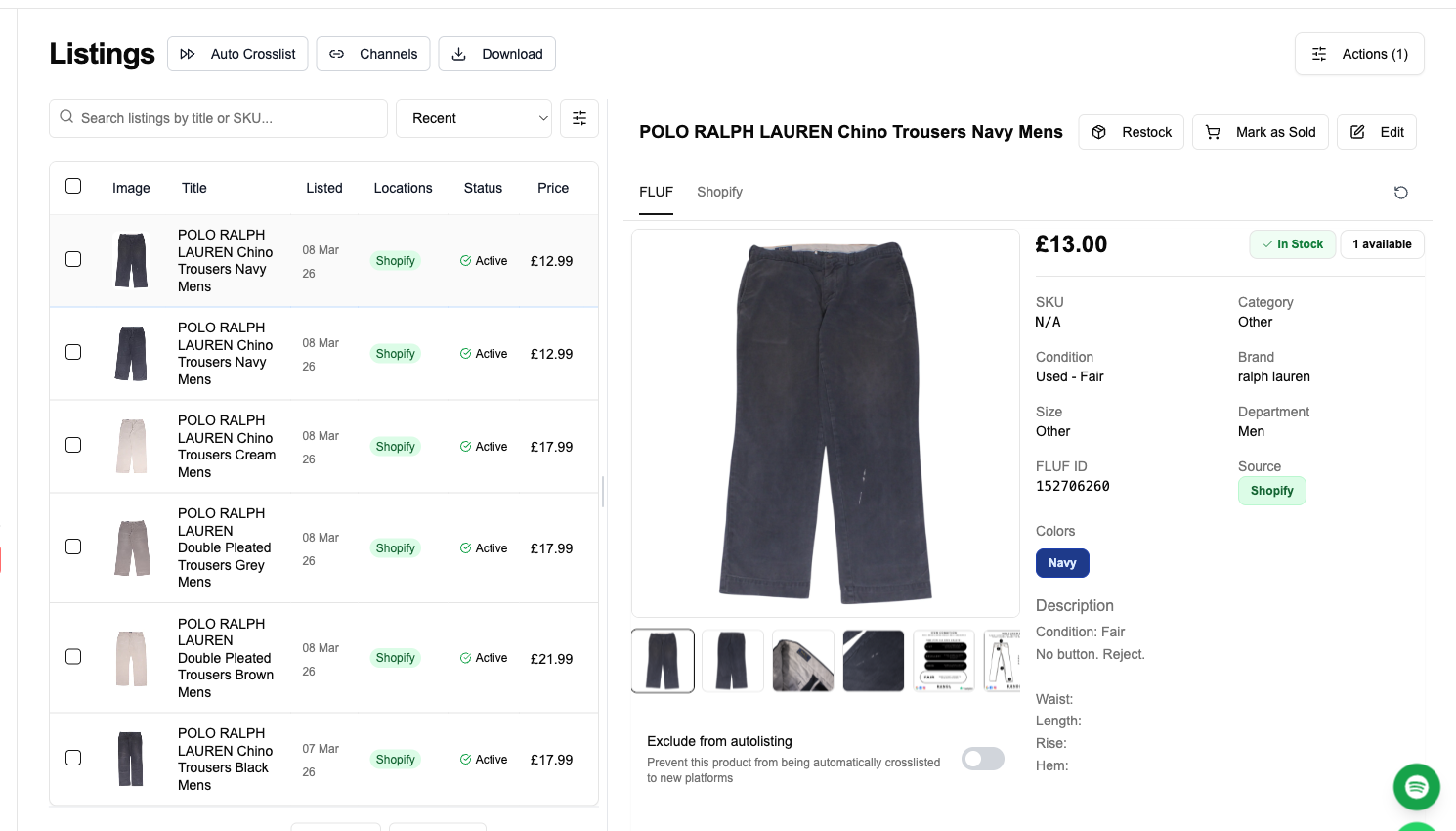
Hit crosslist, and FLUF builds a native Depop listing from each selected BigCommerce product — pulling the photos, title, description, price and variant data and mapping them into Depop’s listing fields and category structure. There’s no re-typing, no re-uploading images and no copy-pasting between tabs. The listing goes live on Depop looking like it was built there from scratch.
From that moment, the connection is two-way. FLUF doesn’t just fire-and-forget a listing — it keeps watching both your BigCommerce store and your Depop shop so that stock, orders, offers and relists all stay aligned. That ongoing synchronisation is what separates a real crosslisting tool from a one-time export, and it’s covered in detail below.
What Transfers When You Crosslist from BigCommerce to Depop?
When FLUF crosslists a product, the goal is a Depop listing that looks and reads as though you built it by hand — without you actually having to. Here’s what carries across from your BigCommerce catalog and how it maps onto Depop’s listing model.
Photos. Review your Depop gallery before publishing. Choose a strong cover image and useful detail shots such as the back, label and fit. Confirm the photo order and any destination image limits.
Title and description. Your product title and description transfer directly. Depop listings lean on searchable, descriptive copy and hashtags, so the descriptive text you’ve already written for BigCommerce gives Depop’s search and discovery something to work with. You can refine listings afterward, but the starting point is your existing copy rather than a blank box.
Price. The product price carries over, and FLUF handles currency conversion where your BigCommerce store and your Depop shop operate in different currencies — so a GBP-priced item lands at a sensible figure for a US Depop audience rather than a raw number in the wrong currency. Because Depop charges a 0% selling fee in the US and UK (Depop), you generally don’t need to inflate your Depop price to absorb a seller commission the way you would on a percentage-fee marketplace.
Variants. Review each item’s size, colour and other options before publishing to Depop. Accurate sizing helps buyers find the item through filters.
Category. Confirm the Depop department, category and subcategory before publishing. Adjust any destination that does not accurately describe the product.
Depop-specific fields. Depop listings care about details that drive its on-app discovery: category and sub-category, condition, brand where applicable, size, colour and hashtags. FLUF populates these from your BigCommerce data where it can, and the listing is fully editable on Depop afterward if you want to add platform-native flourishes — like Depop-style hashtags or styling notes — that help the item perform with a Gen-Z audience. The important thing is that you start from a complete, populated listing rather than an empty form.
What this adds up to is a Depop listing that’s genuinely usable the moment it’s created, built from data you’ve already entered once in BigCommerce. The mapping isn’t a lossy export — it’s a translation of your catalog into Depop’s native shape.
What Syncs (and What Doesn’t)
Crosslisting is only half the value; staying synchronised is the other half. Depop is one of FLUF’s fully-supported destinations, which means the connection between your BigCommerce store and your Depop shop is genuinely two-way and covers the whole lifecycle of a listing.
Inventory sync — always. This is the non-negotiable foundation, and it’s worth being precise about how it protects you. The classic multi-channel failure looks like this: a one-off jacket is live on both your BigCommerce store and your Depop shop. A Depop buyer checks out at 9:02am; thirty seconds later, a customer on your own domain adds the same jacket to their cart. With no sync, you’ve now sold a single physical item twice — and someone is getting a refund, an apology and a worse opinion of your store. FLUF closes that window. When the Depop sale fires, FLUF immediately marks the BigCommerce item out of stock (and the reverse: a BigCommerce sale pulls the Depop listing down). If your BigCommerce stock for a product drops to zero, the corresponding Depop listing is marked sold; if it sells on Depop first, your BigCommerce inventory is decremented in step, both directions, automatically. For single-quantity vintage or preloved items — where every unit is unique and there’s no second one to fall back on — this is exactly what makes listing the same stock in two places safe rather than reckless. You get the reach of two channels with the oversell risk of one.
Order flow-back — yes. Because Depop supports order sync, FLUF brings Depop orders back into your central view, so you can see and manage sales from both channels in one place rather than checking the Depop app separately. Your fulfilment and stock picture stays consolidated.
Mark-as-sold — yes. When a unit sells anywhere in your connected set of channels, FLUF marks it sold on Depop too, removing it from sale so a buyer can’t purchase something you’ve already shipped from your BigCommerce store. This works in both directions.
Relisting — yes. Depop rewards freshness — newer and refreshed listings get more visibility in the feed — so FLUF can relist your Depop items to keep them surfacing, rather than letting them sink as they age. This is automation Depop genuinely supports, and FLUF puts it to work.
Offers — yes. Depop buyers negotiate, and FLUF supports offer management on Depop, so the back-and-forth of offers can be handled as part of your automated workflow rather than requiring you to babysit the app.
In short, for the BigCommerce-to-Depop pairing there’s very little that *doesn’t* sync — inventory, orders, relisting and offers are all covered. The honest caveat is the usual one for any marketplace: platform-native messaging and the buyer’s checkout experience happen inside Depop itself, as they must. FLUF’s job is to keep your catalog, stock, orders and listings consistent across both channels, and on Depop it does the full set.
Automation for BigCommerce + Depop Sellers
The difference between a crosslisting tool that saves you an afternoon and one that quietly runs a chunk of your business is automation. Because Depop supports the full range of capabilities, FLUF Connect can automate the parts of Depop selling that otherwise eat your time — and all of it is included in every plan, not a paid add-on.
Automated relisting. Depop’s feed favours recency, so listings that have been sitting for a while lose visibility. FLUF can relist your Depop items on a schedule so they keep cycling back into view in front of new shoppers. Instead of manually deleting and re-uploading listings to chase the algorithm — the tedious ritual many Depop sellers resort to — you let FLUF handle the refresh, and your inventory keeps getting fresh exposure without fresh effort.
Offer automation. Negotiation is part of the culture on Depop, and responding to every offer manually is a drain — especially across a large catalog crosslisted from BigCommerce. FLUF’s offer management lets you set up how offers are handled so the haggling doesn’t require you to live in the app. That keeps deals moving and buyers engaged even when you’re focused on running your BigCommerce store.
Bulk operations. Crosslisting an enterprise-sized BigCommerce catalog one product at a time would defeat the purpose. FLUF lets you select and crosslist in bulk, push price or inventory updates across the catalog, and manage many listings at once. For mid-market and enterprise BigCommerce merchants with large catalogues, this is the only way multi-channel selling scales.
Always-on inventory protection. The most valuable automation is the one you never have to think about: continuous inventory synchronisation. Every sale on either channel updates the other automatically, so overselling — the single biggest risk of selling the same stock in two places — is handled in the background around the clock.
All of these automations come standard. FLUF’s plans differ by how many products you can manage, not by which automations you unlock — offer handling and bulk operations are included in every plan, and relisting from Seller upwards.
Pricing
FLUF Connect plans start at £9/month (Starter). There is no free plan, but every new account gets a 7-day trial for £1. Higher plans sync more often for larger BigCommerce catalogues, but the automation is the same across the board: bulk operations on Depop is included in every plan, and relisting and offer management from Seller upwards, not a paid add-on. Setup takes about ten minutes — connect your BigCommerce store and your Depop shop, select your products, and start crosslisting. You can begin at /connect.
Put against the time you’d otherwise spend manually duplicating listings and the revenue you’d lose to overselling or stale, unrefreshed Depop listings, a single tier covers the whole BigCommerce-to-Depop workflow end to end.
Sources & Verification
- Depop — removing selling fees, fee-structure evolution (audience, eBay ownership)
- Depop — zero selling fees, Buyer Protection fee
- BigCommerce — native omnichannel / marketplace coverage
- BigCommerce — plans and pricing
- BCG (2024) — the rise of the B2C specialty marketplace (~67% of e-commerce via marketplaces)
Related guides
Frequently Asked Questions
Connect BigCommerce and Depop in FLUF Connect, import your catalog, then select products to crosslist. Review photos, titles, descriptions, prices, variants and categories before publishing.
Yes. Inventory sync is always on. When an item sells on either BigCommerce or Depop, FLUF updates the other channel automatically so you never oversell the same unit. For single-quantity vintage or preloved items this is what makes selling on both channels safe.
Depop charges a 0% selling fee for sellers in the US and UK — you keep the full sale price — while buyers pay a separate Buyer Protection fee at checkout. That's separate from FLUF Connect's own subscription, which starts at £19/month.
Yes. Depop supports both, so FLUF can relist your Depop items to keep them fresh in the feed and manage incoming offers as part of your automated workflow. Bulk operations are included in every plan, and relisting and offer management from Pro upwards, not a paid add-on.
Yes. Depop supports order sync, so FLUF brings Depop orders back into your central view alongside your BigCommerce sales. You manage and fulfil from a consolidated picture rather than checking each platform separately.
No. BigCommerce's native marketplace coverage is limited to Amazon, eBay and Walmart plus social channels — Depop and most fashion-resale marketplaces aren't natively supported. FLUF Connect bridges that gap and adds full two-way sync that native integrations don't provide.
Depop's community skews toward Gen-Z shoppers in the US and UK looking for streetwear, vintage, Y2K and preloved fashion. BigCommerce sellers carrying those categories see the best fit. You can crosslist a hand-picked selection rather than mirroring an entire general-merchandise catalog.
FLUF Connect plans start at £9/month on Starter, with Pro at £29/month and custom Super Seller plans above that; every plan is unlimited on listings and marketplaces, and the tiers differ by which automations they include and how often we check your channels for sales. There is no free plan, but every new account gets a 7-day trial for £1. Higher plans sync more often for larger BigCommerce catalogues, and all automation — relisting, offers and bulk operations — is included from Pro upwards rather than gated behind a higher tier.