Crosslist from Depop to Gumtree — Sell Locally and in Bulk
Move stalled and bulky Depop stock onto the UK's largest local cash classifieds — Depop fully synced, Gumtree managed manually.
7 days for £1, then from £9/month.



TL;DR: crosslisting Depop→Gumtree (national shipped fashion app → UK local cash classifieds). FLUF Connect pulls your existing Depop inventory — titles, descriptions, photos and prices — and helps you re-list it on Gumtree to reach local, all-ages, all-category cash buyers near you. Depop is a fully integrated source channel (relisting, offers, order-sync and automatic mark-as-sold all included), while Gumtree is an extension-first local-classifieds destination that you manage manually: there is no inventory sync, no offers, no relisting and no automatic mark-as-sold on Gumtree, so you confirm sales yourself. It is the right move for bulky or heavy pieces that are uneconomic to post, for stock that has stalled in front of Depop’s Gen-Z audience, and for keeping 100% of your sale price — Gumtree charges no listing fee and no sales commission. Plans start at £9/month (Starter); There is no free plan, but every new account gets a 7-day trial for £1.
If you sell on Depop, you already know its strengths: it is a fashion-first, mobile-native marketplace with a young, trend-hungry audience that ships purchases across the country and beyond. But every Depop seller eventually meets its limits. Some items are too bulky, too heavy or too low-margin to post profitably. Some pieces simply do not land with Depop’s Gen-Z aesthetic — classic coats, household-adjacent items, larger sizes or non-streetwear brands — and they sit unsold for weeks. And some sellers want the immediacy of a local, cash-in-hand sale rather than waiting on shipping, returns and platform payouts. That is exactly where Gumtree comes in, and it is exactly the gap FLUF Connect is built to close. This guide walks through why crosslisting from Depop to Gumtree works, how FLUF Connect moves your listings across, what genuinely syncs (and, just as importantly, what does not), how the field and category mapping behaves, what each platform costs, and how to think about running a national shipped channel and a local cash channel side by side.
Why Crosslist from Depop to Gumtree
Depop and Gumtree sit at almost opposite ends of the UK resale spectrum, and that contrast is the whole point. Depop is a Gen-Z resale fashion app — founded in London in 2011 and acquired by Etsy in 2021 for $1.6 billion in a deliberate bid for younger shoppers [1]. Around 90% of Depop’s active users are under 26, and the platform is built around shipped, app-first selling of secondhand and vintage clothing, streetwear and Y2K fashion [2]. That focus is a strength when you are selling on-trend pieces to a national (and substantially US-based) fashion audience — and a constraint when your stock falls outside that lane.
Gumtree is the other half of the equation: the UK’s largest local classifieds site, founded in 2000, owned over the years by eBay (from 2005) and Adevinta (2020) and now by O3 Industries/Novum Capital [3]. It draws roughly 15 million monthly visits, with about 91% of that traffic coming from inside the UK [4]. Crucially, Gumtree is not a fashion niche — it lists everything: clothing, furniture, electronics, around 200,000 motor listings, jobs, property and bulky household goods. Buyers tend to be local, all-ages and motivated by collection-in-person and cash payment rather than shipped checkout.
Put those two profiles together and the case for crosslisting writes itself. There are three clear reasons to push Depop stock onto Gumtree:
- Clear bulky and slow stock to local cash buyers. Heavy coats, boots, bundles, or anything awkward and expensive to post can be sold for collection on Gumtree instead of eating into your margin with courier costs.
- National shipped fashion app → local cash classifieds. Depop’s reach is national-to-international but mediated by shipping; Gumtree’s reach is hyper-local and immediate. Listing in both places means a stalled item gets a second, completely different audience.
- Keep 100% of your sale price. Gumtree charges no listing fee and no sales commission on standard listings, so a local sale there can net you more than the same item shipped with platform and processing fees attached (more on fees below).
The differentiation matters because these are not two versions of the same buyer. Depop is a Gen-Z fashion niche; Gumtree is all-ages, all-category and built around roughly 15 million UK visitors a month who are often searching for exactly the kind of practical, collectable or bulky items that never quite click on a fashion app. Crosslisting lets you serve both without doubling your admin.
How Crosslisting from Depop to Gumtree Works
FLUF Connect treats Depop as a source channel and Gumtree as a destination channel, and the two roles behave very differently — so it is worth understanding the flow before you start.
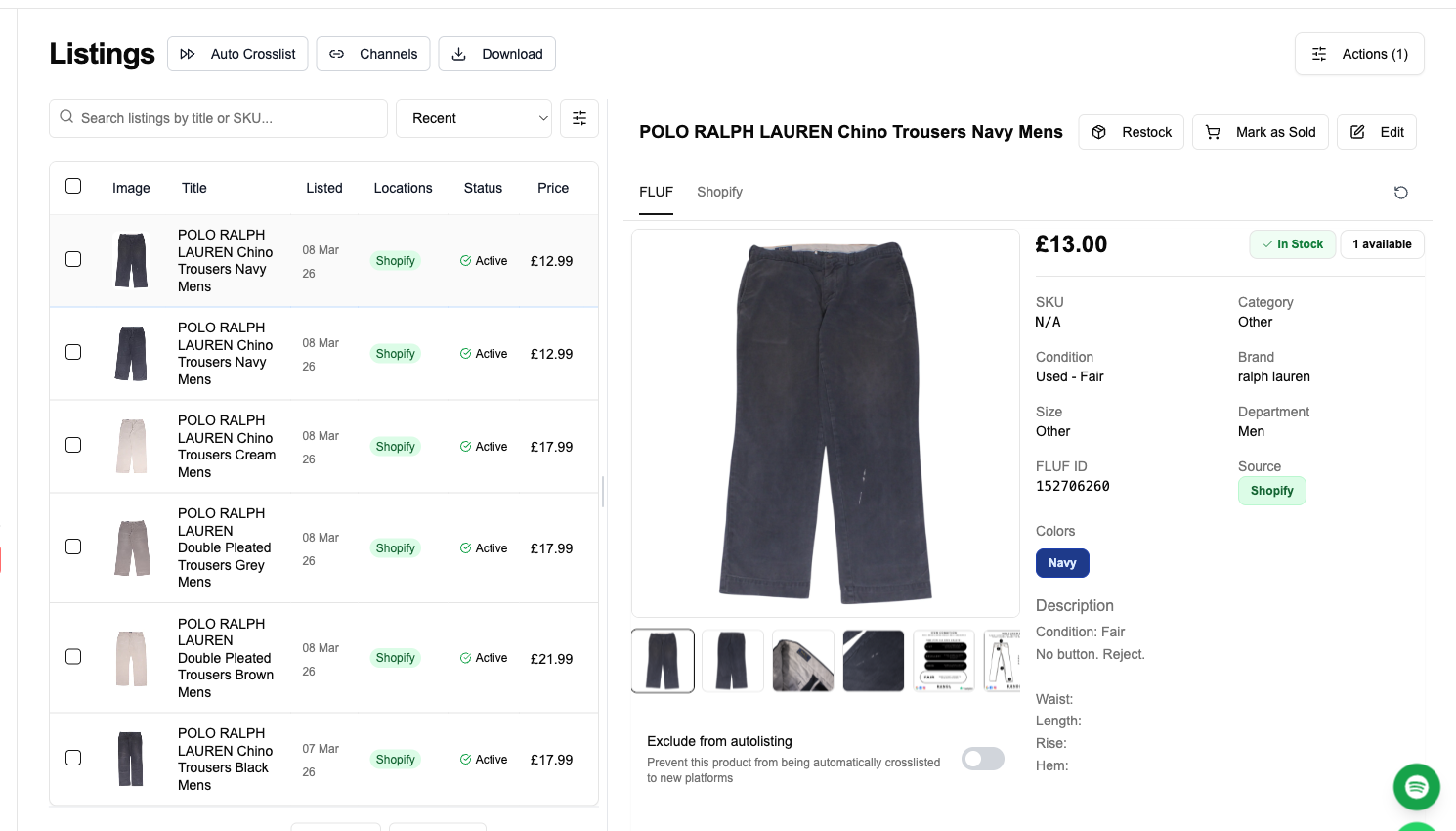
Connect Depop and import your titles, descriptions, photos, prices and condition details into FLUF Connect. Depop supports relisting, offer management, order sync and mark-as-sold.
Gumtree requires the FLUF browser extension. Review the prepared ad, including its title, description, photos, price and location, before publishing. Continue managing local buyer conversations and sales yourself.
The practical workflow looks like this:
- Connect Depop as your source. FLUF Connect imports your existing listings into one central inventory.
- Review and select the items you want to offer locally — typically your bulky, heavy or slow-moving stock.
- Map each listing to Gumtree via FLUF Connect, which reshapes the Depop data into a Gumtree ad (title, description, photos, price, location).
- Place the ad on Gumtree using the extension, adding your postcode and choosing “collection” where shipping does not make sense.
- Manage Gumtree sales yourself. When a local buyer collects and pays, you mark the item sold — on Gumtree and across your other channels — manually.
The single most important thing to internalise: Depop does the heavy lifting automatically; Gumtree is a manual channel you steer. FLUF Connect removes the copy-paste and re-photographing drudgery of getting a Depop listing onto Gumtree, but it does not, and cannot, run Gumtree as an automated synced marketplace. That honesty is by design — Gumtree’s classifieds model has no native programmatic inventory layer to plug into for most listings.
What Syncs — and What Does Not
This is the section to read twice, because the difference between the two channels is where sellers most often trip up. Here is the honest breakdown.
From Depop (source) — fully integrated:
- Listing import: your live Depop catalogue is indexed into FLUF Connect, including titles, descriptions, photos, prices and condition.
- Relisting: FLUF Connect can relist Depop items to keep them fresh in feed.
- Offers: offer handling is supported on the Depop side.
- Order sync: Depop orders flow into FLUF Connect.
- Automatic mark-as-sold: when a Depop item sells, FLUF Connect can mark it sold automatically so your inventory stays accurate.
To Gumtree (destination) — manual only:
- No inventory sync. FLUF Connect does not keep Gumtree stock levels in sync with your other channels. If an item sells on Depop, your Gumtree ad will not automatically come down.
- No offers handling. Gumtree negotiations happen between you and the buyer directly; FLUF Connect does not manage them.
- No automatic relisting. Refreshing or renewing Gumtree ads is something you do yourself.
- No automatic mark-as-sold. When a Gumtree item sells, you mark it sold manually — both on Gumtree and across your linked channels — to avoid overselling.
Why the gap? Gumtree is a classifieds platform with no native checkout for most listings and no programmatic inventory API for sellers to hook into — sales happen via local collection and cash, off-platform [5]. There is simply nothing for an automated sync to talk to. Rather than pretend otherwise, FLUF Connect is explicit that Gumtree is a manual local-sale channel: it does the tedious work of getting your listing prepared and onto Gumtree, but the ongoing management is yours.
In practice this is not a burden so much as a discipline. Because Gumtree sales are local and collection-based, you will usually know the moment an item is spoken for — a buyer messages, arranges a time and collects. At that point you simply mark it sold in FLUF Connect so your Depop (and any other) listing reflects reality. The recommended habit is to only crosslist items to Gumtree where you are comfortable doing that quick manual check, and to lean on FLUF Connect’s automated Depop side for everything that needs hands-off sync.
Field and Category Mapping: Depop to Gumtree
Depop and Gumtree describe products in fundamentally different ways, and FLUF Connect handles the translation so your ad reads well on the destination side. Depop listings are fashion-structured: they carry brand, size, condition and category attributes as discrete fields. Gumtree ads are far looser — essentially a title, a free-text description, photos, a price and a location. There are no structured size or brand fields on Gumtree for clothing the way there are on a fashion marketplace.
FLUF Connect maps the data like this:
- Title → Gumtree ad title. Your Depop listing title becomes the headline of the Gumtree ad.
- Description (plus folded-in attributes) → Gumtree description. Because Gumtree has no dedicated brand, size or condition fields, those Depop attributes are folded into the description prose. A Depop listing for a “Nike, size M, very good condition” jacket becomes a Gumtree description that states the brand, size and condition in plain text where local buyers (and Gumtree’s own search) will read them.
- Images → photos. Your product photos carry across to the Gumtree ad.
- Price: GBP → GBP, no conversion. Both platforms are UK-priced in pounds, so there is no currency conversion — the price carries over directly. You can, of course, adjust it for a local cash sale.
- Shipped Depop item → local “for sale, collection” ad. A shipped Depop listing is reframed as a local pickup ad. You add your postcode and present the item for collection rather than postage, which is what most Gumtree buyers expect.
The practical upshot of folding brand, size and condition into the description is that you should write — or let FLUF Connect prepare — descriptions that surface those details clearly in text. On a fashion app, “size M” lives in a dropdown; on Gumtree it needs to live in the sentence, because that is both what the buyer scans and what Gumtree’s keyword search indexes. Done well, this actually produces richer, more readable Gumtree ads than the terse attribute-tag style of a fashion marketplace.
Fees: Depop vs Gumtree
Fees are one of the strongest arguments for adding Gumtree as a destination, because the economics are genuinely different on each side.
On Depop, the fee picture changed meaningfully in 2024. Depop removed its 10% seller selling fee for UK sellers on GBP sales, applying to new listings from 20 March 2024 [6]. That is a real win for UK sellers — but it does not make Depop free to sell on. Sellers still pay payment-processing fees (2.9% + £0.30 per transaction), and the cost model also shifted partly onto buyers, who can now pay a marketplace fee of up to 5% plus up to £1 [7]. Add shipping into the mix and a shipped Depop sale still carries cost.
On Gumtree, standard listings in most categories are free to post, and there is no sales commission — sellers keep 100% of the sale price. Gumtree’s revenue comes from optional paid promotions (featured ads, bumps, urgent tags) that you can choose to buy but never have to [8]. Because most Gumtree sales are local cash-on-collection with no native checkout, there is also no payment-processing cut on a typical transaction.
Here is the side-by-side:
| Depop (source) | Gumtree (destination) | |
|---|---|---|
| Type | National shipped fashion app | UK local cash classifieds |
| Audience | Gen-Z fashion; ~90% under 26 | All-ages, all-category; ~15M UK visits/month |
| Seller selling fee | 0% for UK GBP sales (new listings from 20 Mar 2024) | None (free to list standard categories) |
| Payment processing | 2.9% + £0.30 per transaction | None on typical local cash sale |
| Sales commission | 0% seller (buyer pays up to 5% + up to £1) | None — keep 100% |
| Optional costs | Boosted listings / shipping | Optional paid promotion only |
| Fulfilment | Shipped (app checkout) | Local collection, cash (no native checkout) |
| FLUF Connect role | Full sync: relist, offers, order-sync, auto mark-as-sold | Manual: extension-assisted listing, you mark sold |
The takeaway: Depop is now far more competitive on fees for UK sellers than it once was, but Gumtree’s zero-commission, keep-100% model is unbeatable for items where local collection makes sense — especially bulky or heavy goods where shipping would have eaten the margin entirely.
Which Depop Items Belong on Gumtree
Not every Depop listing is a good Gumtree candidate, and being selective makes the manual-management side painless. The items that tend to perform best when crosslisted to Gumtree are:
- Bulky and heavy pieces. Winter coats, boots, multi-item bundles, anything where postage cost rivals the item’s value. Local collection neutralises the shipping problem.
- Slow movers on Depop. Items that have been live for weeks without traction in front of a Gen-Z fashion audience may simply be in the wrong place. Gumtree’s broader, all-ages crowd can be a better fit for classic, practical or larger-size pieces.
- Lower-value lots. When a sale’s margin is thin, avoiding processing fees and shipping by selling locally for cash can be the difference between a worthwhile sale and a loss-maker.
- Local-interest goods. Anything where a buyer would reasonably prefer to see it in person before paying benefits from Gumtree’s collection-first model.
By contrast, keep your trend-led, easily shippable, high-demand fashion on Depop’s automated channel where relisting, offers and auto mark-as-sold do the work for you. Use Gumtree as the pressure-release valve for everything that does not fit a fashion app’s shipped, Gen-Z mould. Because you manage Gumtree manually, a focused selection — rather than dumping your whole catalogue across — keeps the workload trivial and the overselling risk near zero.
Running Both Channels Together
The endgame is not to move off Depop — it is to let each platform do what it is best at while one central FLUF Connect inventory keeps you organised. Depop remains your shipped, national, automated fashion channel: connect it once and FLUF Connect handles relisting, offers, order-sync and automatic mark-as-sold. Gumtree becomes your manual local-cash outlet for the stock that does not belong on a fashion app, reaching a completely different pool of roughly 15 million UK visitors a month at zero commission.
Because Gumtree is manual, the one habit that keeps the whole system clean is prompt updating: when a local buyer collects and pays, mark the item sold in FLUF Connect so it comes down everywhere it is listed. Do that, and you get the upside of a second audience — clearing bulky and slow stock, keeping 100% of local sales — without the overselling headaches that catch out sellers who try to run two channels by memory alone. FLUF Connect’s job is to make getting onto Gumtree fast, and to keep your Depop side fully synced; your job on Gumtree is the quick manual confirmation that a classifieds platform inherently requires.
Sell Locally and in Bulk
Depop is a brilliant national, shipped, Gen-Z fashion marketplace — and Gumtree is the UK’s largest local cash classifieds, with around 15 million monthly visitors and no sales commission. Together they cover both ends of the resale market: trend-led shipped fashion and local, all-ages, collection-based selling. FLUF Connect bridges the two by pulling your Depop listings into one inventory, keeping the Depop side fully synced with relisting, offers, order-sync and automatic mark-as-sold, and preparing your stock for fast, extension-assisted manual listing on Gumtree so you can clear bulky and slow items locally while keeping 100% of the sale. Try FLUF Connect and start moving stock that has stalled in front of one audience to a completely different one. Plans start at £9/month (Starter); There is no free plan, but every new account gets a 7-day trial for £1. Automation is included from Seller upwards.
Sources & Verification
- [1] Etsy to acquire Depop for $1.62 billion in a bid for Gen-Z — thefashionlaw.com
- [2] Going secondhand shopping with Gen-Z (Depop ~90% under 26, London 2011) — theweek.com
- [3] Gumtree — UK’s largest classifieds, founded 2000, ownership history — en.wikipedia.org/wiki/Gumtree
- [4] Gumtree traffic (~15M monthly visits, ~91% UK) — similarweb.com
- [5] How Gumtree delivery works (local collection, no native checkout for most listings) — parcel2go.com
- [6] Depop zero selling fees for UK GBP sales, new listings from 20 Mar 2024 — news.depop.com
- [7] Depop seller fees and charges (processing 2.9% + £0.30; buyer fee up to 5% + up to £1) — depophelp.zendesk.com
- [8] Gumtree payments & promotions (free listings, optional paid promotion) — help.gumtree.com
Frequently Asked Questions
No. Gumtree is an extension-first local-classifieds destination channel that you manage manually. FLUF Connect prepares each listing and helps you place it on Gumtree, but it does not provide inventory sync, offers, relisting or automatic mark-as-sold on Gumtree. Depop, by contrast, is a fully integrated source channel where relisting, offers, order-sync and automatic mark-as-sold are all handled for you.
Standard listings in most Gumtree categories are free to post, and there is no sales commission, so you keep 100% of the sale price. Gumtree's revenue comes from optional paid promotions such as featured ads and bumps, which you never have to buy. Most Gumtree sales are local cash-on-collection with no native checkout, so there is also no payment-processing cut on a typical transaction.
No. Depop removed its 10% seller selling fee for UK sellers on GBP sales, applying to new listings from 20 March 2024. Sellers still pay payment-processing fees of 2.9% + £0.30 per transaction, and buyers can now pay a marketplace fee of up to 5% plus up to £1.
Title maps to the Gumtree ad title, images carry across as photos, and price moves over GBP to GBP with no conversion. Because Gumtree has no structured size or brand fields, those Depop attributes are folded into the free-text description. A shipped Depop item is reframed as a local 'for sale, collection' ad with your postcode.
Bulky or heavy pieces that are uneconomic to post, slow movers that have not landed with Depop's Gen-Z fashion audience, lower-value lots where avoiding fees and shipping matters, and local-interest goods buyers prefer to see in person. Keep trend-led, easily shippable fashion on Depop's automated channel.
Because Gumtree is manual, mark an item sold in FLUF Connect promptly when a local buyer collects and pays, so it comes down across your linked channels. Gumtree sales are local and collection-based, so you usually know the moment an item is spoken for. Being selective about which items you crosslist keeps the manual workload and overselling risk near zero.