Crosslist from Marktplaats to Shopify — Turn Marketplace Sales into an Owned Brand
Use Marktplaats for Dutch discovery and build an owned Shopify store on top of the same inventory. FLUF maps the fields, converts the price and keeps stock in sync so you never oversell.



TL;DR: Marktplaats hands you a ready-made Dutch audience but keeps the customer relationship, takes the buyer’s data and confines you to its rules. Shopify is the opposite: not a marketplace at all, but your own branded online store, where you own the customer, pay no per-sale marketplace commission and control everything from the domain to the checkout. Crosslisting your Marktplaats inventory to Shopify with FLUF Connect lets you use the marketplace for discovery and build an owned brand on top of it — FLUF imports your listings once, maps the fields, converts the price and keeps stock in sync so a sale on one side updates the other. Plans start at £9/month (Starter) and every plan is paid.
Marktplaats is the Netherlands’ biggest marketplace, and its strength is discovery: list an item and Dutch buyers find it, because the traffic is already there. But that traffic is rented, not owned. Marktplaats keeps the buyer relationship, you compete on a crowded general-goods feed, and you live by the platform’s rules. Shopify solves a different problem. It is not a marketplace with built-in shoppers — it is the toolkit to run your own store on your own domain, where every visitor is your customer, their email is yours to keep, and there is no marketplace cut on each sale. The two are complementary precisely because they are opposites: Marktplaats brings the buyers, Shopify builds the brand. The friction has always been keeping inventory consistent across both — and that is exactly what crosslisting from Marktplaats to Shopify with FLUF Connect removes.
Why Sell on Both Marktplaats and Shopify?
Sell on both because each does what the other can’t. Marktplaats gives you free, built-in discovery from a large Dutch audience but takes the customer data and offers no branding. Shopify gives you a branded storefront, full ownership of the customer relationship and no per-sale marketplace commission — but you have to drive your own traffic to it. Run them together and you get the best of each: marketplace liquidity feeds early sales and cash flow, while your Shopify store builds an owned brand, an email list and repeat customers that no marketplace will ever hand you.
| Marktplaats | Shopify | |
|---|---|---|
| What it is | A marketplace with a built-in audience | Your own branded store — not a marketplace |
| Traffic | Built in — Dutch buyers already there | You drive it (SEO, social, ads, email) |
| Customer data | Kept by the platform | Yours to keep — emails, repeat buyers |
| Per-sale cost | Free to list locally; platform owns the buyer | No marketplace commission — flat monthly + card fees |
| Geography | Netherlands only | Global — sell anywhere you can ship |
The scale behind Shopify is the reason it’s worth building on. Merchants on Shopify processed roughly $378 billion in gross merchandise volume across fiscal 2025, and the platform powers a meaningful and growing share of online retail. None of that is a built-in audience for your store the way Marktplaats is — Shopify gives you the shop, not the shoppers — but it does mean a mature, reliable commerce platform with the payments, shipping and apps to run a real brand. The right mental model is simple: Marktplaats is a stall in a busy market, Shopify is your own shopfront on the high street. Most successful resellers want both.
What Shopify Costs
Shopify’s pricing is a flat monthly subscription rather than a per-sale marketplace commission. The Basic plan starts at around £25/month billed monthly (less on annual billing), with higher Grow and Advanced tiers for larger stores; card-processing rates apply on each sale, and an extra transaction fee of up to 2% applies only if you choose not to use Shopify Payments (Shopify pricing — figures vary by region, so check the live page for your country). The economics are the mirror image of a marketplace: you pay a predictable monthly cost instead of giving up a slice of every sale, so the more you sell, the more the flat-fee model works in your favour. That is precisely why pairing it with a discovery channel like Marktplaats makes sense — the marketplace finds buyers, and your higher-margin repeat sales happen on the store you own.
What Syncs Between Marktplaats and Shopify
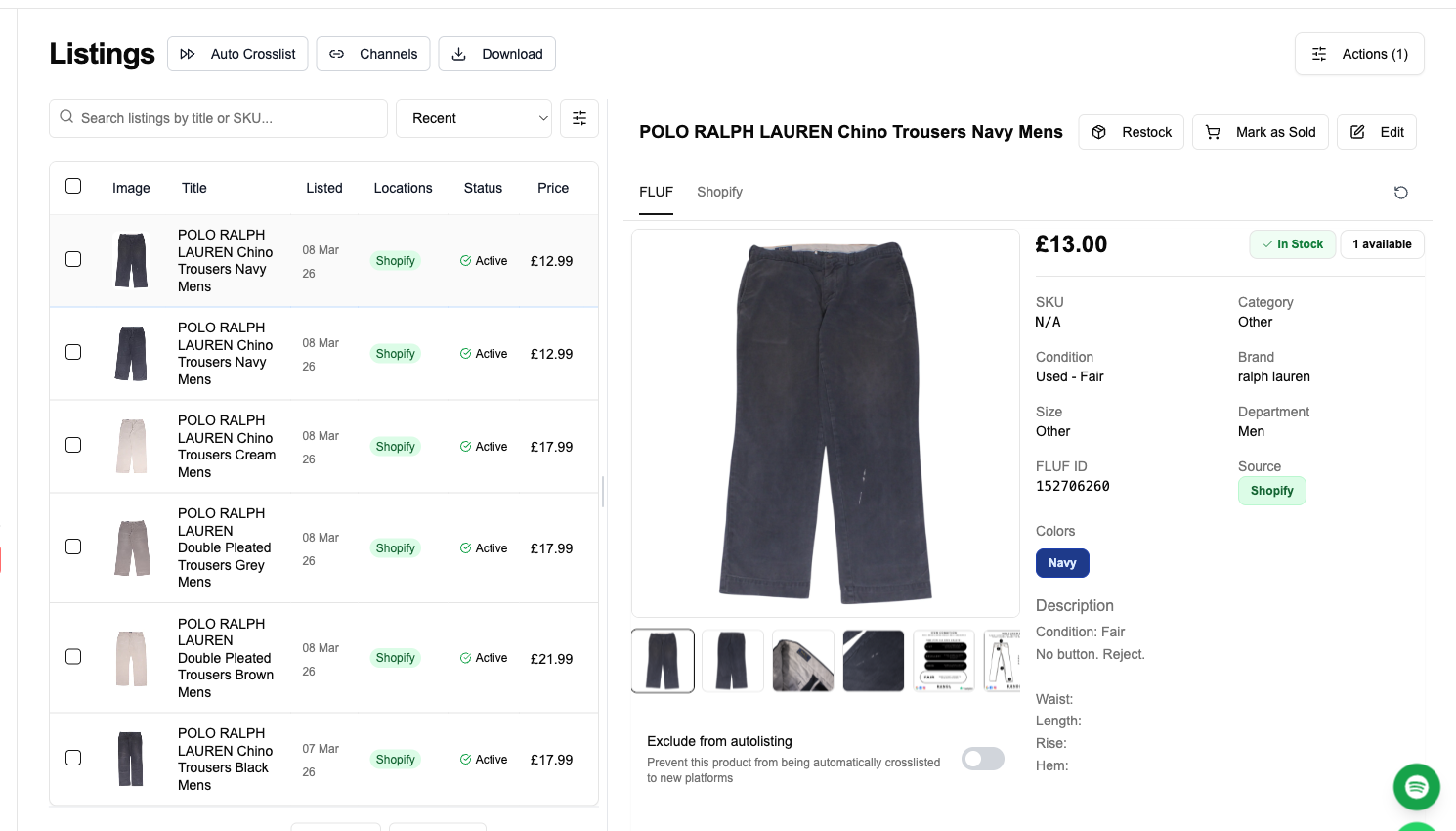
The point of crosslisting is not just to copy a listing — it’s to keep the two in step so you never sell the same item twice. FLUF Connect reads your Marktplaats inventory and creates the product in your Shopify store, then watches both sides for sales. When an item sells, FLUF marks it sold and removes the counterpart, so your store and your marketplace listing never drift out of sync.
| Capability | Marktplaats (source) | Shopify (destination) |
|---|---|---|
| Crosslist — create, update, delete | Yes — live | Yes — live |
| Inventory / mark-as-sold sync | Yes — a Marktplaats sale updates Shopify stock | Yes — a Shopify sale delists the Marktplaats copy |
| Order sync | Yes | Yes — Shopify acts as the order and inventory hub |
| Role in FLUF | Discovery channel | Owned storefront and order centre |
Shopify plays a slightly special role in FLUF Connect: because it’s your own store rather than a marketplace, it often serves as the central order and inventory hub that your marketplace channels feed into. A Marktplaats sale keeps your Shopify stock accurate, and a Shopify sale takes the Marktplaats listing down — so the store you own always reflects reality, and you never oversell.
How Crosslisting from Marktplaats to Shopify Works
The flow is designed to take minutes, not an afternoon:
- Connect both channels. Link Marktplaats to FLUF Connect through the browser extension, and connect your Shopify store with its standard credentials.
- Import your Marktplaats inventory. FLUF reads your existing Marktplaats listings — titles, descriptions, photos and prices — into one dashboard.
- Choose what populates your store. Select the items you want in your Shopify catalogue; everything else stays on Marktplaats only.
- FLUF maps the fields and converts the price. Product details, photos and pricing map across automatically, and your euro price converts to your store’s currency — you keep control to set your branded pricing.
- Crosslist and sync. The products appear in your Shopify store, and from then on FLUF keeps stock in step: a sale on either side updates the other so you never oversell.
From Marketplace Seller to Brand Owner
The real prize in adding Shopify isn’t another sales channel — it’s ownership. On Marktplaats, every buyer belongs to the platform: you can’t email them, you can’t build a mailing list, and you can’t carry your reputation off the site. A Shopify store flips that. Buyers land on your domain, you keep their contact details, and you can market to them again — the repeat-purchase engine that marketplaces deliberately deny sellers. It also insulates you: marketplace rules, fees and algorithms change without warning, and a seller who depends entirely on one platform is exposed. By using Marktplaats for discovery while steadily building an owned Shopify store on top of the same inventory, you turn rented marketplace traffic into a brand you actually control. Crosslisting is what makes running both practical instead of double the work.
Driving Traffic to a Store That Has None
The single honest truth about Shopify is the one worth stating plainly: it gives you a shop, not shoppers. Marktplaats hands you a stream of Dutch buyers the moment you list; a brand-new Shopify store opens to silence until you bring people to it. That is not a flaw — it’s the trade you make for ownership — but it does mean the work shifts from listing to marketing. The good news is that the channels are well understood and within reach of any reseller. Search engine optimisation earns you free, compounding traffic over time as your product and collection pages rank for what buyers type. Social platforms — Instagram, TikTok, Pinterest — turn good photography into discovery, and resale inventory is unusually photogenic. An email list, built from every order and every newsletter sign-up, is the asset marketplaces never let you have: a direct line to past buyers that costs nothing to use again. Paid ads can accelerate all of it once you know what converts. None of these is instant, but each one accrues to you rather than to a platform, and together they turn a quiet storefront into a brand with its own gravity.
This is exactly why running Shopify alongside Marktplaats rather than instead of it is the sensible path. The marketplace keeps the cash flowing while your owned channels are still warming up; the store captures the customers that the marketplace would otherwise keep. Over months, the balance tips — more of your sales come from people who found your brand directly, returned because they trusted it, and bought again because you could reach them. Crosslisting is what makes carrying both feasible: the same inventory populates your store and your marketplace listing in one motion, and FLUF keeps the two from ever disagreeing about what’s in stock.
Using Marktplaats to Fund and Validate Your Store
There’s a smarter way to think about the relationship than “two places to sell.” Treat Marktplaats as the proving ground and Shopify as the destination. Marktplaats’s built-in audience tells you, fast and for the price of a listing, which items actually move, at what price, and how quickly — real demand data you’d otherwise pay for. The pieces that sell briskly there are the ones worth building collections around, photographing properly and featuring on your Shopify home page; the ones that linger tell you what not to overstock. Used this way, the marketplace de-risks the store: instead of guessing what your brand should be, you let early Marktplaats sales fund the subscription and point you at the inventory worth promoting. A reseller who does this arrives at a Shopify catalogue that’s already validated by sales rather than assembled on a hunch.
It also changes how the margin story plays out. Every Marktplaats sale is a sale where the platform owns the buyer; every Shopify sale through your own marketing is one where you keep the customer and pay no marketplace commission, only your flat subscription and card fees. Early on, most of your volume will come from the marketplace, and that’s fine — it’s doing the discovery. As your owned channels mature, a growing share shifts to the store, where each additional sale costs you less and builds an asset (a brand, a list, a reputation) you actually own. Crosslisting keeps that transition smooth: you’re never choosing between channels, just steadily moving the centre of gravity toward the one you control while FLUF keeps stock accurate across both.
A Note on Tax (DAC7)
Marktplaats operates under the EU’s DAC7 rules, which require marketplaces to report sellers who exceed 30 sales or €2,000 in a calendar year to the tax authority (Dutch Tax Administration — DAC7). A Shopify store is your own business rather than a reporting marketplace, so DAC7 platform reporting doesn’t apply to your store sales the same way — but your normal business and VAT obligations do. Selling your own used goods occasionally is generally not taxable; trading for profit is. This is general guidance, not tax advice — check with an accountant as your store grows.
Is It Worth Crosslisting Marktplaats to Shopify?
If you’re serious about building something that outlasts any one marketplace, yes. Marktplaats gives you fast Dutch discovery; Shopify gives you an owned store, the customer relationship and margins that aren’t eaten by a per-sale marketplace cut. The honest caveat is that Shopify won’t bring you buyers on day one — you drive that traffic — which is exactly why running it alongside a discovery marketplace like Marktplaats is the sensible path rather than abandoning the marketplace for it. Plans start at £9/month (Starter) and every plan is paid; crosslisting and inventory sync are included in every plan, not a paid add-on. See full pricing or start from the crosslisting dashboard.
Shopify’s Reach Beyond the Netherlands
Marktplaats stops at the Dutch border; a Shopify store doesn’t. Because your store is your own, you can sell to anyone you’re willing to ship to, set up international pricing and currencies, and grow demand through search and social that no marketplace boundary limits. For a Dutch seller, that means the same inventory that reaches local buyers on Marktplaats can also build an international customer base through your own brand — and FLUF Connect keeps the two in sync so the operational work of running both stays small. Pair this with other discovery channels like Vinted, eBay or Facebook Marketplace and your Shopify store becomes the owned hub that all of them feed.
When Your Shopify Store Becomes the Main Channel
For many resellers the long arc of this pairing ends with the store, not the marketplace, at the centre. It rarely happens overnight — the early months lean on Marktplaats for discovery and cash flow — but as your owned channels mature, the balance can quietly invert. A returning customer who bought once and joined your list, a product page that now ranks in search, a social following that trusts your eye: these compound into demand that arrives without paying any platform for the buyer. At that point Shopify stops being “a second place to list” and becomes the home base your other channels feed. Some sellers keep Marktplaats running indefinitely as a steady top-of-funnel that introduces new buyers they then convert into repeat store customers; others wind it down as direct demand takes over. Either way, the decision is yours to make, which is precisely the freedom a marketplace never grants. The strategic value of crosslisting is that it lets that transition happen gradually and safely: you’re never betting the business on an unproven store or clinging to a marketplace out of fear, because both run from one dashboard with inventory always in sync. You can let the data decide where your effort goes, shifting weight toward the store as it earns it, while FLUF Connect makes sure a sale in either place is reflected instantly in the other. That is what turning rented marketplace traffic into an owned brand actually looks like in practice — not a leap, but a steady migration you control. And because the inventory stays unified throughout, there’s no risky cut-over moment, no week where stock numbers drift, and no point at which you’re forced to choose one channel and abandon the other before you’re ready. The migration happens at whatever pace your store earns, and you keep the marketplace’s safety net underneath you the entire way.
Sources & Verification
Related guides
- Crosslist from Vendora to Shopify — the Greek equivalent, where Shopify sells no shipping labels
- Crosslist from Marktplaats to Amazon
Frequently Asked Questions
No — and that's the point. Shopify is not a marketplace with built-in shoppers; it's the toolkit to run your own branded store on your own domain. Marktplaats brings you a ready-made Dutch audience but keeps the customer relationship, while Shopify gives you ownership of the customer and the brand but you drive your own traffic. Running both means marketplace discovery feeds an owned store you control.
Shopify charges a flat monthly subscription rather than a per-sale marketplace commission. The Basic plan starts at around £25/month billed monthly (less on annual billing), with higher Grow and Advanced tiers, plus card-processing rates on each sale. An extra transaction fee of up to 2% applies only if you choose not to use Shopify Payments. Prices vary by region, so check Shopify's pricing page for your country.
Yes. FLUF Connect keeps both sides in sync: a Shopify sale delists the Marktplaats copy, and a Marktplaats sale updates your Shopify stock. Shopify often acts as the central order and inventory hub in FLUF, so the store you own always reflects reality and you never oversell.
No — Shopify connects to FLUF Connect with its standard store credentials, so no extension is needed for Shopify itself. Marktplaats is the side that connects through the browser extension. Once both are linked, the crosslisting and sync run for you.
Because Marktplaats keeps the customer. On a marketplace you can't email buyers, build a mailing list or carry your brand off the platform, and you're exposed to its rule and fee changes. A Shopify store gives you the customer relationship, repeat sales, your own brand and no marketplace commission — while you keep using Marktplaats for discovery. Crosslisting makes running both practical instead of double the work.
FLUF converts your Marktplaats euro price to your store's currency when it creates the Shopify product, and you keep full control to set your branded pricing. Because a Shopify store has no per-sale marketplace commission, you can often price for healthier margins than a fee-charging marketplace allows.
If you want to build something that outlasts any single marketplace, yes. Marktplaats gives you fast Dutch discovery; Shopify gives you an owned store, the customer relationship and better margins. The honest caveat is that Shopify won't bring buyers on day one — you drive that traffic — which is why running it alongside Marktplaats is the sensible path. Plans start at £9/month (Starter) and every plan is paid.
Sign up for free
Join the community
You're in.
Open your dashboard