Crosslist from Shopify to Marktplaats — Reach the Dutch Market
Push your Shopify catalogue to the Netherlands' biggest general and second-hand marketplace, with automatic GBP-to-EUR pricing and order sync
7 days for £1, then from £9/month.



TL;DR: FLUF Connect crosslists your Shopify catalogue to Marktplaats, the Netherlands’ dominant general and second-hand marketplace. Install the WordPress plugin and browser extension, connect your Shopify store, and push listings to Marktplaats with prices automatically converted from your store currency to EUR. Inventory and orders sync back, sold items end automatically, and relisting keeps your products fresh in front of roughly 8 million monthly Dutch visitors. Plans start at £9/month (Starter); There is no free plan, but every new account gets a 7-day trial for £1.
A Shopify store is a beautifully self-contained thing: your own domain, your own branding, your own checkout. But that strength is also its quiet limitation. Shoppers only find your storefront if they already know it exists — through an ad they clicked, a social post they saw, or a link a friend shared. There is no built-in foot traffic. In the Netherlands, by contrast, there is a single destination where buyers go first when they want to buy almost anything, new or used: Marktplaats. FLUF Connect bridges those two worlds, taking the catalogue you have already built in Shopify and placing it in front of the millions of Dutch buyers who browse Marktplaats every day — without you re-keying a single product.
This page is specifically about the Shopify-to-Marktplaats direction: a hosted, branded e-commerce store on one side, and the busiest general-goods marketplace in the Netherlands on the other. We will cover why that pairing works, exactly how FLUF Connect pushes your products across, what syncs back and what does not, how fields and categories map (including the all-important GBP-to-EUR price conversion), and what Marktplaats charges. We keep the claims honest throughout — Marktplaats is enormous, but it is not the only player, and FLUF Connect does some things on Marktplaats and deliberately does not do others.
Why Crosslist from Shopify to Marktplaats
Marktplaats was founded in 1999 and has grown into the largest online classifieds and second-hand marketplace in the Netherlands. It was owned by eBay until 2020, when the Norwegian classifieds group Adevinta acquired it; Adevinta itself went private in May 2024 in a buyout led by Permira and Blackstone (source, source). For a Shopify merchant, the ownership history matters less than the audience it represents.
That audience is genuinely large. Marktplaats draws around 8 million monthly users and sees hundreds of thousands of new listings posted every day across more than 1,900 categories (source). In the Dutch second-hand and reuse market specifically, Marktplaats held an estimated 73% share in 2023 (source). When a Dutch shopper thinks “where do I look for this,” Marktplaats is, for a very large fraction of the population, the reflexive answer. It is the country’s default doorway to buying.
To keep this honest: Marktplaats dominates classifieds and second-hand, but it is not the single largest e-commerce destination in the Netherlands by every measure — bol.com leads overall Dutch online retail traffic. The point of crosslisting to Marktplaats is not that it is the only marketplace that matters; it is that it is the place Dutch buyers go to search broadly across new and used goods, and that reach is something a standalone Shopify store simply cannot manufacture on its own.
Three things make the Shopify-to-Marktplaats pairing particularly compelling. First, it converts a brand-dependent storefront into a discoverable one: your products appear where local people are already searching. Second, FLUF Connect handles the currency gap automatically, converting your store prices to euros at listing time so you do not have to maintain a parallel Dutch price list. Third, Marktplaats welcomes the kinds of goods that struggle elsewhere — bulky furniture, garden equipment, electronics, home goods, vehicles, and general merchandise — because its 1,900-plus categories were built for a whole country’s worth of stuff, not just fashion.
It is worth dwelling on the discoverability point, because it is the heart of why a Shopify merchant would bother at all. A storefront is a destination, not a search engine. When you launch a Shopify product, nobody is notified, no feed surfaces it, and no category page lists it next to comparable items — you have to drive every visitor yourself, whether through paid advertising, email, social content, or word of mouth. That work never stops, and it scales linearly with spend. A marketplace flips the model: Marktplaats already has the traffic, the search behaviour, and the category browsing built in. When your product lands in the right Marktplaats category, it is immediately adjacent to the exact intent that brings buyers to the platform in the first place. You are renting demand that already exists rather than manufacturing it from scratch. For many small and mid-sized merchants, that difference is the gap between a quiet storefront and a steady second sales channel.
The Dutch market also rewards this approach because of how concentrated buyer attention is. In markets where shopping is fragmented across dozens of mid-sized sites, listing to any one of them moves the needle only slightly. The Netherlands is different: with Marktplaats holding an estimated 73% of the reuse market and pulling around 8 million monthly users, a single integration reaches a large share of the relevant audience at once. That concentration is precisely what makes one well-targeted crosslisting channel worth the effort — you are not chasing a long tail of tiny venues, you are stepping into the one room where most of the country is already shopping.
How FLUF Connect Pushes Shopify Products to Marktplaats
FLUF Connect is a combination of a WordPress plugin and a browser extension. The plugin manages your central inventory and the connections to each marketplace; the extension handles the parts of a marketplace that are best done from inside a logged-in browser session. For Shopify-to-Marktplaats, the flow is straightforward and repeatable.
The first step is installing the FLUF Connect plugin and the companion browser extension. Once installed, you connect your Shopify store as a data source. Shopify is a hosted e-commerce platform where merchants run their own branded shop — catalogue, checkout, and inventory all live in one place — and FLUF Connect reads that catalogue so it becomes the single source of truth for everything you sell (source). After Shopify is connected, you connect Marktplaats as a destination channel.
With both sides linked, you select the products you want to list and push them to Marktplaats. FLUF Connect takes each Shopify product — its title, description, images, and price — and builds a corresponding Marktplaats listing. Because Marktplaats listings are single-item by nature, each Shopify variant becomes its own individual Marktplaats listing rather than a single listing with a variant selector. The images are pulled directly from your Shopify media, so you are not re-uploading photos by hand.
From that point on, the relationship is ongoing rather than one-off. FLUF Connect keeps watching your Shopify inventory and the orders flowing through Marktplaats, so the two stay aligned. The sections below set out exactly what that means in practice.
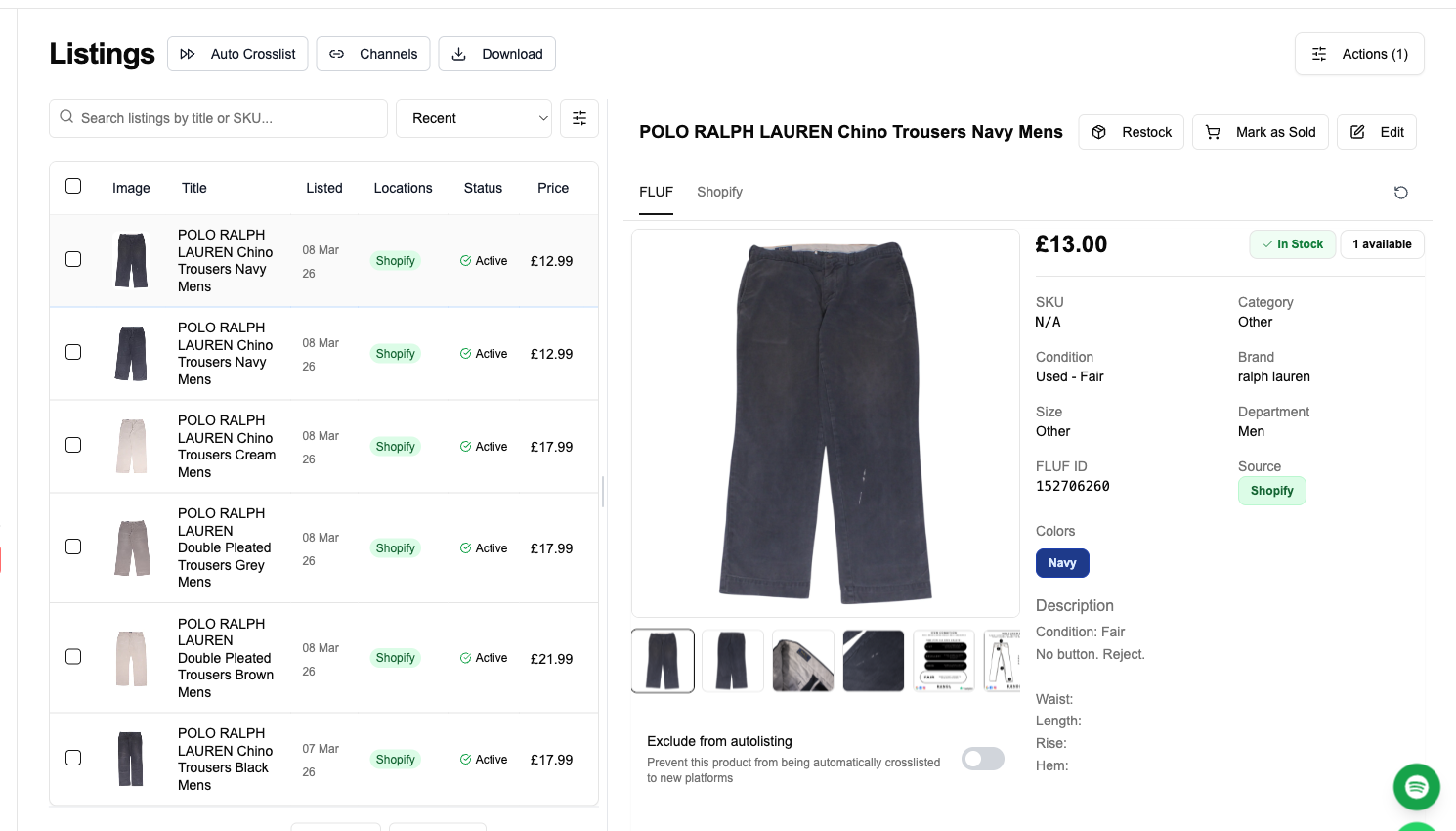
Connect Shopify and Marktplaats in FLUF Connect and manage your products and listing updates from one dashboard. Marktplaats requires the FLUF browser extension for the initial connection.
Once your products are live, the workflow settles into a rhythm. You add or update products in Shopify as you always have — Shopify remains your home base and the single source of truth. FLUF Connect propagates the relevant changes outward to Marktplaats and watches Marktplaats for activity coming back in. You never have to log into Marktplaats to keep your catalogue in step with your store; the integration carries the state between the two so your Shopify catalogue and your Marktplaats presence describe the same reality.
What Syncs Back — and What Does Not
It is worth being precise about FLUF Connect’s capabilities on this specific pairing, because being honest about the boundaries is more useful than overselling.
With Shopify as the source, FLUF Connect provides order synchronisation and mark-as-sold behaviour. That means when a sale happens, the system knows about it and can act on it. It does not, on the Shopify side, perform relisting or offer management — Shopify is the home store, not a marketplace where you relist or negotiate.
With Marktplaats as the destination, FLUF Connect supports relisting, order synchronisation, and mark-as-sold. Listings push to Marktplaats; inventory and orders sync back into your FLUF Connect dashboard; and when an item sells — whether on Marktplaats or on another connected channel — the corresponding Marktplaats listing is ended automatically so you do not sell the same single item twice. Relisting is supported on Marktplaats, which helps keep your products near the top of busy category feeds rather than sinking out of sight as newer listings pile in.
One capability FLUF Connect does not provide on Marktplaats is offer management. Marktplaats buyers can send messages and make bids, but FLUF Connect does not automate the handling of offers there. You manage any back-and-forth negotiation directly in your Marktplaats account. We mention this plainly so there is no surprise: the integration covers listing, inventory, orders, sold-item ending, and relisting — not offer automation.
The table below summarises the capability picture for this direction.
| Capability | Shopify (source) | Marktplaats (destination) |
|---|---|---|
| Push / create listings | Read source catalogue | Yes |
| Order synchronisation | Yes | Yes |
| Mark as sold / auto-end on sale | Yes | Yes |
| Relisting | Not applicable (home store) | Yes |
| Offer / negotiation management | Not applicable | No |
| Automatic GBP→EUR price conversion | Source price read | Yes, at listing time |
Automation across all of this is included from Seller upwards — it is part of what FLUF Connect does, not a paid bolt-on you toggle separately.
Field and Category Mapping, Including GBP to EUR
Marktplaats listings and Shopify products are shaped differently, so FLUF Connect translates between the two formats automatically. The mapping is what turns a Shopify product page into a native-feeling Marktplaats advert.
The core text fields move directly: your Shopify product title becomes the Marktplaats listing title, and your Shopify description carries over to the listing body. Images stored against the Shopify product are pulled into the Marktplaats listing, so the photos a Dutch buyer sees are the same ones you curated in your store. Marktplaats is a single-item marketplace, so where a Shopify product has multiple variants, each variant is mapped to its own Marktplaats listing rather than being collapsed into one.
Review the Marktplaats category before publishing. Its broad catalogue includes fashion, electronics, home and garden, and furniture, so choose the specific category that best fits the item.
The pricing translation is the piece that saves the most manual effort. Shopify stores can price in GBP and in 150-plus currencies via Shopify Payments multi-currency (source), but Marktplaats trades in euros. FLUF Connect converts your store-currency price to EUR at the moment the listing is created, so a product priced in pounds on your storefront appears in sensible euro terms on Marktplaats without you maintaining a separate Dutch price list. This is one of the genuine advantages of the pairing: the currency boundary that normally makes cross-border listing tedious is handled for you.
Consider what the alternative looks like without that conversion. A merchant pricing in GBP who wanted to sell on Marktplaats manually would have to calculate a euro figure for every product, re-enter it on Marktplaats, and then remember to revisit it whenever the GBP price changed or exchange rates drifted. Multiply that across a catalogue of hundreds of items and the maintenance burden becomes the single biggest reason merchants give up on cross-border listing. By converting at listing time from the store currency, FLUF Connect removes that whole class of work and the errors that come with it — a stale euro price that no longer reflects your real GBP price, or a decimal slip that lists something far too cheap. You keep pricing where you already manage it, in Shopify, and the euro figure follows.
The single-item nature of Marktplaats listings is also worth understanding clearly, because it shapes how your catalogue appears. On Shopify, a product with three sizes or two colours is one product page with a variant picker. On Marktplaats, each of those becomes its own standalone advert. FLUF Connect handles that expansion for you, so a multi-variant Shopify product fans out into the right number of individual Marktplaats listings. The upside is that each variant gets its own searchable presence in its category; the thing to be aware of is simply that your Marktplaats listing count will reflect variants, not just parent products.
The following table sets out the field-level mapping at a glance.
| Shopify field | Maps to on Marktplaats | Notes |
|---|---|---|
| Product title | Listing title | Carried across directly |
| Description | Listing body | Carried across directly |
| Product media / images | Listing photos | Pulled from Shopify media |
| Price (store currency) | Price in EUR | Converted store-currency→EUR at listing time |
| Variant | Individual listing | Each variant becomes its own single-item listing |
| Product type | Category (one of 1,900+) | Mapped to the closest Marktplaats category |
Fees on Marktplaats
Marktplaats’s fee structure is one of the reasons it has stayed so dominant among private sellers, and understanding it helps you set expectations before you push your catalogue across.
For private sellers, listing is free in most of the 1,900-plus categories. Marktplaats then monetises through optional paid upgrades rather than a mandatory listing fee: you can pay to add extra photos, to highlight a listing so it stands out visually, or to bump a listing back toward the top of its category feed. None of these are required to have a live advert — they are visibility boosts you choose when a particular item warrants the spend (source).
Business sellers — which is the category most Shopify merchants fall into — typically use Marktplaats Pro, the business-facing side of the platform, and can promote listings through Admarkt, Marktplaats’s cost-per-click advertising product. Admarkt charges on a CPC basis starting from roughly €0.01 per click, so you only pay when a shopper actually clicks through to your advert. This pay-per-click model lets you scale spend up or down per product rather than committing to a flat fee.
The practical upshot for a Shopify merchant is that getting your catalogue listed on Marktplaats does not carry a heavy per-listing cost, and any spend you do incur — highlighting, bumping, or Admarkt clicks — is discretionary and controllable. FLUF Connect handles the listing and synchronisation; how aggressively you promote within Marktplaats is a lever you keep in your own hands.
| Fee item | Who it applies to | Cost |
|---|---|---|
| Standard listing | Private sellers | Free in most categories |
| Extra photos / highlighting / bumping | Optional, any seller | Paid upgrade (per use) |
| Marktplaats Pro | Business sellers | Business account tier |
| Admarkt CPC advertising | Business sellers | From ~€0.01 per click |
Fees and upgrade prices on Marktplaats are set by Marktplaats and can change; always confirm current figures in your own Marktplaats account before committing spend.
Making the Most of the Dutch Market
Listing to Marktplaats is the mechanism; reaching the Dutch market well is the goal. A few things help Shopify merchants get more out of the pairing.
First, lean into the breadth of categories. Because Marktplaats spans everything from cars and furniture to electronics and home and garden, products that are awkward to ship internationally or hard to advertise — large, heavy, or niche general goods — often find a more natural audience here than on a fashion-led platform. If your Shopify catalogue includes bulkier or general merchandise, those items are not second-class citizens on Marktplaats; they are core inventory for the platform.
Second, let relisting work for you. Marktplaats category feeds move quickly, with hundreds of thousands of fresh listings every day. FLUF Connect’s relisting support helps your products resurface rather than sink, keeping them visible to the steady stream of buyers browsing each category.
Third, trust the currency conversion. Because FLUF Connect converts your store-currency prices to euros at listing time, you can keep managing prices in your home currency inside Shopify and let the integration present sensible euro figures to Dutch buyers. That removes a recurring source of manual error — forgetting to update a parallel euro price when you change a GBP one — and keeps your Marktplaats prices aligned with your store.
Finally, remember the division of labour. FLUF Connect handles listing, inventory, orders, auto-ending of sold items, and relisting. Buyer messages and any negotiation on Marktplaats stay with you in your Marktplaats account. Knowing where the automation ends and your hands-on involvement begins keeps the whole operation predictable.
Avoiding the Oversell Problem
The risk that keeps multichannel sellers awake is overselling: a single item sells in two places at once because the channels did not know about each other. It is the classic failure mode of running a Shopify store and a marketplace presence side by side, and it produces the worst possible customer experience — taking money for something you cannot ship. FLUF Connect’s mark-as-sold and auto-end behaviour exists precisely to close that gap. Because the same FLUF Connect inventory underpins both your Shopify catalogue and your Marktplaats listings, a sale on one side triggers the other side to react. When an item sells, the matching Marktplaats listing is ended automatically, so a single-unit product cannot keep accepting buyers after it is gone.
This matters even more on Marktplaats because of its single-item listing model. Each variant lives as its own advert, which means each advert represents a discrete piece of stock that must be retired the moment it sells. FLUF Connect tracks that relationship between the Marktplaats advert and the underlying Shopify item, so the right listing — and only the right listing — comes down when a sale lands. For a merchant, the reassurance is concrete: you can list across both channels without manually policing your inventory to make sure you are not promising the same thing twice.
Keeping Listings Fresh with Relisting
Marktplaats is a high-velocity feed. With hundreds of thousands of new listings posted every day, even a well-written, well-photographed advert sinks down its category page over time as fresher items arrive above it. Buyers who sort by newest or who browse the top of a category simply stop seeing older listings, regardless of how good they are. This is a structural feature of any large classifieds platform, and it is the reason relisting matters.
FLUF Connect supports relisting on Marktplaats, which keeps your products resurfacing rather than disappearing into the depths of a category. The effect is that items you pushed weeks ago can regain visibility instead of quietly going stale, giving each piece of inventory more chances to be seen by the steady stream of buyers entering the platform every day. Combined with the auto-ending behaviour for sold items, relisting means your live Marktplaats presence stays both fresh and accurate: current items resurface, and sold items leave. You get the visibility benefit of regularly refreshed listings without manually re-posting anything by hand.
Pricing and What You Get
FLUF Connect’s plans start at £9/month on the Starter plan, which covers unlimited listings. There is no free plan and no free tier, but every new account gets a 7-day trial for £1 — every plan is paid, and the automation that powers crosslisting, syncing, and relisting is included in every one of them rather than charged as an add-on.
For a Shopify merchant, the calculation is usually simple: a single additional sale that you would never have reached through your own storefront — surfaced to a Dutch buyer who found you on Marktplaats — tends to justify the monthly cost quickly. The Growth plan’s 500-product ceiling fits most small and mid-sized catalogues, and larger inventories can move up the plan ladder as needed. The point is that the path to the Dutch market is paid but modest, and the work of getting there — the listing, the mapping, the currency conversion, the syncing — is done for you.
Open Your Shopify Store to the Dutch Market
Your Shopify store is the home you have built; Marktplaats is where the Netherlands shops. FLUF Connect connects the two so your catalogue appears in front of roughly 8 million monthly Dutch buyers, with prices converted to euros for you, listings kept fresh through relisting, and sold items ended automatically so you never oversell a single item. Install the plugin and extension, connect Shopify as your source and Marktplaats as your destination, and push your products across. Try FLUF Connect and turn a brand-dependent storefront into one that Dutch buyers can actually discover. Plans start at £9/month (Starter); There is no free plan, but every new account gets a 7-day trial for £1.
Sources & Verification
- Adevinta — Marktplaats brand page (ownership, ~8M monthly users, hundreds of thousands of new listings/day, 1,900+ categories, paid options and Admarkt CPC)
- Marktplaats.nl — Wikipedia (founded 1999, largest NL classifieds/second-hand, ~73% NL reuse-market share 2023)
- DutchNews — Adevinta buys Marktplaats from eBay (2020)
- Shopify Help — Store currency and multi-currency with Shopify Payments (GBP plus 150+ currencies)