
Crosslist from WooCommerce to eBay — FLUF’s WordPress Plugin for Multi-Marketplace Selling
Push your WordPress catalogue to eBay's 135 million buyers from wp-admin — no duplicate data entry.
7 days for £1, then from £9/month.



TL;DR: The FLUF Connect plugin for WooCommerce — the WordPress e-commerce plugin powering a huge share of the web’s online stores — reads your catalogue straight from wp-admin and crosslists it to eBay. Titles, descriptions, photos (up to 24), prices, stock quantity, brand, colour, size and category transfer automatically; variable WordPress products become eBay multi-variation listings. Best for WooCommerce stores that want eBay’s 135 million active buyers without hand-keying every SKU into a second system.
If you run a WooCommerce store, you are running WordPress — the open-source platform behind roughly 38% of every e-commerce website on the internet (RedStag, WooCommerce market share). That gives you a branded shop on a domain you own, with full control over data, margin and customer relationships. What it does not give you is a built-in demand pool. eBay does: 135 million active buyers and $79.6 billion in GMV across 2025, with roughly half of that volume generated outside the United States. The FLUF Connect plugin for WooCommerce is what lets one WordPress catalogue feed both surfaces without duplicate data entry.
The reason this matters is structural. A WordPress store earns every visitor — through SEO, content, ads or social — while eBay shoppers are already searching with intent to buy. Rather than choosing between owning your storefront and tapping a marketplace’s traffic, you run both: WooCommerce stays the home base you control, and eBay becomes a demand channel you switch on. The only thing standing between most WordPress stores and that setup is the tedium of recreating every product inside eBay’s listing form — which is exactly the work this integration removes.
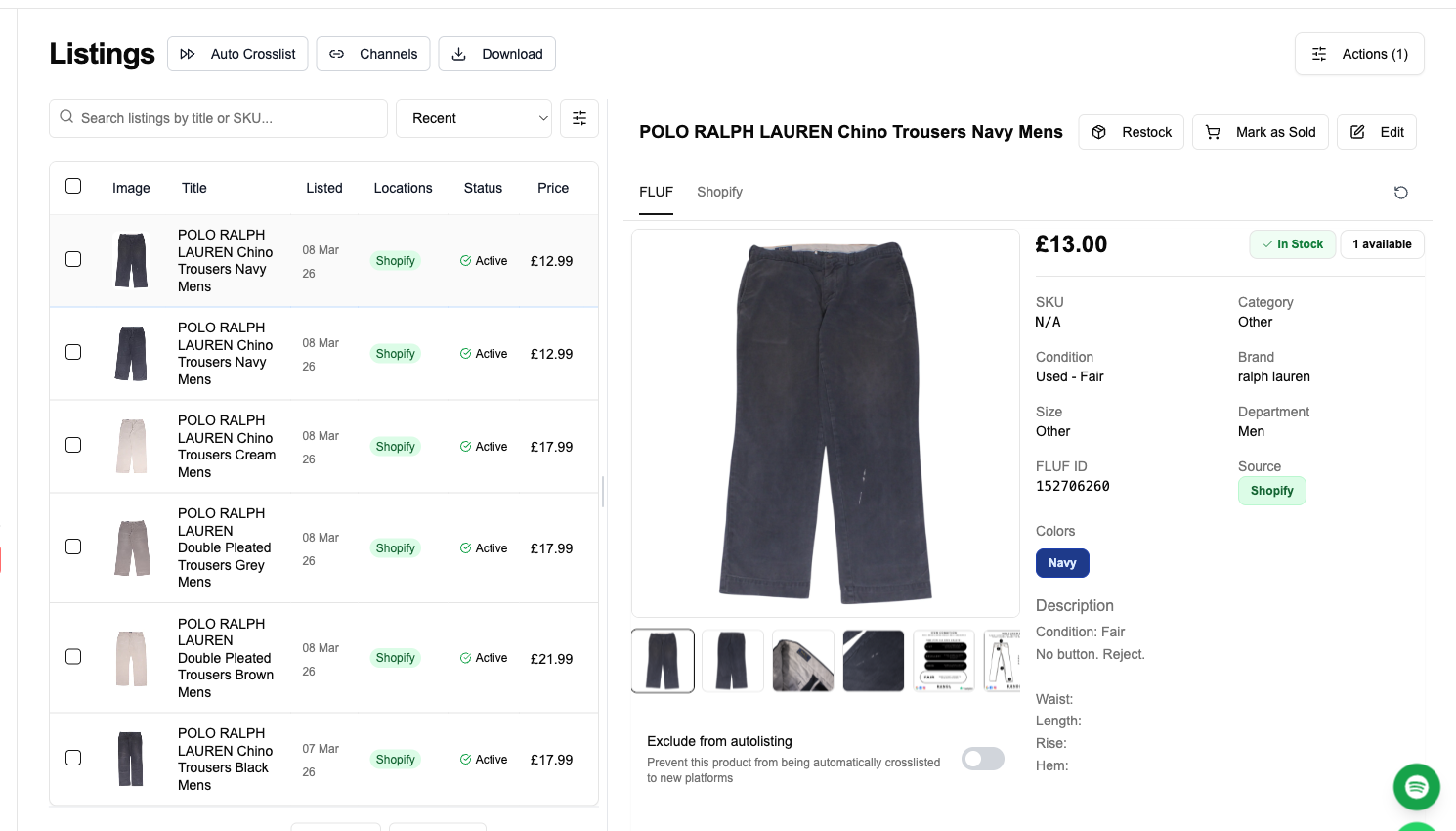
Doing this by hand is the silent tax on a growing WordPress store. eBay’s listing flow demands a specific leaf category, a fistful of required item specifics, a condition, a returns policy and Managed Payments enrolment before a single product goes live. Re-typing all of that for 50, 200 or 2,000 SKUs that already exist cleanly in WooCommerce is exactly the kind of work software should erase. FLUF Connect reads each WooCommerce product through the WordPress REST API and maps it onto eBay’s structure so you approve listings instead of authoring them twice.
Why WooCommerce Store Owners Should Sell on eBay
WooCommerce owns the canonical record — your domain, your product database, your customer list, your full margin on direct sales. eBay owns reach you cannot manufacture on a standalone WordPress site. Run both and the strengths compound rather than compete.
eBay’s audience dwarfs any single WordPress store
eBay closed 2025 with 135 million active buyers and around 2.5 billion live listings, and grew GMV again into 2026, reporting 18% GMV growth in Q1 (EcommerceBytes, Q1 2026). For a WooCommerce store, that is instant access to high-intent shoppers who type a product into eBay’s search box rather than discovering a WordPress domain through Google. A new WordPress store might wait months for SEO to deliver its first hundred visitors; an eBay listing in the right category can be seen by buyers the day it goes live.
Cross-border sales without building international infrastructure
Close to half of eBay GMV is generated outside the US, with the UK the second-largest market (around 17% GMV share) and Germany third (around 14%) per Statista’s GMV-by-country data. A WordPress store would normally need translated pages, local payment methods and overseas shipping partners to reach those buyers. eBay routes them to you through its own trust layer and programmes like eBay International Shipping, so a product listed once can sell into dozens of countries without you building any of that yourself.
Buyers trust eBay’s protections, which lowers the barrier to a first purchase
A first-time visitor to an unknown WordPress store hesitates: is the site legitimate, is checkout safe, will the item arrive? eBay carries that trust for you with Money Back Guarantee and an established dispute process. For products where a buyer is choosing between an unfamiliar brand site and the same item on eBay, the marketplace often wins the first sale — and that buyer can become a direct WooCommerce customer later.
The two together cover discovery and ownership
eBay is where buyers find the product; WooCommerce is where they become repeat customers you actually own. A pragmatic playbook is to use eBay as top-of-funnel — let it introduce your products to its enormous audience — and then earn the reorder on your WordPress site, where no marketplace takes a cut and you keep the customer’s email. Crosslisting makes that funnel possible without doubling your listing workload.
How the FLUF Connect Plugin Crosslists WooCommerce to eBay
FLUF Connect is a WordPress plugin: it installs inside your existing wp-admin and treats your WooCommerce catalogue as the source of truth. Setup from scratch is around ten minutes, and because the connection runs over eBay’s official API there is no browser extension or manual export involved.
Step 1: Install the FLUF Connect plugin in wp-admin
In WordPress, go to Plugins → Add New, search for FLUF Connect, then install and activate it. Follow setup to connect your WooCommerce store and marketplaces.
Step 2: Connect your eBay account
Click Connect eBay in FLUF, sign in to eBay and approve access. You can revoke access from your eBay account.
Step 3: Map categories once, then crosslist
FLUF reads each WooCommerce product and proposes an eBay leaf category plus the required item specifics for that category. You confirm the mapping once per WooCommerce category — for example, “Clothing → Men’s T-Shirts” — and from then on every matching product crosslists with its title, description, photos, price, stock and attributes already in place. Variable WordPress products (a parent product with size or colour variations) are pushed as eBay multi-variation listings, one variant per option, each with its own price and stock count.
Step 4: Review, then publish in bulk
Before anything goes live, FLUF shows you a preview of each listing as eBay will render it, and flags any product missing a value eBay requires. You fix those at the source in WooCommerce — which keeps your WordPress catalogue cleaner too — and then publish in bulk. A catalogue that would take days to hand-key onto eBay goes live in a single sitting.
Stop re-keying your WordPress catalogue into eBay’s listing form.
eBay Fees: What a WooCommerce Seller Pays
Listing on eBay is not free of marketplace fees — but FLUF Connect’s own automation is included from Seller upwards, not charged per listing. eBay’s seller fees as of 2026 break down as follows:
| Fee | Amount | Notes |
|---|---|---|
| Final value fee (most categories) | ~13.25% of total sale | Range ~2.5%–15.3% by category |
| Per-order fixed fee | $0.30 (orders ≤ $10) / $0.40 (over $10) | Charged once per order, not per item |
| Free listing allowance | Up to 250 zero-insertion listings/month | $0.35 each beyond that (non-store) |
| International fee | 1.65% of total sale | When the buyer is outside your country |
Figures are from eBay’s official selling fees and international fees pages. The headline number to plan around is the final value fee of roughly 13.25% in most categories — eBay takes its cut as a percentage of the total amount the buyer pays, including postage. That is the price of the demand eBay supplies, and it is the cost a direct WooCommerce sale avoids, which is why many sellers price slightly higher on eBay to protect margin and steer repeat buyers back to their WordPress store.
If you sell enough volume, an eBay Store subscription lowers final value fees in many categories and grants far larger zero-insertion-fee allowances. eBay also adjusted final value fees upward by up to 0.35% in early 2025, so it is worth checking the live fee table for your specific categories. On the FLUF side, there is no free plan, but every new account gets a 7-day trial for £1: plans start at £9/month (Starter), and eBay automation such as auto-relisting is included from Seller upwards, and offer management from Seller upwards rather than sold as an add-on.
What Transfers from WooCommerce to eBay
Review the following product details before publishing your WooCommerce items on eBay:
| Field | WooCommerce source | On eBay |
|---|---|---|
| Title | Product name | Listing title (truncated to 80 chars) |
| Description | Long description, falling back to short description if blank | HTML item description |
| Photos | Product gallery — first image is primary | Up to 24 images per listing |
| Price | Sale price, else regular price | Buy It Now price (currency-locked) |
| Stock | stock_quantity (or in/out-of-stock as 1/0) |
Available quantity |
| Variations | Variable product → child variations | Multi-variation listing |
| Brand / Size / Colour | WooCommerce attributes | Item specifics (mapped to eBay’s value lists) |
| Category | First WooCommerce category | eBay leaf category (mapped once) |
One detail that trips up generic exporters: WooCommerce stores both a long description and a short_description, and many sellers fill only one. eBay rejects a listing with “A description is required” if the field is blank, so FLUF uses whichever of the two has content rather than blindly taking the long field. Photos behave the same way — your WooCommerce gallery’s first image becomes eBay’s primary photo, and the rest fill the gallery up to eBay’s 24-image limit.
The Item-Specifics Problem (and How FLUF Solves It)
The single most common WordPress-to-eBay failure is item specifics. eBay forces controlled values like Brand, Type, Size and Size Type in many categories, drawn from its own value lists, and a raw WooCommerce export of just name and price is rejected with errors such as “Brand is missing” (eBay item-specifics requirements). Worse, the required specifics differ by category, so there is no single template that works across a varied catalogue.
FLUF reads your WooCommerce attributes — brand, size, colour, condition, material — directly into eBay’s required aspects, matching them to eBay’s controlled values where one exists. When a product genuinely lacks something eBay demands, FLUF tells you exactly which field is missing for which product, so you can add it once in WooCommerce. Many categories also require a product identifier (Brand plus MPN, or a UPC/EAN), and where none applies FLUF supplies eBay’s accepted “Does not apply” / “Unbranded” values so the listing still publishes. The result is that listings go live instead of bouncing back with errors — and your WordPress catalogue ends up better structured as a side effect.
Managed Payments, Returns and the Setup eBay Requires
Before you can sell, eBay requires two things a brand-new WordPress store owner may not have set up: enrolment in eBay Managed Payments (a linked bank account for payouts) and a returns policy on your listings. These are eBay account settings rather than anything FLUF controls, but they are worth handling before your first crosslisting run so listings are not held up. FLUF applies your chosen business policies to every listing it creates, so once your returns and shipping policies exist in eBay, every WooCommerce product inherits them automatically.
Inventory Sync: WooCommerce as Your Source of Truth
FLUF treats your WordPress store as the master record. When a product’s stock falls to zero in WooCommerce — whether through a direct sale on your WordPress site or a manual edit — FLUF detects it on the next inventory check and delists or zeroes the matching eBay listing, so you never sell the same unit twice. Price and description edits made in WooCommerce flow outward to eBay on the same cycle, which means you maintain product data in one place and let it propagate rather than editing the same item in two systems.
This single-source-of-truth model is especially valuable for stores with limited stock of each item. If you hold one of something, double-selling it across your WordPress store and eBay means a cancellation, a refund and a hit to your eBay seller metrics. Driving all stock decisions from WooCommerce removes that risk by design.
How eBay’s Best Match Search Ranks Your Crosslisted Listings
Unlike your WordPress store, where Google decides visibility, eBay listings are ranked by eBay’s Best Match algorithm. It rewards listings with complete item specifics, competitive pricing, fast and free or low-cost postage, strong seller metrics, and good sales history. This is why the item-specifics mapping above is not just about avoiding rejection — fuller specifics also rank better, because Best Match uses them to surface your listing for the precise searches buyers type. A crosslisted WooCommerce product with brand, type, size and condition all populated will routinely out-rank a thin listing of the same item.
Two practical implications for a WooCommerce store. First, the cleaner your WordPress product attributes, the better your eBay search position — another reason completing attributes at the source pays off. Second, eBay favours listings that sell, so a slow-moving product benefits from auto-relisting (included in every FLUF plan), which keeps the listing fresh rather than letting it stagnate at the bottom of search results.
Auction or Buy It Now? Listing Formats for a WooCommerce Catalogue
eBay offers two core formats: fixed-price Buy It Now and timed auctions. For a WooCommerce store crosslisting a standard catalogue, Buy It Now is almost always right — it mirrors how your WordPress store already sells, supports multiple quantities and variations, and lets the inventory sync keep stock aligned. Auctions suit genuinely scarce, collectible or hard-to-price items where competitive bidding can exceed your fixed price. FLUF crosslists your WooCommerce products as fixed-price listings by default, matching your WordPress pricing, which is the format that keeps a multi-channel catalogue consistent and easy to reconcile.
Which WooCommerce Products Sell Best on eBay
eBay is the broadest of the major marketplaces — it sells almost everything, which makes it the most natural first crosslisting destination for a general WooCommerce catalogue. Electronics, parts and accessories, collectibles, tools, fashion, home and garden, and refurbished goods all have deep, search-driven demand. Categories where buyers know exactly what they want and search for it by model number or part are eBay’s sweet spot, because the marketplace’s search rewards precise, well-specified listings.
There are products better served elsewhere. Items that are expensive or awkward to ship — furniture, large appliances — often do better on a local channel like Facebook Marketplace. One-of-a-kind handmade or genuinely vintage pieces may find their audience on Etsy. Fashion aimed at a younger buyer can move faster on Depop. But for the bulk of a typical WordPress store’s inventory, eBay is where the buyers already are, which is why it is usually the first channel WooCommerce sellers add.
Getting the Most From WooCommerce to eBay
- Complete your attributes in WooCommerce first. The cleaner your WordPress product data, the smoother every eBay listing — and the fewer item-specific errors you fix later.
- Map categories carefully the first time. The eBay leaf category determines which item specifics are required and how buyers find the listing; a precise mapping pays off across every product in that category.
- Price for the fee. Build eBay’s ~13.25% final value fee into your eBay pricing so the channel protects rather than erodes margin.
- Use eBay to seed direct sales. Include your brand in listings so eBay buyers can become repeat customers on your WooCommerce store, where you keep the full margin.
eBay is rarely the only channel worth adding — see the full WooCommerce crosslisting hub, or crosslist from WooCommerce to Vinted to reach 100M+ European buyers alongside eBay. For live-stream selling, you can also crosslist from WooCommerce to Whatnot.
Sources & Verification
- eBay active buyers, GMV & revenue (2025): eBay Inc. 10-K, FY2025
- Q1 2026 buyer count & GMV growth: EcommerceBytes
- Seller fees: eBay selling fees; international fees
- Item specifics & photo limits: eBay Trading API guide; adding pictures
- GMV by country: Statista
- WooCommerce market share: RedStag Fulfillment
More crosslisting guides
- Crosslist from eBay to WooCommerce
- Crosslist from Square to eBay
- Crosslist from PrestaShop to eBay — the business seller schedule, not the free private one
- Crosslist from WooCommerce to Amazon
- WooCommerce to Kleinanzeigen
Also from a store platform: Crosslist from BigCommerce to eBay.
Related guide: Crosslist Square to WooCommerce.
Frequently Asked Questions
Yes. FLUF Connect is a standard WordPress plugin that installs in wp-admin on any self-hosted WordPress site running WooCommerce. It auto-generates a WooCommerce REST API key during setup, so there is no manual configuration.
Manage crosslisting in FLUF while continuing to run your WooCommerce store as usual.
Yes. A WooCommerce variable product is pushed to eBay as a multi-variation listing, with each size or colour variation mapped to its own eBay variant, price and stock level.
No. FLUF reads your WooCommerce attributes (brand, size, colour, condition) into eBay's required item specifics, and you confirm the category-to-category mapping once. After that, matching WooCommerce products crosslist automatically.
FLUF keeps WooCommerce as the source of truth: stock changes made in WooCommerce sync outward to eBay so you never oversell. Writing an eBay sale back into your WooCommerce stock count is part of the WooCommerce plugin's ongoing write phase.
FLUF Connect plans start at £9/month (Starter). There is no free plan. eBay automation such as auto-relisting is included from Pro upwards, and offer management from Pro upwards, not sold as a paid add-on. eBay's own seller fees apply separately.
Any modern WordPress install with WooCommerce and the REST API enabled (WooCommerce 3.5 or newer). The FLUF Connect plugin works alongside common caching, security and SEO plugins on standard WordPress hosting.
List Your WooCommerce Catalogue on eBay
Plans from £9/month. Install the WordPress plugin and crosslist in under 10 minutes.