
Crosslist from WooCommerce to Whatnot — FLUF’s WordPress Plugin for Multi-Marketplace Selling
Sync your WordPress store with Whatnot's collectibles and live-shopping marketplace — Buy It Now listings, two-way inventory, orders in wp-admin
7 days for £1, then from £9/month.



TL;DR: The FLUF Connect plugin for WooCommerce pushes your WordPress catalogue onto Whatnot as Buy It Now listings — the structured-catalogue path, not the live-stream auction format. Photos, titles, descriptions, prices, quantities, SKUs, brand and condition transfer; stock stays synced both ways; Whatnot orders flow back into wp-admin. Best fit for WooCommerce stores selling collectibles, trading cards, Funko, sneakers, streetwear, vintage clothing, comics, or sports memorabilia — the categories where Whatnot’s community-driven buyer base concentrates.
If your WooCommerce store sells collectibles, trading cards, sneakers, streetwear, vintage clothing, Funko Pops, comics, jewellery, or sports memorabilia, you should be on Whatnot. Whatnot crossed $8 billion in GMV in 2025 — double its 2024 figure — and raised a $225 million Series F at an $11.5 billion valuation, making it the largest live-shopping platform in the West. The buyer base behaves nothing like a traditional marketplace: shoppers spend roughly 95 minutes per day in the app globally (around 65 minutes per day in Europe), tuning in to live shows the way they would tune into Twitch. A WordPress store with a curated collectibles or fashion catalogue is exactly the kind of inventory those buyers convert on.
Manually managing Whatnot listings alongside a WooCommerce catalogue is painful. Whatnot was built mobile-first around live streams; the off-stream Marketplace listing flow asks you to pick a category from a deep base64-encoded tree, fill structured attributes per category, attach photos one at a time, set a shipping profile, and re-enter every title, description and price by hand. For a dozen collectibles, that is fine. For a WordPress store with even a hundred SKUs the manual path is a part-time job. The FLUF Connect plugin removes the per-item friction: select WooCommerce products in wp-admin, click crosslist, and they appear in your Whatnot shop as Buy It Now listings ready to sell — either off-stream in the Marketplace tab or alongside whatever live show you schedule next.
Why WooCommerce Store Owners Should Be on Whatnot
WooCommerce gives you a branded direct channel; Whatnot gives you access to a buyer base that nothing in the WordPress universe reaches. The two together cover distinct audience segments without changing your operational stack.
Your WordPress store keeps the brand and the margin
WooCommerce gives you complete control: your domain, your design, your customer email list, your full margin on every direct sale. Repeat buyers come back to you, not to a platform’s algorithm. The trade-off is that WordPress traffic does not appear on its own — you spend on SEO, content, social, or ads to bring buyers in, and conversion from cold traffic is slow.
Whatnot brings community buyers WordPress will never reach
Whatnot reports more than 6.4 million sports cards sold per month, roughly two cards sold every second, and over 12 million orders per month in women’s fashion. Sellers ran more than 175,000 hours of live content per week in 2025. None of those buyers find you through Google or your WordPress blog — they discover sellers inside Whatnot, follow their shop, and return on a weekly cadence. By pushing your catalogue to Whatnot you tap an audience that buys on entertainment value and community, not search intent.
An 8% commission undercuts eBay and Depop
Whatnot’s US commission is 8% of the final sale price plus 2.9% + $0.30 payment processing; UK sellers pay 6.67% + VAT commission plus 2.42% + VAT processing plus £0.25 + VAT per order. The all-in take rate lands at roughly 12% — meaningfully lighter than eBay‘s 13–14% final value fees and below Depop‘s 10% seller commission once you factor in processing. For high-velocity categories like trading cards, sneakers and comics, the per-sale margin lift is enough to make Whatnot a serious channel even before factoring in the discovery boost.
The two together compound
Most WooCommerce stores that add Whatnot report a flywheel effect: Whatnot buyers discover the brand on a live show, follow the seller, and eventually click through to the WordPress store for higher-value items at full margin. Whatnot is the discovery and community-building surface; your WordPress store is where the long-tail customer relationship lives.
How the FLUF Connect Plugin Syncs WooCommerce and Whatnot
The FLUF Connect plugin for WooCommerce is the WordPress plugin for crosslisting WooCommerce inventory to Whatnot and other resale marketplaces. Setup is roughly ten minutes.
Step 1: Install the FLUF Connect plugin in wp-admin
From WordPress admin go to Plugins → Add New → search “FLUF Connect” → Install → Activate. Follow the setup prompts to connect your marketplaces. No code or FTP is needed.
Step 2: Connect your Whatnot shop via the bundled extension
Click “Connect Whatnot” in FLUF Connect and sign in to Whatnot using the FLUF Chrome extension. Confirm your available categories and shipping profiles before crosslisting.
Step 3: Apply for category access where Whatnot requires it
Whatnot gates certain high-value categories — trading cards, sports cards, sneakers, and luxury bags among others — behind a seller application that reviews provenance, authentication process, and inventory volume. If your WooCommerce store sells in any of these categories you must apply directly on Whatnot before listings will publish. FLUF Connect flags the gated categories during product selection so you do not push to a category you cannot yet sell in.
Step 4: Select what to crosslist
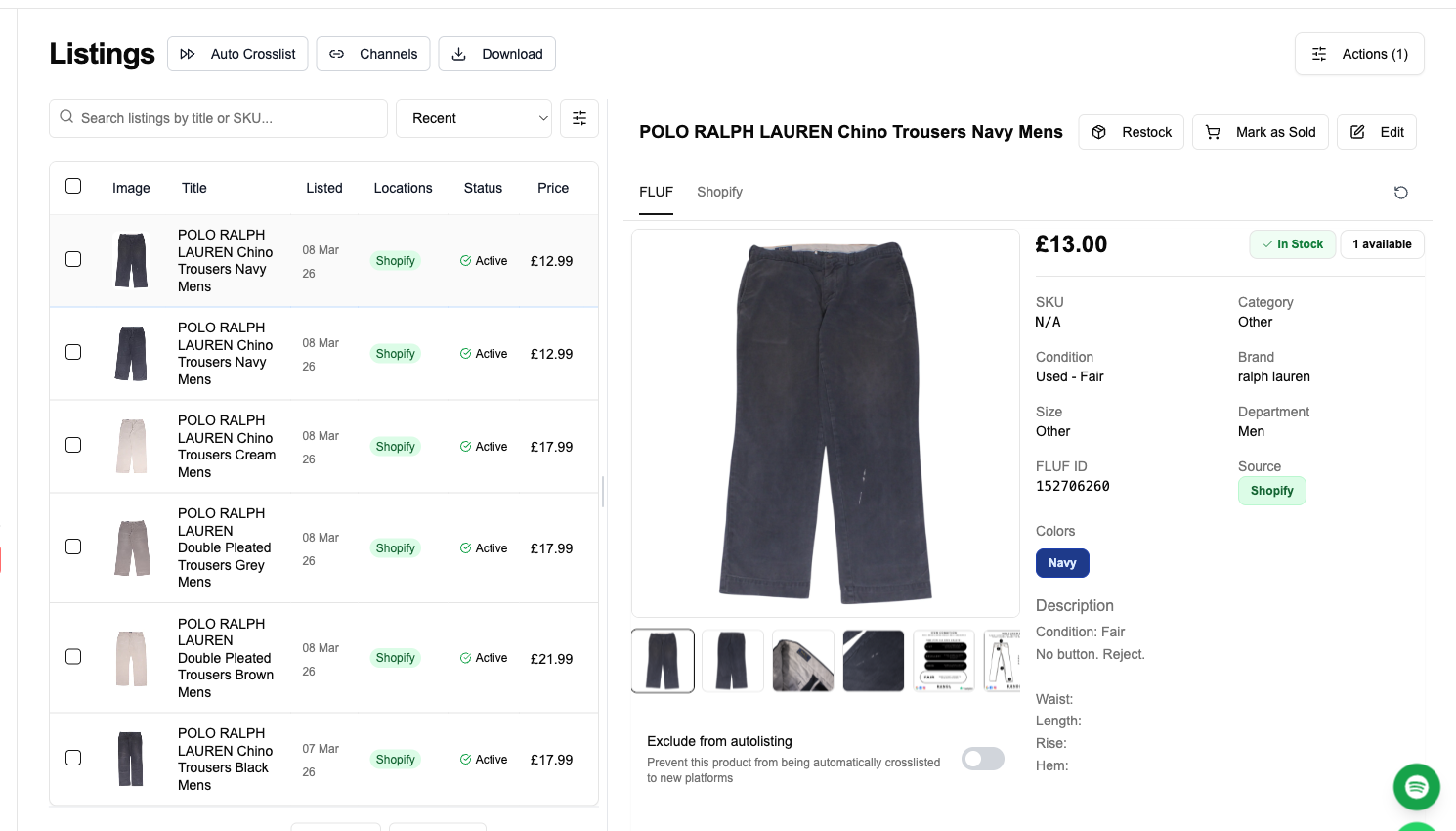
Your WooCommerce products appear in the FLUF dashboard with their Whatnot status — already on Whatnot, queued, or WordPress-only. Filter by WooCommerce category, brand, SKU prefix, tag, or stock level. The dashboard surfaces which products are Whatnot-eligible (BIN-shaped, with structured attributes available) versus better held for a live show.
Step 5: Push to Whatnot with photos, category and attributes mapped
Review the Whatnot Buy It Now preview, including title, description, photos, price, quantity, SKU, brand and condition. Confirm the category and shipping profile before publishing.
Step 6: Inventory stays synchronised in both directions
Stock changes in WooCommerce update the matching Whatnot listing. Whatnot sales reduce WooCommerce stock. When stock reaches zero or you mark the item sold out, FLUF Connect removes the Whatnot listing.
Step 7: Whatnot orders appear in your WooCommerce admin
Every Whatnot Buy It Now sale flows back into your WooCommerce orders screen so you can fulfil from your existing workflow — your shipping plugin, accounting integration, or warehouse system. Whatnot supplies the shipping label directly (USPS in the US, Royal Mail domestic / DPD international in the UK) at no cost to the seller, so the WooCommerce-side order record is for fulfilment tracking and accounting rather than label purchase.
Ready to put your WooCommerce store on Whatnot?
Buy It Now vs Live-Stream Listings — What FLUF Connect Does and Does Not Do
This is the single most important thing to understand about crosslisting WooCommerce to Whatnot, and it is where most automation tools mislead sellers.
Whatnot has two distinct selling formats. Live shows are real-time video auctions where the seller is on camera, running back-to-back auctions or fixed-price sales, answering buyer questions in chat, and shipping the items after the stream ends. Marketplace (off-stream) listings are persistent Buy It Now listings that sit in Whatnot’s catalogue and search results between shows. The FLUF Connect plugin pushes WooCommerce products as Buy It Now / Marketplace listings — the structured-catalogue path. We do not — and structurally cannot — generate live-stream auction inventory automatically: a live show is a human-driven event where you, the seller, decide what to feature, what to start the auction at, and how long to run it.
The practical implication for a WooCommerce store: your crosslisted catalogue gives you a permanent Whatnot storefront that earns sales between live shows and provides the inventory pool you can pull from when you decide to go live. Many serious Whatnot sellers structure their week around this — Marketplace listings handle the steady passive revenue, and a two-to-three-show-per-week live cadence drives the discovery, community building, and inventory velocity that the Whatnot algorithm rewards.
If you have no intention of ever running live shows, Whatnot is still a viable channel for a WooCommerce store via the Marketplace path alone — but you are leaving a significant chunk of the platform’s potential on the table. The buyer base shows up for the entertainment as much as for the listings.
FLUF Connect vs Listing on Whatnot by Hand
Manual Whatnot listing was designed for casual sellers and live-show pickers; it does not scale to a WordPress store catalogue.
| Task | Manual | With FLUF Connect |
|---|---|---|
| Creating Whatnot listings | Open the Whatnot Seller Hub, type title and description, browse the category tree, attach photos one at a time, fill structured attributes, pick a shipping profile, set price and quantity per item. | Select WooCommerce products in the dashboard and click crosslist. Title, description, photos, category, attributes, shipping profile all resolved automatically. |
| Category mapping | Search Whatnot’s category tree manually for every listing — different region trees, different attribute requirements per leaf. | FLUF Connect syncs Whatnot’s full category tree (with attributes and shipping profiles) at connect time, then matches your WooCommerce category to the right Whatnot leaf. |
| Photos | Upload up to 8 photos per listing from your phone or desktop, one at a time. | Featured image + product gallery push automatically via Whatnot’s pre-signed S3 upload flow. Photos register against the listing in one batch. |
| Keeping inventory accurate | Manually mark Whatnot items sold whenever they sell on WordPress. Mark WordPress out-of-stock when sold on Whatnot. | Two-way stock sync; updates may take a few minutes. |
| Processing Whatnot orders | Manage Whatnot orders in the Seller Hub. Manually create WooCommerce orders for accounting and fulfilment. | Whatnot orders flow into WooCommerce admin. Fulfil from your existing dashboard. |
| Price changes | Update on both platforms separately every time you reprice. | Update the price in WooCommerce to apply it on Whatnot. |
| Delisting sold items | Remove Whatnot listings manually after they sell on WordPress. | Automatic delisting when WooCommerce stock hits zero. Included in every plan, not a paid add-on. |
For a WordPress store with even a hundred SKUs, manual Whatnot Marketplace management is a meaningful weekly time commitment. With FLUF Connect it collapses to a few minutes of dashboard oversight.
What Makes FLUF Connect the Right WordPress Plugin for Whatnot
A handful of integrations claim to push WooCommerce to Whatnot. FLUF Connect’s approach differs in four meaningful ways that matter once you are actually selling.
Prepare Your Whatnot Listings
Use the FLUF Chrome extension to connect Whatnot and keep it available while managing listings. You can also connect Vinted and Facebook Marketplace from the same dashboard.
Real category tree, real shipping profiles
Confirm the Whatnot category, required attributes and shipping profile before publishing. Check package weight so the selected shipping option fits your item.
Gated-category awareness
Whatnot gates several high-value categories — trading cards, sports cards, sneakers, luxury handbags, jewellery — behind seller applications. Pushing to a gated category without approval silently fails. FLUF Connect surfaces which categories require approval at the point of selection so you do not waste time queueing items you cannot yet publish.
One plugin for many marketplaces
FLUF Connect also supports eBay, Depop, Vinted, Etsy, Shopify, Facebook Marketplace, Poshmark, and others from the same WordPress install. Most collectibles-focused WooCommerce stores end up on three or four marketplaces; doing that through one plugin avoids credential sprawl and gives you a single source of truth for inventory across every channel.
What Data Transfers from WooCommerce to Whatnot
| Data Field | WooCommerce Source | Whatnot Destination |
|---|---|---|
| Title | WooCommerce product name | Whatnot listing title |
| Description | WooCommerce description; review formatting before publishing. | Whatnot listing description |
| Photos | Featured image + product gallery | Whatnot listing photos (uploaded via pre-signed S3) |
| Price | sale_price ?: regular_price (stored in cents on Whatnot) | Whatnot listing price |
| Quantity | WooCommerce stock_quantity | Whatnot listing quantity |
| SKU | WooCommerce product SKU | Whatnot listing SKU |
| Category | WooCommerce category | Whatnot category (matched against synced category tree) |
| Brand | Brand attribute or taxonomy | Whatnot Brand product attribute |
| Condition | WooCommerce attribute or default per category | Whatnot Condition attribute |
| Size | pa_size attribute | Whatnot Size attribute |
| Shipping profile | WooCommerce product weight | Closest matching Whatnot shipping profile (Small/Medium/Large) |
| Transaction type | — | BUY_IT_NOW (live-stream auctions are out of scope) |
Photos and the Whatnot Visual Standard
Whatnot is more forgiving than Depop or Poshmark on photo composition — buyers expect collectibles photos to look like collectibles photos, not editorial fashion flats. The featured image is what surfaces in Marketplace search and in your shop tile, so make sure your primary WooCommerce gallery image is the strong product shot. Whatnot accepts up to 8 photos per Marketplace listing. FLUF Connect uses the first 8 images from your WooCommerce product gallery, featured image taking the primary slot.
Your WooCommerce gallery photos transfer to Whatnot Marketplace listings. Review them before publishing; a large catalogue may take several minutes to upload.
WordPress Admin Tips for Multi-Channel Collectibles Sellers
WP-CLI for catalogue audits
Review Whatnot listing statuses in the dashboard and open the live listings to check a bulk publish.
WooCommerce hooks for custom Whatnot behaviour
WPML and multi-currency stores
Whatnot supports different currencies and seller accounts by region. If WooCommerce uses multiple currencies, confirm the final Whatnot price and currency before publishing.
Self-Hosted WordPress: Why Whatnot Sellers Should Care
Whatnot can change its fees, algorithm, category gating, or seller policies at any time, and as a fast-growing private company it absolutely will. A WordPress store running in parallel is an insurance policy — every Whatnot buyer you can convert to a direct WooCommerce customer is a buyer Whatnot cannot take away from you. Established Whatnot sellers in the collectibles space frequently use WooCommerce as their long-term canonical inventory database, with Whatnot as the high-velocity acquisition and entertainment surface.
Data ownership matters here too. Your WordPress install owns the canonical product, order, and customer records on hosting you control. Whatnot buyer personal data stays on Whatnot per their privacy policy, but order references and SKU sales history accumulate in your WooCommerce database. If a Whatnot account is ever suspended, restricted, or migrated between regions, the WooCommerce-side records persist intact.
Pricing for Whatnot Crosslisting: No Listing Fees, 8% Commission
Whatnot listings themselves do not cost anything to create — there are no listing fees, no monthly subscription, and no shipping-label markup. Whatnot supplies the label directly (USPS in the US, Royal Mail domestic and DPD international in the UK) at no cost to the seller. The cost is the 8% commission on US sales (6.67% + VAT in the UK) plus the 2.9% + $0.30 payment processing fee on the total order, charged only when an item sells. This makes Whatnot a cost-efficient channel to test for any WooCommerce store with the right inventory mix — you only pay when you earn.
FLUF Connect does not auto-spend on Whatnot’s optional paid visibility tools (Promote Full Show, Boost, Bumps). Those are live-stream-side decisions you make per show, not per Marketplace listing. The smart sync and automatic relisting behaviour FLUF Connect provides handles the organic Marketplace visibility play; promoted shows are for the live cadence you build alongside.
Which WooCommerce and Whatnot Setups Are Supported?
The FLUF Connect plugin requires WordPress 6.0+ and WooCommerce 7.0+ (PHP 7.4+). On the Whatnot side, the bundled Chrome extension is supported on Chrome, Edge, and Brave on macOS and Windows. Your Whatnot seller account must be active in one of the supported regions: United States, Canada, United Kingdom, Germany, France, Netherlands, Belgium, Austria, or Australia. If you sell in categories Whatnot gates (trading cards, sports cards, sneakers, luxury handbags, certain jewellery sub-categories), you must complete Whatnot’s category-access application before crosslisted products in those categories will publish.
FLUF Connect Pricing
FLUF Connect uses transparent, simple pricing. Every plan includes the WordPress plugin, all channels — Whatnot, Depop, Vinted, eBay, Etsy, Shopify, Facebook Marketplace, Poshmark — and every automation feature. The only difference between plans is how often we check your channels for sales. The cheapest paid tier is with no cap on how much you list; FLUF Connect does not offer a no-cost tier.
| Plan | Monthly | Crosslisted products |
|---|---|---|
| Starter | £9/month | Unlimited |
| Pro | £29/month | Unlimited |
| Super Seller | Custom pricing — tell us what you need | Unlimited |
Whatnot’s own 8% commission plus payment processing applies separately and is deducted by Whatnot at payout. Automation features — inventory sync, automatic delisting on sell-out, category and shipping-profile resolution, bulk operations — are included in every plan, not a paid add-on.
Related Guides
- All channels FLUF Connect supports — overview hub including WooCommerce and Whatnot
- WooCommerce crosslisting — the full hub for crosslisting your WooCommerce store to every channel
- Crosslist from WooCommerce to Vinted — reach Vinted’s 100M+ European buyers from your WordPress store
- How to sell on Whatnot — the 2026 guide — full Whatnot seller fundamentals including live-show strategy
- Crosslist from Shopify to Whatnot — the same workflow for Shopify store owners
- Crosslist WooCommerce to eBay — for sellers expanding beyond Whatnot
- Crosslist WooCommerce to Depop — fashion-focused sister page
- Inventory Sync — how two-way sync prevents overselling across every channel
- FLUF Connect pricing — plans start at £9/month, all channels included
- Whatnot to WooCommerce
Sources & Verification
- Whatnot scale, GMV, and Series F: Whatnot company news
- Whatnot seller fees and category gating: Whatnot Help Center
- Whatnot UK and Europe expansion: Whatnot UK & EU blog
- WooCommerce REST API reference: WooCommerce REST API docs
Frequently Asked Questions
Whatnot is community-driven and concentrates around specific verticals: trading cards (Pokémon, Magic, Yu-Gi-Oh), sports cards, sneakers, streetwear, vintage clothing, Funko Pops, comics, sports memorabilia, jewellery, and women's fashion. WooCommerce stores selling those categories tend to do well. Generic homewares, food, or beauty consumables are a poor fit for the platform's buyer base. FLUF Connect lets you crosslist selectively so you push only the WooCommerce SKUs that fit Whatnot's audience, and surfaces which categories require Whatnot's seller-application approval before they will publish.
No. Install FLUF Connect from WordPress admin: Plugins → Add New → Install → Activate. Follow the prompts and connect Whatnot with the FLUF extension in Chrome, Edge or Brave. Setup typically takes ten minutes.
FLUF Connect pushes WooCommerce products as Whatnot Buy It Now (Marketplace) listings — the structured-catalogue path. Live-stream auctions are a separate human-driven workflow on Whatnot where you, the seller, decide on camera what to feature, the starting price, and how long to run each auction. Crosslisting gives you a permanent Whatnot storefront that earns sales between shows; the live cadence you build on top of that is yours to run.
You can manage listing creation, photos, inventory and orders from FLUF Connect after connecting your store. Your hosting can affect the initial catalogue import; keep the Whatnot browser extension available.
Whatnot requires a seller application for several high-value categories — trading cards, sports cards, sneakers, luxury handbags, and certain jewellery sub-categories. Pushing to a gated category without approval silently fails. FLUF Connect's dashboard flags gated categories when you select products to crosslist, so you can apply to Whatnot first and avoid queueing items you cannot yet publish. Once your category access is approved, the same WooCommerce products push successfully.
Three things happen automatically. The Whatnot order flows into your WooCommerce admin via the every-three-minute sync so you can fulfil from your existing dashboard. The WooCommerce stock_quantity for the sold product decreases to match. Whatnot supplies the shipping label directly (USPS in the US, Royal Mail or DPD in the UK) at no cost to the seller, so the WooCommerce order is for fulfilment tracking and accounting rather than label purchase. When stock hits zero, FLUF Connect automatically delists the Whatnot listing.
Whatnot's category tree uses base64-encoded IDs that vary by region, and shipping profiles are reusable size buckets (UK Small, UK Medium, US equivalents). The bundled Chrome extension syncs the full category tree, per-category attributes, and shipping profiles into dedicated WordPress tables when you connect. At crosslist time, FLUF Connect resolves your WooCommerce category to the right Whatnot leaf, fills the required attributes (condition, brand, size), and picks the closest shipping profile based on your product weight.
Yes. Filter the FLUF dashboard by WooCommerce category, brand, SKU prefix, tag, or stock level and choose what to crosslist. Most WooCommerce store owners push only their Whatnot-eligible inventory — typically collectibles, trading cards, sneakers, or vintage clothing — and keep generic homewares or non-collectible SKUs WordPress-only. You can add or remove products from Whatnot at any time without affecting WooCommerce.
FLUF Connect plans start at £9/month on Starter, with Pro at £29/month and custom Super Seller plans above that; every plan is unlimited on listings and marketplaces, and the tiers differ by which automations they include and how often we check your channels for sales. Every plan includes the WordPress plugin, all channels and centralised order management, and Pro and above add automation. Whatnot's own 8% commission (6.67% + VAT in the UK) plus 2.9% + $0.30 payment processing applies separately and is deducted by Whatnot at payout. There are no Whatnot listing fees, no monthly Whatnot subscription, and no shipping-label markup.