
How to Sell on Kijiji in 2026: Fees, Rules and Crosslisting
A complete guide to Canada's biggest classifieds site — what it costs, what actually sells, and exactly what FLUF Connect can and cannot automate on it.
7 days for £1, then from £9/month.



Key Takeaways
- Kijiji is Canada’s classifieds default, not a transactional marketplace. There is no integrated checkout, no shipping label, no buyer protection. A Kijiji sale is a local handover paid in cash or Interac e-Transfer.
- Posting is usually free in the categories resellers care about. Fees are concentrated in Cars & Vehicles, Real Estate, Jobs, Services, Business & Industrial, Vehicle Parts and pet adoptions, charged per listing per 31-day period (Kijiji category pricing overview).
- Most ads run for 60 days, then drop into your inactive list, where they stay recoverable for a further 60 days before deletion (Kijiji listing duration).
- Kijiji is owned by Adevinta, which bought eBay Classifieds Group in a deal completed on 25 June 2021 (Adevinta), and Adevinta itself was taken private by a Permira and Blackstone consortium in 2024.
- Its closest Canadian rival is Facebook Marketplace — same items, same city, different audience habits, and most Canadian sellers run both.
- FLUF Connect supports Kijiji for Canada, and it needs the FLUF Chrome extension running on a desktop computer for every listing action — create, edit and delist — not just for the initial connection.
- On Kijiji, FLUF supports mark-as-sold only. When an item sells on another channel, FLUF pulls the Kijiji ad down. FLUF does not relist on Kijiji, does not manage offers there, and does not import Kijiji orders — a Kijiji sale leaves no order record for any software to read.
What Kijiji Is And Who Owns It Now
Kijiji is Canada’s online classifieds site. You post an ad describing something you want gone — a dining table, a set of winter tires, a 2014 Civic — buyers in your city message you, and you meet and swap the item for money. That is the whole model, and it has barely changed since eBay launched the site in February 2005, first in Quebec City and Montreal. The name is Swahili for “village”: a bulletin board for a place, not a shop window for the world.
Ownership has changed twice since, and it matters more than the trivia suggests. eBay ran Kijiji inside eBay Classifieds Group until 2020, when it agreed to sell the division to the Norwegian group Adevinta. Adevinta announced completion of the acquisition on 25 June 2021, which put Kijiji into the same stable as Marktplaats in the Netherlands, Kleinanzeigen in Germany and a long list of European classifieds properties. Then Adevinta itself was taken private: a consortium led by Permira and Blackstone made a voluntary offer of NOK 115 per share in November 2023, and the deal settled in May 2024. So Kijiji today is a privately held asset inside a private-equity-owned classifieds group, and it is no longer connected to eBay in any operational sense. There is no shared login, no shared listing tool, no shared seller account.
Adevinta describes Kijiji as “Canada’s largest classifieds site with millions of live ads in a wide range of categories”, claiming the number one position for both automotive and rental real estate in Canada. Those two verticals — Kijiji Autos, launched as a separate car-buying platform in November 2018, and rentals — are where the money is. General Buy & Sell, the part a reseller uses, is largely a traffic engine feeding them.
How Big Kijiji Actually Is In Canada
Kijiji no longer publishes a hard audience number: its business site talks of “millions of unique visitors” and reach “across all provinces and territories” rather than a figure. Independent measurement fills the gap — Similarweb ranks kijiji.ca the number one classifieds site in Canada and around the eightieth most visited site in the country, with roughly 15 million visits a month and 95.6% of that traffic from inside Canada.
Two things stand out. The engagement profile — a bounce rate under 30%, close to seven pages per visit, sessions approaching six minutes — is a browsing pattern, not a click-and-leave one. And unlike eBay, Kijiji delivers essentially no international demand: almost every viable buyer is a Canadian within driving distance.
Classifieds, Not A Marketplace: The Distinction That Governs Everything
Almost every mistake sellers make on Kijiji comes from treating it like a marketplace. The difference is structural, not cosmetic. On a transactional marketplace — eBay, Etsy, Poshmark, Mercari, Depop — the platform sits in the middle of the money: it takes the payment, tells you what to ship, releases your funds and adjudicates disputes. In exchange it takes a percentage, knows exactly what you earned, and produces an order record software can read.
Kijiji does none of that. It has no integrated payment system and no buyer or seller protection programme for goods. It publishes your ad and passes messages between you and a buyer. Everything after that first message is between two private individuals: how you meet, what you get paid in, whether you write a receipt, what happens if the item turns out to be faulty. Kijiji’s own safety guidance is written accordingly — it tells sellers to verify funds directly through their bank rather than trusting an email or text confirmation, and to meet in public, well-lit places. That is the guidance of a noticeboard operator, not a payment processor.
Four consequences follow, and they shape how a reseller should use the channel:
There are no selling fees on the sale itself. Sell a $400 sofa and you keep $400 — no final value fee, no payment processing cut, no postage. That is the single biggest argument for the channel, and on a $400 item an eBay sale might leave you $50 to $60 lighter before postage.
There is no order data. Nothing anywhere holds a machine-readable record that item X sold for $Y on date Z — the money moved between two bank accounts. This is why no crosslisting tool, FLUF included, can automatically detect a Kijiji sale. It is not a gap in anyone’s software; the data does not exist.
Buyers behave differently. A Kijiji buyer is not committing money at the point of contact; they are committing to a conversation. Response volume is high, follow-through is low, and haggling is the norm rather than the exception. Sellers used to the psychology of a Buy It Now button find this exhausting until they adjust their expectations and their pricing.
What Kijiji Costs In 2026
The headline is genuine: for a reseller listing household goods, electronics, furniture, tools or baby equipment in Buy & Sell, posting normally costs nothing, and registering costs nothing. Kijiji states no additional account fee applies to a business account — switching from Personal to Business does not itself trigger a charge.
Where Kijiji does charge, it charges for the privilege of publishing, not for the sale. Kijiji’s category pricing overview sets out the fee-bearing categories:
- Real Estate — all subcategories
- Cars & Vehicles — all subcategories
- Jobs — all categories
- Buy & Sell — Business & Industrial, and Vehicle Parts, Tires & Accessories
- Services — all categories
- Pets — dogs and cats for adoption
The mechanics are per listing and per period: “posting fees apply per listing published in a fee-based category,” and “fees are charged for each 31-day listing period.” So a paid ad is not a one-time cost — leave it up for three months and you have paid three times. Free allowances still exist in some of these categories but they are thin: Kijiji’s own table shows most fee-bearing categories allowing a single free listing, and several service and pet-adoption categories allowing none at all. Business accounts pay category fees regardless of what a personal account in the same category would have been allowed.
Kijiji does not publish a single national price list for these fees, and this is the honest limit of what can be verified. Prices vary by category, by city and by ad type. The fee you are quoted for a Cars & Vehicles ad in the Greater Toronto Area is not the fee for the same ad in Moose Jaw. The only reliable way to know what you will pay is to start the posting flow for your specific item in your specific location and read the price Kijiji quotes before you confirm. Any blog quoting you a fixed dollar figure for a Kijiji category fee is quoting a snapshot from one city on one day.
Bump Up, Top Ad, Highlight And The Rest Of The Paid Features
Separate from category posting fees, Kijiji sells per-ad visibility upgrades, bought when you post or edit. Kijiji states the cost depends on the feature, the city and the category, so there is no universal price to quote — but what each one does can be stated precisely.
Bump Up resets your ad’s posting date to now. Because Kijiji’s default browsing behaviour is heavily recency-driven, that pushes the ad back to the top of “Most Recent” results and, per Kijiji, may also help in “Best Match”. Three details matter. First, a Bump Up resets the posting date but does not extend the expiry date — a bumped ad still dies on its original 60-day schedule. Second, you can buy them in packs of 1, 3, 5 or 10, and a multi-pack auto-applies every three days until exhausted, which is the closest thing Kijiji has to a set-and-forget promotion. Third, Bump Up is not available in Events and Garage Sales, which sort by event date instead.
Top Ad places a second copy of your listing in a premium block at the top of relevant search results, available for 3, 7 or 30 days depending on the category. Read Kijiji’s own caveat carefully before buying: it “does not change the position of your listing within the regular search results,” and display is not guaranteed — up to six Top Ads rotate through the block and yours may not appear on every search. You are buying a probability of extra exposure, not a fixed slot.
Highlight adds a coloured background in the results list, Urgent adds an urgency label, Homepage Gallery rotates your ad through high-traffic pages, and the URL feature adds a clickable link to your own website — the one upgrade with obvious value to a business seller running a shop elsewhere.
An honest assessment: for a reseller moving ordinary second-hand goods, these upgrades rarely pay for themselves. What actually moves a Kijiji item is a realistic price, a clear first photo and a fast reply. The one upgrade that changes the arithmetic is a scheduled Bump Up pack on a high-ticket item, because recency is the ranking factor you have least other control over.
Category Structure And Which Ones A Reseller Actually Uses
Kijiji’s top-level structure is broader than a marketplace’s:
- Buy & Sell — the main goods tree: furniture, electronics, appliances, tools, sporting goods, musical instruments, baby items, clothing, books, hobbies, home and outdoor.
- Cars & Vehicles — cars, trucks, motorcycles, RVs, boats, plus the fee-bearing Vehicle Parts, Tires & Accessories subtree. This feeds Kijiji Autos.
- Real Estate — long-term rentals, room rentals, condos and houses for sale, short-term and vacation rentals.
- Jobs — employer postings, fee-bearing.
- Services — trades, tutoring, cleaning, moving, financial and legal, all fee-bearing.
- Pets — accessories and supplies, plus dog and cat adoption listings which carry fees and heavy policy scrutiny.
- Community — events, volunteers, classes, lost and found, garage sales, rideshare.
- Vacation Rentals — with its own shorter default duration.
For a reseller, essentially all the useful oxygen is in Buy & Sell — specifically the categories where an item is bulky, local, expensive to post, or better assessed in person. Furniture is the archetype, along with appliances, exercise equipment, power tools, garden machinery, baby gear and building materials.
Choose the category deliberately. Kijiji’s posting policies prohibit “misleading categories or information”, and miscategorising is a common reason a legitimate ad gets pulled.
Payments, Meetups And The Shipping Reality
There is no Kijiji checkout, no shipping label, no escrow and no purchase protection covering goods you sell. In 2026 that is still true, and it is the product rather than an oversight. Canadian Kijiji sales settle in one of three ways:
Cash on collection. Still the most common and the safest for a seller, because it cannot be reversed. For anything over a few hundred dollars, meet somewhere with cameras — many Canadian police services operate designated exchange zones in their car parks for online-marketplace handovers.
Interac e-Transfer. Ubiquitous, instant, and the source of most Kijiji payment fraud. The critical rule is the one Kijiji itself gives: confirm the money has actually landed by checking your own bank app or online banking, never by reading a confirmation email or text. Fraudulent e-Transfer notification emails are trivially easy to fake and are the single most common way a Canadian seller loses an item. Do not release goods on the strength of a screenshot.
Shipping, by private arrangement. Nothing stops you agreeing to post an item, but Kijiji supplies no label, no tracking and no protection if a buyer claims non-delivery. Take irreversible payment first, use a tracked service, keep the proof — and if you find yourself doing it routinely, that stock belongs on a transactional channel.
Posting Rules, Ad Limits And Why Ads Get Removed
Kijiji is stricter than its reputation suggests: an account has been required to post since 2017, and automated screening runs alongside manual review. The rules that catch honest sellers most often:
One live ad per item. Kijiji does not allow multiple active listings for the same item or service. The automated duplicate check compares photos, title, description, and category together, so cosmetic edits will not fool it — swapping one image or rewording the headline while the underlying item is identical still trips the filter.
No cross-posting the same ad into several categories. The posting policies name this directly, along with using multiple email addresses to get around limits. Both are treated as evasion.
Items must be located in Canada. A geographically absent seller is not welcome, and the requirement is written into the policies.
English or French only. Ads in other languages are removable. Kijiji is a bilingual platform and that is the extent of it.
No keyword stuffing. Padding a description with brand names you are not actually selling is explicitly listed as a removal reason. This is the habit resellers import from eBay title optimisation, and it does not survive contact with Kijiji moderation.
Represent yourself honestly. “A business posing as an individual” is a named violation. If you are running volume, switch the account type. There is no account fee for doing so, and the reputational and enforcement risk of not doing so is real.
Quantity limits also exist. Free posting allowances vary by category and account type, and Kijiji does not publish a single global number, so plan for your twentieth ad in a fee-bearing category behaving differently from your first. Repeat violations lead to account restriction or suspension — a good reason not to make Kijiji your only channel.
The 60-Day Clock, Reposting And The Duplicate Trap
Kijiji ads expire, and the schedule differs by what you are posting. Kijiji’s own duration guide gives:
- 60 days for most listings.
- 31 days for any listing carrying an insertion fee, and for professional dealer, employer and real estate accounts. Reposting may trigger a new fee.
- 30 days for free Vacation Rentals listings, extendable up to a year with paid upgrades.
Kijiji emails you before an ad expires so you can repost it. Once it has expired, it moves into your Inactive Ads and stays recoverable for 60 days after expiry; after that it is permanently deleted. Reposting restarts the original duration and refreshes the listing’s position in results, which makes it a free equivalent of a Bump Up if you are patient enough to wait for the natural expiry.
Here is where sellers get caught. Post a fresh copy while the old ad is still live and the duplicate filter removes the new one, sometimes both. Kijiji’s guidance is unambiguous: completely delete the older ad before creating the new one — not archive, not edit, delete. Build that step into any bulk reposting routine.
The 60-day clock has a quieter consequence for anyone crosslisting: an item that sold elsewhere three weeks ago but is still live on Kijiji keeps generating messages until day 60. Pulling the ad down promptly is not housekeeping — it is the main operational discipline the channel demands.
How Kijiji Decides What Buyers See
Kijiji’s visibility model is much simpler than a marketplace’s, and much more brutal. Kijiji’s sorting documentation describes four options a buyer can choose: Best Match, Most Recent, Least Recent and Lowest Price.
Most Recent is pure chronology. Your ad sits near the top until newer ads or bumped ads push it down. In a busy urban category that can be a matter of hours.
Best Match is Kijiji’s relevance sort, driven by “title, description, category, and recency” among other factors. Note that recency is explicitly a component of the relevance sort too — there is no version of Kijiji ranking in which an old ad is treated equally with a new one.
Top Ads sit outside all of this. They are not affected by the sort the buyer chose and appear in a randomised rotation.
In practice:
Recency is the ranking factor and everything else is a tiebreak — the opposite of eBay, where a long-running listing accrues signal. A Kijiji strategy is a cadence strategy: a steady drip of new and reposted ads beats a static wall of them.
The title carries the search weight. Write it the way a buyer searches: brand, model, key spec, condition. “IKEA Malm 6-drawer dresser, white, excellent condition” outperforms “Beautiful dresser must go!!” — the second contains no searchable term. Resist eBay-style keyword cramming; it is a policy violation here.
Use the tag field. Kijiji lets you add up to five keywords when posting, which is the sanctioned place for the synonyms you would otherwise be tempted to stuff into the title.
Photos are the click-through lever, not the ranking lever. You get up to 10 per ad, with a 15 MB file cap and 300 × 300 to 6500 × 6500 pixel bounds. Shoot in daylight, frame the whole item, and photograph the flaws — a scuff shown in the ad is a negotiation already won; a scuff found at the meetup is a sale lost.
Writing A Kijiji Ad That Gets Answered
Kijiji copy has a different job from marketplace copy. On eBay you write for a search engine and a buyer who will never speak to you; on Kijiji you write to pre-qualify a stranger about to message you, and every question the ad fails to answer becomes a message you must answer instead.
Include, without exception: exact dimensions, an honest and specific condition note, your terms (cash or e-Transfer on collection, buyer collects, no holds without payment), and a neighbourhood or intersection rather than an exact address — Kijiji defaults location to a general area and there is rarely a reason to override it.
Price with the haggle built in. Kijiji buyers open below asking as a matter of course. If you need $200, list at $240 and let them win something. Kijiji also lets you post an ad with the price left blank or set as free or swap — leaving it blank generally suppresses response, because a price is what buyers filter on.
What Sells On Kijiji And What Does Not
The channel has a clear shape, and fighting it is a waste of effort.
Sells well. Furniture of every kind — sectionals, dining sets, dressers, armoires, mattresses, futons, bunk beds, office desks. Appliances: washers, dryers, chest freezers, dehumidifiers, window air conditioners. Power tools and workshop kit — mitre saws, compressors, welders, workbenches. Seasonal machinery is the most Canadian category of all and the most profitable if you time it: snowblowers and toboggans from October, lawnmowers, trimmers and patio sets from April, snowmobiles, ATVs, kayaks and canoes in their windows. Baby and child equipment: cribs, strollers, playpens, high chairs, car seats where provincial rules allow. Treadmills and home gyms. Musical instruments, bicycles, drywall, plywood and salvaged building materials. Vehicles and vehicle parts, Kijiji’s strongest paid vertical. Anything large, anything heavy, anything a buyer would rather plug in before paying for.
Sells badly. Low-value fashion is the clearest example: a $25 dress does not justify a stranger driving across town, and Kijiji has no shipping layer to bridge the gap. Clothing volume that would clear steadily on Vinted, Depop or Poshmark simply sits. Small collectibles suffer the reverse problem — your buyer exists, but lives in another province with no mechanism to reach you. Anything whose value depends on authentication, grading or a niche international audience belongs on eBay.
The useful mental test: would I rather ship this or hand it over? If shipping is cheap and easy relative to value, Kijiji is a secondary channel at best. If shipping is expensive, awkward or impossible, Kijiji may be your primary one.
Regional Reality: The GTA, Quebec And Everywhere Else
Kijiji operates in more than a hundred Canadian cities, but the liquidity is not evenly spread. Southern Ontario, and the Greater Toronto Area in particular, is where the platform is densest: the most listings, the most buyers, the fastest sales, and also the fastest slide down the recency-sorted results. Metro Vancouver, Calgary, Edmonton, Ottawa and Montreal follow, then a second tier — Hamilton, Kitchener-Waterloo, Winnipeg, Halifax, Victoria, Saskatoon, Regina, Windsor, Oshawa, Guelph. Below that, in Moncton, Fredericton, Sudbury, Kelowna or anywhere in Newfoundland and Labrador, Prince Edward Island, Yukon or Nunavut, you are working a genuinely small pool: expect a longer time-to-sale and be slower to discount, because your ad is not being buried by lunchtime.
Quebec deserves separate mention. Kijiji launched in Quebec City and Montreal before anywhere else in Canada and operates fully bilingually — interface, help centre and ads run in both English and French, and French-language ads are the norm rather than an accommodation. Sell in Quebec and write in French, or at minimum in both: an annonce headed “meubles a vendre, ramassage a Laval” reaches buyers in Laval, Gatineau, Longueuil and Sherbrooke that English-only copy will not. Quebec also has a long-established homegrown competitor in LesPAC, so the market there is contested in a way it is not in Ontario; Similarweb ranks Kijiji first among Canadian classifieds nationally, with LesPAC further down the same list.
Scams And Safety On Kijiji
Because Kijiji carries no payment layer, it carries no payment protection, and Canadian sellers are targeted persistently. The Canadian Anti-Fraud Centre reported that Canadians lost a record amount to fraud in 2025, with merchandise and online-purchase scams among the highest-volume categories, and the CAFC itself notes that only a small minority of victims ever report. The patterns to know:
The fake e-Transfer notification. A buyer “sends” payment and forwards you the confirmation email. The email is fabricated. You hand over the item. Nothing ever arrives. Defence: only your own bank app counts as evidence of payment. Never a screenshot, never a forwarded email, never a text.
The overpayment scam. The CAFC describes this pattern directly on its merchandise fraud guidance: a “buyer” sends more than the agreed price and asks you to refund the difference. Days later the original payment is reversed as a fraudulent cheque, compromised account or stolen card, and you are out both the item and the refund. Defence: never refund an overpayment. Cancel the sale and return the whole amount through the same channel, or better, refuse the transaction outright.
The shipping-and-agent scam. A buyer who cannot collect insists on paying through a third-party “shipping agent” that will handle the money. It is always fake.
QR-code payment fraud. A newer variant the CAFC has flagged: the “payment” notification asks you to scan a QR code to receive funds. Scanning authorises a payment out of your account instead. No legitimate incoming e-Transfer requires you to scan anything.
Physical risk at the meetup. Kijiji’s own guidance is to meet in public well-lit locations during daylight, bring someone with you if a buyer insists on coming to your home, tell somebody where you are going and when you expect to be back, and end any transaction that feels wrong. For higher-value items, use a municipal police or RCMP detachment safe-exchange zone where one exists.
Tax: The CRA, Reselling, And Why Kijiji Sits Outside Platform Reporting
Two separate things get conflated here, and it is worth separating them.
Your obligation. If you buy goods with the intention of reselling them at a profit, that is business income in the eyes of the Canada Revenue Agency, and it is reportable regardless of which platform you used, whether you were paid in cash, and whether anyone sent you a slip. Selling your own used household possessions for less than you paid is generally a different matter. The line between clearing out your basement and running a business is one of intention, frequency and organisation, and if you are reading a guide about crosslisting your inventory across several channels, you are probably on the business side of it. GST/HST registration becomes relevant once your taxable supplies pass the small-supplier threshold, and QST separately if you are established in Quebec. This is general information, not tax advice.
The platform’s obligation. Separately, Canada implemented the OECD model reporting rules for digital platform operators with effect from 1 January 2024. Under the CRA’s reporting rules for digital platforms, in-scope platform operators must collect identifying details for reportable sellers, file an annual information return with the CRA, and give each seller a copy — with the first returns, covering 2024, due by 31 January 2025. Analysis of the rules confirms the reporting turns on transaction consideration the platform collects or otherwise knows.
This is where Kijiji differs from the transactional marketplaces. Because Kijiji processes no payments, it has no record of what you were paid, or whether you were paid at all. We have found no evidence that Kijiji issues seller information returns of this kind, and the structure of the rules — which key on consideration the operator knows — is consistent with a pure classifieds site sitting outside them. eBay, Etsy, Poshmark, Mercari and similar platforms that take the buyer’s money are a different case entirely and do report.
Do not read that as a loophole. It changes who tells the CRA; it does not change what you owe. It does, however, change your record-keeping burden: on a channel that generates no order data, you are the only bookkeeper. Log every Kijiji sale — item, date, amount, buyer contact, what you originally paid — at the moment it happens, because there is nothing to reconstruct it from later.
Kijiji vs Facebook Marketplace vs eBay For A Canadian Seller
These three cover most of what a Canadian reseller needs, and they are complements rather than substitutes.
| Kijiji | Facebook Marketplace | eBay (eBay.ca) | |
|---|---|---|---|
| Model | Classifieds — ads only, no transaction layer | Classifieds for local sales; shipped-item flows vary by region | Transactional marketplace with managed payments |
| Reach | Canada only; ~15m visits/month, 95.6% Canadian, organised by city | Canada-wide via Facebook, local radius by default | National plus international buyers |
| Cost to list | No charge in most Buy & Sell categories; per-31-day fees in Cars & Vehicles, Real Estate, Jobs, Services, Business & Industrial, Vehicle Parts and pet adoptions | No charge for local listings | Insertion allowances, then per-listing fees |
| Cost to sell | Nothing — you keep the full sale price | Nothing on a local handover | Final value fee plus payment processing on every sale |
| Shipping | None provided; private arrangement only | Limited and region-dependent; local collection is the norm in Canada | Integrated labels, tracking, international programmes |
| Payment & protection | Cash or e-Transfer between individuals; no protection | Cash or e-Transfer for local sales; no protection on those | Platform-held payment, structured dispute resolution |
| Buyer type | Local bargain hunter researching a bulky purchase | Casual local browser, high message and no-show volume | Intent-driven searcher who has decided to buy |
| Listing lifespan | 60 days most ads; 31 for fee-bearing and pro accounts | Persistent until removed, with renewal prompts | Good Til Cancelled or fixed duration |
| Best for | Furniture, appliances, tools, garden machinery, baby gear, vehicles and parts | Fast local clearance of household goods | Anything shippable, branded or collectible |
| Sale data for your tooling | None — you record it yourself | None for a local handover | Full order record |
The pattern most Canadian sellers land on: bulky and local goes on Kijiji and Facebook Marketplace simultaneously, shippable and branded goes on eBay, and fashion goes to Poshmark, Mercari or Vinted depending on the category. The overlap between Kijiji and Facebook Marketplace is the highest of any pair — same items, same city, same buyer, different audience habits — which is precisely why running both is worth the duplicated effort. Kijiji skews older and more deliberate; Facebook Marketplace skews faster and flakier.
Kijiji Is Not For Everyone
An honest list of reasons to skip this channel:
Your inventory is small and shippable. If your average item is a $30 garment or a $40 pair of trainers, Kijiji will consume time and return almost nothing. The local-collection model does not justify a journey for that value, and there is no shipping layer to rescue it. Put that stock where the buyers and the postage infrastructure already are.
You are not in Canada. Kijiji requires items to be located in Canada, and FLUF’s Kijiji support is Canada-only for that reason. It is not a channel you add for international reach.
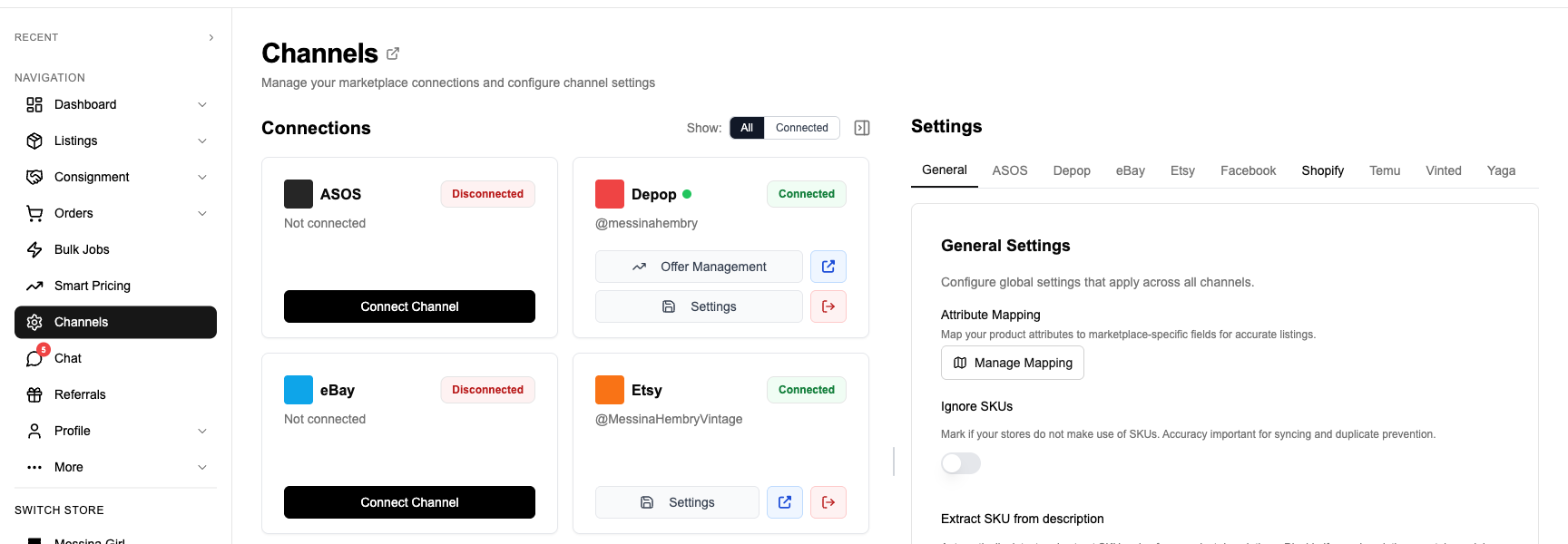
Check the automation you need. Kijiji requires the FLUF Chrome extension on a desktop computer for creating, editing and removing listings. FLUF supports removing Kijiji listings when items sell elsewhere; automatic relisting, offer management and order import are not available for this channel.
You depend on a single channel. Kijiji restricts and suspends accounts for repeat policy violations, and its duplicate and category rules catch honest sellers who were not paying attention. If Kijiji is your only outlet, one enforcement action is your whole business. Spread the risk across the channels that fit your stock.
How FLUF Connect Works With Kijiji
Kijiji is a live channel in FLUF Connect for Canadian sellers. Here is precisely what it does and does not do, with no rounding up.
The Chrome Extension Is Required For Every Listing Action
Install the FLUF Chrome extension and sign in to Kijiji in the same browser before connecting your account.
Keep your computer awake, browser open and extension connected whenever you create, edit or remove a Kijiji listing. Confirm the action has completed before relying on the change.
Sync Is Mark-As-Sold Only, In One Direction
FLUF supports exactly one sync feature on Kijiji: mark as sold. When an item sells on another connected channel — eBay, Poshmark, Depop, wherever — FLUF pulls the corresponding Kijiji ad down so you stop fielding messages about something you no longer have. That is the safe direction, and it is the direction that actually prevents an overselling problem.
What FLUF does not do on Kijiji, stated plainly:
- No automatic relisting. FLUF will not cycle your Kijiji ads to refresh their position, and will not automatically repost them when the 60-day clock runs out. If you want a Kijiji ad refreshed, delete it and post it again yourself, or buy a Bump Up.
- No offer management. Kijiji negotiation happens in Kijiji’s messages, between you and the buyer. FLUF has no part in it.
- No order sync or order import. FLUF does not pull Kijiji orders into your dashboard, because there are none to pull.
- No automatic detection of a Kijiji sale. This is the one that matters most operationally. A Kijiji sale is a local handover with no order record anywhere in Kijiji’s system, so no software can observe it. When you sell something on Kijiji, you mark it sold in FLUF, and FLUF then clears it from your other channels. The sync runs outward from your action, not inward from a Kijiji event.
That last point is a discipline, not a limitation you can work around. Build the habit: money changes hands, phone comes out, item marked sold in FLUF before you have left the car park. Everything downstream depends on it.
Listing Requirements
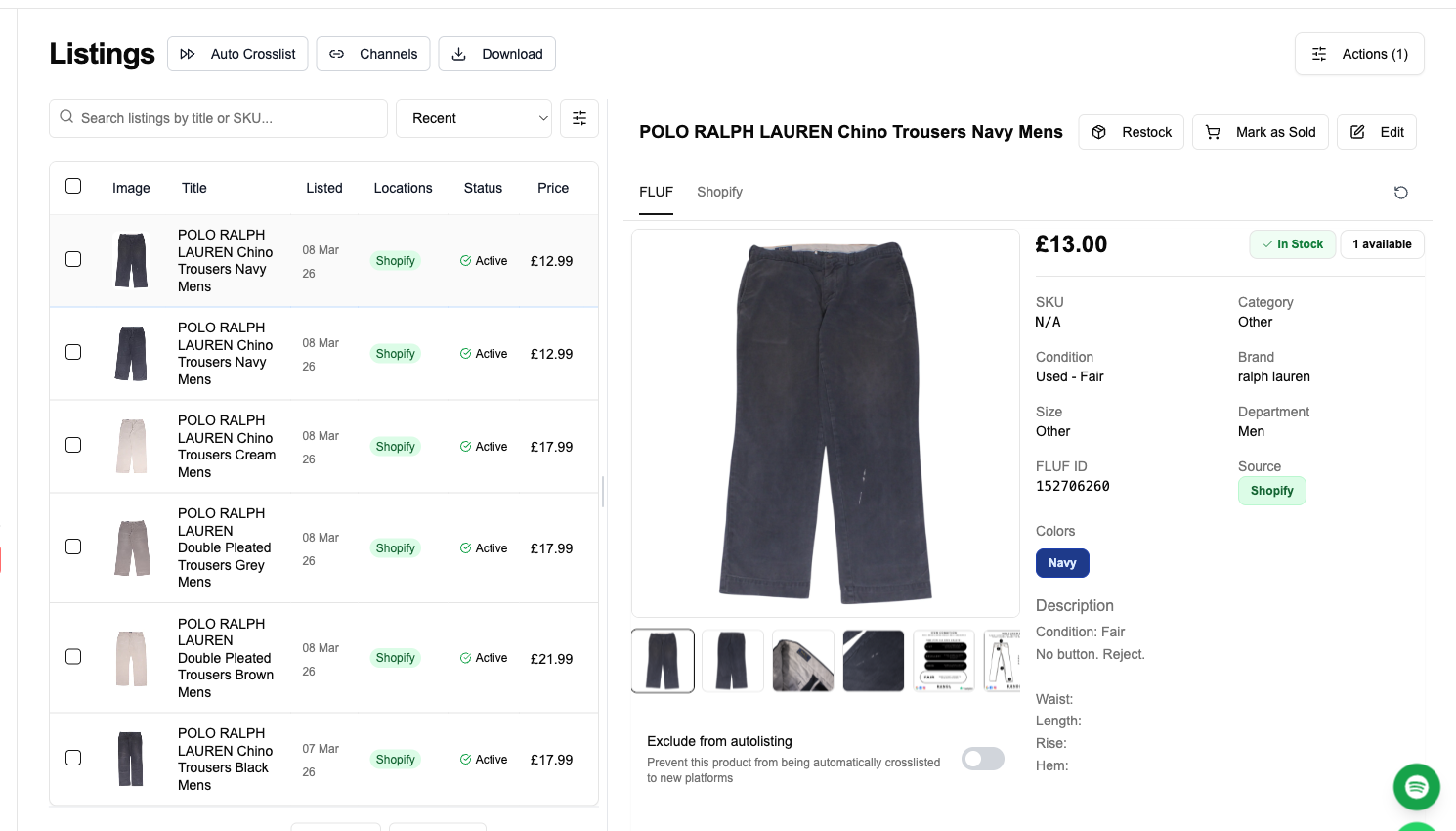
FLUF requires a minimum of one photo for a Kijiji listing. Kijiji itself accepts up to ten per ad, and using more of them is close to free performance. FLUF pushes your product’s title, description, price, category and images through the extension into the Kijiji ad form.
Where Kijiji Fits In A Crosslisting Setup
Think of Kijiji as free local reach bolted onto inventory that already lives on transactional channels, not as a channel you build a business on. One dresser can sit on eBay for the national shipped buyer, on Facebook Marketplace for the fast local browser, and on Kijiji for the deliberate local buyer — the eBay listing carrying fees and producing order data, the Kijiji ad carrying neither.
A Working Weekly Routine
A routine that fits the constraints rather than fighting them:
One listing session a week, at a desk. Because the extension needs your browser, batch it: pick a fixed slot and push the week’s new Kijiji-suitable stock in one go.
Mark sold immediately, always. The moment a Kijiji item is handed over, mark it sold in FLUF. When something sells elsewhere, the Kijiji ad comes down automatically — but only after FLUF’s sales-detection cycle runs, so prompt marking stays your responsibility.
Delete before reposting, every time. The duplicate filter compares photos, title, description and category; the penalty for trying to outwit it is removal.
Reply fast. Nothing in your tooling will beat answering a message in ten minutes rather than ten hours.
What FLUF Connect Costs
FLUF Connect is £1 for 7 days, then plans from £9/month (Starter). There is no free plan. Full details are on the pricing page: Starter £9/mo covers unlimited listings with sales detection every 90 minutes;. Every plan is unlimited on listings and marketplaces; the tiers differ by which automations they include and how often we check your channels for sales — every 90 minutes on Starter, down to every 15 on Super Seller. Paying annually saves 40%.
Automation — relisting, offer management, bulk operations and sync — is included from Seller upwards, not a paid add-on. On Kijiji specifically, remember that the automation you get is the mark-as-sold direction only, for the structural reasons set out above; the relisting and offer features are available on the channels that support them.
See how FLUF Connect crosslisting works
The Short Version
Kijiji is the right channel for a Canadian reseller whose stock is heavy, local and awkward to post, and the wrong one for almost everything else. It costs nothing to list most goods and nothing to sell them, which is a real advantage that no transactional marketplace can match. In exchange you accept no payment protection, no shipping, no order data, a 60-day clock, a strict duplicate filter and a buyer base that negotiates hard and sometimes does not show up. Used deliberately it adds free local demand to inventory that is already working elsewhere; see the full channel list for what else fits your stock.
Related Guides
- Crosslist from Kijiji to Depop — What Actually Survives the Move
- Crosslist from Kijiji to eBay — Becoming a Shipping Business
- Kijiji vs eBay in Canada — Free and Local, or 16% and Global
- Kijiji vs Facebook Marketplace — The Canadian Seller’s Comparison
- Inventory Sync Across Depop, eBay, Vinted, Shopify, and Etsy
Sources & Verification
- Adevinta — completion of the eBay Classifieds Group acquisition (25 June 2021)
- Adevinta — Permira and Blackstone voluntary offer at NOK 115 per share
- Adevinta — Kijiji Canada brand page
- Kijiji — Category Pricing Overview (listing fees by category, 31-day periods)
- Kijiji — Business Accounts and Changes to Listing Fees
- Kijiji — Cost of Promoting Ads
- Kijiji — Bump Up Feature
- Kijiji — Top Ad Feature
- Kijiji — How Long Kijiji Listings Stay Active
- Kijiji — Posting Policies
- Kijiji — Why Are My Ads Being Removed as Duplicates?
- Kijiji — How to Post an Ad (photo and keyword limits, ad types)
- Kijiji — Sorting Search Results (Best Match, Most Recent)
- Kijiji — Safety at Kijiji
- Kijiji for Business — advertising reach
- Similarweb — kijiji.ca traffic, ranking and audience
- Canadian Anti-Fraud Centre
- Canadian Anti-Fraud Centre — Merchandise fraud and overpayment scams
- CRA — Reporting Rules for Digital Platforms
- EY — Canada’s reporting rules for digital platform operators take effect 1 January 2024
- Kijiji — launch history, name origin, Kijiji Autos launch
- Crosslist from Kijiji to Poshmark — trading Kijiji’s 60-day repost for Poshmark’s daily share
- Crosslist from Kijiji to Etsy — the 20-year rule that decides which of your ads can go
- Kijiji vs eBay — free and local against roughly 16% and global, item by item
- Crosslist from Kijiji to Facebook Marketplace — two free Canadian channels, and the 60-day versus two-year clock
- Crosslist from Kijiji to WooCommerce — from expiring classified ads to a WordPress store you own
- Crosslist from Kijiji to Shopify — the Interac line that costs fifteen cents, and keeping local pickup
All sources checked on 23 August 2026. FLUF channel capabilities verified against FLUF’s live channel registry on the same date.
Subscribe to the seller news brief
The marketplace news that changes how you list, in one short email.
- Fee, policy and algorithm changes across 60+ marketplaces
- Only the topics you pick — the marketplaces you actually sell on
- Short enough to read in a minute. Daily or weekly, unsubscribe in one click
No spam. We never share your address.
Pick your topics first ›Frequently Asked Questions
For most general second-hand goods in Buy & Sell, yes — posting costs nothing and Kijiji takes no commission on the sale, so you keep the full amount the buyer hands over. Posting fees do apply in Cars & Vehicles, Real Estate, Jobs, all of Services, Business & Industrial, Vehicle Parts/Tires/Accessories, and dog and cat adoptions. Those fees are charged per listing for each 31-day listing period, and the amount varies by category and by city, so the only reliable way to know what you will pay is to start the posting flow for your item and read the quoted price before confirming.
Most ads run for 60 days. Listings that carry an insertion fee, and ads from professional dealer, employer and real estate accounts, run for 31 days. Free Vacation Rentals listings run for 30 days. Kijiji emails you before expiry so you can repost. After expiry the ad sits in your Inactive Ads and stays recoverable for a further 60 days, after which it is permanently deleted.
Kijiji does not allow more than one active listing for the same item or service, and its automated check compares photos, title, description and category together. Changing a few words or swapping one image will not get a second copy past it. If you want to refresh a listing, completely delete the old ad first, then post the new one. Posting the same ad into several categories, or using multiple email addresses to get around limits, are separate violations that can lead to account restriction.
Yes. Keep your desktop computer awake, the FLUF Chrome extension connected and the browser signed in to Kijiji for creating, editing and removing listings. Check that each action has completed.
No, and no tool can. A Kijiji sale is a local handover — cash or e-Transfer between two people — with no order record anywhere in Kijiji's system for software to read. You mark the item sold in FLUF and FLUF then clears it from your other connected channels. FLUF's Kijiji support is mark-as-sold only: it will pull a Kijiji ad down when an item sells elsewhere, but it does not relist on Kijiji, does not manage offers there, and does not import Kijiji orders.
Adevinta. eBay created Kijiji in 2005 and ran it inside eBay Classifieds Group until it sold the division to the Norwegian group Adevinta, a deal Adevinta confirmed as completed on 25 June 2021. Adevinta itself was then taken private by a consortium led by Permira and Blackstone, which settled in 2024. Kijiji has no operational connection to eBay today — separate accounts, separate rules, separate feedback.
Kijiji processes no payments, so it has no record of what you were paid or whether you were paid at all, and we have found no evidence that it issues seller information returns under Canada's reporting rules for digital platform operators. Those rules, in force since 1 January 2024, key on consideration the platform collects or otherwise knows — which is why eBay, Etsy, Poshmark and similar payment-handling marketplaces do report. None of that changes what you owe. If you buy to resell at a profit, that is business income regardless of the platform or the payment method, and on Kijiji you are the only bookkeeper, so log every sale as it happens.
Bulky, local and awkward-to-post goods do best: furniture, appliances, power tools, garden and snow machinery, exercise equipment, baby gear, musical instruments, bicycles, building materials, and vehicles and vehicle parts. Low-value fashion does worst — a $25 dress does not justify a stranger driving across town, and Kijiji has no shipping layer. Small collectibles fail for the opposite reason: your buyer exists but lives in another province. A useful test is whether you would rather ship the item or hand it over.
The commonest attack is a fake Interac e-Transfer notification: only your own bank app counts as proof of payment, never a forwarded email, text or screenshot. Never refund an overpayment — the original payment is usually a fraudulent cheque, compromised account or stolen card that will be reversed days later. Treat any third-party 'shipping agent' handling the money as fake, and never scan a QR code to receive a payment. For the handover itself, meet in a public, well-lit place in daylight, tell someone where you are going, and use a police safe-exchange zone for high-value items.
They do what Kijiji says, which is narrower than sellers expect. A Bump Up resets your ad's posting date so it climbs the recency-sorted results, but it does not extend the expiry date. A Top Ad shows a second copy of your listing in a premium block for 3, 7 or 30 days without changing your regular listing's position, and Kijiji states display is not guaranteed because up to six Top Ads rotate through that block. For ordinary second-hand goods these upgrades rarely pay for themselves; price, first photo and reply speed matter more.