
Kijiji vs Facebook Marketplace — The Canadian Seller’s Comparison
Neither takes a commission in Canada, so the fee comparison inverts: Kijiji charges you to publish, Facebook charges nothing — and every Marketplace checkout, payout and protection feature you have read about is US-only.



- Neither one takes a cut of your sale in Canada, so the usual fee comparison is a null result. Kijiji and Facebook Marketplace are both classifieds here: you meet the buyer, you take the money, and CA$400 on the ad is CA$400 in your pocket.
- The fees run in the opposite direction to every other marketplace pair. Kijiji can charge you to publish in Cars & Vehicles, Real Estate, Services, Jobs, Pets and Business & Industrial — per listing, per 31-day period, whether or not it sells. Facebook Marketplace charges nothing to publish anything.
- Almost everything Americans praise about Marketplace selling is unavailable in Canada. Checkout, prepaid shipping labels, payouts, Purchase Protection, Seller Protection and Meta’s Seller app are US-only. Canadian Marketplace is local pickup, cash or e-Transfer, and no Meta protection at all.
- Reach versus intent is the real trade-off. Meta reports over 3.5 million listings a day across the US and Canada; Kijiji reports nearly 5 million Canadians a month. Canadian sellers say Marketplace sells faster and Kijiji sells cleaner.
- Kijiji made one move Meta has not. Since April 2026 Kijiji users can verify their identity through their bank with Interac Verified. On Marketplace, the trust signal is still somebody’s Facebook profile.
- Cost to run both: FLUF Connect is £9/month on Starter (300 products), £1 for 7 days to start. There is no free plan.
On this page
- The Canadian picture at a glance
- Fees: a trick question with an inverted answer
- What Canadian sellers do not get on Marketplace
- Discovery: search box versus feed
- Listing experience compared
- Who is actually buying, and where in Canada
- Trust, verification and the scams that follow
- What Canadian sellers say
- How to choose between them
- Running both from one catalogue
- What FLUF Connect actually automates here
- One Canadian wrinkle: the CRA reporting rules
- What it costs
- Sources and verification
The Canadian picture at a glance
The difference between Kijiji and Facebook Marketplace in Canada is not fees, because neither takes commission. It is distribution and intent. Kijiji is a searchable Canadian noticeboard where people arrive already looking for a thing; Facebook Marketplace is a browsing surface inside a social network where people find your thing while doing something else. Everything follows from that.
Kijiji launched in February 2005 as an eBay project, in Quebec City and Montreal; the name is Swahili for “village”. Twenty years on it is still a classifieds site: it publishes ads, passes messages, and stays out of the money. Its owner is Adevinta, the Norwegian classifieds group that bought the eBay Classifieds Group in a deal completed on 25 June 2021 and was itself taken private by a Permira and Blackstone-led consortium in May 2024. Kijiji Canada is still an Adevinta brand — no operational connection to eBay survives.
Facebook Marketplace arrived eleven years later, in October 2016, and never had to build an audience because it already had one. It turned a tab inside an app most Canadians already had open into the country’s default place to sell a couch, and turned ten in 2026.
| Kijiji | Facebook Marketplace | |
|---|---|---|
| Launched | February 2005, Quebec City and Montreal | October 2016, global rollout |
| Owner | Adevinta (privately held by a Permira/Blackstone-led consortium) | Meta Platforms |
| Headquarters | Toronto | Menlo Park, California |
| Coverage | Canada only | Global, including Canada |
| Reported scale | Nearly 5 million Canadians a month; over 4 million live listings | 430 million items listed a month globally; 3.5 million a day across the US and Canada |
| Account required | Kijiji account | A personal Facebook profile |
| Commission on a sale | None | None in Canada |
| Charges to publish | Yes, in six category families | No |
| Payments handled by the platform | No | No, in Canada |
| Shipping | None | US only |
| Buyer protection | None | Checkout orders only, so none in Canada |
| Strongest verticals | Vehicles, rentals, tools, electronics, tires | Furniture, home goods, baby gear |
Adevinta claims Kijiji is Canada’s most visited automotive marketplace and number one in rental real estate. Those verticals — and Kijiji Autos, the standalone car platform launched in November 2018 — are where Kijiji’s revenue lives; General Buy & Sell, the part a reseller uses, is largely the traffic engine feeding them.
Fees: a trick question with an inverted answer
On every other marketplace comparison the fee section is about percentages. Here there are none. Neither platform touches the money, so neither can take a cut. Sell a dining table for CA$400 and you keep CA$400 on both. What differs is what you pay before anything sells.
Kijiji charges for publication, not for sales
Kijiji’s category pricing overview sets the rule plainly: posting fees apply per listing published in a fee-based category, and fees are charged for each 31-day listing period. That second clause catches people. A paid ad is a recurring cost, not a one-off — leave it up three months and you have paid three times, sale or no sale.
The fee-bearing families are Cars & Vehicles, Real Estate, Jobs, Services, Pets (dog and cat adoption), and within Buy & Sell, Business & Industrial plus Vehicle Parts, Tires & Accessories. Kijiji’s table gives most of these one free listing before charges begin, and gives zero to private sellers in Services, Real Estate Services and Automotive Services, to retailers in Computer Repair and Mobile Phone Services, and to anyone posting dogs or cats for adoption.
Ordinary Buy & Sell — furniture, appliances, electronics, sporting goods, baby gear, clothing, books, tools — is still unpaid to post. Creating a business account is itself unpriced; Kijiji states fees are category-dependent, not account-type-dependent.
An honest limitation, and it matters: Kijiji publishes no dollar figures anywhere — not for posting fees, not for promotion. Every relevant help page says the cost depends on the feature, duration, city and category, and is shown inside the posting flow. Any article quoting you a flat Canadian price for a Kijiji Services ad is quoting one city on one day. Start posting your item in your city and read the number before you confirm.
Kijiji’s promotion tiers, and whether they earn their keep
Separately from posting fees, Kijiji sells per-ad visibility upgrades, priced the same opaque way. The promotion page lists Bump Up, Top Ad, Highlight, Homepage Gallery, the URL feature, Urgent, Featured, Reduced/Price Drop, and combined Visibility Packages. Buying a package waives the listing fee for that ad for its duration — the closest thing to a bulk discount on the site.
- Bump Up resets your ad’s posting date to now, pushing you back to the top of Most Recent. It does not extend the expiry.
- Top Ad puts a copy of your ad in a premium block above regular results for 3, 7 or 30 days depending on category. Kijiji states it does not change your position within the regular results and that display is not guaranteed — several Top Ads rotate through the block. You are buying a probability, not a slot.
- Highlight, Urgent and Homepage Gallery change how or where the ad appears. URL adds a link to your own site — the only upgrade with obvious structural value for a business seller.
For ordinary second-hand goods these rarely repay themselves. What moves a Kijiji item is a realistic price, a clear first photo and a fast reply. The exception is a scheduled Bump Up pack on a high-ticket item, because recency is the one ranking factor you cannot otherwise influence.
Facebook Marketplace charges Canadians nothing at all
There is no listing fee and no commission on a Canadian Marketplace sale, because there is no Canadian transaction for Meta to sit inside. The 10% selling fee you will read about — minimum US$0.80 per order, up from 5% and US$0.40 on 15 April 2024 — applies only to shipped checkout orders, and Meta’s Seller Protection Policy and payout page tie both to the United States. An article saying Canadian sellers pay 10% has copied a US page.
The one thing you can pay Meta for is a boost, which is a real Facebook ad placed in the Facebook feed, Facebook search, Marketplace search and Marketplace product pages, targeted within roughly 40 miles for a local listing. For a CA$60 side table it is not worth the arithmetic.
| Cost | Kijiji | Facebook Marketplace (Canada) |
|---|---|---|
| Listing fee, general goods | None | None |
| Listing fee, other categories | Per listing, per 31-day period, in six category families | None |
| Commission on a sale | None | None |
| Payment processing | No platform payments | No platform payments |
| Account or subscription | None | None |
| Promotion | Bump Up, Top Ad, Highlight and others — prices unpublished | Optional boost, priced as a Facebook ad |
- Kijiji: Buy & Sell posting CA$0.00 + commission CA$0.00 + processing CA$0.00 = you keep CA$400.00, paid in cash or Interac e-Transfer at the door.
- Facebook Marketplace: listing CA$0.00 + commission CA$0.00 + processing CA$0.00 = you keep CA$400.00, on the same terms.
- For comparison: the same sofa on a transactional marketplace with a mid-teens take rate leaves roughly CA$340 before packing — and you still have to ship a sofa.
That equivalence is the headline of this comparison. Payouts are identical too: cash or Interac e-Transfer in your hand at the meeting, no platform hold, no new-seller reserve, no dispute process, no order record. Choosing between them is not a financial decision at the point of sale. It is a decision about how many people see the ad, how serious they are, and how much of your week the messages consume.
What Canadian sellers do not get on Marketplace
Most Marketplace advice online is written for Americans and assumes features Canada does not have. Stated flatly: in Canada, Marketplace is local pickup only. Meta’s shipping help page describes buying and selling “all over the continental United States”. The Seller Protection Policy says protection “is currently only available in the US”. Purchase Protection’s eligibility rules exclude local pickups, Messenger transactions and third-party sites — which, in a country with no checkout, excludes everything. From a Canadian connection, Meta’s shipping and checkout help articles replace their contents with a notice that selling with delivery is unavailable in your location.
| Marketplace capability | United States | Canada |
|---|---|---|
| Checkout and in-platform payment | Yes | No |
| Prepaid shipping labels from Meta | Yes | No |
| Payouts to bank or PayPal | Yes, up to 20 days | Not applicable |
| Purchase Protection for buyers | Checkout orders only | No |
| Seller Protection | Yes, items up to US$500 | No |
| Standalone “Seller” app | Yes, iOS, July 2026 | No |
| eBay and Poshmark partner listings | Yes, US pilot from January 2025 | Not announced |
| Local pickup listings | Yes | Yes |
| Paid boosts | Yes | Yes |
Two rows deserve emphasis. Meta’s Seller app — AI listing creation, bulk listing, unified inbox, inventory management, July 2026 — is US and iOS only. And Meta’s March 2026 AI selling tools arrived in a post whose headline statistic covers the US and Canada without saying which tools cross the border. Assume nothing that touches money or logistics does.
The consequence: on both platforms a Canadian seller is running an unmediated private sale. That is an advantage on price and an exposure on risk — which is why no platform holds the money, and why both push the entire risk of the transaction onto two strangers meeting in a car park.
Discovery: search box versus feed
Kijiji is search-and-category. Buyers pick a category, set a radius, filter and sort. Recency is heavily weighted in default browsing, which is precisely why Bump Up exists as a paid product. Ads run on a fixed clock and expire, categories are deep and formal, and a buyer who reaches your ad has usually typed the name of the thing you are selling. Lower volume, higher intent.
Facebook Marketplace is feed-first. Search and categories exist, with sorting by suggested, distance or date listed, but the primary surface is an algorithmic grid personalised by your likes — explicitly so since November 2025. Listings do not expire on a short cycle: Meta deletes listings only after two years of inactivity, and editing or renewing resets that clock. The common claim that Marketplace listings expire after seven days is wrong.
Then there are buy-and-sell Groups, which have no Kijiji equivalent. A local everything-for-sale group, a mid-century furniture group, a mum-to-mum baby gear group: each is a self-selected audience you can share one listing into repeatedly. Sellers who do well on Marketplace work the Groups, because the feed alone is a lottery.
Listing experience compared
On Kijiji the category you choose determines your fields, whether the ad costs anything and how findable it is — getting it wrong is the platform’s commonest self-inflicted wound. Titles carry real weight because buyers arrive through search, so the plain words a Canadian would type — brand, model, size, condition, city — do more work than adjectives.
On Marketplace you photograph, pick a broad category, price it, set a location and publish, often in under a minute on a phone. Since March 2026 Meta will draft the title and description from your photo and suggest a price from similar local items. The trade-off: a loose title costs more than it looks, because the feed’s matching is doing the work rather than a typed query.
| Listing | Kijiji | Facebook Marketplace |
|---|---|---|
| Time to publish | 3–5 minutes | 1–2 minutes |
| Category depth | Over 400 categories | Shallow and broad |
| Keyword sensitivity | High — search-driven | Moderate — feed-driven |
| AI listing assistance | No | Yes, from March 2026 |
| Bulk upload | No native tool | Spreadsheet bulk listing |
| Messaging | On-platform; required if you want a review | Messenger |
| Seller reputation | Reviews, Top Seller badge, published reply rate | Ratings, Community Recommended, AI profile summary |
Kijiji’s reputation mechanics are stricter than most sellers realise. A review can only be left if the conversation happened through Kijiji messaging or email, so moving a buyer to text immediately costs you the rating. Top Seller requires at least three ratings, an average above 4.6, a 90% reply rate and an average response time under thirty minutes. On a platform with no buyer protection, that badge does the work an escrow account does elsewhere.
Who is actually buying, and where in Canada
Marketplace is bigger everywhere; Kijiji is stronger somewhere. Both statements are true and the second one is more useful.
Meta’s figures are continental rather than Canadian: 430 million items listed a month worldwide, over 3.5 million a day across the US and Canada, and one in four young-adult daily Facebook users in those two countries visiting Marketplace. Meta publishes no Canadian user count; its ad-planning tools indicated Facebook reach of about 24.6 million people in Canada in October 2025 — a reach estimate, not a user count.
Kijiji’s current first-party claim is nearly 5 million Canadians a month, with over 4 million live listings and more than a million new ones monthly. Older media kits quoting 16.8 million unique visitors are pre-2021. The two are quoting different units, so the comparison is directional: Marketplace is larger by a wide margin, and Kijiji’s audience is smaller but entirely Canadian — no international browsing traffic to filter, no buyer four provinces away asking about shipping you do not offer.
| Demand | Kijiji | Facebook Marketplace |
|---|---|---|
| Geography | Canada only | Global, strong in Canada |
| Reported reach | Nearly 5 million Canadians a month | Not published for Canada |
| Buyer age skew | Broad, skewing older and transactional | Broad, heavy young-adult usage |
| Regional strength | Ontario, Ottawa, the Maritimes | Strong nationwide |
| Categories that hold up | Vehicles, tires, parts, tools, electronics, instruments, rentals | Furniture, appliances, baby gear, home goods |
| Buyer behaviour | Fewer enquiries, higher follow-through | Many enquiries, high ghosting rate |
The regional split is real and sellers describe it consistently: Kijiji retains liquidity in Ontario and the East and has thinned badly in British Columbia and much of Quebec. In Victoria, treating Kijiji as your primary channel will disappoint you. In Ottawa or Halifax, ignoring it will cost you.
Trust, verification and the scams that follow
The Canadian Anti-Fraud Centre recorded more than 112,000 fraud reports and over CA$704 million in reported losses in 2025, and estimates only 5 to 10% of fraud is ever reported; merchandise fraud accounted for 2,596 reports and CA$11.7 million. No Canadian authority breaks out Kijiji or Facebook Marketplace as a line item, so nobody can honestly tell you which has more fraud. The best Canadian proxy is the BBB’s risk data: online purchase scams made up 32.2% of all scams reported to BBB Scam Tracker in Canada in 2024, ranked fourth riskiest, with 87.4% of those targeted reporting a loss.
The scam catalogue is near-identical on both, because it targets the transaction rather than the site. The CAFC’s merchandise fraud page names spoofed payment notifications, overpayment with a request to wire back the difference, e-transfer phishing, rental fraud using stolen photos and QR-code fraud. Meta’s scam page adds the Marketplace-native variants: screenshots presented as proof of payment, fake courier tracking, a push to move to WhatsApp within two messages, and the verification-code scam where a “buyer” asks you to read back a code that is taking over an account in your name.
Kijiji’s safety guidance reads like a noticeboard operator rather than a payment processor, and is better for it: verify funds with your bank rather than an email or text confirmation, meet in public and in daylight, treat wire transfers as unrecoverable. Kijiji also states it partners with no shipping, inspection or escrow service — so any offer of “Kijiji payment protection”, especially around vehicles, is fraud by definition.
Physical risk is not theoretical. Canadian forces run video-monitored safe exchange zones outside detachments precisely because of this pattern, and Ottawa Police recommended their safe trade zones after two armed Marketplace robberies in four days in August 2026. The 2013 murder of Tim Bosma, who took two strangers on a test drive of a truck he had advertised, is why Canada treats this more seriously than most places. Meet at a police station. Take somebody with you.
The one genuine divergence in 2026 is identity. On 14 April 2026 Kijiji integrated Interac Verified, letting users confirm who they are through their own bank before they message, post, meet or buy, with a document-and-liveness check against government ID expected later in 2026. Interac’s framing is precise: reputation tells you how somebody has transacted before, verified identity tells you who they are. Marketplace has nothing equivalent — profile age, friend count, seller ratings and, since March 2026, an AI summary of all three, are the reputation half with no identity half behind them.
What Canadian sellers say
The recurring verdict from Canadian sellers is a trade-off, not a winner: Marketplace supplies the volume, Kijiji supplies the buyer who actually turns up.
“I list my things on both Marketplace and Kijiji (London, ON) and 99% of all sales come from Marketplace. Kijiji seems dead, and when I search for things there isn’t much at all… Sucks if you don’t want to have a FB account, but Kijiji has lost this fight.”
— Reddit seller, r/waterloo, December 2025
“For me, kijiji takes a while for the item to be sold, but most of the time the buyer is legit and serious. On marketplace, i can sell the item way quicker but expect to get tons of bot msgs, ghostings, and scam offers. This is the trade off. I still use both platforms”
— Reddit seller, r/kijiji, February 2026
“If you want to buy go to FB. If you want to sell go to Kijiji. FB has too many unserious shoppers wasting your time with repetitive inquiries, ridiculous cowbell offers, and meetup no-shows.”
— Reddit seller, r/AskACanadian, July 2026
The most-upvoted explanation of Kijiji’s decline is not fees at all. It is the private seller being buried:
“kijiji lost relevance when it became overrun with ads and business sellers. youd list something for sale and then some business would come right after you and post 15 ads and your new ad is now on page 5 all of a sudden.”
— Reddit seller, r/BuyCanadian, April 2025
Where fees come up it is category-specific, and it is the Services tree, where the free allowance went from two ads to one to none:
“I had quite a lot of business success 2015-2023 using the free Kijiji service ads, but in the last 6-8 months views and interactions cratered. I’m definitely not paying for their ads.”
— Reddit seller, r/kijiji, March 2024
A persistent minority stay on Kijiji for reasons unrelated to sales velocity: the search works, the filters filter, and no Meta account is required. A 2025 r/BuyCanadian thread titled “Use Kijiji, leave Facebook Marketplace” drew over three thousand upvotes.
How to choose between them
There is no overall winner here. The decision is a function of your category, your province and your tolerance for message volume.
- Sell vehicles, tires, vehicle parts, tools, electronics or musical instruments, where buyers search by exact model
- Are in Ontario, Ottawa or the Maritimes, where Kijiji liquidity has held up
- Are unwilling or unable to run a personal Facebook profile
- Value fewer, more serious enquiries over a full inbox
- Want a searchable, filterable, structured listing rather than a feed tile
- Sell furniture, appliances, home goods, baby and kids’ gear — the categories Canadians say are dead stock on Kijiji
- Are in British Columbia or Quebec, where Kijiji has thinned out badly
- Need speed above all, and will tolerate ghosting and lowballing to get it
- Can work local buy-and-sell Groups, which is where Marketplace sellers actually outperform
- Want to publish in ninety seconds from a phone with no category research
Clearing a basement? Post to Marketplace first and add Kijiji for anything mechanical or model-specific. Scaling a resale business? Marketplace supplies the turnover, but Kijiji’s search-driven buyers convert on high-ticket items a feed does not do justice to. Running an actual business? Kijiji’s fee-bearing categories and URL feature give you a commercial route Marketplace does not — Meta’s Commerce Policies state Marketplace is intended for consumer-to-consumer sales. Above a handful of items a month, the answer stops being either one.
Running both from one catalogue
Nothing here is exclusive: no overlapping fees, no interacting listing limits, no policy against being on both. Most Canadian sellers do not run both properly because doing it by hand means writing every listing twice, then remembering to pull the other down the moment something sells. That second half is where money is lost — a sofa that sold on Marketplace on Saturday and is still live on Kijiji on Tuesday generates enquiries you have to answer and apologise for, and on a platform where your reply rate is published, that costs you.
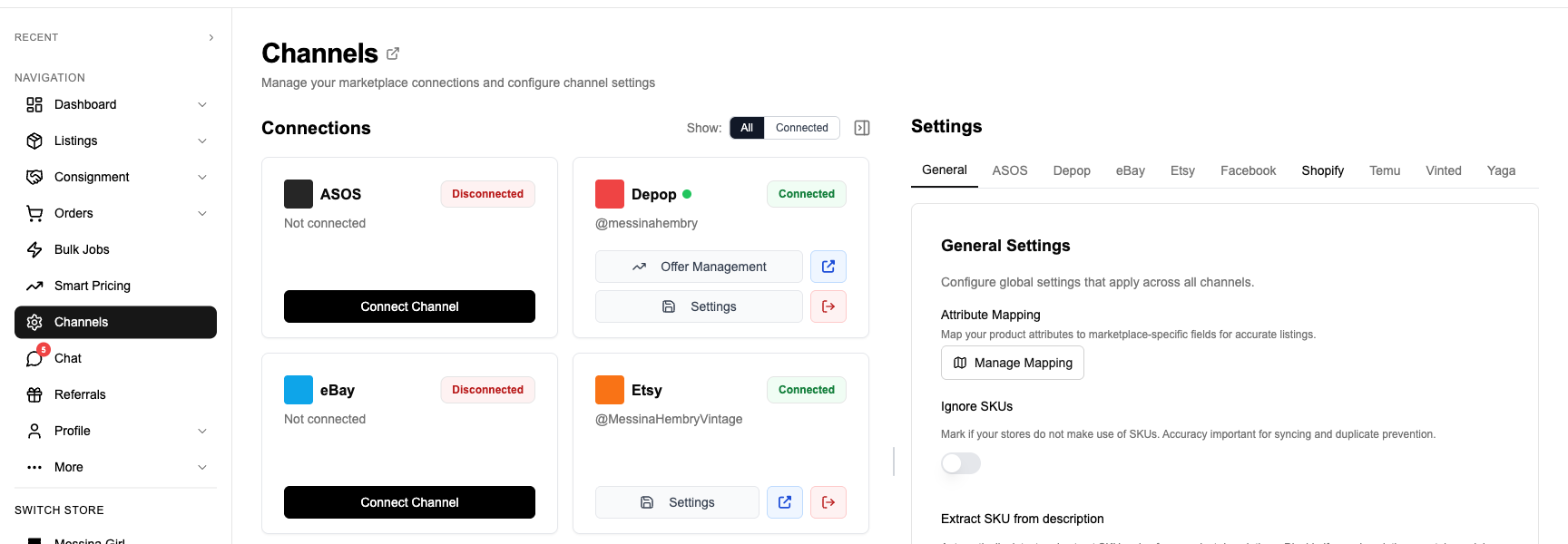
FLUF Connect collapses that. You build the item once and it publishes to both channels, plus any others you have connected — Depop, Vinted, eBay, Shopify, Poshmark — from one catalogue and one set of photos.
| Step | What happens |
|---|---|
| 1. Connect both channels | Both are extension-hosted: you connect them through your own browser with the FLUF Chrome extension, or through the FLUF mobile app. |
| 2. Build the product once | Photos, title, description, condition, price in CAD, location. One record, not two. |
| 3. Choose your channels | Tick Kijiji, tick Facebook Marketplace, tick anything else. Category mapping is handled per channel. |
| 4. Publish | Listings are created on both. Queued items run through your browser or app, so they can sit queued for a few minutes. |
| 5. Mark it sold once | Record the sale in one place and FLUF closes it down on the other channel. |
Both channels being extension-hosted means the work runs through your own browser with the FLUF Chrome extension, or through the FLUF mobile app. That is a statement about how the work is carried out, not about where you have to be.
What FLUF Connect actually automates here
Here it is without softening: on both Kijiji and Facebook Marketplace, FLUF Connect supports bulk listing and mark-as-sold, and nothing else. No relisting. No offer management. No order sync, on either channel.
| FLUF Connect feature | Kijiji | Facebook Marketplace |
|---|---|---|
| Crosslisting from one catalogue | Yes | Yes |
| Bulk operations | Yes | Yes |
| Mark as sold, and delist elsewhere | Yes | Yes |
| Auto-relisting | No | No |
| Offer management | No | No |
| Order sync | No | No |
| Refunds and fulfilment | No | No |
| Execution host | Your own browser with the FLUF Chrome extension, or the FLUF mobile app | Your own browser with the FLUF Chrome extension, or the FLUF mobile app |
That is not a gap in the software; the data does not exist. Neither platform holds a machine-readable record that item X sold for CA$Y on date Z, because the money moved between two people in a car park and nobody told the website. No tool can detect a sale no system observed, and any crosslister claiming Kijiji or Canadian Marketplace order sync is mistaken.
So be clear about what you are buying. The value here is not order automation but the two things that genuinely scale: publishing to both channels from one catalogue instead of typing everything twice, and holding one inventory so marking an item sold once takes it down everywhere. If you also sell on channels that do report their own sales — eBay, Depop, Etsy, Shopify — those sales are detected automatically and pull your Kijiji and Marketplace listings down with them. That is where this arrangement earns its keep.
One Canadian wrinkle: the CRA reporting rules
Canada’s Reporting Rules for Digital Platform Operators took effect on 1 January 2024, with the first returns filed in early 2025. Platforms in scope must report seller identification and activity to the Canada Revenue Agency. For goods, the excluded-seller threshold is fewer than 30 sales and consideration not exceeding CA$2,800 in the period — but the decisive point sits upstream of it. The rules bite on platforms that know the consideration, and a classified-ad site that merely connects two people without processing payment is out of scope. Kijiji processes no payments. Canadian Marketplace processes no payments.
So no slip is arriving from either platform. That is not the same as the income being invisible or untaxable — if you buy to resell, the CRA treats that as business income regardless of who reported it — and it is a reason to keep your own records. It is also, quietly, another argument for one catalogue: a system that knows what you listed, at what price, and when you marked it sold is the closest thing to a sales ledger a Canadian classifieds seller can have.
What it costs
FLUF Connect starts at £9/month on Starter (300 products), then Growth £19 for 1,000, Seller £49 for 2,500, Pro £99 for 5,000 and Super Seller £299 for unlimited. Every new account starts with £1 for 7 days. There is no free plan.
Automation — relisting, offer management, bulk operations — is included in every plan rather than sold as a paid add-on. On this pair only bulk operations apply, since neither channel supports relisting or offers through FLUF; that tooling becomes relevant the moment you add a channel that does, such as eBay, Depop or Vinted. Set against two platforms that take nothing from a Canadian sale, the honest framing is that you are paying for your own time and for not overselling — not for a cheaper transaction.
Sources and verification
Checked against primary sources on 24 August 2026, in Canadian dollars unless stated. Two figures are deliberately absent because they cannot be verified: Kijiji publishes no dollar amounts for posting fees or promotion tiers anywhere, and no Canadian authority breaks out either platform as a fraud category.
- Kijiji — category pricing overview: fee-bearing categories, per-listing 31-day billing, free-listing limits
- Kijiji — cost of promoting ads: promotion tiers; prices vary by city and category
- Kijiji — Top Ad: 3, 7 and 30-day durations, no guaranteed placement
- Kijiji — business accounts and listing fees
- Kijiji — safety: verifying funds, meeting places, no escrow or shipping partners
- Kijiji — media page: 2005, Toronto, 400+ categories, nearly 5 million Canadians monthly
- Interac and Kijiji, 14 April 2026: Interac Verified; 4 million live listings
- Adevinta — Kijiji Canada: ownership; automotive and rental positions
- Adevinta, 25 June 2021: eBay Classifieds Group acquisition completed
- Adevinta: the Permira and Blackstone take-private, settled May 2024
- Meta — Seller Protection Policy: 10% fee, US$0.80 minimum, US$20 chargeback fee, US$500 cap, US-only protection
- Meta — getting paid on Marketplace: fee deduction, up-to-20-day payout
- Meta — shipping on Marketplace: continental United States
- Meta — Purchase Protection: local pickups do not qualify
- Meta — renewing listings: deletion after two years of inactivity
- Meta — searching and sorting Marketplace
- Meta — boosting a listing: placements and radius
- Meta — scams on Marketplace
- Meta — Commerce Policies: prohibited categories, consumer-to-consumer framing
- Meta Newsroom, July 2026: 430 million items monthly; Seller app, US and iOS only
- Meta Newsroom, March 2026: 3.5 million listings a day in the US and Canada; AI tools
- Meta Newsroom, November 2025: young-adult usage; feed personalisation
- Meta Newsroom, October 2016: Marketplace launch
- Canadian Anti-Fraud Centre — merchandise fraud
- Canadian Anti-Fraud Centre: 2025 reports and loss totals
- BBB Canada Risk Report 2024: 32.2% share, 87.4% loss rate
- RCMP Gazette — buy-and-sell crimes
- Ottawa Police — safe trade zones
- CRA — Reporting Rules for Digital Platforms
- EY tax alert: CA$2,800 / 30-sale threshold; platforms not processing consideration are out of scope
- DataReportal — Digital 2026: Canada: Facebook ad reach of ~24.6 million, October 2025
Seller quotations are verbatim from public Reddit threads in r/waterloo, r/kijiji, r/AskACanadian and r/BuyCanadian, March 2024 to July 2026, with original spelling.
Related guides
- How to sell on Kijiji — the complete Canadian guide
- How to sell on Facebook Marketplace
- eBay vs Facebook Marketplace
- Vinted vs Facebook Marketplace
- Crosslist from Depop to Facebook Marketplace
- FLUF Connect vs List Perfectly
- Kijiji vs eBay — free and local against roughly 16% and global, item by item
- Crosslist from Kijiji to Facebook Marketplace — two free Canadian channels, and the 60-day versus two-year clock
Frequently Asked Questions
Neither takes a commission on a Canadian sale, so on the sale itself they are identical: sell a sofa for CA$400 and you keep CA$400 on both. The difference is what you pay before anything sells. Kijiji charges to publish in six category families — Cars & Vehicles, Real Estate, Jobs, Services, Pets, and Business & Industrial plus Vehicle Parts, Tires & Accessories — per listing, per 31-day period, whether or not it sells. Facebook Marketplace charges nothing to publish anything. For ordinary Buy & Sell goods, both cost nothing.
Kijiji does not publish the number. Every relevant help page states that posting fees and promotion prices depend on the feature, the duration, the city and the category, and are shown to you inside the posting flow. A Cars & Vehicles ad in the Greater Toronto Area is not priced the same as the same ad in Moose Jaw. Any article quoting you a flat Canadian figure is quoting one city on one day — start the posting flow for your item, in your city, and read the price before you confirm.
No. The 10% fee, with its US$0.80 minimum per order, applies only to shipped checkout orders, and Meta's own Seller Protection Policy and payout help page tie both to the United States. Canadian Marketplace is local pickup only, so there is no checkout for Meta to charge against. If an article tells you Canadian Marketplace sellers pay 10%, it has copied a US page.
No. Meta's shipping help page describes buying and selling “all over the continental United States”, and viewed from a Canadian connection its shipping and checkout articles are replaced with a notice that selling with delivery is unavailable in your location. Prepaid labels, payouts, Purchase Protection, Seller Protection and Meta's standalone Seller app are all US-only. In Canada, Marketplace means meeting the buyer and taking cash or an Interac e-Transfer.
Not dead, but regionally uneven. Kijiji reports reaching nearly 5 million Canadians a month with over 4 million live listings, and Adevinta claims it is Canada's most visited automotive marketplace and number one in rental real estate. Canadian sellers consistently report that Kijiji still works in Ontario, Ottawa and the Maritimes, and has thinned out badly in British Columbia and much of Quebec. The common complaint is not fees but private ads being buried under business listings.
Neither platform holds the money or offers protection on a Canadian transaction, so the risk profile is similar and the scam catalogue is nearly identical — spoofed payment notifications, overpayment with a wire-back request, e-transfer phishing, fake courier tracking, and verification-code scams. The one real divergence in 2026 is identity: since 14 April 2026 Kijiji users can verify who they are through their own bank using Interac Verified, with a document and liveness check expected later in the year. Facebook Marketplace has no equivalent — its trust signals are profile age, friend count and seller ratings. On both, meet at a police-station safe exchange zone and never test-drive a vehicle alone.
Yes. Neither platform restricts the other, there are no overlapping fees and no interacting listing limits. The practical obstacle is that doing it manually means writing every listing twice and remembering to pull the other down the moment something sells. FLUF Connect publishes to both from one catalogue, and marking an item sold once closes it on the other channel.
No, and no tool can. On both channels FLUF Connect supports bulk listing and mark-as-sold, and nothing else — no relisting, no offer management, no order sync, in either direction. That is not a software gap: neither platform holds a machine-readable record that an item sold for a given price on a given date, because the money moved between two people in person and nobody told the website. The value on this pair is one-pass listing and one inventory that delists everywhere, not order automation.
Neither does. Canada's Reporting Rules for Digital Platform Operators, effective 1 January 2024, apply to platforms that know the consideration paid; a classified-ad site that merely connects two people without processing payment is out of scope, and neither Kijiji nor Canadian Marketplace processes payments. That does not make the income untaxable — if you buy to resell, the CRA treats that as business income regardless of who reported it — so keep your own records.
FLUF Connect starts at £9/month on Starter, covering 300 products, with Growth at £19/month for 1,000, Seller at £49 for 2,500, Pro at £99 for 5,000 and Super Seller at £299 for unlimited. Every new account starts with £1 for 7 days. There is no free plan. Both Kijiji and Facebook Marketplace are extension-hosted, so listings run through your own browser with the FLUF Chrome extension, or through the FLUF mobile app.