
How to Sell on Marktplaats — The Complete Guide for 2026
Everything you need to sell on Marktplaats, the Netherlands' biggest marketplace — fees, listing strategy, shipping, scams to avoid, and how to crosslist to Vinted, eBay and Depop automatically.



Key Takeaways
- What it is: Marktplaats is the dominant online classifieds marketplace in the Netherlands — a general-goods platform for everything from cars and furniture to electronics and fashion, not a fashion-only resale app (Adevinta).
- Scale: over 8 million unique visitors a month, around 18.7 million live advertisements at any moment, and roughly 350,000 new ads added every day — about four new ads per second (Adevinta).
- Fees: placing a standard ad is free for private sellers. There is no per-sale commission on local deals; on shipped, paid orders the buyer pays the Kopersbescherming (buyer-protection) fee — a percentage of the price with a minimum of €0.59 and a maximum of €20 — and the seller pays nothing (Marktplaats).
- Reach is domestic: Marktplaats is overwhelmingly a Netherlands audience. To reach buyers abroad you crosslist to international platforms — which is exactly the gap FLUF Connect fills.
- Best for: bulky local items (furniture, white goods), cars and parts, electronics, baby and kids gear, bikes, and general second-hand goods sold by pickup.
- Cross-list with FLUF Connect: sync Marktplaats with Vinted, eBay, Depop, Shopify and more from one dashboard — get started in minutes.
- Cost to scale: FLUF Connect plans start at £9/month (Starter) and every plan is paid; inventory sync is included in every plan; relisting, offer management and smart pricing come with the plans above Starter.
What Is Marktplaats?
Marktplaats is the largest online marketplace in the Netherlands: a general-goods classifieds platform where private and business sellers list new and used items across hundreds of categories, from cars and furniture to phones, bikes, baby gear and clothing. It is the Dutch equivalent of what eBay’s classifieds or Craigslist are elsewhere — a search-driven noticeboard rather than a curated fashion app — and for two decades it has been the default place a Dutch household goes to sell something second-hand.
The site launched in 1999 and was acquired by eBay in 2004, then sold as part of eBay’s Classifieds Group to Adevinta in 2020–2021. Adevinta itself was taken private in May 2024 by a consortium led by Permira and Blackstone in a buyout valuing the group at roughly €14 billion (Adevinta press release). Marktplaats remains an Adevinta brand and is not part of Prosus or OLX, despite occasional confusion with other classifieds groups.
The scale is the headline. Adevinta reports that Marktplaats draws over 8 million unique visitors each month, carries around 18.7 million live advertisements at any given moment, and gains roughly 350,000 new ads per day — about four new ads every second (Adevinta). In a country of around 18 million people, that reach makes Marktplaats a genuine mass-market channel. Its Belgian sister sites, 2dehands and 2ememain, run under the same Benelux management but are separate brands — Marktplaats itself is a Netherlands platform.
| Metric | Detail |
|---|---|
| Founded | 1999 (acquired by eBay 2004; Adevinta since 2020–2021) |
| Headquarters | Amsterdam, Netherlands |
| Owner (2026) | Adevinta (taken private by Permira & Blackstone, May 2024) |
| Unique visitors | Over 8 million per month |
| Live ads | ~18.7 million at any moment |
| New ads per day | ~350,000 (four per second) |
| Geography | Netherlands (sister sites 2dehands / 2ememain in Belgium) |
| Top categories | Cars & parts, home & furniture, electronics, baby & kids, bikes, fashion |
| Revenue model | Free listings; buyer-paid protection fee, promotion upsells, business CPC ads |
Why Sell on Marktplaats in 2026?
Marktplaats is worth selling on for one overriding reason: it is where Dutch buyers already look. When someone in the Netherlands wants a second-hand sofa, a used phone or a child’s bike, they search Marktplaats first. That concentrated, high-intent domestic demand is hard to replicate anywhere else, and for bulky or local items it is the single best channel in the country.
A genuinely mass-market Dutch audience
With over 8 million monthly unique visitors against a population of around 18 million, Marktplaats reaches a large share of Dutch adults (Adevinta). The audience spans every age group — unlike Depop or Vinted, which skew young and fashion-led, Marktplaats buyers are all ages and shop across every category.
No listing fee and no seller commission on local deals
For a private seller, placing a standard ad costs nothing, and a normal local pickup sale carries no platform commission. You set a price (or invite offers), a local buyer collects, and you keep the full amount. That zero-fee floor is a real advantage over commission-based marketplaces.
Strong for the items other platforms can’t handle
Furniture, white goods, garden equipment, car parts and bicycles are awkward to ship and rarely move on fashion apps. On Marktplaats they sell fast to local buyers who collect in person. Cars are a flagship vertical, and home and furniture remain among the most actively traded categories (Adevinta).
Where it falls short — and why crosslisting matters
Marktplaats’s biggest limitation is the flip side of its strength: it is almost entirely domestic. A vintage jacket priced for a Dutch local audience reaches none of the European fashion buyers on Vinted or the international collectors on eBay. The smart play in 2026 is to keep using Marktplaats for what it does best — fast local sales — while crosslisting your shippable inventory to platforms with a wider or different buyer base. The fee comparison below shows why no single platform wins on every axis.
| Marktplaats | Vinted | eBay | |
|---|---|---|---|
| Listing fee | Free (private) | Free | Free allocation, then per-listing |
| Seller commission | None on local sales | None (buyer pays protection) | ~13% final value fee + per-order fee |
| Who pays protection | Buyer (€0.59–€20) | Buyer | Built into FVF |
| Audience | Netherlands, all categories | EU-wide, fashion | Global, all categories |
| Best for | Bulky / local goods | Pre-owned clothing | Collectibles, electronics, cross-border |
eBay’s standard final value fee is roughly 13% plus a small per-order fee and varies by category and eBay site (eBay selling fees); Vinted charges sellers nothing and funds the platform through a buyer-paid protection fee (Vinted Buyer Protection).
The competitive picture in the Netherlands
Marktplaats is no longer the only game in town. Vinted has grown rapidly in the Netherlands for second-hand clothing, pulling fashion sellers towards a fee-free, shipping-first model, while Facebook Marketplace has captured a slice of the local buy-and-sell audience through its social graph and Messenger. Yet for general goods, cars and bulky local items, Marktplaats remains the default destination Dutch buyers reach for — its ~73% share of the domestic reuse market is built on two decades of habit and the deepest local inventory in the country. The practical conclusion is not “Marktplaats or Vinted” but “Marktplaats and the platform that best fits each item”, which is exactly the multi-channel approach this guide builds toward.
When Should You Use Marktplaats vs Another Platform?
The fastest way to decide where an item belongs is to match it to the audience and the shipping reality. Marktplaats wins on local, bulky and general goods; fashion and international demand are better served elsewhere. The table below is the decision shortcut most experienced Dutch resellers use.
| What you’re selling | Best primary platform | Why |
|---|---|---|
| Furniture, white goods, garden, bikes | Marktplaats (+ Facebook Marketplace) | Local pickup, no shipping risk, no commission |
| Pre-owned clothing & shoes | Vinted (+ Marktplaats) | EU-wide fashion buyers, no seller fee, built-in shipping |
| Streetwear & younger fashion | Depop (+ Vinted) | Gen-Z, international, curated feed |
| Collectibles, electronics, parts | eBay (+ Marktplaats) | Cross-border demand and price discovery |
| Cars & motoring | Marktplaats | Flagship vertical; unmatched domestic demand |
Notice how often the answer is “both”. A designer coat photographed well sells for more to Vinted’s fashion buyers, but a local Marktplaats listing can move it the same day to someone nearby. Listing in both places doubles your shots on goal — the only catch is keeping the two listings in sync so the item comes down everywhere the moment it sells. That synchronisation is the job automation does, and it’s covered in the crosslisting section below.
How Much Does It Cost to Sell on Marktplaats? — Fees Explained
For a private seller, selling on Marktplaats is close to free: a standard listing costs nothing, and a local pickup sale carries no commission. Costs only appear when you choose to promote a listing or when a buyer opts into a paid, shipped transaction — and even then, the headline protection fee is paid by the buyer, not you.
Listing fees
Placing a standard advertisement in a free category costs €0 for private sellers. There is no charge to list an item, edit it, or keep it live until it sells. A small number of professional categories (such as cars, jobs and real estate) carry per-listing tariffs, and high-volume business sellers use paid plans, but the everyday private-seller experience is free to list (Marktplaats ad tariffs).
Seller commission
On a normal local sale arranged through Marktplaats — the buyer collects and pays in person — Marktplaats takes no commission from the seller. This is the core reason the platform stays popular for high-value items like furniture and electronics, where a percentage fee would sting.
Buyer protection (Kopersbescherming)
When a deal goes through Marktplaats’s paid, shipped flow, the platform applies Kopersbescherming — a buyer-protection scheme that holds the buyer’s money in escrow (via Online Payment Platform) until the item is confirmed received. Crucially, the protection fee is paid by the buyer, not the seller: it is a percentage of the asking price with a minimum of €0.59 and a maximum of €20 (Marktplaats Kopersbescherming). Since June 2025, buyer protection is applied by default on items shipped via Marktplaats’s own carriers (Emerce).
Pay-on-pickup (gelijk oversteken)
For in-person deals, Marktplaats offers “gelijk oversteken” — the buyer pays by iDEAL at the moment of handover, so neither side has to trust the other first. The buyer pays a service cost of 2% of the purchase amount plus a €0.40 iDEAL transaction fee on this flow. Again the cost falls on the buyer, not the seller.
Promotion and visibility upsells
Because Marktplaats is search-driven, your ad sinks down the results as newer listings appear. Optional paid features push it back up. Marktplaats’s published feature pricing lists Omhoogplaatsen (bump to the top of results) at €0.98, Dagtopper (24-hour top placement) at €1.41, the Blikvanger homepage feature at €3.61, and a clickable website-link feature at €9.00 (Marktplaats feature pricing). Longer Topadvertentie placements exist at higher monthly prices; check the live listing flow for current amounts, as these vary by category and region.
Business sellers (Marktplaats Pro / Admarkt)
Professional sellers advertise through Marktplaats Pro using Admarkt, a cost-per-click model. There is no monthly subscription and no startup cost; you set a budget (minimum €50 to begin) and a bid (from €0.01 per click), and pay only when someone clicks your ad (Marktplaats Zakelijk). Because the bid influences your ad’s position, dealers in competitive categories like cars or electronics treat Admarkt as a controllable cost of acquisition rather than a flat fee.
Hidden costs sellers often miss
The fees themselves are transparent, but two indirect costs catch sellers out. The first is promotion creep: it is easy to keep paying €0.98 to bump a listing day after day, and on a slow-moving item those euros add up to more than a single Dagtopper or a price cut would have cost. The second is the time cost of manual selling — every Marktplaats deal involves answering “laatste prijs?” messages, arranging a pickup window, and dealing with no-shows. None of that shows up as a fee, but for anyone selling more than a handful of items it is the real expense, and it is the cost crosslisting automation is designed to cut.
How to minimise what you pay
For private sellers the recipe is simple: write a strong, keyword-rich listing so it sells on organic search without paid bumps; price it correctly from the start rather than promoting an overpriced ad; and reserve paid placement for genuinely time-sensitive or high-value items. When you do promote, a single well-timed Dagtopper (€1.41) on a Sunday will usually do more than a week of daily Omhoogplaatsen. And because the buyer carries the protection fee, you almost never need to discount to “absorb” platform costs — your headline price is very close to what you actually keep.
Example: what you keep on a €100 local sale
- Listing fee: €0.00
- Seller commission: €0.00 (local pickup)
- Optional bump (Omhoogplaatsen): €0.98 — only if you choose to promote
- You keep: €100.00 (or €99.02 if you paid for one bump)
- Buyer-protection fee, if the buyer ships and pays online: paid by the buyer, capped at €20 — not deducted from you
The takeaway: for a private seller doing local deals, Marktplaats is one of the cheapest ways to sell in the Netherlands. The trade-off is reach — your buyers are local, and you handle each sale manually. That is precisely where crosslisting and automation earn their keep.
How to Set Up Your Marktplaats Seller Account
You can be listing on Marktplaats within a few minutes. Setup is deliberately light for private sellers, and verification only escalates when you start shipping paid orders or selling as a business.
- Create an account with an email address (or sign in with an existing account). A phone number improves trust and is needed for some features.
- Choose private or business. Private accounts are free and instant; business accounts (Marktplaats Pro) unlock Admarkt advertising, bulk tools and a shopfront.
- Link a payout method. To receive money from shipped, protected sales you connect a bank account through the Online Payment Platform escrow partner.
- Set your location. Because so many deals are local pickups, an accurate town/postcode helps the right buyers find you.
- Optimise your profile. A clear seller name, a profile photo and a short bio raise buyer confidence, especially for higher-value items.
| Private account | Business account (Pro) | |
|---|---|---|
| Monthly fee | None | Plan / CPC budget based |
| Standard listings | Free | Included, plus Admarkt |
| Advertising | Pay-per-feature | CPC Admarkt campaigns |
| Shopfront & analytics | Limited | Yes |
| Best for | Occasional / personal sellers | Dealers, shops, high volume |
How to Create Marktplaats Listings That Actually Sell
Marktplaats has no recommendation feed — buyers find items by searching and browsing categories. That makes your title, category and photos the entire battle. A listing that uses the words buyers type, in the right category, with clear photos, will outsell a vague one every time.
Title optimisation
Titles are limited to around 60 characters, so use them deliberately. Lead with the brand and product, add colour and key specifics, and — because discovery is pure search — include the synonyms buyers actually type. A Dutch buyer might search “fauteuil” or “stoel” for the same armchair, so working both natural terms into the title and description widens your reach (experienced-seller guidance).
Compare:
❌ “Stoel te koop”
✅ “Vintage teak fauteuil / eetkamerstoel — bruin, jaren 60, z.g.a.n.”
Description writing
State the essentials buyers ask anyway: brand, dimensions, age, condition, why you’re selling, and whether you offer pickup, shipping or both. Honesty about flaws reduces no-shows and post-sale disputes — both common Marktplaats frustrations. Repeat important search terms naturally so the listing surfaces for more queries.
Pricing strategy
Research comparable live listings before pricing. For used goods, pricing just under similar items sells fastest. Many sellers set a fixed anchor and leave room for offers (“bieden”), letting interested buyers compete — for example, listing at €150 while privately willing to accept €120. Decide your floor before you list so you can answer the inevitable “wat is je laatste prijs?” (“what’s your lowest price?”) without dithering.
Category selection
Choosing the most specific correct category matters because so much traffic comes from category browsing, not just search. The right category also surfaces the right attribute fields (size, condition, brand) that buyers filter on.
Condition and item attributes
Marktplaats lets you flag condition (new, as-good-as-new, used) and fill category-specific attributes — frame size for a bike, storage capacity for a phone, age suitability for baby gear. These aren’t busywork: buyers filter and sort on them, so a phone listed with its exact model and storage appears in far more refined searches than a vague “iPhone te koop”. Be accurate about condition; over-grading is the fastest route to a disputed handover or a buyer-protection claim on a shipped order. When you crosslist with FLUF Connect, these attributes are mapped automatically into Marktplaats’s own category tree, so you fill them once and they translate to the destination’s required fields.
Negotiation: handling “bieden” and lowballs
Marktplaats deals are negotiable by design, and bids are not binding, so expect offers — including unrealistic ones. The seasoned approach is to enable “bieden” on items where you want competition, ignore openers that lead with “what’s your lowest price?” before showing real interest, and hold firm on a floor you set in advance. A polite “the price is fair for the condition, but I’m open to a reasonable offer” filters tyre-kickers without killing genuine interest.
Photography Tips for Marktplaats Sellers
Photos do most of the selling on Marktplaats. The platform lets you add multiple images, and listings with several clear shots consistently outperform single-photo ads.
- Use at least three photos: a clear full shot, a close-up of detail or brand, and the item shown in context (furniture photographed in a room reads as honest and helps buyers judge scale).
- Shoot in natural light against an uncluttered background. Daylight near a window beats harsh overhead lighting.
- Show every angle and any flaws. A photo of the scratch or worn corner builds trust and pre-empts complaints at handover.
- Use your own in-hand photos, never stock images — buyers (and crosslisting destinations) treat reused photos as a red flag.
Shipping, Pickup and Returns on Marktplaats
Marktplaats grew up as a local-pickup platform, but it now has a full shipping flow for sellers who want to reach buyers beyond their own town.
Local pickup
The classic Marktplaats deal: the buyer collects, inspects in person, and pays — increasingly via “gelijk oversteken” (pay-on-pickup by iDEAL) so neither party has to trust the other first. Pickup remains the fastest route for bulky goods.
Shipping via Marktplaats
For shipped sales, Marktplaats integrates carriers directly: PostNL and DHL for parcels, and Brenger for large items delivered to the door (home delivery from around €42). The buyer pays the shipping cost at checkout, so the seller no longer has to front it (Marktplaats shipping). Funds are held in escrow by Online Payment Platform and released to the seller once the buyer confirms receipt — or automatically 48 hours after delivery if the buyer does nothing (Marktplaats seller protection).
| Option | Who pays | Protection | Best for |
|---|---|---|---|
| Local pickup (gelijk oversteken) | Buyer pays 2% + €0.40 iDEAL | Pay-at-handover | Furniture, large or local items |
| PostNL / DHL parcel | Buyer pays shipping | Kopersbescherming escrow | Clothing, electronics, small goods |
| Brenger (large items) | Buyer pays (~€42+) | Kopersbescherming escrow | Sofas, wardrobes, bulky furniture |
Returns
For private local sales, there is no statutory return right — “seen, bought” applies once a buyer inspects and collects. For business sellers shipping to consumers, EU distance-selling rules (the 14-day right of withdrawal) apply. Buyer protection covers items that never arrive or arrive significantly not-as-described.
How Marktplaats Search and Visibility Work
Unlike Vinted or Depop, Marktplaats has no algorithmic “for you” feed that resurfaces your items. Visibility is driven almost entirely by search relevance and recency, which changes how you keep listings seen.
| Factor | Impact | What you can control |
|---|---|---|
| Recency | High | Renew or bump (Omhoogplaatsen) to return to the top |
| Title keywords | High | Include brand, type and search synonyms |
| Correct category | High | Pick the most specific category and fill attributes |
| Photo quality | Medium | Use multiple clear images |
| Paid placement | High (temporary) | Dagtopper / Topadvertentie / Admarkt |
| Price competitiveness | Medium | Check comparable live listings |
Because there is no engagement-based boost, the practical visibility lever is freshness: a free “verlengen” (renew) keeps an ad alive but buries it, while a paid Omhoogplaatsen at €0.98 pushes it back to the top of results (Marktplaats feature pricing). On platforms that do reward freshness algorithmically — like Vinted and eBay — automatic relisting tools handle this for you, which is one reason multi-channel sellers lean on automation.
The timing of that freshness matters as much as the frequency. Because buyers are most active on Sunday afternoons and on weekday evenings after dinner, a bump or a fresh listing placed just before those windows captures the most eyes. Cold and rainy days reliably push more people indoors and onto the site, so a quiet listing on a grey Sunday is a good candidate for a single Dagtopper rather than a wasted weekday one. There is no benefit to renewing into a dead window, and over-renewing trains nobody — spend your attention, and any promotion budget, where the buyers actually are.
Getting Paid and Tax Obligations on Marktplaats
For local pickup deals you are paid directly — cash, or instantly by iDEAL through gelijk oversteken. For shipped, protected sales the money sits in Online Payment Platform escrow and is paid out to your linked bank account once the buyer confirms receipt or 48 hours after delivery (Marktplaats).
Tax obligations by country
Most Dutch people selling off their own used possessions are not running a business and owe no tax on the proceeds. But two thresholds matter:
- Netherlands & EU (DAC7): under the EU’s DAC7 rules, marketplaces report sellers who exceed 30 sales or €2,000 in a calendar year to the tax authority (Belastingdienst). Being reported is not the same as owing tax, but if you are effectively trading for profit, the income is taxable (Belastingdienst — DAC7).
- United Kingdom: a £1,000 trading allowance applies; above it you must declare income via Self Assessment (HMRC).
- United States: the IRS 1099-K reporting threshold has been phased down in recent years; check the current year’s threshold before assuming you’re under it.
- Australia: hobby sales of personal items are generally not taxed, but regular trading for profit is assessable income.
This is general guidance, not tax advice. Consult a qualified accountant for your specific situation.
What Sells Best on Marktplaats in 2026?
Marktplaats moves general goods, and the fastest-selling categories play to its local, all-ages, pickup-friendly nature.
| Category | Why it works | Tip |
|---|---|---|
| Cars & auto parts | Flagship vertical; huge buyer demand | Detailed specs and honest mileage sell fastest |
| Home & furniture | Bulky, local pickup, strong demand | Photograph in the room; state dimensions |
| Electronics | Phones, laptops, consoles move quickly | Include model number and condition |
| Baby & kids gear | Strollers, cots, baby baths in constant demand | Confirm safety/age suitability |
| Bikes | Core Dutch category, year-round | Frame size and brand in the title |
| Branded fashion | Designer bags, sneakers, coats | Also crosslist to Vinted / Depop for wider reach |
Seasonality matters: list garden furniture in spring, fans in a heatwave, ice skates when it freezes, and toys before the holidays. Items sold “in season” move far faster than off-season listings — a paddling pool listed in October will sit, while the same pool in June sells in a day.
If you’re sourcing to resell rather than clearing your own cupboards, Marktplaats’s own completed and live listings are your best research tool: search the item, see what comparable examples are asking, and price just under the median to move quickly. Branded clothing, designer bags and sneakers, current-generation phones and games consoles, and baby gear (strollers, cots, baby baths) are the reliable fast movers. Anything genuinely scarce or collectible is usually better served by eBay’s cross-border audience, where a niche buyer somewhere in the world will pay more than the local Dutch market — another reason to crosslist rather than commit an item to a single channel.
Avoiding the Common Marktplaats Seller Scams
Because Marktplaats is so widely used, it attracts fraud aimed specifically at sellers. Nearly all of it starts the same way — a “buyer” tries to move you off-platform — so the single best defence is to keep all chat and payment inside Marktplaats.
- Fake Tikkie / verification-code phishing. A buyer asks you to “verify” yourself or confirm a payment by clicking a link and entering a code, or by paying a tiny “verification” amount via a fake Tikkie. The link mimics your bank or Tikkie and hands over your access. A genuine buyer never needs you to pay or enter a code to receive money, and Tikkie only ever uses the domain
tikkie.me(Veilig Internetten). - The “I’ll send a courier” scam. The buyer insists on their own courier and sends a phishing link resembling a transport service, then a fake courier asks you to scan your ID or bank card with your phone — which actually authorises a banking app on theirs. Never scan your ID or card for a buyer (Brenger fraud guide).
- Fake payment-confirmation pages. A scammer sends a screenshot or a link to a professional-looking “escrow” or payment page claiming the money is waiting, and pressures you to ship first. Only trust money you can see settled in your own bank or Marktplaats wallet.
- The WhatsApp redirect. “Let’s continue on WhatsApp” is the opening move in almost every seller scam, because off-platform there is no protection or traceability. Treat it as a red flag, especially when paired with a payment link.
Pro Tips from Experienced Marktplaats Sellers
- Post when buyers are browsing. Sellers report Sundays and weekday evenings draw the most active buyers; refreshing a listing just before the weekend catches people with time to browse.
- Answer fast. Interest cools quickly — a same-hour reply often wins the sale over a cheaper but slower competitor.
- Set your floor before you list, so the “lowest price?” messages don’t drag you below what you’ll accept.
- Use bumps strategically, not constantly — one well-timed Omhoogplaatsen on a quiet listing beats daily renewing into the void.
- Bundle related items (a full baby package, a set of garden chairs) to raise the order value and reduce the number of handovers.
- Sell on more than one platform. A sofa moves fastest locally on Marktplaats; a designer coat fetches more on Vinted or Depop. Listing across channels maximises both speed and price — and tools like FLUF Connect keep the listings in sync so you don’t double-sell.
Common Mistakes New Marktplaats Sellers Make
- One blurry photo. Listings with several clear, well-lit images sell far faster — use multiple angles and show any flaws.
- Vague titles. “Stoel te koop” reaches almost no one. Pack the title with brand, type and the synonyms buyers actually search.
- Wrong or too-broad category. The right specific category surfaces your item to filtered, ready-to-buy browsers.
- Moving the deal to WhatsApp. Off-platform you lose protection and invite scams — keep chat and payment on Marktplaats.
- Pricing without research. Check comparable live listings; overpricing leaves an ad to rot, and there is no algorithm to rescue it.
- Selling only locally. Limiting a shippable item to a Dutch pickup audience leaves money on the table — crosslisting to Vinted, eBay or Depop reaches buyers Marktplaats never will.
Cross-List Your Marktplaats Products to Sell Faster with FLUF Connect
Selling on one platform caps your reach. Marktplaats is unbeatable for fast local sales in the Netherlands, but a shippable item — clothing, sneakers, collectibles, electronics — can reach far more buyers if it’s also live on the platforms those buyers use. The challenge is doing that without manually re-uploading every item or accidentally selling the same thing twice. That is what FLUF Connect is built for.
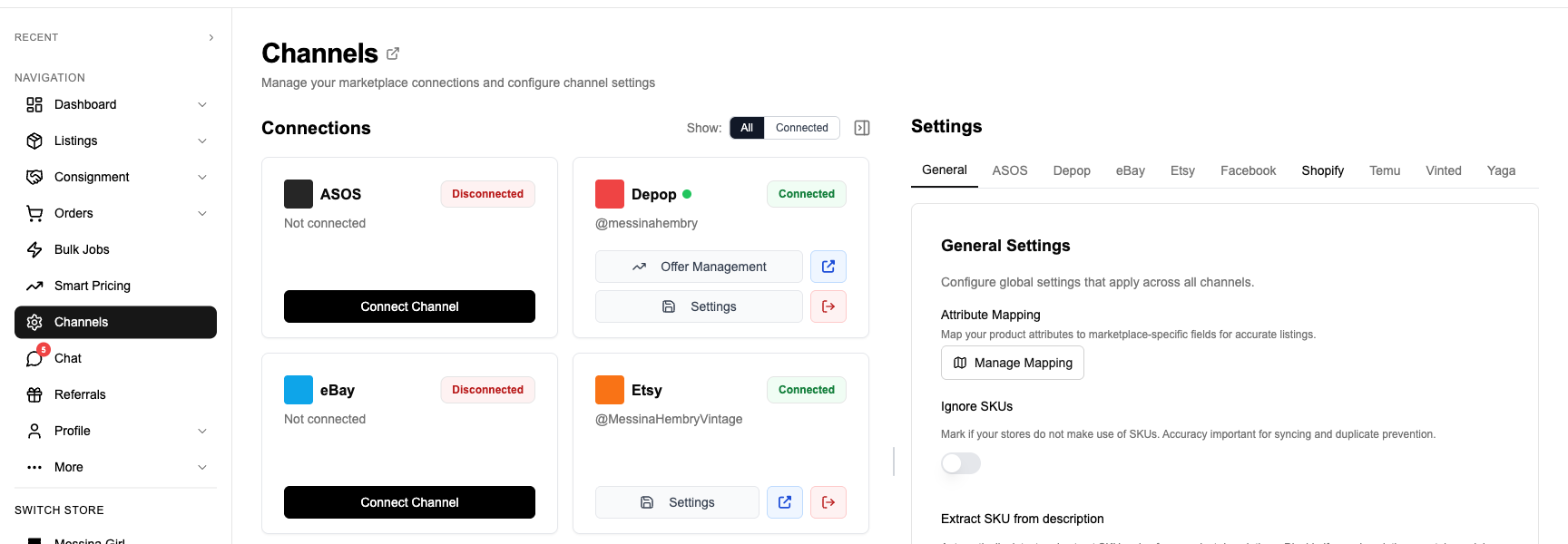
FLUF Connect lists your products to Marktplaats and 16 other marketplaces from one dashboard, and keeps inventory in sync so a sale on one channel updates the others. Which platforms pair best with Marktplaats depends on what you sell:
- Fashion and vintage → Vinted reaches an EU-wide pool of clothing buyers with no seller fee, and Depop adds a younger, international fashion audience.
- Collectibles, electronics and parts → eBay opens cross-border demand that a domestic platform can’t reach.
- Everyday local goods → Facebook Marketplace adds social, Messenger-driven local reach alongside Marktplaats.
Connecting takes minutes: install FLUF Connect, link your Marktplaats account, choose your channels, and crosslist. FLUF handles the heavy lifting — including dynamic category and attribute matching into Marktplaats’s own category tree, which went live for the channel in June 2026.
| Feature | Marktplaats support in FLUF Connect |
|---|---|
| Crosslisting (create, update, delete) | Yes — live |
| Inventory / mark-as-sold sync | Yes |
| Order sync | Yes |
| Auto-relisting | Yes — supported on Marktplaats (also live on Depop, eBay, Vinted) |
| Offer management | Not yet for Marktplaats |
| Bulk operations | Yes |
FLUF Connect plans start at £9/month (Starter) and every plan is paid; inventory sync, bulk operations and crosslisting are included in every plan, not a paid add-on. See full pricing or compare against tools like Vendoo and List Perfectly.
Related Guides
- Crosslist from Marktplaats to Amazon.nl: fees, KvK and sales sync
- Crosslist from Marktplaats to Depop — Automatically
- Marktplaats vs Vinted: Which Is Better for Selling in NL?
- eBay vs Marktplaats: Fees, Shipping and Payouts for Dutch Sellers
- Auto-Relisting on 10 Marketplaces
- Sell on 2dehands
Sources & Verification
Last verified: 2026-06-28. Please contact us if any figure is out of date.
- Adevinta — Marktplaats brand page — Marktplaats ownership (Adevinta), monthly visitor numbers and live-ad volume
- Adevinta — Permira & Blackstone voluntary offer — the 2024 take-private of Adevinta (Marktplaats’s parent) by Permira and Blackstone
- Marktplaats — Kopersbescherming — the buyer-protection fee scale (€0.59–€20) charged to buyers
- Marktplaats — buyer protection for sellers — seller payout flow and the held-funds release window after delivery
- Marktplaats — Verzenden (shipping) — supported carriers (PostNL, DHL) and Brenger for large/bulky items
- Marktplaats API — advertisement features — paid promotion / feature pricing applied to individual listings
- Marktplaats Zakelijk — advertising with Pro — business “Pro” plans and the Admarkt cost-per-click advertising model
- Emerce — Marktplaats past voorwaarden kopersbescherming — the June 2025 change to Marktplaats’s buyer-protection terms
- Belastingdienst — DAC7 information for sellers — Dutch tax authority guidance on DAC7 platform reporting of seller income (30 sales / €2,000 thresholds)
- Veilig Internetten — Tikkie / payment-request fraud — how the “Tikkie” / fake payment-request scam common on classifieds works
- Brenger — recognising Marktplaats / WhatsApp fraud — how to spot shipping and off-platform payment scams targeting sellers
- Marktplaats — Advertentietarieven (listing rates) — free standard listings and the paid listing-tariff / upgrade options
- eBay — selling fees — comparison reference for eBay’s seller fees
- Vinted — Buyer Protection fee — comparison reference for Vinted’s buyer-protection fee
- GOV.UK — income from online platforms — UK HMRC guidance and the £1,000 trading allowance, for UK-based sellers
FLUF data This week on Marktplaats via FLUF: 1,335 active listings (+32%).
Subscribe to the seller news brief
The marketplace news that changes how you list, in one short email.
- Fee, policy and algorithm changes across 70+ marketplaces
- Only the topics you pick — the marketplaces you actually sell on
- Short enough to read in a minute. Daily or weekly, unsubscribe in one click
No spam. We never share your address.
Pick your topics first ›Frequently Asked Questions
Placing a standard advertisement is free for private sellers, and a normal local pickup sale carries no seller commission — you keep the full sale price. Costs are optional: you only pay if you choose to promote a listing (for example Omhoogplaatsen at €0.98 to bump it to the top). On shipped, protected orders the buyer-protection fee is paid by the buyer, not the seller.
For private sellers there is no listing fee and no commission on local sales. Optional promotion features include Omhoogplaatsen at €0.98, Dagtopper at €1.41 and the Blikvanger homepage feature at €3.61. The Kopersbescherming buyer-protection fee on shipped orders is paid by the buyer (a percentage of the price, minimum €0.59, maximum €20). Business sellers use the Pro/Admarkt cost-per-click model with no monthly subscription.
The buyer pays it, not the seller. It is a percentage of the asking price with a minimum of €0.59 and a maximum of €20, and the buyer's money is held in escrow by Online Payment Platform until they confirm the item arrived as described. The seller receives the full agreed price once funds are released — on confirmation, or automatically 48 hours after delivery.
Marktplaats is a general-goods marketplace, so its strongest categories are cars and auto parts, home and furniture, electronics (phones, laptops, consoles), baby and kids gear, and bikes. Bulky items that are awkward to ship sell fastest because so many deals are local pickups. Branded fashion sells too, though clothing often reaches more buyers when also listed on Vinted or Depop.
Marktplaats is search-driven with no algorithmic feed, so visibility comes from relevance and recency. Use a keyword-rich 60-character title with the synonyms buyers actually search, pick the most specific category, add several clear photos, and price competitively against comparable live listings. To return to the top of results, renew the ad or pay for Omhoogplaatsen or a Dagtopper placement.
It is safe if you keep all communication and payment inside Marktplaats. Most seller scams begin with a buyer asking to move to WhatsApp, then sending a phishing link or fake Tikkie, or claiming a courier needs your bank details or ID scan. A genuine buyer never needs you to pay, enter a code, or scan your ID to receive money — only trust funds you can see settled in your own bank or Marktplaats wallet.
Selling off your own used possessions is generally not taxable. However, under the EU's DAC7 rules, platforms report sellers who exceed 30 sales or €2,000 in a year to the Belastingdienst, and income from trading for profit is taxable. UK sellers have a £1,000 trading allowance before declaring via Self Assessment. This is general guidance, not tax advice — consult a qualified accountant for your situation.
Yes, and for shippable items it is the smartest way to sell. Marktplaats is unbeatable for fast local sales in the Netherlands, but clothing, electronics and collectibles reach far more buyers on platforms like Vinted, eBay and Depop. FLUF Connect crosslists your Marktplaats inventory to 16 other marketplaces from one dashboard and keeps stock in sync so you don't accidentally sell the same item twice. Plans start at £9/month (Starter) and every plan is paid.
Crosslisting to Marktplaats — creating, updating and deleting listings — is live through FLUF Connect, along with order sync and mark-as-sold inventory sync. Automatic relisting and offer management are not yet available for Marktplaats specifically, though they are live on channels like Depop, eBay and Vinted. Bulk operations are supported across all connected channels.
Sign up for free
Join the community
You're in.
Open your dashboard