
Crosslist from Marktplaats to WooCommerce — FLUF’s WordPress Plugin for Multi-Marketplace Selling
Turn your Marktplaats ads into products in your own WooCommerce store — automatically. Photos, prices and descriptions transfer, and stock stays in sync so you never oversell.



- Marktplaats: the Netherlands’ dominant classifieds marketplace — around 48 million monthly visits and roughly 73% of the Dutch second-hand market.
- WooCommerce: the free, open-source e-commerce plugin for WordPress, the software behind about 41.9% of all websites. Your own store, your own brand, no marketplace commission.
- Fields that transfer automatically: title, description, photos, price, category and stock — mapped from your Marktplaats ad into a structured WooCommerce product.
- Inventory sync: when an item sells on Marktplaats, FLUF Connect lowers the stock on your WooCommerce product within minutes, so you never sell the same unit twice.
- Why bother: Marktplaats reaches Dutch buyers; a WooCommerce store reaches everyone else — on a domain you own, with no platform fee or revenue share.
- Cost: from £9/month (Starter). Every plan is a paid plan; crosslisting, inventory sync and bulk tools are included in every plan.
Why Move Marktplaats Listings into a WooCommerce Store?
Crosslisting from Marktplaats to WooCommerce lets you keep selling to Dutch buyers on the country’s biggest marketplace while building a storefront you actually own — one that reaches buyers Marktplaats can’t, on your own domain, with no marketplace cut taken from every sale. FLUF Connect reads each Marktplaats ad and rebuilds it as a proper WooCommerce product, then keeps stock in sync so the two never oversell.
The two channels solve different problems. Marktplaats is built for fast, local, second-hand selling: it draws roughly 48 million visits a month and is the second most-visited retail site in the Netherlands after bol.com (Similarweb), holding an estimated 73% of the Dutch reuse market. But it is a rented audience — Marktplaats owns the customer relationship, its integrated shipping is domestic-only (DHL eCommerce NL), and you compete in a crowded feed.
A WooCommerce store flips that. WooCommerce is the e-commerce plugin for WordPress, the content-management system that powers about 41.9% of every website on the internet (W3Techs, June 2026). It is free and open-source, with no platform fee and a 0% revenue share (WooCommerce.com) — you keep your customer data, your email list, your SEO and your brand. Run both, and the Marktplaats feed becomes a discovery channel that funnels Dutch buyers toward a store you control.
| Marktplaats | WooCommerce | |
|---|---|---|
| Monthly reach | ~48M visits/month (NL) | ~4.5M live stores worldwide; you bring your own traffic |
| Primary market | Netherlands (Belgium via 2dehands/2ememain) | Global — wherever you ship |
| Strongest for | Cars, electronics, furniture, general second-hand | Your own brand, repeat customers, any category |
| Seller fees | Free basic ads; paid bumps; 5% buyer-paid protection | No platform fee; you pay hosting + payment processing |
| Listing format | Classified ad, bidding or “Direct kopen” buy-now | Structured product page with checkout |
| Owns the customer | Marktplaats does | You do |
How to Crosslist from Marktplaats to WooCommerce with FLUF Connect
FLUF Connect is the connector that sits between your marketplaces. Setting up the Marktplaats → WooCommerce flow takes a few minutes:
- Sign up for FLUF Connect and open the dashboard.
- Connect Marktplaats. Use the browser extension once; no open tab is needed afterwards.
- Connect WooCommerce. Install the FLUF Connect plugin for WooCommerce from your WordPress admin (Plugins → Add New), then paste the connection key. No code, no developer.
- Import your Marktplaats listings. FLUF pulls in your live ads — title, description, photos and price — in bulk.
- Review the mapping. Check how each Marktplaats category lands in your WooCommerce category tree and fill in anything a structured product needs (SKU, stock count).
- Select and crosslist. Tick the products you want and click crosslist. FLUF creates each one as a native WooCommerce product, uploads the images and publishes it.
- Done. Your items are live in your own store within minutes, and inventory stays linked to Marktplaats.
FLUF publishes your Marktplaats products and photos to WooCommerce. Set auto-crosslisting rules by category, price or keyword, or select a batch of ads to publish together.
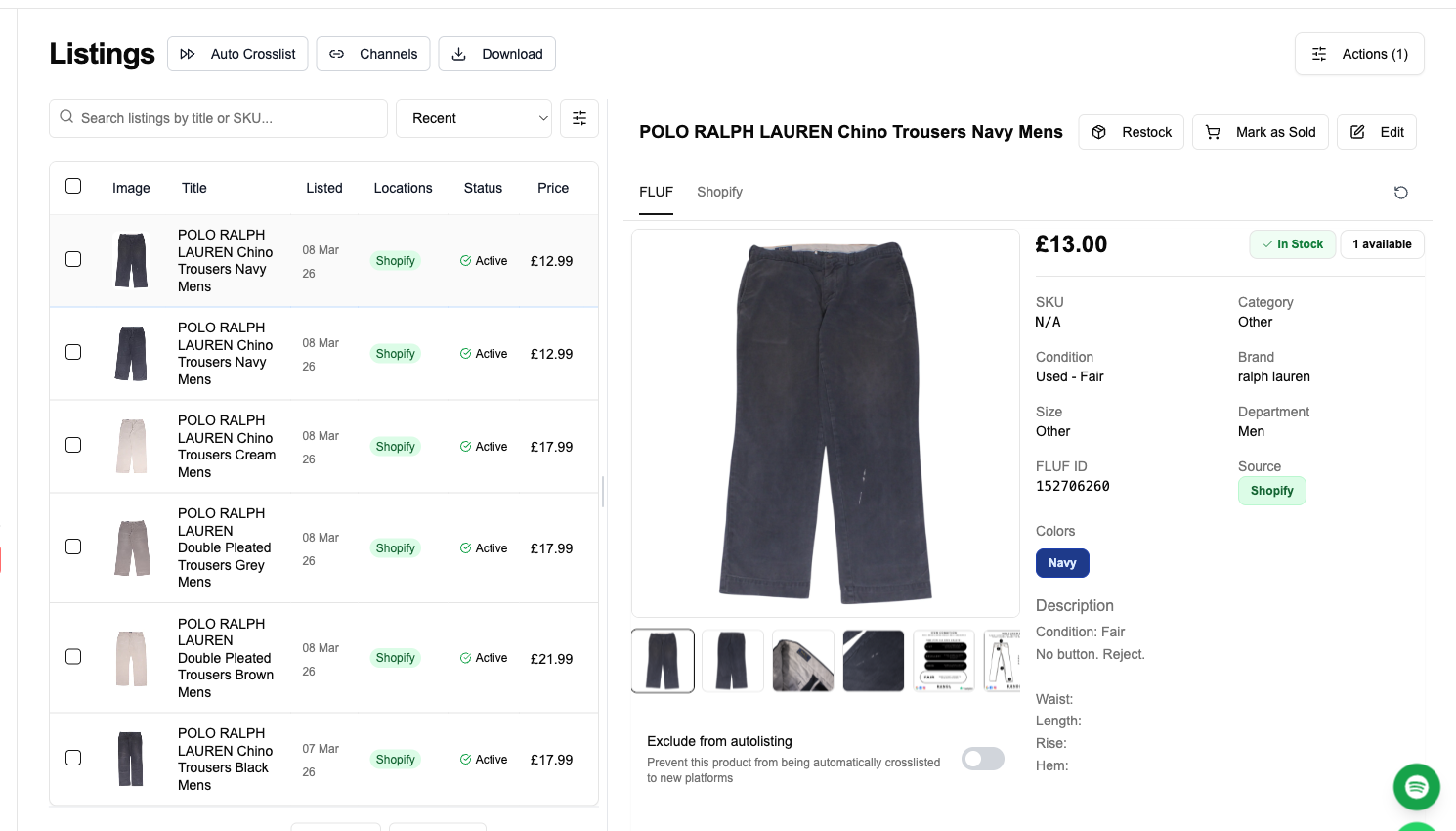
What Transfers When You Crosslist from Marktplaats to WooCommerce?
No other tool maps these two platforms field by field. The key shift is that a Marktplaats ad is a loose, free-text classified, while a WooCommerce product is structured data — name, price, stock, categories, attributes — that powers your store’s search, filtering and checkout. FLUF Connect does that conversion for you, turning each ad into a clean product record rather than a flat copy. Here is exactly what moves and what needs your attention.
Field Mapping — Marktplaats to WooCommerce
| Marktplaats field | WooCommerce field | Transfer status | Notes |
|---|---|---|---|
| Title | Product name | ✅ Automatic | Carried straight across; edit freely afterwards. |
| Description | Product description | ✅ Automatic | WooCommerce supports rich/HTML descriptions, so nothing is lost. |
| Photos | Product image + gallery | ✅ Automatic | Marktplaats allows up to 24 photos; WooCommerce’s gallery has no core limit, so every photo transfers. |
| Asking price | Regular price | ✅ Automatic | Both in EUR — no currency conversion needed for a Dutch store. |
| Category | Product category | ⚡ Smart mapped | FLUF maps the Marktplaats category to the closest branch of your WooCommerce category tree. |
| Condition | Attribute / tag | ⚡ Mapped | WooCommerce has no native “condition” field; FLUF stores it as a product attribute you can show on the page. |
| (implicit single item) | Stock quantity | ⚠️ Set on import | FLUF sets stock to 1 for a single second-hand item; adjust for multi-quantity stock. |
| — | SKU | ⚠️ Optional | WooCommerce can auto-assign one, or you can set your own for clean inventory tracking. |
| Bidding / “Direct kopen” | — | ❌ Not applicable | A WooCommerce product is fixed-price with checkout; Marktplaats’s bidding has no equivalent. |
Legend: ✅ Automatic · ⚡ Smart mapped · ⚠️ Needs your input · ❌ Not available.
Category Mapping Examples
| Marktplaats category | WooCommerce category | Notes |
|---|---|---|
| Kleding | Dames > Jurken | Clothing > Women > Dresses | FLUF builds the matching branch if it doesn’t exist yet. |
| Audio, Tv en Foto > Televisies | Electronics > TVs | General-goods categories map cleanly to broad store categories. |
| Huis en Inrichting > Banken | Home & Living > Sofas | Furniture is a Marktplaats strength; group it however your store is organised. |
Fields That Need Your Attention
WooCommerce is a structured store, not a classifieds feed, so two fields are worth a glance after import: stock quantity (FLUF defaults to 1 per second-hand item) and SKU (optional, but useful if you track inventory). If you sell branded goods, WooCommerce’s Brands taxonomy lets you tag the maker — handy for store filtering even though Marktplaats has no dedicated brand field on most ads.
Inventory Sync Between Marktplaats and WooCommerce — What Stays in Sync?
| Event | What happens | Timing |
|---|---|---|
| Item sells on Marktplaats | FLUF lowers the stock on the matching WooCommerce product (to zero for a single item) | Within minutes |
| Item sells in your WooCommerce store | The order is read in and FLUF ends the listing on Marktplaats and any other connected channel | Within minutes |
| Price changed on Marktplaats | Re-run the crosslist to push the new price; FLUF does not silently overwrite store prices you’ve set | On next sync |
| New WooCommerce order placed | Synced into FLUF so your sales sit in one dashboard | Within minutes |
When something sells on Marktplaats, FLUF Connect lowers the stock on your WooCommerce store (and every other connected channel) within minutes — and a WooCommerce sale ends the Marktplaats ad the same way. One unit, one sale.
Being honest about the limits: Marktplaats does not expose a public price-edit feed, so price and description changes flow when you re-crosslist rather than instantly. And because WooCommerce is your own store, FLUF treats your store’s prices and content as the source of truth — it syncs stock and orders, not constant two-way content overwrites. That’s deliberate: your storefront copy is usually more polished than a quick classifieds ad.
Crosslisting from Marktplaats to WooCommerce: Before and After
Without FLUF Connect (manual)
- Open the Marktplaats ad, copy the title and description.
- Download each photo one by one.
- Log into WordPress, open WooCommerce, click “Add product”.
- Paste the title and description, re-format for a product page.
- Upload every image to the media library.
- Pick a category, set the price, set stock, add a SKU.
- Publish, then note in a spreadsheet which items are live where.
- When it sells on Marktplaats, go back to WooCommerce and set the product out of stock by hand.
Time per item: ~8–12 minutes, and the spreadsheet is where overselling creeps in.
With FLUF Connect
- Tick the products in the FLUF dashboard.
- Click “Crosslist to WooCommerce”.
- Confirm the pre-mapped fields.
- Done — stock syncs on its own.
Time per item: ~30 seconds.
Manual: roughly 13–20 hours of copy-paste. With FLUF Connect: under an hour — and no spreadsheet to keep overselling at bay.
Automation Features for Marktplaats and WooCommerce Sellers
FLUF Connect’s automation works across every channel you connect, not just this pair:
- Auto-crosslisting rules — new Marktplaats ads flow into your WooCommerce store automatically, filtered by category, price or brand.
- Bulk operations — crosslist, edit or end hundreds of products at once, with find-and-replace across titles and descriptions.
- Inventory sync — the overselling guard above, running on every connected channel.
- One order inbox — Marktplaats and WooCommerce orders land in a single dashboard.
| Feature | Marktplaats | WooCommerce |
|---|---|---|
| Crosslisting | ✅ | ✅ |
| Inventory sync | ✅ | ✅ |
| Order sync | ✅ | ✅ |
| Bulk operations | ✅ | ✅ |
| Auto-crosslisting rules | ✅ | ✅ |
Competing multichannel tools for WooCommerce — CedCommerce (from about $9/month) and Codisto (from about $29/month) — connect WooCommerce to Amazon, eBay and Etsy, but none of them list Marktplaats as a supported channel (CedCommerce). That’s the gap FLUF Connect fills: it treats your WooCommerce store as just another channel in the same dashboard as your Dutch marketplace, so you manage Marktplaats, your store and anything else you connect from one place — and the inventory sync that prevents overselling spans all of them at once, not just this pair.
Who Should Crosslist from Marktplaats to WooCommerce?
This pairing isn’t for everyone on Marktplaats — it’s for sellers who have outgrown a marketplace-only setup and want a home of their own. A few profiles get the most out of it:
- The Marktplaats power-seller who lists dozens or hundreds of items a month and is tired of being one ad among millions. A WooCommerce store gives those products a branded, searchable home that ranks in Google on its own merits.
- The small brand or maker who started by testing demand on Marktplaats and now wants repeat customers, an email list and a checkout they control — none of which a classifieds ad provides.
- The reseller building a catalogue who wants their stock visible to buyers outside the Netherlands. Marktplaats’s integrated shipping is domestic-only (DHL eCommerce NL); a WordPress store with WooCommerce ships wherever you set up couriers and payment.
If you only sell the occasional item and never plan to build a brand, a store may be more than you need. But if Marktplaats has become a real revenue stream, crosslisting into WooCommerce turns that traffic into an asset you own outright. Because WooCommerce runs on WordPress — the platform behind roughly 41.9% of all websites (W3Techs) — you also inherit a mature ecosystem of themes, SEO plugins and payment gateways the moment you launch.
Why a WooCommerce Store Pays Off Alongside Marktplaats
Marktplaats is brilliant at one thing: putting your item in front of Dutch buyers who are already searching for it. Its 5% buyer-paid protection fee and “Direct kopen” buy-now flow make casual transactions easy, and basic ads cost nothing. But everything that happens after the sale belongs to Marktplaats — the buyer’s email, the chance to remarket, the brand impression. You’re renting attention, not building equity.
A WooCommerce store is the opposite trade. There’s no platform fee and a 0% revenue share (WooCommerce.com), you own every customer relationship, and the storefront compounds in value as it earns its own search rankings and repeat buyers. The catch is that a store needs traffic, which is exactly where Marktplaats helps: it becomes a top-of-funnel discovery channel that introduces Dutch buyers to your brand, while the WooCommerce store captures the buyers who’d rather deal with you directly — and the international ones Marktplaats can’t reach at all. Crosslisting with FLUF Connect is what keeps the two in step so the same stock never sells twice.
It’s also a gap the established tools leave open. Multichannel plugins for WooCommerce focus on Amazon, eBay and Etsy, and none of them connect Marktplaats (CedCommerce) — so for a Dutch seller, FLUF Connect is one of the only ways to wire these two platforms together at all.
Tips for Crosslisting from Marktplaats to WooCommerce
A Marktplaats ad and a WooCommerce product page have different jobs, so a few small adjustments make the imported listings perform:
- Tidy the title for search. Marktplaats titles are written for a fast-scrolling feed; a WooCommerce product title should read like a search query — brand, item, key attribute — because it becomes your page’s SEO headline.
- Set real categories. A structured store relies on its category tree for navigation and filtering. Let FLUF map the Marktplaats category, then refine it so your storefront browses cleanly.
- Confirm stock counts. FLUF sets stock to 1 for single second-hand items. If you hold multiples of a product, raise the quantity so the store doesn’t go out of stock after one sale.
- Use the gallery. Marktplaats allows up to 24 photos and WooCommerce’s gallery has no core limit, so let every image transfer — product pages with more photos convert better.
- Add a SKU for anything you restock. It’s optional, but a clean SKU makes inventory and the FLUF sync far easier to follow as your catalogue grows.
How Much Does It Cost to Crosslist from Marktplaats to WooCommerce?
| Plan | Monthly | Crosslisted products |
|---|---|---|
| Starter | £9/month | Unlimited |
| Seller | £29/month | Unlimited |
| Pro | £99/month | Unlimited |
| Super Seller | Custom pricing — tell us what you need | Unlimited |
Plans start at £9/month (Starter). Every plan is paid. Every plan includes crosslisting, inventory sync and bulk operations across all supported channels — not just Marktplaats and WooCommerce — so connecting eBay, Vinted or Depop later costs nothing extra. The WooCommerce plugin itself is free and open-source; you only pay for your own hosting and payment processing, exactly as you would with any WordPress store. See the full pricing page for details.
Sources & Verification
- Marktplaats traffic and market position — Similarweb: marktplaats.nl
- Marktplaats domestic-only shipping — DHL eCommerce Netherlands
- WordPress share of all websites (41.9%, June 2026) — W3Techs
- WooCommerce is a free, open-source plugin with no platform fee — WooCommerce.com pricing
- WooCommerce product images and galleries — WooCommerce documentation
- WooCommerce ↔ marketplace integration tools — CedCommerce
Frequently Asked Questions
Plans start at £9/month (Starter). Every plan is paid. Every plan includes crosslisting, inventory sync and bulk operations across all supported channels, so automation is part of the plan rather than a paid add-on. The WooCommerce plugin itself is free and open-source; you only pay for your own hosting and payment processing.
Yes. WooCommerce runs on WordPress, and FLUF Connect installs as a standard plugin from your WordPress admin under Plugins → Add New. Any self-hosted WordPress site running WooCommerce can connect, regardless of theme or hosting provider.
Yes. When an item sells on Marktplaats, FLUF Connect lowers the stock on the matching WooCommerce product within minutes — to zero for a single second-hand item. When something sells in your WooCommerce store, FLUF ends the Marktplaats ad and any other connected listing the same way, so you never sell one unit twice.
No. The heavy lifting — reading Marktplaats ads, mapping fields, syncing stock — runs on FLUF Connect's servers, not inside your WordPress install. The plugin only receives product and order updates, so it adds negligible load to your WooCommerce store.
FLUF Connect creates standard WooCommerce products from your Marktplaats ads, which are almost always single second-hand items. You can convert any product to a variable product with size or colour variations inside WooCommerce afterwards; the FLUF connection keeps tracking the parent product's stock.
FLUF Connect sets the WooCommerce product out of stock within minutes of the Marktplaats sale, so it stops being purchasable in your store automatically. You don't have to log into WordPress to mark it sold by hand.
Importing your Marktplaats listings takes a few minutes, and each product appears in your WooCommerce store within minutes of clicking crosslist. Bulk crosslisting hundreds of items runs in the background while you carry on with other work.
Yes. Every plan includes all supported marketplaces, so the same Marktplaats inventory can go to eBay, Vinted, Depop, your WooCommerce store and more at once — with one shared inventory sync keeping every channel in step.
No. You install the FLUF Connect plugin for WooCommerce from your WordPress admin, paste a connection key, and you're done. There is no theme editing, no developer and no API setup required.