
How to Sell on Vakoop in South Africa (2026 Seller Guide)
A complete, practical guide to selling preloved fashion, sneakers, electronics and designer bags on Vakoop — South Africa's agentic AI marketplace — and reaching buyers worldwide with FLUF Connect.



- Vakoop is a South African marketplace for buying and selling preloved items — fashion, sneakers, electronics and designer bags — and styles itself as “SA’s Agentic AI Marketplace” (vakoop.co.za).
- Listing is free for sellers and the platform advertises item authentication, secure wallet payments and free delivery (vakoop.co.za). Prices are in South African Rand (ZAR, R).
- Vakoop’s AI listing tool turns a photo into a draft listing, so you spend less time typing titles, descriptions and attributes.
- Vakoop is local-first, but South Africa’s preloved apparel market is forecast to grow at roughly 22.8% a year through 2031 (Mobility Foresights) — demand is real and rising.
- To reach buyers beyond South Africa, crosslist with Vakoop connected to eBay, Depop, Shopify and Facebook Marketplace through FLUF Connect — one catalogue, many storefronts.
- Connect your Vakoop account once; no browser extension is required. FLUF Connect supports order sync and sold-item removal on this channel.
Why Sell on Vakoop in 2026?
South Africa is in the middle of a preloved boom. The country’s second-hand apparel (thrift) market is projected to grow from roughly USD 5.2 billion in 2025 to USD 17.9 billion by 2031, a compound annual growth rate of about 22.8% (Mobility Foresights). The wider e-commerce picture is just as strong: South African online retail was expected to surpass R130 billion in turnover by the end of 2025, accelerating at an annualised rate of about 38%, driven by mobile shopping, faster delivery and trusted payment options (Lula). Registered e-commerce users are forecast to climb from about 11.7 million in 2025 to 21.52 million by 2029 (Statista). More South Africans than ever are comfortable buying second-hand online — and that is exactly the buyer Vakoop is built for.
Vakoop positions itself squarely in this trend. It is a South African marketplace for buying and selling preloved fashion, electronics, sneakers and designer bags, and it brands itself as “SA’s Agentic AI Marketplace” (vakoop.co.za). For a seller weighing where to put a closet clear-out or a small resale side hustle, three things stand out. First, listing is free — there is no upfront cost to put items in front of buyers (vakoop.co.za). Second, the platform leans on item authentication and secure wallet payments, which lowers the trust barrier that has historically held back informal second-hand selling in South Africa. Third, the AI listing tool — the “agentic” part of the brand — is designed to turn a photo into a draft listing, so you spend less time writing titles and filling in attributes and more time sourcing and shipping.
That matters in a market where many sellers come from informal channels — Facebook groups, WhatsApp, classifieds — where there is no buyer protection, no authentication and a lot of admin. A dedicated, structured marketplace with wallet escrow-style payments and authentication is a genuine upgrade for both sides of the transaction. The question for an ambitious seller is rarely “Vakoop or something else” — it is “Vakoop and what else”, and how to run all of it without quadrupling the workload. That is where crosslisting comes in, and we cover it in detail below.
Who Sells Well on Vakoop
Vakoop’s category mix tells you who thrives there. Because the marketplace explicitly highlights fashion, sneakers, electronics and designer bags (vakoop.co.za), the sellers who do best tend to fall into a few groups:
- Closet clear-out sellers. Anyone with a wardrobe of barely-worn clothing, especially recognisable high-street and mid-tier brands, can list quickly and benefit from free listing. The AI listing tool removes most of the friction that makes people abandon a sale.
- Sneakerheads and streetwear resellers. Sneakers are a global resale category with strong demand in South Africa. Authentication is a real differentiator here — buyers paying a premium for limited or hyped pairs want assurance they are genuine.
- Designer and premium accessory sellers. Designer bags carry the highest authentication risk and the highest reward. A marketplace that authenticates items lets you command better prices than a Facebook group could.
- Electronics and gadget flippers. Phones, tablets, headphones and consoles move well second-hand in a price-sensitive market. Clear condition notes and wallet-protected payment make buyers comfortable spending more.
- Small businesses and side hustlers who want a structured storefront with payment protection rather than chasing EFTs in DMs.
If your inventory is broad — and FLUF supports any product type, not just fashion — Vakoop is a strong local anchor, with crosslisting handling everything Vakoop’s audience does not reach.
Vakoop vs the Other Resale Marketplaces
South Africa has a surprisingly rich second-hand marketplace ecosystem, and each platform plays a slightly different role. Understanding where Vakoop sits helps you decide what to list where — and why crosslisting beats picking just one.
| Marketplace | Focus | Geography | Seller cost model | Payment / trust model | Best for |
|---|---|---|---|---|---|
| Vakoop | Preloved fashion, sneakers, electronics, designer bags; AI listing tool | South Africa | Free listing; authentication and wallet payments (vakoop.co.za) | Secure wallet + item authentication + free delivery | SA sellers who want authentication and fast AI-assisted listing |
| Yaga | New and preloved fashion | South Africa | Free to list and sell; buyer pays a Buyer Protection fee of 6.5% + R19.90 (Yaga Help Centre) | Buyer Protection holds funds until delivery confirmed | Fashion-only sellers who want sellers to keep 100% of the price |
| bob Shop | General marketplace, “buy now” and auctions | South Africa | Listing/commission fees apply; strong in collectibles (Webs) | Integrated payment gateway; established escrow-style flow | Collectibles, electronics, auction-style selling |
| Gumtree SA | Classifieds with “Pay & Ship” escrow option | South Africa | Free listing; optional paid promotion (Webs) | Mostly cash-on-collection; optional Pay & Ship for protection | Bulky goods, local pickup, broad categories |
| Facebook Marketplace | Everything, social discovery | SA + global | Free local listings; no built-in buyer protection on local sales | Cash/EFT meetups for local sales — buyer beware | Fast local sales, large reach, zero listing cost |
| Takealot Marketplace | General retail marketplace | South Africa | Monthly fee + success fee of roughly 5.5%–15% by category (Shopify ZA) | Platform-managed payments and fulfilment; high trust | Volume sellers wanting SA’s largest retail audience |
| eBay | Everything, global buyers | Worldwide | Insertion + final value fees | Managed payments + buyer/seller protection | Reaching international buyers in stronger currencies |
Fee structures vary by category and change over time; confirm current rates on each marketplace before pricing.
The headline differences are geography, fee model and trust. Vakoop, Yaga, bob Shop, Gumtree and Takealot are South-Africa-first; eBay and (to a lesser extent) Facebook Marketplace let you reach buyers abroad. On cost, the spread is wide: Vakoop and Yaga keep seller costs low (free listing, with Yaga shifting protection to the buyer), Gumtree and Facebook Marketplace are effectively free but offer little or no built-in protection on local deals, while Takealot charges a monthly fee plus a category success fee in exchange for a large, trusting audience (Shopify ZA). Vakoop’s distinguishing feature among the local platforms is the combination of authentication + secure wallet payments + an AI listing tool in one place (vakoop.co.za). Yaga’s pitch is that sellers keep 100% of the price because the buyer absorbs the protection fee (Yaga Help Centre). The smart move is not to choose — it is to run Vakoop as your authenticated SA anchor and crosslist the same items to the platforms that reach the buyers Vakoop does not.
Payments and trust: wallet escrow vs the classic “scam meetup”
The trust gap between a structured marketplace and a free-for-all classifieds site is a big reason a Vakoop-style platform exists. Where deals are settled cash-on-collection at a meetup, both sides are exposed: the buyer can be handed a counterfeit or a faulty phone with no recourse, and the seller risks a no-show, a robbery, or a buyer who pays with a fake EFT confirmation and disappears. “Meet in a public place” advice only goes so far.
A wallet / escrow model — where the buyer’s money is held by the platform and released only once the item is delivered and accepted — neutralises most of that risk. The seller knows the funds are committed before they ship; the buyer knows they can dispute if the item is not as described. Layer Vakoop’s item authentication on top, and the counterfeit problem that plagues designer bags and hyped sneakers on classifieds largely disappears (vakoop.co.za).
This dovetails with how South Africans increasingly pay online. Account-to-account (A2A) instant EFT via services like Ozow, mobile wallets such as SnapScan and the bank-backed PayShap (instant low-cost transfers using just a cellphone number) have become mainstream, prized for speed, low chargeback risk and not needing a card. A2A already accounts for around 22% of SA e-commerce transactions and digital-wallet usage has been growing over 35% year on year (Netcash). A marketplace wallet on top of these rails gives buyers instant-EFT convenience with the safety of escrow — a far better deal than meeting a stranger with cash.
Vakoop Fees Explained
Vakoop advertises free listing for sellers (vakoop.co.za). That means there is no upfront charge to put an item live, which lowers the risk of listing slow-moving stock — you only have real economics to think about when an item sells.
Beyond free listing, Vakoop’s own homepage describes secure wallet payments, item authentication and free delivery as platform features (vakoop.co.za). What it does not publish in a way we could independently verify is a precise seller commission percentage or any transaction fee figure. Most South African marketplaces fund authentication, payment protection and delivery in one of two ways: a buyer-side protection fee (Yaga’s model — 6.5% + R19.90 charged to the buyer, per the Yaga Help Centre) or a category-based seller commission (the model used by larger marketplaces such as Takealot, which charges a monthly fee plus a success fee of roughly 5.5%–15% by category, per Shopify ZA). Vakoop’s exact structure should be confirmed directly on vakoop.co.za before you price, because whatever the platform charges feeds directly into your margin.
The practical takeaway: treat “free listing” as the floor, not the whole story. Price each item with a buffer for whatever the platform takes at the point of sale and for your shipping or packaging, so a sale is always net-positive.
What You Keep — a Worked Example
Because Vakoop’s exact commission is not publicly published, the honest way to model take-home is to plan for a range. Suppose you sell a preloved pair of branded sneakers for R800. Run two scenarios:
- Buyer-fee model (like Yaga). If protection is charged to the buyer, you keep close to the full R800 minus any packaging you pay for. Your job is simply to price competitively, because the buyer sees the protection fee added at checkout.
- Seller-commission model. If the platform takes, say, a 10% commission for the sake of illustration, R800 becomes R720 before packaging. At a 15% illustrative rate it becomes R680. Subtract a few rand for a courier bag and label and you have your real take-home.
These percentages are illustrative — they are not Vakoop’s published rates, which we could not verify. The discipline matters more than the exact number: always model your net, not your sticker price. When you crosslist the same R800 sneakers to eBay, you can price for an international buyer paying in a stronger currency, which often more than covers eBay’s final-value fee. One catalogue, priced per channel, is how serious resellers protect margin across very different fee structures.
Currency and Shipping
Vakoop is a South African marketplace, so listings are priced in South African Rand (ZAR, R). If you also crosslist with FLUF Connect, FLUF converts your price to ZAR when pushing to Vakoop and lists in the local currency of each other channel, so you are not manually recalculating exchange rates for every storefront.
On delivery, Vakoop advertises free delivery as a platform feature (vakoop.co.za), which removes a major friction point for buyers. In a price-sensitive market, “free delivery” does real conversion work: South African shoppers are delivery-cost-aware, and a R59–R109 courier fee bolted onto a R300 preloved jacket is often enough to abandon the cart. When the marketplace absorbs delivery, the buyer sees a clean price and is far more likely to commit. It is still worth knowing the wider courier landscape, because it shapes buyer expectations, your packaging habits and your margins when you ship yourself on other channels.
South Africa’s courier market has shifted decisively from door-to-door delivery towards locker-to-locker and store-to-door networks, which are dramatically cheaper for small, lightweight resale parcels. The headline options are:
- PUDO (“Pick Up, Drop Off”) smart lockers from The Courier Guy — a nationwide locker network accepting parcels up to 20kg, accessible 24/7, with locker-to-locker, door-to-locker and locker-to-door options. PUDO pricing starts from around R50 for items up to 2kg locker-to-locker, and roughly R60 for 5–20kg locker-to-locker — among the cheapest options in the country (Govchain, DeliverAI).
- Paxi at PEP stores — leveraging PEP’s enormous retail footprint as collection points. Paxi starts at about R59.95 for the 7–9 working-day tier, with a faster 3–5 working-day option for roughly R50 more; parcels are capped at 10kg (DeliverAI). It is the budget choice for non-urgent items and reaches small towns mainstream couriers skip.
- Aramex Store-to-Door — drop your parcel at a participating retailer; it is delivered to the buyer’s door within 1–3 working days, from about R99 for a small parcel that fits a 45cm × 35cm bag (DeliverAI).
- PostNet2PostNet — counter-to-counter between PostNet branches, from about R109 for the first 5kg and R25/kg thereafter (up to 15kg), in 2–3 business days (DeliverAI). Useful where there is a PostNet but no locker nearby.
- The Courier Guy and RAM door-to-door — the premium tier when a buyer wants a parcel delivered to their door rather than collected. Same-day within metros, overnight between major cities; reserve it for higher-value items where the margin carries the cost.
The practical lesson: locker-to-locker (PUDO) or store networks (Paxi, Aramex) are almost always the right default for preloved clothing, sneakers and small electronics; door-to-door is a premium you add only when item value justifies it. Knowing these cost bands also lets you price shipping accurately on channels where you ship yourself.
Operational reality: load-shedding, packing and dispatch
No guide to selling in South Africa is honest without addressing load-shedding — Eskom’s rolling power cuts, which shaped how every small business operates. The good news is that it has eased markedly: load-shedding moderated to 83 days in 2024 and only around 12 days in the first eight months of 2025, with one stretch of over 200 days without cuts — though a sudden Stage 3 return in February 2025 was a sharp reminder that the risk has not disappeared, and small businesses without backup power felt it immediately, closing earlier and absorbing service delays (IOL).
For a preloved seller, the impact is mostly logistical rather than catastrophic, and it is easy to design around:
- Keep devices charged during supply hours. If you rely on your phone for the AI listing tool and photography, keep it and a power bank charged so a two-hour slot does not stop you packing and dispatching.
- Photograph in daylight. Natural light is free, load-shedding-proof and produces better photos anyway — a happy overlap with good listing practice.
- Use locker networks to decouple dispatch from your power schedule. A 24/7 PUDO locker lets you drop a parcel whenever you have power and transport, rather than waiting for a courier collection window a power cut might disrupt (Govchain).
- Pack the moment an item sells and build a small buffer into your stated dispatch time, since door-to-door collections can slip when area-wide outages snarl traffic and depots — protecting your seller rating.
Treat load-shedding as a manageable variable, not a blocker. The sellers who keep their ratings high are simply the ones who build a little resilience into their dispatch routine.
Selling Fashion and Sneakers on Vakoop
Fashion and sneakers are Vakoop’s core, so it is worth getting these right. Buyers shopping preloved clothing in South Africa care about three things above all: fit certainty, condition honesty and authenticity.
- Measure, do not just label. Sizes vary wildly between brands and countries. List the brand size, but add real measurements — chest, waist, length, shoulder — in centimetres. This single habit reduces returns more than anything else.
- Photograph flaws on purpose. A small mark you photograph and describe builds trust; a flaw the buyer discovers on arrival destroys it. Honest condition notes protect your seller rating.
- Lean on authentication for premium items. For designer bags and hyped sneakers, Vakoop’s item authentication is your selling point — mention provenance, include box and dust-bag photos, and let the platform’s verification do the heavy lifting on trust (vakoop.co.za).
- Use the AI listing tool, then edit. Let Vakoop’s AI draft the title, description and attributes from your photo, then tighten it — add measurements, correct the brand, sharpen the condition. AI gets you 80% there fast; the last 20% is where your knowledge earns the sale.
Setting Up Your Vakoop Shop
Getting started on Vakoop follows the pattern of most modern marketplaces. Create your account on vakoop.co.za, verify your contact details, and set up your wallet so payments can be received and released securely. Add a clear profile — a recognisable name, a short bio that signals you respond quickly and ship promptly, and a profile photo or logo. Configure your delivery preferences in line with Vakoop’s free-delivery setup and the courier options buyers expect. The more complete and professional your shop looks before your first listing goes live, the more buyers will trust a new seller.
Building Trusted Seller Status
On any marketplace, trust compounds. Early sales are the hardest because you have no track record; every smooth transaction after that makes the next sale easier. To build trusted-seller momentum on Vakoop:
- Ship the same or next day. Speed is the single biggest driver of positive reviews.
- Describe accurately. Under-promise on condition and over-deliver. A buyer who receives something better than expected leaves five stars.
- Communicate quickly. Answer questions within hours, not days. Responsiveness signals reliability.
- Lean on authentication and wallet payments. These platform features (vakoop.co.za) protect both sides; using them well — packing authenticated items carefully, never trying to take payment off-platform — keeps your record clean.
- Keep a steady listing cadence. Active shops surface more often. A trickle of fresh listings beats one big dump followed by silence.
How to List on Vakoop
Vakoop’s defining feature is its AI listing tool, which is built to turn a photo into a draft listing. A typical flow looks like this:
- Photograph the item in good, even light against a clean background — front, back, label, and any flaws.
- Let the AI generate a draft. The agentic tool reads your photo and proposes a title, description, category, brand and condition.
- Review and correct. Fix anything the AI got wrong — especially brand, size and condition — and add measurements. The AI saves time; your accuracy makes the sale.
- Set your price in ZAR, factoring in whatever the platform charges at sale and your packaging cost.
- Publish. Listing is free, so there is no penalty for putting more items live (vakoop.co.za).
If you sell across several marketplaces, you will not want to repeat this process platform by platform. With FLUF Connect you list once and push to Vakoop and every other connected channel together — more on that below.
Offers and Negotiation
Preloved buyers expect to haggle, and a little negotiation room often closes a sale faster than a rock-bottom fixed price. Price with a small buffer so you can accept a sensible offer and still hit your target net. Respond to offers quickly while interest is hot, bundle multiple items for a buyer browsing your shop, and be firm but polite on items you know are correctly priced.
One important note for crosslisting sellers: FLUF does not manage Vakoop offers through the dashboard. Offer and negotiation handling on Vakoop happens natively on the platform. FLUF supports offer management on channels such as eBay, Depop and Vinted, but for Vakoop you handle offers directly in Vakoop.
Promoting Your Listings
Discovery on a marketplace is part algorithm, part hustle. To get your Vakoop listings seen:
- Front-load keywords buyers actually search — brand, item type, colour, size — in the title.
- List consistently. Fresh activity tends to surface a shop more often.
- Share off-platform. Post standout pieces to your own Instagram, WhatsApp status or relevant Facebook groups and link back. Free, social-led demand is enormous in South Africa.
- Price to move your slow stock. A small markdown on a stale listing often beats letting it sit invisible.
Vakoop Verification and Trust
Authentication is one of Vakoop’s headline features (vakoop.co.za), and it is the reason a seller can confidently list a designer bag or a hyped sneaker and a buyer can confidently pay a premium. For categories where counterfeits are common, this is the difference between a marketplace and a Facebook group. As a seller, work with the verification process: keep proof of purchase where you have it, photograph authenticity markers (serial numbers, stitching, box codes), and never route a buyer off-platform to dodge it. Combined with secure wallet payments, where funds are protected until the transaction completes, authentication is what lets new sellers earn trust quickly.
Photography and Descriptions
Photos sell preloved items; descriptions close them. A few rules that travel across every marketplace:
- Natural light, clean background. A windowsill in daytime beats any flash. Avoid clutter.
- Multiple angles. Front, back, label/brand tag, sole or hardware, and a close-up of any flaw.
- Show scale and fit. A photo on a hanger or worn (where appropriate) helps buyers judge.
- Write for search and for trust. Lead the description with brand, size and condition, then measurements, then the story (“worn twice, smoke-free home”). Specifics convert.
The good news for AI-tool users: a clean, well-lit photo also makes Vakoop’s AI listing tool far more accurate, so better photos pay off twice.
A Playbook for Local and International Sellers
Here is how to think about Vakoop depending on where your buyers are:
- If you are a South African seller targeting South African buyers, Vakoop is a natural anchor: free listing, authentication, wallet payments and local delivery all reduce friction in your home market.
- If you want national reach across South Africa, combine Vakoop with Gumtree SA, Yaga and Facebook Marketplace so your item appears wherever a SA buyer happens to be looking.
- If you want international buyers — and the foreign-currency prices that come with them — crosslist to eBay and Depop. A pair of sneakers that fetches R800 locally may sell for considerably more to a buyer paying in pounds, dollars or euros.
The catch is workload. Listing the same item by hand on four or five platforms, then remembering to mark it sold everywhere the moment it goes on one, is where most resellers either burn out or accidentally oversell. That is precisely the problem FLUF Connect solves.
Scaling Beyond Vakoop — Crosslisting with FLUF Connect
Vakoop is an excellent South African anchor, but your buyers are not all in South Africa — and your inventory is too valuable to show to only one audience. FLUF Connect lets you list an item once and push it to Vakoop and eBay, Depop, Shopify, Facebook Marketplace and many more from a single dashboard — turning one closet into a multi-storefront business.
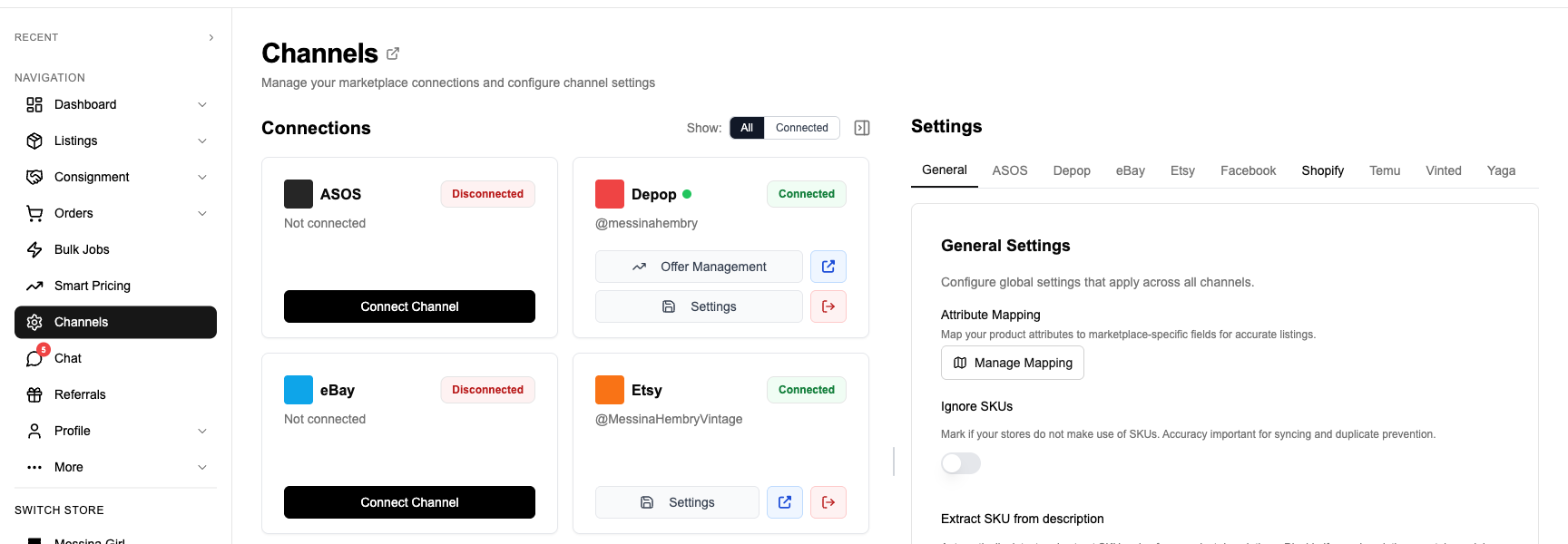
Here is how the Vakoop integration works, precisely:
- Connect your account. Authorise FLUF Connect at vakoop.co.za/connect. No browser extension is required.
- What FLUF pushes to Vakoop: title, description, photos, price (converted to ZAR), brand, condition, size, colour and a mapped category. You write a listing once and FLUF translates it into Vakoop’s structure.
- Order sync. When an order comes in on Vakoop, it syncs back into FLUF so your records stay in one place.
- Sold-out delisting. When a piece sells — on Vakoop or on any other connected channel — FLUF marks it sold and delists it on the others within minutes, so you do not oversell the same one-of-a-kind item twice.
Two honest limits, because accuracy matters: through FLUF, Vakoop supports order sync and sold-out delisting, but not relisting automation and not offer management. Relisting and offers on Vakoop are handled natively on the platform. FLUF does offer relisting and offer automation on other channels — for example eBay, Depop and Vinted — so as your channel mix grows, more of your workflow can be automated. FLUF supports any product type, so whether you sell sneakers, electronics or homeware, the same one-catalogue model applies.
A concrete SA seller scenario
To make this tangible, picture Thandi, a Johannesburg reseller with about 200 preloved pieces — local high-street brands, a few designer bags and a steady stream of branded sneakers. Here is how crosslisting changes her week:
- She lists once. Thandi photographs a Levi’s denim jacket, lets Vakoop’s AI draft the listing, tidies it, and from the same FLUF catalogue pushes it to Vakoop, eBay, Depop and Shopify. FLUF converts the price to ZAR for Vakoop and lists in the local currency on each other channel — she never opens a currency converter.
- The jacket reaches buyers Vakoop alone never would. On Vakoop it sits in front of South African buyers who value the authentication and free delivery. On eBay and Depop it reaches UK, EU and US buyers — and because Southern-Hemisphere winter stock is Northern-Hemisphere summer stock and vice versa, her off-season local items are often in season abroad. A jacket worth R450 locally can fetch considerably more from a buyer paying in pounds, comfortably covering eBay’s final-value fee.
- One sale, no overselling. A buyer in Manchester buys it on eBay. FLUF’s sold-out delisting marks it sold and pulls it from Vakoop, Depop and Shopify within minutes — so no South African buyer pays for an item that is already gone, and Thandi never has to cancel a sale and bruise her rating. The eBay order also syncs back into FLUF, keeping her records, dispatch list and inventory count in one dashboard.
- More channels, more automation. As Thandi adds Vinted and Depop relisting and offer handling, FLUF automates the repetitive parts on the channels that support them, while Vakoop quietly does its job as her authenticated SA anchor.
The net effect: Thandi spends her time sourcing and packing, not copy-pasting listings or firefighting double-sales.
Common Mistakes
- Pricing off your sticker, not your net. Always subtract whatever the platform takes at sale plus packaging before you decide a price is worth it.
- Trusting the AI draft blindly. Vakoop’s AI tool is fast but not infallible — always correct brand, size and condition before publishing.
- Going off-platform for payment. It voids wallet protection and authentication, and it is the fastest way to get scammed or banned.
- Listing on multiple marketplaces by hand and forgetting to mark items sold. This is how you oversell a one-of-one item — exactly what FLUF’s sold-out delisting prevents.
- Thin photos and vague descriptions. Missing measurements and hidden flaws drive returns and bad reviews.
- Ignoring courier options. Not offering locker drop-off (PUDO/Paxi) loses convenience-driven buyers (Govchain).
Timing and Seasonality
South African resale has its own rhythm, and selling into it deliberately beats listing at random. The calendar has a few clear peaks:
- Black Friday and Cyber Monday (late November). This is now the single biggest retail bonanza of the South African year. In 2025, South Africans spent over R2 billion across the weekend, with at least 3.5 million card swipes, and online sales at one major bank rose 75% year on year (TechCabal). It has stretched into a “Black November” of research and planned buying, so list your best stock in early-to-mid November while shoppers are actively comparing.
- The festive season (December). Gift-buying and year-end bonuses keep demand high; preloved makes a smart gift in a value-conscious market, and sneakers, electronics and accessories move particularly well.
- Back-to-School (January). The event that comes closest to Black Friday in scale, as families restock after the holidays — though post-festive budgets are tighter, so price keenly (TechCabal).
- Pay-day / month-end. Many South African shoppers buy around month-end when salaries land, so timing a listing or markdown to the last few days of the month catches buyers with cash in hand.
The biggest seasonal insight for a South African seller — especially one crosslisting internationally — is that the Southern Hemisphere seasons are inverted relative to Europe and the US. When your local buyers want summer dresses and shorts (roughly November–February), buyers on eBay and Depop in the UK, Europe and North America want coats and knitwear — and vice versa. A winter coat that is out of season for a Cape Town buyer in December is exactly what a London buyer is searching for. Crosslisting lets you keep both halves of your wardrobe selling year-round — summer stock to local buyers, winter stock to Northern-Hemisphere buyers at the same time — instead of letting half the rail sit dead for six months.
The practical rule: keep a steady listing cadence year-round, push your best stock live a week or two before each local demand peak, and let crosslisting smooth out the seasonal swing by pointing off-season local stock at in-season international buyers.
How FLUF Connect Automates Your Vakoop Workflow
Once Vakoop is connected to FLUF , your day-to-day looks very different:
- List once, sell everywhere. One listing fans out to Vakoop and every other connected channel — no copy-pasting titles or re-uploading photos five times.
- Automatic ZAR conversion. FLUF prices your Vakoop listing in Rand while listing in the right currency on each other channel.
- Mark-as-sold sync. Sell on any channel and FLUF delists the item on the rest within minutes, so a one-of-a-kind piece is never double-sold.
- Order sync. Vakoop orders flow back into FLUF, keeping your sales records in one dashboard.
- More automation on more channels. Relisting and offer automation run on channels that support them (eBay, Depop, Vinted and others), so the more you crosslist, the more hands-off your operation becomes. Every plan includes crosslisting, sync and bulk tools across all supported channels — automation is included from Seller upwards, not a paid add-on.
Is Vakoop Worth It in 2026?
For a South African seller, yes — with the right strategy. The market tailwinds are real: SA second-hand apparel is forecast to grow at roughly 22.8% a year through 2031 (Mobility Foresights), and online retail is expanding at double-digit rates with millions of new e-commerce users coming online (Lula, Statista). Vakoop’s free listing, authentication, wallet payments and AI listing tool make it one of the lowest-friction places to start (vakoop.co.za). The one caveat is reach: Vakoop is local-first. The sellers who get the most out of it use Vakoop as their authenticated SA anchor and crosslist the same inventory to global channels — and that is exactly the workflow FLUF Connect is built for.
FLUF Connect Pricing
FLUF Connect is a paid tool — every plan is subscription-based, with no free option. Every plan includes crosslisting, inventory, sold-out sync, bulk tools across all supported channels (with Vakoop limited to order sync, sold-out delisting, as described above), Seller and above add relisting, and Seller and above add offers. Pricing is published at fluf.io/pricing:
| Plan | Monthly | Crosslisted products |
|---|---|---|
| Starter | £9/month | Unlimited |
| Pro | £29/month | Unlimited |
| Super Seller | Custom pricing — tell us what you need | Unlimited |
The cheapest plan is Starter at £9/month, with no cap on how much you list. The plans are all paid subscriptions — crosslisting and sync are included in every plan, and automation from Seller upwards rather than sold as add-ons. For a Vakoop seller already making sales, the time saved by listing once and never overselling typically pays for itself well before the month is out.
Start crosslisting from Vakoop
Connect Vakoop once at vakoop.co.za/connect, then push your catalogue to eBay, Depop, Shopify, Facebook Marketplace and more from a single dashboard — with ZAR pricing and sold-out sync handled for you.
Related Guides
- Vakoop to Depop Crosslisting: Reach Global Buyers
- Crosslist from Vakoop to eBay: A Seller’s Guide
- Inventory Sync Across Depop, eBay, Vinted, Shopify, and Etsy
- How to Sell on Multiple Platforms at Once — The Complete Guide
- Sell in South Africa: Kloset Klub, Vakoop, Yaga and Where FLUF Fits
Sources & Verification
Last verified: 2026-06-28. Please contact us if any figure is out of date.
- Vakoop — Buy and Sell Preloved in South Africa (official site) — categories, free listing, authentication, wallet payments, free delivery, “SA’s Agentic AI Marketplace” positioning
- Mobility Foresights — South Africa Second-hand Apparel (Thrift) Market — market size and forecast for SA pre-loved fashion
- Lula — E-commerce in South Africa: trends driving growth in 2026 — SA online-retail growth context for resellers
- Statista — E-commerce in South Africa: statistics & facts — e-commerce user forecasts and market data
- Yaga South Africa Help Centre — Yaga’s Fees Guide — competing SA resale marketplace fee context (Buyer Protection 6.5% + R19.90)
- Webs — Second-hand multivendor marketplaces in South Africa — the SA resale landscape (Yaga, bob Shop, Gumtree)
- Shopify South Africa — Online selling sites — SA marketplace fee context (Takealot 5.5%–15%)
- Govchain — Most affordable courier options in South Africa — SME shipping options (PUDO, Paxi, Aramex)
- DeliverAI — Courier rate comparison South Africa — PUDO, Paxi, Aramex and PostNet pricing and delivery times
- IOL Cape Times — Small businesses blindsided by sudden return of load-shedding (Feb 2025) — load-shedding impact on SA small online sellers
- Netcash — Top online payment methods in South Africa, 2025 — Ozow instant EFT, SnapScan, PayShap and account-to-account payment share
- TechCabal — Black Friday spending soars in South Africa — R2bn weekend and Back-to-School spending comparison
Subscribe to the seller news brief
The marketplace news that changes how you list, in one short email.
- Fee, policy and algorithm changes across 70+ marketplaces
- Only the topics you pick — the marketplaces you actually sell on
- Short enough to read in a minute. Daily or weekly, unsubscribe in one click
No spam. We never share your address.
Pick your topics first ›Frequently Asked Questions
Vakoop advertises free listing for sellers, so there is no upfront cost to put an item live (vakoop.co.za). Vakoop also highlights secure wallet payments, item authentication and free delivery as platform features. Vakoop does not publish a precise seller commission percentage that we could independently verify, so confirm any sale-time fee directly on vakoop.co.za and price your items with a buffer for whatever the platform charges at the point of sale plus your packaging.
Vakoop is a South African marketplace for preloved items, with a focus on fashion, sneakers, electronics and designer bags (vakoop.co.za). It is well suited to closet clear-outs, streetwear and sneaker resale, premium accessories and gadgets. If you crosslist with FLUF Connect, you can sell any product type and push the same catalogue to other channels such as eBay, Depop, Shopify and Facebook Marketplace.
Vakoop brands itself as 'SA's Agentic AI Marketplace' and offers an AI listing tool designed to turn a photo into a draft listing (vakoop.co.za). You photograph the item, the AI proposes a title, description, category, brand and condition, and you review and correct it before publishing. Clean, well-lit photos make the AI more accurate, so good photography pays off twice.
Vakoop is a South African marketplace, so listings are priced in South African Rand (ZAR, R). If you crosslist with FLUF Connect, FLUF automatically converts your price to ZAR when pushing to Vakoop and lists in the right local currency on each of your other channels.
Yes. FLUF Connect lets you list an item once and crosslist it to Vakoop and other supported marketplaces. Authorise Vakoop once at vakoop.co.za/connect; no browser extension is required. Check sale-sync support for the other channels you connect.
Through FLUF, Vakoop supports order sync and sold-out delisting, but not relisting automation and not offer management. Relisting and offers on Vakoop are handled natively on the platform. FLUF does offer relisting and offer automation on other channels such as eBay, Depop and Vinted, so as you add channels more of your workflow can be automated.
Both are South African preloved marketplaces. Yaga is fashion-focused and free to list and sell, with the buyer paying a Buyer Protection fee of 6.5% plus R19.90, so sellers keep 100% of the price (Yaga Help Centre). Vakoop covers fashion, sneakers, electronics and designer bags, offers free listing, and adds item authentication and an AI listing tool (vakoop.co.za). Many sellers run both and crosslist with FLUF Connect rather than choosing one.
Vakoop uses secure wallet payments, where funds are protected until the transaction completes, and advertises free delivery as a platform feature (vakoop.co.za). Across the wider South African resale ecosystem, affordable courier options include PUDO smart lockers, Paxi at PEP stores and Aramex Store-to-Door, which let buyers collect parcels conveniently and help sellers cope with delivery delays (Govchain). Pack items promptly so you can drop them at the next available slot.
For South African sellers, yes — with the right strategy. SA second-hand apparel is forecast to grow at roughly 22.8% a year through 2031 (Mobility Foresights) and online retail is expanding at double-digit rates (Lula, Statista). Vakoop's free listing, authentication, wallet payments and AI listing tool make it a low-friction place to start. Because it is local-first, the most successful sellers use Vakoop as their SA anchor and crosslist the same inventory to global channels with FLUF Connect.
Sign up for free
Join the community
You're in.
Open your dashboard