
Wallapop vs Depop: Which Is Better for Sellers in 2026?
A side-by-side breakdown of fees, audience, categories and shipping for Spain's everything-marketplace versus the global Gen-Z fashion app — so you can choose the right platform, or sell on both.
7 days for £1, then from £9/month.



- Choose Wallapop if: you sell across many categories — electronics, furniture, motors, baby and kids gear, as well as fashion — and your buyers sit in Spain, Italy, Portugal, the UK, or France. Wallapop is a general-purpose, location-first marketplace where in-person pickup still matters.
- Choose Depop if: you sell curated, trend-led fashion, vintage, or streetwear to a young, global, mobile-native audience. Depop is fashion-only, social-first, and skews heavily Gen Z across the US, UK, and Australia.
- Fees: Depop charges UK and US sellers 0% commission (you pay only payment processing — 2.9% + £0.30 in the UK), while buyers pay a marketplace fee. Wallapop charges sellers 0% on in-person sales and roughly 10% handling/protection on shipped sales through Wallapop Envíos.
- Audience: Wallapop has around 19 million monthly active users concentrated in Iberia. Depop has roughly 30–35 million registered users globally, with about 7 million active buyers, skewing US/UK and 16–26.
- Categories: Wallapop is everything second-hand; Depop is fashion, vintage, and streetwear only. This is the biggest single difference between them.
- Best strategy: For most fashion sellers, these two reach almost separate buyer pools — so the honest answer is often “both.” Crosslist with FLUF Connect to list once and sell on both (plans from £9/month — there is no free plan, but every new account gets a 7-day trial for £1).
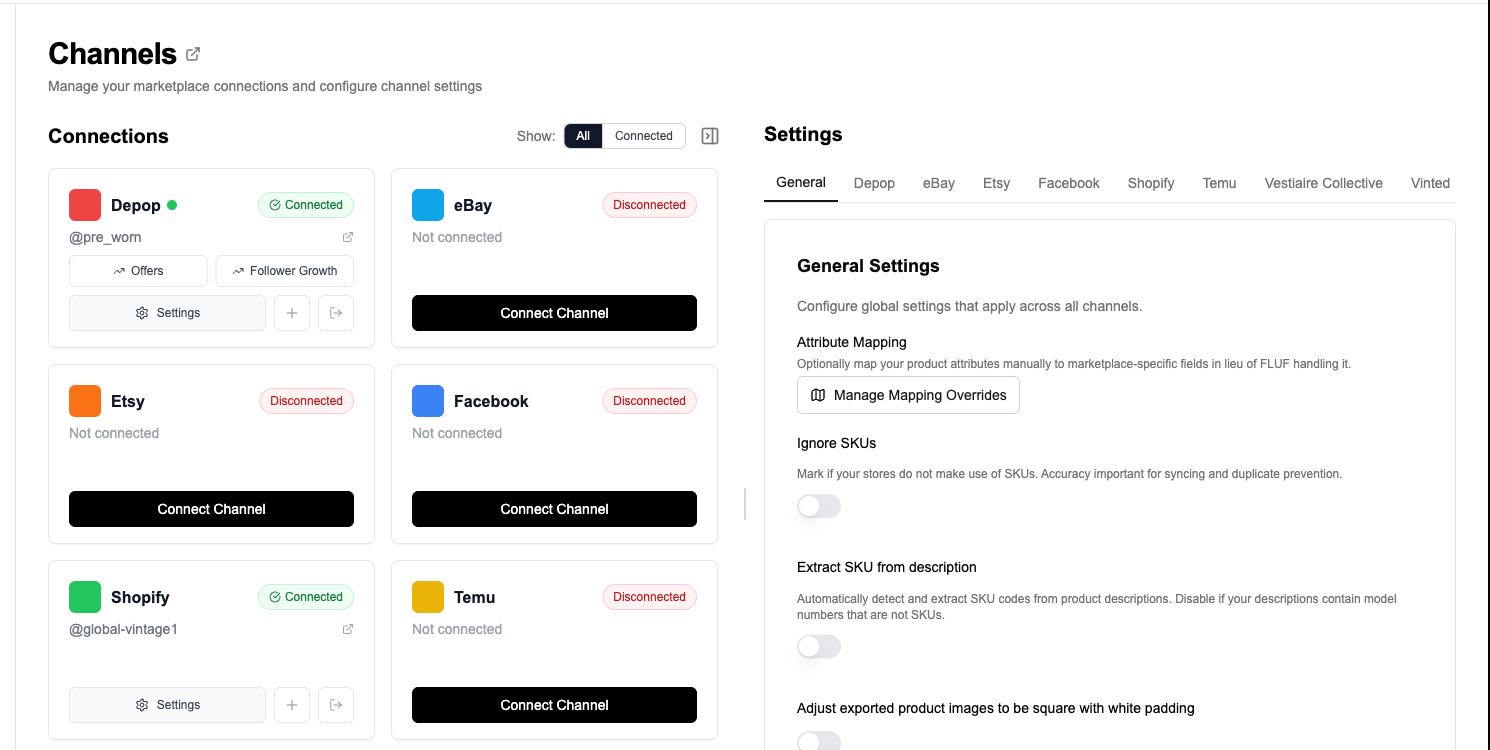
Wallapop vs Depop at a Glance
The difference between Wallapop and Depop comes down to geography and category. Wallapop is a general-purpose, location-first second-hand marketplace built in Spain — you can sell a sofa, a phone, a car, or a coat to buyers in Spain, Italy, Portugal, the UK, and France. Depop is a fashion-only, social-first resale app where a young, global audience hunts for vintage, streetwear, and curated style. One is “everything second-hand, near me”; the other is “trend-led fashion, worldwide.”
Wallapop launched in Barcelona in 2013 as a hyperlocal classifieds app and grew into Spain’s largest C2C platform, later adding nationwide shipping and buyer protection. In August 2025, South Korea’s Naver acquired 100% of Wallapop (it had previously held around 30%), valuing the business at roughly €600 million. Depop launched in 2011 out of Italy and the UK, became the go-to resale app for Gen Z fashion, and was bought by Etsy in 2021 for $1.625 billion; in early 2026 eBay announced an agreement to acquire Depop, so its ownership is in transition.
| Wallapop | Depop | |
|---|---|---|
| Founded | 2013, Barcelona | 2011, Italy / UK |
| Headquarters | Barcelona, Spain | London, UK |
| Owner | Naver (100%, August 2025) | Etsy (eBay acquisition announced 2026) |
| Active users | ~19 million monthly active | ~30–35M registered; ~7M active buyers |
| Top markets | Spain, Italy, Portugal, UK, France | US, UK, Australia |
| Best for | Electronics, furniture, motors, baby/kids, fashion — everything | Vintage, streetwear, trend-led and Gen-Z fashion only |
| Seller fees | 0% in-person; ~10% handling on shipped sales | 0% commission (UK/US); 10% (other countries) |
| Free listings | Yes — no listing or subscription fee for individuals | Yes — no listing fee |
| Currency | EUR (ES/IT/PT/FR), GBP (UK) | GBP, USD, EUR by market |
| Mobile app | Yes — strong, app-first | Yes — social-feed, app-first |
If you sell anything other than clothing, Wallapop is the obvious home and Depop simply isn’t an option. If you sell fashion, both are live candidates — and that is where this comparison really matters.
Wallapop vs Depop: Feature-by-Feature Comparison
Both are mobile-first marketplaces with messaging, offers, and integrated shipping — but they are built around different transactions. Wallapop supports both shipped sales and “solo en mano” (in-person, hand-to-hand) deals, so local pickup is a core feature. Depop is shipped-only and leans hard into social discovery: followers, likes, and a curated shop aesthetic drive sales as much as the listing itself.
| Feature | Wallapop | Depop |
|---|---|---|
| Fixed-price listings | Yes | Yes |
| Auction listings | No | No |
| Offer / haggle system | Yes — through chat | Yes — Make Offer + counter-offers |
| Built-in messaging | Yes — central to the platform | Yes |
| In-person / local pickup | Yes — “solo en mano” core to the platform | No — shipped only |
| Integrated shipping labels | Yes — Wallapop Envíos | Yes — discounted carrier labels in-app |
| Buyer protection | Yes — on shipped sales | Yes — on tracked, app-paid sales |
| Social features (likes, follows) | Basic | Extensive — followers, likes, a social feed |
| Promoted / boosted listings | Yes — Bump Up, Spotlight, featured slots | Yes — Boosted Listings (ad fee on sale) |
| Seller analytics | Basic | Yes — shop and listing insights |
| Business / Pro accounts | Wallapop Pro (Spain) | Yes — business seller accounts |
| Category breadth | Everything — motors, tech, home, fashion | Fashion, vintage, accessories only |
| International selling | Within active markets | Yes — global, ~30%+ of sales cross-border |
The three differences that matter most: Wallapop lets you sell any category and meet buyers in person, Depop is fashion-only and shipped-only, and Depop’s social layer (followers, likes, a curated feed) does heavy lifting that Wallapop’s more transactional interface doesn’t attempt.
Listing Experience: Wallapop vs Depop
Listing on either platform takes a couple of minutes from your phone, but the emphasis is different. On Wallapop you photograph the item, pick a category from a broad tree (Fashion, Tech, Motor, Home, Baby, Sports, and more), set a price, and choose whether you’ll ship via Wallapop Envíos or only sell in person. Because Wallapop covers so many categories, the listing form adapts — selling a car asks for different details than selling a jacket. Titles and descriptions in the local language (Spanish, Italian, Portuguese) generally perform best in each market.
On Depop, listing is a styling exercise as much as a data-entry one. You get up to four image slots, and the platform rewards bright, consistent, well-shot photos that fit a recognisable shop aesthetic. You add a description, hashtags, brand, size, condition, and category — all fashion-specific. Depop’s search and “Explore” feed surface listings partly on freshness and engagement, so sellers who post regularly, refresh listings, and build a following tend to get more visibility. Good photography and on-trend tagging matter more on Depop than on almost any other resale platform.
For beginners, Wallapop is arguably gentler — list it, price it, wait for a message — because there’s no expectation to build a brand. Depop has a steeper “soft” learning curve: the mechanics are simple, but doing well means treating your shop like a small fashion business with consistent styling, regular posting, and community engagement. If you sell non-fashion items, the comparison ends here — only Wallapop accepts them.
Time-to-list is similar on both — under five minutes once you have photos — but the upstream work differs. On Depop, the photography is the listing: a flat-lay or modelled shot against a clean background, edited for consistent lighting, typically outperforms a quick snap, so many sellers batch-shoot a whole drop in one session. Hashtags and accurate brand and size tagging feed Depop’s search, and “Refresh” (a free re-bump on your own listings) plus boosted listings give sellers levers to fight the freshness decay built into the feed. On Wallapop, the photo bar is lower and discovery is more search- and location-driven: a clear, honest photo, the right category, and a sensible price do most of the work, and a paid Bump Up or Spotlight can lift a stale listing back up the results. Neither platform charges to list, so there’s no penalty for posting often — and frequent, fresh listings help on both, for different algorithmic reasons.
Fees Compared: How Much Do Wallapop and Depop Actually Cost?
Fees are where these two diverge most, because they pass costs to different sides of the transaction. Depop has removed seller commission in its two biggest markets and recoups revenue partly through a buyer-facing marketplace fee. Wallapop charges nothing on in-person deals but takes a handling and protection cut on shipped sales. Neither charges a listing fee, and neither requires a monthly subscription for individual sellers.
| Fee Type | Wallapop | Depop |
|---|---|---|
| Listing fee | £0 / €0 | £0 / $0 |
| Seller commission | 0% in person; ~10% handling/protection on shipped sales | 0% (UK/US); 10% (other countries) |
| Payment processing | Bundled into the shipped-sale handling fee | UK: 2.9% + £0.30; US: 3.3% + $0.45 |
| Buyer-facing fee | Buyer protection fee on shipped sales | Marketplace fee — up to 5% + up to £1 (UK) |
| Monthly subscription | None for individuals (Wallapop Pro optional, Spain) | None |
| Promoted / boosted listing | Bump Up / Spotlight — a few euros per listing | Boosted Listings — 12% (UK) on the sale |
Depop’s 2024 fee overhaul
Depop made the most significant change of either platform. On 20 March 2024 it removed its 10% seller commission for new listings in the UK, and extended zero seller commission to US sellers from 15 July 2024. UK sellers now pay only payment processing of 2.9% + £0.30 per transaction; US sellers pay 3.3% + $0.45. To fund this, Depop introduced a buyer-side marketplace fee of up to 5% of the item price plus a fixed amount of up to £1 in the UK. Sellers outside the US and UK still pay a 10% selling fee plus processing. Boosted listings, which are optional, cost 12% of the sale in the UK.
Wallapop’s shipping-based model
Wallapop’s model is simpler to describe but charges the seller, not the buyer, on shipped sales. If you complete a deal in person (“solo en mano”), Wallapop takes nothing. If you ship through Wallapop Envíos, the platform applies a handling and protection fee of around 10% of the sale price, deducted from the seller’s proceeds, and the buyer pays their own protection fee on top. There are no listing fees on any plan and no monthly subscription for individual sellers.
- Wallapop (shipped, UK): Listing fee £0 − ~10% handling (≈£3.00) = you keep ≈£27.00. In person: keep the full £30.00 (no fee).
- Depop (UK): Listing fee £0 − payment processing (2.9% + £0.30 ≈ £1.17) = you keep ≈£28.83. (The buyer separately pays Depop’s marketplace fee of up to 5% + up to £1.)
The headline: for a UK fashion seller shipping the item, Depop leaves you with slightly more per sale because it shifted most of the cost onto buyers, while Wallapop’s ~10% comes out of your proceeds. But Wallapop’s in-person option is genuinely free, which can beat both for local bulky items. Worked examples are illustrative — always check each platform’s live fee pages before pricing.
There’s a subtler trade-off behind those numbers. Depop’s zero-commission model is great for the seller’s take-home, but the buyer-facing marketplace fee (up to 5% + up to £1 in the UK) is visible at checkout, so buyers effectively pay a little more than your sticker price — something price-sensitive shoppers notice on cheaper items. Wallapop keeps the buyer’s cost cleaner on shipped sales (they pay the item plus shipping plus a protection fee) while the seller absorbs the ~10%. On very low-value items the maths flips: Depop’s fixed £0.30 processing component is a bigger proportional bite on a £5 sale than on a £50 one, whereas Wallapop’s free in-person route means a £5 hand-to-hand sale costs you nothing at all. The practical rule of thumb: for mid-to-higher-value fashion you’re shipping anyway, Depop’s structure is usually kinder to the seller; for cheap or bulky local items, Wallapop’s in-person deal is unbeatable.
Neither platform charges to relist or to keep listings live, and neither requires a subscription for an individual seller. Promotion is the main optional cost on both — Depop’s boosted listings (12% on the sale in the UK, charged only if the boost leads to a sale within the boost window) and Wallapop’s Bump Up and Spotlight (a few euros per listing, paid up front regardless of whether it sells). Build promotion into your pricing rather than treating it as an afterthought, especially on Depop where the 12% stacks on top of processing.
| Wallapop | Depop | |
|---|---|---|
| Payout method | Wallapop Wallet → bank transfer | Depop Payments (Stripe / PayPal legacy) → bank |
| Payout speed | Released after delivery confirmation | Funds typically available after the sale clears |
| New seller holds | Possible on first shipped sales | Possible for new accounts |
| Minimum payout | Wallet balance withdrawable to bank | No fixed minimum |
Audience and Demand: Who’s Buying on Wallapop vs Depop?
The two platforms reach almost entirely different buyers — different ages, different countries, different shopping intent. Wallapop draws roughly 19 million monthly active users concentrated in Spain, with growing audiences in Italy, Portugal, the UK, and France. Its buyers skew slightly male and span all age groups, shopping for practical second-hand goods: phones, consoles, furniture, baby gear, used cars, and fashion. Depop’s roughly 30–35 million registered users skew young (its core is 16–26) and global, with the US, UK, and Australia as top markets, hunting specifically for vintage, streetwear, and trend-led pieces.
| Wallapop | Depop | |
|---|---|---|
| Primary age group | 25–44, all ages active | 16–26 (Gen Z core) |
| Top markets | Spain, Italy, Portugal, UK, France | US, UK, Australia |
| Estimated users | ~19M monthly active | ~30–35M registered; ~7M active buyers |
| Buyer intent | Practical, local, value-driven | Trend-driven, style-led, discovery browsing |
| Best-selling categories | Tech, motors, home, baby/kids, fashion | Vintage, Y2K, streetwear, designer fashion |
| Buyer behaviour | Search-led, deal-seeking | Feed-led, aesthetic-driven, follows sellers |
The practical upshot for a fashion seller: Wallapop puts you in front of a huge Iberian audience that buys clothing alongside everything else, but where fashion competes with cars and furniture for attention. Depop puts you in front of a smaller but fashion-obsessed, globally distributed audience that arrives specifically to shop style. A vintage Levi’s jacket might sell faster on Depop to a US buyer; a bundle of kids’ clothes or a designer bag might move quickly on Wallapop in Spain. Both audiences are growing — Depop reported strong year-on-year active buyer and seller growth into late 2025, and Wallapop continues expanding outside Iberia.
Geography is the cleanest way to think about it. If your primary market is Spain, Portugal, or Italy, Wallapop is the dominant second-hand platform and Depop has comparatively thin reach there. If your primary market is the United States or Australia, Depop has a real presence and Wallapop effectively does not. The UK is the one country where both are live and competitive — Depop has a strong, long-established UK fashion community, and Wallapop runs a full UK marketplace — so UK fashion sellers are the clearest candidates to use both. Outside fashion, demand splits even harder: Wallapop’s busiest categories (smartphones, consoles, furniture, used cars, baby and kids equipment, bikes) simply have no home on Depop, while Depop’s vintage-and-streetwear demand has no real equivalent depth on Wallapop. The two platforms are less competitors than complements for anyone whose inventory and audience span both worlds.
Shipping: Wallapop vs Depop
Both platforms offer integrated, in-app shipping with discounted labels and tracking, but their philosophies differ. Wallapop offers Wallapop Envíos for shipped sales and a fully free in-person option — many Spanish sellers still hand bulky items over directly. Depop is shipped-only and partners with carriers (USPS, UPS, Royal Mail and others by market) to offer discounted prepaid labels through the app, with tracking baked in. Because Depop’s audience is global, a meaningful share of sales ship internationally — sellers commonly report cross-border orders making up a large slice of revenue.
| Wallapop | Depop | |
|---|---|---|
| Integrated shipping labels | Yes — Wallapop Envíos | Yes — discounted carrier labels in-app |
| Who pays shipping | Usually the buyer | Buyer or seller (seller’s choice) |
| In-person / local pickup | Yes — “solo en mano”, no fee | No |
| International shipping | Within active markets | Yes — common, ~30%+ of sales for many sellers |
| Return shipping | Handled via buyer protection process | Handled via dispute / buyer protection |
| Tracking required | Yes — for buyer protection | Yes — for seller protection |
For local, bulky, or low-value items, Wallapop’s in-person option is unbeatable — no fees, no packing, no courier. For posting clothing to buyers anywhere in the world, Depop’s discounted labels and international reach are the bigger advantage.
Two practical notes for sellers weighing them up. First, returns and disputes are handled through each platform’s buyer-protection process rather than left to the seller to arbitrate — on Depop a buyer can open a dispute on a tracked, app-paid order, and on Wallapop the protection that funds the buyer fee covers shipped purchases, so keeping every transaction inside the app (rather than taking payment off-platform) is what keeps you protected. Second, packaging plays differently: Depop’s fashion audience rewards a tidy, on-brand parcel — tissue paper, a thank-you note, branded touches all feed the social, repeat-buyer dynamic — whereas Wallapop’s more transactional buyers care mainly that the item arrives as described and on time. If you’re shipping across both, standardise on tracked services and honest condition descriptions; that single habit prevents most disputes on either platform.
What Real Sellers Say About Wallapop vs Depop
Because Wallapop and Depop barely overlap geographically, you rarely see head-to-head seller debates — most sellers use one because of where they live and what they sell. The sentiment that does surface is consistent.
“Depop’s whole thing is the feed and the followers. If you don’t post regularly and your photos aren’t on-brand, you get buried. It’s basically running a tiny clothing shop on Instagram.”
— Paraphrased seller sentiment, r/Depop
“On Wallapop I sell everything — old phones, the kids’ outgrown clothes, a bike. Half the time the buyer just collects it. No fees if you meet up.”
— Paraphrased seller sentiment, Wallapop community
“Since Depop dropped seller fees I keep more per sale, but the buyer fee means my prices look a bit higher at checkout. Net-net it’s still cheaper to sell on than it used to be.”
— Paraphrased seller sentiment, r/Depop
“Wallapop is amazing for the bulky stuff nobody wants to post — furniture, a washing machine, baby gear. It would never move on a fashion app. But for vintage clothes I want a wider audience than just my city.”
— Paraphrased seller sentiment, Wallapop community
Common themes: Depop sellers value the zero-commission change and the engaged fashion audience but find success demands styling, consistency, and community-building. Wallapop sellers value the breadth (sell anything) and the free in-person route, but note that shipped-sale handling fees eat into margins and that the platform is far quieter outside Spain. Sellers who operate in both ecosystems — for example a UK reseller — tend to treat them as separate channels for separate inventory rather than direct substitutes. The recurring message from sellers active on both is that the platforms solve different problems: Wallapop clears a household and reaches local buyers cheaply; Depop builds a fashion brand and reaches the world. Few sellers feel they have to pick one, because the two rarely cannibalise each other’s sales — the same vintage jacket can find a Spanish buyer on Wallapop and a US buyer on Depop without the listings competing.
How to Choose Between Wallapop and Depop
The honest answer depends on what you sell and where your buyers are. For most non-fashion items there is no choice to make — Depop only accepts clothing and accessories, so Wallapop wins by default. For fashion, the decision turns on geography and brand-building appetite.
- Sell across categories — electronics, furniture, motors, baby/kids, plus fashion
- Are based in or selling to Spain, Italy, Portugal, the UK, or France
- Want the option to sell in person, fee-free, for bulky or local items
- Prefer a transactional, no-frills selling experience over brand-building
- Sell vintage, streetwear, Y2K, or trend-led fashion
- Want a young, global, style-focused audience (US/UK/Australia)
- Are happy to build a curated shop with strong photography and regular posting
- Want zero seller commission in the UK or US and easy international shipping
For a casual seller clearing out a mix of items, Wallapop is the natural single home. For a fashion-focused reseller chasing margin and a global trend audience, Depop is hard to beat. For a scaling reseller, the two platforms reach such different buyers that picking one leaves money on the table — which is exactly where crosslisting comes in.
Why Not Both? Sell on Wallapop and Depop at the Same Time
Because Wallapop and Depop reach almost separate buyer pools — local Iberian shoppers versus global Gen-Z fashion fans — listing the same fashion item on both maximises the chance of a fast sale at a good price. The catch is doing it by hand: re-photographing and re-writing every listing twice, then remembering to remove an item from one platform the moment it sells on the other, or risk overselling. FLUF Connect automates exactly that.
FLUF Connect lets you list an item once and crosspost it to Wallapop, Depop, and more, then keeps stock in sync so a sale on one platform updates the other. Here’s what the registry confirms FLUF supports for each of these two channels:
| FLUF Connect Feature | Wallapop | Depop |
|---|---|---|
| Crosslisting | Yes | Yes |
| Inventory sync | Yes | Yes |
| Order sync | Yes | Yes |
| Auto-relisting | No | Yes |
| Offer management | No | Yes |
| Bulk operations | Yes | Yes |
In practice that means you can crosslist between the two in either direction — Wallapop to Depop or Depop to Wallapop — and lean on Depop-specific automation (automatic relisting to keep listings fresh in the feed, plus offer management) while Wallapop benefits from crosslisting, inventory sync, and order sync. It works in three steps:
- Connect your Wallapop and Depop accounts to FLUF Connect.
- Crosslist a product once — FLUF posts it to both, with each platform’s fields handled for you.
- Sync automatically — when it sells on one, FLUF updates stock on the other so you never oversell.
Automation — relisting, offer management, bulk operations, inventory sync — is included from Seller upwards, not sold as a paid add-on. Plans start at £9/month (Starter). There is no free plan, but every new account gets a 7-day trial for £1. See pricing, browse all supported marketplaces, or read our Depop vs Vinted and Wallapop vs Vinted comparisons.
Sources & Verification
Every fee, ownership and active-user figure on this page is cited inline to a primary or reputable secondary source. Marketplace terms change frequently — verify current details on each marketplace’s official pages before making selling decisions.
Frequently Asked Questions
It depends on your buyers. Depop is a fashion-only, global app where a young (16-26) audience hunts for vintage, streetwear and trend-led pieces across the US, UK and Australia, so curated fashion often sells faster there. Wallapop is a general-purpose marketplace strongest in Spain, Italy and Portugal where clothing sells alongside everything else. For UK fashion sellers both are viable, which is why many list on both.
Depop charges UK and US sellers 0% commission and you pay only payment processing (2.9% + £0.30 in the UK; 3.3% + $0.45 in the US), while buyers pay a marketplace fee of up to 5% + up to £1. Wallapop charges sellers nothing on in-person sales but takes roughly 10% handling and protection on shipped sales through Wallapop Envíos. For shipped fashion, Depop usually leaves the seller with more; for local in-person sales, Wallapop is free.
Yes. Depop removed its 10% seller commission for new UK listings from 20 March 2024 and extended zero seller commission to US sellers from 15 July 2024. Sellers in those markets now pay only payment processing. Sellers outside the US and UK still pay a 10% selling fee plus processing. To fund the change, Depop introduced a buyer-facing marketplace fee.
South Korea's Naver acquired 100% of Wallapop in August 2025 (it had previously held around 30%). Depop was bought by Etsy in 2021 for $1.625 billion; in early 2026 eBay announced an agreement to acquire Depop, so its ownership is in transition.
Wallapop has around 19 million monthly active users, concentrated in Spain with growing audiences in Italy, Portugal, the UK and France. Depop has roughly 30-35 million registered users and about 7 million active buyers, skewing younger and more globally distributed. They reach largely different audiences rather than competing for the same one.
Yes. Because the two reach almost separate buyer pools, listing the same fashion item on both maximises your chance of a fast sale. FLUF Connect lets you list once and crosspost to both, then syncs inventory so a sale on one platform updates the other and you never oversell. Crosslisting, inventory sync, order sync and bulk operations are supported for both channels.
Wallapop is gentler to start on — list it, price it, wait for a message, with no expectation to build a brand. Depop's mechanics are simple but doing well demands consistent styling, good photography, regular posting and community engagement, so it has a steeper soft learning curve. If you sell anything other than fashion, Wallapop is the only option of the two.
Yes, in either direction. FLUF Connect crosslists Wallapop to Depop and Depop to Wallapop, keeping stock in sync. It also offers Depop-specific automation such as auto-relisting and offer management. Automation is included from Pro upwards, not a paid add-on. FLUF Connect plans start at £9/month on Starter, with Pro at £29/month and custom Super Seller plans above that; every plan is unlimited on listings and marketplaces, and the tiers differ by which automations they include and how often we check your channels for sales.
For fashion sellers, usually yes, because the platforms barely overlap geographically and demographically — a Spanish buyer on Wallapop and a US buyer on Depop rarely compete for the same listing. The risk of selling on both manually is overselling and double the listing work, which a crosslisting tool like FLUF Connect removes by syncing inventory automatically.