
Crosslist from Shopify to ASOS — Put Your Store’s Vintage in Front of 17 Million Shoppers
Your Shopify store gives you the brand and the margin, but no built-in audience. FLUF Connect submits the genuine vintage from your store to ASOS's 17-million-strong, trend-led customer base — curated, not guaranteed.



Key Takeaways
- ASOS is not an open marketplace. It closed its standalone Marketplace in April 2025 and now sells third-party stock on asos.com through the Mirakl-powered “Partner Fulfils” programme, where sellers fulfil their own orders (ASOS PLC, 23 Jan 2025; Mirakl).
- For resellers the realistic route is genuine, curated vintage. Every item is reviewed by ASOS’s vintage curation team and acceptance is never guaranteed.
- The audience is the prize. ASOS reported 17.0 million active customers, with roughly 49% of revenue from the UK and 33% from the EU, skewing toward “fashion-loving 20-somethings” — ideal for vintage and Y2K (ASOS PLC Annual Report FY2025).
- Shopify is your own branded storefront, not a marketplace. It powers millions of active stores and facilitated over $100bn in GMV in a single quarter, but it gives you no built-in audience (Shopify Inc. SEC filings, Q1 2026).
- FLUF connects Shopify natively through Shopify’s official app and API — mature, with products created natively and stock kept in step — while ASOS connects through Mirakl with an API key and Shop ID.
- Plans start at £9/month (Starter). There is no free plan, but every new account gets a 7-day trial for £1. Automation is included from Seller upwards, not a paid add-on. ASOS commission is negotiated per partner and is not published.
Why crosslist Shopify to ASOS
Running a vintage boutique on Shopify is the dream setup in one important sense: you own everything. Your own domain, your own brand, your own theme, your own checkout, your own customer list. Nobody takes a cut of your storefront, nobody dictates your aesthetic, and the buyer who falls in love with your curation becomes your repeat customer, not a marketplace’s. Shopify is an owned-storefront e-commerce platform — you run your own branded store, not a stall inside someone else’s mall. Shopify powers millions of active stores worldwide and facilitated over $100 billion in gross merchandise volume in a single quarter (Shopify Inc. SEC filings, Q1 2026). It is the most mature owned-store platform there is.
But owning your storefront has one structural weakness that every independent merchant runs into eventually: a Shopify store gives you no built-in audience. There is no feed full of browsing shoppers, no “explore” tab, no marketplace search that surfaces your stock to people who have never heard of you. Every visitor to your store is one you paid for — through ads, content, SEO, social, or word of mouth. Your beautiful 1990s Levi’s denim jacket is only seen by the people you can drive to your domain.
ASOS is the opposite. It has the audience and none of the brand ownership you’d want. According to the ASOS PLC Annual Report FY2025, ASOS had 17.0 million active customers, with around 49% of revenue from the UK and 33% from the EU, and a core demographic of “fashion-loving 20-somethings” — young, trend-led shoppers who are exactly the people hunting for vintage and Y2K pieces (ASOS PLC Annual Report FY2025). That is a mainstream audience that no independent vintage store could buy its way in front of cost-effectively.
Crosslisting from Shopify to ASOS lets you have both. You keep your store as the home of your brand and your repeat customers, and you surface your genuine vintage to ASOS’s 17-million-strong audience for additional, incremental sales. FLUF Connect is the bridge that does this without you re-keying product data, re-photographing items, or managing two stock counts by hand. The catch — and it is a real one you need to understand before you start — is that ASOS is not an open marketplace you can simply push to. The next section is the one to read first.
The reality check — ASOS is curated vintage (read first)
Be clear-eyed about what ASOS is in 2026, because it is not what most resellers assume. ASOS closed its standalone ASOS Marketplace in April 2025. The open, list-anything Marketplace where independent boutiques sold directly is gone. Today, ASOS sells third-party stock on the main asos.com site through a Mirakl-powered programme called “Partner Fulfils”, where approved sellers list on asos.com and fulfil their own orders (ASOS PLC, 23 Jan 2025; Mirakl).
For a vintage boutique, the realistic and relevant route into ASOS is genuine, curated vintage. ASOS operates a vintage curation team, and every item submitted for sale on asos.com is reviewed by that team. This is the single most important fact on this page: acceptance is not guaranteed and listing is not automatic. You do not get to push a product and have it appear. You submit qualifying genuine vintage, and ASOS’s curators decide whether it fits the asos.com edit.
That means crosslisting to ASOS is fundamentally different from crosslisting to an open marketplace like Depop or eBay, where a valid listing goes live the moment it’s submitted. With ASOS, FLUF’s job is to filter your Shopify catalogue down to the items that genuinely qualify, format them to ASOS’s spec, and submit them in curated batches — and then ASOS decides. Some items will be accepted, some won’t. If you go in expecting a guaranteed, instant, list-everything pipe, you’ll be disappointed. If you go in understanding that ASOS is a curated, premium vintage destination with a 17-million-customer audience, and that getting accepted is worth the gate, it’s one of the strongest reach opportunities in resale.
On commission: ASOS commission for partners is negotiated per partner and is not published. The roughly 20% figure that circulates online relates to the historical legacy Marketplace and is not a reliable guide to current Partner terms. Treat any specific public number with caution and confirm your own rate directly with ASOS.
How FLUF Connect submits your Shopify vintage to ASOS
FLUF Connect handles the two ends of this connection very differently, because the two platforms are technically very different.
Shopify connects natively. FLUF uses Shopify’s official app and API — the same mature, supported integration any serious Shopify tool uses. Products are created natively in your store, your existing Shopify catalogue is read directly, and stock stays in step automatically. There is no scraping, no browser extension, and no fragile workaround on the Shopify side. This is a first-class, owned-store integration.
Connect ASOS with your Mirakl API key and Shop ID. New vintage items may need catalogue approval before they can be listed. FLUF helps you submit them; review the submission status and allow time for ASOS to approve eligible items.
Before anything reaches ASOS, FLUF applies a vintage curation gate. This is FLUF’s own pre-filter designed to avoid wasting ASOS curators’ time (and your submission allowance) on items that have no chance:
- Genuine-vintage keywords pass. Items described and tagged as genuine vintage move forward to the next checks.
- Fast fashion is auto-rejected. Brands including Shein, Boohoo, PrettyLittleThing, Zara, H&M, Topshop and ASOS Design are blocked outright — they are not vintage and ASOS will not take them.
- Nike, Adidas and Converse are excluded even when the item is genuinely vintage. These are excluded from the vintage route regardless of age.
- Check vintage eligibility before submitting. ASOS makes the final acceptance decision.
- Curated batches go to ASOS. Items that clear the gate are submitted in batches to ASOS’s vintage curation team, who make the final call.
The honest summary: FLUF does everything it can to maximise the share of your eligible vintage that ASOS will accept, but the gate exists precisely because ASOS is curated. FLUF cannot make ASOS accept an item — it can only present qualifying items correctly.
Step by step
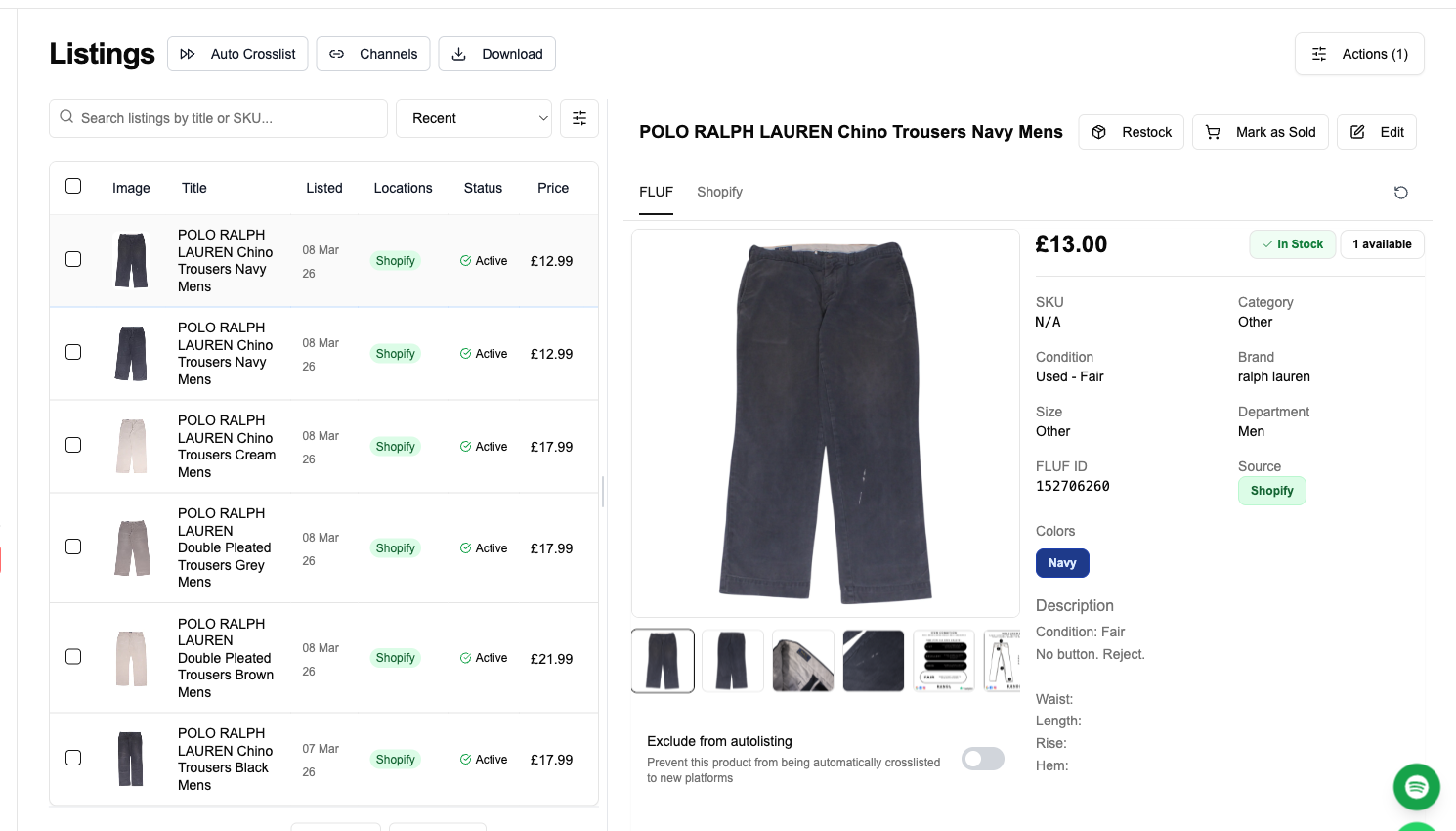
- Connect Shopify natively. In FLUF Connect, add Shopify as a source channel. You’ll authorise FLUF’s official Shopify app, which connects to your store via the Shopify API. Your existing product catalogue, images, variants and stock levels are read in directly.
- Connect ASOS via Mirakl. Add ASOS as a destination channel by entering your Mirakl API key and Shop ID (this assumes you have an approved ASOS partner account). There is no OAuth pop-up — ASOS authentication is key-based.
- Review eligibility. Submit genuine vintage that meets the stated brand and category requirements. Excluded brands and non-vintage items are not eligible; ASOS makes the final decision.
- Review and format. For each candidate, FLUF maps your Shopify fields toward the ASOS vintage spec — including the strict title format and image requirements covered below. You can review what will be submitted.
- Submit in curated batches. FLUF creates the Mirakl product proposal where needed and attaches your Offer, then sends qualifying items in batches to ASOS’s vintage curation team.
- Wait for curation. ASOS reviews. Accepted items go live on asos.com; rejected items simply don’t list — they remain untouched and for sale on your Shopify store and anywhere else you sell.
- Sell and stay in sync. Once live, FLUF keeps inventory and orders in step. A sale on Shopify marks the item sold and delists it on ASOS; a sale on ASOS does the same in reverse, preventing oversells.
Field & category mapping
Shopify’s product model and ASOS’s Mirakl vintage spec are not the same shape, so FLUF translates between them. A few Shopify-specific notes matter here. Shopify products can have variants (size/colour combinations under one product) and belong to collections (your store’s groupings). Vintage is typically one-of-a-kind, so most vintage items are single-variant; where a product does carry variants, each saleable, in-stock variant is treated as its own potential ASOS Offer. Collections are a Shopify-side organisational tool and do not map to an ASOS category — FLUF derives the ASOS-appropriate item type from the product itself.
| Shopify field | ASOS (Mirakl) destination | Notes |
|---|---|---|
| Product title | ASOS vintage title | Keep the title within 80 characters and review the brand, item type, colour and vintage wording before submitting. |
| Vendor / brand | Brand (within title + catalogue) | Drives the title’s {Brand} slot and the exclusion checks (Nike/Adidas/Converse blocked; fast-fashion brands auto-rejected). |
| Product type / collection | {Type} in title + Mirakl product category | Review the ASOS item type and title before submitting the product. |
| Variant (size) | Offer size attribute | Each in-stock variant becomes its own ASOS Offer where applicable. |
| Variant (colour) / tags | {Colour} in title | Feeds the “in {Colour}” portion of the required title format. |
| Price | Offer price | Carried across as your asking price on ASOS. |
| Inventory quantity | Offer stock / availability | Kept in step; a sale on either side delists on the other. |
| Product images | ASOS vintage images | Must be portrait JPEG, approximately 2116×2700px, sRGB colour, under 3MB each, with at least 4 images. FLUF maps your Shopify images toward this spec; items that can’t meet the minimum image requirements won’t pass. |
| Description / condition | Offer description & condition | Genuine-vintage condition language; description supports the curation review. |
The two parts of this mapping that catch people out are the title format and the image spec. ASOS is strict on both. A title that doesn’t follow “Vintage {Brand} {Type} in {Colour}” or runs over 80 characters, and images that aren’t portrait JPEGs at the required resolution, are common reasons an otherwise-good vintage piece fails. FLUF does the reformatting and image handling automatically, but it’s worth photographing your vintage stock in portrait orientation at high resolution from the start so the source material is already close to spec.
What syncs and what doesn’t
Honesty here matters more than a long feature list. ASOS supports fewer automated operations than open marketplaces, and FLUF reflects that rather than pretending otherwise. Here’s exactly what FLUF can and cannot do on ASOS:
- Crosslisting (submission): yes. FLUF submits qualifying genuine vintage from Shopify to ASOS via Mirakl, subject to the vintage curation gate and ASOS’s review.
- Inventory sync: yes. Stock is kept in step between Shopify and ASOS for live items.
- Order sync: yes. ASOS orders are pulled through so you can fulfil them (remember, Partner Fulfils means you ship the order).
- Auto mark-as-sold / delist: yes. When a vintage item sells on one channel, FLUF marks it sold and delists it on ASOS (or vice versa), preventing oversells.
- Relisting: no. FLUF does not relist on ASOS. The automatic relist cycle available on some channels is not supported here.
- Offers / negotiation: no. ASOS has no buyer-offer mechanism in this flow, so FLUF has no offers feature for ASOS.
So the picture is: get accepted, sell, and stay in sync — fully automated. Relisting and offers — not part of the ASOS flow. For a vintage boutique whose stock is largely one-of-a-kind, the absence of relisting matters less than it would for repeatable-stock sellers, and the inventory/order/mark-as-sold automation is exactly what protects you from selling the same unique jacket twice across your store and ASOS.
Before & after workflow
Before FLUF Connect. Your vintage lives in your Shopify store and that’s the end of its reach. To get any of it onto ASOS, you’d manually identify which pieces are genuine vintage, manually exclude the brands ASOS won’t take, re-photograph anything not shot portrait, rewrite every title into ASOS’s exact format under 80 characters, learn Mirakl’s Products-and-Offers model, create product proposals by hand, submit, and then track which items were accepted — all while manually adjusting Shopify stock every time something sold on ASOS to avoid overselling a one-of-a-kind item. In practice, most Shopify boutiques simply never attempt it, and the 17-million-customer audience stays out of reach.
After FLUF Connect. You connect Shopify once (natively) and ASOS once (via Mirakl key). FLUF reads your catalogue, applies the vintage curation gate so only genuinely eligible pieces are considered, reformats titles and images to ASOS spec, handles the Mirakl product proposals and Offers, and submits in curated batches. You review, ASOS curates, accepted items go live, and from then on inventory, orders and mark-as-sold are automatic across both channels. Your Shopify store is unchanged — same brand, same checkout, same customers — but your genuine vintage now also reaches ASOS’s mainstream audience without you maintaining a second catalogue by hand.
What qualifies and what won’t
This is where most of the disappointment in Shopify-to-ASOS crosslisting comes from, so it’s worth being blunt. A Shopify store often sells a mix — some genuine vintage, some new or contemporary stock, some basics. Only the genuine vintage qualifies for ASOS. Everything else in your store stays exactly where it is, selling on your storefront, but it will not pass ASOS curation.
What qualifies:
- Genuine vintage garments and accessories, described and tagged as vintage, that read as authentically of their era.
- The kind of vintage and Y2K pieces ASOS’s young, trend-led audience actively searches for.
- Items you can photograph as portrait JPEGs at the required resolution, with at least four images.
What won’t pass:
- New or non-vintage store stock. Contemporary, modern or newly produced items — even if they’re lovely — are not vintage and won’t be accepted.
- Fast fashion. Shein, Boohoo, PrettyLittleThing, Zara, H&M, Topshop and ASOS Design are auto-rejected by FLUF’s gate before they ever reach ASOS.
- Nike, Adidas and Converse — excluded from the vintage route even when the item is genuinely vintage.
- Items that do not meet genuine-vintage requirements.
If most of your store is non-vintage, expect only a slice of your catalogue to be eligible. That’s not a FLUF limitation — it’s the nature of a curated vintage destination. The right mental model is: ASOS is a high-value home for the genuine-vintage portion of your inventory, not a dumping ground for your whole store.
Pricing
There are two costs to think about, and they’re separate.
FLUF Connect. Plans start at £9/month (Starter). There is no free plan, but every new account gets a 7-day trial for £1. Automation is included from Seller upwards, not a paid add-on — the inventory sync, order sync and auto mark-as-sold described above come with your subscription rather than as upsells. See pricing for the full plan range.
Your platform costs. On the Shopify side, you pay your own Shopify subscription and payment-processing fees. Shopify’s plans are tiered — for context, recent 2026 pricing places Basic around $39/month with online card processing of roughly 2.9% + 30¢, with higher tiers carrying lower processing rates (Shopify Help Center). On the ASOS side, commission is negotiated per partner and is not published — confirm your rate directly with ASOS. The historical legacy Marketplace figure of around 20% is not a reliable current guide.
Your owned store, plus marketplace reach
The strategic point of crosslisting Shopify to ASOS is to stop treating “own your brand” and “reach a big audience” as a trade-off. A vintage boutique on Shopify has already done the hard, valuable thing: built a branded storefront where it owns its margin and its customer relationships. That foundation doesn’t go anywhere when you crosslist. Your store stays the home of your brand, your repeat buyers, your email list and your full catalogue — including all the non-vintage stock ASOS would never take.
What ASOS adds is pure incremental reach for the one part of your inventory that suits it: genuine vintage, in front of 17 million mostly-young, trend-led shoppers who are actively in the market for it (ASOS PLC Annual Report FY2025). You are not moving your business onto a marketplace and surrendering your brand. You are lending your best vintage pieces to a discovery channel you could never replicate, while keeping everything that makes your store yours.
FLUF Connect makes that practical instead of theoretical. The native Shopify integration means your store remains the source of truth and stays accurate; the Mirakl-based ASOS integration, the vintage curation gate, the title and image reformatting, and the inventory/order/mark-as-sold sync mean you can pursue the ASOS audience without a second job managing it. Just go in knowing the truth on this page: ASOS is curated, acceptance is decided by ASOS, and only your genuine vintage is in the running. Within those honest limits, it’s one of the best reach plays an independent Shopify vintage seller can make.
Related Guides
- Sell on ASOS
- Sell on Shopify
- Crosslist from Depop to ASOS
- Crosslist from Etsy to ASOS
- Crosslist from Shopify to Depop
Sources & Verification
- ASOS PLC — Marketplace closure (April 2025) and Partner Fulfils announcement, 23 January 2025; FY2025 Annual Report (17.0m active customers; UK ~49% / EU ~33% of revenue).
- Mirakl — marketplace platform powering ASOS’s third-party programme; Products and Offers model.
- Shopify Inc. SEC filings (Q1 2026) — active stores and gross merchandise volume.
- Shopify Help Center — Shopify Payments fees — transaction-fee structure and plan tiers (Basic ~$39/mo, online card ~2.9% + 30¢, current 2026 pricing).
Frequently Asked Questions
No. ASOS only accepts genuine, curated vintage. A Shopify store often also sells new or non-vintage stock, and none of that will pass ASOS's vintage curation. Fast-fashion brands (Shein, Boohoo, PrettyLittleThing, Zara, H&M, Topshop, ASOS Design) are auto-rejected, and Nike, Adidas and Converse are excluded even when genuinely vintage. FLUF only forwards items that match genuine-vintage criteria.
No. FLUF submits qualifying genuine vintage for ASOS review. ASOS makes the final acceptance decision, and approval is not guaranteed.
Yes. Once an item is accepted and live on ASOS, FLUF keeps stock in step. If a vintage piece sells on your Shopify store, FLUF marks it sold and delists it on ASOS, and vice versa — preventing oversells. Order sync and auto mark-as-sold are included. Relisting and offers are not supported on ASOS.
Plans start at £9/month (Starter). There is no free plan, and automation is included from Seller upwards, not a paid add-on. That is the FLUF Connect subscription. Separately, ASOS commission is negotiated per partner and is not published — historical legacy Marketplace rates of around 20% are no longer a reliable guide.
Connect your Shopify store in FLUF Connect and connect ASOS using your Mirakl API key and Shop ID. New vintage items may need catalogue approval before they can be listed. Review the submission status and allow time for ASOS to approve eligible items.
A Shopify store gives you total control of your brand, margin and customer relationship — but it provides no built-in audience. ASOS reported 17.0 million active customers in its FY2025 Annual Report, skewing young and trend-led. Crosslisting puts your genuine vintage in front of that mainstream demand while your store keeps the brand and repeat-buyer relationship.
ASOS vintage has a strict spec. Titles follow the format 'Vintage {Brand} {Type} in {Colour}' and must be 80 characters or fewer. Images must be portrait JPEG at roughly 2116×2700px, sRGB colour, under 3MB each, with at least four photos per item. FLUF maps your Shopify product data and images toward this spec during submission.
Nothing breaks on your side. The item stays live and for sale on your Shopify store and on any other channels you sell through. Rejection by ASOS curation simply means that piece is not listed on asos.com — your store catalogue, stock and pricing are unaffected, and you can keep selling it everywhere else.