
How to Sell on ASOS — The Complete Guide for 2026
ASOS is no longer an open reseller marketplace — it's a curated vintage channel on asos.com powered by Mirakl. Here's exactly who can sell, what gets accepted, and how FLUF Connect submits eligible pieces for ASOS's curation team.



Key Takeaways
- ASOS shut down its standalone Marketplace (marketplace.asos.com) and migrated vintage and independent-boutique sellers onto asos.com, with the integration finalised by April 2025 source.
- Selling on ASOS today runs through the Partner Fulfils programme, powered by the Mirakl marketplace platform — sellers list on asos.com and ship orders themselves, with no stock held in ASOS warehouses source.
- It is not an open self-serve marketplace. Migration and onboarding are “subject to meeting the criteria required for selling on the site” — for resellers, that realistically means genuine, curated vintage source.
- ASOS reported 17.0 million active customers and £2,477.8m revenue in FY2025 (52 weeks to 31 August 2025) source.
- ASOS’s enduring positioning is the destination for “fashion-loving 20-somethings” — a young, trend-led audience that rewards desirable vintage and Y2K pieces source.
- Commission is not publicly published — it is negotiated per partner under Partner Fulfils. The legacy boutique Marketplace charged roughly 20%, but that figure is historical only and should not be treated as a current rate.
- ASOS is a curated marketplace. Review its current eligibility and content requirements before submitting; acceptance is not guaranteed.
- FLUF supports crosslisting (submission), inventory sync, order sync, and automatic mark-as-sold/delist for ASOS. It does not support relisting or offer management on ASOS, because the channel doesn’t.
Why sell on ASOS in 2026?
Ask most resellers what ASOS is, and they’ll describe the place they buy a going-out top at 2am. Ask them whether you can sell on it, and almost everyone gets the answer wrong — because the answer changed in 2025 and almost no one updated their mental model. ASOS is no longer an open marketplace where any individual can register and start dumping inventory. The standalone ASOS Marketplace is gone. What replaced it is narrower, more selective, and — for the right kind of vintage seller — potentially far more valuable.
The appeal is straightforward: scale and audience. ASOS reported 17.0 million active customers in its FY2025 annual report for the 52 weeks to 31 August 2025, on revenue of £2,477.8m source. That is a vast, young, fashion-forward audience already in a buying mindset. For a seller with genuinely desirable vintage, getting a piece in front of that crowd — sitting in the same catalogue as the trend-led product those shoppers came for — is a different proposition to listing on a peer-to-peer app and hoping the algorithm smiles on you.
But the reason this guide exists is honesty. Most “how to sell on ASOS” content online is years out of date, still describing a self-serve marketplace that no longer operates. This guide tells you what’s actually true in 2026: ASOS is a curated vintage channel on asos.com, gated by criteria and human approval, and we’ll be specific about who qualifies, what gets in, what gets rejected, and how a tool like FLUF Connect can submit your eligible pieces into that pipeline without you guessing at the rules.
The truth about ASOS Marketplace: it closed in 2025
For well over a decade, marketplace.asos.com was a separate platform — a hub of independent boutiques and vintage sellers running their own storefronts under the ASOS umbrella. It was the closest thing ASOS had to an open marketplace, and it built a reputation as a discovery channel for one-off vintage and emerging independent brands.
That era ended. On 23 January 2025, ASOS announced it was finalising the integration of its vintage and independent-boutique Marketplace sellers directly onto asos.com, with the migration completed by April 2025 source. The standalone Marketplace site was wound down, and its sellers were folded into the main ASOS catalogue. ASOS framed the benefit as giving customers “one central destination for style,” and giving sellers access to ASOS’s full traffic plus features like “Buy the Look,” which lets shoppers buy a whole outfit assembled from multiple sellers in a single click source.
The single most important sentence in that announcement, for anyone hoping to sell, is this: sellers “will have the opportunity to do so, subject to meeting the criteria required for selling on the site” source. The phrase “subject to meeting the criteria” is doing enormous work. Migration was never automatic, even for established Marketplace boutiques. New entry is gated. This is the part competitors’ guides skip — and it’s the difference between a realistic plan and wasted effort.
So the headline truth is simple: there is no open ASOS marketplace any more. What exists in its place is a curated programme on the main site, and that’s what we explain next.
What Partner Fulfils actually is
The mechanism that absorbed the old Marketplace sellers is ASOS’s Partner Fulfils programme. It’s a third-party seller model: approved partners list their stock on asos.com and the ASOS app, but they fulfil orders themselves — shipping directly to the customer. Crucially, the product never enters an ASOS fulfilment centre. ASOS provides the storefront, the audience, and the checkout; the partner provides the inventory and the shipping.
Partner Fulfils is powered by the Mirakl marketplace platform. ASOS first expanded the programme with Mirakl publicly in early 2023, growing it from a couple of brands to more than twenty across the UK and Europe, with Mirakl supplying the marketplace technology to “diversify and strengthen” the supply chain and serve customers across markets source. When ASOS closed the standalone Marketplace in 2025, Partner Fulfils was the rail that vintage and boutique sellers were migrated onto.
Mirakl is a French SaaS company that powers third-party marketplaces for large retailers worldwide — it’s the same category of infrastructure behind many enterprise marketplace operations. For you as a seller, the practical consequence is that ASOS behaves like a Mirakl operator: there’s a seller back-office, a structured product catalogue, an offer model, and an approval workflow. Understanding that structure (covered below) is the key to listing successfully, because ASOS doesn’t behave like a casual peer-to-peer app — it behaves like an enterprise marketplace with rules.
Who can sell on ASOS now
Let’s be blunt, because vagueness here wastes people’s time. ASOS in 2026 is not a place where an individual reseller signs up in five minutes and starts listing whatever’s in their wardrobe. It is criteria-gated and curated. There is no public self-serve onboarding flow analogous to opening a shop on Depop or Vinted.
For resellers specifically, the realistic and relevant route is genuine vintage. ASOS retained a vintage proposition through the migration, and curated vintage is the category where individual-style sellers can plausibly participate. That means:
- You need genuine vintage stock — real provenance, not “old fast fashion.” Y2K, retro, and decade-defined pieces with authentic vintage character.
- You meet ASOS’s seller criteria — the migration and onboarding language is explicit that selling is conditional, not open source.
- Your individual items pass curation — even an approved seller doesn’t get automatic listings. ASOS’s vintage curation team reviews items, and acceptance is decided piece by piece.
- You can fulfil your own orders — Partner Fulfils means you ship directly to the customer, to ASOS’s service standards source.
If you sell brand-new fast fashion, dropshipped generic product, or non-vintage branded goods as an individual, ASOS is almost certainly not your channel — and a tool that promised otherwise would be lying to you. FLUF Connect is deliberately conservative here: it filters your catalogue down to what could plausibly be accepted before anything is submitted, so you’re not throwing ineligible stock at a curation team that will reject it.
What gets accepted and what gets rejected
Check ASOS’s current vintage eligibility and brand requirements before selecting stock for submission.
Accepted (in principle): genuine vintage pieces — items that carry real vintage, Y2K, retro, or decade signals (think “1990s,” “vintage Levi’s,” “Y2K leather,” “70s suede”). The category is about authentic pre-loved character and desirability, not just age.
Check brand eligibility. Only submit stock that meets ASOS’s current vintage requirements.
Check ASOS’s current excluded-brand rules before submitting vintage sportswear. A vintage item is not automatically eligible.
| Category | Examples | Status for ASOS vintage |
|---|---|---|
| Genuine vintage | Vintage Levi’s, Y2K leather, 90s denim, retro knitwear with real provenance | Eligible — subject to curation approval |
| Fast fashion | Shein, Boohoo, PrettyLittleThing, Zara, H&M, Topshop, ASOS Design | Check current ASOS eligibility rules |
| Excluded sportswear | Nike, Adidas, Converse (even when genuinely vintage) | Excluded under ASOS policy |
| Non-vintage branded resale | Current-season high-street and mall brands | Not a fit for the curated vintage route |
Submission does not guarantee acceptance. ASOS makes the final decision, so keep selling your stock through other suitable channels while you wait.
The ASOS audience and demographics
If you get accepted, who are you selling to? ASOS’s audience is the reason the channel is worth the effort. Its long-standing mission is to be “the number one destination for fashion-loving 20-somethings” source — a young, trend-driven base that skews toward students and early-career shoppers and is highly receptive to vintage, Y2K, and statement pieces.
The scale, from the FY2025 annual report (52 weeks to 31 August 2025): 17.0 million active customers on £2,477.8m revenue source. By revenue, ASOS is anchored in the UK (roughly half), with a substantial EU contribution, plus the US and rest-of-world tails. By customer count, the European base is actually the largest single group, ahead of the UK and well ahead of the US.
| Region | Approx. share of revenue (FY2025) | Active customers (FY2025) |
|---|---|---|
| UK | ~49% | 6.5m |
| EU | ~33% | 7.6m (Europe) |
| US | ~10% | 1.7m |
| Rest of World | ~8% | — |
Figures from the ASOS PLC FY2025 annual report source. The practical read for a vintage seller: this is a large, young, international audience with the UK and Europe doing the heavy lifting. Vintage and Y2K resonate strongly with exactly this demographic, which is why a well-chosen vintage piece on ASOS can find a buyer that a niche resale app might not reach. It also means your sizing, descriptions, and pricing should suit a young, value-and-trend-conscious shopper — not a high-end collector audience.
How the Mirakl Products + Offers model works
Because Partner Fulfils runs on Mirakl, ASOS uses Mirakl’s two-layer data model, and understanding it removes most of the confusion sellers hit. The two layers are Products and Offers.
A Product is a catalogue entry — the canonical description of an item that lives in ASOS’s shared catalogue. An Offer is your listing against a product: your price, your quantity, your condition. Multiple sellers can in principle attach offers to the same product, while the product record stays consistent. Mirakl’s platform is built around aggregating, standardising, and deduplicating catalogue entries from many sellers, with the operator (ASOS) controlling category structure and attribute schemas source.
The wrinkle for vintage is that vintage items are usually one-of-a-kind — there’s no existing catalogue product to attach an offer to. In Mirakl terms, that means a new item often needs a product proposal: you propose a new product to the catalogue, it’s reviewed, and only once a product exists can your offer sit against it. This is fundamentally different from the “type a caption and post” flow of a social resale app, and it’s why vintage on ASOS requires structured, spec-compliant data rather than a casual description.
Connect ASOS using the API key and Shop ID from your seller back office. Review your product details and eligibility before submitting listings.
How to get listed: application and curation
Getting onto ASOS is a process, not a button. At a high level it looks like this:
- Qualify as a seller. ASOS onboards Partner Fulfils sellers against its criteria. For vintage, that means demonstrating you have genuine vintage stock and can meet ASOS’s fulfilment and content standards. This is the gate the public announcements refer to as “subject to meeting the criteria required for selling on the site” source.
- Get back-office access. Approved sellers receive access to the ASOS/Mirakl seller back-office, where the Mirakl API key and Shop ID live — the credentials FLUF Connect uses to integrate.
- Submit items for curation. Individual vintage items are submitted (as product proposals plus offers) and reviewed by ASOS’s vintage curation team. Acceptance is decided per item.
- Go live and fulfil. Accepted items appear on asos.com. When they sell, you ship directly to the customer under Partner Fulfils source.
The honest caveat: ASOS does not run a public, instant self-serve signup for individual resellers the way an app does. If your situation doesn’t fit the curated-vintage profile, no integration tool can manufacture acceptance. Where FLUF Connect helps is everything after you have back-office access — turning your existing catalogue into spec-compliant, pre-filtered submissions so the curation step has the best possible chance.
The fees reality: not publicly published
Here’s where we refuse to make something up. ASOS does not publicly publish the commission for selling under Partner Fulfils. Under this model, terms are negotiated per partner, which means any blog quoting a single fixed “ASOS sells at X%” figure for the current programme is guessing.
There is a historical reference point: the legacy boutique ASOS Marketplace charged roughly 20% commission. That number is historical only — it described the old standalone Marketplace, not the current curated Partner Fulfils arrangement on asos.com. Do not budget against it as if it were today’s rate. The accurate position in 2026 is: your commission and terms come from your own ASOS partner agreement, and you should treat those documents as the source of truth.
What we can be precise about is the FLUF Connect side, because we publish it. Plans start at £9/month (Starter). There is no free plan, but every new account gets a 7-day trial for £1. Automation — inventory sync, order sync, mark-as-sold — is included from Seller upwards, not a paid add-on. Pro is £99/month and Super Seller is custom-priced; both, like Starter, are unlimited. So your true cost of selling on ASOS through FLUF is your ASOS partner commission (negotiated, not public) plus a flat, predictable FLUF subscription — no per-listing surcharge from us.
Listing requirements: vintage titles and image spec
ASOS vintage has strict, specific content rules, and they’re non-negotiable — get them wrong and the item won’t pass curation. These are the same rules FLUF Connect enforces when it builds a submission.
Title format. A vintage title must start with the word “Vintage” and follow the pattern:
Vintage {Brand} {Type} in {Colour}
For example, “Vintage Levi’s Denim Jacket in Washed Blue.” The title is capped at 80 characters, so brevity and the correct word order matter. There’s no room for hashtags, emoji, or keyword-stuffing — this is a structured catalogue field, not a social caption.
Image specification. ASOS vintage imagery is demanding:
- Portrait JPEG, approximately 2116 × 2700px.
- sRGB colour profile.
- Under 3MB per image.
- At least 4 images per item.
This is a meaningfully higher bar than a phone snap for a peer-to-peer app. Photos that are landscape, oversized, in the wrong colour space, or too few in number will fail. FLUF Connect checks images against this spec as part of preparing a submission, so non-compliant photos are caught before they reach ASOS rather than bouncing back from curation.
How FLUF Connect submits your eligible pieces for curation
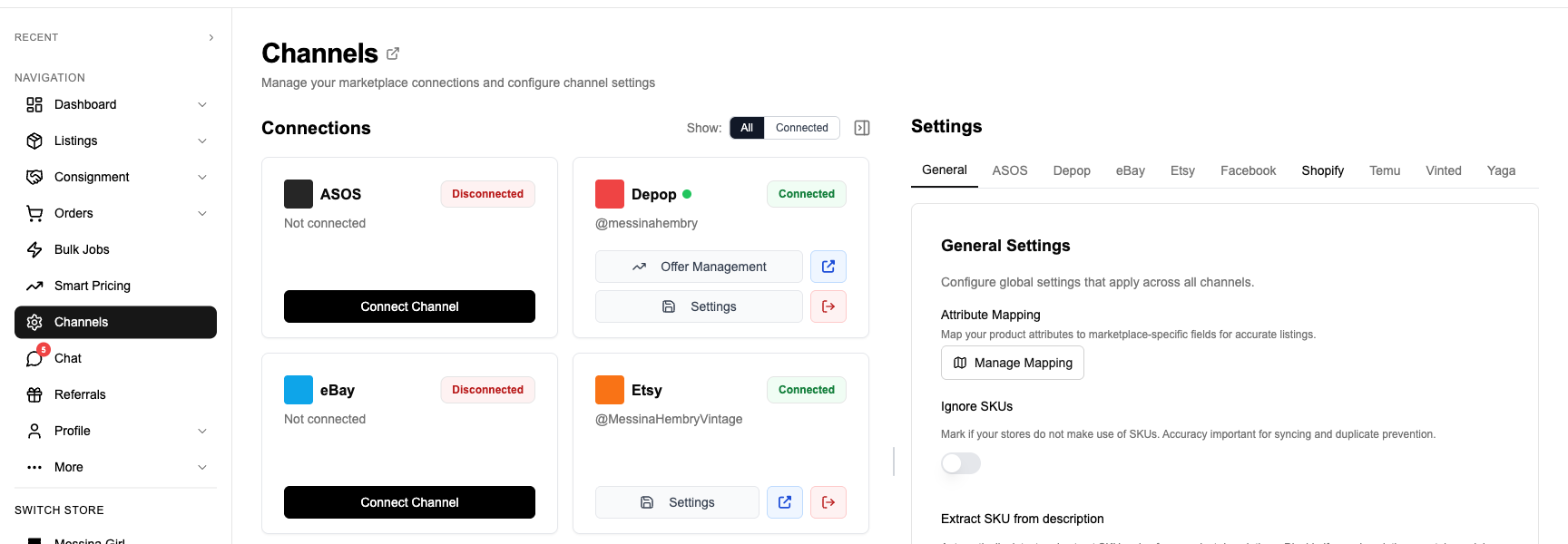
Connect your approved ASOS seller account, choose eligible stock and review the listing details before submitting.
1. Connection. You connect ASOS by entering your Mirakl API key and Shop ID from the ASOS seller back-office.
2. Choose eligible stock. Review ASOS’s current criteria before selecting products.
3. Review your photos. Use clear images that meet the marketplace’s current requirements.
4. Review the listing. Check the title, description, images, price, quantity and product details before submission.
5. Submit and check the outcome. ASOS decides whether to accept each item. Review any requested corrections; acceptance is not guaranteed.
What syncs — and what doesn’t
Once your vintage pieces are accepted and live on asos.com, FLUF Connect keeps them in step with the rest of your selling. What it does on ASOS:
- Crosslisting (submission): preparing and submitting eligible vintage to ASOS curation, as described above.
- Inventory sync: keeping stock levels aligned so an ASOS-live item reflects your true availability.
- Order sync: pulling ASOS orders into FLUF so you can fulfil them under Partner Fulfils.
- Automatic mark-as-sold and delist: when an item sells elsewhere — say on eBay or Depop — FLUF marks it sold and delists it on ASOS so you don’t sell the same one-of-a-kind vintage piece twice. This is the oversell protection that matters most for unique stock.
What FLUF deliberately does not do on ASOS:
- No relisting. Unlike channels where you can bump or re-post stale listings, ASOS doesn’t support a relist flow through this integration, so FLUF doesn’t fake one.
- No offer management. Adjusting and managing live offers on ASOS isn’t supported by the channel, so FLUF doesn’t expose it.
We list these limits openly because a tool that pretends to support actions a channel doesn’t have just creates silent failures. On ASOS, FLUF does the things ASOS actually supports — and is honest about the rest.
Crosslisting beyond ASOS
ASOS should almost never be your only channel — especially because it’s selective and curation can decline items you love. The strength of FLUF Connect is that the same catalogue feeds every channel at once, so your vintage works everywhere it can while ASOS curation runs in the background.
The natural companions for an ASOS vintage seller:
- Depop — the obvious home for Y2K and vintage with a young, style-led audience.
- Vinted — huge European reach and zero seller fees on many markets, ideal for volume.
- Etsy — strong for genuine vintage (Etsy’s own vintage rules require items 20+ years old), a good fit for the same stock you’d send to ASOS.
- eBay — unmatched breadth and a deep vintage buyer base, plus auction options for rarer pieces.
Because FLUF handles inventory sync and automatic mark-as-sold across all of them, listing one vintage jacket on five channels doesn’t create five oversell risks — the first sale anywhere cleans up the rest. That’s what makes pursuing a selective channel like ASOS low-risk: you’re not putting eggs in one basket, you’re adding one more shop window to a catalogue that’s already working.
Common mistakes sellers make with ASOS
Most ASOS failures trace back to treating it like the channel it used to be, or like a casual app. The recurring mistakes:
- Assuming it’s still an open marketplace. The standalone Marketplace closed in 2025. Trying to “sign up to ASOS Marketplace” today is chasing something that no longer exists source.
- Trying to list fast fashion as vintage. Shein, Boohoo, Zara, H&M and ASOS Design won’t pass as curated vintage. Old fast fashion is not vintage, and the curation team knows the difference.
- Submitting Nike, Adidas or Converse vintage. Even genuinely vintage sportswear from these labels is excluded under ASOS policy — a very common and costly assumption.
- Ignoring the title format. A title that doesn’t start with “Vintage” or doesn’t follow
Vintage {Brand} {Type} in {Colour}within 80 characters will fail. There’s no flexibility here. - Wrong image spec. Landscape photos, files over 3MB, the wrong colour space, or fewer than four images will sink an otherwise good item.
- Expecting instant approval. Curation is a human decision and acceptance is never guaranteed — budget for some rejections and keep selling the same stock elsewhere.
- Treating ASOS as the only channel. Because it’s selective, relying on ASOS alone caps your sales. Crosslist.
Pricing vintage for the ASOS audience
Pricing on ASOS should reflect who’s buying: a young, trend- and value-conscious audience of “fashion-loving 20-somethings” source, not a luxury-collector base. That doesn’t mean cheap — desirable vintage commands a premium — but it does mean your pricing has to make sense next to the trend-led product these shoppers came for.
A few principles:
- Price the piece, not the age. “Vintage” alone isn’t a price justification to this audience; desirability, condition, and on-trend appeal are. A clean Y2K leather jacket earns more than a tired 80s blazer regardless of which is “older.”
- Build commission into the number. Because ASOS commission is negotiated per partner and not public, work it out from your own agreement and price so the piece still clears a margin you’re happy with.
- Stay consistent across channels. If the same jacket is on Depop and Vinted at one price and ASOS at another, you’ll confuse buyers and undercut yourself. FLUF lets you keep pricing coherent across the catalogue.
- Let the spec do the selling. Strong portrait images and a clean, compliant title do more for conversion at this price point than aggressive discounting.
Is selling on ASOS worth it?
Honestly? It depends entirely on what you sell. ASOS in 2026 is a narrow, high-value channel, not a catch-all.
It’s worth it if you have genuine, desirable vintage (especially Y2K and decade-defining pieces), excluding the blocked sportswear brands, and you can meet the content spec and fulfil your own orders. For you, ASOS offers something no resale app can: placement of curated vintage inside a 17.0-million-customer catalogue aimed squarely at the young, trend-led shoppers who buy vintage source. Even with some curation rejections, the upside on the pieces that land can be substantial.
It’s not worth it if you sell fast fashion, current-season high-street resale, generic dropshipped product, or vintage that’s mostly Nike/Adidas/Converse. For you, ASOS will mostly mean rejection, and your energy is better spent on Depop, Vinted, eBay and Etsy.
Keep ASOS as an additional channel for eligible stock. Continue selling on your other marketplaces while submissions are reviewed, and check each channel’s inventory-update support.
Getting started with FLUF Connect
Connect ASOS in FLUF Connect with the API key and Shop ID from your seller back office. Choose stock that meets ASOS marketplace requirements and review each listing before submission. Check current channel support before relying on automatic updates.
Plans start at £9/month (Starter). There is no free plan, but every new account gets a 7-day trial for £1. Automation is included from Seller upwards, not a paid add-on — Pro is £99/month and Super Seller is custom-priced, and every plan is unlimited. List once in FLUF, let the eligible pieces flow to ASOS curation, and sell everywhere else at the same time.
Shipping and fulfilment under Partner Fulfils
The word “Fulfils” in Partner Fulfils is the whole operating model, and it’s worth understanding before you apply. Unlike a wholesale arrangement where a retailer buys your stock and ships it from their own warehouse, Partner Fulfils keeps the inventory — and the shipping — with you. ASOS lists your accepted item on asos.com, takes the order and the payment, and passes the order to you to pick, pack and dispatch directly to the customer source. Your stock never enters an ASOS fulfilment centre.
That has two practical consequences. First, you keep full control of your inventory: a one-of-a-kind vintage jacket physically stays with you until it sells, so you can keep it listed elsewhere at the same time (more on that below). Second, you inherit ASOS’s delivery expectations. ASOS customers are used to fast, tracked, well-packaged dispatch, and a Partner Fulfils seller is judged against that standard rather than the more forgiving norms of a peer-to-peer app. Before you commit, be honest with yourself about whether you can pack to a retail standard and dispatch promptly — because on ASOS your fulfilment is part of the ASOS brand experience, not a private transaction between two app users.
What happens when an ASOS item sells
When an accepted vintage piece sells on asos.com, the order flows back to you through the Mirakl back-office, and FLUF Connect pulls it in via order sync so it sits alongside your orders from every other channel rather than living in a separate dashboard you have to remember to check. You fulfil it under Partner Fulfils — ship to the customer, add tracking — and the sale is recorded against your ASOS shop.
The more important moment is the reverse: what happens to your other listings. Because vintage is almost always one-of-a-kind, the single biggest risk of selling the same jacket on ASOS, Depop and Vinted at once is selling it twice. FLUF Connect’s automatic mark-as-sold closes that gap: the instant the piece sells on any connected channel, FLUF marks it sold and delists it on the others — including pulling it from ASOS when it sells elsewhere. That is the difference between treating ASOS as a safe additional shop window and treating it as a liability. With oversell protection running in the background, adding ASOS to your channel mix costs you nothing in risk, even on unique stock.
ASOS vs Depop, Vinted, Etsy and eBay for vintage
For a vintage seller deciding where ASOS fits, it helps to place it against the channels you probably already use. ASOS is the most selective of them — and that selectivity is both its cost and its value.
| Channel | Access for an individual vintage seller | Best at |
|---|---|---|
| ASOS | Gated — curated vintage only, criteria + human approval | Placing standout vintage in front of a 17m-customer fashion audience |
| Depop | Open — sign up and list | Y2K, vintage and trend pieces to a young, social audience |
| Vinted | Open — sign up and list, zero seller fees in many markets | High-volume everyday and vintage across Europe |
| Etsy | Open — but genuine “vintage” must be 20+ years old | True vintage and collectables to search-driven buyers |
| eBay | Open — vast vintage buyer base, auctions available | Reach, rarer pieces, and anything ASOS rejects |
The takeaway is not that ASOS is “better” — it’s that ASOS is a different kind of channel. Depop, Vinted, Etsy and eBay are where you build volume and turn stock over reliably, because anyone can list. ASOS is where a curated subset of your best vintage can reach a mainstream fashion audience those apps don’t touch — if it’s accepted. The right strategy treats the open channels as your base and ASOS as upside layered on top, with one catalogue feeding all of them through FLUF Connect so the curated pieces flow to ASOS while everything keeps selling everywhere else.
Related Guides
Sources & Verification
Last verified: 2026-06-28. Please contact us if any figure is out of date.
- ASOS plc — Annual Report and Accounts 2025 — FY2025 (52 weeks to 31 August 2025): 17.0 million active customers, £2,477.8m revenue, regional splits
- ASOS plc — ASOS finalises integration of vintage and boutique Marketplace sellers onto asos.com — standalone Marketplace wind-down, migration completed by April 2025, sellers subject to meeting on-site selling criteria
- Mirakl — ASOS expands ‘Partner Fulfils’ programme in partnership with Mirakl — Partner Fulfils model, ASOS takes order and payment while sellers pick, pack and dispatch directly
- Retail Gazette — ASOS migrates marketplace sellers to main site — sellers gain ASOS’s full traffic plus features such as “Buy the Look”
- TrustRadius — Mirakl Marketplace Platform details — catalogue aggregation/standardisation/deduplication, operator-controlled category structure and attribute schemas (Products and Offers model)
Subscribe to seller brief
Choose topics firstFrequently Asked Questions
No. ASOS closed its open standalone Marketplace in April 2025 and migrated sellers onto asos.com via the Mirakl-powered Partner Fulfils programme. It is criteria-gated and curated, not a self-serve site where any reseller can list inventory. Today the realistic route for resellers is genuine vintage, and even then every batch must pass ASOS's vintage curation team. Acceptance is never guaranteed.
Genuine vintage only — pieces with real vintage, Y2K, retro or decade provenance. Fast-fashion brands such as Shein, Boohoo, PrettyLittleThing, Zara, H&M, Topshop and ASOS Design are rejected outright. Nike, Adidas and Converse are excluded even for vintage sellers under ASOS policy. Listings must follow the strict vintage title format and portrait JPEG image spec, and pass human curation before going live.
ASOS does not publicly publish its current commission — it is negotiated per partner under the Partner Fulfils model, so anyone quoting a fixed public rate is guessing. The legacy boutique Marketplace charged roughly 20%, but that is historical only. On the FLUF Connect side, plans start at £9/month (Starter). There is no free plan, and automation is included from Seller upwards, not a paid add-on.
Yes. Once your vintage pieces are accepted and live, FLUF Connect runs inventory sync and order sync for ASOS, and will automatically mark an item as sold and delist it across your other channels when it sells. What FLUF does not do on ASOS is relisting or offer management — those actions aren't supported by the channel, so they're deliberately disabled rather than faked.
Partner Fulfils is ASOS's third-party seller model, powered by the Mirakl marketplace platform. Approved partners list on asos.com and fulfil orders themselves — shipping directly to customers without stock ever entering an ASOS warehouse. It replaced the standalone ASOS Marketplace, folding vintage and independent-boutique sellers into the main ASOS catalogue and audience.
Submit eligible genuine vintage items and review the submission status in FLUF Connect. ASOS’s vintage curation team makes the final acceptance decision; submission does not guarantee approval.
ASOS reported 17.0 million active customers and £2,477.8m revenue in its FY2025 annual report (52 weeks to 31 August 2025). By customer count Europe leads with 7.6m, ahead of the UK on 6.5m and the US on 1.7m. Its long-standing positioning is the destination for fashion-loving 20-somethings, which makes it a strong fit for desirable vintage and Y2K pieces.
Vintage titles must start with the word Vintage in the format 'Vintage {Brand} {Type} in {Colour}', capped at 80 characters. Images must be portrait JPEG around 2116×2700px, sRGB, under 3MB, with at least four images per item. Mirakl's model also separates Products (the shared catalogue) from Offers (your listing), so a new item may need a product proposal before you can attach an offer.