
Crosslist from Etsy to ASOS — Take Your Genuine Vintage to a Mainstream Fashion Audience
Etsy already defines vintage as 20+ years old — the exact standard ASOS's curation team wants. Here's how FLUF Connect submits your genuine Etsy vintage to ASOS's 17m-strong young fashion audience, honestly and without overselling.



Key Takeaways
- Etsy’s own policy defines vintage as items at least 20 years old — the exact standard ASOS‘s vintage curation team is looking for, making Etsy vintage the strongest true-vintage fit of any source (Etsy vintage policy).
- ASOS is not an open marketplace. It closed its standalone Marketplace in April 2025 and now sells third-party stock on asos.com via the Mirakl-powered “Partner Fulfils” programme, where sellers fulfil their own orders (ASOS PLC, 23 Jan 2025; Mirakl).
- For resellers the realistic route is genuine vintage, curated — reviewed by ASOS’s vintage team, with acceptance not guaranteed. FLUF Connect submits; ASOS decides.
- ASOS reaches 17.0m active customers, with roughly 49% of revenue in the UK and 33% in the EU — “fashion-loving 20-somethings”, young and trend-led, ideal for vintage and Y2K (ASOS PLC Annual Report FY2025).
- Etsy charges a $0.20 listing fee plus a 6.5% transaction fee, with payment processing and optional Offsite Ads on top (Etsy Fees & Payments Policy).
- Etsy handmade and craft items are not a fit for ASOS’s vintage route, and Nike, Adidas and Converse are excluded even when genuinely vintage. Only authentic vintage qualifies.
Why crosslist Etsy to ASOS
Most crosslisting guides start by selling you on reach. This one starts with a standard, because the standard is the whole story. Etsy and ASOS happen to agree on the single most important definition in the resale world: what counts as vintage.
Etsy’s own house rules state plainly that for an item to be sold as vintage, it must be at least 20 years old at the time of listing. Reproductions, “vintage-inspired” pieces and items merely made to look old do not qualify (Etsy vintage policy). That is not a loose marketing label — it is policy, and Etsy can ask sellers where their vintage comes from and how it is sourced.
ASOS, meanwhile, runs a vintage curation programme for third-party stock and is looking for exactly that: genuine, authentic vintage, not fast fashion dressed up as retro. So if you already run a compliant Etsy vintage shop, you have done the hard part. Your stock is, by definition, the kind of merchandise ASOS’s curation team exists to find. Of every source channel FLUF Connect supports, an Etsy vintage shop is the strongest true-vintage fit — because the entry bar on both sides is the same 20-year rule.
The opportunity, then, is not about creating new inventory. It is about audience. Etsy is a search-driven marketplace built around handmade, craft and vintage discovery. Its shoppers arrive with a query in mind and browse a long tail of small sellers. ASOS is a different animal entirely: a mainstream fashion destination whose customers are young, trend-led and shopping the way they shop for new clothes. Your genuine Etsy vintage rarely surfaces in front of that crowd through Etsy’s craft-led search. Crosslisting fixes that — the same garment, in front of two audiences, with one set of listing work.
This page is deliberately honest about where that opportunity ends. Not everything in an Etsy shop belongs on ASOS, and ASOS does not simply publish whatever you send. Read the reality check next before you connect anything.
The reality check — ASOS is curated vintage (read first)
It is tempting to picture ASOS as just another marketplace you switch on. It is not, and treating it that way will lead to disappointment. Here is what is actually true in 2026.
ASOS closed its standalone Marketplace. The old open boutique platform shut down in April 2025. Third-party stock now appears on the main asos.com site through a Mirakl-powered “Partner Fulfils” programme, in which sellers fulfil their own orders rather than shipping into an ASOS warehouse (ASOS PLC, 23 Jan 2025; Mirakl).
For resellers, the route is genuine vintage — and it is curated. ASOS’s vintage curation team reviews items before they go live. There is no “publish” button that bypasses that review. FLUF Connect can prepare and submit your eligible vintage in the correct format, but acceptance is never guaranteed. ASOS makes the final call, item by item.
Choose genuine vintage items. Fast-fashion items are not suitable for this ASOS vintage programme. Review the eligibility requirements before submitting; ASOS makes the final acceptance decision.
Nike, Adidas and Converse are excluded — even when genuinely vintage. This catches a lot of sellers off guard, because vintage sportswear is hot. But these brands are excluded from the ASOS vintage route regardless of age, so a 1990s Nike windbreaker that is unquestionably 20+ years old still will not pass. Plan around it.
Commission is negotiated, not public. ASOS does not publish a standard commission rate for its third-party programme; the rate is agreed per partner. Any “around 20%” figure you see quoted is historical context from the old Marketplace and should not be treated as today’s number.
None of this makes ASOS a bad channel. It makes it a selective one. If your Etsy shop is full of authentic vintage clothing — and especially Y2K, retro and statement pieces that suit a young fashion audience — ASOS is a genuinely exciting place to be. Just go in understanding that you are submitting to a curator, not flipping a switch.
How FLUF Connect submits your Etsy vintage to ASOS
FLUF Connect sits between your Etsy shop and ASOS, importing on one side and submitting on the other. The two ends work quite differently, and it helps to know why.
Connect Etsy. Follow Etsy’s authorisation prompts in FLUF Connect, then import your titles, descriptions, photos, prices and categories.
Connect ASOS. Enter the Mirakl API key and Shop ID issued to your approved seller account. ASOS reviews submitted items before they can go live.
- Keyword pass: genuine-vintage signals in your title and description pass; fast-fashion brand names (Shein, Boohoo, PrettyLittleThing, Zara, H&M, Topshop, ASOS Design) trigger automatic rejection.
- Brand exclusions: Nike, Adidas and Converse are filtered out even if the listing reads as vintage.
- Review the photos. Make sure they accurately show the item and meet ASOS’s presentation requirements.
- Curated batches: items that clear the pre-check are grouped and submitted to ASOS’s curation team for the final human review.
Confirm each item meets ASOS’s eligibility and presentation requirements before submitting it. ASOS makes the final decision about acceptance.
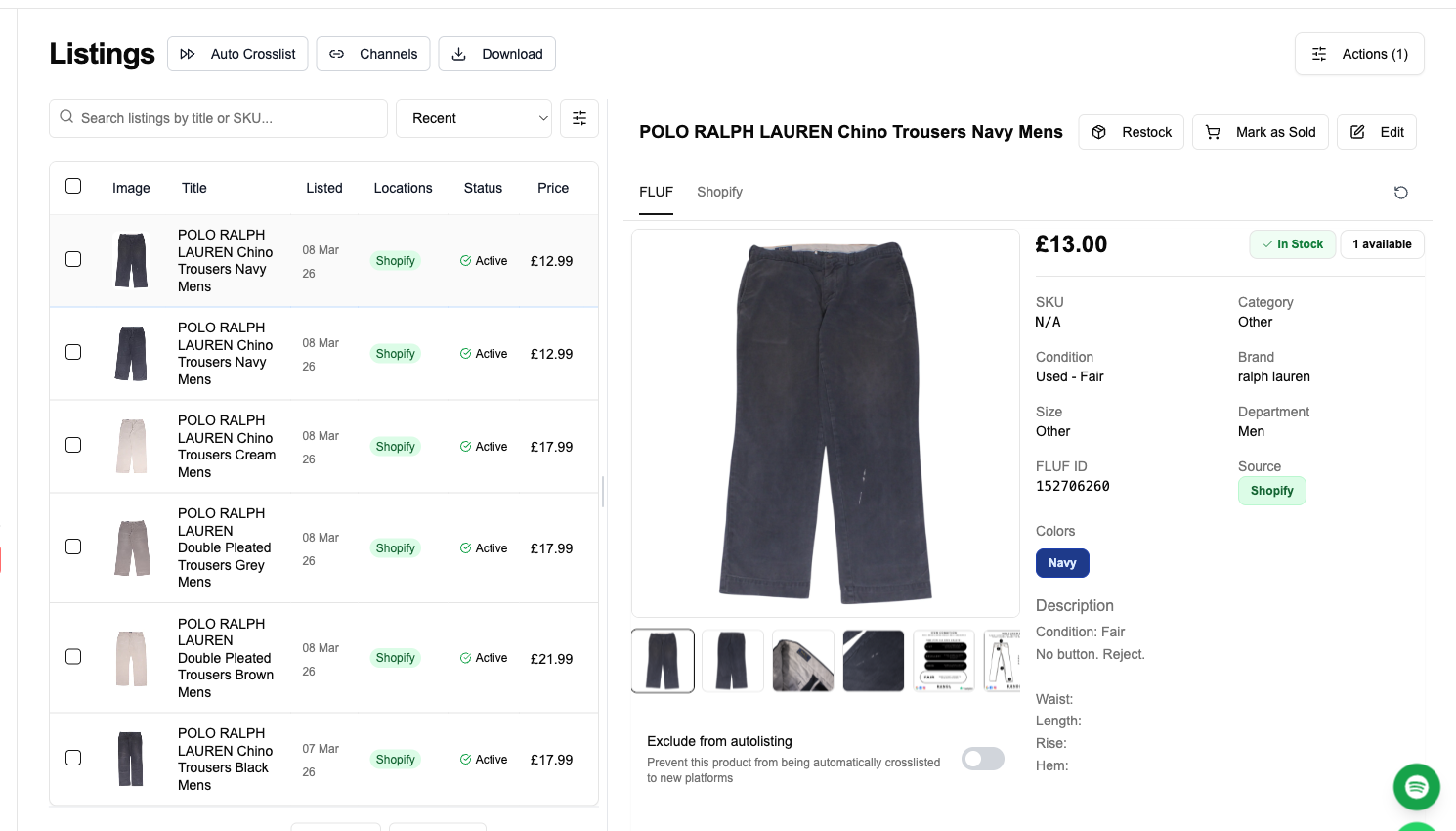
Step by step
- Connect Etsy. Add Etsy in FLUF Connect and complete the authorisation prompts, then import your listings.
- Connect ASOS. Enter the Mirakl API key and Shop ID issued to your approved ASOS seller account.
- Identify your genuine vintage. Filter your imported Etsy stock to the items that are authentic vintage (20+ years old). Set aside everything handmade, craft, print-on-demand or made-to-order — those are for your other channels, not ASOS.
- Review your selection. Confirm that each item meets ASOS’s vintage, brand and presentation requirements before submission.
- Reformat for ASOS. FLUF rebuilds titles to the “Vintage {Brand} {Type} in {Colour}” format (max 80 characters) and prepares images to ASOS’s portrait JPEG spec. Check that your photos meet the size and count requirements.
- Submit the curated batch. FLUF creates the Mirakl product proposal where needed and attaches your offer, then submits the batch to ASOS’s vintage curation team.
- Wait for curation. ASOS reviews. Accepted items go live on asos.com; declined items stay only on your other channels. Acceptance is not guaranteed, so don’t assume a submission is a listing.
- Sell and stay in sync. Once an item is live, FLUF keeps inventory and orders in sync. When it sells anywhere, FLUF auto marks-as-sold and delists across channels so you don’t oversell. You fulfil ASOS orders yourself under Partner Fulfils.
Field & category mapping
FLUF translates each Etsy field into the shape ASOS’s Mirakl integration expects. The two fields that trip sellers up most are the title format and the image spec — get those right and curation goes far more smoothly.
| Etsy field | ASOS / Mirakl target | Notes |
|---|---|---|
| Listing title | Vintage title: Vintage {Brand} {Type} in {Colour} |
Rebuilt by FLUF. Max 80 characters. “Vintage” prefix signals the curation team this is an authentic vintage piece. |
| Description | Mirakl product description | Carried across; keep genuine-vintage language. Fast-fashion brand mentions can trigger rejection. |
| Photos | Portrait JPEG, ~2116×2700, sRGB, under 3MB, at least 4 images | ASOS is strict here. Portrait orientation and JPEG are required; non-conforming images can block a listing. |
| Price | Mirakl Offer price | Your offer attaches to the ASOS catalogue Product. Set with ASOS’s young, trend-led audience in mind. |
| Category / item type | Mirakl Product category | Review the ASOS category. New items may need ASOS approval before publication. |
| Brand | Brand attribute (with exclusions) | Nike, Adidas and Converse are excluded even if vintage. Fast-fashion brands auto-reject. |
| Quantity / stock | Offer stock (typically 1 for vintage) | Vintage is usually unique. Inventory sync keeps this accurate after listing. |
| — | Product layer vs Offer layer | Mirakl splits the catalogue entry (Product) from your listing (Offer). FLUF handles both, including the product proposal for new items. |
What syncs and what doesn’t
Being clear about FLUF’s caps on ASOS matters more here than on most channels, because ASOS deliberately supports fewer operations than an open marketplace would.
What FLUF does on ASOS:
- Crosslisting (submission): formatting and submitting eligible vintage to ASOS’s curation team.
- Inventory sync: keeping stock levels aligned once an item is live.
- Order sync: pulling ASOS orders back into FLUF.
- Auto mark-as-sold and delist: when an item sells on any connected channel, FLUF marks it sold and removes it elsewhere to prevent overselling.
What FLUF does not do on ASOS:
- No relisting. Unlike some channels, there is no automatic relist on ASOS. A sold or removed item stays down until you list afresh.
- No offers. ASOS’s third-party route does not support buyer offers through FLUF, so there is no offer management to sync.
And one more honest caveat: every operation above only applies after ASOS’s curation team has accepted and published the item. Inventory sync cannot keep a listing live that ASOS never accepted. Think of submission and sync as two separate stages — FLUF owns the submission and the post-acceptance housekeeping; ASOS owns the gate in between.
Before & after workflow
Before FLUF Connect. Your vintage lives on Etsy, where it competes for attention in a search-driven craft marketplace. To reach ASOS’s audience you would need to be an approved ASOS partner, learn the Mirakl Products-and-Offers model, hand-build vintage-format titles within an 80-character limit, reshoot or reprocess every photo to a strict portrait JPEG spec, work out which of your items the curation team will even consider, and then manage two stock counts by hand so you never sell the same one-of-a-kind piece twice. Most Etsy vintage sellers, quite reasonably, never attempt it.
After FLUF Connect. Import your Etsy stock, select items eligible for ASOS and review their titles, photos and required product details before submission. ASOS reviews the items; only accepted listings go live. Inventory sync applies once the item is accepted and published.
The difference is not magic — ASOS still curates, and not everything gets in. The difference is that the unglamorous, error-prone formatting and reconciliation work disappears, leaving you to focus on sourcing good vintage.
What qualifies — genuine vintage (20+ years) yes, handmade/craft no
This is the section to bookmark, because getting it right saves you wasted submissions.
Yes — genuine vintage. Authentic clothing and accessories that are at least 20 years old, matching Etsy’s own definition of vintage (Etsy vintage policy). Y2K, 1990s, retro and statement pieces are particularly well suited to ASOS’s young, trend-led customers. If you already sell it as compliant vintage on Etsy, it is a strong ASOS candidate.
No — handmade and craft. Etsy’s heartland is handmade goods, craft supplies, print-on-demand and made-to-order items. None of these are vintage, and none of them fit ASOS’s vintage route, however well they sell on Etsy. They belong on your other channels.
No — excluded brands. Nike, Adidas and Converse are excluded from the ASOS vintage route even when the item is genuinely old. Don’t submit them; they won’t pass.
No — anything fast fashion. Shein, Boohoo, PrettyLittleThing, Zara, H&M, Topshop and ASOS Design are auto-rejected by FLUF’s pre-check before submission, which is exactly what you want — it keeps your submission batches clean and your standing with the curation team good.
The mental model is simple: ASOS is not a second Etsy. It is a curated vintage shelf inside a mainstream fashion site. Send it the slice of your Etsy shop that genuinely belongs on that shelf, and leave the rest where it already performs.
Pricing and the audience-reach angle
FLUF Connect plans start at £9/month (Starter). There is no free plan, but every new account gets a 7-day trial for £1. Automation is included from Seller upwards, not a paid add-on. You can see the full breakdown on the pricing page.
Your other costs sit on the two marketplaces themselves. On Etsy, expect a $0.20 listing fee, a 6.5% transaction fee on the item price plus shipping, payment processing (around 3% + $0.25 in the US), and — for shops over $10,000 in annual sales — mandatory Offsite Ads at 12–15% on attributed orders (Etsy Fees & Payments Policy). On ASOS, commission is negotiated per partner and not published, so factor in an agreed rate rather than a public number.
Now the reason it can be worth it. ASOS serves 17.0 million active customers, with roughly 49% of revenue in the UK and 33% across the EU, and an audience that ASOS itself describes as “fashion-loving 20-somethings” — young, trend-led, and the natural home for vintage and Y2K (ASOS PLC Annual Report FY2025). Etsy is large in its own right, but its buyers arrive through craft-led, query-driven search. A vintage Levi’s jacket that a young ASOS shopper would buy on impulse may simply never appear in their world via Etsy.
That gap is the whole pitch. You are not creating new inventory or changing what you sell. You are taking the genuine vintage you already curate to Etsy’s 20-year standard and placing it in front of a mainstream fashion audience that Etsy’s search rarely reaches — with FLUF doing the formatting, the Mirakl plumbing and the cross-channel reconciliation, and ASOS doing the curation. Honest expectations, real upside.
Related Guides
- Sell on ASOS — channel guide
- Sell on Etsy — channel guide
- Crosslist from Depop to ASOS
- Crosslist from Vinted to ASOS
- Crosslist from Etsy to Vinted
Sources & Verification
- Etsy — Vintage Items on Etsy (House Rules): vintage = at least 20 years old
- Etsy — Fees & Payments Policy: $0.20 listing fee, 6.5% transaction fee
- Etsy Inc. — SEC filing, Q2 2025: active sellers and active buyers
- ASOS PLC (23 Jan 2025): standalone Marketplace closure; FY2025 Annual Report audience figures
- Mirakl — marketplace platform powering ASOS Partner Fulfils
Frequently Asked Questions
No. ASOS's third-party route for resellers is genuine vintage only, reviewed by its curation team. Etsy handmade, craft, print-on-demand and made-to-order items are not vintage and won't pass, no matter how well they sell on Etsy. In addition, ASOS excludes Nike, Adidas and Converse even when those items are genuinely vintage. Only authentic vintage pieces (Etsy's own bar is 20+ years old) are candidates.
No. ASOS reviews submitted items before they go live, and acceptance is not guaranteed. Check that your items meet its current vintage, brand and presentation requirements before submitting them.
Yes, once ASOS has accepted and published the item. FLUF Connect then supports inventory and order sync and updates connected listings when it sells. Relisting and offer management are not available on ASOS.
FLUF Connect plans start at £9/month (Starter). There is no free plan, and automation is included from Seller upwards rather than a paid add-on. ASOS does not publish a public commission for its third-party programme; the rate is negotiated per partner. Etsy charges its own separate seller fees, including a $0.20 listing fee and a 6.5% transaction fee.
ASOS requires eligible authentic vintage. Confirm the production date and current brand restrictions before submission. Reproductions and vintage-inspired modern items do not qualify as genuine vintage.
Import your Etsy listing into FLUF Connect, then review the title, description, photos, price and category for ASOS. Check ASOS’s current image and presentation requirements before submitting the item for review.
Etsy is a search-driven craft and vintage marketplace; ASOS is a mainstream fashion destination with roughly 17 million active customers who skew young and trend-led — the exact audience for Y2K and retro vintage. Etsy's craft-led search rarely surfaces your vintage to that crowd. Crosslisting puts the same stock in front of both audiences without doubling your listing work.
Under ASOS's Partner Fulfils programme you ship the order yourself. FLUF Connect receives the ASOS order, syncs it back, and automatically marks the item as sold and delists it on your other connected channels so you don't oversell. Because ASOS has no relisting on FLUF, a sold item stays down until you create a fresh listing.