Designer Wardrobe vs Vinted: The Honest 2026 Seller Comparison (AU & NZ)
Fees, audience and region compared — plus why Vinted isn't a NZ option and how to sell on both in Australia



Key takeaways
- Region is the first thing to settle. Designer Wardrobe operates across Australia and New Zealand. Vinted only launched in Australia on 1 July 2026 and has no New Zealand presence at all source. A like-for-like “Designer Wardrobe vs Vinted” comparison is therefore only realistic for Australian sellers — if you sell from New Zealand, Vinted is not an option yet and Designer Wardrobe (or eBay via eBay.com.au) is your route.
- Fees point in opposite directions. Designer Wardrobe charges the seller a success fee — flat $4.95 under $40, or 12.95% above $40 (capped at $249) — plus payment fees source. Vinted charges the seller nothing (0% commission, keep 100% of the price) and puts a Buyer Protection fee (~5% + a fixed amount, A$0.70 in Australia) on the buyer instead source.
- Audience is dense-and-curated vs vast-but-new. Designer Wardrobe has ~350,000 members concentrated in Australia and New Zealand, doing ~$1.6m in transactions a month source. Vinted has 100M+ registered users and €10.8bn GMV in 2025 source — but almost all of that is in Europe; its Australian base is brand-new and thin.
- Category mix differs. Designer Wardrobe skews pre-loved designer and contemporary fashion, women’s-led source. Vinted is broad second-hand with a high-street / mass-market skew source.
- Shipping is local on both. Designer Wardrobe handles pre-loved fashion posted within Australia/New Zealand; Vinted uses integrated prepaid labels per country — Australia Post in Australia source.
- Why not both? For Australian sellers, FLUF Connect lists one catalogue to both Designer Wardrobe and Vinted (and Depop, Shopify and more). Both channels support full order sync and mark-as-sold, so a sale on one automatically removes the item from the other. Plans start at £19/month (Growth — 500 products). There is no free plan.
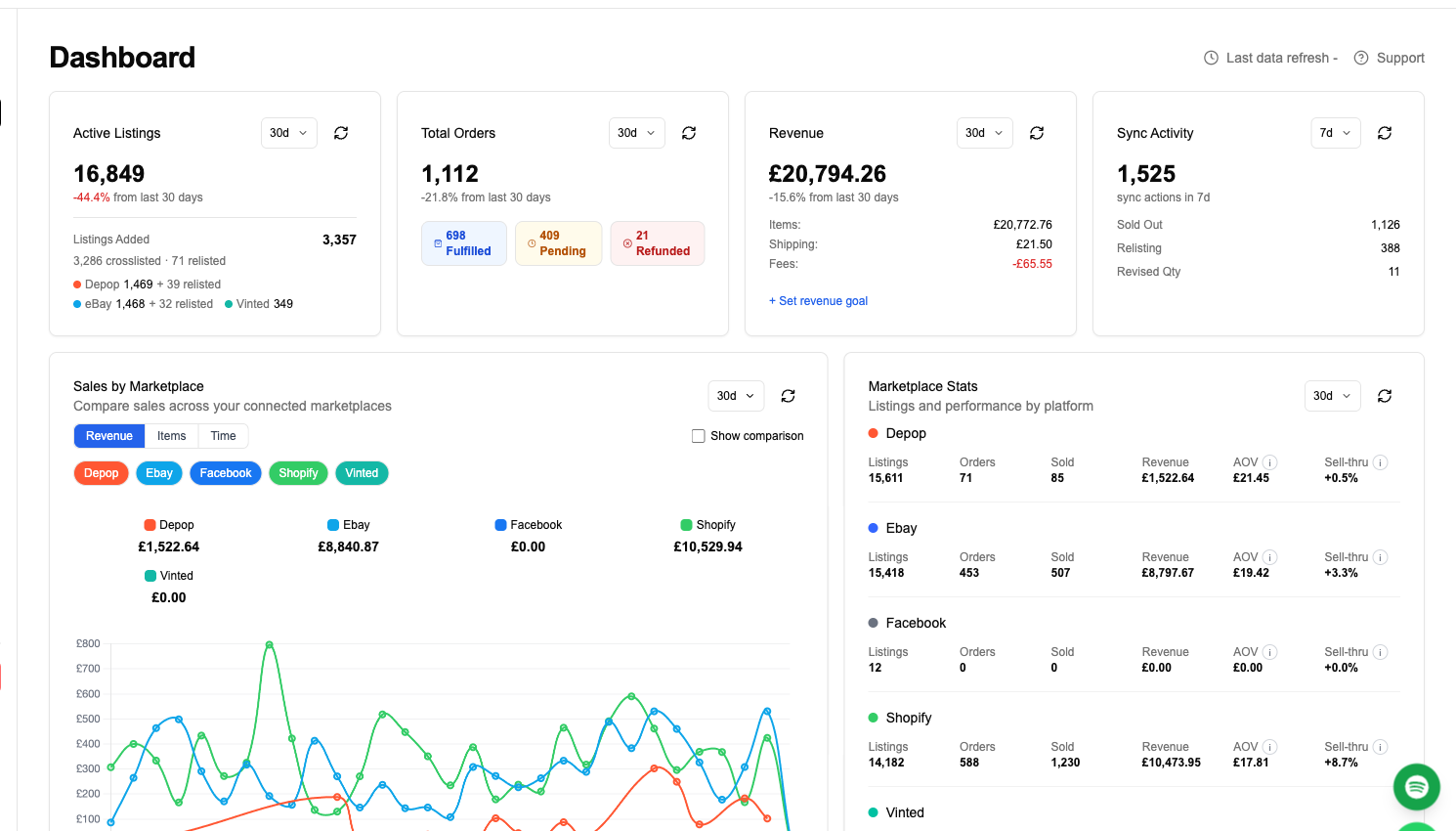
Table of contents
- 1. At a glance
- 2. Feature by feature
- 3. Listing experience
- 4. Fees & payouts
- 5. Audience & demand
- 6. Shipping
- 7. What real sellers say
- 8. How to choose
- 9. Why not both? Sell on both with FLUF Connect
- 10. Sources & verification
1. At a glance
On paper, Designer Wardrobe and Vinted look like the same kind of business: an app-first, pre-loved fashion marketplace where individuals list clothes they no longer wear and buyers scroll a feed to find them. In practice they are so different in geography, fee philosophy and scale that the honest answer to “which should I use?” depends almost entirely on where you are and what you sell — and, crucially, whether you can even access both.
That last point is the one most comparisons skip, so we will put it first. Designer Wardrobe was founded in Auckland in 2014 and operates across both New Zealand (its home market, on the .co.nz site in NZD) and Australia (in AUD), where it expanded to “shop and sell across the Tasman” source. Vinted, by contrast, is a European giant that has only just started arriving in the Southern Hemisphere: it launched in the United States in January 2026, and in Australia on 1 July 2026, with AUD pricing, Australian sizing and Australia Post integration. There is no New Zealand launch — Vinted is simply not available to sell on in NZ source.
So the practical framing is this. If you are a New Zealand seller, “Designer Wardrobe vs Vinted” is not a live choice — Vinted isn’t there, and Designer Wardrobe (or eBay via eBay.com.au) is your realistic domestic pre-loved route. If you are an Australian seller, you genuinely can weigh the two: a mature, curated, Tasman-focused platform against a brand-new local outpost of the world’s biggest dedicated second-hand fashion app. Everything below assumes the Australian reader unless stated otherwise, because that is the only place the comparison is real.
Here is the shape of it before we go deep:
| Designer Wardrobe | Vinted | |
|---|---|---|
| Home region | New Zealand (founded 2014), expanded to Australia | Europe; US Jan 2026; Australia 1 July 2026; not in NZ |
| Available to sell in AU? | Yes | Yes (since 1 Jul 2026, thin/new base) |
| Available to sell in NZ? | Yes | No |
| Who pays the fee | The seller (success fee + payment fees) | The buyer (Buyer Protection fee); seller pays 0% |
| Seller commission | $4.95 under $40 / 12.95% over $40 (cap $249) | 0% |
| Members / scale | ~350,000 (AU+NZ), ~$1.6m/month transactions | 100M+ registered, €10.8bn GMV (2025) — Europe-heavy |
| Category skew | Pre-loved designer & contemporary, women’s-led | Broad second-hand, high-street / mass-market skew |
| Currency | NZD (.co.nz) / AUD (AU site) | AUD in Australia |
| Order sync via FLUF | Yes | Yes |
| Mark-as-sold via FLUF | Yes | Yes |
Read that table and the strategic picture almost writes itself: Designer Wardrobe is the deeper, more established, more certain option in the region, but you pay for the privilege of selling on it; Vinted is cheaper to sell on and enormous globally, but in Australia it is a young marketplace still building liquidity, and in New Zealand it doesn’t exist. The rest of this page unpacks each of those trade-offs.
2. Feature by feature
Both platforms give you the core toolkit of a modern resale app: photo-led listings, in-app messaging, buyer offers, integrated payments and prepaid shipping. The differences are in the flavour rather than the feature checklist.
| Feature | Designer Wardrobe | Vinted |
|---|---|---|
| Listing cost | Free to list | Free to list |
| Seller success/commission fee | $4.95 (<$40) or 12.95% (>$40), cap $249 | None (0%) |
| Buyer-side fee | Buyer Protection built in; fee borne within the model | Buyer Protection ~5% + fixed (A$0.70) |
| Paid promotion | Buyer Protection + community moderation focus | Optional paid Bumps / Spotlight |
| Offers / negotiation | Yes, in-app | Yes, in-app |
| Payout mechanism | DW Wallet, withdraw to bank after buyer receives item | Payout to balance, transfer to bank |
| Curation / moderation | Curated designer focus, community moderation | Open listing, broad categories |
| Buyer protection | Yes | Yes (funded by buyer fee) |
The single most important structural difference in this table is the fee row, and it deserves emphasis because it changes seller behaviour. On Designer Wardrobe the platform makes its money from you, the seller: list free, but when the item sells the success fee comes out of your proceeds, and card/BNPL payment fees may apply on top source. On Vinted the platform makes its money from the buyer: you keep 100% of your asking price, and the person buying pays the Buyer Protection fee at checkout source.
That is not a cosmetic accounting choice. It means Vinted sellers can price aggressively low and still net the full amount, which is a big part of why Vinted’s culture is high-volume, low-ticket, fast-turnover selling. Designer Wardrobe’s seller-pays model, combined with its designer curation, tends to reward higher-value items where a 12.95% fee is comfortably absorbed by the sale price — and where the audience is specifically hunting for that kind of piece.
Note too that Vinted offers optional paid visibility tools (Bumps and Spotlight) that push a listing up the feed for a fee source. Designer Wardrobe leans instead on curation and community moderation to keep the feed relevant rather than a pay-to-surface auction of attention source. Neither approach is objectively better; they suit different sellers.
3. Listing experience
Creating a listing on either app follows the familiar resale pattern: photograph the item, add a title and description, pick a category, size and brand, set a price, and publish. Both are mobile-first and designed so a casual seller can get an item live in a couple of minutes.
Where the experience diverges is in what the platform expects of the listing. Designer Wardrobe is a curated designer and contemporary marketplace, so brand and authenticity matter more — buyers arrive searching for specific labels, and a well-branded, accurately categorised listing performs meaningfully better source. The platform’s own pitch is that sellers are “up to six times more likely to sell” and that most items sell within three days, which reflects a dense, intent-driven audience rather than a passive one source.
Vinted’s listing flow is tuned for breadth and volume. Because it accepts a very wide range of second-hand goods with a high-street and mass-market skew, listings tend to be quicker and lighter — you are throwing an item into a very large pond and relying on scale and search to find the buyer source. In Europe that scale is overwhelming; in Australia, as of mid-2026, the pond is real but still filling, so listings may sit longer than a European seller would expect until the local user base thickens.
A practical consequence for Australian sellers: the same jacket photographed the same way may behave very differently on the two platforms. On Designer Wardrobe it lands in front of a smaller but highly targeted group of designer-fashion buyers. On Vinted it lands in front of a potentially larger but newer, less category-focused audience. This is exactly the kind of asymmetry that makes listing to both attractive — you get the certainty of the curated market and the upside of the growing mass one without choosing between them.
It’s also worth being realistic about listing effort. Because Designer Wardrobe rewards accurate brand and category data, a little extra care per listing — the correct label spelling, the right sub-category, a clear condition note — pays off in visibility to buyers actively searching that label. Vinted’s breadth means titles and hashtags carry more of the discovery weight, and volume matters: sellers who list consistently tend to surface more often. Neither approach is hard, but they reward slightly different habits, which is one more reason that writing an item once and letting a crosslisting tool adapt it to each channel’s strengths saves real time versus hand-crafting two separate listings for every piece.
4. Fees & payouts
This is the section where the two platforms are most clearly opposite, so let’s work a concrete example. Imagine you sell a contemporary-brand dress for A$100 (item price, ignoring shipping for simplicity).
On Designer Wardrobe, the sale is above $40, so the success fee is 12.95% of the final value: $12.95. Payment processing may apply on top depending on how the buyer pays — for example card is 3% + 49c, and Afterpay/Zip/Laybuy is 4.95% source. Taking a mid-range card scenario, you might see roughly $12.95 success fee plus around $3–$5 in payment fees, so you net somewhere in the region of $82–$84. The success fee is capped at $249, which only bites on very high-value items source. Payout lands in your DW Wallet and becomes withdrawable to your bank once the buyer confirms receipt.
On Vinted, the seller commission is zero. You listed at $100, and you keep the full $100 source. The Buyer Protection fee (~5% + a fixed A$0.70 in Australia) is added on top of your price at checkout and paid by the buyer, so it never touches your proceeds. If you choose to pay for an optional Bump or Spotlight to raise visibility, that is a separate, elective cost — but the core sale costs you nothing.
| A$100 sale | Designer Wardrobe | Vinted |
|---|---|---|
| Seller success/commission fee | $12.95 (12.95%) | $0 |
| Payment fee (illustrative) | ~$3–$5 depending on method | $0 to seller |
| Buyer pays extra? | Within the model | Yes — Buyer Protection ~5% + A$0.70 |
| Approx. seller net | ~$82–$84 | $100 |
| Fee cap | $249 max success fee | n/a (no seller fee) |
On pure take-home, Vinted wins this example decisively — an ~$16–$18 difference on a single $100 sale. So why would anyone pay the Designer Wardrobe fee? Because a fee only matters if the item actually sells, and sells at a good price. Designer Wardrobe’s dense, designer-focused Tasman audience means the probability and speed of a sale — and often the price a buyer will pay for a sought-after label — can be higher than on a young, thin local Vinted. A 12.95% fee on a fast $100 sale beats 0% on an item that sits unseen. The right way to read the fee comparison is therefore not “Vinted is cheaper, use Vinted,” but “Vinted is cheaper per sale, Designer Wardrobe is more certain per listing in the AU/NZ region — which is why many sellers want both.”
Both platforms pay out after the buyer receives the item, which is standard buyer-protection practice: Designer Wardrobe via the DW Wallet, Vinted via your Vinted balance transferred to your bank.
5. Audience & demand
Audience is where the “it depends where you are” theme becomes numbers. Designer Wardrobe reports around 350,000 members across New Zealand and Australia and about $1.6m in transactions per month as of 2025 source. That is small next to global marketplaces, but it is concentrated: those members are specifically in the region, specifically shopping pre-loved designer and contemporary fashion, and the platform’s data shows most items selling within three days with an average seller earning around $126/month source. Density and intent, not raw size, are its advantage.
Vinted is the opposite profile. It reported 100M+ registered users (2023, its last official figure) and, for 2025, €10.8bn in GMV (up 47%), €1.1bn revenue and €62m net profit source. Those are colossal numbers — but they are overwhelmingly European. Vinted’s US arm opened only in January 2026 and its Australian arm on 1 July 2026, so an Australian seller in mid-2026 is not selling into the 100M — they are selling into a brand-new Australian cohort that is still growing off a small base source. And a New Zealand seller is not selling into Vinted at all, because it hasn’t launched there.
So the audience trade-off for an Australian seller is: a proven ~350k regional base that is buying today (Designer Wardrobe) versus a globally-huge brand whose Australian liquidity is real but immature (Vinted). Over the next year or two Vinted’s Australian base will likely thicken considerably given its European trajectory — which is an argument for establishing your listings there early rather than waiting. For a New Zealand seller, there is no audience question to weigh yet: Designer Wardrobe (and eBay via eBay.com.au) is where the buyers are.
Category demand reinforces this. Designer Wardrobe’s audience arrives hunting recognisable designer and contemporary labels, women’s-led source. Vinted’s audience is broader and skews high-street and mass-market, spanning a wider range of second-hand goods source. If your inventory is designer, Designer Wardrobe’s audience is unusually well-matched; if it is everyday high-street pieces at volume, Vinted’s model and culture fit better. If you carry a mix — which most resellers do — that is another nudge toward listing across both.
6. Shipping
Both platforms keep shipping domestic and integrated, which suits their casual-seller base. On Vinted in Australia, shipping runs on integrated prepaid labels through Australia Post — the buyer selects a shipping option, the platform generates the label, and you drop the parcel off source. This mirrors Vinted’s per-country prepaid-label model everywhere it operates, and it is one of the reasons Vinted feels frictionless for high-volume sellers: you rarely touch a courier account or weigh-and-quote a parcel yourself.
Designer Wardrobe handles pre-loved fashion posted domestically within Australia and New Zealand, with the platform’s buyer-protection and wallet flow wrapping the transaction so funds release once the buyer confirms receipt source. Because the catalogue is fashion, parcels are typically small and light, and shipping is a routine part of the sale rather than a complication.
For an Australian seller running both, the shipping workflows are similar enough that operating in parallel is not a burden: light garment parcels, domestic post, funds released on receipt. The one thing to keep straight is fulfilling the right order on the right platform when the same item is listed in two places — which is precisely the problem that crosslisting-with-sync solves, and which we cover in the “Why not both?” section.
7. What real sellers say
Seller sentiment on the two platforms is genuinely different, and it tracks the fee models and maturity described above.
Designer Wardrobe’s seller feedback is broadly positive. Sellers cite the speed and probability of sales — the platform’s “up to six times more likely to sell” and “most items sold within three days” claims resonate with a base that values quick, reliable turnover in the region source. The friction points that surface tend to be practical rather than structural — for instance, app bugs noted in store reviews source — rather than complaints about the fundamental deal. Sellers understand they are paying a fee, and generally feel the audience quality justifies it.
Vinted’s sentiment is more polarised, as you would expect from a platform at global scale. The praise is loud and consistent: zero seller fees. Being able to list, sell and keep 100% of the price is Vinted’s single most beloved feature and the thing sellers mention first source. The criticism clusters around the buyer-protection fee (buyers sometimes resent the added charge) and dispute handling, which some sellers find frustrating when a transaction goes wrong source. For an Australian seller specifically, the honest caveat as of mid-2026 is maturity: the zero-fee upside is real, but the local buyer base is new, so early Australian sellers should set expectations around discovery and time-to-sale accordingly.
Netted out: Designer Wardrobe sellers pay to play and mostly feel it’s worth it for the targeted, fast-moving regional audience; Vinted sellers love the free selling and mostly grumble about buyer-side friction — with the extra Australian wrinkle that the market is still young. It is a useful reminder that “sentiment” is platform-relative: a Designer Wardrobe seller and a Vinted seller are optimising for different things, and each community’s complaints are essentially the shadow of what that platform is best at. Designer Wardrobe sells the audience and charges for it; Vinted gives away the selling and monetises the buyer. Read that way, the reviews are less a verdict on which is “better” and more a description of which trade-off you would rather live with.
8. How to choose
Use this decision matrix to narrow it down. The very first branch is geography, because for half the region there is no choice to make.
| Your situation | Lean toward |
|---|---|
| You sell from New Zealand | Designer Wardrobe (Vinted is not available in NZ) — plus eBay via eBay.com.au if you want reach |
| You sell from Australia and want the lowest cost per sale | Vinted (0% seller fee, keep 100%) |
| You sell from Australia and want the fastest, most certain regional sales | Designer Wardrobe (dense ~350k AU/NZ base, fast turnover) |
| Your inventory is designer / contemporary | Designer Wardrobe (curated, intent-driven buyers) |
| Your inventory is high-street / mass-market at volume | Vinted (broad, high-volume, low-ticket culture) |
| You have a mix of both, and sell in Australia | Both — list to each and let sync prevent overselling |
| You care most about keeping 100% of price | Vinted |
| You care most about audience quality & match | Designer Wardrobe |
The pattern in that matrix is deliberate. There are clean single-platform answers at the edges — a New Zealand seller has no Vinted option; a high-volume high-street Australian seller optimising purely for take-home leans Vinted; a designer-focused seller wanting certainty leans Designer Wardrobe. But the largest group of real resellers sits in the middle: based in Australia, carrying a mix of designer and high-street pieces, wanting both the certainty of the curated market and the free-selling upside of the mass one. For that group the honest recommendation is not to pick — it is to list to both and remove the operational headache of doing so manually.
9. Why not both? Sell on both with FLUF Connect
For Australian sellers, the choice between Designer Wardrobe and Vinted is a false one. FLUF Connect lets you list a single catalogue to both — and to eBay, Depop, Shopify, Etsy, Facebook Marketplace and more — from one dashboard. You write each item once, and the title, description, images, price, quantity and SKU (plus brand, size, category and condition where the destination supports them) push out to every channel you’ve connected.
The reason crosslisting to both is safe here — and not everywhere — comes down to sync capability, and this is worth being precise about. Both Designer Wardrobe and Vinted support full order sync and mark-as-sold through FLUF Connect. That means when your item sells on either platform, FLUF detects the sale and automatically removes the listing from the other, so you can’t accidentally sell the same dress twice. You do not have to babysit two apps or race to delist — the sold-status propagates for you across both channels. (This is genuinely a per-channel fact: some marketplaces FLUF supports have no order sync and require you to end the listing yourself. Designer Wardrobe and Vinted are not among those — both are fully synced.)
Getting started is straightforward: connect your Designer Wardrobe and Vinted accounts in FLUF Connect, import or build your catalogue once, choose the channels for each item, and publish. From then on you manage inventory, offers and orders in one place, with bulk tools to edit or relist in batches rather than item by item. Inventory sync and order sync are included on every plan — not a paid add-on.
On pricing: plans start at £19/month (Growth — 500 products). There is no free plan. That single subscription covers crosslisting to both Designer Wardrobe and Vinted plus every other channel you connect, with the sync that keeps them from overselling included. For a seller who would otherwise be manually double-listing and manually delisting across two apps, the time saved on a mixed catalogue typically dwarfs the subscription — and you capture both the curated certainty of Designer Wardrobe and the free-selling, fast-growing upside of Vinted in Australia at the same time. If you sell from New Zealand, FLUF Connect still lists you to Designer Wardrobe and your other available channels today, and Vinted becomes available the moment it launches there.
10. Sources & verification
Every figure above is drawn from the following primary and reference sources. Fees, member counts, GMV and launch dates change — verify against the originals before making decisions.
- Vinted Australia launch (1 July 2026), no NZ presence: FashionUnited — Vinted expands into Australia and Value Added Resource — Vinted quietly launches Australia
- Vinted seller 0% commission & Buyer Protection fee (~5% + A$0.70): Vinted Help — Buyer Protection fee
- Vinted scale — 100M+ users, €10.8bn GMV 2025: Vinted — Financial results 2025
- Vinted seller sentiment: Trustpilot — Vinted reviews
- Designer Wardrobe fees ($4.95 under $40 / 12.95% over $40, cap $249): Designer Wardrobe Help — DW fees
- Designer Wardrobe payment fees (card 3%+49c, Afterpay/Zip/Laybuy 4.95%, EFTPOS): Designer Wardrobe Help — Card payment fee
- Designer Wardrobe ~350k members, ~$1.6m/month, AU launch: Ocean Road Magazine and Ragtrader
- Designer Wardrobe how-it-works & category: Designer Wardrobe Help — How it works
- Designer Wardrobe sell-speed & avg seller earnings: NZ Entrepreneur; app-bug notes: App Store — Designer Wardrobe
Marketplace capability facts (order sync, mark-as-sold) reflect FLUF Connect’s channel registry at time of writing. FLUF pricing: plans start at £19/month (Growth — 500 products); there is no free plan. See /pricing/ and the crosslisting hub for current details.
Frequently Asked Questions
No. As of mid-2026 Vinted has not launched in New Zealand and cannot be used to sell there. It launched in Australia on 1 July 2026 with AUD pricing and Australia Post integration, and in the US in January 2026, but there is no NZ presence. New Zealand sellers should use Designer Wardrobe (or eBay via eBay.com.au) for pre-loved fashion.
Per sale, Vinted is cheaper for the seller: it charges 0% commission and you keep 100% of your price, while the buyer pays a Buyer Protection fee (~5% + a fixed A$0.70 in Australia). Designer Wardrobe charges the seller a success fee — flat $4.95 under $40 or 12.95% above $40 (capped at $249) — plus payment fees. On a A$100 sale you'd keep about $82–$84 on Designer Wardrobe versus the full $100 on Vinted. But Designer Wardrobe's dense regional audience can mean faster, more certain sales.
They're opposite. Designer Wardrobe charges the seller (success fee plus card/BNPL payment fees). Vinted charges the buyer (a Buyer Protection fee added at checkout), so the seller pays nothing on the core sale.
Designer Wardrobe has around 350,000 members across Australia and New Zealand, doing roughly $1.6m in transactions a month — small but dense and regionally concentrated. Vinted has 100M+ registered users and €10.8bn GMV in 2025, but that base is overwhelmingly European; its Australian market is brand-new and still building liquidity.
Designer Wardrobe skews pre-loved designer and contemporary fashion and is women's-led, with buyers actively searching specific labels. Vinted is broader second-hand with a high-street and mass-market skew, suited to higher-volume, lower-ticket selling.
Yes, if you're in Australia. FLUF Connect lists one catalogue to both from a single dashboard. Both channels support full order sync and mark-as-sold, so when an item sells on one platform FLUF automatically removes it from the other, preventing you from selling the same item twice.
Yes. Designer Wardrobe and Vinted both support order sync and mark-as-sold in FLUF Connect, so a sale on either platform propagates and delists the item from the other automatically. You don't have to manually delist in two apps.
Plans start at £19/month (Growth — 500 products). There is no free plan. That subscription covers crosslisting to both Designer Wardrobe and Vinted plus every other channel you connect, with inventory sync and order sync included on every plan.