Crosslist from Vakoop to Vestiaire Collective — Automatically
Route your genuine designer and luxury pieces from South Africa's Vakoop to Vestiaire Collective's global luxury audience — in one click, with overselling protection built in.



- Vakoop is a South African marketplace for preloved fashion, electronics, sneakers and designer bags where it is free to list; Vestiaire Collective is a global, curated luxury and designer pre-owned marketplace with 23 million-plus members across 100-plus countries.
- FLUF Connect crosslists the eligible designer subset of your Vakoop inventory to Vestiaire Collective — not general preloved items. Vestiaire Collective is brand-curated and authenticates items, so only genuine designer and luxury pieces qualify.
- Two-way overselling protection: both channels support order sync and automatic mark-as-sold in FLUF Connect, so a sale on one removes the matching copy on the other.
- Vestiaire Collective adds relisting and offer management through FLUF Connect; Vakoop does not support those two features.
- FLUF Connect plans start at £9/month (Starter — 300 active products), with automation included in every plan.
Table of contents
- 1. Why sell on both Vakoop and Vestiaire Collective?
- 2. How to crosslist from Vakoop to Vestiaire Collective with FLUF Connect
- 3. Field & category mapping
- 4. Inventory sync — what stays in sync
- 5. Before & after workflow
- 6. Automation features
- 7. Pricing
- 8. Sources & verification
1. Why sell on both Vakoop and Vestiaire Collective?
If you sell preloved items in South Africa, Vakoop is a natural home base. It is a South African marketplace for preloved fashion, electronics, sneakers and designer bags, and it is free to list — so building up a catalogue carries no upfront listing cost. The catch with any single marketplace is reach: a designer handbag listed only on a local platform is seen mainly by local buyers, even when that same bag would command strong interest from collectors abroad.
That is exactly the gap Vestiaire Collective fills. Vestiaire Collective is a global, curated marketplace built specifically for pre-owned luxury and designer fashion, with more than 23 million members across over 100 countries. Its buyers are there precisely to shop authenticated designer and luxury pieces — the kind of inventory that can sit slowly on a general local marketplace but sell briskly to the right international audience.
The crucial point of honesty: Vestiaire Collective is luxury and designer-curated. It is not a general preloved marketplace. Items must meet its brand-eligibility criteria and pass its authentication standards. That means the right strategy is not to mirror your entire Vakoop catalogue onto Vestiaire Collective. Instead, you identify the designer subset of your Vakoop inventory — genuine designer handbags, premium footwear, recognised luxury fashion brands — and route only those eligible pieces to Vestiaire Collective’s global luxury buyers. General preloved fashion, unbranded items and most electronics stay on Vakoop, where they belong.
Because Vakoop already sells designer bags, many South African Vakoop sellers are sitting on exactly the kind of eligible inventory Vestiaire Collective wants. Crosslisting that subset means a designer bag that was previously visible to a domestic audience is now also in front of a worldwide pool of luxury shoppers — without you re-photographing, re-describing or re-pricing it by hand. FLUF Connect does the duplication, and its inventory sync makes sure that selling the bag in one place takes it down in the other.
It also helps to think about why the same item can fetch a different result on each platform. A local marketplace prices against local supply; a global luxury marketplace prices against worldwide demand for that specific brand and model. A sought-after designer handbag with only a handful of potential buyers in one country may have thousands of interested collectors once it is visible internationally. That is the structural advantage of routing your eligible designer pieces to Vestiaire Collective: you connect a single item to the deepest possible pool of buyers who already understand and value the brand. Vakoop keeps doing what it does well — moving your broad, everyday preloved stock to nearby buyers quickly — while Vestiaire Collective handles the high-value designer tail that benefits most from global exposure.
How to tell if a Vakoop item is Vestiaire Collective-eligible
The single most useful skill for this pair is being able to look at a Vakoop listing and judge, before you crosslist it, whether Vestiaire Collective will accept it. A few practical tests:
- Is the brand a recognised designer or luxury label? Vestiaire Collective curates by brand. If the item is from a genuine designer or premium luxury house — the kind of brand a luxury reseller would recognise on sight — it is a candidate. If it is unbranded, generic or high-street, it almost certainly is not.
- Is it within Vestiaire Collective’s fashion scope? Vestiaire Collective is a fashion and accessories marketplace — handbags, footwear, ready-to-wear, jewellery and similar. Electronics, phones and most non-fashion preloved goods fall outside its scope no matter how good they are, so they stay on Vakoop.
- Can you stand behind its authenticity? Vestiaire Collective authenticates qualifying items, and the brand you declare is checked against the physical piece. Only list items you are confident are genuine. If you have any doubt about provenance, keep the item on Vakoop rather than risk a failed authentication on the luxury side.
- Is the condition honestly luxury-saleable? Designer buyers are exacting. A bag with heavy wear can still sell on a general marketplace but may struggle — or grade poorly — on Vestiaire Collective. Be realistic about what is worth routing across.
Run those four checks and you will quickly sort your Vakoop catalogue into a designer subset worth crosslisting and a larger remainder that belongs on Vakoop alone. FLUF Connect gives you the filtering tools to act on that decision, but the eligibility judgement comes from you, because you know your stock.
Audience comparison
| Factor | Vakoop | Vestiaire Collective |
|---|---|---|
| Primary market | South Africa | Global (100+ countries) |
| Audience size | Growing South African marketplace | 23 million-plus members |
| Focus | General preloved: fashion, electronics, sneakers, designer bags | Curated luxury & designer pre-owned fashion only |
| Item eligibility | Broad — most preloved items | Brand-eligible designer/luxury items that pass authentication |
| Cost to list | Free to list | Free to list; commission charged on sale |
| Authentication | Item authentication available | Authentication & buyer protection on qualifying items |
| Best for | Your full preloved catalogue, local buyers | Your designer subset, global luxury buyers |
The two platforms are complementary rather than competing. Vakoop captures local demand across your whole range; Vestiaire Collective extends the high-value designer slice of that range to a worldwide audience that is specifically hunting for it.
2. How to crosslist from Vakoop to Vestiaire Collective with FLUF Connect
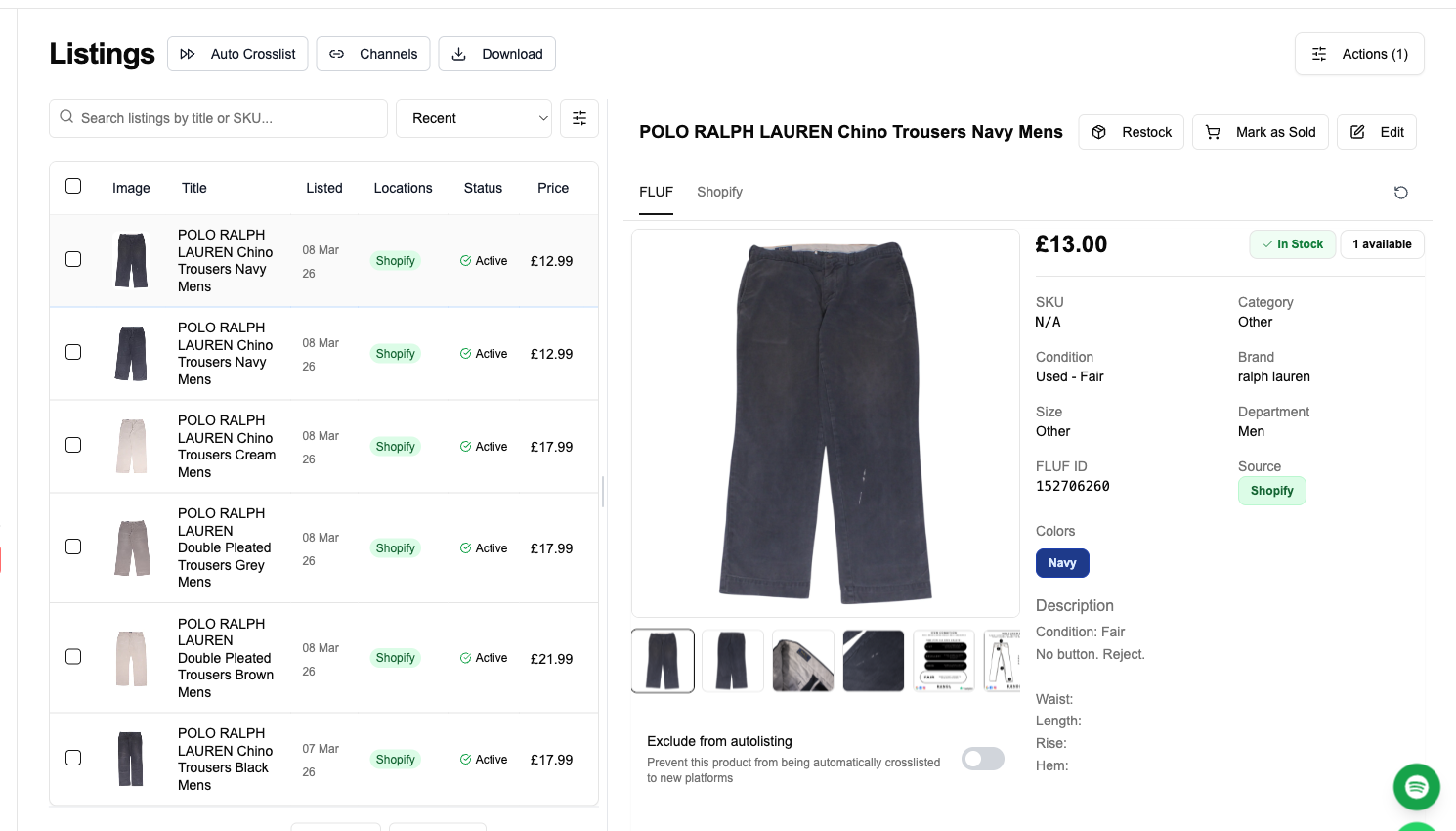
FLUF Connect is a multi-marketplace crosslisting tool: you connect each marketplace once, and from then on you push and sync listings from a single dashboard. Here is the end-to-end flow for sending eligible designer items from Vakoop to Vestiaire Collective.
- Connect Vakoop via the official OAuth API. In FLUF Connect, choose Vakoop and authorise the connection through Vakoop’s official OAuth API. You log in to Vakoop and grant access — FLUF Connect never stores your password, and the secure token lets it read your listings and detect sales for sync.
- Connect Vestiaire Collective via app login (browser extension). Add Vestiaire Collective as a channel. Because Vestiaire Collective is connected through app login using the FLUF Connect browser extension, you sign in to your Vestiaire Collective account in your browser and the extension bridges your session so FLUF Connect can create and update listings on your behalf.
- Import your Vakoop catalogue. FLUF Connect pulls in your existing Vakoop listings — photos, titles, descriptions and prices — so you do not start from a blank slate.
- Filter down to the eligible designer subset. This is the step that matters most for this pair. Select only the genuine designer and luxury items that meet Vestiaire Collective’s brand-eligibility and authentication standards — for example designer handbags and premium footwear. Leave general preloved, unbranded and electronics items on Vakoop only.
- Review the Vestiaire Collective mapping. Confirm each item’s Vestiaire Collective category, brand, condition and price. Brand and category accuracy is essential on Vestiaire Collective because listings are curated and authenticated against the declared brand.
- Publish to Vestiaire Collective. Push the selected items in bulk. FLUF Connect creates the Vestiaire Collective listings and records the link between each Vakoop item and its new Vestiaire Collective copy.
- Let sync run. From here, FLUF Connect monitors both channels. When an item sells on either side, order sync detects it and mark-as-sold removes the duplicate on the other — no manual delisting.
3. Field & category mapping
FLUF Connect maps the fields from your Vakoop listing onto the equivalent Vestiaire Collective fields. Some map cleanly, some need a quick confirmation, and a couple require your attention because Vestiaire Collective enforces stricter requirements as a curated luxury platform. The general rule is that the more a field affects how a luxury buyer finds, trusts and values your item, the more worthwhile a quick manual check is. Photos, descriptions and prices carry across freely; brand, category and condition are where Vestiaire Collective’s curation makes precision matter.
Legend: ✅ maps automatically ⚡ maps with a quick confirmation ⚠️ needs your attention ❌ not supported / not transferable
| Field | Vakoop → Vestiaire Collective | Notes |
|---|---|---|
| Photos | ✅ | Imported and reused; ensure images clearly show the brand, logos and any authenticity details Vestiaire Collective buyers expect. |
| Title | ⚡ | Carried over; confirm it leads with the brand and model, which Vestiaire Collective search favours. |
| Description | ✅ | Transferred as-is; you can add condition and provenance detail buyers of luxury items look for. |
| Price | ⚡ | Carried over; review against Vestiaire Collective comparable listings and factor in Vestiaire Collective’s commission and processing fee. |
| Brand | ⚠️ | Must match a Vestiaire Collective-recognised brand. Items without an eligible designer brand cannot be listed on Vestiaire Collective. |
| Category | ⚠️ | Mapped to Vestiaire Collective’s luxury taxonomy; confirm the exact category and sub-category before publishing. |
| Condition | ⚡ | Mapped to Vestiaire Collective’s condition grades; verify the grade is accurate, since authentication checks against it. |
| Authentication / certificate | ❌ | Vestiaire Collective runs its own authentication on qualifying items; FLUF Connect does not perform authentication and cannot transfer one. |
Category examples
| Vakoop item | Eligible for Vestiaire Collective? | What happens |
|---|---|---|
| Genuine designer handbag (recognised luxury brand) | ✅ | Strong fit — crosslist to Vestiaire Collective’s bags category; this is the flagship use case for South African Vakoop sellers. |
| Premium designer trainers / sneakers | ⚡ | Eligible if the brand is Vestiaire Collective-recognised; confirm the brand and category map before publishing. |
| General preloved high-street fashion (no eligible brand) | ⚠️ | Likely not eligible — Vestiaire Collective is designer-curated. Keep these on Vakoop. |
| Used electronics / phone | ❌ | Outside Vestiaire Collective’s luxury fashion scope. List on Vakoop only. |
Photographing and describing for luxury buyers
A listing that performed perfectly well on Vakoop can still be improved for Vestiaire Collective’s audience, because luxury buyers scrutinise details that a general shopper might skip. FLUF Connect carries your existing Vakoop photos and description across automatically, but a few minutes of refinement on each crosslisted designer item tends to pay off:
- Show the brand evidence. Luxury buyers look for the markers that confirm authenticity — logo hardware, embossing, serial or date codes, stitching, lining and engraved fastenings. If your Vakoop photos do not already capture these, add close-ups before or after crosslisting. Clear brand evidence helps both buyer confidence and Vestiaire Collective’s authentication.
- Document condition honestly and in detail. Where a general listing might say “good used condition”, a luxury buyer wants specifics: corner wear, sole wear, marks on the lining, signs of repair. Spelling this out reduces disputes and helps your item grade correctly, and because authentication checks against the condition you declare, accuracy here protects your seller rating.
- Lead the title with brand and model. Vestiaire Collective’s search favours the recognised brand and model name, so make sure the title that carries over leads with them rather than with generic words. This is one of the quick title confirmations the field mapping flags.
- Add provenance where you have it. Original receipts, dust bags, authenticity cards, boxes and any service history all reassure luxury buyers. Mention them in the description — they can justify a higher price and speed up the sale.
None of this is mandatory — FLUF Connect publishes the imported listing as-is — but the designer subset is precisely the inventory where extra care converts best.
Pricing against Vestiaire Collective’s commission
Pricing is the field most worth your attention, because Vestiaire Collective charges a selling commission and a payment processing fee on each sale, whereas Vakoop is free to list. The price that earned you the margin you wanted on Vakoop will net you less on Vestiaire Collective once its fees are deducted — so you should price each side deliberately rather than mirroring one number across both.
The exact fee structure is documented in the Sources & verification section below; confirm the current figures on Vestiaire Collective’s own help pages before pricing. The practical approach is straightforward:
- Work backwards from your target payout. Decide what you want to clear on the item, then add Vestiaire Collective’s commission and processing fee on top so the listed price still leaves you that payout after fees.
- Benchmark against comparable Vestiaire Collective listings. Global luxury demand sets the ceiling. Check what the same brand and model are currently listed and selling for on Vestiaire Collective, and price into that range rather than simply converting your Vakoop price.
- Use offers where available. Because Vestiaire Collective supports offer management through FLUF Connect, you can list with a little headroom and let buyers negotiate, handling those offers from the same dashboard. Vakoop does not support offers through FLUF Connect, so this lever exists only on the Vestiaire Collective side of the pair.
- Mind the fee bands. Because fees behave differently at very low and very high prices, an item near a band boundary can be worth nudging up or down to land on the better side of the threshold. The fee detail in Sources shows where those boundaries fall.
FLUF Connect carries your Vakoop price over as a starting point and flags price as a field to confirm, so you always get the chance to adjust before publishing.
4. Inventory sync — what stays in sync
The whole point of crosslisting the same physical item to two marketplaces is that you only own it once. Inventory sync is what stops a single designer bag being sold twice. Both Vakoop and Vestiaire Collective support order sync and automatic mark-as-sold in FLUF Connect, which gives you two-way protection.
| What syncs | Vakoop | Vestiaire Collective |
|---|---|---|
| Sale detection (order sync) | ✅ FLUF Connect detects sales | ✅ FLUF Connect detects sales |
| Auto mark-as-sold elsewhere | ✅ removes the copy when sold elsewhere | ✅ removes the copy when sold elsewhere |
| Relisting | ❌ not supported on Vakoop | ✅ supported via FLUF Connect |
| Offer management | ❌ not supported on Vakoop | ✅ supported via FLUF Connect |
Because order sync and mark-as-sold work in both directions for this pair, selling your designer bag on Vakoop automatically pulls its Vestiaire Collective copy, and selling it on Vestiaire Collective automatically pulls its Vakoop copy. You avoid the worst-case scenario of two buyers paying for one item and then having to cancel and refund — which is especially damaging on a luxury platform where seller ratings matter.
How the two-way sync actually works
It is worth understanding the mechanics, because the two channels connect in different ways yet both feed the same sync engine. Vakoop connects through its official OAuth API, so FLUF Connect holds a secure token that reads your Vakoop listings and detects Vakoop sales directly. Vestiaire Collective connects through app login using the FLUF Connect browser extension, which bridges your signed-in session so FLUF Connect can create, update and monitor your Vestiaire Collective listings. Different method, same outcome: FLUF Connect knows the live state of both sides.
When you crosslist a designer bag, FLUF Connect records the link between the Vakoop item and its new Vestiaire Collective copy. From then on it watches both channels for sales. The moment the bag sells on either side, order sync registers the sale and mark-as-sold removes the still-live copy on the other channel. The protection is genuinely two-way — it does not matter whether the buyer comes from your local Vakoop audience or from Vestiaire Collective’s global one; the other listing comes down either way.
One honest caveat applies to the Vestiaire Collective side. Because it is connected through the browser extension rather than a server-side API, that side of the sync depends on the extension being installed and your Vestiaire Collective session being available for FLUF Connect to act through, whereas the Vakoop API connection runs server-side once authorised. Keeping the extension active is therefore part of keeping the two-way protection reliable. And to be clear throughout: FLUF Connect does not perform authentication — it lists, syncs and manages offers, but Vestiaire Collective’s own authentication on qualifying items stays with Vestiaire Collective.
5. Before & after workflow
The difference crosslisting makes is clearest when you compare the manual routine with the FLUF Connect routine.
Before FLUF Connect
- You list a designer bag on Vakoop, then manually re-create it on Vestiaire Collective: re-uploading photos, re-typing the title and description, and re-selecting the brand and category in Vestiaire Collective’s luxury taxonomy.
- You watch both inboxes. When the bag sells on one platform, you have to remember to log into the other and delist it before a second buyer commits.
- A missed delist means a double sale, a cancellation and a refund — and a dent in your reputation on a luxury marketplace.
- Scaling this across dozens of eligible items eats hours every week.
After FLUF Connect
- Connect Vakoop and Vestiaire Collective once. Your Vakoop catalogue imports automatically.
- Filter to the eligible designer subset and bulk-publish to Vestiaire Collective in a few clicks.
- When the bag sells anywhere, order sync detects it and mark-as-sold removes the duplicate automatically.
- You spend your time sourcing and pricing, not copy-pasting listings or firefighting double sales.
For a broader playbook on running several marketplaces at once, see the guide to selling on multiple platforms.
6. Automation features
Automation is included in every FLUF Connect plan. For the Vakoop-to-Vestiaire Collective pair, these are the features that actually apply:
- Bulk crosslisting: push many eligible designer items from Vakoop to Vestiaire Collective at once, rather than one at a time.
- Order sync (both channels): FLUF Connect automatically detects sales on both Vakoop and Vestiaire Collective.
- Auto mark-as-sold (both channels): a sale on one channel automatically removes the matching listing on the other for two-way overselling protection.
- Relisting (Vestiaire Collective only): FLUF Connect can refresh your Vestiaire Collective listings to keep them visible. This is not available on Vakoop.
- Offer management (Vestiaire Collective only): handle buyer offers on Vestiaire Collective through FLUF Connect. See offer management. This is not available on Vakoop.
To be clear about the limits: Vakoop does not support relisting or offers through FLUF Connect. Those two automations apply only on the Vestiaire Collective side of this pair.
7. Pricing
FLUF Connect plans start at £9/month (Starter — 300 active products). there is no free plan, but every new account gets a 7-day trial for £1. Automation is included in every plan, not a paid add-on.
| Plan | Monthly | Crosslisted products |
|---|---|---|
| Starter | £9/month | 300 |
| Growth | £19/month | 1,000 |
| Seller | £49/month | 2,500 |
| Pro | £99/month | 5,000 |
| Super Seller | Custom pricing — contact sales | Unlimited |
This is FLUF Connect’s subscription only. It is separate from Vestiaire Collective’s own selling commission and payment processing fee, which Vestiaire Collective charges on each sale (see Sources & verification). Vakoop is free to list. Full details are on the pricing page.
8. Sources & verification
- Vakoop seller model and free listing: vakoop.co.za — South African marketplace for preloved fashion, electronics, sneakers and designer bags; free to list, with item authentication and buyer protection.
- Vestiaire Collective seller selling fees (GBP, from 9 March 2026): Vestiaire Collective Help Centre — Seller: Selling Fees — 12% selling fee on items priced roughly £83–£16,667, a fixed £10 fee for items under £83, a fixed £2,000 fee above £16,667, plus a payment processing fee of 3% (minimum £3).
- Vestiaire Collective prior selling fees (until 11 January 2026), for context on tiers: Vestiaire Collective Help Centre — Seller: Selling Fees (until 11 January 2026).
- Vestiaire Collective membership and global reach: France 2030 company profile — 23 million-plus members across more than 100 countries.
- FLUF Connect channel overviews: Sell on Vakoop and Sell on Vestiaire Collective.
Marketplace fees and member figures change over time and can vary by currency and seller type — always confirm the current numbers on Vestiaire Collective’s and Vakoop’s own pages before pricing your items.
Related crosslisting routes
Frequently Asked Questions
FLUF Connect plans start at £19/month for the Growth plan, which covers up to 1,000 products. The Seller plan is £99/month for up to 5,000 products, and Super Seller is £299/month for unlimited products. Automation is included in every plan rather than sold as a paid add-on. These are FLUF Connect's own subscription fees and are separate from any selling commission Vestiaire Collective charges on a sale.
Yes. FLUF Connect detects sales on both Vakoop and Vestiaire Collective and propagates that status across your connected channels. Because both channels support order sync and automatic mark-as-sold in FLUF Connect, you get two-way overselling protection: a sale on one removes the matching copy on the other.
When an item sells on either Vakoop or Vestiaire Collective, FLUF Connect detects the sale through order sync and automatically marks the item as sold on the other channel, removing the duplicate listing so you do not sell the same single item twice.
No. Vestiaire Collective is a curated luxury and designer pre-owned marketplace, and items must meet its brand-eligibility and authentication standards. Genuine designer pieces such as designer handbags, premium footwear and recognised luxury fashion brands qualify; general preloved items, unbranded goods, and most electronics do not. Only crosslist the eligible designer subset of your Vakoop inventory to Vestiaire Collective.
Vestiaire Collective offers physical and digital authentication and buyer protection on its platform — FLUF Connect does not perform authentication itself. FLUF Connect handles the listing and inventory side: it pushes your eligible designer items to Vestiaire Collective and keeps stock in sync. Vestiaire Collective's own authentication and buyer-protection processes then apply once an item sells, per its policies.
According to Vestiaire Collective's Help Centre, for items listed in GBP from 9 March 2026 a 12% selling fee applies to items priced roughly £83–£16,667, with a fixed £10 fee for items under £83 and a fixed £2,000 fee above £16,667, plus a payment processing fee of 3% (minimum £3). Commission tiers and amounts can vary by currency and over time, so always check Vestiaire Collective's current Help Centre. This commission is charged by Vestiaire Collective and is separate from your FLUF Connect subscription.
Once both channels are connected, crosslisting an eligible item takes a few clicks — you select the item, confirm the Vestiaire Collective category and brand mapping, and publish. Bulk crosslisting lets you push many eligible designer items at once rather than re-entering each listing by hand.
Yes. FLUF Connect supports many marketplaces including eBay, Depop, Etsy, Vinted and more. You can route the same eligible inventory to several channels at once, and FLUF Connect's inventory sync keeps stock aligned across all of them to help prevent overselling.