Vakoop to Depop Crosslisting: Reach Global Buyers
List once on Vakoop in South Africa, crosspost to Depop's 35-million-strong Gen-Z audience, and let FLUF Connect keep your stock in sync.



- Vakoop is South Africa’s preloved AI marketplace (fashion, sneakers, designer, vintage) priced in Rand; Depop is a global, Gen-Z-led fashion marketplace with 35 million+ registered users across more than 150 countries.
- The two are a strong category match — preloved fashion, sneakers, vintage and streetwear are exactly what Depop’s young buyers come for, so your Vakoop inventory needs little reworking.
- FLUF Connect pushes your Vakoop listings to Depop automatically: title, photos, description, brand, size, condition, colour and a mapped category, with price converted to the buyer’s currency.
- On Depop, FLUF adds auto-relisting (bumping items back up the feed) and offer management — levers Vakoop does not expose through FLUF.
- Sell on one channel and FLUF marks the item sold and delists it on the other within minutes, so you avoid selling the same one-of-one twice.
- Plans start at Growth, £19/month for 1,000 products — there is no free plan, but automation is included in every tier, not a paid add-on.
Why Sell on Both Vakoop and Depop?
If you sell preloved fashion, sneakers, designer pieces or vintage on Vakoop, you already have the right stock for Depop — you are just missing the audience. Vakoop is built for the South African market: it lists in Rand, leans on item authentication and wallet payments, and keeps buyers close to home. Depop pulls in the opposite direction: a global, English-speaking, fashion-obsessed crowd that skews heavily Gen-Z and is concentrated in the United States, the United Kingdom and Australia. Crosslisting from Vakoop to Depop lets a South African seller keep the trusted local channel and tap an international buyer base that simply does not exist on any single SA marketplace.
South African resellers already juggle a fragmented local landscape — Facebook Marketplace, Gumtree SA, Yaga and bob Shop all compete for the same domestic eyeballs, and none of them reliably reaches the Gen-Z fashion buyer in Brooklyn, Manchester or Melbourne. That is the structural reason to crosslist outward rather than just sideways: a vintage Nike windbreaker or a pair of barely-worn designer loafers might wait weeks for the right SA buyer, but on Depop it sits in a feed that millions of fashion-led shoppers refresh every day. You are not abandoning Vakoop — you are giving each piece a second, much larger shop window, and letting whichever market is hungriest buy first.
Depop is one of the largest dedicated resale apps in the world, with over 35 million registered users and a famously young user base — roughly 80–90% are under 26 — spread across more than 150 countries source. That demographic is exactly the cohort driving the secondhand boom: a 2024 Harris Poll found 63% of Gen-Z shoppers had bought clothing or accessories secondhand in the past year source. For a Vakoop seller sitting on vintage tees, Y2K denim, trainers and designer bags, that is a deep, warm market you are not currently reaching.
| Vakoop | Depop | |
|---|---|---|
| Registered users | South-Africa-focused (figure not publicly disclosed) | 35 million+ source |
| Audience | SA buyers seeking preloved fashion, electronics, sneakers, designer | Global Gen-Z, fashion/vintage/streetwear obsessed; ~80% under 26 source |
| Top markets | South Africa | United States, United Kingdom, Australia source |
| Discovery | Search, AI-assisted listing, curated SA catalogue | Algorithmic feed, hashtags, refreshes/bumps reward active sellers |
| Seller fees | Free to list source | US/non-UK 10% selling fee + 3.3% + $0.45 processing; UK selling fee removed Mar 2024, 2.9% + £0.30 processing source |
| Currency | South African Rand (ZAR, R) | USD / GBP / AUD and more, by buyer market |
Fee and user figures are taken from the sources cited above and from Depop’s own help documentation; Vakoop figures are limited to what vakoop.co.za publishes and are described qualitatively where no public number exists.
- Local trust + global demand: keep Vakoop’s SA buyers and add Depop’s 35M+ international shoppers without listing each item twice.
- Right product, bigger stage: vintage, sneakers, designer and streetwear are top-performing Depop categories — your Vakoop stock is a natural fit.
- Currency handled for you: FLUF converts your ZAR prices to Depop’s display currency on every push.
How to Crosslist from Vakoop to Depop with FLUF Connect
FLUF Connect sits between your two shops and does the repetitive work. You list (or import) once, and FLUF builds the Depop listing for you. Setup is a one-off, then every new piece flows through automatically.
- Connect Vakoop. Authorise FLUF once via Vakoop’s official partner API — you sign in at vakoop.co.za/connect and grant access (OAuth). There is no browser extension to install for Vakoop.
- Connect Depop. Link your Depop shop through FLUF’s in-app connection. Like Vakoop, Depop needs no browser extension — you connect the account directly inside FLUF.
- Import or create your inventory. Pull your existing Vakoop catalogue into FLUF, or create products in FLUF as your single source of truth.
- Map fields and categories. FLUF translates Vakoop’s brand, size, condition, colour and category into Depop’s structure. Review the mapping once; FLUF remembers it.
- Set price and currency rules. Your ZAR price is converted to Depop’s display currency; you can add a margin to cover international shipping and fees.
- Push to Depop. Crosspost individually or in bulk. New Vakoop listings can be sent to Depop automatically going forward.
- Let sync run. When something sells on either channel, FLUF marks it sold and delists it on the other within minutes.
The connection step is worth dwelling on because it is where crosslisting tools usually create friction. Some channels require you to install a browser extension and keep a session alive; neither Vakoop nor Depop does here. Vakoop uses a proper OAuth handshake through its official partner API, so you grant FLUF access once and it stays connected without you babysitting a browser tab. Depop links directly inside FLUF the same way. That means you can run the whole Vakoop-to-Depop pipeline from any device, and a SA seller is not tied to one machine to keep listings flowing.
What Transfers — Fields & Categories
FLUF carries the data that makes a Depop listing convert, not just the bare minimum. On each crosspost from Vakoop to Depop it transfers:
- Title and description — copied across, ready for Depop’s hashtag-and-keyword culture.
- Photos — your full image set, in order, so the first frame stays your hero shot.
- Price — converted from ZAR to the buyer’s display currency, with any margin rule you set.
- Brand — mapped to Depop’s brand field so your designer and labelled pieces surface in brand searches.
- Condition — translated to Depop’s condition scale.
- Size and colour — mapped to Depop’s structured attributes, which power filtered search.
- Category — Vakoop’s category is mapped to the closest Depop category so your item lands in the right part of the feed.
Because Vakoop and Depop overlap so heavily on preloved fashion, sneakers, vintage and streetwear, the category mapping is usually clean — there is rarely a Vakoop category with no sensible Depop home. That is the advantage of a like-for-like crosslist over pushing fashion stock onto a general-goods marketplace.
A few mapping habits pay off specifically for Depop. Depop buyers search by brand and by era as much as by garment type, so make sure your Vakoop brand field is populated before you push — FLUF carries it across, but it can only map what you have entered. Use the colour and size attributes too: Depop’s filtered search leans on structured attributes, and a sneaker listed with its UK size mapped cleanly will surface for buyers narrowing by size in a way a free-text-only listing never will. Where Vakoop has captured condition, FLUF translates it to Depop’s scale, which matters because secondhand buyers filter aggressively on condition and read it as a trust signal.
What Syncs (and What Doesn’t)
The point of crosslisting one-of-one fashion is never to sell the same piece twice. FLUF’s sync is built around that.
- Sold-out delisting works both ways. Sell a jacket on Depop and FLUF marks it sold and removes it from Vakoop; sell it on Vakoop first and FLUF delists it from Depop. Both directions are covered, and both run within minutes.
- Orders sync back to FLUF. Depop and Vakoop orders are both pulled into FLUF so you have one place to see what sold where.
- What FLUF does not do: it does not push live stock-level counts to most channels — resale is a single-item world, so the model is mark-as-sold, not quantity broadcasting. And the automation features available differ by channel (see below): relisting and offers run on Depop but are not exposed for Vakoop through FLUF.
Before & After: a Real Workflow
Before FLUF. You photograph a pair of vintage Air Max, write the listing once for Vakoop in Rand, then re-photograph or re-upload, re-write, and re-price the same pair for Depop in dollars — guessing the conversion. When the sneakers sell on Vakoop, you have to remember to log into Depop and pull the listing down before someone else buys it there. Multiply that across fifty items and the double-handling and oversell risk become a real tax on your time.
After FLUF. You list the Air Max once. FLUF builds the Depop version, converts the price, and posts it. When they sell on either side, the other listing comes down on its own. You spend your time sourcing and shipping, not copy-pasting.
The compounding effect shows up at volume. A seller adding ten pieces a week is writing, pricing and uploading those listings once instead of twice, and never has to run a manual sweep to pull sold items down from the second channel. Over a month that is dozens of duplicate uploads avoided and, more importantly, a category of mistake — the oversold one-of-one, the angry second buyer, the refund and the negative review — designed out of the workflow entirely rather than guarded against by memory.
- One listing, two shops: no re-writing, re-uploading or re-pricing for Depop.
- No manual delisting: sold-out sync pulls the duplicate down automatically.
- Fewer oversells: the same one-of-one item can’t stay live on both channels after it sells.
Automation Features for Vakoop and Depop Sellers
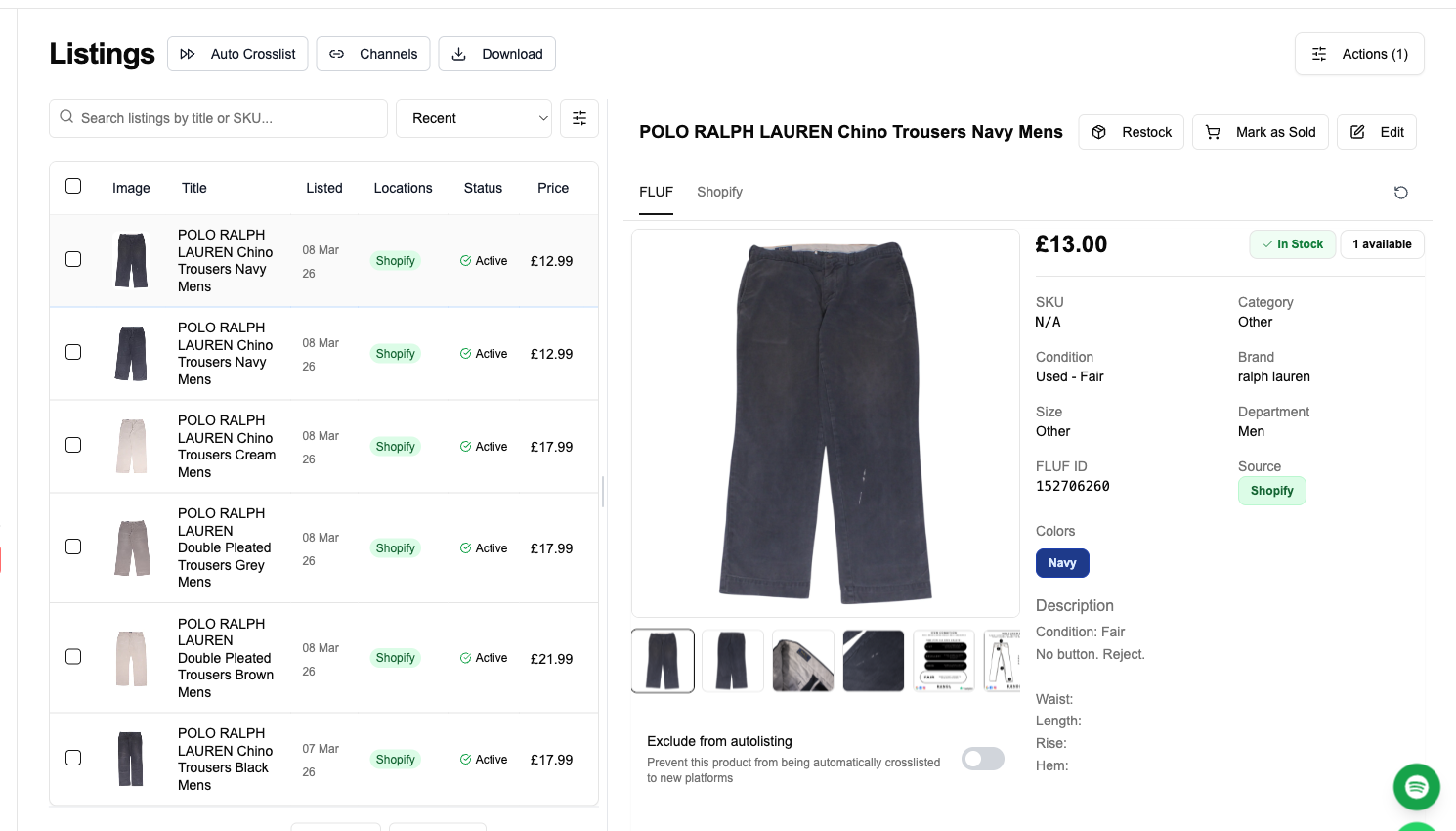
This is where the two channels diverge most. Vakoop through FLUF gives you order sync and sold-out delisting — the safety rails. Depop through FLUF adds two active growth levers on top: auto-relisting and offer management. Both run inside the same dashboard.
Auto-relisting on Depop
Depop’s feed rewards freshness — newer and refreshed listings surface higher, so a piece that has sat for weeks effectively disappears. FLUF’s relisting bumps your Depop items back up the feed automatically, putting tired inventory back in front of buyers without you re-uploading anything. Vakoop does not expose relisting through FLUF, so this is a lever you gain specifically on the Depop side.
Offer management on Depop
Depop buyers expect to negotiate, and offers are part of how items move. FLUF lets you manage offers on Depop — handling the back-and-forth that converts browsers into buyers. Again, this is Depop-only: Vakoop offers are not managed through FLUF. For a South African seller, that combination matters: you may not be online when a US buyer makes an offer at 2am SAST, and stale listings are the single biggest reason good stock goes unsold on Depop. Automating both removes the two tasks most likely to slip when you are managing a cross-border shop from a different time zone.
Order sync and sold-out delisting (both channels)
The features both channels share. Orders flow back into FLUF from Vakoop and Depop alike, and a sale on either channel delists the item on the other within minutes.
| Feature via FLUF | Vakoop | Depop |
|---|---|---|
| Connection method | Official Vakoop API (OAuth, no extension) | In-app connection (no extension) |
| Auto-relisting (feed bump) | ❌ | ✅ |
| Offer management | ❌ | ✅ |
| Order sync | ✅ | ✅ |
| Sold-out delist | ✅ | ✅ |
What’s Different About Selling on Depop vs Vakoop
- Audience age and geography. Vakoop is South African and broad in category; Depop is global and skews hard toward Gen-Z fashion buyers in the US, UK and Australia source.
- Currency. Vakoop prices in Rand; Depop shows prices in the buyer’s market currency. FLUF converts on push, but set your margins with international shipping and fees in mind.
- Fees. Vakoop is free to list source. On Depop, US and non-UK sellers pay a 10% selling fee plus payment processing (around 3.3% + $0.45 in the US); the UK selling fee was removed in March 2024, leaving UK sellers with processing of about 2.9% + £0.30 source. Optional Boosted Listings add roughly an extra 8% on items that sell via the boost source.
- Discovery culture. Vakoop relies on search and AI-assisted listing; Depop is hashtag-driven, aesthetic-led and curation-heavy, so strong styling photos and on-trend tags matter more there.
- Shipping. From South Africa you will arrange your own international postage for Depop sales — Depop’s auto-generated labels do not cover cross-border shipments, so factor courier cost into your Depop pricing.
- Engagement. Depop users are highly active (around three app sessions a day per user source), so freshness and responsiveness — exactly what FLUF’s relisting and offer tools support — pay off.
- Category strength. Vintage, Y2K and streetwear are core Depop territory rather than niche — vintage fashion is a far larger share of the catalogue than on general resale sites, and streetwear and vintage search interest have grown strongly on the platform source. If your Vakoop shop leans into those categories, you are listing into demand rather than against it.
None of these differences are reasons to pick one channel over the other — they are reasons to sell on both, and to let a crosslisting layer absorb the differences. Currency conversion, feed freshness and offer handling are all places a manual two-shop seller loses time or money; they are all places FLUF does the work. The Vakoop shop keeps doing what it is good at — trusted local sales in Rand — while Depop does what it is good at, putting your stock in front of a young global audience that buys fast and buys often.
How Much Does It Cost to Crosslist from Vakoop to Depop?
FLUF Connect is a flat monthly subscription — your Vakoop and Depop marketplace fees are separate and paid to those platforms. Every FLUF plan includes crosslisting, inventory and sold-out sync, relisting, offers and bulk tools across all supported channels.
| Plan | Price | Products | Best for |
|---|---|---|---|
| Growth | £19/month | 500 | Solo SA sellers testing Depop reach |
| Seller | £99/month | 5,000 | Established preloved shops scaling internationally |
| Super Seller | £299/month | Unlimited, priority sync | High-volume vintage and sneaker operations |
There is no free plan. The cheapest way in is Growth at £19/month for 1,000 products, and automation — relisting, offers, sync — is included in every tier, not a paid add-on. For a SA seller, the maths is straightforward: if crosslisting to Depop’s 35-million-strong audience moves even a handful of extra preloved pieces a month that would otherwise have sat unsold on Vakoop alone, the subscription pays for itself, and the time reclaimed from duplicate listing and manual delisting is on top of that. See fluf.io/pricing for current details.
Start crosslisting from Vakoop to Depop
Keep your South African Vakoop shop, reach Depop’s 35-million-strong global audience, and let FLUF Connect handle the conversion, relisting, offers and sold-out sync. List once — sell everywhere.
Sources & Verification
- Gitnux — Depop statistics (users, Gen-Z skew, engagement, category strength)
- ExportYourStore — Depop seller fees (selling fee, processing, UK removal Mar 2024, boost)
- Statista — Depop GMV share by country (top markets US/UK/AU)
- The Harris Poll — Gen-Z secondhand apparel purchasing
- Vakoop — official site (SA preloved marketplace, free listing, ZAR)
- FLUF Connect — pricing
Related guides
Frequently Asked Questions
Yes — and they're a strong match. Vakoop's preloved fashion, sneakers, designer pieces and vintage are exactly what Depop's Gen-Z buyers come for. FLUF Connect pushes your Vakoop listings to Depop with title, photos, brand, size, condition, colour and a mapped category, converting your Rand price to the buyer's display currency.
It depends on your location. US and non-UK sellers pay a 10% selling fee plus payment processing of around 3.3% + $0.45 per sale. The UK selling fee was removed in March 2024, so UK sellers pay only processing of about 2.9% + £0.30. Optional Boosted Listings add roughly 8% on items that sell via the boost. Listing itself is free.
You arrange your own international postage. Depop's auto-generated shipping labels don't cover cross-border shipments, so you'll use a courier of your choice and build that cost into your Depop price. FLUF helps by letting you add a margin to your converted price to cover international shipping and fees.
Yes. FLUF's sold-out sync works both ways: sell an item on Depop and FLUF marks it sold and delists it from Vakoop within minutes; sell it on Vakoop first and FLUF removes it from Depop. For one-of-one resale items, that's the core protection against overselling.
No. Vakoop connects through its official partner API — you authorise FLUF once at vakoop.co.za/connect via OAuth. Depop connects through FLUF's in-app connection. Neither channel requires a browser extension.
Yes. Your Vakoop price is in South African Rand; FLUF converts it to Depop's display currency (USD, GBP, AUD and others by market) on every crosspost. You can set a margin rule so the converted price covers international shipping and Depop's fees.
Yes, on Depop. FLUF adds auto-relisting (bumping your items back up Depop's feed) and offer management on top of order sync and sold-out delisting. These two levers aren't exposed for Vakoop through FLUF — Vakoop gets order sync and sold-out delisting only.
FLUF plans start at Growth, £19/month for 1,000 products. Seller is £99/month for 5,000 products and Super Seller is £299/month for unlimited products with priority sync. There's no free plan, but crosslisting, sync, relisting and offers are included in every tier. Your Vakoop and Depop marketplace fees are separate.
Reach. Vakoop is focused on South African buyers, while Depop has over 35 million registered users across more than 150 countries, skewing heavily Gen-Z and concentrated in the US, UK and Australia. Crosslisting lets you keep your trusted local Vakoop shop while opening your stock to a large international fashion audience.