Marktplaats vs Vinted: Which Is Better for Selling in NL?
A Dutch seller's guide to the two biggest secondhand marketplaces in the Netherlands — fees, audience, shipping and which fits what you sell.



- Marktplaats is the Netherlands’ largest general-goods marketplace, with over 8 million unique monthly visitors and around 18.7 million live ads across cars, electronics, furniture, fashion and more.
- Vinted is a fashion-led, peer-to-peer resale app with over 105 million members across 20+ markets, and is the Netherlands’ leading secondhand fashion platform after absorbing United Wardrobe in 2020.
- Vinted is free to sell on — sellers pay no listing or commission fees; the buyer covers a Buyer Protection fee of roughly 5% + €0.70 at checkout.
- Marktplaats is free to list for private sellers in most everyday categories (clothing, home, kids, books); a few categories (cars, services) and all promotion options like Topadvertentie (from €7.95) cost money.
- Marktplaats favours local pickup for bulky goods plus optional domestic shipping; Vinted is built around posted parcels and its Vinted Go drop-off and locker network.
- You don’t have to choose: FLUF Connect lists fashion on Vinted and general goods plus fashion on Marktplaats, then keeps both in sync so nothing double-sells.
Marktplaats vs Vinted at a Glance
If you are selling secondhand in the Netherlands, two names dominate the conversation: Marktplaats and Vinted. They are both enormous, but they are not really the same kind of marketplace. Marktplaats is a general classifieds platform where Dutch households trade everything from sofas and bikes to phones, cars and the occasional designer coat. Vinted is a fashion-led resale app where people sell clothes, shoes and accessories to buyers who post them out by parcel. The right choice depends far more on what you sell than on which brand is bigger.
Plenty of guides try to crown one platform the “winner”, but that framing misses how Dutch resale actually works. The two platforms are complementary far more than they are competitive. Marktplaats answers the question “where do I sell this specific thing locally?” for almost any object. Vinted answers the question “where do I sell my clothes to people who actively want secondhand fashion?”. A seller who only ever moves furniture has no reason to touch Vinted; a seller who only clears wardrobes has little reason to wrestle with Marktplaats’ classifieds model. The interesting case — and the most common one — is the seller whose stock straddles both worlds, and for them the decision is less “which one” and more “how do I run both without losing my mind”.
Marktplaats is the largest online trading platform in the Netherlands, with over 8 million unique visitors each month, around 350,000 new listings posted per day and roughly 18.7 million live advertisements at any moment, according to its owner Adevinta (source). Vinted, meanwhile, has grown into one of Europe’s biggest resale platforms, with more than 105 million registered members and a gross merchandise value of €10.8 billion in 2025 (source).
| Marktplaats | Vinted | |
|---|---|---|
| Type | General classifieds / marketplace | Fashion-led peer-to-peer resale app |
| Reach | 8M+ unique monthly visitors (NL) | 105M+ members across 20+ markets |
| Owner | Adevinta (ex-eBay Classifieds) | Vinted UAB (Vilnius, Lithuania) |
| Seller fees | Free to list in most categories; some categories & all promotions paid | Free — sellers pay nothing |
| Buyer fees | None on the item; optional shipping | Buyer Protection ≈ 5% + €0.70 |
| Best for | Furniture, electronics, cars, bulky goods, local deals | Clothing, shoes, accessories, posted parcels |
| Fulfilment | Local pickup or optional domestic shipping | Parcel post via Vinted Go & carriers |
| Geography | Netherlands-focused | Pan-European, NL is a core market |
Figures verified against Adevinta’s Marktplaats brand page and Vinted’s published company data — see Sources below.
Feature-by-Feature Comparison
The two platforms feel different the moment you start listing. Marktplaats is built like a noticeboard: you post an advert, buyers message you, and you negotiate and arrange handover — often a local pickup. Vinted is built like a shop: you list an item with a fixed price, buyers can hit “Buy now” or send an offer, and the platform handles payment, shipping labels and protection in the background.
| Feature | Marktplaats | Vinted |
|---|---|---|
| Free to list | ✅ Most everyday categories | ✅ Always |
| Seller commission | ✅ None on the sale | ✅ None |
| Buyer Protection built in | ⚡ Only when using “Verzenden via Marktplaats” | ✅ On every “Buy now” purchase |
| In-app secure payment | ⚡ Optional (iDEAL / Wero via Messages) | ✅ Standard |
| Offers & negotiation | ✅ Via direct messages (manual) | ✅ Structured offer system |
| Local pickup | ✅ Core use case | ❌ Posted parcels only |
| Integrated shipping labels | ✅ Domestic (PostNL, DHL, Brenger) | ✅ Vinted Go & partner carriers |
| Paid promotion | ✅ Topadvertentie, Dagtopper, Admarkt | ✅ Bumps & spotlights |
| Category breadth | ✅ Almost anything | ❌ Fashion, beauty, homeware, some lifestyle |
| Business / Pro selling | ✅ Dedicated Pro & Admarkt tools | ⚡ Consumer-first; Pro accounts emerging |
The headline difference: on Vinted the buyer experience is unified and protected by default, while on Marktplaats the experience ranges from a no-frills cash-on-collection deal to a fully shipped, protected transaction — depending on whether both parties opt into “Verzenden via Marktplaats” (source).
Fees Compared
This is where many Dutch sellers make their decision, so it is worth being precise. The two platforms recover their costs in completely different places.
Vinted fees
Vinted charges sellers nothing: no listing fee, no commission, no final-value fee and no payment-processing fee. You keep 100% of your asking price (source). Instead, the buyer pays a Buyer Protection fee at checkout — roughly 5% of the item price plus €0.70 across European markets including the Netherlands. That fee buys the purchaser Vinted’s refund policy, secure payment and dispute support (source). Shipping is normally paid by the buyer, who receives a prepaid label; sellers can choose to absorb shipping to make a listing more attractive.
Marktplaats fees
For private sellers, Marktplaats is free to list in most everyday categories — clothing and accessories, home and furnishings, children and baby goods, and books can all be posted at no cost (source). A handful of categories, notably cars and “Diensten & Vakmensen” (services and tradespeople), carry a small placement fee, and business advertisers use Marktplaats Pro and the Admarkt cost-per-click system instead (source).
Where Marktplaats really earns is promotion. To stand out in 18.7 million live ads you can pay to boost visibility: a Topadvertentie typically starts around €7.95, while a daily top placement (Dagtopper-style) can run from roughly €25 per day, with exact prices varying by category (source). These are optional — plenty of private sellers never pay a cent — but in busy categories they are often what gets a listing seen.
| Cost | Marktplaats | Vinted |
|---|---|---|
| Listing fee | Free in most categories; small fee for cars/services | Free, always |
| Seller commission | None | None |
| Buyer fee | None on the item | ≈ 5% + €0.70 Buyer Protection |
| Promotion / visibility | Topadvertentie from ~€7.95; daily top from ~€25/day; Admarkt CPC | Paid Bumps & spotlights (optional) |
| Payment processing | Included when using Marktplaats payment/shipping | Included (buyer-funded) |
The practical takeaway: on Vinted your stated price is your take-home, and the buyer shoulders the platform fee. On Marktplaats your stated price is also your take-home, but you may choose to spend on visibility rather than have a fee taken out. Neither charges the seller a cut of the sale — a big reason both are so popular with Dutch households.
Audience and Geography
Both platforms are giants in the Netherlands, but they reach different people in different moods. Marktplaats is woven into Dutch daily life — it is where you go when you need a secondhand bike, a dining table, a used car or a cheap monitor, and where you sell the things cluttering your garage. Its 8 million-plus unique monthly visitors span every demographic and almost every product imaginable, and the platform is deliberately Netherlands-focused (source). Marktplaats came under Norwegian classifieds group Adevinta when eBay sold its classifieds division in 2020 in a deal valued at around $9.2 billion (source for context).
Vinted’s audience skews younger and is overwhelmingly there to shop and sell fashion. Founded in Vilnius in 2008, Vinted became the dominant secondhand-fashion app in the Netherlands when it acquired the Dutch platform United Wardrobe — then the largest secondhand fashion marketplace in the country — in October 2020, gaining around 4 million users in one move and migrating that community onto its pan-European platform (source). Today the Netherlands is one of Vinted’s core European markets, alongside France, Germany, the UK and Belgium. Vinted’s Dutch roots run deeper than the acquisition alone: its long-serving chief executive, Thomas Plantenga, is a Dutch entrepreneur, and the company maintains an office in the Netherlands (source). That presence, combined with the United Wardrobe community it absorbed, is why Vinted feels less like a foreign import and more like the default fashion-resale app for a generation of Dutch sellers.
For a seller, that means Marktplaats gives you broad, local, all-category reach, while Vinted gives you a deep, motivated, fashion-hungry audience that extends across borders — a Dutch listing can be bought by a shopper in Belgium, France or Germany, since Vinted ships cross-border within its connected markets.
The behavioural difference matters as much as the headline numbers. A Marktplaats visitor is often there with a specific need — a particular phone model, a particular size of table — and is searching, comparing and negotiating. That makes Marktplaats excellent for items with clear demand and a recognised resale value, where buyers know roughly what they should pay. A Vinted shopper, by contrast, is frequently browsing for inspiration: scrolling a fashion feed, following favourite brands and sizes, and buying on impulse when a piece catches their eye. If your stock photographs well and rides current style trends, that browsing behaviour works in your favour; if you are shifting a worn-out appliance, it does not.
It is also worth noting how cross-border demand changes the maths on Vinted. Because Dutch listings are visible to buyers in neighbouring connected markets, a niche or hard-to-find fashion item that might wait weeks for the right local buyer on Marktplaats can find a willing shopper much faster across a pool of more than 100 million members. That same reach is largely irrelevant for a sofa nobody is going to ship internationally — which is precisely why category and platform have to be matched thoughtfully rather than chosen by brand loyalty.
Shipping and Local Pickup
Fulfilment is one of the sharpest dividing lines between the two.
Marktplaats grew up around local pickup. For a wardrobe, a fridge or a bicycle, that is a feature, not a limitation — the buyer collects, pays cash or by transfer, and there is no parcel to pack. For items that can be posted, Marktplaats offers “Verzenden via Marktplaats”: the seller sends a payment request through Messages, the buyer pays the item price plus shipping in one go (via iDEAL or Wero), and the seller gets a digital label for PostNL or DHL — with Brenger available for large items. This integrated shipping is for domestic Dutch transactions; there is no built-in international programme (source).
Vinted is built for posting parcels. When an item sells, the seller downloads a prepaid label and drops the parcel at a carrier point or one of Vinted’s own Vinted Go lockers and drop-off locations, many open 24/7 at stations, shopping centres and partner shops (source). The buyer collects from a nearby point, and Vinted’s Buyer Protection covers the transaction end-to-end. There is no local-pickup culture on Vinted — almost everything moves by post, which is exactly why it suits clothing and small goods and not sofas.
Rule of thumb: if it fits in a parcel, both can ship it; if it doesn’t, Marktplaats and its local-pickup base win by default.
The fulfilment model also shapes your workload and your risk. On Marktplaats, a local-pickup sale is the lowest-effort transaction there is: no packing, no postage, no return logistics — but it is also unprotected unless both parties opt into Marktplaats’ payment and shipping flow, so a no-show buyer or a cash-handover dispute is your problem to manage. On Vinted, every posted sale is wrapped in Buyer Protection, which removes most of the dispute risk but adds the routine of packing parcels, printing labels and getting to a drop-off point. Neither is objectively better; they suit different sellers. A weekend declutterer offloading furniture will prefer Marktplaats pickup, while someone steadily clearing a wardrobe will find Vinted’s posted, protected flow far less stressful at volume.
One more practical point: shipping cost scales differently. Clothing and small accessories are cheap and predictable to post, which is why Vinted’s parcel-first model works so smoothly for fashion. Bulky or heavy goods are expensive or impossible to send affordably, which is why Marktplaats’ local handover — or its Brenger large-item transport option — is the realistic route for furniture and white goods. If you try to force the wrong item onto the wrong fulfilment model, the postage either eats your margin or kills the sale entirely.
Categories — What Each Platform Is Best For
Match the item to the marketplace and you will sell faster for more money.
Where Marktplaats wins
- Furniture and homeware — sofas, tables, lamps, white goods that need local pickup.
- Electronics — phones, laptops, TVs, consoles, with a huge buyer pool.
- Cars, bikes and vehicle parts — Marktplaats is the default Dutch marketplace for transport.
- Bulky and high-value one-offs — power tools, garden equipment, instruments.
- General clearouts — the place Dutch households empty a garage or attic.
Where Vinted wins
- Everyday and branded clothing — the core of the platform, with deep demand.
- Shoes and accessories — bags, jewellery, sunglasses, watches.
- Childrenswear — fast-moving, frequently outgrown, ideal for posting.
- Vintage and designer fashion — a motivated, cross-border buyer base.
- Small lifestyle items — beauty, some homeware and books in postable sizes.
The overlap is fashion: clothing and accessories sell on both. That overlap is precisely why so many Dutch sellers end up wanting to be on both platforms at once — which brings its own headache, and its own solution.
How to Choose Between Marktplaats and Vinted
If you only want one platform, decide by what dominates your stock and how you prefer to hand items over:
- Choose Marktplaats if you sell mostly non-fashion goods — furniture, electronics, vehicles, household items — or you prefer local pickup and cash/transfer handovers with no parcels to pack. It is also the right home for bulky things Vinted simply can’t carry.
- Choose Vinted if you sell mostly clothing, shoes and accessories, you are happy posting parcels, and you want a hands-off, protected transaction where the platform handles payment and the buyer covers the fee. Its cross-border reach is a bonus for desirable fashion.
- Choose both if your stock spans categories — say, a wardrobe clear-out plus some furniture and a phone — or if your fashion items would benefit from being seen by both Marktplaats’ general audience and Vinted’s fashion specialists at the same time.
A useful gut check: picture how the buyer will receive the item. If you imagine someone driving over to collect it, lift it into a car or pay cash at your door, that is a Marktplaats item. If you imagine slipping it into a parcel and dropping it at a locker, that is a Vinted item. Anything you can picture both ways — a coat, a pair of boots, a handbag — is a candidate for both platforms, and is exactly the kind of stock where running them in parallel pays off.
For most sellers with mixed stock, the honest answer is “both” — and that is where the real friction starts. Listing the same item twice means duplicate photos, duplicate descriptions, and the constant risk that something sells on Vinted while it’s still live on Marktplaats. Sell the same coat twice and you have an oversell, a disappointed buyer and a dent in your seller reputation.
There is also a pricing dimension to the decision. Because Vinted’s Buyer Protection fee is added on top of your price at the buyer’s expense, you can list at your true take-home figure and let the platform present the all-in cost. On Marktplaats, your headline price is what the buyer sees and what you pocket, but you may decide to invest in a Topadvertentie or daily top placement to be seen — effectively spending to acquire visibility rather than having a fee deducted. Sellers who think about it as “fee taken out” versus “visibility paid for” usually find the comparison clearer: on a clean fashion sale Vinted costs the seller nothing, while on a competitive Marktplaats category you may choose to spend a few euros to surface above thousands of rival ads.
Finally, consider your time. Maintaining two storefronts by hand — re-uploading the same photos, rewriting the same descriptions, and policing both for sold items — is the hidden tax of going multi-platform. For a handful of items it is trivial; for fifty or five hundred it becomes a part-time job, and the day you forget to pull a sold listing is the day you oversell. That ongoing maintenance burden, not the listing itself, is what pushes serious sellers towards automation.
Why Not Both? Crosslisting Marktplaats and Vinted with FLUF Connect
You don’t have to pick a side. The smart play for a Dutch seller with mixed stock is to use both platforms and let FLUF Connect handle the busywork. List your fashion on Vinted and your general goods and fashion on Marktplaats, and FLUF keeps everything synchronised so nothing double-sells.
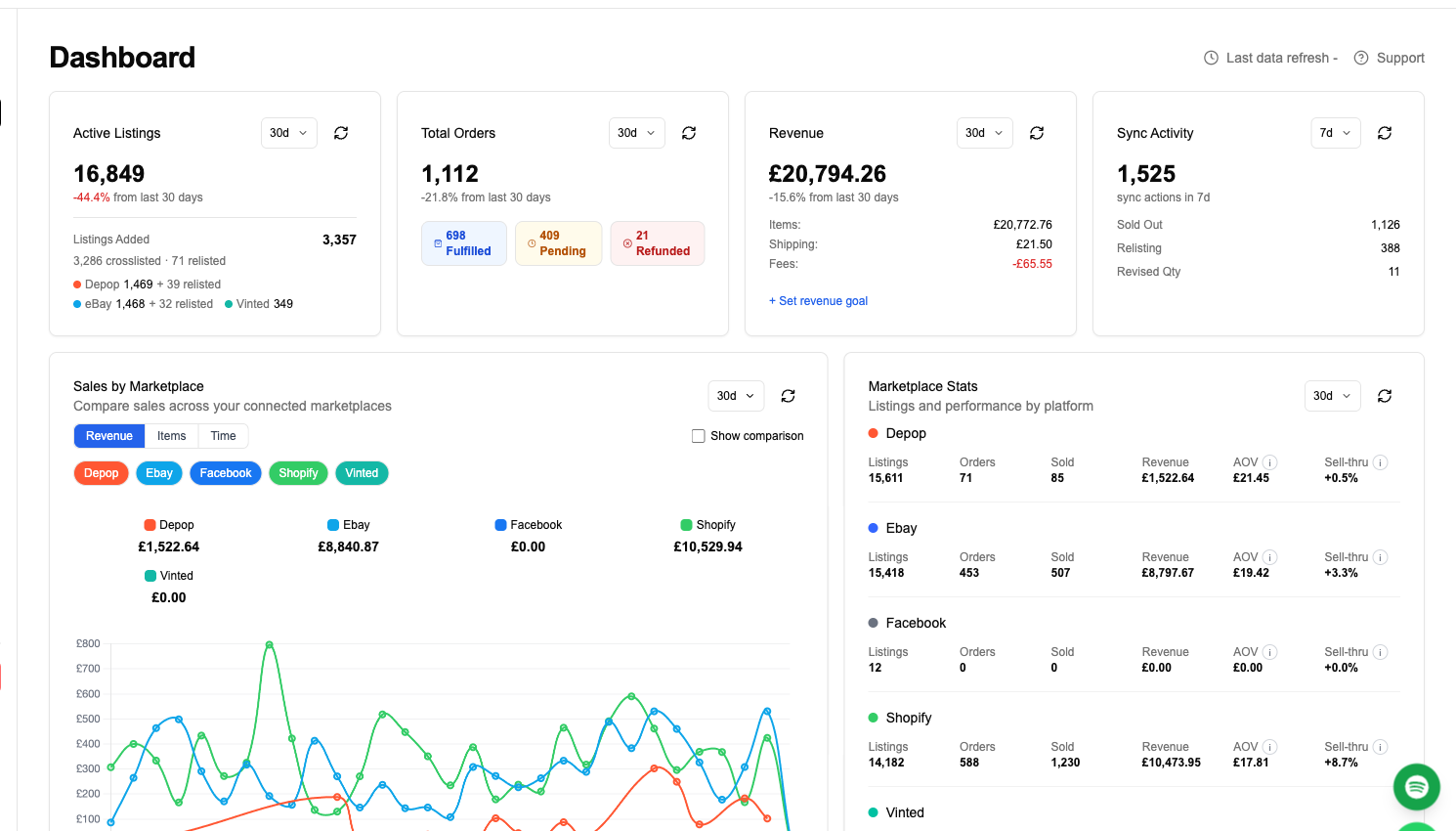
Here is how it works in practice. You build a listing once in FLUF — title, description, photos, price, brand, condition, size and category — and push it to both Marktplaats and Vinted (and any of FLUF’s 19 supported channels). When a buyer takes the item on one platform, FLUF detects the sale and acts on the others within minutes.
The two channels have different capabilities through FLUF, and it is important to be accurate about them:
- Vinted (via FLUF’s browser extension): full support — relisting, offers, order sync and sold-out delist. When something sells elsewhere, FLUF marks it sold on Vinted; when an item goes stale, FLUF can relist it to push it back up the feed; and offers can be managed through FLUF.
- Marktplaats: order sync and sold-out delist. When an item sells on Vinted (or any other channel), FLUF removes it from Marktplaats so it can’t sell twice, and orders flow back into your dashboard. Marktplaats does not support relisting or offer management through FLUF — those run natively on Marktplaats.
So the core promise holds exactly where it matters: a coat listed on both Marktplaats and Vinted that sells on Vinted is delisted from Marktplaats automatically, and vice versa. You get the combined reach of the Netherlands’ biggest general marketplace and its biggest fashion app, without manually racing to pull listings down. FLUF does the inventory reconciliation; you focus on sourcing and pricing.
Because FLUF supports 19 marketplaces in total — including Depop, eBay, Etsy, Facebook Marketplace, Shopify and more — the same workflow scales the moment you want to add another channel. List once, sync everywhere, and let the sold-out delisting protect you from overselling across the lot.
For a Dutch seller specifically, the combination is hard to beat. Marktplaats gives you the broadest local audience for everything from a coat to a coffee table; Vinted gives you a fashion-obsessed, cross-border audience for the clothing and accessories in your stock. Running both used to mean double the admin and double the overselling risk. With FLUF, a jacket can sit on Marktplaats in front of millions of general shoppers and on Vinted in front of fashion specialists at the same time — and whichever side it sells on, the other listing comes down automatically. The furniture and electronics that only make sense on Marktplaats stay there; the fashion that thrives on Vinted reaches both. You get the upside of each platform without manually reconciling inventory between them.
It is worth being clear about the boundaries so expectations are right. FLUF’s sold-out delisting and order sync are the load-bearing features for a Marktplaats-plus-Vinted setup — they are what stop the double-sale. Relisting and offer management add extra leverage on Vinted, where FLUF can refresh a stale listing to lift it back up the feed and let you handle offers centrally; on Marktplaats those two actions happen natively on the platform rather than through FLUF. Knowing which lever lives where means you can lean on FLUF for the cross-channel safety net and use each marketplace’s own tools for the rest.
Pricing
FLUF Connect is a paid tool — There is no free plan, but every new account gets a 7-day trial for £1. Plans start at Starter (£9/month), then Seller (£29/month) and Pro (£99/month) — all of them unlimited, differing only in how often we check your channels for sales. Crosslisting, inventory, sold-out sync and bulk tools are included in every plan, and relisting and offers from Seller upwards across all supported channels — automation is part of the plan, not a paid add-on (source).
| Plan | Monthly | Crosslisted products |
|---|---|---|
| Starter | £9/month | Unlimited |
| Seller | £29/month | Unlimited |
| Pro | £99/month | Unlimited |
| Super Seller | Custom pricing — tell us what you need | Unlimited |
Listing on Marktplaats and Vinted themselves remains free for sellers in the ways described above; FLUF’s fee is for the crosslisting and sync layer that lets you run both at once without overselling.
For a seller weighing the cost, the question is what your time and your reputation are worth. Every plan is unlimited for the price of a couple of takeaways a month, and it pays for itself the first time it stops you double-selling a sold-out item across Marktplaats and Vinted — an oversell that costs you the sale, the buyer’s trust and potentially a negative review. As your catalogue grows, the Seller and Super Seller tiers keep the same one-listing-syncs-everywhere workflow while raising the product ceiling, so the tool scales with your selling rather than against it.
Sell on Marktplaats and Vinted at the same time
List once, reach the Netherlands’ biggest general marketplace and its biggest fashion app, and let FLUF Connect keep your inventory in sync so nothing double-sells.
Sources & Verification
- Adevinta — Marktplaats brand page (visitors, live ads, daily listings, market position)
- Wikipedia — Vinted (founding, members, GMV, eBay/Adevinta classifieds deal context)
- Voolist — Vinted Fees 2026 (zero seller fees)
- Vinted Help Centre — Buyer Protection fee
- Hallo Marketing — free vs paid categories on Marktplaats
- Marktplaats Help — what it costs to place an advertisement
- Marktplaats Help — Topadvertentie, omhoogplaatsen and Dagtopper
- DHL eCommerce — sending a parcel via Marktplaats
- Vinted Go — shipping, lockers and drop-off points
- RetailDetail — Vinted acquires United Wardrobe (NL market)
- FLUF Connect — pricing
The equivalent comparison for the German market is Kleinanzeigen vs Vinted. Kleinanzeigen vs Vinted.
Related guides
- Vendora vs Vinted compared — a national classifieds incumbent against Vinted, in Greece
Frequently Asked Questions
It depends on what you sell. Marktplaats is the Netherlands' largest general marketplace, with over 8 million unique monthly visitors and around 18.7 million live ads, and is best for furniture, electronics, cars and bulky goods that suit local pickup. Vinted is a fashion-led app with 105 million-plus members and is best for clothing, shoes and accessories you post out. For mixed stock, many Dutch sellers use both.
Yes. Vinted charges sellers nothing — no listing fee, no commission, no final-value fee and no payment-processing fee, so you keep 100% of your asking price. The platform is funded by a Buyer Protection fee paid by the buyer at checkout, which is roughly 5% of the item price plus €0.70 in European markets including the Netherlands.
For private sellers, Marktplaats is free to list in most everyday categories such as clothing, home and furnishings, children's items and books. A few categories like cars and services carry a small placement fee, and business sellers use Marktplaats Pro and the Admarkt cost-per-click system. Promotion options like Topadvertentie (from about €7.95) or daily top placement (from around €25 per day) are always paid but optional.
Yes, and many Dutch sellers do. The challenge is keeping inventory in sync so an item doesn't sell on both at once. A crosslisting tool like FLUF Connect lets you list fashion on Vinted and general goods plus fashion on Marktplaats from one place, then automatically delists an item on the other channel within minutes of it selling — so you never oversell.
The Buyer Protection fee is paid by the buyer, not the seller, and is around 5% of the item price plus €0.70 across European markets including the Netherlands. It covers Vinted's refund policy, secure payment and customer support for disputes. Sellers are not charged this fee and keep their full asking price.
Marktplaats grew up around local pickup, but also offers domestic shipping through 'Verzenden via Marktplaats', where the buyer pays via iDEAL or Wero and the seller gets a PostNL, DHL or Brenger label in Messages. Vinted is built for posting parcels: the seller drops the item at a carrier point or a Vinted Go locker, and the buyer collects from a nearby point, with the whole transaction covered by Buyer Protection.
Marktplaats reaches the broadest general audience, with over 8 million unique monthly visitors across every category. Vinted reaches a deep, motivated fashion audience — it became the Netherlands' leading secondhand fashion platform after acquiring United Wardrobe in 2020 — and adds cross-border reach into Belgium, France and Germany. For fashion specifically, listing on both maximises exposure.
Yes. Through FLUF, Vinted supports relisting, offers, order sync and sold-out delisting via a browser extension, while Marktplaats supports order sync and sold-out delisting. That means an item listed on both is automatically removed from one channel when it sells on the other, protecting you from overselling. FLUF also supports 17 other marketplaces if you want to expand further.
No. FLUF Connect is a paid tool with no free plan. FLUF Connect plans start at £9/month on Starter, with Seller at £29/month and Pro at £99/month; every plan is unlimited on listings and marketplaces, and the tiers differ by which automations they include and how often we check your channels for sales. Crosslisting, inventory, sold-out sync and bulk tools are included in every plan, and relisting and offers from Seller upwards across all supported channels.