Crosslist from Depop to Marktplaats — Reach Dutch Buyers Automatically
Put your Depop items in front of the Netherlands' biggest marketplace — free to list and sell.



TL;DR: FLUF Connect crosslists your Depop items to Marktplaats, the Netherlands’ leading marketplace, mapping titles, descriptions, photos, prices and condition. Marktplaats is free for sellers — the buyer pays the protection and service fees — and reaches around 8 million monthly Dutch visitors who buy everything from fashion to furniture. It is how a Depop seller reaches Dutch and Benelux buyers.
Depop is a fashion-first app with a young, UK and US-centric audience. Marktplaats is something different: the dominant general marketplace in the Netherlands, where buyers of every age look for everything from clothing to furniture to cars. For a Depop seller who wants to reach Dutch and Benelux buyers — and to sell categories beyond fashion that Depop is not built for — crosslisting to Marktplaats opens up a large, local market that Depop alone never touches. FLUF Connect removes the work of listing on both, translating and mapping your Depop items into Marktplaats ads.
This page explains how crosslisting from Depop to Marktplaats works, why Marktplaats is free for sellers, what you need to add for the Dutch market (language, location and delivery), what sells, and how FLUF keeps inventory in sync so the same item is never sold twice.
Why Crosslist Depop Items to Marktplaats?
The first reason is reaching Dutch buyers directly. Marktplaats is the Netherlands’ leading marketplace, drawing around 8 million monthly unique visitors with roughly 350,000 new ads posted every day — close to universal reach in a country of around 18 million people (Marktplaats figures). For Dutch shoppers it is the default place to buy and sell second-hand, much as Depop is for young fashion resellers elsewhere. A Depop listing reaches Depop’s global fashion community; a Marktplaats ad reaches the Dutch mainstream.
The second reason is category breadth. Depop is built for fashion, but Marktplaats sells essentially everything — clothing, electronics, furniture, bikes, baby items, even vehicles — across roughly 1,900 categories. A reseller whose inventory is not purely fashion can list all of it on Marktplaats, where Depop would only take the clothing. Add that Marktplaats reaches an all-ages audience in a market that is far less fashion-saturated than Depop, plus the simple value of diversifying off a single platform, and crosslisting to Marktplaats becomes a natural way to reach buyers and categories Depop cannot. Local pickup is also normal on Marktplaats, which suits bulkier items that would never ship economically on a fashion app.
How Marktplaats Works for Sellers
Marktplaats is free for private sellers in most categories: posting an ad costs nothing, and there is no seller commission on a sale — the fees are paid by the buyer (Marktplaats ad costs). There are two buyer-side charges, both paid by the buyer, not you: a buyer-protection fee (Kopersbescherming), a percentage of the purchase price — around 5%, with a minimum of €0.59 and a maximum of €20 — and a flat service fee (servicekosten) of €0.40 per payment request (Marktplaats buyer protection; service fee). The seller receives the item price in full. There is no per-listing cap for private sellers in free categories, so you can list a whole catalogue without hitting a limit.
Where money enters for a seller is optional and limited. Some high-value categories are paid to post, Marktplaats sells optional visibility boosts (such as Dagtopper, which keeps an ad at the top of its category for a period), and business accounts have their own pricing. Shipping is handled through “Verzenden via Marktplaats” using carriers like PostNL, DHL and Brenger for bulky goods, with the buyer paying for delivery and the money held in escrow until the item arrives. For a private seller crosslisting fashion and general goods, the channel is free to list and free to sell.
Reach 8 million Dutch buyers with your Depop items — free to list on Marktplaats.
How to Crosslist from Depop to Marktplaats with FLUF Connect
1. Connect Depop and Marktplaats
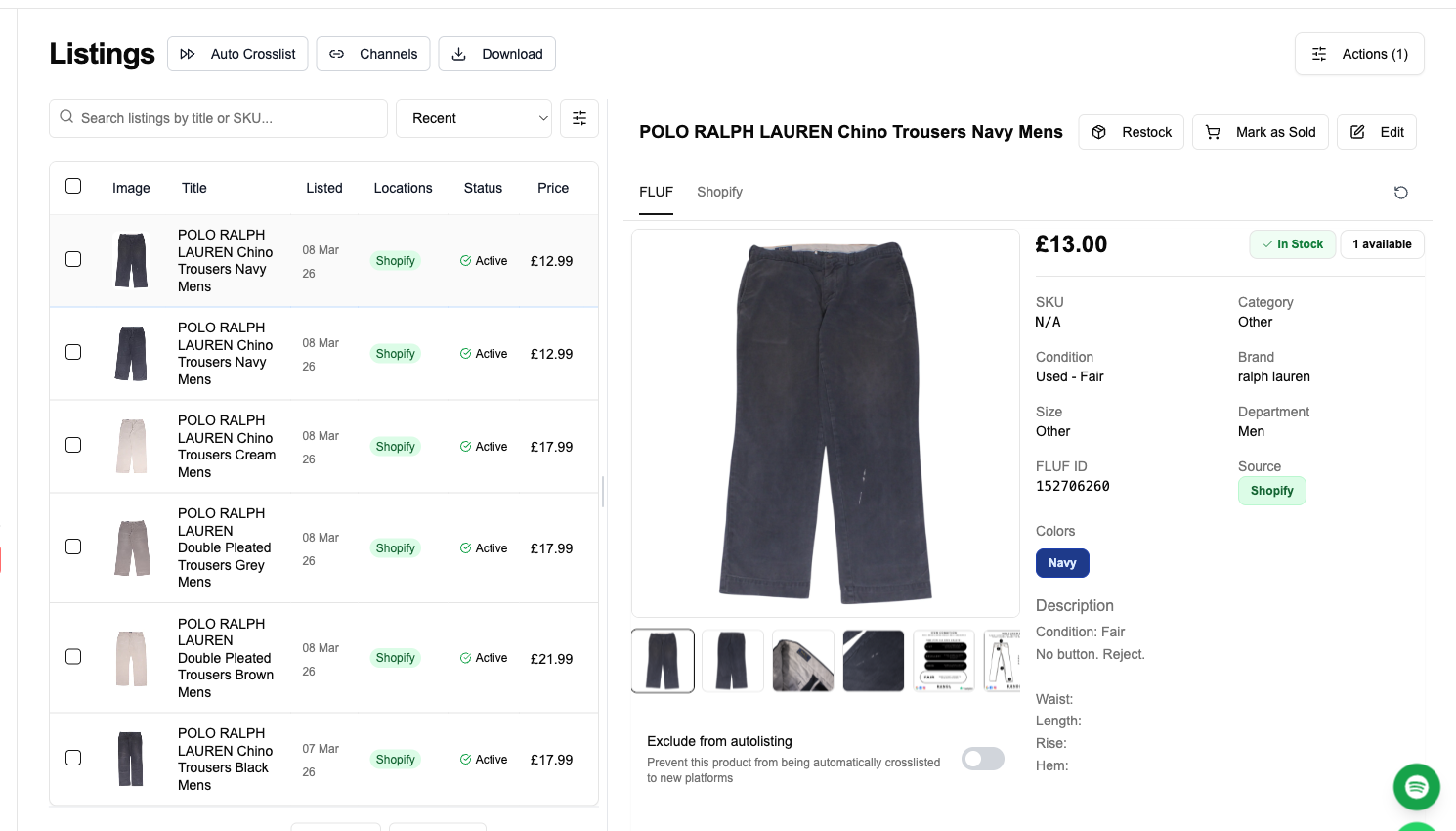
Connect both channels in FLUF Connect. FLUF reads your Depop listings and prepares them for Marktplaats.
2. Import your Depop listings
FLUF imports each item’s photos, title, description, price and details, so you are not rebuilding listings you have already created on Depop.
3. Localise for the Dutch market
Marktplaats needs a Dutch title and description, a Dutch postcode for the item’s location, a price type, the Marktplaats category, and a delivery method. You set these, and FLUF maps the rest across.
4. Crosslist and keep inventory in sync
FLUF creates the Marktplaats ads. From then on, when an item sells on Depop or Marktplaats, FLUF marks it sold on the other connected channel, so the same item is never bought twice.
What Transfers from Depop to Marktplaats
| Field | Depop source | On Marktplaats |
|---|---|---|
| Title | Item title | Titel (Dutch) |
| Description | Description | Omschrijving (Dutch) |
| Photos | Up to 8 | Up to 24 |
| Price | Listing price | Prijs + price type (you set) |
| Condition | Five levels | Conditie (three levels) |
| Brand / size / colour | Structured fields | Kenmerken or description |
| Category | Depop category | Rubriek + sub-rubriek |
| Location | — | Dutch postcode (required) |
Photos, price, brand, size and colour carry across, with Depop’s rich fashion attributes folding into Marktplaats’s Kenmerken (item characteristics) or the description. A few transformations are specific to Marktplaats. Its condition scale has three levels (Nieuw, Zo goed als nieuw, Gebruikt), so Depop’s five condition grades collapse into the nearest of the three. Marktplaats also requires a price type — a fixed asking price, “bidding”, “free”, and so on — a delivery method (pickup, shipping or both, with a parcel weight band), and a Dutch postcode as the item location, none of which a Depop listing carries. These are the fields you set when crosslisting, and getting the location and language right is what makes a Marktplaats ad perform.
Localising for Dutch Buyers
The most important thing to get right is language. Marktplaats is a Dutch marketplace, and English listings get very little traction — a Dutch title and description, with the right Kenmerken filled in, signal to both buyers and Marktplaats’s search that the ad belongs. A correct local postcode matters too, since it determines where your item shows up for nearby buyers and whether local pickup is feasible. Treat the crosslist as entering a Dutch marketplace rather than copying a Depop listing across a border: FLUF moves the photos, price and structured details, and you present the item in Dutch for a Dutch audience. That small amount of localisation is the difference between an ad that sells and one that is never seen.
Marktplaats’s Reach and the Benelux Market
Marktplaats is not just large in the Netherlands; it anchors a wider Benelux footprint. The same operator runs 2dehands and 2ememain in Belgium on one platform, extending reach into the Belgian market, where the sister site is also the leader (2dehands / 2ememain). For a Depop seller, that means crosslisting to Marktplaats taps not only Dutch demand but a broader Low-Countries audience for second-hand and general goods. The Netherlands also has a sizeable second-hand market overall, and Marktplaats holds the dominant share of Dutch online reuse, so you are listing into the established default rather than a niche challenger. The scale and entrenchment are precisely why a fashion-app seller looking to grow into the Dutch market starts with Marktplaats.
What Sells on Marktplaats
Marktplaats is a true generalist: its strongest categories include vehicles, electronics, furniture and household goods, alongside fashion, bikes and baby items. For a Depop seller, your fashion inventory has a home there, but so does anything else you sell — homeware, accessories, electronics — that Depop’s fashion focus would exclude. The categories where Marktplaats is strongest and Depop is absent, such as furniture and larger household items, are exactly where local pickup and a Dutch audience make selling practical. So crosslisting to Marktplaats is doubly useful: it gives your fashion a new national audience, and it gives your non-fashion inventory a place to sell at all. Match your items to the right Marktplaats Rubriek and the generalist audience does the rest.
Verzenden via Marktplaats: Shipping Across the Netherlands
One of the practical advantages Marktplaats has over a purely local sale is integrated shipping, which lets you sell to a buyer anywhere in the Netherlands rather than only to someone nearby. “Verzenden via Marktplaats” works with PostNL and DHL for parcels, and Brenger for bulky goods like furniture, with the buyer paying for delivery at checkout and the funds held in escrow by the platform’s payment provider until the item is delivered and accepted (Marktplaats shipping). For a Depop seller, this is familiar — Depop also revolves around shipping fashion to buyers — and it means your crosslisted items can reach the whole Dutch market, not just local buyers. You set a parcel weight band when you crosslist, and Marktplaats’s shipping system handles the carrier and label.
The escrow element is worth noting because it builds buyer trust: the buyer’s money is held until they have the item, which makes them more comfortable buying from a seller they do not know. For you, that translates into more completed sales to distant buyers who might hesitate over a cash-on-pickup deal. Local pickup remains an option for buyers nearby, but shipping is what unlocks the national audience that makes Marktplaats worth crosslisting to.
How Selling on Marktplaats Differs from Depop
Marktplaats is more of a classifieds-and-negotiation marketplace than Depop’s fixed-price app, so the selling flow is a little different. Buyers message sellers, sometimes negotiate, and items can be reserved while a deal is arranged; local pickup brings the usual haggling and the occasional time-waster, much as on any second-hand marketplace. Pricing with a little room to negotiate and responding promptly to messages are the habits that work well. For a Depop seller used to a tap-to-buy app, this is a modest adjustment rather than a hurdle — and it suits exactly the kind of second-hand and general goods that move on Marktplaats, where buyers expect a degree of back-and-forth.
Trust and Safety on Marktplaats
As on any big marketplace, Marktplaats attracts scams, and the canonical one targets sellers with fake payment links. The classic fraud involves a “buyer” sending a payment-request link — often via a well-known Dutch payment app — designed to capture your bank details or trick you into paying rather than being paid (Marktplaats payment scam warning). The defence is simple and the same advice Marktplaats gives: keep transactions inside Marktplaats’s own secure payment and shipping system, and never act on a payment link sent outside the platform. The buyer-paid protection fee exists precisely to cover in-app transactions, so staying inside the platform keeps both sides safe and the money guaranteed. For a seller crosslisting from Depop, the rule of thumb is to treat Marktplaats’s in-app payment and “Verzenden via Marktplaats” as the only safe route, and to ignore any attempt to move the deal elsewhere.
Who Should Crosslist Depop to Marktplaats
This pairing suits a few clear cases. If you are a Depop seller in or selling into the Netherlands, Marktplaats multiplies your audience from Depop’s fashion niche to the Dutch mainstream. If your inventory extends beyond clothing — homeware, electronics, accessories, anything Depop’s fashion focus excludes — Marktplaats gives that stock somewhere to sell. And if you simply want to diversify off a single platform and reach a market less saturated with fashion resellers, Marktplaats is the obvious Dutch destination. The main thing to be ready for is localisation: Dutch-language listings, a Dutch postcode, and fulfilment to Dutch buyers. For a seller willing to handle that, the reward is access to the Netherlands’ default marketplace at no listing or selling cost — and crosslisting means you keep your Depop community while adding the Dutch audience on top, with FLUF doing the duplication so it takes minutes per item rather than hours. The sellers who get the most from it treat Depop and Marktplaats as two doors into different rooms — Depop for the global fashion crowd that already follows them, Marktplaats for the Dutch mainstream and the non-fashion stock Depop never wanted — and let the inventory sync make sure the two never trip over each other on the same item. Done that way, adding Marktplaats is pure upside: a second, free-to-sell national audience for everything in your catalogue, with none of the overselling risk that usually makes running two marketplaces a headache, and very little extra work to maintain once the initial crosslist is set up.
Inventory Sync: Never Sell the Same Item Twice
Listing one item on both Depop and Marktplaats raises the risk of selling it twice. FLUF prevents it: when an item sells on Depop or Marktplaats, FLUF marks it sold on the other connected channel, so a single piece cannot be bought in both places. Both Depop and Marktplaats support this sold-detection, so the protection works in both directions — sell it on Depop and the Marktplaats ad is marked sold; sell it on Marktplaats and the Depop listing is too. For a reseller of one-of-a-kind items, that automatic sync is what makes running two marketplaces manageable rather than a constant risk of cancelling on a buyer who bought something you had already sold elsewhere.
A Note on Depop’s Fees
It is worth a brief word on the Depop side for context, because its fee model changed recently. Depop removed its seller selling fee in the US (in 2024) and the UK (in 2024), shifting to a buyer-paid marketplace fee instead, although sellers in many other countries still pay the legacy selling fee (Depop fee changes). Listing on Depop is free, and the buyer pays shipping. So for many sellers, both Depop and Marktplaats now run on a buyer-pays model, which keeps more of each sale with the seller on both sides. That alignment makes the pairing financially clean: you reach two audiences without a seller commission eating into your take on either.
Getting Started With Depop to Marktplaats
If you sell on Depop and want to reach Dutch and Benelux buyers — and to sell categories beyond fashion — the path is straightforward: connect both channels, import your Depop listings, localise them for the Netherlands with a Dutch title, description and postcode, set the price type and delivery method, and crosslist. You pay nothing to list or sell as a private seller, you reach the marketplace Dutch buyers actually use, and FLUF keeps stock in sync so nothing sells twice.
Marktplaats is one of many destinations — see the crosslisting hub, go the other way with Marktplaats to Depop, or crosslist Depop to other channels like Vinted and eBay. Keep stock aligned with inventory sync, and read our guide to crosslisting on Depop. See plans on the pricing page.
FLUF Connect has no free plan — plans start at £9/month (Starter). Crosslisting, inventory sync and bulk operations are included in every plan, and relisting and offers from Seller upwards, not a paid add-on.
Sources & Verification
- Marktplaats ad costs (free for private sellers): Marktplaats help
- Buyer protection fee (around 5%, min €0.59 / max €20): Marktplaats help
- Service fee (€0.40 per payment request): Marktplaats help
- Marktplaats scale: Marktplaats press
- Depop fee changes: Depop newsroom
Frequently Asked Questions
No, for private sellers in most categories. Posting an ad is free and there is no seller commission — the buyer pays the fees. There is no per-listing cap for private sellers in free categories. Some high-value categories are paid to post, and optional visibility boosts are available.
The buyer. They pay a flat service fee of €0.40 per payment request, plus a buyer-protection fee that is a percentage of the price — around 5%, with a minimum of €0.59 and a maximum of €20. The seller receives the full item price.
Marktplaats is a Dutch local marketplace, and English listings get very little interest, so you will want Dutch-language titles and descriptions and to fulfil to Dutch buyers. You localise the listing when you crosslist; FLUF carries across the photos, price and details.
Marktplaats is an all-category Dutch marketplace for buyers of every age, with local pickup common and a generalist catalogue from fashion to furniture. Depop is an international, fashion-focused resale app with a young audience. Marktplaats lets you reach Dutch buyers and sell non-fashion items Depop is not built for.
No, not with FLUF Connect. When an item sells on Depop or Marktplaats, FLUF marks it sold on the other connected channel, so a single one-of-a-kind item cannot be bought in both places.
No. FLUF imports your Depop listings and crosslists them to Marktplaats, mapping the fields and carrying across photos, price and details. You set the Dutch-specific fields — language, postcode, price type and delivery — and FLUF builds the ads.