
Crosslist from Kijiji to Etsy — The 20-Year Rule Decides Everything
Etsy bans reselling commercially available items newer than twenty years, whatever condition they are in. Work out which seam of your Kijiji catalogue clears that gate before you spend an evening on the listing form.
7 days for £1, then from £9/month.



- Read this before you spend an evening on it: most Kijiji stock is not eligible on Etsy. Etsy’s Creativity Standards exclude “resold commercially available items that are newer than 20 years old, even if the item is designed to appear vintage.”
- The gate is age and authorship, not condition. Used is fine. Used and mass-produced and made in 2015 is not. Twenty years old, handmade by you, designed by you, or a craft supply — those are the four doors.
- Etsy can ask you to prove it. Its own wording: Etsy “may ask for additional photo documentation or information about vintage items in your shop, such as their source, age, designer, or materials.”
- Listings cost money before they earn any. US$0.20 per listing, charged whether or not it sells, and again every four months on renewal. A Kijiji ad is free.
- Canadian sellers get an unusually good processing rate — 3% + C$0.25 on domestic orders and on orders from the US, against 4% + C$0.25 internationally — but also a 0.50% Regulatory Operating fee that most countries do not pay.
- Canada Post labels to US destinations are currently suspended on Etsy, which matters because the US is the natural export market for a Canadian shop.
- Cost: £1 for 7 days, then plans from £9/month (Starter). There is no free plan.
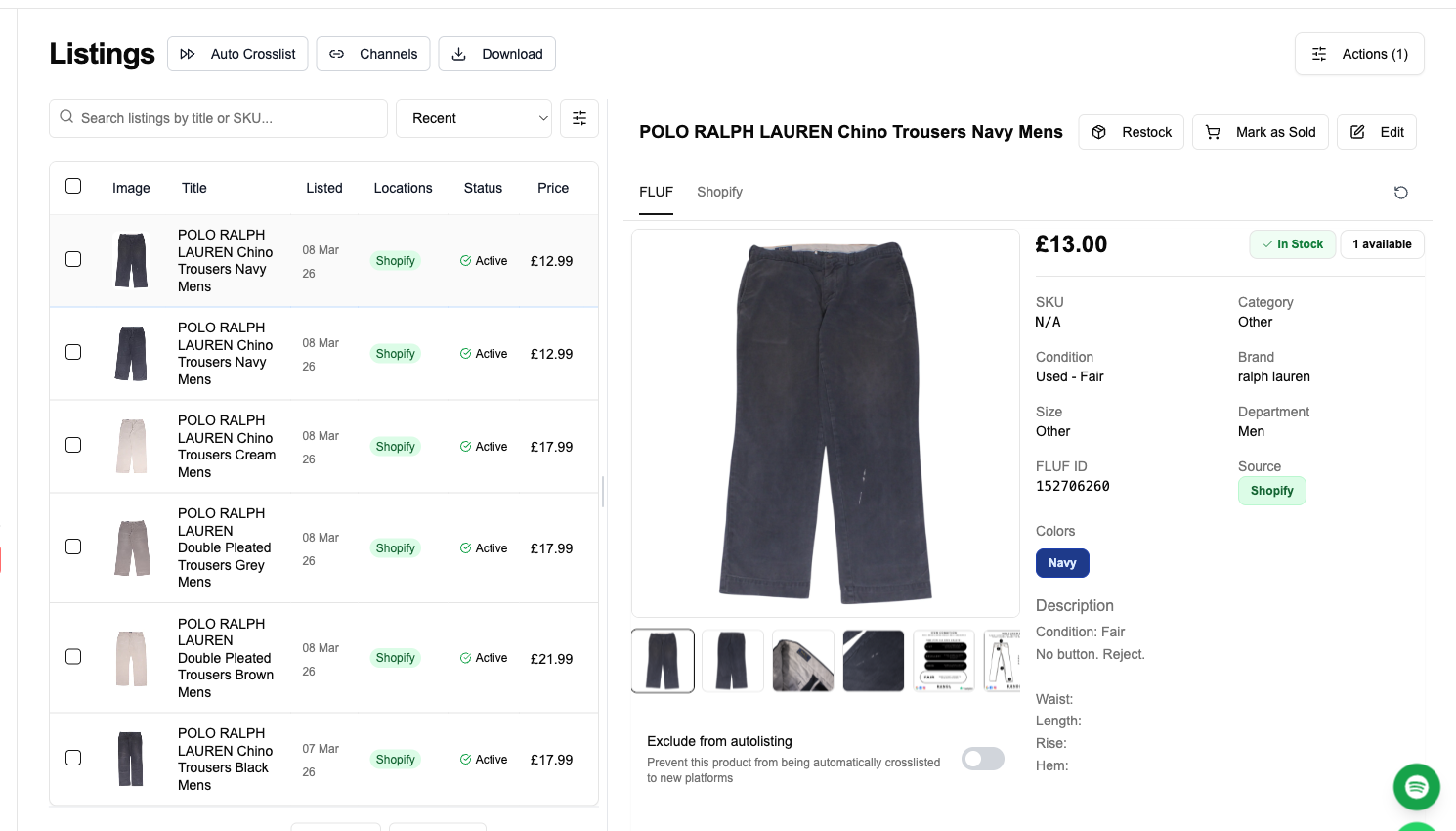
The eligibility gate, in Etsy’s own words
Almost every article about moving from classifieds to Etsy skips the only question that matters, so this page starts with it: Etsy will not let you list most of what is on Kijiji, and it is not a grey area.
A new Seller Policy took effect on 9 July 2026, and it is short: “everything listed for sale on Etsy must be made, designed, handpicked, or sourced by a seller” (Etsy, Seller Policy). The substance sits in the accompanying Creativity Standards, which define “handpicked” and then state what does not qualify. Verbatim, on what does:
“Vintage items: Items that are 20+ years old, that the seller personally curated or collected. Etsy may ask for additional photo documentation or information about vintage items in your shop, such as their source, age, designer, or materials.” (Etsy, Creativity Standards)
And, on the same page, verbatim on what does not: “Resold commercially available items that are newer than 20 years old, even if the item is designed to appear vintage.”
Etsy’s help centre puts it even more directly: “Reselling is not allowed on Etsy except for the following items that are handpicked or sourced by sellers”, listing craft and party supplies, vintage items over 20 years old, and gift baskets — and defines the term: “Reselling is the practice of selling a commercially available item that the seller did not make or design” (Etsy, does Etsy allow drop shipping or reselling?).
Notice what the rule is not about. It is not about condition — an item can be well used and perfectly eligible. It is about who made it and when. A 1970s Pyrex bowl is fine. A 2015 Pyrex bowl in identical condition is not. And the “designed to appear vintage” clause closes the obvious loophole: reproduction and Y2K-styled new stock is out too.
Etsy also reserves the right to remove listings that break this, and notes that “sellers remain obligated to pay any fees incurred in listing such items” — which, given that listings cost money up front, means an ineligible catalogue can cost you real money before anyone tells you it was ineligible.
One footnote for anyone who reads Etsy’s help pages and gets confused: Etsy’s own “How to Create a Listing” article still opens by telling sellers to make sure items “fit into Etsy’s handmade, vintage, or craft supply categories”. That is stale wording in a help document, not the current policy. The Creativity Standards are the binding text.
What in a Kijiji catalogue actually qualifies
Kijiji spans more than 400 categories (Kijiji, about), and the honest answer is that the great majority of them cannot cross. Here is the sorting exercise, done properly.
| Typical Kijiji stock | Etsy? | Why |
|---|---|---|
| A 2019 sofa, a 2021 dishwasher, last year’s phone | No | Resold commercially available goods newer than 20 years |
| Used kids’ clothing and gear from the last decade | No | Same rule; condition is irrelevant to it |
| A 1968 teak sideboard, a 1970s lamp, a 1990s band tee | Yes | 20+ years old and personally curated — be ready to evidence the age |
| Vinyl, cameras, glassware, tools from before 2006 | Yes | Vintage, and among the strongest Etsy categories for classifieds sellers |
| Anything you made, altered or designed yourself | Yes | Handcrafted, from raw or basic materials |
| Yarn, beads, blanks, craft tools and kits | Yes | Craft supplies are an explicit exception to the resale ban |
| New retail stock bought to flip | No | Reselling, and drop shipping is separately banned outside craft and party supplies |
| Cars, property, jobs, services, pets | No | Not Etsy’s marketplace at all |
The useful reframing is that this is not a channel for your Kijiji catalogue. It is a channel for a specific seam within it — the things that turned up in a house clearance, an estate sale, a grandparent’s garage or your own workshop — and that seam is often the most valuable stock you have and the worst-served by a classifieds site. A mid-century sideboard on Kijiji is competing on how far someone will drive. The same sideboard on Etsy is competing on how much a collector wants it.
If your answer to the sorting exercise above is “almost nothing”, that is a genuine result and a good reason to spend the evening on eBay or Poshmark instead, where no such gate exists.
Per-listing fees change how you think about stock
Kijiji conditions you to think of a listing as free. Ordinary Buy & Sell ads cost nothing, and the only fees are aimed at dealers who exceed published per-category limits (Kijiji, category pricing overview). So the natural Kijiji instinct is to list everything and see what happens.
That instinct is expensive on Etsy. A listing costs US$0.20 and Etsy charges it “whether or not the item sells”. Listings expire after four months and auto-renew by default, charging another US$0.20 each cycle, and a multi-quantity listing auto-renews at US$0.20 after each unit sells (Etsy, Fees and Payments Policy).
Twenty cents is nothing. Two hundred listings renewing three times a year is US$120 in fees on stock that may never sell, and that is the number that catches classifieds sellers out. The behavioural change is real: on Etsy you curate, and you turn auto-renew off for anything you are unsure about.
The rest of the stack, for a Canadian seller listing in CAD:
| Fee | Amount |
|---|---|
| Listing | US$0.20, per listing, per four-month cycle |
| Transaction | 6.5% of the displayed price plus shipping and gift wrapping |
| Payment processing, domestic and US orders | 3% + C$0.25 |
| Payment processing, international orders | 4% + C$0.25 |
| Regulatory Operating fee (Canada) | 0.50% of item price plus shipping and gift wrap |
| Offsite Ads | 15%, falling to 12% once the shop passes US$10,000 in 365 days — at which point participation becomes mandatory for the shop’s lifetime |
| Currency conversion | 2.5%, if your listing currency differs from your payment account currency |
Read together, a Canadian seller listing in CAD on a domestic order pays roughly 10% plus C$0.25 plus the US$0.20 listing fee, before any advertising. That is a good deal less than Poshmark’s 20% and rather more than a Kijiji sale, which costs nothing at all.
The Offsite Ads threshold deserves a moment. Below US$10,000 in trailing-year sales you may opt out. At or above it, participation becomes mandatory and stays mandatory for the lifetime of the shop even if sales later fall — and for a non-USD shop the threshold is measured in US dollars, converted at the time each sale processed. It is a one-way door, and worth knowing about before you walk through it rather than after.
The Canadian specifics: rates, tax, and the label problem
Three things are genuinely Canada-specific and none of them appear in a generic Etsy guide.
The domestic rate is unusually generous, and the currency choice decides whether you keep it. Canada gets the low 3% + C$0.25 band on domestic orders and on orders from the United States, which is a carve-out most countries do not have (Etsy Payments Policy). But if you list in US dollars while your payment account is in Canadian dollars — a common instinct for Canadians chasing American buyers — Etsy adds a 2.5% currency conversion fee on the sale amount. Etsy’s own advice is to list in the same currency as your payment account. For most Canadian sellers that means listing in CAD and accepting that the US buyer sees a converted price.
Etsy handles the sales tax, and how it does so depends on your registration. Etsy has collected and remitted GST/HST since 1 July 2022. If you have a GST/HST number on file, you include the tax in your own listing prices; if you do not, Etsy charges it at checkout on physical goods shipped within Canada. QST works the same way, while BC PST, Saskatchewan PST and Manitoba RST are collected by Etsy at checkout regardless of whether you hold a provincial number. The CRA registration threshold is C$30,000 in sales (Etsy, what Etsy remits to Canadian tax authorities). There is a second-order effect worth knowing: if you are GST/HST-registered, tax is charged on all of your Etsy seller fees.
Canada Post labels to the United States are currently suspended. Etsy’s own words: “Recent changes to US trade policies could result in large customs fees and halted shipments. In response, we’ve temporarily suspended the purchase and use of shipping labels on Etsy through Canada Post with a US destination” (Etsy, Canada Post shipping labels). Canadian sellers otherwise get Canada Post Level 4 Solutions for Small Business rates automatically. This is a live operational constraint rather than a policy quibble: the US is the obvious export market for a Canadian vintage shop, and reaching it right now means arranging another carrier yourself. Etsy also requires US-bound orders to ship Delivery Duty Paid, so the customs cost lands on you rather than surprising the buyer.
Kijiji’s five fields against Etsy’s twenty
A Kijiji ad is a title, a category, a description, a price and a location with a mandatory postal code, plus up to ten photos and five optional keyword tags (Kijiji, how to post an ad). Etsy’s listing form runs to seven tabs and is where its search actually lives.
| Kijiji | Etsy | Notes |
|---|---|---|
| Title | Title, up to 140 characters | Etsy advises under 15 words; the listing URL is frozen from the first published title |
| Description | Description | Transfers |
| Up to 10 photos | Up to 20 photos, plus 2 videos of 5–15 seconds | Etsy’s allowance is double Kijiji’s — the constraint is your photography, not the platform |
| Price | Price | Transfers; set a channel rule for the fee stack |
| Category | Category | Mapped; Etsy’s category then determines which attributes appear |
| Up to 5 keyword tags | Up to 13 tags, 20 characters each | Etsy’s tags are a primary ranking input, not an afterthought |
| — | Who made it, what it is, when it was made | Required, and this is where the vintage claim is formally made |
| — | Attributes: colour, material, occasion | Category-dependent |
| — | Shipping profile | Required. There is no Kijiji equivalent, because Kijiji ships nothing |
| — | Renewal setting | Automatic by default, at US$0.20 a cycle |
| Postal code, location | — | Not used; Etsy is not proximity-based |
The “when it was made” field is the one that matters most on this route. It is not decoration — it is the declaration that makes a vintage listing legitimate, and it is the field Etsy will hold you to if it asks for documentation.
A practical photo note: Kijiji does not support HEIC on Windows desktop Chrome or Android mobile web, and only partially on macOS Chrome (Kijiji, image compatibility). If your photos come off an iPhone, convert once rather than debugging per listing.
How to crosslist with FLUF Connect
- Do the eligibility sort first. Everything above is wasted effort if the stock cannot legally be listed. Work out which of your ads are 20+ years old, handmade, designed by you, or craft supplies.
- Connect Kijiji. This needs the FLUF browser extension, because Kijiji publishes no seller API and no developer portal. FLUF reads your live ads into a catalogue.
- Connect Etsy. A standard authorisation you approve once. No extension required on this side.
- Filter to the eligible seam and leave everything else on Kijiji.
- Fill the Etsy-only fields. Who made it, what it is, when it was made, the attributes for the category, tags and a shipping profile. This is the real work, and it is one-off per item.
- Decide the renewal policy. Auto-renew is on by default and costs US$0.20 a cycle per listing. For speculative stock, turn it off.
What syncs, and what does not
| Event | What happens |
|---|---|
| Item sells on Etsy | Automatic. Etsy supports order sync, so FLUF reads the sale and the Kijiji ad comes down without you doing anything. |
| Item sells on Kijiji | You mark it sold in FLUF and the Etsy listing comes down. A Kijiji sale is cash between two people and the platform never learns of it. |
| Automatic relisting | Supported on Etsy. Not available on Kijiji through FLUF, so the 60-day expiry stays a manual repost. |
| Offer management | Not available on either channel through FLUF. |
| Etsy’s four-month expiry | Handled by Etsy’s own auto-renew setting, not by FLUF. |
This is a better sync story than most Kijiji pairings, and the reason is simply that Etsy is a proper marketplace with a proper API that emits orders. Etsy supports order sync, relisting and mark-as-sold; Kijiji supports mark-as-sold and nothing more. So the Etsy-sells-first case is fully automatic and the Kijiji-sells-first case needs one click from you. Inventory sync covers the full picture across channels.
What it costs
FLUF Connect is £1 for 7 days, then plans from £9/month — Starter. Every plan is unlimited on listings and marketplaces; the tiers differ by which automations they include and how often we check your channels for sales. There is no free plan. Inventory sync and bulk operations are included in every plan, and relisting and offer management from Seller upwards on every channel that supports them, not sold as add-ons.
Kijiji and Etsy charge separately. Ordinary Kijiji Buy & Sell ads are free with no commission; Etsy charges US$0.20 per listing up front and the fee stack above on a sale.
Sources and verification
- Etsy — Seller Policy, effective 9 July 2026: made, designed, handpicked or sourced by a seller
- Etsy — Creativity Standards: the 20-year vintage definition and the resale exclusion
- Etsy — drop shipping and reselling: the definition of reselling and its exceptions
- Etsy — Fees and Payments Policy: listing fee, four-month expiry, transaction fee, Offsite Ads, currency conversion
- Etsy — Etsy Payments Policy: the Canadian processing rates
- Etsy — Regulatory Operating fee: 0.50% for Canada
- Etsy — what Etsy remits to Canadian tax authorities: GST/HST, QST and provincial taxes
- Etsy — Canada Post shipping labels: Level 4 small-business rates, and the suspension of US-destination labels
- Etsy — how to create a listing: 140-character titles, 20 photos, attributes and renewal
- Etsy — how to use tags: 13 tags of up to 20 characters
- Kijiji — how to post an ad: the ad form, ten photos and five keyword tags
- Kijiji — about: 400+ categories and Canada-only operation
- Kijiji — category pricing overview: free Buy & Sell ads and the dealer limits
- Kijiji — how long listings stay active: the 60-day expiry
- Kijiji — image compatibility: HEIC support gaps
Where a figure could not be traced to the platform that sets it, this page omits it. Etsy’s one-time shop set-up fee is one such figure — Etsy states it exists and that you will see the amount before completing set-up, but publishes no number for Canada. Kijiji’s title and description character limits are another; Kijiji does not publish them.
Related guides
Frequently Asked Questions
Usually not. Etsy's Creativity Standards explicitly exclude “resold commercially available items that are newer than 20 years old, even if the item is designed to appear vintage”. The test is age and authorship, not condition — a well-used 1970s lamp is eligible, a pristine 2019 lamp is not. The four routes in are: items 20+ years old that you personally curated, items you made by hand, items you designed, and craft or party supplies.
Verbatim from the Creativity Standards: “Vintage items: Items that are 20+ years old, that the seller personally curated or collected. Etsy may ask for additional photo documentation or information about vintage items in your shop, such as their source, age, designer, or materials.” So the twenty-year line is hard, and Etsy reserves the right to ask you to evidence it. The “when it was made” field on the listing form is where that claim is formally recorded.
A Kijiji Buy & Sell ad is free and carries no commission. An Etsy listing costs US$0.20, charged whether or not the item sells, expires after four months and auto-renews at another US$0.20 by default. On a sale, a Canadian seller pays 6.5% transaction fee, 3% + C$0.25 processing on domestic and US orders, and a 0.50% Regulatory Operating fee — roughly 10% all in, before advertising. Two hundred speculative listings renewing three times a year is about US$120 in fees on stock that may never sell, so Etsy rewards curation rather than volume.
Canadian dollars, in almost every case. Canada gets an unusually good 3% + C$0.25 processing rate on domestic orders and on orders from the United States, where most countries pay the 4% international rate. But if you list in USD while your payment account is in CAD, Etsy adds a 2.5% currency conversion fee on the sale amount. Etsy's own advice is to list in the same currency as your payment account.
Not with Canada Post labels at the moment. Etsy states that “recent changes to US trade policies could result in large customs fees and halted shipments” and that it has “temporarily suspended the purchase and use of shipping labels on Etsy through Canada Post with a US destination”. Canadian sellers otherwise get Canada Post Level 4 Solutions for Small Business rates automatically. Reaching US buyers right now means arranging another carrier yourself, and Etsy separately requires US-bound orders to ship Delivery Duty Paid.
Below US$10,000 in trailing-365-day sales you can opt out of Offsite Ads, which cost 15% of an attributed order. At or above that threshold participation becomes mandatory, the rate drops to 12%, and the mandatory status lasts for the lifetime of the shop even if sales later fall below the line. For a non-USD shop the threshold is measured in US dollars, converted at the time each sale processed. It is a one-way door and worth understanding before you cross it.
Quite a lot. Who made it, what it is and when it was made are required and are where the vintage claim lives. Then category-dependent attributes such as colour, material and occasion, up to 13 tags of 20 characters each, and a shipping profile — which has no Kijiji equivalent at all, because Kijiji ships nothing. On the upside, Etsy allows up to 20 photos and two short videos against Kijiji's ten photos, so nothing is lost on images.
In one direction automatically. Etsy supports order sync, so when something sells there FLUF reads the order and takes the Kijiji ad down with no action from you. Kijiji has no orders to read — a Kijiji sale is cash between two people and the platform never learns of it — so a local sale is one you mark in FLUF, and the Etsy listing comes down from that. Etsy also supports automatic relisting; Kijiji does not, so its 60-day ad expiry stays a manual repost.
That is a real and common result, and it is better to discover it in five minutes than after an evening of data entry. If your Kijiji catalogue is mostly recent household goods, electronics and kids' items, Etsy is the wrong channel and eBay or Poshmark are the right ones — neither has an eligibility gate of this kind. The seam that does qualify tends to be house-clearance and estate-sale stock, which is often the most valuable thing in a classifieds catalogue and the worst served by a proximity-based site.
£1 for 7 days, then plans from £9/month — Starter. Every plan is unlimited on listings and marketplaces; the tiers differ by which automations they include and how often we check your channels for sales. There is no free plan. Inventory sync and bulk operations are included in every plan, and relisting and offer management from Pro upwards on every channel that supports them, rather than sold as add-ons. Kijiji and Etsy charge their own fees separately.