Crosslist from Kijiji to Shopify — From Arranging Meetings to Taking Payments
Kijiji sellers do not lack a website, they lack a way to be paid without meeting someone. Canadian plan pricing, the Interac line that costs fifteen cents, and how to keep the buyer who collects.
7 days for £1, then from £9/month.



- This is the move from arranging meetings to taking payments. A Kijiji sale ends with cash in a car park. A Shopify sale ends with money in your bank and an order record with a name attached.
- The Canadian numbers: Basic at $49 CAD a month, or $37 on an annual commitment, with Shopify Payments at 2.8% + 30¢ CAD online.
- Interac in person is 0% + 15¢ CAD on every plan — which turns the Kijiji handover you already do into a recorded, receipted sale for fifteen cents.
- Local pickup survives the move. On Shopify it becomes a shipping method rather than a field on the ad, so you can keep the buyer who collects and still be paid before they arrive.
- Meta has quietly made a website compulsory for a Facebook Shop. Since September 2025, Shops on Facebook and Instagram send buyers to your own site to check out — so a store is now a prerequisite for that channel rather than an alternative to it.
- A store supplies no demand whatsoever. This route only makes sense alongside marketplaces, never instead of them, and anyone telling a classifieds seller otherwise is describing an outcome rather than a plan.
- Cost: £1 for 7 days, then plans from £9/month (Starter). There is no free plan.
The actual change: you acquire a checkout
It is tempting to describe this route as “getting a website”, which undersells it. Kijiji sellers do not lack a website; they lack a way to be paid without meeting someone.
Everything awkward about classifieds selling traces to that single missing piece. The buyer who agrees a price and then does not turn up. The one who arrives and reopens the negotiation on your doorstep, knowing they have driven across the city and you know it. The e-transfer you have to trust, and the ones Kijiji’s own community guidance warns about — the fake overpayment cheque that bounces days later, the transfer from a compromised account that gets reversed when the real owner regains access. Kijiji’s entire payment advice is about cash, bank drafts and in-person verification, because there is nothing else on offer (Kijiji, paying safely).
A Shopify store replaces all of that with a checkout. The money moves before the item does. There is an order record, a shipping address, an email, and a receipt. Nobody negotiates at the door because the transaction has already completed. That is the change, and once you have seen it work it is difficult to go back to arranging Saturday meetings for a $200 item.
The second change follows quietly. Because there is now an order record, there is now a customer — someone you can email when the next thing arrives. Kijiji hands you an anonymous stranger and forgets both of you the moment the ad expires at sixty days (Kijiji, how long listings stay active). Over a year of selling, the difference between accumulating buyers and forgetting them compounds into a genuinely different business.
What it costs in Canadian dollars
Shopify prices Canadian merchants in Canadian dollars, which is worth stating because a great deal of Shopify advice quotes US figures that do not apply here.
| Plan | Monthly | Billed annually | Online card rate | In person |
|---|---|---|---|---|
| Basic | $49 CAD | $37 CAD/mo | 2.8% + 30¢ | 2.6% + 0¢ |
| Grow | $132 CAD | $99 CAD/mo | 2.6% + 30¢ | 2.5% + 0¢ |
| Advanced | $517 CAD | $389 CAD/mo | 2.4% + 30¢ | 2.4% + 0¢ |
| Plus | from $3,400 CAD | — | Negotiated | Negotiated |
All figures from Shopify’s Canadian pricing page. There is one additional charge worth understanding before you pick a processor: if you use a payment gateway other than Shopify Payments, Shopify adds a transaction fee on top of whatever that gateway charges — 2% on Basic, 1% on Grow, 0.6% on Advanced and 0.2% on Plus. On Basic that penalty usually outweighs any rate advantage a third-party processor might offer, so unless you have a specific reason, use Shopify Payments.
Set against Kijiji, where an ordinary Buy & Sell ad is free and there is no commission at all (Kijiji, category pricing overview), the store is a fixed monthly cost that buys infrastructure rather than audience. At $37 CAD a month on an annual commitment, the store needs to carry roughly one extra $150 sale a month to pay for itself — which is a low bar if you are already selling steadily, and an impossible one if you are not. That distinction is the whole of the decision.
Notice what is not in the table: any per-listing fee, and any commission on the sale. Shopify charges a flat plan fee and a card rate, so unlike a marketplace your cost per item falls as you sell more rather than scaling with revenue.
Interac, and the fifteen-cent trick
This is the most under-appreciated line on Shopify’s Canadian pricing page, and it is aimed precisely at people coming from classifieds.
In-person Interac payments are 0% + 15¢ CAD on every plan, including Basic. Not 2.6%, not 2.8% — fifteen cents, flat, regardless of the amount.
Think about what that does to the transaction you are already doing. A buyer contacts you about a $400 item and comes to collect it. Today that is cash, or an e-transfer you have to verify while they wait, with no receipt and no record on either side. With a Shopify card reader it becomes an Interac tap: the money is confirmed instantly, both parties get a receipt, the order enters your system with the item marked sold, and it costs you fifteen cents rather than the $11.20 an online card payment would have cost.
That is a strictly better version of the Kijiji handover for both people. The buyer gets a receipt and a real merchant rather than a stranger with a bank account. You get certainty that the money is real before the item leaves your hands — which removes the entire reversed-transfer scam category in one move, because there is nothing to reverse.
It also means the store is not purely an online proposition. For a Canadian seller shifting volume locally, the reader plus Interac may be the strongest argument for having a store at all, and it is one that almost never comes up in the usual own-your-storefront pitch.
Keeping the buyer who collects
A common worry when leaving classifieds is that the local buyer disappears — that a store means parcels, and parcels mean weighing, packing and postage on items that were never worth posting.
It does not have to. Local pickup on Shopify is a shipping method rather than a property of the listing, which is a small conceptual shift from Kijiji where the location is part of the ad. Configure a pickup option and the buyer selects it at checkout, pays there and then, and collects. Nothing gets posted and nothing gets weighed.
The sequence is simply reordered, and the reordering is the entire benefit. On Kijiji the meeting comes first and the payment comes last, so every no-show costs you the meeting. On Shopify the payment comes first and the meeting comes last, so a no-show costs the buyer their money rather than costing you your Saturday. For anyone who has cleaned a living room for a buyer who never arrived, that reversal is worth more than the fee comparison.
The natural split falls out of this. Heavy, bulky items become pickup-only products on the store, advertised on Kijiji for reach and paid for through your checkout. Anything that fits in a box gets a real shipping rate and can be sold to anyone in Canada. And the items that are genuinely not worth either — the low-value bric-a-brac — stay purely on Kijiji, where a free ad costs you nothing but the reposting.
Hosted or self-hosted: choosing between the two routes
Shopify is not the only way to acquire a checkout, and it is worth being straight about when it is and is not the right one.
Shopify is hosted. You pay a monthly fee and Shopify runs the servers, the security updates, the payment integration, the card reader and the uptime. You will not be debugging anything at eleven at night. The trade is that the platform fee is unavoidable, and the store is on infrastructure you rent.
The self-hosted alternative — a WordPress site running WooCommerce — has no platform fee and no revenue share at all, but you own the hosting, the updates and the problems. It is the better answer for someone technical, or someone already running a WordPress site, and the worse answer for someone who wants to sell things rather than maintain a stack. That route is covered in full on the Kijiji to WooCommerce page.
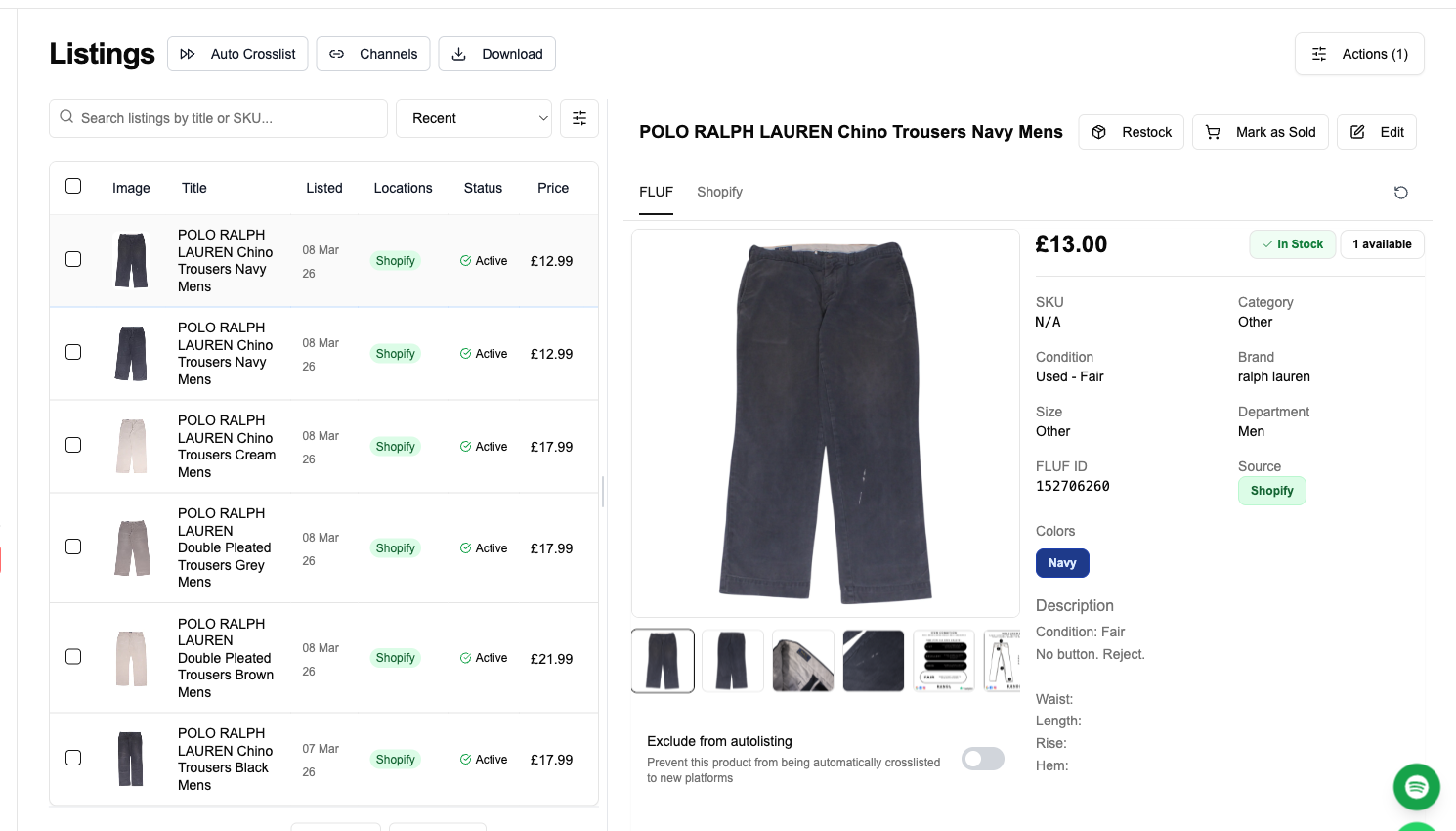
The honest heuristic: if the phrase “generate REST API keys and check your SSL detection” made you tense, choose Shopify. If it did not, the self-hosted route will cost you less every month for the rest of the store’s life. Both end in the same place — a checkout, an order record and a customer list — and FLUF connects to either.
Turning an ad into a product without overselling
A Kijiji ad carries a title, a category, a description, a price, a postal code, up to ten photos and up to five keyword tags (Kijiji, how to post an ad). A Shopify product wants rather more, and one field in particular decides whether the store works.
| Kijiji ad | Shopify product | Notes |
|---|---|---|
| Title | Title | Transfers |
| Description | Description | Transfers, and becomes rich text you can format properly |
| Up to 10 photos | Media | All transfer; Shopify imposes no comparable limit |
| Price | Price, compare-at price, cost per item | Transfers, with margin tracking available for the first time |
| Category | Product category and collections | Mapped. Collections are how your shop is actually navigated |
| Up to 5 keyword tags | Tags | Mapped |
| — | Inventory quantity | The critical one — set to 1, with tracking on, for a one-of-a-kind item |
| — | SKU | New, and worth setting as your cross-channel key |
| — | Weight and customs information | New. Needed only for items you actually post |
| Condition, in prose | A tag, a metafield or the description | Shopify has no native condition field for used goods |
| Postal code | — | Replaced by your shipping zones and pickup locations |
The inventory row is the one to get right on the first day. A used item is unique, so it needs inventory tracking switched on with a quantity of one. Leave tracking off and the store will cheerfully accept three orders for the same jacket, and you will spend the evening writing three apologetic emails and issuing two refunds. It is a setting, not a plan, and it is the most common way a first store from a classifieds background goes wrong.
Weight is the other new field, and it is worth knowing that you only need it for things you post. A pickup-only product needs no weight at all, which means the heavy items that would have been most annoying to measure are exactly the ones that do not require it.
Why Meta has made this less optional
One development from the last year has quietly changed the arithmetic, and it is not widely understood.
Meta’s own help centre states that “as of September 2025, Shops on Facebook and Instagram now use website checkout. If your shop used checkout on Facebook or Instagram, the checkout method has been updated or your shop is invisible… customers are now directed to your own website to complete the purchase” (Meta, changes to Shops and checkout).
Read that as a Canadian seller and the implication is direct. A Facebook or Instagram Shop is now a discovery surface that hands buyers off to a site you own. Without a store, that channel is not available to you in any meaningful form. Combined with the fact that Marketplace itself offers Canadians no checkout at all — Meta scopes Marketplace delivery to “the continental US” and confines seller protection to the US (Meta, about delivery on Facebook Marketplace) — the position is that Meta will happily give a Canadian seller enormous reach and no way whatsoever to take money on its platforms.
So the store stops being a nice-to-have and becomes the thing the free channels point at. Kijiji brings local buyers. Facebook brings volume. Neither will process a payment for you in Canada, and one of them now explicitly requires you to have somewhere else for the payment to happen.
What syncs, and what does not
| Event | What happens |
|---|---|
| Order placed in your Shopify store | Automatic. Shopify supports order sync, so FLUF reads the order and the Kijiji ad comes down without you touching anything. |
| Item sells on Kijiji | You mark it sold in FLUF and the Shopify product goes out of stock. A Kijiji sale is cash between two people that no server ever learns about. |
| In-person Interac sale through your reader | It is a Shopify order like any other, so it flows through the automatic path above. |
| You edit a title, description or price in FLUF | Pushed to the store. |
| Automatic relisting | Not applicable to a store, and not available on Kijiji through FLUF — the 60-day expiry stays a manual repost. |
| Offer management | Not available on either side through FLUF. |
The third row is the quietly useful one. Because an in-person Interac payment is a real Shopify order, taking payment properly at the handover also solves the delisting problem — the item comes off Kijiji automatically, rather than depending on you remembering after the buyer has driven away. That is the case where the store’s bookkeeping is doing work for the classifieds channel rather than the other way round.
Kijiji requires the FLUF browser extension. Review inventory sync to understand supported sale-sync directions and any manual steps.
The honest limitation
A Shopify store supplies exactly zero demand. On day one it has no visitors, no search ranking, no social following and no email list, and a well-built catalogue will sell nothing until somebody finds it. Kijiji hands you an audience the moment you press publish — its own current figure is nearly 5 million Canadians a month, with more than four million live listings on the site (Kijiji, about Kijiji Canada).
That is why every sentence on this page assumes you keep Kijiji. The sequence that works is marketplaces for the buyers, store for the payment and the relationship: list on Kijiji and Facebook for reach, take the money through your own checkout wherever you can, and let the store accumulate customers, rankings and repeat purchases in the background. Eighteen months in, a meaningful share of orders arrive directly, and those are the ones with no commission and no expiry date attached.
If you are selling three things a month, none of this is worth $37 CAD. If you are selling thirty, the store will pay for itself on the Interac line alone.
Sources and verification
- Shopify Canada — pricing: plan costs in CAD, Shopify Payments card rates, in-person Interac at 0% + 15¢, and third-party gateway fees
- Shopify Help — product details: the product fields, SKU, inventory and shipping information
- Shopify Help — products: what a product minimally requires
- Meta — changes to Shops and checkout: website checkout from September 2025
- Meta — about delivery on Facebook Marketplace: checkout scoped to the continental US
- Kijiji — paying safely: cash, drafts and e-Transfer, in person
- Kijiji — how long listings stay active: the 60-day expiry
- Kijiji — category pricing overview: free Buy & Sell ads and the dealer limits
- Kijiji — how to post an ad: the ad form, ten photos and five keyword tags
- Kijiji — about Kijiji Canada: reach, live listings and Canada-only operation
- Kijiji — duplicate ads policy: why you cannot simply repost to stay visible
- Competitor coverage checked 25 August 2026 against Vendoo, List Perfectly, Crosslist and PrimeLister — none supports Kijiji
Where a figure could not be traced to the platform that sets it, this page omits it. Shopify’s negotiated Plus rates are one such case, as are Kijiji’s promotion prices and its title and description character limits, none of which Kijiji publishes. Meta’s help centre is geo-gated, so the delivery scoping quoted here is Meta’s own positive statement of where checkout works rather than a Canada-rendered denial.
Related guides
Frequently Asked Questions
Shopify prices Canadian merchants in Canadian dollars: Basic at $49 CAD a month or $37 on an annual commitment, Grow at $132 or $99, Advanced at $517 or $389, and Plus from $3,400. Shopify Payments charges 2.8% + 30¢ CAD online on Basic, falling to 2.6% on Grow and 2.4% on Advanced. If you use a payment gateway other than Shopify Payments, Shopify adds a transaction fee on top — 2% on Basic — which usually outweighs any rate advantage the other gateway offers.
In-person Interac payments are 0% + 15¢ CAD on every plan, including Basic. Flat fifteen cents, whatever the amount. That directly upgrades the Kijiji handover you already do: instead of cash or an e-transfer you have to verify while the buyer waits, an Interac tap through a Shopify reader confirms the money instantly, issues both parties a receipt, records the order and marks the item sold. On a $400 item it costs fifteen cents rather than the $11.20 an online card payment would have.
Yes, and the sequence improves. Local pickup on Shopify is a shipping method rather than a field on the ad, so the buyer selects it at checkout, pays there and then, and collects — nothing is posted or weighed. The important change is the ordering: on Kijiji the meeting comes first and payment last, so a no-show costs you your Saturday; on Shopify payment comes first and the meeting last, so a no-show costs the buyer their money instead.
Turn inventory tracking on and set the quantity to one. A used item is unique, and with tracking off Shopify will happily accept three orders for the same jacket, leaving you to write three apologetic emails and issue two refunds. It is a single setting on the product, not a plan, and it is the most common way a first store from a classifieds background goes wrong.
Only the things you actually post. Weight and customs information are required for calculating shipping rates, so a pickup-only product needs no weight at all — which conveniently means the heavy, awkward items that would have been most annoying to measure are exactly the ones that do not require it. Kijiji never asked you for a weight, so anything you do intend to ship is a number that does not currently exist in your records.
Shopify if you want to sell things; self-hosted if you are comfortable maintaining a stack. Shopify is hosted, so you pay a monthly platform fee and never debug a server at eleven at night. A WordPress site running WooCommerce has no platform fee and no revenue share at all, but the hosting, updates and problems are yours. The rough heuristic: if the phrase “generate REST API keys and check your SSL detection” made you tense, choose Shopify. Both end with a checkout, an order record and a customer list, and FLUF connects to either.
Because Meta changed where its checkout lives. Meta's own help centre states that as of September 2025, Shops on Facebook and Instagram use website checkout and customers “are now directed to your own website to complete the purchase”. Combined with Marketplace offering Canadians no checkout at all — Meta scopes Marketplace delivery to the continental US — the position is that Meta will give a Canadian seller enormous reach and no way to take money on its platforms. A store is now the thing those free channels point at.
One direction is fully automatic. Your Shopify store emits real orders, so FLUF reads a sale and delists the Kijiji ad without you doing anything — and that includes in-person Interac sales through a reader, since those are ordinary Shopify orders. The other direction takes one click: a Kijiji sale is cash between two people in a car park, invisible to every server, so you mark it sold in FLUF and the Shopify product goes out of stock from that action. Kijiji supports mark-as-sold and nothing beyond it.
No, not on its own, and it is worth being blunt about it. A store supplies zero demand: on day one it has no visitors, no ranking, no following and no email list. Kijiji hands you an audience the instant you publish — its own figure is nearly 5 million Canadians a month. The sequence that works is marketplaces for the buyers and the store for the payment and the relationship. If you sell three things a month this is not worth $37 CAD; if you sell thirty, it pays for itself on the Interac line alone.
£1 for 7 days, then plans from £9/month — Starter. Every plan is unlimited on listings and marketplaces; the tiers differ by which automations they include and how often we check your channels for sales. There is no free plan. Inventory sync and bulk operations are included in every plan, and relisting and offer management from Pro upwards on every channel that supports them, rather than sold as add-ons. Shopify's subscription and Kijiji's own charges are separate from this.