
Amazon vs Shopify — a marketplace you rent against a store you own
Amazon brings the buyers and the rulebook; Shopify brings neither, and that is the point. Fees in GBP and USD, condition rules, identifiers, returns and what FLUF Connect can and cannot sync between them.



- You are not comparing two shops. You are comparing a tenancy with a freehold. On Amazon you rent a slot inside somebody else’s building: the footfall is theirs, the rules are theirs, the buyer is theirs. On Shopify you own the building and nobody walks past it until you make them.
- Amazon’s price of entry is a subscription plus a cut of every sale. The Professional plan is £25 a month excluding VAT in the UK and $39.99 in the US, and each sale then pays a referral fee set by category, mostly between 8% and 15%, with a floor of £0.25 or $0.30 per item. Fulfilment by Amazon adds per-unit and storage charges on top.
- Shopify’s price of entry is a subscription plus card processing. Basic is £25 a month, or £19 paid yearly, with online card rates of 2% plus 25p; in the US it is $39 a month with cards at 2.9% plus 30¢. Grow and Advanced cost more and process cheaper.
- If you sell pre-owned clothing, shoes or bags, Amazon is closed to you. Its UK condition guidelines say only New items are permitted in Apparel, Shoes and Handbags, Sports, Baby, Pet and Grocery. Shopify imposes no condition rule of any kind.
- Amazon needs a barcode before it will hear you out; Shopify does not care. A listing on Amazon must resolve to an ASIN, either by matching one that exists or by supplying a GTIN so Amazon can create one. A Shopify product can be a title, a photo and a price.
- The customer relationship belongs to Amazon on Amazon and to you on Shopify. Amazon hides buyer identity behind relay email addresses and restricts address data; your Shopify store gives you every name, email and order history to re-market to.
- Most sellers with new, barcoded stock end up running both, using Amazon for discovery and Shopify for margin and repeat custom. 7 days for £1, then from £9/month, then plans from £9 a month.
Which should you pick, Amazon or Shopify?
Pick Amazon if you have new, barcoded stock that buyers already search for by name, and you want sales this week rather than an audience next year. Pick Shopify if margin, brand or your customer list matters more than immediate volume, or if your stock is second-hand, handmade or otherwise unwelcome on Amazon. If you have both kinds of stock, the honest answer is both, and the rest of this page is about doing that without either channel tripping the other.
The two are not rivals in the way that Amazon and eBay are rivals. Amazon is a marketplace: a crowd of buyers, a search engine tuned to sell to them, and a rulebook you did not write. Shopify gives you a shop, a checkout and a back office, and then leaves you alone. Nobody arrives at a Shopify store by accident; everyone arrives at Amazon by habit, and almost every difference below follows from that.
Who owns the customer
On Shopify, the customer is yours. Every order writes a customer record into your admin with name, email, delivery address and purchase history, and you can segment them, email them and export the whole list if you leave. On Amazon, the customer is Amazon’s. The buyer’s contact email is an Amazon relay address that expires with the order, buyer name and address are classed as restricted data that a third-party app can only read with a specific approval, and Amazon handles the buyer conversation itself. FLUF Connect’s own Amazon integration therefore records the buyer as Amazon Customer and returns no shipping address, because a partial address would look real and mislabel a parcel.
This is the difference that compounds. A Shopify merchant with 1,000 orders behind them owns 1,000 relationships and a mailing list that lowers the acquisition cost of every future order. An Amazon seller with 1,000 orders owns a feedback score and nothing else that leaves the platform with them.
The flip side: Amazon supplies the crowd. A Shopify store on its first day has a polished checkout and no visitors, and every visitor after that is one you paid for.
What each one costs, in pounds and dollars
The two fee structures do not line up, so the tables keep them apart and a worked example follows. All Amazon figures exclude VAT, as Amazon’s own pricing pages state.
Amazon: subscription, referral fee, then fulfilment
| Amazon charge | UK (amazon.co.uk) | US (amazon.com) |
|---|---|---|
| Individual plan | £0.75 per item sold | $0.99 per item sold |
| Professional plan | £25 per month | $39.99 per month |
| Referral fee, Clothing and Accessories | 5% up to £15; 10% from £15 to £20; 15% above £20 | 5% up to $15; 10% from $15 to $20; 17% above $20 |
| Referral fee, Footwear | 15% | 15% |
| Referral fee, Consumer Electronics | 7% | 8% |
| Referral fee, Home | 8% up to £20; 15% above | 15% (Home and Kitchen) |
| Referral fee, Beauty and Health | 8% up to £10; 15% above | 8% up to $10; 15% above |
| Referral fee, Books | 15% | 15% plus a $1.80 closing fee per item |
| Minimum referral fee per item | £0.25 (most categories) | $0.30 (most categories) |
| FBA monthly storage, standard size | £0.76 per cubic foot January to September; £1.51 October to December | Published in Amazon’s US rate card |
Two things the table cannot show. The referral fee is charged on the whole amount the buyer pays, delivery included. And Amazon’s rates moved in your favour recently: on 15 December 2025 the UK and EU clothing bands were cut from 8% to 5% below £15 and from 15% to 10% between £15 and £20, and from 5 January 2026 Home Products under £20 dropped from 15% to 8%, part of what Amazon described as an average reduction of £0.15 per unit across its European stores. FBA fulfilment fees for parcels fell by an average of £0.26 at the same time. The per-unit FBA fulfilment charge depends on size tier and weight and is published only in Amazon’s downloadable rate card, so no single figure is quoted here.
The Individual plan is cheaper than Professional only below 34 sales a month, and it cannot use the Selling Partner API, so no third-party tool, FLUF Connect included, can connect to it.
Shopify: subscription, card processing, and a penalty for using someone else’s gateway
| Shopify plan | UK monthly / yearly | UK online card rate | US monthly / yearly | US online card rate | Fee if you use a third-party gateway |
|---|---|---|---|---|---|
| Basic | £25 / £19 | 2% + 25p | $39 / $29 | 2.9% + 30¢ | 2% |
| Grow | £65 / £49 | 1.7% + 25p | $105 / $79 | 2.6% + 30¢ | 1% |
| Advanced | £344 / £259 | 1.5% + 25p | $399 / $299 | 2.5% + 30¢ | 0.6% |
| Plus | from £1,800 | negotiated | quoted on request | negotiated | 0.2% |
Shopify’s middle tier was renamed from “Shopify” to Grow, so older guides that price a “Shopify plan” are describing Grow. Shopify Payments, the built-in processor that earns those card rates, is available to businesses in 45 countries including the United Kingdom and the United States; if your country or business category is not supported you must use a third-party provider and pay the extra percentage in the last column on top of that provider’s own fees. The headline rate is for a standard UK card: on Basic the same page lists 3.1% plus 25p for Amex and international cards, 4.99% plus 30p for Klarna, and 2.2% plus 20p for iDEAL and Bancontact. New stores currently get three days without paying, then £1 a month for three months, before standard pricing starts.
The fees neither headline mentions
Amazon’s pricing page carries a second tier of charges that only appear once you are trading. A refund costs you a refund administration fee of the lesser of £5 or 20% of the referral fee; a 1.5% fuel and logistics surcharge is applied to FBA fulfilment fees from 17 April 2026; units sitting in a fulfilment centre for more than 241 days attract an aged-inventory surcharge; a storage utilisation ratio above 22 weeks triggers a further surcharge; and getting unsold stock back out again is a removal order with its own fee. None of these exist on Shopify, whose pricing page states there are no setup fees on any plan and whose Basic tier bundles unlimited hosting, a custom domain, an SSL certificate, abandoned checkout recovery, discount codes, gift cards, email campaigns and pay-per-send SMS. Paid apps, premium themes and advertising are what you buy separately.
A £30 jacket, sold once on each
| Cost line | Amazon UK, Professional, merchant-fulfilled | Shopify UK, Basic, Shopify Payments |
|---|---|---|
| Sale price including £3.95 postage charged to buyer | £33.95 | £33.95 |
| Platform take on the sale | 15% referral fee on £33.95 = £5.09 | 2% + 25p = £0.93 |
| Fixed monthly cost, spread over 50 sales | £25 / 50 = £0.50 | £25 / 50 = £0.50 |
| Cost of the visitor | Included in the referral fee | Whatever you spent to bring them: ads, content, social, or nothing if they already knew you |
| Left before postage and stock cost | £28.36 | £32.52 minus acquisition |
That £4.16 gap is the whole argument in one row. Shopify’s take is a processing fee; Amazon’s is a finder’s fee. For a new brand with no audience the cost of finding the buyer yourself is frequently larger than 15%; for an established seller with a list it is close to zero, and the maths inverts.
Condition rules: what Amazon refuses and Shopify never asks about
Amazon publishes a condition rulebook and enforces it at the category level. The UK guidelines list a set of categories in which “only New items are permitted”: Apparel, Shoes and Handbags, Sports, Baby, Pet and Grocery, plus anything consumable, ingestible or topical, which sweeps in Beauty, Health Care and supplements. New means unused, with original tags, packaging and protective wrapping intact; a jacket worn once cannot be listed in Apparel at all. The guidelines also warn that once you have chosen a condition for a listing you cannot change it afterwards.
Used is welcome in Books, Music, Video and DVD, Video Games, Electronics, Home, Office, Toys and Automotive, each with its own ladder of grades. There Amazon’s vocabulary is fixed: New, Used – Like New, Used – Very Good, Used – Good, Used – Acceptable, plus Collectible and Refurbished grades where the category allows them. FLUF Connect maps your own condition text onto that fixed set when it pushes to Amazon, and defaults an unrecognised description to Used – Good rather than anything higher, because a used item mis-graded upwards on Amazon is the fastest route to a return and an A-to-z claim.
Shopify has no condition rule and no condition field. A product on Shopify is whatever you say it is, and the platform’s only interest in your stock is that it is legal to sell and not on the payment processor’s prohibited list. For a second-hand clothing business, a vintage dealer or a refurbisher, that is the reason Shopify is on the shortlist and Amazon is not.
Product identifiers: ASIN and GTIN against nothing at all
An Amazon listing is not a page you write; it is an offer you attach to a catalogue entry. Every entry has a ten-character ASIN, and the question Amazon asks before anything else is which ASIN you mean. There are two acceptable answers and one refusal:
- You know the ASIN. Your offer attaches to the existing entry with a price, a quantity and a condition. The photographs, title and bullet points already belong to the catalogue page; Amazon does not even require an image.
- You know the barcode. A GTIN, meaning a UPC, EAN, ISBN or JAN of a valid length (EAN-8, ISBN-10, UPC-A at twelve digits, EAN-13, or GTIN-14), lets Amazon match your product to an existing ASIN or create a fresh one, and for a fresh one you must supply a product type from Amazon’s fixed vocabulary, names like SHIRT, SHOES or HOME_BED_AND_BATH, plus the attributes that product type’s schema demands. Amazon’s own guide states that most product categories require a GTIN to create a listing.
- You know neither. Amazon rejects the submission. The route around it is a GTIN exemption, applied for per brand and per category, on the grounds that the product is handmade, generic, a part, a bundle or your own private label.
Shopify asks none of this. A Shopify product needs a title; everything else, including the barcode field, is optional. The cost of that freedom shows up later, when you push those products to a marketplace and discover it needs the barcode you never recorded.
Before publishing to Amazon, add the correct ASIN or valid product barcode. Check that the identifier belongs to the product; a warehouse or stock reference is not a manufacturer barcode.
Branding, the product page and the search box
On Shopify, the storefront is yours to the pixel: theme, domain, typography, photography, copy, checkout wording, the email that goes out after purchase, the packaging insert that says where to find you next. The product page is a page you wrote, and it competes with nothing on the same screen. On Amazon, the product page belongs to the catalogue and to every other seller of that ASIN, and the buyer’s eye is steered to whichever offer Amazon has chosen as the Featured Offer, which Amazon defines as the prominent area at the top of a product detail page where customers can select Add to Cart or Buy Now, awarded on price, delivery speed and certainty, order experience and being in stock. Your logo appears nowhere unless you hold Brand Registry, which needs a pending or registered trademark and unlocks A+ Content, a Brand Store, Sponsored Brands ads, Vine reviews and Transparency serial codes.
| Lever | Amazon | Shopify |
|---|---|---|
| Domain and design | amazon.co.uk or amazon.com; Amazon’s template; a Brand Store page if enrolled | Your domain; any theme; edit every template |
| Paid visibility | Sponsored Products and Sponsored Brands, cost-per-click, charged only when clicked, deducted from your selling balance | None built in; you buy Google, Meta or TikTok ads yourself |
| Reviews | Verified purchase reviews on the shared ASIN; Vine for enrolled brands | Whatever review app you install, on a page only you sell from |
| Repeat purchase | Subscribe & Save for consumables; otherwise the buyer returns to Amazon, not to you | Your mailing list, Shop Pay accelerated checkout, Shopify Inbox chat, discount codes |
| Cross-border | Global Selling into Amazon’s other stores, each with its own referral schedule | Shopify Markets: translated storefront, local currencies, local domains |
| Wholesale | Amazon Business: business prices and quantity discounts to registered business buyers | Shopify B2B, up to three catalogues on Basic |
| Logistics you can rent | FBA, Multi-Channel Fulfilment, Seller Fulfilled Prime badge if you meet its targets | Shopify Shipping labels; Shopify Fulfillment Network; or Amazon’s MCF via the Buy with Prime app |
An Amazon ranking is won on the Featured Offer and Sponsored clicks, and is rented month to month; a Google ranking for your own Shopify domain is an asset.
Returns: Amazon’s policy against yours
On Amazon you sell under Amazon’s returns policy, not your own. Buyers return through Amazon’s flow, and if you decline a return the buyer can raise an A-to-z Guarantee claim and have Amazon decide. On FBA orders Amazon processes the return itself and you find out afterwards.
On Shopify you write the policy. Shopify supplies a template you can insert and edit, and then says plainly that you are responsible for following your published policies. Consumer law in your country still sets the floor, which for a UK online sale means the buyer can cancel within 14 days of receiving the item, has a further 14 days to send it back, and must be refunded within 14 days of its return; above that floor the terms are yours to set.
For a multi-channel seller the practical difference is where returned stock reappears: a Shopify return lands back in your own inventory count, while an FBA return lands in Amazon’s warehouse, may be graded unsellable, and is available to relist nowhere until you recall it.
Buy with Prime and Marketplace Connect, the two bridges
Marketplace Connect takes your Shopify products out to Amazon. It is Shopify’s own app, formerly Codisto, and it lists Shopify products on Amazon, eBay and two US retail marketplaces, syncing orders and inventory back into the Shopify admin. Its pricing is per synced order: the first 50 marketplace-synced orders a month are included, then 1% per additional synced order, capped at $99 a month. It needs a verified seller account on the marketplace you connect, and every Amazon constraint above still applies through it.
Buy with Prime brings Amazon’s fulfilment and Prime badge into your Shopify store. Through the Amazon MCF and Buy with Prime app, Amazon charges a Prime service fee of 3% per order with a $0.30 minimum, payment processing of 2.4% plus $0.30 through Amazon Pay, and fulfilment from $5.60 per unit, with a 3.5% fuel and logistics surcharge on fulfilment fees from 2 May 2026 and peak-season surcharges between 15 October 2026 and 14 January 2027. The published pricing and the Prime checkout are US-only; the Multi-Channel Fulfilment half of the app can ship to US and UK customers.
When running both is the right answer
Run both when your stock is new, barcoded and repeatable, and you want Amazon to do the finding while your own store does the keeping: list the range on Amazon, treat the referral fee as customer acquisition, and put a reason to visit your own store in every parcel, inside the rules, so the second purchase happens at 2% plus 25p instead of 15%.
The failure mode of running both is the oversell: one unit, two places, one sale, and a second buyer paying for something already gone. With Amazon it has a sharper edge, because a pattern of cancelled orders is an account health problem, not a customer service one. Whatever runs both has to zero one side when the other sells, and be honest about which directions it covers.
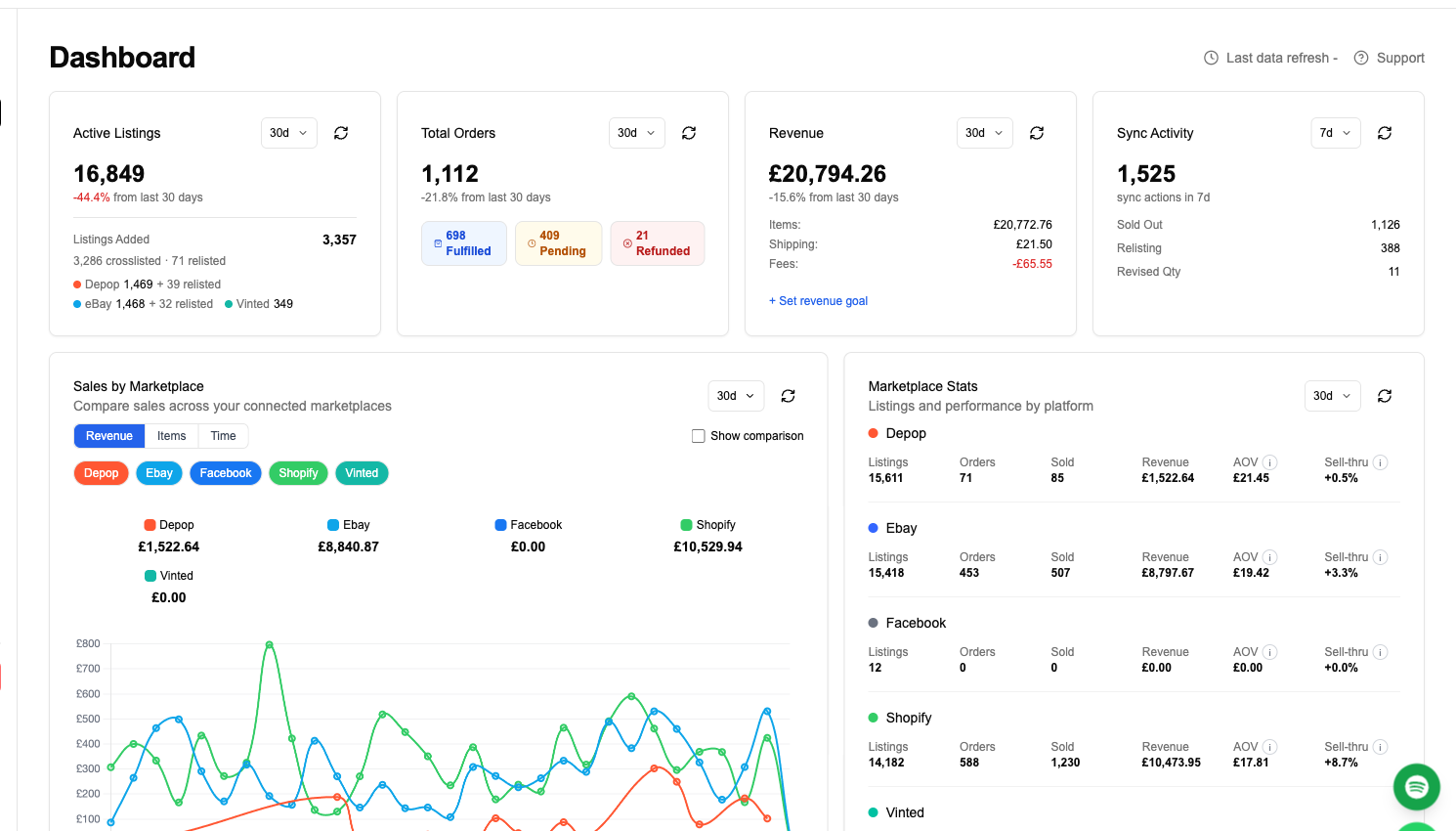
How FLUF Connect treats Amazon and Shopify differently
FLUF Connect supports both Shopify and Amazon, but their available features differ. Review the supported sync directions before deciding how to manage your stock.
Shopify: the hub, both directions
Shopify requires no browser extension and can serve as your source catalogue and destination store. Shopify sales update connected marketplace availability. Supported marketplace orders can be centralised in Shopify for fulfilment, with tracking sent back to the selling channel. Relisting and offer management do not apply to Shopify.
Amazon: one direction covered, one deliberately not
Amazon requires a Professional selling account and no browser extension. Follow the authorisation prompts in FLUF Connect. Review the SKU, product identifier, required attributes and fulfilment settings before publishing.
Sold elsewhere, ended on Amazon: supported. When an item that is also on Amazon sells on Shopify or on any other channel, FLUF Connect sets the Amazon offer’s quantity to zero. That covers merchant-fulfilled offers; stock held in Amazon’s warehouses under FBA is Amazon’s count, not yours, and the integration deliberately treats an FBA listing with no declared quantity as live rather than sold out, because reading it as zero would delist a seller’s whole Amazon range everywhere else.
Amazon sales do not currently update other channels automatically or create mirrored Shopify orders. When an item sells on Amazon, remove it from your other channels yourself, or keep dedicated Amazon stock.
Inventory updates are not instantaneous. Amazon sales currently require manual reconciliation on your other channels.
What FLUF Connect costs
7 days for £1, then from £9/month, then plans from £9 a month. The Starter plan at £9 a month has unlimited listings and includes crosslisting, inventory sync, order sync and bulk operations; relisting, offer management and smart pricing come with the plans above Starter. Yearly billing costs 40% less than paying monthly.
Sources and verification
Every fee, rule and date on this page was checked against a primary source on 8 September 2026.
- Amazon UK selling plan pricing — the £0.75 Individual per-item fee and £25 Professional monthly fee, both excluding VAT; the banded Clothing, Home and Beauty referral rates; the 15% Footwear and Books rates; the 7% Consumer Electronics rate; the £0.25 minimum; and the £0.76 and £1.51 per cubic foot monthly storage fees, the refund administration fee, the 1.5% surcharge from 17 April 2026, and the 241-day and 22-week inventory surcharges.
- Amazon US selling plan pricing — the $0.99 and $39.99 plan fees, the $0.30 minimum referral fee, and the Clothing, Footwear, Electronics, Home and Kitchen, Beauty and Books rates, including the $1.80 media closing fee.
- Amazon’s announcement of its 2026 European fee changes — the 15 December 2025 and 5 January 2026 effective dates, the Clothing and Home Products cuts, the average £0.15 per unit reduction and the average £0.26 FBA parcel reduction.
- Amazon UK Condition Guidelines (PDF) — the verbatim New-only wording for Apparel, Shoes and Handbags, Sports, Baby, Pet and Grocery and for consumable, ingestible and topical products; the categories where used is permitted; the used-condition ladder; and the statement that a listing’s condition cannot be changed after it is chosen.
- Amazon’s GTIN guide — the definition of a GTIN, the UPC, EAN, ISBN and JAN formats, the statement that most categories require one, and the exemption route.
- Amazon’s SP-API developer registration page and registration documentation — that only Professional selling accounts can integrate with the Selling Partner API and Individual accounts are not eligible.
- Amazon’s returns policy — the A-to-z Guarantee escalation for third-party orders.
- Shopify UK pricing — the £25/£19 Basic, £65/£49 Grow and £344/£259 Advanced monthly and yearly prices, the from-£1,800 Plus price, the 2%, 1.7% and 1.5% plus 25p online card rates, the 2%, 1%, 0.6% and 0.2% third-party transaction fees, the Amex, international, Klarna, iDEAL and Bancontact rates and the three-day then £1-a-month introductory offer.
- Shopify US pricing — the $39/$29 Basic, $105/$79 Grow and $399/$299 Advanced prices and the 2.9%, 2.6% and 2.5% plus 30¢ online card rates.
- Shopify Payments supported countries — the 45-country list including the United Kingdom and the United States, and the requirement to use a third-party provider elsewhere.
- GOV.UK on accepting returns and giving refunds — the 14-day cancellation window for online sales, the further 14 days to return, and the 14-day refund deadline.
- Shopify’s store policies documentation — the policy templates and the statement that the merchant is responsible for following their published policies.
- Shopify Marketplace Connect and its requirements page — the supported marketplaces, the 50 included synced orders, the 1% per additional order and the $99 monthly cap, and the verified-seller-account requirement.
- Buy with Prime pricing — the 3% Prime service fee with $0.30 minimum, the 2.4% plus $0.30 Amazon Pay processing fee, the from-$5.60 fulfilment fee, the 3.5% surcharge from 2 May 2026, and the 15 October 2026 to 14 January 2027 peak surcharge window.
- Amazon on the Featured Offer — its definition and the pricing, delivery, order-experience and stock factors that decide it.
- Amazon Brand Registry and Amazon’s seller programmes page — the trademark requirement, A+ Content, Brand Stores, Sponsored Brands, Vine, Transparency, Subscribe & Save, Amazon Business, Global Selling, Seller Fulfilled Prime and Multi-Channel Fulfilment as described by Amazon.
- Amazon Ads for UK sellers — Sponsored Products and Sponsored Brands on a cost-per-click model, charged only on clicks.
- Amazon’s Listings Items API reference — the SKU-keyed listing path and the patch-rather-than-replace update model.
What we could not verify, and therefore treated with care. Shopify’s US pricing page redirected to the UK edition when we fetched it, so the dollar figures in the Shopify table were confirmed against several current third-party summaries of shopify.com/pricing rather than read from the page itself. Amazon’s own help page on its returns window returned a server error when we fetched it, so we have stated the A-to-z escalation and left out a specific number of days. Amazon’s per-unit FBA fulfilment fees live only in a downloadable rate card, so we quoted storage fees and not fulfilment fees. Whether Buy with Prime will reach UK merchants, and on what terms, is not stated anywhere we could find and should be treated as unknown.
Related guides
- Selling on Amazon
- Selling on Shopify
- Crosslisting from Shopify to Amazon
- Amazon vs eBay
- Shopify vs WooCommerce
- Selling on eBay
- All marketplace guides
- All crosslisting guides
- Amazon vs WooCommerce
- Wix vs Amazon compared
- BigCommerce vs Amazon
- Shopify vs TikTok Shop
- Crosslist from Amazon to Shopify
- Shopify vs Mercado Libre
- Shopify vs Walmart Marketplace
Frequently Asked Questions
Per sale, Shopify is cheaper: on the Basic plan you pay a card-processing rate of 2% plus 25p in the UK, or 2.9% plus 30 cents in the US, against Amazon’s category referral fee of roughly 8% to 15% of the full amount the buyer pays. Both charge a monthly subscription of £25 (Shopify Basic paid monthly, or Amazon Professional excluding VAT). The difference is that Amazon’s fee buys you the visitor; on Shopify you have to find the visitor yourself, and that cost can be larger than Amazon’s cut for a new brand with no audience.
No. Amazon’s UK condition guidelines state that only New items are permitted in Apparel, Shoes and Handbags, Sports, Baby, Pet and Grocery, and in anything consumable or topical such as Beauty and Health. Used is allowed in Books, Music, Video, Video Games, Electronics, Home, Office, Toys and Automotive. Shopify has no condition rule and no condition field, so second-hand fashion, vintage and refurbished stock can be sold there without restriction.
On Amazon, yes in almost every case: a listing must attach to an existing ASIN or supply a GTIN (a UPC, EAN, ISBN or JAN) so Amazon can match or create one, and Amazon says most categories require a GTIN to create a listing. Without either you need a GTIN exemption, granted per brand and category. On Shopify a product needs only a title; the barcode field is optional and nothing checks it.
Shopify gives you access to your store’s customer records. Amazon restricts access to buyer contact details; do not expect Amazon buyer email addresses or shipping details to be available through FLUF Connect for marketing or fulfilment.
In one direction. When an item sells on Shopify or any other connected channel, FLUF Connect sets its Amazon offer quantity to zero. In the other direction, a sale on Amazon does not yet end the item on Shopify or elsewhere: FLUF Connect reads Amazon orders but deliberately does not act on them, because Amazon reports orders as Pending before payment clears and cancels a meaningful share, and treating those as sold would delist items for sales that never happened. Amazon is not an order-sync channel in FLUF Connect today, and you must end Amazon-sold items elsewhere yourself.
No. Amazon allows only Professional selling accounts to integrate with the Selling Partner API; Individual accounts cannot authorise any third-party tool. Professional costs £25 a month excluding VAT in the UK or $39.99 in the US, and is cheaper than the Individual per-item fee once you sell more than about 34 items a month anyway.
They run in opposite directions. Marketplace Connect is Shopify’s app that lists your Shopify products on Amazon and other marketplaces, with the first 50 synced orders a month included, then 1% per synced order capped at $99 a month. Buy with Prime brings Amazon’s fulfilment and the Prime badge into your own Shopify store, at a 3% Prime service fee, 2.4% plus $0.30 payment processing through Amazon Pay, and fulfilment from $5.60 a unit; its published pricing and Prime checkout are US-only.
If your stock is new, barcoded and repeatable, usually yes: Amazon supplies the buyers and Shopify supplies the margin and the customer list. Keep Shopify as the master catalogue, list on Amazon for discovery, and make sure stock is ended on one side when it sells on the other. FLUF Connect connects Shopify and Amazon among its 70+ channels, with Shopify as the fulfilment hub; be aware that only the sold-elsewhere-to-Amazon direction is automated today.
Sign up for free
Join the community
You're in.
Open your dashboard