Sell on Amazon — the complete seller guide for 2026
Amazon is a catalogue, not a listings board — which decides everything else. What you need to list, what Amazon takes, the categories that refuse used goods, and exactly what FLUF syncs across 50+ marketplaces.
- Amazon is a catalogue, not a listings board. This is the one structural fact that changes everything else. You do not create a page for your item; you attach an offer to a page that already exists, identified by an ASIN. Everything below follows from that.
- Which means an identifier is not optional. To list, you need an ASIN for the exact product, or a barcode — an EAN, UPC, GTIN or ISBN — that Amazon can resolve to one. A hand-typed title and six photographs, which is a complete listing on Vinted or Depop, will not open an Amazon listing at all.
- Two plans, and the maths is a single division. Individual costs £0.75 (excl. VAT) per item sold in the UK, or $0.99 in the US, and no monthly fee. Professional is £25 or $39.99 a month with no per-item charge. The crossover is about 34 items a month in the UK, 41 in the US.
- Referral fees run 5% to 45% depending on category, with a £0.25 / $0.30 minimum on most categories. UK clothing is banded: 5% up to £15, 10% from £15 to £20, 15% above £20.
- You do not have to use FBA. Merchant-fulfilled selling — Amazon’s own term is MFN — means you post the parcel yourself, exactly as you would from any other marketplace. FBA is a separate, opt-in logistics service with its own storage and fulfilment fees.
- Read this before anything else if you sell second-hand clothing. Amazon’s UK condition guidelines list Apparel, Shoes and Bags, Sports, Baby, Pet and Grocery as New only. Used fashion — the entire category that Vinted, Depop and Vestiaire Collective exist for — cannot be listed on Amazon at all. Used books, media, electronics, home and automotive can.
- Amazon Handmade is a separate programme with a 15% referral fee and the Professional subscription waived after the first month — and, usefully for makers, a product-ID exemption route.
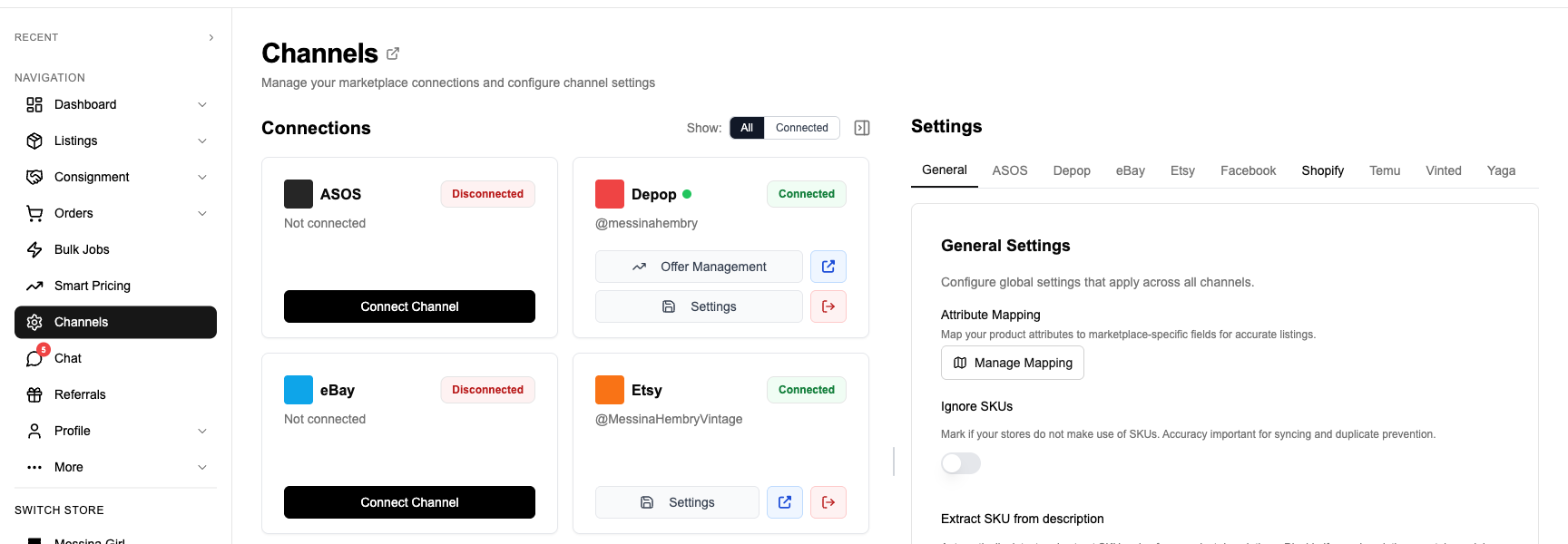
- What FLUF Connect supports: create merchant-fulfilled Amazon listings, update product details, price and stock, and remove listings when an item sells on another supported channel. Sales made on Amazon are not detected automatically; remove those items from other channels yourself. 7 days for £1, then from £9/month.

On this page
- The catalogue model, and why it decides everything
- The identifier problem, said plainly
- The Featured Offer, and what you actually compete on
- If you have no barcode: the product ID exemption
- Individual or Professional: the only sum that matters
- What Amazon takes when something sells
- FBA, FBM, and the choice you do not have to make
- Selling second-hand on Amazon
- Amazon Handmade, for makers
- Where you can register as a seller
- What FLUF does, and what it does not do yet
- What travels from your catalogue into an Amazon listing
- Connecting Amazon to FLUF, step by step
- What FLUF costs
- Sources and verification
- Related guides
The catalogue model, and why it decides everything
Amazon is a catalogue with offers attached to it. Every other marketplace guide on this site describes a system where you write a listing and that listing is the product. Amazon inverts it, and almost every difficulty a new Amazon seller runs into is a consequence of that inversion.
A product page on Amazon is owned by nobody in particular. It has an ASIN — a ten-character alphanumeric identifier — a title, a set of photographs, bullet points and a description, and it is shared by every seller offering that item. What you create when you “list on Amazon” is an offer: your price, your condition, your stock quantity, your fulfilment method, hung off that shared page. The Buy Box you have read about is Amazon choosing which of those competing offers to feature.
Three consequences follow, and they are worth internalising before you spend an evening on this.
Your photographs and copy may never be seen. If you attach an offer to an existing ASIN, the page keeps its own images and text. Your listing quality work — the thing that wins on Etsy and eBay — has nowhere to go. What you compete on instead is price, condition grade, delivery speed and seller rating.
A unique item is a hard case, not an easy one. Everywhere else, a one-off is the simplest possible listing. On Amazon it is the most awkward, because there is no catalogue entry to attach to and you must create one, which is a materially higher bar.
Matching wrongly is worse than not matching. Attach your offer to the wrong ASIN and you have promised a buyer a specific product with specific specifications. They will receive something else. Amazon treats that as an inauthentic or not-as-described item, and it is one of the faster routes to an account problem.
The identifier problem, said plainly
To open a listing, Amazon needs to know which catalogue entry you mean. There are two ways to tell it, and they are not equally easy.
Give it an ASIN. You already know the exact product page. Your offer attaches to it, Amazon asks for essentially nothing beyond price, condition and quantity, and the submission is about as likely to be accepted as an Amazon submission ever is. This is the normal path for anyone selling stock that already exists in the catalogue — books, media, boxed goods, branded products, most second-hand items of any commercial history.
Supply an accurate product identifier. Use an ASIN or valid barcode for the exact product, and complete the required product details. Check any requested corrections before publishing.
Add the correct ASIN or barcode to your product before crosslisting. If needed, create the listing in Seller Central first and add its ASIN in FLUF Connect. Confirm that the listing is linked before relying on automatic updates.
There is a third route for makers and own-brand sellers: the product ID exemption. Amazon’s own Handmade documentation states that during listing you must “provide a product ID or request a product ID exemption”, so a barcode is not absolutely mandatory for every seller in every category. It is an application, not a checkbox.
The Featured Offer, and what you actually compete on
Because many sellers share one detail page, Amazon has to choose which offer the page presents by default. That is the Featured Offer — what everyone still calls the Buy Box. Amazon describes it as “the prominent area at the top of a product detail page where customers can select Add to Cart or Buy Now.” Every other offer is pushed into an “Other sellers on Amazon” panel that most buyers never open.
Amazon names the drivers: a competitive price, typically at or below the lowest alternatives; fast and free delivery; customer-experience metrics; and being in stock. An out-of-stock offer cannot be featured. So can one priced too high — or, less obviously, one priced suspiciously low.
Condition is a separate dimension in that comparison, and Amazon requires that “the item and its condition match what is shown on the product detail page.” What that means in practice for a used-goods seller is the part most guides get wrong, so we will say only what Amazon says: condition is compared, and grading honestly is a policy obligation rather than a tactic.
One change worth knowing about if you are new: Amazon announced in 2026 that it is “removing seller eligibility requirements for the Featured Offer”, rolling out from July 2026 and completing globally by the end of the year. The performance gate is going; the ranking is not changing. Amazon’s own wording: “We’re not changing how the Featured Offer is selected.” No seller action is required.
The practical reading for a crosslister: on Amazon your listing quality is largely someone else’s, and what you control is price, stock accuracy and dispatch speed. That is a genuinely different discipline from the one that wins on Etsy, and it is worth deciding whether you want to play it before you connect the channel.
If you have no barcode: the product ID exemption
The identifier requirement has an official escape hatch, and it is under-known. Amazon grants product ID exemptions — also called GTIN exemptions — where the brand owner, manufacturer or publisher never issued a barcode. Amazon’s own guidance names private brands and handmade products as qualifying grounds, along with product parts that carry no GTIN and bundles.
How it works: in the listing flow you choose “I don’t have a product ID”, continue, and an “Apply now” button appears where an exemption is needed. The application wants images showing all sides of the product and its packaging. Amazon says approval “usually takes about 48 hours.”
Two constraints matter more than the process. First, scope: “You need separate approvals for each product category and store” — per category, per marketplace, so an approval on amazon.co.uk in one category buys you nothing in the next. Second, permanence: if you designate a product as generic — belonging to no identifiable brand — Amazon states that “once you designate a product as generic, it cannot be changed.”
If you are a brand owner rather than a reseller, the parallel route is Brand Registry, which grants control over the detail page’s own content. Amazon requires “an active, registered trademark or a pending trademark application” for the brand name or logo from a government trademark office in a country with a corresponding Amazon store, plus “a logo that includes your brand name permanently affixed to your products or packaging”, with proof. That is a real barrier, and it is the barrier that keeps most resellers on the offer-only path.
Individual or Professional: the only sum that matters
Amazon sells two selling plans and the choice between them is arithmetic, not strategy.
| Plan | United Kingdom | United States | Charged |
|---|---|---|---|
| Individual | £0.75 excl. VAT per item sold | $0.99 per item sold | Per sale, no subscription |
| Professional | £25 excl. VAT per month | $39.99 per month | Monthly, no per-item charge |
Divide the subscription by the per-item fee and you have your crossover. In the UK, £25 divided by £0.75 is a little over 33, so at about 34 sales a month Professional starts paying for itself. In the US, $39.99 divided by $0.99 is just over 40. Below that, Individual is cheaper; above it, Professional is, and the gap widens fast.
The per-item fee is charged on items sold, not on listings created, so an Individual seller with 400 dormant listings and nine sales pays for nine. Both plans pay referral fees on top; the plan fee is not a substitute for them.
Professional does buy things beyond the arithmetic — bulk listing tools, Buy Box eligibility, restricted-category applications, and third-party API integration — and for most sellers the API access is the deciding factor rather than the break-even point.
What Amazon takes when something sells
The referral fee is Amazon’s commission and it varies by category more than any comparable marketplace’s does. Amazon’s own pricing pages put the range at 5% to 45%, with a minimum of £0.25 in the UK and $0.30 in the US on most categories — Books, Music, Video and DVD have no per-item minimum in the UK schedule.
Some published examples, taken directly from Amazon’s UK and US pricing pages:
| Category | Rate | Market |
|---|---|---|
| Clothing and Accessories | 5% up to £15; 10% from £15 to £20; 15% above £20 | UK |
| Clothing & Accessories | 17% above $20.00 | US |
| Home Products | 8% up to £20 | UK |
| Home & Kitchen | 15%, minimum $0.30 | US |
| Electronics | 8%, minimum $0.30 | US |
| Jewellery | 20% on the portion up to $250.00 | US |
| Pet Clothing and Food | 5% up to £10 | UK |
| Amazon Device Accessories | 45%, minimum $0.30 | US |
Two things to take from that table rather than the individual numbers. The first is that the UK clothing schedule is banded by price, which is unusual and which rewards low-value apparel unexpectedly well — a £12 top costs you 5%, where the same item on most fashion marketplaces costs the same percentage at every price. The second is that a rate you read in an article about “Amazon’s 15% fee” is a category rate, not a platform rate, and the spread between 5% and 45% is far too wide to generalise across. Read the schedule for the category and the site you actually sell in, and check it again when you add a category.
Note also the fuel surcharge Amazon introduced on fulfilment fees: its UK pricing page states that “Starting from April 17, 2026, a 1.5% fuel and logistics-related surcharge will be applied to fulfilment fees.” That applies to FBA fulfilment, not to referral fees.
FBA, FBM, and the choice you do not have to make
A great deal of Amazon writing assumes FBA, and a seller arriving from a resale marketplace often assumes FBA is compulsory. It is not.
FBM — merchant fulfilled, which Amazon’s own systems call MFN. Your stock stays with you. An order arrives, you pack it and post it, you confirm dispatch. This is identical in shape to how you already sell on every other channel, and it is the only mode that makes sense for one-off, second-hand or made-to-order stock.
FBA — fulfilled by Amazon. You send stock into Amazon’s warehouses in advance, and Amazon picks, packs, ships and handles returns. It buys Prime badging and generally better Buy Box odds, and it costs a fulfilment fee per unit plus monthly storage, which Amazon’s UK page bands from £0.62 per cubic foot per month for clothing between January and September up to £1.51 for standard-size non-clothing between October and December.
FLUF Connect supports merchant-fulfilled Amazon listings: you hold the stock and dispatch orders yourself. Manage any FBA inventory and fulfilment separately in Amazon.
Selling second-hand on Amazon — and the categories that refuse it
Amazon does accept used goods. It does not accept them everywhere, and the exclusions are precisely the categories most resale sellers live in. This section is the one to read twice.
The categories that are New only
Amazon’s published UK condition guidelines carry an explicit New only section. Verbatim from it:
- Apparel — “Only New items are permitted to be sold in the Apparel category on Amazon.co.uk.”
- Shoes and Bags — “Only New items are permitted to be sold in the Shoes and Handbag category.”
- Sports and Outdoors — “Only New items are permitted.”
- Baby, Pet and Grocery — “Only New items are permitted to be sold in the these product categories.”
- Anything consumable, ingestible or topical — “All consumable, ingestible, and/or topical products sold on Amazon must be listed in New condition”, naming Beauty, Food & Grocery, Health Care and Vitamins & Dietary Supplements.
Take that list seriously, because it is the single most consequential difference between Amazon and every fashion-resale channel we support. If your stock is pre-owned clothing, trainers or handbags, Amazon is not a destination for it — not because it is hard, but because it is against policy. No crosslisting tool changes that, and any tool that implies otherwise is going to get your listings removed.
Where used is welcome
The same guidelines set out per-category condition definitions for Books, Music, Videos and DVDs, Video Games, Automotive, Electronics & Photo, Home & Garden, Large Appliances, Office Products, Software and Toys. Ink and toner is a special case: used is permitted only with Seller Support approval, and Certified Refurbished is prohibited outright.
That is a real and substantial business. Second-hand books, vinyl, CDs, DVDs, games, cameras, tools and small appliances all have a legitimate home on Amazon, and for a bookseller in particular Amazon is arguably the most liquid second-hand market that exists.
The condition ladder, in Amazon’s own words
These definitions come from Amazon’s public Marketplace Items Condition Guidelines, which is the buyer-facing page and therefore the one you can actually read without a Seller Central login:
- New — “Just like it sounds. A brand-new item. Original manufacturer’s warranty, if any, still applies… Original packaging is present for most New items but certain items may be re-boxed.”
- Used – Like New or Open Box — “An item in perfect working condition. Original protective wrapping may be missing, but the original packaging is intact and in good condition with minor damage possible. Instructions are included.”
- Used – Very Good — “A well-cared-for item that has seen limited use and remains in good working condition. The item may show some limited signs of wear with small scratches or cosmetic blemishes.”
- Used – Good — “The item shows wear from consistent use, but it remains in good condition and functions properly… It may be marked, have identifying markings on it, or have minor cosmetic damage.”
- Used – Acceptable — “The item is fairly worn but continues to function properly… Signs of wear can include aesthetic issues such as scratches, dents, and worn corners.”
Books, Music, Video and DVD, Video Games and Toys additionally carry a Collectible ladder — Collectible – Like New, Very Good, Good and Acceptable — for items whose value is in rarity rather than utility. Amazon is blunt about the bar: for books, “Generally, books in Good condition are not considered to be collectible grade”, and Acceptable is collectible-grade only “for all but the rarest items”. Collectible also demands a justification in the condition notes: signed, out of print, a first or limited edition, a special pressing.
Review Amazon’s condition rules for the category before listing. Do not assume that a condition used on another marketplace has the same meaning on Amazon. If the category does not permit your item’s condition, do not list it there.
Renewed, and why it is not for most people
Amazon Renewed is the programme for professionally refurbished electronics, and its entry requirements are considerably higher than most sellers expect. Amazon’s own programme page asks for itemised invoices showing at least $50,000 of qualifying refurbished purchases in the previous 90 days — $2.5 million for Apple-branded goods — plus trademark documentation or Brand Registry enrolment, and sample images meeting Renewed’s “Excellent” cosmetic grade. It is a distribution business, not a side hustle, and it is worth knowing it exists mainly so you do not plan around it.
Gating
Separately from condition, Amazon gates entire categories behind pre-approval. Amazon’s condition guidelines put it as: “you may be required to obtain approval to list certain products.” When a product is in a gated or New-only category, the used, open-box, collectible and refurbished options simply do not appear in the listing flow — the refusal is silent rather than explained. If you cannot find a condition dropdown, that is usually why.
Amazon Handmade, for makers
Handmade is Amazon’s answer to Etsy: a curated storefront within Amazon for hand-altered, hand-designed, handcrafted, repurposed or upcycled products, with an application and approval process rather than open registration.
The commercial terms differ from standard Amazon in three ways that matter. There are no listing fees at all — you are not charged to put something up, which is the opposite of Etsy’s model. The referral fee is a flat rate rather than a category rate, and it differs by market: Amazon’s US page states “a referral fee of 15% or $0.30, whichever is greater” per unit shipped, while its UK page states a “12.24%” referral fee. We quote both because they are both verbatim from Amazon; we have not been able to reconcile the gap, and it may be a VAT-exclusive presentation on the UK side. And the Professional selling plan subscription is waived for approved Handmade sellers — after the first month, which you pay regardless. Amazon’s US page puts the saving at “$480 per year”. For a maker selling more than a handful of items a month, that waiver substantially changes the arithmetic in the plans section above.
The application runs: register as a Professional seller, submit an application describing you, your products and your process, list and classify products with the Handmade Classification attribute, and build a maker profile. Amazon says it “uses an application process to add new makers to the Handmade category to ensure customers can buy with confidence”.
The UK Handmade categories Amazon lists are Accessories; Artwork; Baby; Beauty & Personal Care; Clothing, Shoes & Handbags; Home, Outdoor & Home Care; Jewellery & Watches; Kitchen & Dining; Pet Supplies; Sporting Goods; Stationery & Party Supplies; and Toys & Games.
Note what that list quietly does for a fashion seller: Clothing, Shoes & Handbags is a Handmade category even though used apparel is banned on the main marketplace. The distinction Amazon draws is between items that are “hand-altered, hand-assembled by the artisan” and vintage pieces sold as they are. A hand-reworked garment can qualify; a resold one cannot. If your business is genuinely upcycling rather than reselling, Handmade is the door.
The product-ID exemption route matters most here, because handmade goods by definition have no manufacturer barcode — and Amazon names “private brands or handmade products” as a qualifying ground for one.
Where you can register as a seller
Amazon ships almost everywhere. It onboards sellers in a much smaller set of countries, and the distinction trips people up regularly. The seller-registration marketplaces are, by region:
- North and South America — United States, Canada, Mexico, Brazil.
- Europe, the Middle East and Africa — United Kingdom, Ireland, Germany, France, Italy, Spain, Netherlands, Belgium, Sweden, Poland, Türkiye, United Arab Emirates, Saudi Arabia, Egypt, South Africa.
- Asia-Pacific — India, Japan, Australia, Singapore.
Within a region, unified accounts let one registration reach several of those marketplaces. Amazon’s own wording for the North American one: “Use a North America and Brazil unified account to reach Amazon customers in the US, Canada, Mexico, and Brazil.” Brazil sits inside it now, which it did not always.
The European unified account covers ten stores, which Amazon lists as “Amazon.co.uk, Amazon.fr, Amazon.de, Amazon.it, Amazon.es, Amazon.pl, Amazon.nl, Amazon.se, Amazon.com.be, and Amazon.ie”. Note that the UK is still inside it — Brexit split the VAT, customs and fulfilment arrangements, not the seller account.
Asia-Pacific and the Middle East are the exception: Amazon says to “use country-specific Asia-Pacific accounts” for Australia, India and Japan, and country-specific accounts for the UAE, Saudi Arabia and Egypt. There is no unified account there. And no unified account is global — registering in the UK does not give you the US, and the two remain separate businesses for tax and compliance whatever the login arrangement.
What FLUF does, and what it does not do yet
Amazon opened to all FLUF sellers on 5 September 2026, and we would rather be exact about the boundaries of that than sell you a capability we have not proven.
Connect Amazon from FLUF Connect and authorise access on Amazon’s own screen. No browser extension is required. You can create merchant-fulfilled listings, update product details, price and stock, and remove listings. Check the supported sale-sync directions for each other marketplace you connect.
What is not live. Order sync is not claimed on Amazon and you should not plan around it. We can read your Amazon orders, but nothing is yet written into FLUF’s order records, so a sale on Amazon does not currently pull your Vinted or eBay copy of that item down. The protection runs one way today: other channels to Amazon, not Amazon to other channels. Relisting, offer management and smart pricing are not available on Amazon either. Nor are they claimed anywhere in the product — the channel’s capability record lists exactly one feature, and everything on this page is written from that record rather than around it.
The honest reason for that restraint is worth stating. Amazon’s order statuses include Pending, which is an order whose payment has not cleared and a meaningful share of which Amazon subsequently cancels. Treating a Pending order as a sale would delist a real item everywhere else for a sale that never happened. We would rather ship sold-detection late than ship it wrong, and until the order shape has been read from a live account it stays off.
What travels from your catalogue into an Amazon listing
What Amazon accepts depends on which of the two paths your product takes.
| Field | Offer on an existing ASIN | New listing from a barcode |
|---|---|---|
| Title | Not used — the catalogue page’s title stands | Sent as the item name |
| Description | Not used, but see condition note | Sent as plain text |
| Condition note | Yes — up to 2,000 characters | Yes |
| Images | Not used — the catalogue page’s images stand | Main image plus up to eight more |
| Brand | Not used | Sent where your product carries one |
| Condition | Yes | Yes |
| Price | Yes, in your store currency | Yes |
| Stock quantity | Yes, merchant-fulfilled | Yes, merchant-fulfilled |
| Category / product type | Inherited from the ASIN | Resolved from your category, then Amazon’s own suggestion |
Images are handled unusually and it is worth knowing why: Amazon is sent image URLs and fetches them itself, rather than accepting an upload. They therefore have to be publicly reachable. A photograph behind a login produces a listing with no picture and no error message, which is a much worse failure than a rejection.
Review the updated listing in Seller Central after changing product details, price or stock.
Connecting Amazon to FLUF, step by step
- Have a Professional seller account. Third-party API integration is a Professional-plan capability, so the Individual plan cannot authorise FLUF.
- Open Channels in FLUF Connect and choose Amazon. You will be sent to Amazon’s own consent screen.
- Authorise on Amazon’s page, not ours. Confirm the marketplace region you sell in and approve the connection. You are never asked for your Amazon password by FLUF.
- Check the region and currency. Confirm that the Amazon marketplace and price currency match where you intend to sell.
- Put identifiers on the products you want to list. An ASIN if you have it; otherwise an EAN, UPC, GTIN or ISBN. This is the step that decides whether the rest works.
- Crosslist one item first and read the result. Amazon returns a submission outcome rather than a simple success, and a rejection comes back with an itemised list of what it wants. Fix one item before you push a hundred.
Review your first Amazon listings carefully, especially when adding a new product category. Correct any missing or rejected product details before trying again, and contact FLUF support if you need help.
What FLUF costs
7 days for £1, then from £9/month. There is no free plan and no free tier.
Crosslisting, inventory sync, order sync and bulk operations are on every plan. Relisting, offer management and smart pricing are included from Seller (£29/month) upwards; Starter does not include them. Paying annually saves 40%.
| Plan | Monthly | Crosslisted products |
|---|---|---|
| Starter | £9/month | Unlimited |
| Seller | £29/month | Unlimited |
| Pro | £99/month | Unlimited |
| Super Seller | Custom pricing — tell us what you need | Unlimited |
One Amazon-specific note on plan choice: because Amazon does not support relisting or offer management at all, the automation tiers buy you nothing on this channel. If Amazon and a store platform are your only two channels, Starter genuinely is the right plan. The automation tiers earn their money on Vinted, Depop, eBay and Etsy, where relisting and offers exist.
Sources and verification
Every fee, rule and limit above was checked against a primary source on 7 September 2026.
- Amazon’s UK selling plan pricing page — the £0.75 excl. VAT per-item Individual fee, the £25 excl. VAT Professional monthly fee, the 5%–45% referral fee range, the £0.25 minimum referral fee and its Books/Music/Video/DVD exception, the banded UK clothing rates, the Home Products and Pet rates, the £0.62–£1.51 per cubic foot monthly storage bands, and the 1.5% fuel and logistics surcharge applying to fulfilment fees from 17 April 2026.
- Amazon’s US selling plan pricing page — the $0.99 per-item Individual fee, the $39.99 Professional monthly fee, the $0.30 minimum referral fee, and the Clothing, Electronics, Home & Kitchen, Jewelry and Device Accessories rates quoted.
- Amazon Handmade’s programme page — the definition of what qualifies as handmade, the “15% or $0.30, whichever is greater” referral fee, the Professional subscription waiver after the first month and its “$480 per year” value, the five-step application, and the requirement to “provide a product ID or request a product ID exemption”.
- Amazon’s authorisation guide — approving an application connection.
- Amazon’s Marketplace Items Condition Guidelines — the verbatim New, Used – Like New or Open Box, Very Good, Good and Acceptable definitions, the Collectible ladders for Books, Music, Video and Video Games, and Amazon’s statement that books in Good condition are generally not collectible grade.
- Amazon’s UK Condition Guidelines (PDF) — the “NEW ONLY” section quoted above for Apparel, Shoes and Bags, Sports, Baby, Pet and Grocery, and for all consumable, ingestible and topical products; the categories where used is permitted; the ink and toner exception; and the statement that approval may be required to list certain products.
- Amazon on the Featured Offer — the definition, the selection drivers, the out-of-stock and mispriced exclusions, and the requirement that the item and its condition match the detail page.
- Amazon’s GTIN guide and Amazon on generic products — the exemption grounds, the “I don’t have a product ID” flow, the roughly 48-hour approval, the per-category and per-store scope, and the irreversibility of a generic designation.
- Amazon Brand Registry — the registered-or-pending trademark requirement and the permanently affixed logo requirement.
- Amazon Renewed — the $50,000 and $2.5m qualifying-purchase thresholds and the Excellent cosmetic grade.
- Amazon Handmade UK — the 12.24% UK referral fee, the UK Handmade category list, the waiver of the £25 monthly fee after the first month, and the hand-altered-versus-vintage distinction.
- Amazon Global Selling and Sell across Europe — the unified account wording, the ten European stores named verbatim, and the country-specific requirement for Asia-Pacific and MENA.
- FLUF’s own channel capability record for Amazon — the source for every capability claim on this page, and for the seller-registration market list. It is what the channel grid renders from.
What we could not verify, and therefore left out. Amazon’s current active-customer and Prime-member totals: Amazon does not publish a maintained figure, and the numbers in circulation are third-party estimates or several years old, so no buyer count appears anywhere on this page. The full referral-fee schedule for every category and every marketplace — we quote only the examples Amazon’s own pricing pages publish, and you should read the schedule for the category and site you sell in. Amazon’s exact per-unit FBA fulfilment fees, which are banded by size and weight in tables too long and too volatile to reproduce responsibly. The complete list of categories that are gated or that refuse used offers, which Amazon publishes only behind a Seller Central login we do not hold. Whether the description field renders as plain text or as HTML on a live detail page — Amazon’s documentation says the field is plain text while the page renders HTML, and we send the plain form because a collapsed paragraph is merely ugly where literal markup tags would not be; this is flagged for correction against the first live listing. And the acceptance rate of our own new-listing attribute maps, which by definition cannot be known until real sellers have pushed real stock.
Related guides
- Amazon vs eBay — a catalogue against a listings board
- Amazon vs Etsy — where handmade actually belongs
- Crosslist from eBay to Amazon
- Crosslist from WooCommerce to Amazon
- Crosslist from Etsy to Amazon
- Sell on eBay — the complete seller guide
- Sell on Etsy — the complete seller guide
- All marketplace guides
- All crosslisting routes
- Amazon vs Shopify
- Crosslist from Shopify to Amazon
- Crosslist from Trendyol to Amazon
Frequently Asked Questions
No. Amazon's UK condition guidelines list Apparel and “Shoes and Handbag” as New only — “Only New items are permitted to be sold in the Apparel category on Amazon.co.uk.” The same restriction covers Sports, Baby, Pet, Grocery and anything consumable, ingestible or topical, including Beauty, Health Care and Vitamins. If your stock is pre-owned fashion, Amazon is not a channel for it, and no crosslisting tool changes that. Used books, music, video, video games, electronics, home and garden, large appliances, office products, software, toys and automotive are all permitted.
You need an identifier of some kind. Either an ASIN, which attaches your offer to a product page that already exists, or a barcode — an EAN, UPC, GTIN or ISBN — that Amazon can resolve to one. If you have neither, FLUF refuses the listing rather than guessing at a match. The escape route is Amazon's product ID exemption, which the company grants for private brands, handmade goods, parts and bundles; you apply inside the listing flow, approval usually takes about 48 hours, and it is granted separately for each product category and each store.
It is one division. In the UK, Professional is £25 a month excluding VAT and Individual is £0.75 excluding VAT per item sold, so Professional starts paying for itself at about 34 sales a month. In the US it is $39.99 against $0.99, so the crossover is about 41 sales. Below that, Individual costs less. One caveat that usually decides it regardless: third-party API integration is a Professional-plan capability, so an Individual account cannot authorise FLUF.
Not yet, and we would rather say so. Amazon's capability record in FLUF lists exactly one feature, mark-as-sold, and that runs one way: when an item sells on another connected channel, your Amazon quantity is set to zero. A sale on Amazon does not currently pull your Vinted, eBay or Etsy copy down. The reason is deliberate — Amazon orders include a Pending status for payments that have not cleared and that Amazon cancels a meaningful share of, and treating one as a sale would delist a real item everywhere else for a sale that never happened.
No. Amazon supports none of the three, and we do not claim them. Crosslisting, inventory sync and bulk operations work on Amazon on every FLUF plan. Relisting, offer management and smart pricing are included from Seller (£29/month) upwards, but they earn their money on channels that actually support them — Vinted, Depop, eBay, Etsy and Vestiaire Collective — not on Amazon.
No. FLUF Connect supports merchant-fulfilled Amazon listings, where you hold the stock and dispatch the order yourself. FBA inventory and fulfilment are managed separately through Amazon.
There are no listing fees. Amazon's US page states a referral fee of “15% or $0.30, whichever is greater” per unit shipped, while its UK page states “12.24%” — we quote both because both are verbatim from Amazon and we have not been able to reconcile the gap. The Professional subscription is waived for approved Handmade sellers after the first month, which you pay regardless; Amazon puts the US saving at “$480 per year.” Handmade also covers Clothing, Shoes and Handbags, but only for pieces you hand-altered or hand-assembled — vintage sold as-is does not qualify.
Choose Amazon in FLUF Connect and follow the authorisation steps on Amazon’s own screen. No browser extension is required, and you do not need to leave a browser tab open.
50+ marketplaces in total, from one product catalogue. Amazon sits alongside eBay, Etsy, Vinted, Depop, Shopify, WooCommerce, Facebook Marketplace, Vestiaire Collective and the rest, and the point of running them together is that stock stays honest across all of them. Pricing starts with the trial, then plans from £9/month, and paying annually saves 40%.