Crosslist from Kijiji to Grailed — Automatically
Kijiji handles no money and tells you to inspect items in person. Grailed prices in dollars, forces Canadian sellers onto buyer-paid labels, and deletes what it does not recognise.
7 days for £1, then from £9/month.



- Grailed still charges sellers, whatever you have read. Its fee page, updated June 2026, opens with “Grailed is free for buyers. Sellers pay a seller commission fee” — 9% at $120 and above, 6% with a $1.99 minimum below that for sales on or after 20 May 2026.
- Grailed Labels are compulsory for Canada-to-US sales, and that is good news: the buyer pays for the label, and using one means your commission is charged on the item price alone rather than item plus postage.
- The label has hard ceilings. It generates only for sales up to $750 and packages under 20 lb. Above either, you buy your own postage and contact Grailed.
- There is no accepted-brand whitelist. Grailed publishes a disallowed list — Goros, unbranded fine jewellery and about 45 watch houses. The real gate is moderation discretion over condition, quality, brand and desirability.
- Everything is priced in US dollars. A Canadian seller lists in USD, is paid in USD through Stripe, and carries the conversion themselves.
- Kijiji handles no money at all. Its own guidance is to inspect items in person before paying and treats shipping as a scam vector. No labels, no escrow, no payout, no buyer protection.
- Kijiji clothing ads run 60 days and cap at 10 photos, and deleting-then-reposting to refresh is caught by automated duplicate filters that compare titles, descriptions, categories and images.
- Every parcel to a US buyer is now dutiable. The US suspended duty-free de minimis for all countries at 12:01am EDT on 29 August 2025, and duty follows country of manufacture, not country of shipment.
- Cost: FLUF Connect crosslists to 60+ marketplaces from one dashboard. £1 for 7 days, then plans from £9/month (Starter). There is no free plan.
Why a Kijiji seller looks at Grailed
Kijiji is the default place Canadians sell things, and it is genuinely enormous within its borders: founded in 2005, operating exclusively in Canada, reaching nearly five million Canadians every month across more than 400 categories. Its Clothing section carried 239,106 live ads when we counted on 1 September 2026.
It is also, structurally, a noticeboard. Kijiji handles no payment between buyer and seller, provides no shipping, and its safety guidance tells you to always inspect items in person before paying while listing shipping-and-payment scams as a category of fraud to avoid. Every deal is arranged privately, in cash, in a car park.
That works fine for a sofa. It works badly for the one jacket in your rail that a specific person in Osaka or Los Angeles would pay real money for. The tell is in what each platform surfaces: Kijiji’s own Clothing page pushes Canada Goose, Lululemon, The North Face, Jordan and winter jackets, with visible asking prices clustered between a dollar and eighty. Grailed’s own taxonomy names its demand poles as Grails (Saint Laurent, Raf Simons, Rick Owens), Hype (Supreme, Air Jordan, Yeezy) and Sartorial (Brunello Cucinelli, Tom Ford, Alden).
Those are different buyers. Adding Grailed is not about leaving Kijiji; it is about having somewhere to put the pieces Kijiji’s audience will never pay for.
The commission Grailed never removed
A widely repeated claim says Grailed abolished seller commission and shifted its fees onto buyers. Grailed’s own fee page, updated in June 2026, says the opposite in its first line: Grailed is free for buyers, and sellers pay a seller commission fee.
The current rates are tiered. 9% on sales of $120 and above, and 6% with a $1.99 minimum on sales below $120, that reduced tier applying to sales on or after 20 May 2026. Grailed states the fee applies to all domestic and international transactions, and confirms separately that it does not charge international sellers more — a Canadian seller pays the same commission as an American one.
Payment processing is charged on top and is entirely separate. For a seller onboarded with Stripe the international rate is 4.99% plus $0.49; a seller in a Stripe-eligible country who has not completed onboarding pays a higher fixed component. Grailed may also charge GST or VAT on the commission itself, shown as a tax line, which a registered business seller can suppress by adding a registration number.
All in, a Canadian seller on a US sale is paying roughly 9% plus 4.99% plus $0.49 — about 14% of the sale price. That is our arithmetic from Grailed’s two published rates rather than a number Grailed prints anywhere.
Kijiji, by contrast, takes nothing. Clothing ads are free — the mandatory-fee categories are Real Estate, vehicles, Pets, Jobs, Services and Vacation Rentals, and Clothing is on none of them — and its terms contain no transaction or final-value fee at all. Its paid features are Bump Up, Top Ad, Homepage Gallery, Highlight, Urgent and Featured, in 3, 7 or 30-day durations, and Kijiji deliberately does not publish their prices, saying they vary by duration, city and category. We are not going to invent a figure it withholds.
Grailed Labels, and why Canada is a special case
Sellers in most countries outside the US are left to arrange their own postage. Canada is the exception, and it works in your favour.
Grailed’s Canada labels policy makes Grailed Labels mandatory on all new listings shipping to the US from Canada. The buyer pays for the label, it is available the instant the item sells, customs forms are completed and stored digitally on it, and carriers are UPS and Canada Post. Grailed also covers label surcharges on packages under 20 lb.
The commercial consequence is the part to notice. Grailed charges commission on the listing price plus buyer-paid shipping when no Grailed Label is used, and on the listing price alone when one is. Because Canada-to-US sales are forced onto labels, your commission base is the item price only — a genuinely better position than a British or Australian seller, who pays 9% on their postage too.
Two ceilings to plan around. Labels generate only for sales up to $750 and packages under 20 lb; above either, you buy your own postage, ship with a carrier of your choice, and contact Grailed. And the label will not generate at all unless you have entered the country of origin correctly, which brings us to the next section.
The 29 August 2025 line
The executive order suspending duty-free de minimis treatment for all countries was signed on 30 July 2025 and took effect at 12:01am EDT on 29 August 2025. Goods manufactured in China or Hong Kong had already lost the exemption on 2 May 2025.
Grailed states the effect to its own sellers in its tariffs resource: as of 29 August 2025, most international shipments to US buyers under $800 no longer qualify for duty-free import and are subject to tariffs and duties. Bona fide gifts valued at $100 or less remain duty-free.
The sentence that undoes the intuitive Canadian assumption is this one: tariffs are based on the country where the item was manufactured, not where it is shipped from. Posting a Japanese or Italian garment from Toronto does not make it North American for customs purposes. Most of what sells well on Grailed — archive Japanese labels, European designer, sneakers — was made outside North America, so proximity buys you shipping speed and nothing else.
Buyers pay the duties by default, and carriers may contact them after checkout for payment and occasionally for identifying information before delivering. But the seller carries real liability: Grailed warns that false or incomplete country-of-origin or declared-value information can mean delays, fines or returned packages, and that sellers may be responsible for refunding buyers’ duties, with payouts cancelled or funds taken back. There is also an optional seller-paid duties programme, in which you ship DDP, earn a “Duties Covered by Seller” badge, and are debited via Stripe if a buyer gets charged anyway.
Fill the customs field in accurately. It is the cheapest risk control on this page.
What Grailed will actually delete
There is a persistent belief that Grailed maintains an approved-brand whitelist and rejects anything outside it. It does not. What it publishes is a disallowed list: Goros, unbranded fine jewellery, and roughly 45 named watch houses including Rolex, Patek Philippe, Audemars Piguet, Cartier, Omega, Hermès and Chanel. Brands missing from the dropdown can be requested, by supplying the name, a link to the brand’s site or a stockist, and whether they make menswear, womenswear or both.
The real gate is discretion, and Grailed states it plainly in its listing FAQ: it reserves the right to delete any listing for any reason, and may do so because of the item’s condition, quality, brand, age of listing or lack of desirability — adding that custom items and those without designers are also subject to removal.
For someone bringing a Kijiji rail across, that is the sentence that matters. Unbranded clothing, worn-out basics and the Lululemon-and-North-Face mass market that moves briskly on Kijiji is precisely what Grailed’s curation removes. Bring the labelled, the archival and the intact.
Womenswear is welcome, and has been since 25 October 2022, when Grailed folded it into the main marketplace a week after GOAT Group announced its acquisition. Replicas and counterfeits carry zero tolerance — listings deleted, sellers suspended or removed permanently. And Grailed Verification is tiered rather than universal: human review of listing photographs for items Grailed deems high-risk, machine moderation for the rest, with authenticators free to reject a listing or ask for more images.
Rebuilding a Kijiji ad as a Grailed listing
A Kijiji ad allows 10 photos and up to five keyword tags, runs for 60 days, and can then be reposted for another 60. Grailed publishes no photo count or title character limit anywhere in its help centre, and the numbers circulating in third-party guides contradict each other, so we are not going to give you one — shoot generously and see what the uploader accepts.
What Grailed does document is how a listing lives afterwards. Bumping brings it to the top of search and of your followers’ feeds, and you may bump once every seven days within the first 30 days; after that you can only bump by dropping the price by 10% or more. Grailed never lists bumping among its fees, which strongly implies it is free, but it does not say so — so we will say only that it does not appear on any fee page.
Duplicate listings of the same item are removable; list a second unit only after the first sells.
Kijiji has a matching rule that trips people constantly. Its duplicate policy requires you to completely delete the old ad before creating a new one, and its automated filters compare titles, descriptions, categories and images — so changing a few words or swapping one photo does not defeat them. Posting the same item across multiple categories or cities is also prohibited, as is running several accounts to get round posting limits. Kijiji does not publish how many free ads a category allows; it says only that limits exist, vary, and that insertion fees may apply past them.
Note too that a Kijiji ad’s category, region, province, ad type and private-or-business flag cannot be edited after publication. If you miscategorise, you recreate.
Getting paid, in a currency that is not yours
Everything on Grailed is transacted in US dollars only. You list in USD, you are paid in USD to a bank account linked through Stripe, and the conversion to Canadian dollars happens at your bank’s rate, on your side of the transaction. Price with that in mind rather than converting a Kijiji asking price at today’s rate and hoping.
Funds are released within three calendar days of the item showing as delivered, and non-US sellers should allow up to an additional 10 business days for payment to process after release. You have seven calendar days from purchase to add tracking and ship, or the sale auto-cancels and the buyer is refunded. You also cannot publish your first listing at all until payment details are connected.
Against that, Kijiji pays you in cash, immediately, in person, with no platform between you and the money — and no recourse whatsoever if the notes are counterfeit or the buyer never turns up. The two models are opposite in every respect, which is rather the point of running both.
What FLUF Connect syncs, and what it does not
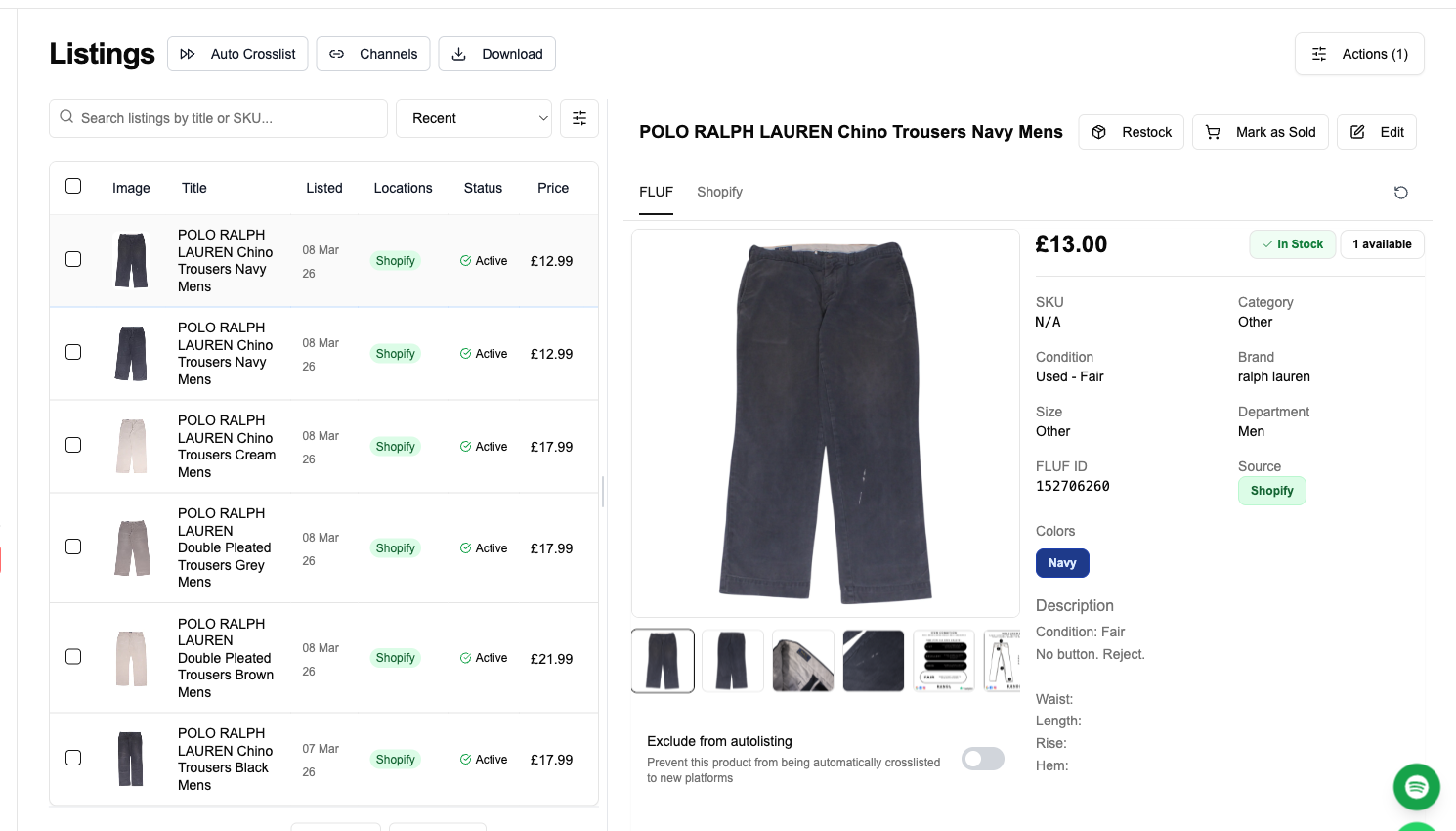
FLUF Connect holds one master record per item and pushes it to the channels you connect, so a single jacket exists once in your system and twice in the world.
| Capability | Kijiji | Grailed |
|---|---|---|
| Create and update listings from FLUF | Yes, via the FLUF browser extension | Yes, via the FLUF browser extension |
| Mark as sold when it sells elsewhere | Yes | Yes |
| Order sync back into FLUF | No | No |
| Automated relisting | No | No |
| Offer management from FLUF | No | No |
Both channels require the FLUF browser extension. Neither imports orders into FLUF, so check both marketplaces for sales yourself.
What both do support is sold-out protection, and on this pair that is the feature that earns its keep. A Kijiji buyer who turns up with cash for a coat you sold on Grailed three days ago is a genuinely unpleasant conversation, and it is entirely avoidable.
Neither channel supports automated relisting through FLUF today, which is worth knowing given Kijiji’s 60-day expiry and its strict rules about how you may repost. Handle that renewal deliberately rather than assuming it happens.
FLUF Connect also runs on iOS and Android, and the mobile app can host some device-executed channels directly — check the channels screen in the app for the current list rather than assuming a desktop is required.
The CRA, and who reports what
Canada’s equivalent of DAC7 is Part XX of the Income Tax Act, which received royal assent on 22 June 2023 and applies from 1 January 2024. The sale of goods for consideration is explicitly a relevant activity, so clothing resale is in scope rather than only gig services. Operators report seller identification — name, address, tax number, financial account details — along with consideration paid and platform fees. The first information return was due 31 January 2025 covering calendar 2024, and the same information must be given to the seller by that date.
The reporting threshold is 30 or more transactions, or revenue over CAD 2,800 in a calendar year, net of fees. Those figures sit in the legislation rather than on the CRA’s public landing page, and Grailed states them itself — it verifies sellers over the threshold through Persona, and warns that failing to verify can bring cashout freezes or restricted selling privileges. Reportable sales exclude shipping paid to Grailed, tax Grailed collects and remits, and cancelled or returned orders.
Kijiji sits differently, and the reason is mechanical rather than a favour. The rules bite on platforms whose operator knows or can calculate what a seller was paid. Kijiji processes no money between buyer and seller at all — its payment provider handles only its own advertising fees — so it has no transaction value to report. That is our reading of how the definition applies rather than a statement either Kijiji or the CRA has published, and it changes only who files. Your own obligation to declare income is identical either way, and a Canadian accountant should confirm your position.
Sources and verification
- Kijiji’s media page — founded 2005, Canada-only, nearly five million Canadians a month, 400-plus categories.
- Kijiji’s paid-category policy (Clothing is free), its terms of use (listing fees only, no commission), and its promotion page, which declines to publish feature prices.
- Kijiji ad durations, the 10-photo limit, the duplicate-ad filters and its cash-in-person safety guidance.
- Grailed’s fee page — 9% at $120 and above, 6% with a $1.99 minimum below it from 20 May 2026, and the commission base including buyer-paid shipping where no label is used; plus its statement that international sellers are not charged more.
- Grailed processing fees and tax on seller fees.
- Grailed Labels for Canada — mandatory for Canada-to-US, buyer-paid, UPS and Canada Post, the $750 and 20 lb ceilings, and automated customs forms.
- Grailed’s tariffs resource, and the 29 August 2025 de minimis suspension.
- Grailed’s disallowed designers, the listing FAQ covering removal discretion and bumping, and the Grails, Hype, Sartorial and Core tiers.
- Grailed on currency (USD only) and payout timing, including the extra 10 business days for non-US sellers.
- GOAT Group’s acquisition of Grailed, announced 17 October 2022, and the womenswear launch of 25 October 2022.
- The CRA on reporting rules for digital platforms and Grailed’s own reporting page stating the 30-transaction and CAD 2,800 thresholds.
What we could not verify, and therefore left out. Grailed’s maximum photo count and title character length, which appear nowhere in its help centre and are given inconsistently by third-party guides. Whether bumping costs money — it is absent from every fee page, which implies free but does not state it. The year attached to Grailed’s “beginning on May 22nd” wording for mandatory Canada-to-US labels. Kijiji’s title and description limits, its exact free-ad allowance per category, its feature prices in Canadian dollars, and its app download count — Kijiji publishes none of these, and an older 2021 media kit contradicts its current reach figure, so we have used only the current one. We also found no realised-price or sell-through data for either platform, so the comparison of what each audience pays is drawn from the brands each platform itself puts forward rather than from sales statistics.
Related guides
Frequently Asked Questions
Sellers. Its fee page, updated in June 2026, opens with “Grailed is free for buyers. Sellers pay a seller commission fee.” The rates are 9% on sales of $120 and above and 6% with a $1.99 minimum below that, the reduced tier applying to sales on or after 20 May 2026. Grailed states separately that it does not charge international sellers more, so a Canadian pays the same as an American. Payment processing is charged on top, at 4.99% plus $0.49 for an international Stripe-onboarded seller — so roughly 14% all in on a US sale, which is our arithmetic rather than a Grailed figure.
Yes, and it is compulsory. Grailed makes Grailed Labels mandatory on all new listings shipping to the US from Canada, the buyer pays for the label, it is available the instant the item sells, customs forms are completed digitally on it, and the carriers are UPS and Canada Post. That works in your favour: Grailed charges commission on the listing price plus buyer-paid shipping when no label is used, and on the listing price alone when one is — so being forced onto labels means your commission base excludes postage, unlike a British seller's. Two ceilings apply: sales up to $750 and packages under 20 lb.
It ended. The executive order suspending duty-free de minimis treatment for all countries took effect at 12:01am EDT on 29 August 2025, with China and Hong Kong-made goods losing the exemption earlier on 2 May 2025. Grailed tells its own sellers that most international shipments to US buyers under $800 no longer qualify for duty-free import. The sentence that undoes the intuitive Canadian assumption is that tariffs are based on country of manufacture, not country of shipment — so a Japanese or Italian garment posted from Toronto is dutied as Japanese or Italian. Buyers pay by default, but incorrect origin or value declarations can mean you refund their duties or lose the payout.
There is no accepted-brand whitelist, which is a common misconception. Grailed publishes a disallowed list — Goros, unbranded fine jewellery and roughly 45 watch houses including Rolex, Patek Philippe, Cartier and Hermès — and missing brands can be requested by supplying the name, a link to the brand's site or a stockist, and whether they make menswear, womenswear or both. The real gate is discretion: Grailed reserves the right to delete any listing for any reason, and names condition, quality, brand, age of listing and lack of desirability, adding that items without a recognised designer are subject to removal.
The labelled, archival and intact ones. Kijiji's own Clothing page surfaces Canada Goose, Lululemon, The North Face, Jordan and winter jackets, with visible asking prices clustering between a dollar and eighty. Grailed's own taxonomy names its demand poles as Grails — Saint Laurent, Raf Simons, Rick Owens — Hype, meaning Supreme, Air Jordan and Yeezy, and Sartorial, meaning Brunello Cucinelli, Tom Ford and Alden. Unbranded clothing and worn-out mass-market basics that move briskly on Kijiji are exactly what Grailed's curation removes.
US dollars, only. Everything on Grailed is transacted in USD, so you list in dollars and are paid in dollars to a bank account linked through Stripe, with the conversion to Canadian dollars happening at your bank's rate. Funds are released within three calendar days of delivery, and non-US sellers should allow up to an additional 10 business days for payment to process after release. You have seven calendar days from purchase to add tracking or the sale auto-cancels, and you cannot publish your first listing until payment details are connected.
Clothing ads are free — the mandatory-fee categories are Real Estate, vehicles, Pets, Jobs, Services and Vacation Rentals — and Kijiji's terms contain no transaction or final-value fee at all. Most ads run 60 days and reposting grants the same duration again. Its paid features are Bump Up, Top Ad, Homepage Gallery, Highlight, Urgent and Featured in 3, 7 or 30-day durations, but Kijiji deliberately does not publish their prices, saying they vary by duration, city and category. It also does not publish how many free ads a category allows.
Only carefully. Kijiji's duplicate policy requires you to completely delete the old ad before creating a new one, and its automated filters compare titles, descriptions, categories and images — so changing a few words or swapping one photo does not defeat them. Posting the same item across multiple categories or cities is prohibited, as is running several accounts to get around posting limits. Note too that an ad's category, region, province, ad type and private-or-business flag cannot be edited after publication; a miscategorised ad has to be recreated.
Both channels require the FLUF browser extension. FLUF supports creating and updating listings and marking them sold, but does not import orders from either channel. Check sales yourself and mark sold items in FLUF. Automated relisting is not supported on either channel.
Almost certainly not, and for a mechanical reason. Canada's Part XX rules, in force from 1 January 2024, bind platforms whose operator knows or can calculate what a seller was paid. Kijiji processes no money between buyer and seller at all — its payment provider handles only its own advertising fees — so it has no transaction value to report. That is our reading of the definition rather than something Kijiji or the CRA has published. Grailed is squarely in scope and says so, reporting at 30 or more transactions or revenue over CAD 2,800 net of fees, and verifying sellers through Persona with cashout freezes for non-compliance. Your own obligation to declare income is identical either way.