
How to Sell on Kleinanzeigen — The Complete Guide for 2026
Everything you need to sell on Kleinanzeigen, Germany's biggest classifieds marketplace — fees, Sicher bezahlen, shipping, listing tips, scams to avoid, and how to crosslist to Vinted, eBay and Depop automatically.
7 days for £1, then from £9/month.



Key Takeaways
- What it is: Kleinanzeigen is Germany’s biggest online classifieds marketplace — a general-goods site for everything from furniture and electronics to fashion and bikes. It was called eBay Kleinanzeigen until it rebranded to simply “Kleinanzeigen” in May 2023 (Adevinta).
- Scale: more than 35 million monthly users and around 50 million live listings across 280+ categories — most of them second-hand (Adevinta).
- Fees: placing a standard ad is free for private sellers, and a local pickup sale carries no commission — you keep the full price. On shipped, protected orders the buyer pays the “Sicher bezahlen” fee of €0.50 + 4.5% of the price; the private seller pays nothing (Kleinanzeigen).
- Reach is domestic and local: Kleinanzeigen is a German audience, and searches are location-based (postcode + radius). To reach buyers beyond Germany you crosslist to other platforms — the gap FLUF Connect fills.
- Best for: bulky local items (furniture, white goods), electronics, baby and kids gear, bikes, garden, and general second-hand goods — especially anything sold by pickup.
- Cross-list with FLUF Connect: sync Kleinanzeigen with Vinted, eBay, Depop, Shopify and more from one dashboard — get started in minutes.
- Cost to scale: FLUF Connect plans start at £9/month (Starter) and every plan is paid; inventory sync and delisting are included in every plan; relisting, offer management and smart pricing come with the plans above Starter.
A simple crosslisting workflow
In practice, selling everywhere with FLUF Connect looks like this:
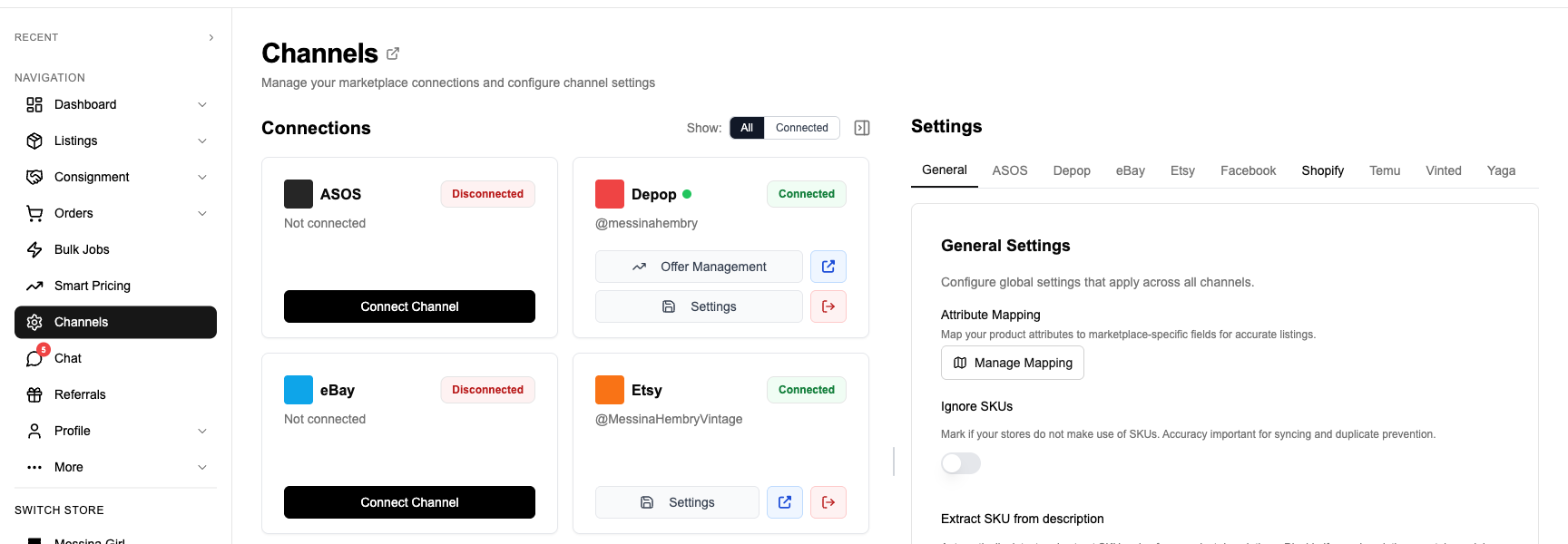
- Connect Kleinanzeigen once through the FLUF browser extension — a one-time step that links your account.
- Add a product once in FLUF, with its photos, price and description — or import your existing listings from another connected channel.
- Choose where it goes — Kleinanzeigen plus any other marketplaces you sell on — and crosslist. FLUF matches the category, size, colour, condition and shipping option for each channel.
- Sell anywhere. When the item sells on one channel, or you mark it sold, FLUF removes it from Kleinanzeigen and everywhere else automatically, so you never double-sell.
What is Kleinanzeigen?
Kleinanzeigen is Germany’s largest online classifieds marketplace — a place where private individuals and businesses list new and used goods for local pickup or nationwide shipping. It is a general-goods platform, not a fashion-only resale app: on any given day you’ll find sofas, iPhones, road bikes, garden tools, baby prams, vinyl records and vintage jackets side by side.
The site launched in 2009 as “eBay Kleinanzeigen” and grew into one of Germany’s most-visited websites. In 2020 eBay agreed to sell its classifieds business to Adevinta (completed in 2021), and in May 2023 it dropped the eBay name to become simply Kleinanzeigen (Adevinta press release). If you still search for “eBay Kleinanzeigen”, this is the same platform — same listings, same accounts, new name.
Today the owner reports more than 35 million monthly users and around 50 million active listings across 280+ categories, the overwhelming majority of them second-hand (Adevinta brand page). That scale, combined with its hyper-local, postcode-based search, makes it the default place Germans go to buy and sell second-hand goods.
Kleinanzeigen at a glance
| Metric | Detail |
|---|---|
| Launched | 2009 (as eBay Kleinanzeigen); rebranded to Kleinanzeigen in May 2023 |
| Owner | Adevinta (operated by Marktplaats B.V.) |
| Headquarters | Berlin, Germany |
| Monthly users | 35 million+ |
| Live listings | 50 million+ across 280+ categories |
| Audience | Germany-wide, search is local (postcode + radius) |
| Revenue model | Free for private sellers; paid promotion features + commercial packages |
Is “eBay Kleinanzeigen” still a thing?
This trips a lot of people up, so to be clear: eBay Kleinanzeigen and Kleinanzeigen are the same website. It was only ever loosely connected to the main eBay marketplace — a separate classifieds service that happened to carry the eBay name. When Adevinta bought the classifieds business it was contractually required to drop the eBay brand, which it did in May 2023, switching to the standalone name “Kleinanzeigen” and a new green “K” logo. Nothing about how you sell changed: the same accounts, listings and app carried straight over. It is not the same as selling on eBay.de proper, which is a shipping-first, fee-charging auction and fixed-price marketplace — a different platform with a different audience (and one you can also reach by crosslisting).
Why sell on Kleinanzeigen in 2026?
If you sell in Germany, Kleinanzeigen is hard to ignore. It is where the buyers already are, it costs nothing to list, and it moves the kind of bulky, local, “come and collect it” items that are awkward to sell anywhere else. Here is why it earns a place in almost every German seller’s mix.
A massive, ready-made German audience
With more than 35 million monthly users, Kleinanzeigen reaches a huge share of Germany (Adevinta). For everyday second-hand goods, that reach is unmatched domestically — no other German classifieds site comes close.
Free to list, no commission on local sales
For private sellers, placing a standard ad costs nothing, and a normal cash-on-pickup sale carries no platform commission — you keep 100% of the price. Costs are optional and only apply if you choose to promote an ad or use protected shipping (more in the fees section).
Built for bulky and local
Furniture, appliances, bikes and garden equipment are painful to ship and easy to sell locally. Kleinanzeigen’s postcode-based search and pickup culture make it the natural home for exactly these items — a sofa that would never sell on a shipping-first marketplace moves quickly to a buyer three streets away.
Optional shipping unlocks the whole country
For anything that fits in a parcel, turning on “Versand möglich” (shipping available) widens your audience from your neighbourhood to all of Germany, with the platform’s integrated labels and buyer protection handling the risky part.
A genuine second-hand and sustainability platform
Kleinanzeigen positions itself around the circular economy — “second-hand before buying new” — and most of its listings are pre-owned (Adevinta). For resellers, that means buyers arrive already comfortable with used goods, so you’re not fighting to justify why something isn’t brand new.
When to use Kleinanzeigen vs another platform
No single marketplace is best for everything. The fastest way to sell is to match each item to the platform whose buyers want it — and to list on several at once. Here’s how Kleinanzeigen stacks up against the other channels German resellers use.
| Platform | Best for | Reach | Seller cost | Selling model |
|---|---|---|---|---|
| Kleinanzeigen | Bulky/local goods, furniture, electronics, everything second-hand | 36M+ monthly, Germany, hyper-local | Free to list; buyer pays “Sicher bezahlen” on shipped orders | Local pickup or integrated shipping |
| Vinted | Fashion, vintage, accessories | Large fashion audience across the EU | No seller fees; buyer pays Buyer Protection (see Vinted) | Shipping-first, integrated labels |
| eBay.de | National reach, collectibles, niche and auctions | National, search-driven buyers | Free allowance then selling fees (see eBay) | Shipping-first, fixed price or auction |
| Momox / reBuy | Books, media, phones — instant buyback | You sell to the platform | No listing; you accept a fixed offer | Free label, fast payout, no haggling |
| Mobile.de | Cars and vehicles | Germany’s leading auto marketplace | Paid vehicle listings | In-person |
The practical answer for most sellers is “both/and”, not “either/or”: list a designer coat on Vinted and Kleinanzeigen, a lamp on Kleinanzeigen and eBay. The only catch is the manual work of listing everywhere and pulling items down when they sell — which is what crosslisting solves.
Kleinanzeigen fees explained
For private sellers, Kleinanzeigen is free to use for standard listings. There is no listing fee for a normal ad and no commission on a local pickup sale — the money changes hands in person and the platform takes nothing. You only pay if you opt into extras: promoting an ad, or using protected shipping (where the fee falls on the buyer, not you). This is the single most important thing to understand about selling here.
“Sicher bezahlen” (secure payment) and buyer protection
When you ship an item to a remote buyer, the safe way to get paid is Kleinanzeigen’s “Sicher bezahlen” flow, which includes buyer protection (Käuferschutz). The service fee is €0.50 plus 4.5% of the item price, and it is paid by the buyer — a private seller pays nothing for it. The money is held in escrow by the payment provider Adyen and released to you once the buyer confirms the item arrived (or a dispute is resolved) (Kleinanzeigen: Was ist Sicher bezahlen). For sellers this is close to ideal: you get paid safely, and the buyer covers the cost of that safety.
Optional promotion features
Because the default search order is by recency, paid features exist to push an ad back up or make it stand out. Kleinanzeigen lists four (Welche Hervorhebungsfunktionen gibt es?):
- Hochschieben (bump-up) — a one-time paid action that returns your ad to the top of the results as if freshly posted, without changing its actual listing date (Was ist Hochschieben?).
- Highlight — gives your ad a coloured background so it stands out in the results list.
- Top-Anzeige (Top Ad) — locks one of the top positions on every page of results for the booked duration.
- Galerie (Gallery) — features your ad in the gallery block on regional homepages, reaching people who aren’t actively searching.
Prices for these vary by category and location and are shown at the point of booking, so check the live price before you commit. For most private sellers, a single well-timed Hochschieben is all that’s ever needed.
Commercial (gewerbliche) sellers
If you sell as a business, Kleinanzeigen offers paid PRO packages with higher listing limits, business branding and tools like automatic bump-up that re-surfaces your ads roughly every 30 days without manual effort (PRO: automatisches Hochschieben). Whether you need a commercial account depends on your volume and legal status in Germany — high-volume or clearly commercial activity must be registered as gewerblich.
Commercial accounts work differently from private ones on fees: instead of unlimited free ads, business sellers get a small free quota per category over a rolling 30-day window and then pay a per-listing fee, or take a monthly PRO package for higher limits, business branding and automation tools (Kleinanzeigen PRO). Kleinanzeigen has adjusted these commercial conditions over 2025–2026, so if you sell as a business, check the current gewerbliche fee tables before you plan your volume — the exact quotas and per-listing prices vary by category and change periodically. For a private seller clearing out their own belongings, none of this applies: your listings stay free.
What you actually keep — a worked example
Say you sell a used pair of trainers for €60. Here is roughly what lands in your pocket under the two common scenarios:
| Scenario | Item price | Who pays the fee | You keep |
|---|---|---|---|
| Local pickup, cash | €60 | No fee — money changes hands in person | €60 |
| Shipped with Sicher bezahlen | €60 | Buyer pays €0.50 + 4.5% = €3.20 on top; you pay nothing for the protection | €60 (minus your postage, which you can pass to the buyer) |
In both cases the private seller keeps the full asking price — the platform’s fee is either zero (local) or paid by the buyer (shipped). That is dramatically different from shipping-first marketplaces, where a final-value fee comes straight out of the seller’s proceeds. It is also why so many German sellers use Kleinanzeigen as a low-cost base and crosslist to fee-charging platforms only to widen reach.
How to set up your Kleinanzeigen account
Getting started takes a few minutes:
- Create an account at kleinanzeigen.de with an email address, or sign in if you already had an eBay Kleinanzeigen account (it carried over to the new name).
- Confirm your email and add your location — your postcode powers the local search that buyers use, so make it accurate.
- Decide private vs commercial — most individuals sell as private. If you sell in volume or as a registered business, set up a gewerblich (commercial) account to stay compliant and unlock PRO tools.
- Set up “Sicher bezahlen” if you plan to ship — you’ll add payout bank details so protected payments can be released to you.
- Post your first ad — pick a category, write a keyword-rich title, add photos, set your price type, and choose pickup or shipping.
Private or commercial — which are you?
The account type you choose has legal and fee consequences, so it’s worth getting right. You’re a private (privat) seller if you’re occasionally selling your own used possessions — free to list, no VAT, and casual sales are usually tax-free. You’re a commercial (gewerblich) seller if you buy to resell, sell in significant volume, or make things to sell — in which case German law requires you to register as a business, you fall under the commercial fee structure, and you take on obligations like VAT, imprint (Impressum) and consumer-return rights. If you’re scaling a reselling operation, register properly from the start; the platform’s tax reporting (see below) makes under-declaring a bad bet.
There is no application or approval wait — you can be live within minutes of signing up.
How to create listings that sell
On Kleinanzeigen the listing itself does most of the selling, because buyers find ads by typing words into a search box and skimming a recency-ordered list. Two things decide whether they click yours: the title and the first photo.
Write a title buyers actually search
You get up to 65 characters in the title — use them for the terms people type: brand, model, size, colour (Kleinanzeigen: Gute Anzeigen, schlechte Anzeigen). “Nike Air Max 90 Herren Gr. 43 weiß” will be found; “Schöne Schuhe” will not. Front-load the most distinctive term.
Write a full, honest description
Describe condition, dimensions, brand and model, what’s included, and any flaws. Buyers on Kleinanzeigen expect detail and will message with questions if it’s missing — pre-empting those questions in the description saves back-and-forth and builds trust. Skip the ad-speak; specifics sell.
Choose the right price type
Kleinanzeigen gives you three price modes, and the choice affects how many people contact you:
- VB (Verhandlungsbasis) — “or best offer”. Haggling is part of the culture here, and marking a price VB invites buyers to make contact. Price slightly above your target so there’s room to come down.
- Festpreis — a firm price, no negotiation. Best when you know the item’s value and don’t want lowball offers.
- Zu verschenken — free/giveaway, commonly used to clear bulky or low-value items quickly.
Decide pickup vs shipping upfront
Set “Versand möglich” if the item can post — it opens your ad to the whole country. Use “Nur Abholung” (pickup only) for anything bulky or fragile you’d rather not pack. You can offer both.
Pick the right category and fill in the details
Kleinanzeigen sorts everything into a deep category tree — clothing splits by men’s, women’s and kids’, then by type; electronics by phones, laptops, consoles and so on. Choosing the most specific category matters because buyers browse and filter by it: a men’s jacket buried in a generic “clothing” catch-all won’t surface for someone filtering to men’s outerwear in their size. Once you pick a category, the form offers structured attributes — size, brand, colour, condition — and filling them in is free extra visibility, because those are the filters buyers narrow down with. A listing tagged “The North Face, size L, blue, very good” appears in far more filtered searches than a bare title. When you crosslist with FLUF Connect, these attributes are mapped automatically to whatever each channel expects, so you don’t re-enter them per platform.
Messaging buyers and closing the sale
Most Kleinanzeigen deals are won or lost in the chat. A few habits close more sales: reply fast — the first seller to answer usually gets the sale, so enable notifications and check regularly. Be concise and friendly, answer the actual question, and confirm the key facts (price, condition, whether it’s still available). For local pickup, agree a clear time and meet in a public, daylight spot; take cash and count it before handing the item over. Don’t mark an item reserved until a buyer has genuinely committed — over-reserving for people who never show just stalls other interested buyers. And keep the whole conversation and payment inside Kleinanzeigen; anyone pushing you to WhatsApp, email or a private payment link is usually up to no good.
Photography and presentation
You can add up to 20 photos to a listing, and they carry more weight than any other element (Kleinanzeigen seller guide). A few rules that consistently lift response rates:
- Use real photos of the actual item — never stock images. Buyers are wary and a generic photo reads as a scam or a drop-shipper.
- Make the first photo count — it’s the thumbnail in search results. Clean background, item filling the frame, good light.
- Show the flaws — a photo of the scuff or stain builds trust and heads off “is this actually as described?” disputes.
- Use several angles — front, back, labels, serial numbers, accessories. The more complete the set, the fewer questions and the faster the sale.
Natural daylight against a plain wall or floor beats any filter. If you crosslist with FLUF Connect, the same clean photo set is reused across every channel, so you only shoot once.
Shipping and pickup
Every Kleinanzeigen listing is either local pickup, shipped, or both — and the choice shapes who can buy it.
Local pickup (Abholung)
The classic Kleinanzeigen sale: the buyer collects, pays cash, done. There’s no fee and no postage, which is why it dominates for furniture and bulky goods. The trade-off is reach — only nearby buyers can take part.
Integrated shipping (Versand)
For parcels, Kleinanzeigen offers integrated shipping with prepaid labels through DHL and Hermes, priced by package size, with the buyer paying the postage. Combined with “Sicher bezahlen”, the buyer pays securely, you print a label, and buyer protection covers the transaction (within Germany). Turning on shipping is the single biggest thing you can do to sell faster, because it lifts the ceiling from your town to the whole country. Current label prices (Kleinanzeigen shipping prices):
| Carrier & size | Up to | Price |
|---|---|---|
| Hermes Päckchen | 37 cm longest side | from €3.70 |
| Hermes S-Paket | — | from €4.50 |
| DHL Paket S | 2 kg | €6.19 |
| Hermes M-Paket | — | from €5.90 |
| DHL Paket M | 5 kg | €7.69 |
| DHL Paket L | 10 kg | €10.49 |
| DHL Paket XL | 31.5 kg | €18.99 |
Delivery is typically one to two business days within Germany, and buyer protection covers domestic shipments only.
Who pays postage?
You decide: absorb it to make the price look sharper, or add it on top. Many sellers quote the item price and pass postage to the buyer at checkout. Either way, package items well — buyer protection depends on the item arriving as described.
How the Kleinanzeigen search order works
Kleinanzeigen doesn’t have a complex engagement algorithm like a social feed. Its default sort is Aktualität — recency — so the newest and most-recently-bumped ads sit at the top, and older ads sink over time (Kleinanzeigen: Was ist Hochschieben). Understanding this changes how you sell.
- Freshness is visibility. Most buyers browse the newest results, so a listing that has slipped to page 5 is effectively invisible even though it’s still live.
- Bumping resets your position. A paid Hochschieben returns the ad to the top for a fresh audience; a free re-edit gives a smaller, shorter lift.
- Location and keywords drive relevance. Buyers filter by postcode + radius and by search terms, so an accurate location and a keyword-rich title are what get you into the right result set in the first place.
- Free ads expire. Standard listings run for a limited period (around eight weeks) and then need re-posting — another reason freshness management matters.
The takeaway: on Kleinanzeigen you’re managing recency, not chasing engagement. Post at the right time, keep the listing fresh, and get the title right.
Payments, buyer protection and tax
Payments. Local deals are cash on pickup. For shipped deals, “Sicher bezahlen” routes the payment through escrow (Adyen): the buyer pays into escrow, you ship, and the money is released once receipt is confirmed — with buyer protection covering non-delivery or not-as-described disputes (Kleinanzeigen). Avoid moving a Kleinanzeigen deal onto PayPal “Friends & Family” — see Scams to avoid.
How selling with “Sicher bezahlen” works, step by step
If you’ve only ever done cash-on-pickup, the protected-shipping flow is worth understanding, because it removes almost all the risk of shipping to a stranger:
- The buyer starts a protected purchase from your listing and pays the item price plus shipping plus their buyer-protection fee into escrow — the money is held, not sent to you yet.
- You get a prepaid label. Kleinanzeigen generates a DHL or Hermes label; you pack the item, stick the label on, and drop it at a parcel shop or arrange pickup.
- The buyer receives and confirms the item is as described. Buyer protection covers them if it never arrives, is counterfeit, or is significantly not as described (within Germany).
- You get paid. Once the sale completes, the escrowed money is released to your bank account. Because the buyer has already paid in, there’s no chargeback risk from a bounced transfer.
The whole point is that neither side has to trust the other — the platform and its payment provider sit in the middle. It’s why “Sicher bezahlen” is the right default for any shipped sale, and why moving a deal onto private PayPal is a red flag.
Tax. Occasional private selling of your own used belongings is generally not taxable income in Germany (“kein Gewinn, keine Steuer”), but selling as a business — or at volume for profit — is. Under the German platform-transparency law (PStTG, implementing EU DAC7), Kleinanzeigen reports a seller to the tax authorities only once they reach 30 or more sales in a year, or €2,000 or more in income — reported by 31 January for the prior year, with a copy sent to you (Kleinanzeigen: PStTG/DAC7). Being reported doesn’t automatically mean you owe tax, but if your selling is genuinely commercial you should register as gewerblich and keep records. This is general information, not tax advice — check your own situation with a Steuerberater.
What sells best on Kleinanzeigen
Kleinanzeigen’s sweet spot is anything bulky, local, or too niche to ship easily. Categories that move fast include:
- Furniture and home — sofas, tables, shelving, lamps; the classic pickup sale.
- Baby and kids — prams, cots, clothes bundles, toys; parents buy heavily second-hand.
- Electronics — phones, laptops, consoles, TVs; high demand, but describe condition precisely.
- Bikes and sports gear — bicycles, e-bikes, fitness equipment.
- Garden and DIY — tools, plants, outdoor furniture, especially seasonally.
- Fashion — everyday and branded clothing, though dedicated fashion buyers also cluster on Vinted, which is why crosslisting both wins.
Timing and seasonality
Second-hand demand on Kleinanzeigen swings with the calendar, and listing in season noticeably speeds up sales. Garden furniture, bikes and barbecues move in spring and early summer; winter sports gear and heaters in autumn; kids’ items spike around back-to-school and after Christmas as families clear and restock. Because the search order is recency-based, the day and hour you post also matter — evenings and Sunday nights, when more people are browsing at home, put your fresh listing in front of the most eyes. If something isn’t selling, re-listing it at the start of its natural season often does more than dropping the price.
The pattern: if an item is cheap or annoying to post, Kleinanzeigen’s local buyers are your best market. If it ships easily and has national demand, list it on Kleinanzeigen and a shipping-first platform to catch both audiences.
Scams to avoid
Classifieds attract scammers, and on Kleinanzeigen a handful of tricks come up again and again. German consumer authorities publish clear warnings (Verbraucherzentrale). Learn these and you’ll avoid almost all of them:
- PayPal “Friends & Family”. A buyer asks to pay via PayPal “Geld an Freunde und Familie” — which has no buyer or seller protection and can’t be reversed by you. Insist on “Waren & Dienstleistungen” or, better, Kleinanzeigen’s “Sicher bezahlen”.
- Fake “Sicher bezahlen” links. A scammer sends a link that mimics the real pay flow to phish your bank or card details. Only ever use the payment flow inside the Kleinanzeigen app or site — never a link a stranger sends you (TECHBOOK).
- Overpayment scam. A “buyer” sends too much and asks you to refund the difference; the original payment later fails, leaving you out of pocket. Never refund an overpayment.
- Advance-fee for “shipping/insurance”. Never pay upfront for a shipping agent, insurance or transport a buyer insists on — it’s a classic bait (Verbraucherzentrale Hamburg).
Rule of thumb: keep the whole transaction inside Kleinanzeigen’s own tools, take cash for local pickups, and be suspicious of any buyer trying to move you off-platform.
Pro tips from experienced sellers
- List as VB, not fixed. Negotiable pricing invites contact in a haggling market — price a little high and let buyers feel they won (Handelsblatt).
- Front-load the title with specs. Brand, model, size, colour — the title is the main thing the search matches against.
- Use every photo slot. Up to 20 photos; a complete set cuts questions and speeds the sale.
- Bump when buyers are browsing. Reseller lore points to Sunday evenings as a peak window; a well-timed Hochschieben beats a random one.
- Reply fast. The first seller to answer usually wins. On Android, whitelist the app from battery optimisation so message notifications aren’t silently delayed (seller tips).
- Refresh before items expire. Re-post or bump near the end of the listing window to reset freshness instead of letting the ad die.
Common mistakes to avoid
- Overpricing with no VB. In a market that expects haggling, a firm high price kills inquiries.
- Skipping shipping when the item would post. Pickup-only needlessly caps a parcel-friendly item to local buyers.
- Thin descriptions and weak photos. Low relevance in search, low trust, more time-wasting questions.
- Letting ads go stale. A listing that has sunk in the recency order is invisible — manage freshness.
- Taking PayPal Friends & Family. The single most common way sellers get burned; use Sicher bezahlen instead.
- Listing only on Kleinanzeigen. A German-only audience leaves money on the table for anything with national or international demand — crosslist.
Is Kleinanzeigen worth it? The verdict
For anyone selling second-hand goods in Germany, Kleinanzeigen is close to essential. It is free to list, it takes no commission on local sales, its buyer-paid protected-shipping option removes the risk from posting to strangers, and it reaches more German buyers than any rival classifieds site. The trade-offs are that it’s a German-only, largely local audience, and that its recency-based order means you have to keep listings fresh. Neither is a reason to skip it — they’re reasons to pair it with other channels. The sellers who do best treat Kleinanzeigen as their zero-fee home base for bulky and local items, and crosslist everything parcel-friendly to fashion and national marketplaces at the same time to catch the buyers Kleinanzeigen can’t reach.
Cross-list Kleinanzeigen to sell faster
Kleinanzeigen is huge, but it is a German audience. The single biggest lever on how fast your items sell is how many buyers see them — and no one platform reaches everyone. A jacket sitting on Kleinanzeigen is invisible to the millions of shoppers on Vinted, eBay and Depop. Listing the same item everywhere multiplies your exposure — the problem is that doing it by hand means re-typing every title, description, price and photo set on every site, then remembering to take an item down everywhere the moment it sells so you never oversell.
FLUF Connect automates that. You list once, and it crossposts to Kleinanzeigen and every other marketplace you sell on from a single dashboard — with the category, size, colour, condition and shipping option matched to what each channel expects. Everything happens on our side: connect Kleinanzeigen once through the FLUF browser extension, and after that listing, editing and removing are all handled for you.
What FLUF Connect does with Kleinanzeigen
- List automatically — push a product to Kleinanzeigen with its photos, price, description and category in one click, alongside your other channels.
- Edit in sync — change a price or title once and it updates on Kleinanzeigen too, so your listings never drift out of step.
- No overselling — when an item sells anywhere, or you mark it as sold, FLUF removes it from Kleinanzeigen automatically, so you never sell the same thing twice.
- Any product type — Kleinanzeigen is a general-goods marketplace, and so is FLUF: clothing, electronics, furniture, homeware, collectibles — not just fashion.
FLUF Connect plans start at £9/month (Starter), and every plan is paid; inventory sync and delisting are included in every plan; relisting, offer management and smart pricing come with the plans above Starter. See how crosslisting works or compare plans.
Related Guides
- Kleinanzeigen to Amazon.de: listing your used electronics, games and books
- Crosslist from Kleinanzeigen to eBay — Automatically
- eBay vs Kleinanzeigen: Which Is Better for Sellers in 2026?
- Kleinanzeigen vs Vinted — Which Is Better for German Sellers?
- Auto-Relisting on 10 Marketplaces
- Crosslist from Shopify to Kleinanzeigen
- Whatnot to Kleinanzeigen
- Crosslist from Wix to Kleinanzeigen
- Auf Vinted verkaufen (Deutsch)
- eBay-Gebühren in Deutschland (Deutsch)
Sources & verification
We keep this guide accurate and cite primary sources for factual claims. Please contact us if any figure is out of date.
- Adevinta — Kleinanzeigen brand page — monthly users (36M+), listings (50M+), categories, sustainability positioning.
- Adevinta press release — the May 2023 rebrand from eBay Kleinanzeigen.
- Kleinanzeigen Help — Sicher bezahlen & buyer protection — €0.50 + 4.5% fee, buyer-paid, Adyen escrow.
- Kleinanzeigen Help — highlighting features — Hochschieben, Highlight, Top-Anzeige, Galerie.
- Kleinanzeigen Help — Hochschieben (bump-up) & recency sort.
- Kleinanzeigen — good vs bad ads — 65-character title, up to 20 photos, description best practice.
- Verbraucherzentrale & TECHBOOK — common scams.
- Kleinanzeigen Help — PStTG / DAC7 tax reporting — the 30-sales / €2,000 reporting thresholds.
- Kleinanzeigen Help — shipping prices & delivery times — DHL / Hermes label prices.
Subscribe to the seller news brief
The marketplace news that changes how you list, in one short email.
- Fee, policy and algorithm changes across 60+ marketplaces
- Only the topics you pick — the marketplaces you actually sell on
- Short enough to read in a minute. Daily or weekly, unsubscribe in one click
No spam. We never share your address.
Pick your topics first ›Frequently Asked Questions
Yes for private sellers. Placing a standard advertisement is free, and a normal local pickup sale carries no commission, so you keep the full price. The only costs are optional: promoting an ad, or protected shipping — where the 'Sicher bezahlen' fee (€0.50 + 4.5%) is paid by the buyer, not the seller. Commercial (gewerblich) sellers have a separate fee structure.
The secure-payment service fee is €0.50 plus 4.5% of the item price, and it is paid by the buyer — a private seller pays nothing for it. The buyer's money is held in escrow by the payment provider Adyen and released to you once the buyer confirms the item arrived, with buyer protection covering non-delivery or not-as-described disputes within Germany.
Yes — it is the same website. It was called eBay Kleinanzeigen until May 2023, when it dropped the eBay name and rebranded to simply 'Kleinanzeigen'. The same accounts, listings and app carried over. It is not the same as eBay.de, which is a separate shipping-first marketplace.
Shipping uses DHL and Hermes labels priced by package size, and the buyer pays. As a guide, Hermes Päckchen starts around €3.70, DHL Paket S (2 kg) is €6.19, M (5 kg) €7.69, L (10 kg) €10.49 and XL (31.5 kg) €18.99. Delivery is usually one to two business days within Germany, and buyer protection covers domestic shipments only.
Occasionally selling your own used belongings is generally tax-free in Germany. Under the platform-transparency law (PStTG/DAC7), Kleinanzeigen reports a seller to the tax authorities only once they reach 30 or more sales in a year or €2,000 or more in income. Selling as a business is taxable and must be registered as gewerblich. This is general information, not tax advice.
Use a keyword-rich title (brand, model, size, colour), add up to 20 clear photos, price as VB (negotiable) to invite offers, turn on shipping for parcel-friendly items, and keep the listing fresh because the search order is recency-based. The biggest lever is reaching more buyers — list the same item on other marketplaces too, which FLUF Connect can automate.
Yes. FLUF Connect lets you list once and crosspost to Kleinanzeigen plus Vinted, eBay, Depop, Shopify and more from a single dashboard, with the category, size, colour and shipping option matched per channel. When an item sells anywhere, or you mark it sold, it's removed from Kleinanzeigen automatically so you never oversell. Plans start at £9/month.