
Vendora to Shopify: what a Greek seller gains and loses
Vendora hands you 2 million registered users; a Shopify store hands you an empty shop. Here is what the move really costs a Greek seller, field by field. Or sell on both across [fc_channel_count_band] channels.
7 days for £1, then from £9/month.



- This is not a like-for-like move. Shopify says so itself: a marketplace brings you browsers and shoppers “without the marketing efforts required to bring visitors to your own site”. Vendora hands you an audience. A Shopify store hands you an empty shop with your name over the door.
- Vendora costs almost nothing to sell on. No listing fee, no sale commission, no buyer fee. The only charge is €0.99 + 5.1% + VAT when you withdraw from the Vendora Wallet, minimum €5 — avoidable if you spend the balance on the platform.
- Shopify in Greece starts at €27/month on Basic (€19/month billed annually), with Grow at €74 and Advanced at €384. Annual billing saves 25%. Card rates vary by plan and are published on Shopify’s Greek pricing page.
- Shopify Payments only reached Greece on 21 March 2025. Using it is what zeroes the third-party gateway fee of 2% / 1% / 0.6% that otherwise stacks on top of your gateway’s own charges.
- Greece is not on Shopify’s shipping-label country list. Italy is; Greece is not. A Greek Shopify store arranges its own carriers, where the same seller on Vendora gets BOX NOW, ELTA Courier, ACS, Speedex and DPD wired in, with island surcharges already inside the checkout price.
- Shopify has no native product condition field — the single biggest modelling decision for a second-hand seller, and Google Merchant Center makes condition compulsory for used goods.
- Cost of running both: FLUF Connect is £1 for 7 days, then plans from £9/month (Starter). There is no free plan.
What you gain and what you lose
Most pages on this subject open by telling you a store is the grown-up choice. That skips the only number that matters. Vendora had 3,630,972 live ads in its shared pool when we counted on 29 August 2026, and the company reports 2 million registered users and monthly transactions worth millions of euros. Those people arrive on their own.
Shopify is candid that it is not that. Comparing an e-commerce platform against a marketplace, Shopify writes that a marketplace gives a seller browsers and shoppers “without the marketing efforts required to bring visitors to your own site”. That sentence is the whole trade. Shopify supplies the shop, the checkout and the plumbing — not a single visitor.
What you gain
Mostly control — specifically over things Vendora currently takes away from you.
- Your own domain and customer list. On a marketplace the buyer is the platform’s customer. On your store they are yours, and you can email them again.
- No moderation queue. Several of Vendora’s pause rules catch honest sellers out. Reusing one of your own photographs across two of your own ads pauses the ad. So does a competitor platform’s watermark — a picture shot for Vinted and never re-cropped will not pass. So do unclear titles, unstated bundle prices, indicative prices, and undeclared real-versus-synthetic fur.
- No ban on contact details or links. Vendora removes ads carrying contact details or instructions to transact off-platform. On your own store your phone number, address and outbound links are simply part of the page.
- No duplicate rule. Vendora treats duplicates as a removal offence, and the wording explicitly covers copies of a hidden ad, not only a published one. Hiding an item does not free it up to post again.
- No one-account limit. Vendora’s terms allow one account per person, with a second only if it is a business account.
What you lose
The audience, first. Vendora’s Greek site alone drew roughly 3.92 million monthly visits in July 2026, 91.36% of them from Greece. Fashion is the dominant category at around 1.1 million live ads, roughly 30% of the pool — so if you sell clothing, the audience you are walking away from is specifically yours.
And the near-zero cost base. Vendora charges nothing to list and takes no commission. Shopify charges monthly whether you sell or not. That flips the business from “costs nothing until something sells” to “costs the same in a slow month as a good one”.
The costs, properly compared
What Vendora charges
Listing is free of charge, and Vendora states there is no sale commission and no buyer fee. The one charge is on withdrawal: taking money out of the Vendora Wallet costs €0.99 fixed plus 5.1% of the amount withdrawn, plus VAT, with a €5 minimum. The business page repeats it as “5.1% + €0.99 + VAT” with zero setup, listing or selling fees.
That fee is avoidable: you can spend the balance on the platform, or convert it to a partner gift card at no additional cost in Greece. A seller who also buys can transact at an effective cost of zero. The only optional spend is promotion: a Boost costs €1.49 per listing per week, and nothing obliges you to buy one.
What Shopify charges a Greek merchant
Read the Greek pricing page, not a generic one — euro prices are not uniform across the eurozone. As of 29 August 2026 the Greek page shows Basic at €27/month monthly or €19 annually, Grow at €74 or €56, Advanced at €384 or €289, and Plus from €2,100/month. Annual billing saves 25%, which is where the second figure in each pair comes from. Compare the Irish page, showing Basic at €32 and Grow at €92. Same currency, different country, different number.
Two naming points. The middle tier is now Grow, so older guides are out of date. And Shopify Starter — still quoted everywhere as a way onto Shopify for a few dollars a month — is not available to new stores, and merchants who leave it cannot return. Treat it as closed. Basic is the floor.
Transaction costs
There is also a card-processing rate on every order, and we are deliberately not printing a number for it: the pricing page is geo-rendered, two independent readings of the Greek page produced different percentages, and a wrong figure here is worse than none. What is safe to say is that the rate falls as you move up the plans, is quoted as a percentage plus a fixed per-transaction amount, and is published on the Greek pricing page. Shopify hedges the same way — “I prezzi possono variare in base alla sede del negozio”, prices vary by store location. Read it with your own store’s country selected.
Then the fee most people miss. If you take payment through a third-party gateway rather than Shopify Payments, Shopify charges an additional 2% on Basic, 1% on Grow, 0.6% on Advanced and 0.2% on Plus, on top of whatever that gateway charges you. Using Shopify Payments reduces it to zero. On Basic, an extra 2% is €20 on every €1,000 of turnover — roughly three-quarters of the monthly subscription, paid again every €1,000. It is the most avoidable cost on the platform, which is why the next section matters.
Two Greece-specific facts that decide the project
1. Shopify Payments has only been in Greece since March 2025
Shopify Payments is supported in Greece, but recently. Greece was in the batch of fourteen European countries that gained it on 21 March 2025, alongside Cyprus, Bulgaria, Poland and Lithuania. Guides written before that date will tell a Greek merchant to use an external gateway — the expensive path.
2. Greece is not on Shopify’s shipping-label list
Shopify sells discounted carrier labels inside the admin in a defined set of countries. Per Shopify’s setup documentation that set is the United States, Canada, Australia, the United Kingdom, France, Germany, Italy and Spain; Italian merchants get BRT Bartolini, Poste Italiane and DHL Express Europe. Greece does not appear. Be precise about what that means: it is an absence from a documented list, not a published exclusion of Greece.
The international picture is narrower still. Shopify states that “if your business is in the United States, Canada, or Australia, then you can use shipping labels to help ship internationally”. Either way the practical conclusion is the same: a Greek Shopify store negotiates and pays for its own carrier relationships, prints labels through each carrier’s own system, and works out its own island rates.
Now what the same seller gets on Vendora for nothing. Vendora integrates BOX NOW, ELTA Courier, ACS, Speedex, Geniki Taxydromiki, Kronos Express, DHL Greece and DPD for Greece and Cyprus, and ships to all 27 EU member states. It also handles the thing that catches every new Greek store owner: DPD island and remote surcharges for the Argo-Saronic islands, Kythira, Lesbos, Chios, Samos, the Cyclades, the Dodecanese and Crete sit inside the checkout price, so the buyer pays them and you never find the gap after the sale. A BOX NOW large locker delivery is €3.99 on a 2–4 working-day service.
The shipping gap is the largest concrete operational difference between the two, and it is invisible in any side-by-side of subscription prices.
Escrow versus being your own payment desk
On Vendora, money is not your problem. Payment runs exclusively through the integrated escrow service, which collects, holds and releases only when both sides are satisfied; the e-money provider is Mangopay, licensed in Luxembourg. Cash, bank deposit and cash on delivery are banned outright and can get an account suspended. Even in-person handovers route through escrow, with the buyer given 30 minutes to inspect and approve or reject. Buyers pay item plus delivery upfront, and you work to clocks: two days to accept, five to dispatch, or it auto-refunds.
On Shopify you are the merchant of record: nobody holds the money and nobody adjudicates. A disputed charge is your chargeback and your evidence file. An EU buyer exercising the fourteen-day right of withdrawal is your refund to process and your loss if the item comes back worn. A missing parcel is your conversation with a carrier you contracted yourself. For a one-person operation that is the change of job description hiding inside the words “get your own store”.
Field-by-field mapping
Vendora requires a title, images, category, description, price, delivery method and contact details. Shopify wants a product record with variants, options, tags, an SKU and a barcode.
| Vendora field | Shopify field | Transfer | Notes |
|---|---|---|---|
| Title | Product title | ⚡ Mapped | Vendora runs an AI rewriter that scans the title and description of a new listing and creates an optimised version of the title. What is stored may not be what you wrote, so expect to re-edit. |
| Description | Product description (HTML) | ⚡ Mapped | A Vendora ad is plain text and bans links and contact details. A Shopify description is full HTML — headings, lists, links, size charts. The text migrates; making it good means rewriting it as a product page. |
| Photos (up to 12) | Product media | ✅ Automatic | Shopify allows a maximum of 250 images, 3D models or videos per product, so twelve is never a constraint in this direction. |
| Price | Price | ✅ Automatic | Straight carry-across, but the economics differ: a Vendora price costs nothing to sell at, a Shopify price carries the card rate and a share of the subscription. |
| Category (20 roots) | Standard Product Taxonomy | ⚡ Mapped | Vendora has 20 top-level categories. Shopify’s built-in taxonomy is far deeper, and assigning a category unlocks category metafields and drives channel listings and tax rates; unassigned products fall back to “uncategorized”. |
| Μάρκα (brand) | Vendor field or metafield | ⚡ Mapped | The vendor field is the usual home for brand on a resale catalogue. Be consistent — your storefront filters get built on it. |
| Μέγεθος, Χρώμα | Options and variants | ⚡ Mapped | Shopify allows up to 3 options per product, and the variant ceiling was raised to 2,048 on 15 October 2025. Single-item stock usually needs one variant; structure matters once you stock multiples. |
| — | Tags (up to 250) | ⚠️ Manual input | No Vendora equivalent. Tags drive collections, filters and search on a Shopify storefront, so populate them deliberately. |
| — | SKU | ⚠️ Manual input | Vendora has no SKU field. Stock control across two systems means inventing a scheme — ideally before the catalogue is large. |
| — | Barcode (ISBN, EAN, GTIN) | ⚠️ Manual input | No equivalent. Relevant if you sell media — books, music and film are Vendora’s second-largest category — because barcodes feed shopping channels clean data. |
| Κατάσταση χρήσης / Κατάσταση | — | ❌ Not available | Shopify has no native condition field. See the next section. |
| Delivery method | Shipping profile | ⚠️ Manual input | Vendora’s delivery choice is a pick from integrated carriers. A Shopify profile is rates you define, for carriers you contracted, because Greece is not a label-selling country. |
| Contact details / address | — | ❌ Not available | Required on the Vendora ad form, banned from the ad text. On Shopify they live on the store, not the product. |
The condition problem
Budget thinking time for this, because it cannot be retrofitted cheaply. Shopify has no native product condition field. Neither the Product nor the ProductVariant resource carries one in the Admin API, and there is no condition entry in Shopify’s list of standard metafield definitions.
For a seller whose whole catalogue is second-hand that is not cosmetic. Condition is the second thing a used-goods buyer looks at after price: it has to appear on the page, be filterable, and be structured rather than buried in a sentence. There is a hard downstream consequence too. Google Merchant Center’s condition attribute accepts exactly three values — new, refurbished or used — and is required for used and refurbished products. Not recommended: required. Syndicate a Shopify catalogue to Google Shopping without carrying condition somewhere and mapping it, and the products are not eligible.
Your realistic options
- A custom metafield. Your own product metafield with a fixed value list you control. Structured data, storefront filtering, and something clean to map to Google’s three values. More setup, and almost always the right answer.
- A product option. Works and is visible to buyers, but consumes one of only three option slots and distorts your variant structure if you also need size and colour.
- Tags. Fast, and legitimate for filtering given the 250-tag allowance, but weakest as data: a flat namespace with no validation, so “used”, “Used” and “pre-owned” all appear within a month.
- Description text only. Do not. Cannot be filtered, mapped or reported on.
The source data is not tidy either. Vendora exposes two condition fields — “Κατάσταση χρήσης” (usage status, where a value such as “Μεταχειρισμένο” means used) and a separate “Κατάσταση” grade, where values such as “Σε καλή κατάσταση” and “Εξαιρετική κατάσταση” appear on live ads. Vendora publishes no full enumeration of the grades, so we will not invent a ladder. Build the metafield value list from what your own listings contain, and decide by hand which grades map to Google’s “used”.
What you may sell on each
Shopify’s Acceptable Use Policy is principle-based rather than a category list: illegal activity, violence, fraudulent or deceptive practices, spam, regulated health data. No list of banned product types. The list you actually have to read is a different document. Shopify Payments carries its own, much stricter prohibited-business list: cannabis, prescription drugs, medical devices, tobacco, firearms and weapons, money transfer, cryptocurrency, credit repair, explicit content, pseudo-pharmaceuticals, gambling and counterfeit goods — and Shopify says it is not exhaustive and varies by region. So you can sit within the AUP and still be unable to take payment — an expensive place to land, given the gateway surcharge.
Vendora publishes twelve prohibited categories: weapons, protected-species products, pharmaceuticals, tobacco and nicotine, antiquities and certain collectibles, counterfeits, inappropriate content, digital and intangible goods, goods below quality standards, mystery boxes, carrier- or iCloud-locked phones, and items of doubtful authenticity. The overlap is the obvious core — counterfeits, tobacco, pharma, weapons. The interesting part is Vendora’s additions, which have no Shopify analogue. Digital and intangible goods are banned outright, so a seller of e-books, templates or presets has no Vendora business at all, and a store is not an upgrade but the only option.
Regulation and VAT
GPSR. The EU General Product Safety Regulation has applied since December 2024. Per Shopify’s own guidance, a compliant listing needs an identifying element, the manufacturer’s name with a physical and electronic address, an EU Responsible Person where the manufacturer is outside the EU, and warnings in the appropriate languages. Be realistic about the tooling: Shopify provides a “Disclosures” product metafield, there is no dedicated EU Responsible Person field, and Shopify points merchants at third-party apps. The platform gives you somewhere to put the text and leaves the compliance model to you.
VAT. The number to know is the EU-wide €10,000 per year net threshold for intra-EU B2C distance sales. Below it you generally keep charging domestic VAT; above it you charge destination rates, via per-country registration or one One Stop Shop return. Vendora already ships to all 27 member states, so a seller with cross-border marketplace orders may be closer to that line than they assume.
Currency. Selling in more than one currency carries a Shopify conversion fee of 2% outside the United States, Greece included. And from 6 April 2026, conversion and multi-currency payout fees are calculated on the gross order amount rather than on what remains after Shopify Payments fees — a small increase on every multi-currency order, best put in the margin model rather than discovered in a payout statement.
What actually syncs
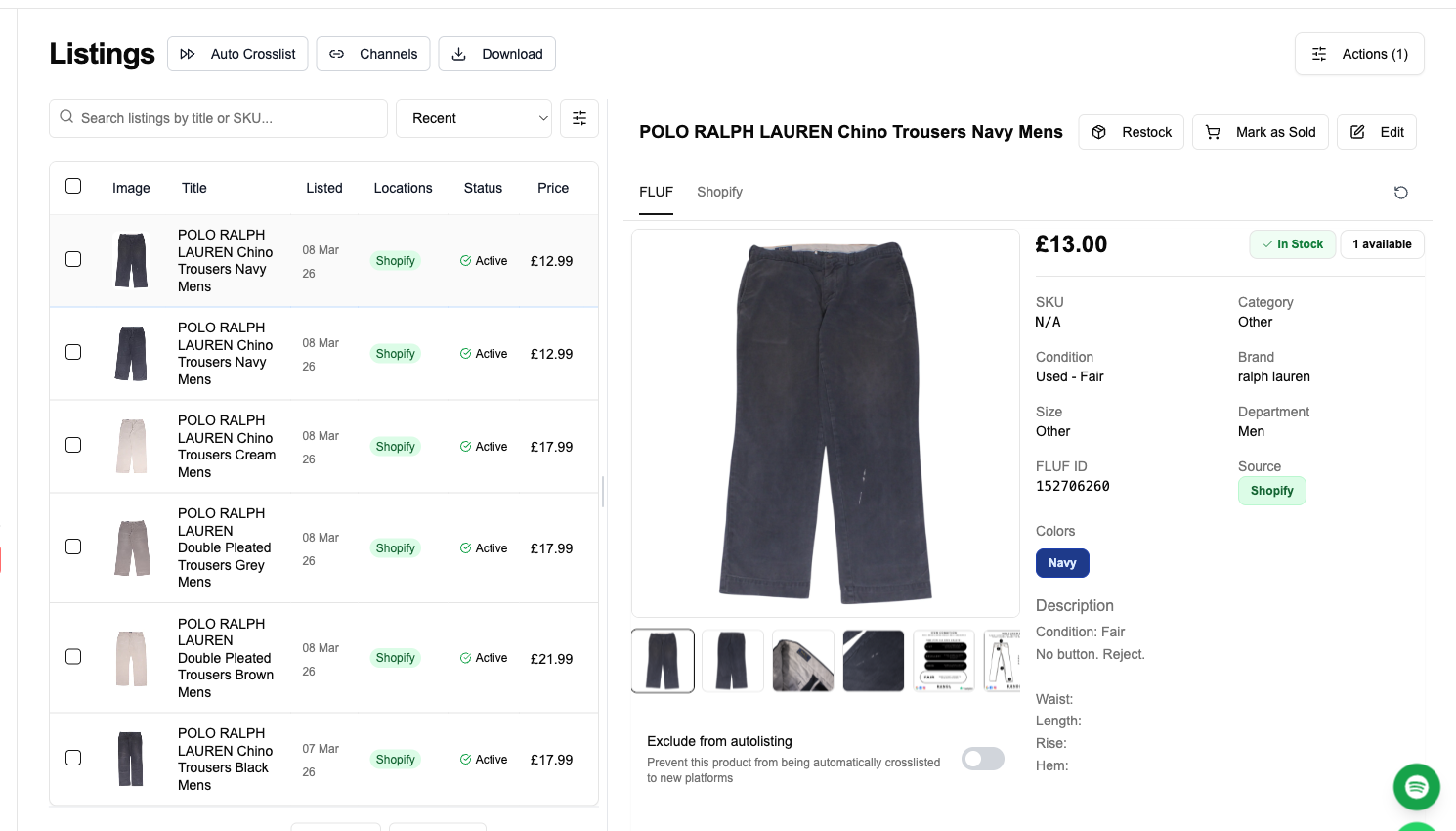
FLUF Connect pushes your Vendora stock into Shopify and keeps quantities aligned, so one sale does not leave the item advertised in two places. Shopify supports order sync, so marketplace orders are picked, packed and fulfilled from the same place as store orders.
Now the honest limitation. Vendora has no “sold” listing status. Its tabs are active listings, listings available to renew, and disabled listings; a completed sale lives inside the escrow flow, not as a state on the ad. So automatic sold-on-Vendora detection is not something we will promise. What is wired is the other direction, and it is the one that costs you: when an item sells on your Shopify store, the Vendora listing is withdrawn, so the same physical item is not still on offer to a Vendora buyer.
One Vendora behaviour to factor in: Vendora automatically syndicates every listing to Facebook Marketplace across Greece, Cyprus and Bulgaria at no cost and with no opt-out — the help centre says a disable option is still being worked on. Messaging and transactions stay inside Vendora, no Facebook account is needed, and your name and profile are not shown. A Vendora listing therefore already reaches further than the Vendora site.
The honest recommendation
Do not migrate. Run both.
The two are good at opposite things, and their weaknesses are almost perfectly complementary. Vendora gives you demand, integrated Greek shipping including island surcharges, escrow that removes payment risk, and a cost base of effectively zero — in exchange for rules you did not write, a moderation queue, one account, no links, and no ownership of the customer. Shopify gives you the domain, the customer list, the brand, unrestricted product pages and full margin — in exchange for €27 a month before you sell anything, your own carrier contracts, your own chargebacks, and an empty room you have to fill yourself.
So: Vendora for discovery and cash flow, Shopify for brand and margin, one catalogue feeding both so neither becomes a second job. Sell fast-moving, price-led stock where the buyers already are; put the pieces that carry your brand on your own store, and move happy Vendora buyers toward it over time.
FLUF Connect crosslists to 60+ marketplaces from one dashboard and bulk operations are included in every plan, and relisting and offer management from Seller upwards rather than sold as an add-on. Pricing is £1 for 7 days, then plans from £9/month (Starter). There is no free plan. Every plan is unlimited on listings and marketplaces; the tiers differ by which automations they include and how often we check your channels for sales — every 90 minutes on Starter, down to every 15 on Super Seller. It works for any physical product type, not only fashion, which matters on a marketplace where books, music and film are the second-largest category.
Sources and verification
- Shopify Greek pricing page — plan prices, the 25% annual saving, gateway fees, and the note that prices vary by store location. The Irish page shows euro pricing is not uniform.
- Grow plan and Starter plan documentation — the middle tier’s name; Starter closed to new stores, no route back.
- Shopify Payments supported countries and the changelog of 21 March 2025 — Greek availability and its start date.
- Shopify Shipping setup — the eight label-selling countries, Greece absent. International shipping — the three-country rule.
- Admin API Product resource and the standard metafield definitions — no native condition field; the 3-option and 250-tag limits.
- Variant-limit changelog, product media documentation and product category documentation — 2,048 variants from 15 October 2025, 250 media per product, and what a category unlocks.
- Google Merchant Center condition attribute — three permitted values, required for used and refurbished.
- Acceptable Use Policy and the Shopify Payments prohibited businesses list — principle-based policy versus a categorical, regional list.
- Shopify GPSR guidance — the requirements, and the Disclosures metafield with no EU Responsible Person field.
- EU VAT One Stop Shop — the €10,000 annual intra-EU distance-selling threshold.
- International pricing fees and the conversion calculation page — 2% outside the US; the 6 April 2026 move to gross-amount calculation.
- Shopify on platforms versus marketplaces — the quoted admission about marketing effort.
- Vendora service fee, the business page, buyer-protection benefits, the Wallet page and boosting — the withdrawal fee and its avoidance, no commission or buyer fee, and boost rates.
- Paused ads and the terms of use — duplicates, own-photo reuse, watermarks, contact details, one account per person, Mangopay.
- Courier list, BOX NOW and EU selling — integrated carriers, island surcharges inside the checkout price, €3.99 large locker, all 27 member states.
- Escrow service, seller shipping deadlines and return policy — escrow-only payment, the 2- and 5-day clocks, the 30-minute inspection window.
- AI titles, posting ads, prohibited items and Facebook Marketplace syndication — the title rewrite, 12-photo limit, twelve prohibited categories, no-opt-out syndication.
- Skai on Vendora’s EU expansion and Semrush data for vendora.gr — 2 million registered users; July 2026 traffic mix.
What we could not verify, and left out. No Shopify card rate for Greece appears here: the pricing page is geo-rendered and two independent readings returned different percentages for every plan, so we send you to the source instead. No Italy-specific plan prices, for the same reason. No Shopify title or description character limit, because Shopify publishes none. No Vendora condition ladder or field length limits, because Vendora publishes neither — only grades observed on live listings are named. Greece’s absence from the shipping-label list is described as an absence from a documented list, not an exclusion. And no claim of automatic sold-on-Vendora detection, because Vendora exposes no sold status.
Related guides
Frequently Asked Questions
No. Shopify says as much itself: a marketplace brings you browsers and shoppers “without the marketing efforts required to bring visitors to your own site”. Vendora has 2 million registered users and had 3,630,972 live ads in its shared pool when we counted on 29 August 2026, and Vendora’s Greek site drew about 3.92 million visits in July 2026. A new Shopify store has no audience at all on day one. Treat Shopify as a brand and margin channel you build traffic for, not as a replacement source of buyers.
Shopify’s Greek pricing page shows Basic at €27 a month billed monthly or €19 billed annually, Grow at €74 or €56, Advanced at €384 or €289, and Plus from €2,100 a month. Annual billing saves 25%. Euro prices are not uniform across the eurozone — the Irish page shows Basic at €32 and Grow at €92 — so read the Greek page, not a generic one. Card processing rates vary by plan and are published on that same page.
Listing costs nothing, there is no sale commission and no buyer fee. The only charge is withdrawing money from the Vendora Wallet: €0.99 fixed plus 5.1% of the amount withdrawn, plus VAT, with a €5 minimum withdrawal. Vendora’s business page states the same as “5.1% + €0.99 + VAT” alongside zero setup, listing and selling fees. The withdrawal fee is avoidable if you spend the balance on the platform or convert it to a partner gift card, which is offered in Greece at no additional cost.
Yes, but only since recently. Greece gained Shopify Payments on 21 March 2025, in a batch of fourteen European countries that also included Cyprus, Bulgaria, Poland and Lithuania. It matters financially: taking payment through a third-party gateway instead adds a Shopify fee of 2% on Basic, 1% on Grow, 0.6% on Advanced and 0.2% on Plus, on top of that gateway’s own charges. Using Shopify Payments reduces that additional fee to zero, so on Basic it saves €20 on every €1,000 of turnover.
No. Shopify’s documentation lists the United States, Canada, Australia, the United Kingdom, France, Germany, Italy and Spain as the countries where it sells labels, and Greece is not among them. That is an absence from a documented list rather than a stated exclusion, but the practical result is the same: a Greek Shopify store contracts its own carriers and prints its own labels. On Vendora the same seller gets BOX NOW, ELTA Courier, ACS, Speedex, Geniki Taxydromiki, Kronos Express, DHL Greece and DPD integrated, with island surcharges shown in the checkout price.
You have to model it yourself. Shopify has no native product condition field — neither the Product nor the ProductVariant resource carries one, and there is no standard metafield definition for it. The strongest option is a custom product metafield with a fixed value list; a product option works but burns one of only three option slots; tags are quick but unvalidated. It is not optional if you use Google Shopping: Google Merchant Center’s condition attribute accepts only new, refurbished or used, and is required for used and refurbished products.
Not automatically, and we will not claim otherwise. Vendora has no “sold” listing status — its tabs are active listings, listings available to renew, and disabled listings, and a completed sale sits inside the escrow flow rather than as a state on the ad. What is wired is the other direction: when an item sells on your Shopify store, the Vendora listing is withdrawn so the same physical item is not still on offer. FLUF Connect also pushes Vendora stock into Shopify and keeps quantities aligned.