
Crosslist from Vendora to Etsy — Automatically
Etsy bans reselling mass-produced items, so only the vintage 20-years-plus slice of a Greek wardrobe qualifies. Here is what does cross, what it costs, and the two things Greece gets cheaper than the UK.



- Most of your Vendora stock cannot go on Etsy at all. Etsy’s own words: “Reselling mass-produced items is not allowed on Etsy.” Only three exceptions exist — craft and party supplies, seller-assembled gift baskets, and vintage items over 20 years old.
- The vintage line is 20 years, and it is literal. A 1998 handbag qualifies. A 2010 one does not. That single rule decides which part of your wardrobe this route is for.
- Etsy Payments works in Greece. Greece is on the eligible-countries list and is not one of the Payoneer-only territories, so you are paid in euros to a Greek IBAN with no currency-conversion fee.
- Greece pays no Regulatory Operating Fee. That surcharge applies to nine countries including the UK and Italy. A Greek shop is genuinely cheaper to run than a British one on the same sales.
- Etsy gives Greek sellers no shipping labels. Labels exist for Australia, Canada, the UK and the US only. You buy postage yourself and complete your own customs paperwork.
- The fee stack is roughly 11.6% on a small order — $0.20 to list, 6.5% transaction fee charged on shipping too, and 4% plus €0.30 to process. Vendora, by contrast, charges nothing until you withdraw.
- Offsite Ads become compulsory forever at $10,000. Below that you can opt out and pay 15% on converting clicks; cross $10,000 in any rolling 365 days and participation is mandatory for the life of the shop, at 12%.
- Etsy’s buyers are American. 74% of its gross merchandise sales came from US buyers in 2025, which is why a Greek shop should list in English.
- Cost: FLUF Connect crosslists to 45 marketplace channels from one dashboard. £1 for 7 days, then plans from £9/month (Starter). There is no free plan.
On this page
- Read this before you list anything
- What counts as vintage, exactly
- What Etsy costs a Greek seller
- Two things Greece gets right
- No labels, and what that means for postage
- Rebuilding a Vendora ad as an Etsy listing
- Who is actually buying
- What FLUF Connect syncs, and what it does not
- DAC7, VAT and the Greek trader test
- Sources and verification
- Related guides
Read this before you list anything
Almost every other crosslisting route is a question of fees and field mapping. This one starts with an eligibility problem, and pretending otherwise would waste your afternoon.
Etsy is not a general secondhand marketplace. Its what-you-can-sell policy requires that everything be made, designed, handpicked or sourced by the seller, and states plainly that reselling mass-produced items is not allowed. Its separate reselling policy defines reselling as selling a commercially available item the seller did not make or design — which describes the great majority of Vendora ads exactly.
There are three carve-outs, and only three: craft and party supplies, vintage items over 20 years old, and gift baskets assembled by the seller. Etsy closes the obvious workaround too — adding a card, a gift tag or a note to an unaltered commercial item is explicitly named as prohibited reselling. And the craft-supplies exception is narrower than people assume: a blank t-shirt, a plain tumbler, a phone case or a canvas tote is a ready-to-use commercial product, not an allowed craft blank.
So the honest shape of this route is that a slice of your Vendora inventory can go to Etsy, and the rest should go somewhere that accepts general secondhand goods. Listing an ineligible item risks removal, and Etsy says repeat violations can lead to temporary or permanent suspension of selling privileges. It is not worth finding out.
What counts as vintage, exactly
Etsy’s definition is a number, not a mood: vintage means at least 20 years old. In 2026 that is anything made in 2006 or earlier. Y2K-era clothing has only just crossed the line. Nineties denim and eighties leather are comfortably over it. A 2010 designer bag, however desirable, is not vintage on Etsy and cannot be listed as one.
This is where a Greek wardrobe can genuinely do well. Vendora’s 20 top-level categories run far wider than fashion — Art and Antiques, Collectibles, Books, Music and Film, Cameras, Musical Instruments, Furniture. Those are the categories where twenty-plus years is ordinary rather than exceptional, and where Etsy’s American buyer base actually pays. A film camera, a piece of mid-century Greek ceramic, a vinyl pressing, a piece of costume jewellery from the seventies: all straightforwardly eligible.
Do the age check before you crosslist, item by item, and keep whatever establishes it — a maker’s mark, a union label, a date stamp. It is also good listing copy.
What Etsy costs a Greek seller
Vendora’s model is unusually simple: listing is free and there is no sale commission. The only charge is moving money out of your Vendora Wallet, at a flat €0.99 plus 5.1% of the withdrawal, plus VAT on that fee, with a €5 minimum withdrawal. Spend the balance on Vendora or convert it to a partner gift card and you pay nothing at all.
Etsy charges in layers, and they add up before anything sells.
| Charge | Amount | Notes |
|---|---|---|
| Listing fee | $0.20 per listing | Charged whether it sells or not; the listing expires after 4 months |
| Auto-renewal | $0.20 | On by default; keeps the listing’s views, favourites and URL |
| Transaction fee | 6.5% of the total order | Includes the shipping and gift wrap you charged the buyer |
| Payment processing (Greece) | 4% + €0.30 per order | Also charged on the total including shipping |
| Currency conversion | 2.5% | Avoidable — list in euros with a Greek euro account and it does not apply |
| Offsite Ads | 15%, or 12% above $10,000 | Capped at $100 per order; only charged on a converting click |
| Deposit fee | None for Greece | Applies only to nine listed countries |
On a €40 item with €5 postage, the transaction fee is 6.5% of €45, the processing fee is 4% of €45 plus €0.30, and the listing cost €0.20 — roughly €5.23 in total, or about 11.6%. That is our arithmetic from Etsy’s published rates rather than a figure Etsy prints, so treat it as a worked example. It also excludes Offsite Ads, VAT on fees, and the one-time shop set-up fee, whose amount Etsy varies by location and does not publish in a per-country table.
The 6.5% transaction fee has been in place since 11 April 2022, when Etsy raised it from 5% — a change it disclosed in its annual report. Anyone quoting 5% is four years out of date.
The Offsite Ads threshold deserves its own sentence, because it is irreversible. Below $10,000 in any consecutive 365-day period you can opt out entirely. Once you cross it, participation becomes mandatory for the lifetime of the shop, at the reduced 12% rate. There is no opting back out.
Two things Greece gets right
Two details make a Greek Etsy shop cheaper to run than several of its neighbours, and neither is widely known.
First, the Regulatory Operating Fee does not apply in Greece. Etsy levies it on sellers in Canada, France, Hungary, Italy, India, Spain, Türkiye, the United Kingdom and Vietnam, at rates from 0.05% to 1.97%. Greece is absent from that list. A Greek shop running the same sales as an Italian one pays 0.80% less, permanently.
Second, Etsy Payments is available in Greece, and Greece is not one of the countries restricted to Payoneer. Because you are in the eurozone, you list in euros, are paid in euros to a Greek IBAN, and the 2.5% currency-conversion fee never fires. Sellers in Bulgaria, Croatia, Czechia, Hungary, Romania and Poland do not have that luxury.
One caveat on both: Etsy charges VAT on seller fees for EU shops, Greece included, unless you supply a VAT identification number. If you have one, add it on day one.
No labels, and what that means for postage
Vendora generates a prepaid label automatically when an item sells, across eight Greek and Cypriot couriers including BOX NOW, ACS, ELTA Courier, Geniki Taxydromiki, Speedex, DHL Greece and DPD — and the buyer pays for it.
Etsy offers none of that here. Its own page is unambiguous: shipping labels are offered to sellers in Australia, Canada, the UK and the US. A Greek seller buys postage from ELTA or a courier directly, at counter rates, and completes their own customs documentation for anything leaving the EU.
Price accordingly. The postage you charge is inside the base for both the 6.5% transaction fee and the 4% processing fee, so under-charging for shipping costs you twice — once at the post office and again in fees on a number that did not cover it.
Within the EU there is no customs duty, and Etsy notes that an EU seller under €10,000 a year of cross-border EU sales may charge domestic VAT only, with the One-Stop Shop available above that. For the UK, Etsy collects and remits UK VAT to HMRC on orders up to £135 dispatched from outside the UK, so do not charge VAT again on those. Above £135 it does not, and your buyer may meet an import bill on the doorstep.
Rebuilding a Vendora ad as an Etsy listing
Photos are the easy part. Vendora allows up to 12 per ad at a minimum of 600 by 600 pixels; Etsy allows 20 photos and two videos. Nothing gets cut. Etsy wants at least 2,000 pixels on the long edge, and its first photo should be landscape or square and at least 635 pixels wide or it ranks lower. Transparent PNGs and animated GIFs are not supported — transparency renders as black.
Text is the real work. Etsy’s title limit is 140 characters, and it advises staying under about fifteen words with no price or shipping information and no subjective words like “perfect”. You also get 13 tags of up to 20 characters each. Your Greek ad copy has to become English keywords that an American buyer would actually type — and Etsy’s own automatic title-recommendation tool is only available to shops whose language is set to English, which settles the question. You can add Greek as an additional shop language afterwards and translate manually.
One structural note: the listing URL is generated from the first published title and never changes, so get the title right before you publish rather than after.
Etsy also publishes what it wants in exchange for a chance at priority placement: at least one image, a high-resolution primary photo that is a single un-collaged shot of the finished item, the most specific category available, and a stated return policy — even if that policy is “no returns”. Leaving the return policy blank costs you search visibility for nothing.
Who is actually buying
Etsy reported 86.5 million active buyers and 5.6 million active sellers at the end of 2025, with over 100 million items listed. Two figures from that same filing shape how you should write your listings.
74% of gross merchandise sales came from US buyers. A Greek shop on Etsy is, in practice, selling into America. That is the argument for English copy, for US-friendly measurements alongside metric, and for realistic international postage quoted up front.
Around 30% of sales are custom or made-to-order. Etsy’s demand is oriented towards things made and personalised, which is the commercial reason behind the reselling policy rather than a bureaucratic one. Vintage sits alongside that as a deliberate, smaller lane — and it is the lane you are entering.
Etsy also reported gross merchandise sales per active buyer of $121 over the trailing twelve months, down slightly year on year, with active buyers down 3.4%. It is a large, mature marketplace rather than a growing one, and pricing should reflect that.
What FLUF Connect syncs, and what it does not
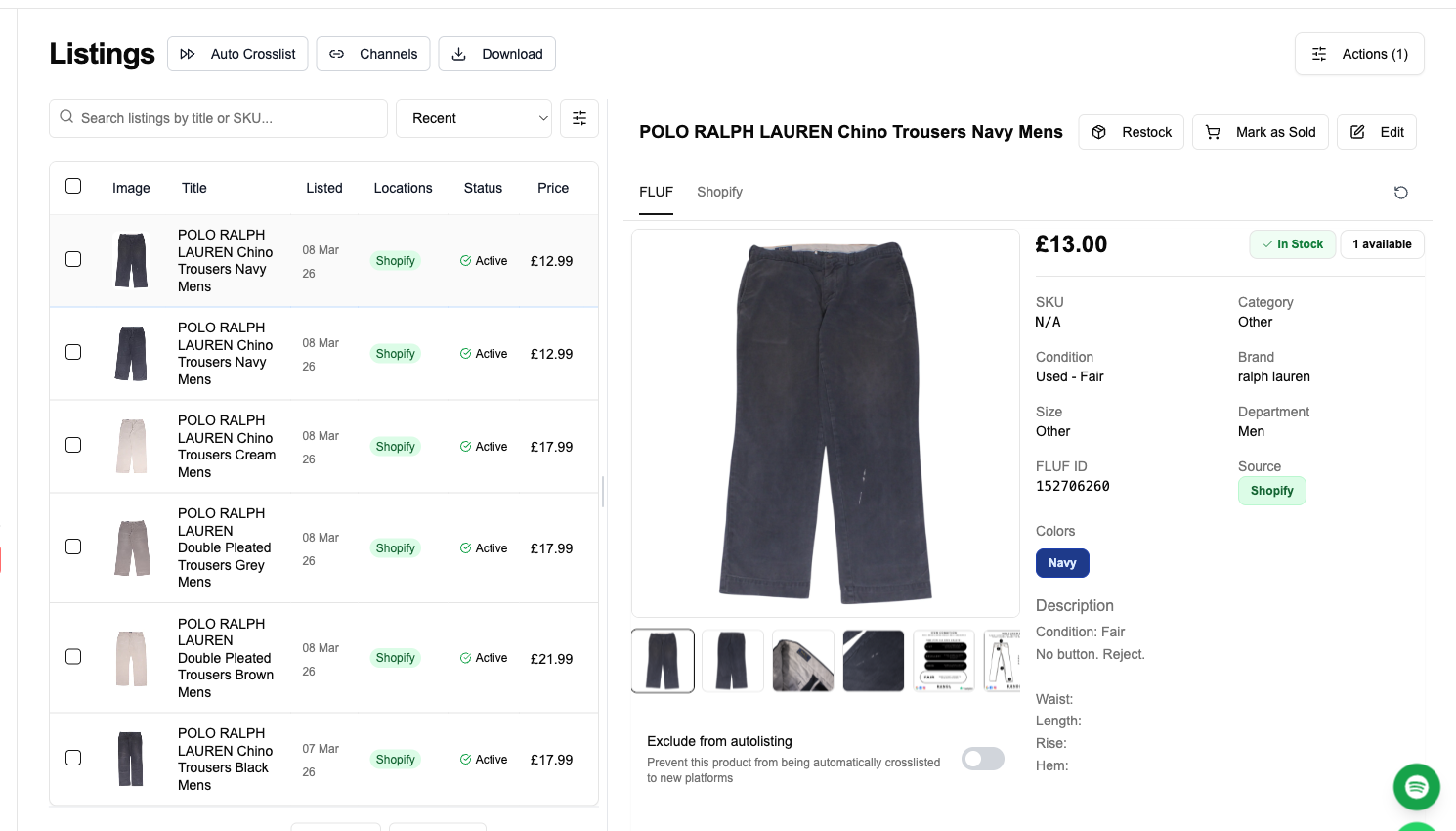
FLUF Connect holds one master record per item and pushes it to the channels you connect, so your Greek ad and your Etsy listing describe the same object and go out of stock together.
| Capability | Vendora | Etsy |
|---|---|---|
| Create and update listings from FLUF | Yes, via the FLUF browser extension | Yes, over Etsy’s own API |
| Mark as sold when it sells elsewhere | Yes | Yes |
| Order sync back into FLUF | No | Yes |
| Automated relisting | No | Yes |
| Offer management from FLUF | No | No |
The asymmetry is worth understanding. Etsy is a full API channel: orders flow back into your FLUF dashboard and FLUF can handle relisting. Vendora is extension-hosted, so listing work runs through your own browser session, and Vendora orders do not report back automatically — you will still check Vendora for sales.
Sold-out protection works in both directions regardless, which matters more than it sounds when a single vintage coat exists once. Sell it on Etsy and the Vendora ad can be pulled before someone in Thessaloniki pays for something you have already posted to Ohio.
Relisting on Etsy is not merely convenient, either. Listings expire after four months and renewal costs another $0.20, so the difference between an automated renewal policy and a manual one is the difference between a live shop and a shop that quietly emptied.
FLUF Connect also runs on iOS and Android, and the mobile app can host some device-executed channels directly — check the channels screen in the app for the current list rather than assuming a desktop is required.
DAC7, VAT and the Greek trader test
Both platforms report you, and at the same thresholds. Under DAC7, transposed into Greek law by ν. 5047/2023 and implemented by AADE decision 1016/2024, a seller is reportable once they pass 30 sales of goods or €2,000 in consideration in a calendar year. Reports are filed by 31 January following.
Vendora states those thresholds itself, collects your tax identification number and full address, and says it may restrict account features if you do not provide them. It also makes a point worth repeating: the €2,000 figure concerns the reporting obligation only and does not itself mean you are taxed.
Etsy reports on the same 30-transaction or €2,000 basis, plus a third limb with no de minimis at all: any sales of made-to-order digital items. For an individual it reports name, address, date of birth, the bank account receiving funds, your tax number and your VAT number if you hold one. Ignore its request and Etsy puts the shop into Vacation Mode — no new orders, and your listings disappear from search.
On when a Greek seller must actually register a business, the law does not give a euro threshold. Article 21 of ν.4172/2013 defines a business transaction by intent and systematic conduct, and creates a presumption: three similar transactions within six months are treated as systematic activity. Profit intent must exist at acquisition rather than at sale, and there are carve-outs for inherited property, gifts from close relatives, and assets held more than five years — which is why clearing your own old wardrobe reads differently from buying stock to flip. Greece’s domestic small-business VAT exemption sits at €10,000 of annual turnover. None of this is tax advice, and a Greek accountant should confirm your own position before you register anything.
Sources and verification
- Etsy on what you can sell and its reselling and drop-shipping policy — the ban on reselling mass-produced items, the three exceptions, and the 20-year vintage rule.
- Etsy on craft and party supplies — why blank commercial products are not allowed craft blanks.
- Etsy fees and taxes — the $0.20 listing fee, the four-month expiry, the 6.5% transaction fee charged on shipping, the 2.5% conversion fee and the $100 Offsite Ads cap.
- Etsy payment processing fees — the Greek 4% plus €0.30 rate and the deposit-fee country list.
- Etsy’s Regulatory Operating Fee — the nine countries it applies to, none of which is Greece.
- Etsy Payments eligible countries and VAT on seller fees.
- Etsy Offsite Ads — the 15% and 12% rates and the irreversible $10,000 threshold.
- Etsy shipping labels — available in Australia, Canada, the UK and the US only.
- Etsy listing creation (20 photos, two videos, the 140-character title), tags and image requirements.
- Etsy on customs and VAT collection — the EU €10,000 cross-border threshold and the UK £135 rule.
- Etsy’s FY2025 annual report — 86.5m active buyers, 5.6m active sellers, 74% of sales from US buyers, ~30% custom or made-to-order.
- Vendora service fees — free listing, no sale commission, and the €0.99 plus 5.1% plus VAT withdrawal charge; and Vendora ad creation for the 12-photo cap and 600×600 pixel minimum.
- Vendora couriers and Vendora on DAC7.
- Etsy’s DAC7 reporting and árthro 21 ν.4172/2013 for the systematic-conduct test.
What we could not verify, and therefore left out. Etsy’s shop set-up fee for Greece specifically — Etsy says the amount varies by location and publishes no per-country table. Etsy’s description character limit, and its deposit schedule for Greek sellers. Vendora’s title and description limits, and its listing duration, none of which appear in its help centre. Any published comparison of how a Greece-based Etsy shop performs against a US or UK one — Etsy releases no per-country seller data, so we have made no such claim. And the exact Greek wallet-inactivity charge, which Vendora’s help centre lists as a section without a figure on the page we could read.
Related guides
Frequently Asked Questions
Mostly no, and this is the first thing to establish. Etsy requires everything to be made, designed, handpicked or sourced by the seller, and states plainly that reselling mass-produced items is not allowed. It defines reselling as selling a commercially available item the seller did not make or design, which describes most Vendora ads exactly. Three exceptions exist: craft and party supplies, seller-assembled gift baskets, and vintage items over 20 years old. Listing an ineligible item risks removal, and Etsy says repeat violations can lead to temporary or permanent suspension of selling privileges.
At least 20 years old — a number, not a mood. In 2026 that means anything made in 2006 or earlier. Y2K-era clothing has only just crossed the line; a 2010 designer bag has not, however desirable. This is where a Greek wardrobe can genuinely do well, because Vendora's 20 categories run far wider than fashion: Art and Antiques, Collectibles, Books, Music and Film, Cameras, Musical Instruments and Furniture are all categories where twenty-plus years is ordinary. Do the age check item by item before crosslisting, and keep whatever establishes it — a maker's mark, a union label, a date stamp.
Yes. Greece is on Etsy's eligible-countries list and is not one of the territories restricted to Payoneer. Because you are in the eurozone you list in euros and are paid in euros to a Greek IBAN, so Etsy's 2.5% currency-conversion fee never applies — an advantage sellers in Bulgaria, Croatia, Czechia, Hungary, Romania and Poland do not have. Greece also pays no deposit fee, which applies only to nine listed countries.
Layers, and they add up before anything sells. A $0.20 listing fee, charged whether it sells or not, with the listing expiring after four months and auto-renewal costing another $0.20. A 6.5% transaction fee on the total order, which includes the shipping you charged. And payment processing for Greece at 4% plus €0.30, also on the total including shipping. On a €40 item with €5 postage that is roughly €5.23, or about 11.6% — our arithmetic from Etsy's published rates rather than a figure Etsy prints. That excludes Offsite Ads, VAT on fees, and a one-time shop set-up fee whose amount Etsy varies by location and does not publish per country.
No, and it is a genuine saving. Etsy levies that fee on sellers in Canada, France, Hungary, Italy, India, Spain, Türkiye, the United Kingdom and Vietnam, at rates from 0.05% to 1.97%. Greece is absent from the list. A Greek shop running the same sales as an Italian one pays 0.80% less, permanently. Note separately that Etsy does charge VAT on seller fees for EU shops including Greece unless you supply a VAT identification number, so add one on day one if you have it.
Below $10,000 in any consecutive 365-day period you can opt out entirely, and if you stay in you pay 15% on a converting click. Once you cross $10,000, participation becomes mandatory for the lifetime of the shop, at the reduced rate of 12%. There is no opting back out. The fee is only charged when an ad click converts within 30 days, and it is capped at $100 per order.
No. Etsy's own page says shipping labels are offered to sellers in Australia, Canada, the UK and the US. A Greek seller buys postage from ELTA or a courier directly and completes their own customs documentation for anything leaving the EU. Price accordingly, because the postage you charge sits inside the base for both the 6.5% transaction fee and the 4% processing fee — under-charging costs you twice. Vendora, by contrast, generates a prepaid label automatically across eight Greek and Cypriot couriers, and the buyer pays for it.
Photos are the easy part: Vendora allows up to 12 per ad at a minimum of 600 by 600 pixels, and Etsy allows 20 photos plus two videos, so nothing gets cut. Etsy wants at least 2,000 pixels on the long edge and a first photo that is landscape or square and at least 635 pixels wide, or the listing ranks lower. Text is the real work — a 140-character title limit and 13 tags of up to 20 characters each, in English, since Etsy's automatic title-recommendation tool is only available to shops set to English. The listing URL is generated from the first published title and never changes, so get it right before publishing.
Etsy is a full API channel: orders flow back into your FLUF dashboard and FLUF can handle relisting, which matters because Etsy listings expire after four months and renewal costs another $0.20. Vendora is extension-hosted, so listing work runs through your own browser session and Vendora orders do not report back automatically. Sold-out protection works in both directions regardless, which matters when a single vintage coat exists once — sell it on Etsy and the Vendora ad can be pulled before someone in Thessaloniki pays for something already posted to Ohio.