BigCommerce vs eBay: Store vs Marketplace, Fees & Which to Choose (2026)
An honest, up-to-date comparison of building your own store on BigCommerce versus selling on the eBay marketplace \u2014 pricing, fees, audience, control and data ownership \u2014 plus how to use both at once.
7 days for £1, then from £9/month.



TL;DR: BigCommerce and eBay solve different problems. BigCommerce is a hosted “build your own store” platform — you own the brand, the customer relationship and the data, but you bring the traffic and pay a monthly subscription. eBay is a marketplace with 135 million built-in buyers — you get instant reach and low upfront cost, but you pay a per-sale fee and never own the customer. For most serious sellers it is not either/or: run a BigCommerce store for margin and brand, sell on eBay for reach, and use FLUF Connect to crosslist the same catalogue to both — with inventory synced so you never oversell.
“Should I build my own store on BigCommerce or sell on eBay?” is one of the most common questions in e-commerce, and it is slightly the wrong question — because the two are not really competitors. One is a platform for building a branded storefront you control; the other is a marketplace where buyers already are. They sit at different points in how a product reaches a customer, and the honest answer for most sellers is that they complement each other rather than replace one another.
This comparison sticks to verified, current facts — both platforms changed their pricing in the last year — and it is deliberately balanced. We break down what each one actually is, how the money works on each, and which seller each suits, then cover the part that matters most: how you can use both at once without doubling your workload. Where older articles are out of date, we flag it, because getting the fundamentals right is the difference between a useful comparison and a misleading one.
BigCommerce vs eBay: Quick Verdict
There is no universal winner because they do different jobs. BigCommerce gives you a branded store you fully own — your domain, your design, your customer data — in exchange for a monthly subscription and the responsibility of driving your own traffic. eBay gives you immediate access to a vast, intent-driven buyer base at almost no upfront cost, in exchange for a per-sale fee and a relationship you rent rather than own. Neither is “better”; they are answers to different needs.
Choose BigCommerce if you want to build a brand, keep repeat customers, own your customer data, and avoid per-sale commissions — and you are ready to invest in marketing to bring traffic. Choose eBay if you want to reach millions of buyers today, keep upfront cost low, test demand quickly, or sell used, vintage, collectible or spare-parts inventory where eBay’s search intent is strongest. Do both if you are serious about scale — which is what most established sellers end up doing.
BigCommerce at a glance
BigCommerce is a fully hosted, subscription-based commerce platform for building your own online store. You pay a monthly subscription, get a hosted storefront with your own domain and branding, and the platform handles servers, security patches, uptime and the bulk of PCI compliance. It positions itself as “Open SaaS” — API-first and more configurable out of the box than some rivals — and is aimed at merchants who want a serious, self-owned store without running their own infrastructure.
BigCommerce renamed its plans on 1 June 2026, so older comparisons referencing “Standard / Plus / Pro / Enterprise” are out of date. The current tiers are Core ($39/mo), Growth ($105/mo), Scale ($399/mo) and Performance (custom, from $1,499/mo), each carrying a trailing-twelve-month GMV cap that bumps you to the next tier when your sales cross it. The defining quality of a store platform like BigCommerce is ownership: the customer arrives on your site, buys from your brand, and their data is yours to keep and remarket to.
What a store platform cannot do, however, is hand you an audience. A BigCommerce store launches empty, and every visitor has to be earned through SEO, paid ads, email and social. That is the central trade of owning your storefront: total control, but the traffic is your problem to solve. On the marketplace front, BigCommerce’s native channel coverage is deliberately narrow — Amazon, eBay and Walmart, plus social — which is exactly why a dedicated crosslisting layer matters for reaching beyond those.
BigCommerce tends to suit merchants who are past the experimental stage and want to invest in a real brand: businesses with a coherent product range, a marketing budget or organic audience to draw on, and a reason to own the customer relationship — repeat purchases, subscriptions, wholesale, or a community around the brand. Its “Open SaaS” approach bundles a lot natively, from faceted search to multi-storefront to B2B tooling, so you install fewer add-ons than on some rivals, in exchange for a slightly steeper initial learning curve. For a seller whose ambition is a lasting, self-owned business rather than a quick route to sales, that depth is the appeal. For a seller who simply wants to move stock quickly with minimal setup, it can feel like more platform than they need on day one — which is precisely the gap a marketplace fills.
eBay at a glance
eBay is a global marketplace, not a store platform — and that distinction shapes everything. You do not build a branded site; you list into an existing audience of 135 million active buyers who arrive already searching to buy. eBay handles the traffic, the search, the trust and the payments infrastructure; your job is to list good products at fair prices and fulfil them well.
The scale is the headline. eBay reported around 135 million active buyers in its most recent fiscal year, with particularly deep markets in the US, UK and Germany, and billions of live listings at any moment. More broadly, marketplaces now account for roughly 67% of global e-commerce sales (BCG, 2024), up from around 40% a decade ago — discovery has consolidated onto marketplaces, and eBay is one of the largest single pools you can tap.
eBay’s strength is intent-driven discovery you cannot replicate on a new storefront. Buyers search by brand, part number, model, size and condition, and eBay’s structured item specifics surface your listing for exactly those queries. It is especially strong for used, vintage, collectible and spare-parts inventory, and it supports both auction and fixed-price formats. The trade-off is that you are renting the relationship: you pay a fee on every sale, you compete directly against identical listings, and you do not own the buyer’s contact details to remarket to later.
It is worth understanding what that 135 million figure actually buys you, because it is the entire value proposition. These are not casual browsers — eBay’s audience arrives with purchase intent, typing specific queries into a search box and filtering by the exact attributes that matter. A listing for a particular camera lens, car part or vintage jacket can surface in front of someone who is, at that moment, looking to buy precisely that. No new storefront can manufacture that intent; it has to buy attention through ads and hope some of it converts. eBay’s auction format adds a second dimension your own store usually lacks — a way to let the market price one-of-a-kind, rare or end-of-line items rather than guessing. For the right inventory, that price discovery is worth as much as the reach.
The flip side, beyond fees, is sameness and dependence. Because every seller’s listing looks broadly the same, you compete largely on price, feedback score and shipping, with limited room to express a brand. And your presence lives entirely at eBay’s discretion — policy changes, fee changes and algorithm changes are out of your hands in a way they never are on a store you own. That platform dependence is the quiet cost of renting an audience, and it is the strongest structural argument for not relying on a marketplace alone.
Fees and Pricing
The two charge in completely different ways, which is the crux of the decision. BigCommerce charges a fixed monthly subscription regardless of how much you sell (until you cross a GMV cap), and takes no commission on your sales. eBay charges nothing to maintain a presence but takes a percentage of every sale. Here are the verified numbers side by side.
| BigCommerce (own store) | eBay (marketplace) | |
|---|---|---|
| Core cost | Monthly subscription: Core $39, Growth $105, Scale $399, Performance from $1,499 | No subscription to sell; optional Store subscriptions exist |
| Per-sale fee | None — you keep the full sale price (minus your own gateway costs) | US: ~13.6% final value fee + $0.40 per order (most categories, no Store sub) |
| UK fees | Same subscription model | £0 selling fees for private sellers since Oct 2024 (buyer pays a Buyer Protection fee) |
| GMV cap | Yes — each tier has a sales ceiling that bumps you up a plan | No plan cap; fees scale with sales |
| Payment processing | Your own gateway (e.g. ~2.9% + 30¢) or an Open Payment Provider fee | Included in the final value fee structure |
| Customer data | You own it | eBay owns the relationship |
BigCommerce plans & GMV caps: BigCommerce 2026 pricing update. eBay US fees: eBay selling fees. UK private-seller £0 fees: eBay UK.
The practical read is about cost shape, not just headline numbers. BigCommerce’s cost is fixed and predictable: you pay the subscription whether you sell ten items or ten thousand, so your cost per sale falls as volume rises — but you carry that subscription even in slow months, and a GMV cap can bump your plan as you grow. eBay’s cost is purely variable: you pay nothing to be there, but you give up roughly an eighth of each US sale (and in the UK, private sellers now pay £0, an unusually generous position since October 2024). For a low-volume or testing seller, eBay’s pay-only-when-you-sell model is lower risk; for a high-volume brand, a flat subscription with no commission can be dramatically cheaper per unit.
There is a subtler point too. On eBay the fee buys you demand — you are paying for access to 135 million buyers you did not have to acquire. On BigCommerce the subscription buys you infrastructure, but the demand is still yours to generate and pay for separately through marketing. So comparing “13.6% vs $39/month” misses the real question: on your own store, what does it actually cost you to acquire each customer through ads and SEO? For many sellers, the all-in cost of driving traffic to a storefront exceeds eBay’s commission — which is the strongest argument for using both rather than choosing.
To make the cost-shape difference concrete, picture two sellers each doing $5,000 a month in sales. The eBay seller in the US pays roughly 13.6% plus per-order fees — call it around $700 a month in selling fees — but pays nothing else and reaches buyers without an ad budget. The BigCommerce seller pays a fixed subscription (perhaps $39–$105 depending on tier) plus payment processing, and keeps the rest of the margin — but only if they can actually generate $5,000 of sales, which means spending on marketing to bring the traffic. If that seller spends $700 a month on ads to hit the same revenue, the two end up in a similar place; if they have organic traffic, an existing audience or strong SEO, the store is far cheaper. That is the real comparison, and it is why “which is cheaper” genuinely has no universal answer — it hinges on your cost of acquiring traffic, which only you can estimate.
Store vs Marketplace: the Differences That Matter
Fees aside, the decision comes down to a handful of structural differences between owning a store and selling on a marketplace. Here is where each genuinely leads, kept honest in both directions.
Branding and control
A clear BigCommerce win. Your store is your brand — your domain, your design, your checkout, your voice. On eBay, every listing lives inside eBay’s branded interface, and you are one seller among millions presenting near-identical product pages. If building a recognisable brand and a controlled customer experience matters to you, only the store delivers it.
Audience and discovery
A decisive eBay win. eBay hands you 135 million buyers and an intent-driven search engine on day one; a BigCommerce store starts with zero visitors. For reach and immediate discovery, nothing about a new storefront competes with an established marketplace — this is the single biggest reason sellers add eBay even when they have a great store.
Customer ownership and repeat business
Another BigCommerce win. On your own store you capture the customer’s email and order history and can remarket to them — building repeat business and lifetime value. On eBay, the buyer is eBay’s customer; you generally cannot market to them directly afterwards. For a business built on repeat purchases and relationships, that ownership is decisive.
Setup effort and risk
eBay is the lower-friction start. You can list and be live in front of buyers within an hour, with no store to design or traffic to buy. A BigCommerce store takes more setup and a marketing plan before it sells anything. For testing a product or starting fast, eBay’s low barrier wins; for building a long-term asset, the store’s extra effort pays off.
Fees and margin at scale
This depends on volume. At low volume eBay is cheaper (pay only when you sell); at high volume BigCommerce’s flat subscription with no per-sale commission can win comfortably on margin, provided you can drive the traffic. The crossover point is different for every seller, which is why modelling your own numbers beats trusting a headline.
Platform risk and longevity
A BigCommerce win on resilience. A store you own is an asset that survives any single channel’s policy changes — your domain, your customer list and your catalogue are yours. On eBay, a fee change, a category rule change or a suspension is entirely outside your control and can affect your business overnight. Marketplaces are powerful but rented; a store is owned. For anyone building something to last, that durability matters, and it argues for a store as the foundation even when marketplaces drive much of the volume.
Trust and payments infrastructure
An eBay strength for new sellers. eBay brings established buyer trust, dispute resolution and managed payments out of the box — buyers are comfortable purchasing from an unknown seller because eBay stands behind the transaction. A new BigCommerce store has to earn that trust itself, through reviews, secure checkout and brand signals. Over time a store builds its own credibility, but on day one the marketplace’s borrowed trust converts browsers into buyers more readily.
Which Should You Choose?
The honest answer depends on what you are trying to build. Here is a balanced recommendation by seller type.
Brand-builders and repeat-purchase businesses lean toward BigCommerce. If your products inspire loyalty, if you want to own the customer relationship and remarket, and if you are prepared to invest in driving traffic, a self-owned store is the long-term asset worth building. The subscription and marketing cost buy you control and lifetime value a marketplace cannot.
Sellers who want reach and speed lean toward eBay. If you need buyers now, want to keep upfront cost and risk low, or sell the kind of used, vintage, collectible or spare-parts inventory eBay’s search excels at, the marketplace’s instant audience is hard to beat. You trade some margin and brand control for demand you do not have to manufacture.
Testing a new product or category favours eBay first. Its pay-only-when-you-sell model and built-in traffic make it the cheapest way to validate demand before investing in a storefront and ad budget. If it sells on eBay, you have evidence worth building a store around.
Established sellers serious about scale should do both — and this is where most successful operations land. A branded BigCommerce store protects margin and builds equity on the products that can carry a brand; eBay adds incremental reach and discovery for the same inventory. The only real obstacle to running both has always been the operational overhead of managing two systems — and that is exactly the problem FLUF Connect solves.
A simple way to decide your starting point: write down your single biggest constraint right now. If it is “I have no audience and need sales quickly,” start on eBay and add a store later. If it is “I have traffic or a brand but no proper storefront,” build on BigCommerce first. If it is “I am already selling well and leaving reach on the table,” the answer is to add the other channel — and at that point the question stops being which platform and becomes how to run both without doubling your work. Most sellers pass through all three of those stages as they grow, which is why treating the decision as permanent is usually a mistake; the right setup evolves, and a crosslisting layer lets it evolve without a painful re-platform each time.
Use Both — and Every Marketplace — with FLUF Connect
Here is the limitation a store and a marketplace share when run separately: a BigCommerce store only receives the traffic you bring, and eBay only reaches you while you actively maintain listings there. Run them as two disconnected systems and you double your listing work and risk overselling the same item on both. The point of FLUF Connect is to make running both feel like running one.
FLUF Connect reads your BigCommerce catalogue — products, variants, images and categories — and lets you crosslist those products to eBay in one click, mapping each field, including the item specifics that drive eBay search. eBay is a native BigCommerce marketplace channel, but the native connection is basic: it publishes a feed without automatic relisting, offer campaigns or a unified inventory view. FLUF adds full two-way sync and automation on top of eBay — and crucially extends the same catalogue to marketplaces BigCommerce does not support natively.
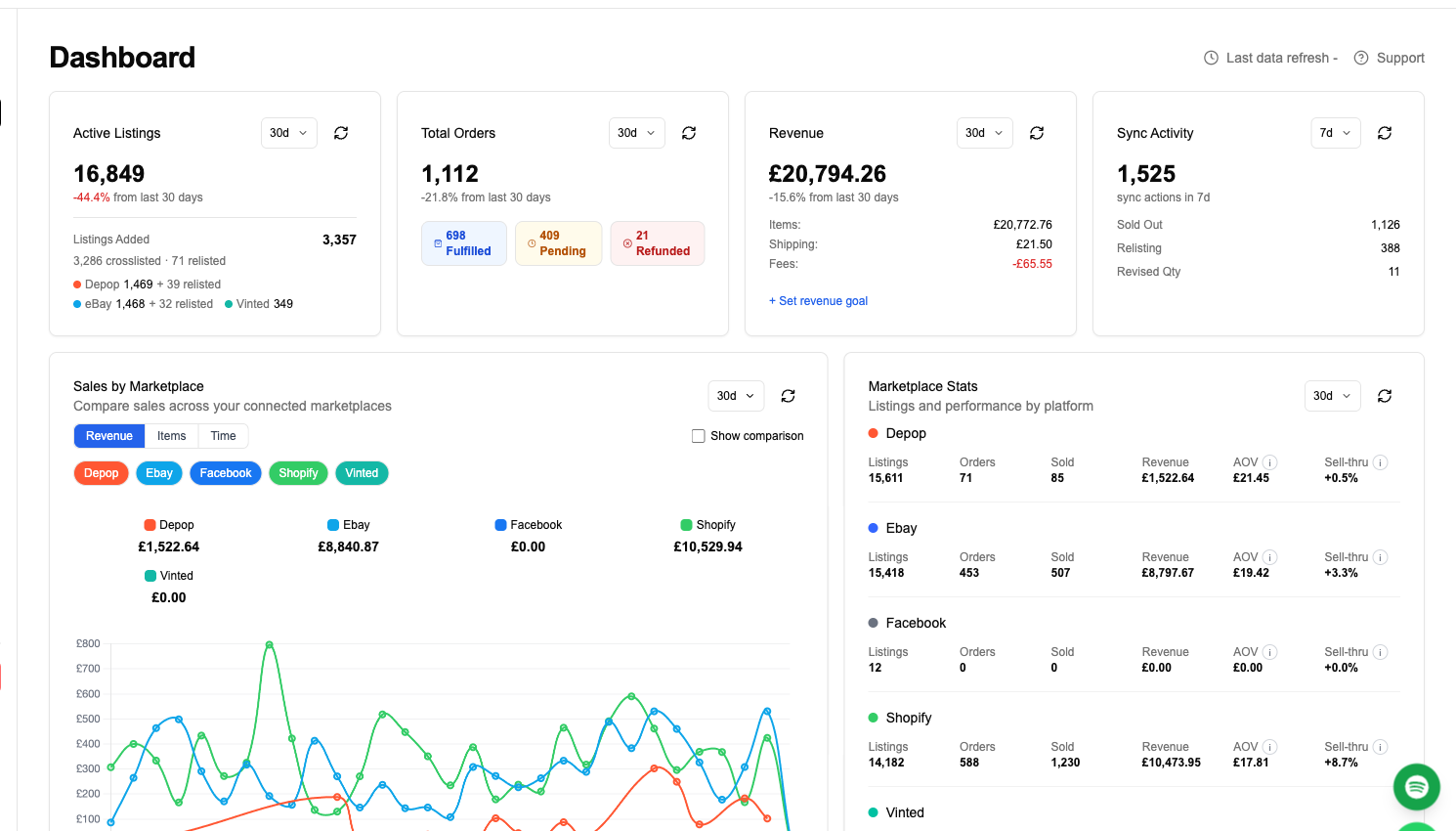
From the same connected BigCommerce store, your products can also reach Depop and Vinted for fashion resale, Etsy for handmade and vintage, and more — none of which are native BigCommerce channels. Inventory stays in sync across every channel, so when an item sells anywhere, FLUF marks it sold elsewhere and you never sell the same unit twice. Because eBay exposes a full selling API, this pairing gets the complete feature set: two-way inventory sync, eBay order sync into one central view, automatic relisting to keep listings fresh, offer management including Send Offer to watchers, and automatic mark-as-sold. BigCommerce, as your store, feeds the catalogue and brings its own orders into the same view.
Connect your BigCommerce store and selected marketplaces in FLUF Connect. Import your catalogue, review the destination listing details and publish. Manage inventory from one dashboard and allow time for sales updates to complete.
This is the answer to the platform-dependence problem too. When your catalogue, your customer data and your brand live on a BigCommerce store you own, eBay stops being a single point of failure and becomes one channel among several — valuable for its reach, but not something your whole business rests on. If eBay changes its fees or rules, you adjust how much you lean on it; your store and your other marketplaces carry on. Running a store as your foundation and reaching marketplaces through crosslisting gives you both the durability of ownership and the reach of the marketplaces, which is a stronger position than either alone.
It also removes the operational tax that usually stops sellers from doing both. The reason most merchants pick one is not strategy — it is that maintaining listings across two systems, re-entering products, watching stock and racing to pull a sold item down before it sells twice is genuinely a part-time job. Automate that, and the case for running a branded store and reaching eBay’s 135 million buyers stops being aspirational and becomes the obvious default. You write the product once, and it works everywhere.
Pricing
FLUF Connect plans start at £9/month (Starter). There is no free plan, but every new account gets a 7-day trial for £1. Higher plans sync more often, and automation — relisting, offers, order sync and bulk operations — is included from Seller upwards rather than sold as a paid add-on. You can connect your BigCommerce store and start crosslisting to eBay and beyond from the FLUF Connect dashboard in about ten minutes.
So the BigCommerce-versus-eBay decision is really a question of what each does best — a branded store you own versus a marketplace audience you reach — and the strongest strategy for most sellers is not to pick one but to use both well. FLUF Connect is what turns that from a doubling of effort into a single, synced operation.
Sources & Verification
- https://www.bigcommerce.com/pricing/
- https://www.bigcommerce.com/dm/plan-pricing-updates-2026/
- https://www.bigcommerce.com/solutions/omnichannel/
- https://www.ebay.com/help/selling/fees-credits-invoices/selling-fees?id=4822
- https://www.ebay.co.uk/help/selling/fees-credits-invoices/fees-private-sellers-activated-managed-payments?id=4822
- https://www.ebayinc.com/stories/news/ebay-uk-announces-it-is-now-free-to-sell-across-its-categories/
- https://www.bcg.com/publications/2024/the-rise-of-the-b2c-specialty-marketplace
Related guides
Frequently Asked Questions
It depends on volume. eBay charges no subscription but takes a per-sale fee — around 13.6% plus $0.40 per order in the US (UK private sellers pay £0 since October 2024). BigCommerce charges a flat monthly subscription (Core $39 up to Performance from $1,499) with no per-sale commission, so cost per sale falls as volume rises. Low-volume sellers usually pay less on eBay; high-volume sellers often pay less on a flat BigCommerce plan — provided they can drive their own traffic.
No. On eBay the buyer is eBay's customer — you generally cannot market to them directly afterwards. On a BigCommerce store you own the customer's email and order history and can remarket to build repeat business. If customer ownership and lifetime value matter to you, that is a strong reason to run your own store alongside any marketplace selling.
In the US, the standard final value fee is around 13.6% of the total sale plus $0.40 per order for most categories without a Store subscription. In the UK, eBay charges private sellers £0 in selling fees on domestic sales since October 2024, monetising instead through a buyer-side Buyer Protection fee. Fees vary by category and market.
BigCommerce renamed its plans on 1 June 2026 to Core ($39/mo), Growth ($105/mo), Scale ($399/mo) and Performance (custom, from $1,499/mo). Each tier carries a trailing-twelve-month GMV cap that moves you up a plan when your sales cross it — unlike eBay, which has no plan cap. Older comparisons referencing Standard/Plus/Pro/Enterprise are out of date.
For testing a product, eBay first is usually cheapest and fastest — its pay-only-when-you-sell model and built-in 135 million buyers let you validate demand before investing in a storefront and ad budget. If the product sells, that is evidence worth building a BigCommerce store around. Many sellers start on eBay and add a store as they grow.
eBay is a native BigCommerce marketplace channel — BigCommerce natively supports Amazon, eBay and Walmart only — but the native connection is basic: it publishes a feed without automatic relisting, offer campaigns or a unified inventory view across resale marketplaces. FLUF Connect adds full two-way sync, relisting and offer automation on top of eBay, and extends the same catalogue to non-native channels like Depop, Vinted and Etsy.
Yes. FLUF Connect crosslists your BigCommerce catalogue to eBay (and Depop, Vinted, Etsy and more) and keeps inventory synced, so when an item sells on one channel it is marked sold everywhere else within minutes. eBay orders flow into one central view alongside your store's, so you run both as a single operation rather than two disconnected systems.
FLUF Connect plans start at £9/month (Starter). There is no free plan, but every new account gets a 7-day trial for £1. Higher plans sync more often, and automation such as relisting, offers and order sync is included in every plan rather than sold as a paid add-on. You can connect a BigCommerce store and crosslist to eBay in about ten minutes.