Crosslist from BigCommerce to Vestiaire Collective with FLUF Connect
Push your BigCommerce designer and luxury catalogue to Vestiaire Collective in one click — with two-way inventory sync, order flow-back, auto-relisting and offer automation.
7 days for £1, then from £9/month.



TL;DR: If you run a luxury or designer fashion catalogue on BigCommerce, FLUF Connect pushes those products to Vestiaire Collective in one click — photos, titles, descriptions, prices and variants carry over, mapped from your BigCommerce category tree. Inventory stays in sync so you never oversell, orders flow back into one place, and because Vestiaire Collective supports full two-way sync, FLUF can also auto-relist, manage offers and mark items sold automatically. Note that Vestiaire Collective is for pre-owned premium and designer pieces only, and items pass physical authentication at a Vestiaire hub before they reach the buyer.
A BigCommerce store gives you a fast, fully hosted catalogue with strong B2B tooling and an API-first architecture — but it only sees its own storefront traffic. You bring the buyers. That works well until you want your designer handbags, watches or ready-to-wear in front of a global audience of luxury resale shoppers who are already searching for exactly those pieces. That audience lives on a marketplace, and roughly 67% of global e-commerce now happens on marketplaces rather than standalone stores.
BigCommerce’s native marketplace connectors are narrow — Amazon, eBay and Walmart, plus social channels — and luxury resale marketplaces are not among them (BigCommerce omnichannel). That is the gap FLUF Connect closes: it reads your BigCommerce catalogue through the official API and crosslists it to Vestiaire Collective and other marketplaces, then keeps everything in sync from a single dashboard.
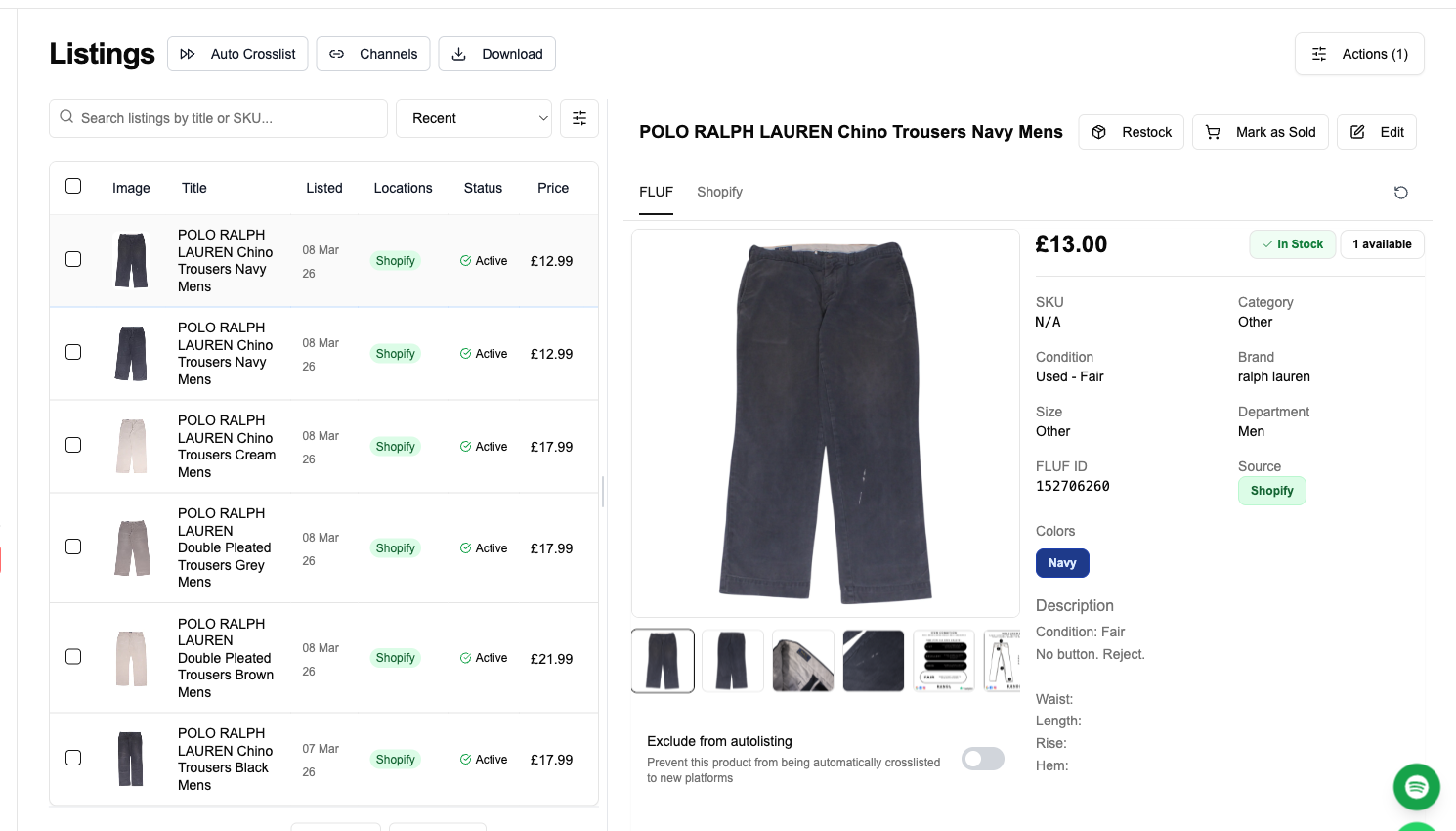 Vestiaire Collective with live inventory status” loading=”lazy” width=”1490″ />
Why Sell on Both BigCommerce and Vestiaire Collective?
Selling on both lets you keep BigCommerce as your branded home base while reaching buyers who specifically hunt for pre-owned luxury. Vestiaire Collective has more than 23 million members across 70+ countries, and the platform reported around €1 billion of items sold in 2025 — demand a single-store catalogue cannot match on its own.
The two channels do different jobs. Your BigCommerce storefront is where you control branding, customer data, design and B2B relationships — the place repeat buyers come back to. Vestiaire Collective is a discovery engine for premium fashion: shoppers browse it precisely because they want authenticated, pre-owned designer pieces, and they arrive with high intent. Listing the same item in both places means you capture demand you already own plus demand you would otherwise never see.
It matters that Vestiaire Collective is global with a strong European footprint. A designer coat sitting on your BigCommerce store reaches whoever finds your domain; the same coat on Vestiaire Collective can sell to a buyer in Paris, Milan, London or New York who trusts the platform’s authentication process. For sellers of handbags, watches and ready-to-wear, that reach is the entire point — and FLUF makes adding the channel a one-time setup rather than a duplicate-data-entry chore.
There is an honesty caveat worth being clear about. Vestiaire Collective is strictly for pre-owned luxury and designer fashion — handbags, watches and ready-to-wear from recognised brands. A generic or non-designer catalogue is not a fit. If your BigCommerce store sells premium or designer inventory, crosslisting is a strong move. If it sells general merchandise, channels like eBay or Facebook Marketplace will suit you better, and FLUF can push to those instead.
It also helps to understand why a BigCommerce seller would even need a second channel for designer stock. BigCommerce sits in the mid-market-to-enterprise tier, built for larger catalogues and B2B workflows; it gives you a polished, scalable storefront but no built-in shopper audience. A buyer only finds your BigCommerce designer coat if they already know your domain or you’ve paid to drive them there. Vestiaire Collective inverts that: it supplies the audience and the trust layer, and you supply the inventory. Running both means your marketing spend builds your own brand while a high-intent marketplace quietly clears stock you’d otherwise sit on. The economics of resale reward velocity, and a second authenticated sales channel raises the odds that each piece sells before it dates.
How to Crosslist from BigCommerce to Vestiaire Collective with FLUF Connect
The whole flow takes about ten minutes to set up, and after that crosslisting is a one-click action. No passwords are stored with FLUF, and your account access is revocable at any time. Here is how it works end to end.
Step 1: Connect your BigCommerce store
Link your BigCommerce store to FLUF from the Channels screen. FLUF then reads your catalogue — products, variants, images and your store’s full category tree — to build accurate listings elsewhere. Nothing is changed on your store; FLUF only reads what it needs.
Step 2: Connect Vestiaire Collective
Authorise your Vestiaire Collective seller account through FLUF. This is the channel that will receive your listings and send order and sale signals back. Connection is secure and revocable — you can disconnect at any time without losing your BigCommerce data.
Step 3: Select the products to crosslist
Choose which BigCommerce items to send. Because Vestiaire Collective only accepts pre-owned luxury and designer pieces, you select the relevant handbags, watches and ready-to-wear rather than dumping the whole catalogue. FLUF shows your products with their current status so you can pick deliberately.
Step 4: Crosslist in one click
Hit crosslist and FLUF builds a Vestiaire Collective listing from each selected BigCommerce product — pulling photos, title, description, price and variant data, and mapping your BigCommerce category to the closest Vestiaire Collective category. From that point the listing is live and FLUF watches it for sales, offers and inventory changes so your channels stay aligned.
Throughout, your BigCommerce store remains the source of truth. When something sells anywhere, FLUF marks the BigCommerce item sold via the orders API so stock never drifts — the same mechanism that keeps every other connected channel honest.
A note on what makes this reliable rather than fragile. FLUF reads BigCommerce through its official V3 catalog API rather than scraping pages, so it sees structured product data — SKUs, variant options, image URLs and category IDs — exactly as BigCommerce stores them. That structure is what lets the mapping to Vestiaire Collective be accurate instead of approximate. It also means that when you update a product in BigCommerce — say you correct a measurement or swap a photo — that data is available to FLUF the next time it touches the listing, so your source store and your marketplace presence don’t slowly fall out of step. For sellers used to maintaining the same item in two systems by hand, removing that duplication is often the single biggest time saving, ahead of even the new sales reach.
Setup is genuinely a one-time cost. Once BigCommerce and Vestiaire Collective are connected, adding a new designer piece to the marketplace is the same one-click action — select it in FLUF, crosslist, done. There’s no per-listing re-authentication, no copying fields between tabs, and no separate spreadsheet tracking which item is live where. The dashboard is the single view of what’s listed, what’s sold and what needs attention.
What Transfers When You Crosslist from BigCommerce to Vestiaire Collective?
FLUF reads the structured data already in your BigCommerce catalogue and rebuilds it as a native Vestiaire Collective listing. The goal is that you enter product details once, in BigCommerce, and never re-type them per marketplace. Here is what carries over.
- Photos: Your BigCommerce product images transfer as the listing gallery. Clear, well-lit photos matter doubly on Vestiaire Collective because buyers — and the authentication team — assess condition and authenticity partly from imagery.
- Title: The product name maps to the listing title. For luxury resale, including the brand and model in the title is what makes a piece discoverable.
- Description: Your BigCommerce description carries over, including condition notes, measurements and materials — all of which serious luxury buyers read closely.
- Price: Your price transfers across. Keep in mind Vestiaire Collective enforces a minimum listing price of around $18, so very low-value items are not eligible.
- Variants: BigCommerce variants — size and similar options — are read so the right attributes appear on the Vestiaire Collective listing.
- Category: FLUF maps your BigCommerce category tree to the closest Vestiaire Collective category, so a handbag lands under handbags and a watch under watches rather than in a generic bucket.
There are destination-specific requirements unique to Vestiaire Collective that are worth flagging up front. First, eligibility: every item must be a genuine pre-owned luxury or designer piece. A manufactured, non-designer product will not pass. Second, and most importantly, physical authentication. Vestiaire Collective can route a sold item through one of its authentication hubs, where experts physically verify the piece before it reaches the buyer (Vestiaire authentication). This is a feature, not a friction point — it is exactly why buyers trust the platform with high-ticket purchases — but it means your listing data and the physical item need to match, and condition honesty is essential.
Brand selection is also stricter than on a general marketplace. Vestiaire Collective curates around recognised luxury and designer labels, so the brand field on your listing needs to correspond to a brand the platform accepts. FLUF carries across the data you have in BigCommerce, but the actual approval of any given listing remains Vestiaire Collective’s call — as it should be for an authenticated luxury marketplace.
The practical upshot: if your BigCommerce catalogue already contains clean, branded, well-photographed designer inventory, the crosslisting is smooth and the data transfer does the heavy lifting. If your listings are thin on brand and condition detail, tighten those fields in BigCommerce first and every connected channel benefits.
What Syncs (and What Doesn’t)
Vestiaire Collective is one of the channels where FLUF supports full two-way sync, so the answer here is more generous than it is for some marketplaces. Here is exactly what stays in step.
- Inventory — always. This is the core promise. When an item sells on any connected channel, FLUF marks the matching BigCommerce product sold and updates your other channels, including Vestiaire Collective, so you never sell the same one-of-a-kind designer piece twice. For single-quantity luxury resale, this protection is the whole reason to use a crosslister.
- Order flow-back — yes. Vestiaire Collective supports order sync, so sales made there are visible centrally rather than trapped in one platform’s dashboard. You see orders in one place instead of logging in and out of each marketplace.
- Mark-as-sold — yes. A sale on Vestiaire Collective propagates outward; a sale elsewhere marks the Vestiaire Collective copy sold. The two-way nature is what keeps stock accurate across the board.
- Relisting — yes. Vestiaire Collective supports relisting, so FLUF can refresh listings to keep them visible (more on that below).
- Offers — yes. Vestiaire Collective supports offer management, so buyer offers can be handled through FLUF’s automation rather than only inside the Vestiaire app.
What this means in practice is that Vestiaire Collective behaves like a fully connected channel, not a fire-and-forget one. Unlike marketplaces where FLUF can only detect a sale after the fact and update everything else to prevent overselling, Vestiaire Collective participates in two-way sync — orders come back, inventory flows both ways, and the automation layer can act on offers and relisting. The one thing FLUF cannot override is the platform’s own rules: authentication, brand acceptance and eligibility are decided by Vestiaire Collective, and that is by design for a marketplace whose entire value rests on trust.
It’s worth being concrete about the fee picture too, since it shapes how you price between channels. Vestiaire Collective charges a 12% commission on items priced between $83 and $16,667, with a flat $10 fee on items under $83, plus a 3% payment-processing fee with a $3 minimum; listing itself is free, and the minimum listing price is around $18 (Vestiaire Collective seller fees). FLUF carries your BigCommerce price across as-is, so if you want to absorb or pass on those marketplace costs, you adjust the price on the items you crosslist — and because the inventory sync is two-way, you stay protected against overselling regardless of which channel ultimately closes the sale.
The honest boundary, again, is eligibility. FLUF can format and submit a listing, but it cannot make a non-designer item acceptable on a luxury marketplace, and it cannot shortcut the authentication step. If a piece is sold and routed for physical authentication, that verification happens at a Vestiaire hub before the buyer receives it, and the listing data you provided needs to hold up against the physical item. Accurate condition grading and honest photos in BigCommerce are therefore not just good practice — they’re what keeps your sales clearing authentication cleanly.
Automation for BigCommerce + Vestiaire Collective Sellers
Because Vestiaire Collective supports relisting and offer management, FLUF’s automation does real work for this channel rather than sitting idle. These automations are included from Seller upwards, not a paid add-on.
Auto-relisting
Listings that have been live a while tend to drift down search results. FLUF can automatically relist your Vestiaire Collective items to keep them fresh and visible, so a designer coat that didn’t sell in its first weeks gets renewed exposure without you manually re-posting it. For a luxury catalogue where individual pieces can take time to find the right buyer, steady visibility is what eventually converts.
Offer automation
Vestiaire Collective buyers often negotiate, and offers can arrive at any hour across 70+ countries and time zones. FLUF’s offer automation lets you set the rules once and have offers handled consistently, so you are not glued to the app to respond. This keeps your response times competitive without the manual grind, which matters when buyers comparing similar pieces tend to favour the seller who replies quickly.
Inventory automation
The always-on protection is automated overselling prevention. The moment a piece sells on BigCommerce, Vestiaire Collective or any other connected channel, FLUF updates every other listing. For one-of-a-kind luxury items this is non-negotiable — selling the same authenticated handbag twice means cancellations, refunds and damaged seller standing on a platform where reputation is currency.
Bulk operations
For larger BigCommerce catalogues, doing everything one item at a time doesn’t scale. FLUF supports bulk operations where the channel allows them, so you can crosslist, update or refresh batches of designer pieces in one pass rather than item by item. A seller bringing fifty handbags onto Vestiaire Collective for the first time treats it as a single selection-and-crosslist action, and ongoing maintenance — price changes, relists — happens in bulk too. This is where the time savings compound for established stores.
All of this runs in the background once configured. You spend your time sourcing and photographing inventory, not babysitting listings across tabs. And because the automation is included from Seller upwards rather than an extra tier, you don’t pay more to keep your channels honest.
One thing automation deliberately doesn’t do is make pricing or curation decisions for you. FLUF will keep your listings fresh, your offers handled by your rules and your stock accurate, but the judgment calls — which pieces to list, how to price them against the marketplace’s fee structure, how to grade condition — stay with you. That’s the right division of labour for luxury resale, where a human eye on authenticity and presentation is part of what earns buyer trust in the first place.
Pricing
FLUF Connect plans start at £9/month (Starter). There is no free plan, but every new account gets a 7-day trial for £1. Higher plans sync more often for larger BigCommerce catalogues. Automation — relisting, offer management and bulk operations where the channel supports them — is included from Seller upwards, not a paid add-on. Setup takes about ten minutes, and you can start crosslisting from BigCommerce to Vestiaire Collective the same day. When you’re ready, head to the FLUF Connect dashboard to link your accounts.
Sources & Verification
- https://www.vestiairecollective.com/about-us/ — Vestiaire Collective membership, country reach and 2025 sales
- https://faq.vestiairecollective.com/hc/en-us/articles/24659638721425-Seller-Selling-Fees — Vestiaire Collective seller fees
- https://faq.vestiairecollective.com/hc/en-us/articles/360001379078-Buyer-Authentication-fees — Vestiaire Collective authentication
- https://www.bigcommerce.com/ — BigCommerce platform overview and APIs
- https://www.bigcommerce.com/solutions/omnichannel/ — BigCommerce native channel coverage
- https://www.bcg.com/publications/2024/the-rise-of-the-b2c-specialty-marketplace — marketplace share of global e-commerce
Related guides
Frequently Asked Questions
Yes. FLUF Connect reads your BigCommerce catalogue through the official BigCommerce V3 catalog API and rebuilds each selected product as a native Vestiaire Collective listing — photos, title, description, price, variants and category mapping — in one click. Setup takes about ten minutes.
Vestiaire Collective accepts pre-owned luxury and designer fashion only — handbags, watches and ready-to-wear from recognised brands. A generic or non-designer catalogue is not eligible. If your BigCommerce store sells premium or designer inventory it's a strong fit; for general merchandise, FLUF can crosslist to channels like eBay or Facebook Marketplace instead.
Yes, with full two-way sync. When an item sells on any connected channel, FLUF marks the matching BigCommerce product sold and updates your other listings, including Vestiaire Collective, so you never sell the same one-of-a-kind piece twice. Orders made on Vestiaire Collective also flow back into your central dashboard.
Vestiaire Collective can route a sold item through one of its authentication hubs, where experts physically verify the piece before it reaches the buyer. This is why buyers trust the platform with high-value purchases. Accurate condition grading and honest photos in BigCommerce help your sales clear authentication smoothly.
Vestiaire Collective charges 12% commission on items priced $83–$16,667 (a flat $10 on items under $83), plus a 3% payment-processing fee with a $3 minimum. Listing is free and the minimum listing price is around $18. FLUF carries your BigCommerce price across, so you can adjust pricing to account for these fees.
Yes. Vestiaire Collective supports both relisting and offer management, so FLUF can automatically relist your items to keep them visible and handle buyer offers by your rules. This automation is included from Pro upwards, not a paid add-on.
FLUF Connect plans start at £9/month on Starter, with Pro at £29/month and custom Super Seller plans above that; every plan is unlimited on listings and marketplaces, and the tiers differ by which automations they include and how often we check your channels for sales. There is no free plan, but every new account gets a 7-day trial for £1. Higher plans sync more often for larger BigCommerce catalogues, and automation — relisting, offer management and bulk operations where the channel supports them — is included from Pro upwards.