Wix vs Etsy: Which Is Better for Sellers?
A side-by-side breakdown of fees, audience, control and what real sellers think — so you can choose the right platform, or sell on both.



Choosing between Wix and Etsy comes down to one fundamental question: do you want to own a store, or rent access to a marketplace? Wix is a website builder — you create your own branded online shop and bring the traffic yourself. Etsy is a marketplace with roughly 86.5 million active buyers already shopping for handmade, vintage and craft (Etsy — Q4/FY2025 results) — but you sell on its terms, inside its rules, competing in its search. This comparison breaks down fees, audience, control and effort side by side, then shows why many sellers stop choosing and simply do both.
- Etsy is better for: instant access to a built-in audience actively searching for handmade, vintage and craft — no traffic-building required to start
- Wix is better for: owning a branded store, selling any product type, keeping your customer data, and paying no per-sale marketplace commission
- Fees: Etsy stacks $0.20 listing + 6.5% transaction + ~3% + $0.25 processing (plus Offsite Ads); Wix is a flat plan from $29/month + 2.9% + $0.30 processing, no marketplace cut
- Audience: Etsy has ~86.5M active buyers built in; Wix has none — you drive 100% of your own traffic
- Category limits: Etsy allows only handmade, vintage (20+ years) and craft supplies; Wix allows anything
- Our take: they solve different problems — use Etsy for discovery and Wix for brand, and crosslist both with FLUF Connect
At a glance
The quickest way to understand Wix versus Etsy is that they aren’t really the same kind of product. Etsy is a destination shoppers visit; Wix is a tool you use to build a destination of your own. That single difference cascades into everything else — fees, audience, control, discovery and effort — so keep it in mind as we compare the details.
| Wix | Etsy | |
|---|---|---|
| What it is | Website builder — your own store | Marketplace — a shared shopping destination |
| Built-in buyers | None — you drive traffic | ~86.5M active buyers |
| Cost to sell | From $29/mo (Core plan) + 2.9% + $0.30 processing | $0.20 listing + 6.5% + ~3% + $0.25 processing |
| Marketplace commission | None | 6.5% transaction fee per sale |
| What you can sell | Any legal product | Handmade, vintage (20+ yrs), craft supplies only |
| Customer data | Yours (email, retargeting) | Owned by Etsy |
| Discovery | Google SEO, social, ads you run | Etsy internal search |
| Best for | Brand, control, any niche, scale | Fast start, built-in demand, handmade/vintage |
If you need buyers today and you sell eligible handmade or vintage goods, Etsy is the faster path. If you want to build a brand you control and keep more of each sale over time, Wix is the stronger foundation. Neither is universally “better” — the right answer depends on whether your bottleneck is traffic or ownership.
It’s also worth being clear about who each platform is genuinely built for, because a lot of “which is better” confusion comes from comparing them as if they compete for the same job. Etsy competes for the maker or vintage seller who wants demand handed to them and is happy to trade a per-sale cut and a fixed catalogue policy for it. Wix competes for the entrepreneur who wants a storefront that is unmistakably theirs and will invest to bring people to it. A candlemaker testing the market this weekend and a growing brand building a customer base for the next five years are different people with different bottlenecks — and that, more than any single fee or feature, is what should decide the platform.
Feature-by-feature
On features, Wix and Etsy optimise for opposite things. Wix gives you design freedom, a custom domain, full control of your storefront’s look, unlimited product types, and marketing tools (email, ads, automations) that you own and run. Etsy gives you almost no design control — every shop looks broadly the same — but hands you something Wix can’t: a stream of buyers who are already on the platform, searching. Etsy’s features are about being found within Etsy; Wix’s features are about building something that’s yours.
Wix also isn’t limited to physical products or a single aesthetic — you can sell services, digital downloads, bookings and subscriptions, and design the site to match your brand exactly. Etsy is deliberately narrow: it exists for handmade, vintage and craft, and its tooling reflects that focus. For a maker who fits Etsy’s categories, that focus is an advantage; for anyone selling outside them, it’s a wall.
Consider marketing tools specifically. Wix bundles email campaigns, automations, abandoned-cart recovery, coupon codes, loyalty features and analytics that report on your customers — data you keep and act on. Etsy’s marketing tools largely serve Etsy’s ecosystem: promoted listings that bid for position in Etsy search, and Offsite Ads that place your products across the web but charge you a percentage of any resulting sale. The philosophical difference is stark. On Wix, marketing builds an asset you own; on Etsy, marketing mostly buys you more visibility within a marketplace you don’t. Neither is wrong, but they reward completely different behaviours — a Wix seller thinks like a brand owner, an Etsy seller thinks like a marketplace competitor.
There’s also the question of scale and stability. A Wix store can grow into a large multi-page operation with hundreds of products, custom checkout flows and integrations, all under your control. Etsy caps how much you can differentiate no matter how big you get — a top Etsy seller and a brand-new one occupy the same template, differing only in reviews, photography and search position. If your ambition is to build something distinctive and durable, that ceiling matters; if your goal is simply to sell eligible items to a ready audience, it may not bother you at all.
The listing experience
Listing on Etsy is quick and structured. You add photos, a title, tags, price and attributes, pay the $0.20 listing fee, and you’re live in front of Etsy’s audience within minutes. The trade-off is sameness: your listing sits in a grid of visually similar competitors, and standing out is a matter of photography, tags and reviews rather than store design.
Building a store on Wix is a bigger up-front effort — you’re designing a website, not filling in a listing form — but the result is entirely yours. You choose the layout, the branding, the navigation and the checkout experience. There’s a learning curve Etsy doesn’t have, and there’s no audience waiting when you flip the switch. What you get in return is a storefront that looks like your business, not a marketplace search result, and complete freedom over how products are presented and merchandised.
Day-to-day, the listing rhythm differs too. On Etsy, adding a product is a repeatable few-minute task, and much of your ongoing effort goes into renewing listings, refining tags for search, and managing reviews. On Wix, once the store is built, adding products is straightforward, but the ongoing effort shifts toward marketing — writing content, running campaigns, improving SEO — because nothing surfaces your products unless you make it. In other words, Etsy front-loads discovery and asks little marketing of you; Wix front-loads setup and asks continuous marketing. Understanding which kind of work suits you is often more decisive than any fee comparison.
Photography and presentation carry different weight on each. Etsy buyers scan a dense grid, so a scroll-stopping first image and tight, keyword-rich titles do most of the selling. Wix gives you room to tell a fuller story — lifestyle imagery, longer descriptions, bundled collections, an about page — because you control the whole page, not a single tile in someone else’s search results. Sellers who are strong storytellers often find Wix lets them convert better once traffic arrives; sellers who rely on marketplace demand often find Etsy’s structured, comparison-friendly format does the job with less effort.
Fees and payouts
This is where the two models diverge most sharply, and where the right choice often depends on your sales volume.
Etsy’s fees stack per sale. Every listing costs $0.20 (charged whether or not it sells, renewed every four months), then each sale carries a 6.5% transaction fee on the item price plus shipping, plus payment processing of around 3% + $0.25 (Etsy — Fees and payments). On top of that, Offsite Ads charge 15% on attributed orders for smaller shops (12%, and mandatory, once you pass $10,000 in trailing-12-month sales). There’s no monthly subscription required to start, though Etsy Plus is available at $10/month for extra tools. The result: Etsy is cheap to open but takes a meaningful slice of every sale, and that slice doesn’t shrink as you grow.
Wix charges a flat plan plus processing. To sell online you need at least the Core plan at $29/month, with Business at $39/month and Business Elite at $159/month for larger operations (Wix — Plans & pricing). Wix takes no marketplace commission of its own; you pay only the payment-processing fee of 2.9% + $0.30 per transaction. That means your per-sale cost on Wix is essentially just card processing, no matter how much you sell — so the more volume you do, the more the flat monthly fee is outweighed by the commission you’re not paying Etsy.
| Cost element | Wix | Etsy |
|---|---|---|
| Monthly | From $29 (Core) to sell online | $0 to start ($10 optional Etsy Plus) |
| Per listing | None | $0.20 (renewed every 4 months) |
| Per sale (marketplace) | None | 6.5% transaction fee |
| Payment processing | 2.9% + $0.30 | ~3% + $0.25 |
| Advertising | Optional, you control | Offsite Ads 15% / 12% (mandatory above $10k/yr) |
The crossover is the whole fee story. At low volume, Etsy’s start-cheap model wins because you avoid a monthly subscription. At higher volume, Wix’s flat cost wins because a 6.5% marketplace cut on every order adds up fast. Payouts differ too: Etsy releases funds to your Etsy Payments balance on a schedule, while Wix routes payments through your chosen processor to your own account. Always confirm the current figures on each platform’s official fees page before you model your margins.
A worked example makes the crossover concrete. Sell ten items a month at $30 each — $300 in sales — and Etsy’s per-sale fees (roughly 6.5% plus processing plus listing fees) run to a modest amount, comfortably less than Wix’s $29 monthly plan, so Etsy is cheaper. Sell a hundred items a month at $30 — $3,000 in sales — and Etsy’s 6.5% transaction fee alone is around $195, before processing and Offsite Ads, while Wix’s marketplace cut is zero and you’ve paid a flat $29. The more you sell, the more decisively Wix’s economics win, because a percentage-of-every-sale model scales its cost with your success while a flat subscription does not. This is why many sellers begin on Etsy and add or shift to a Wix store as volume grows.
Offsite Ads deserve a special mention because they surprise sellers. For shops that have passed $10,000 in trailing-twelve-month sales, Etsy’s Offsite Ads are mandatory — you cannot opt out — and charge 12% on any sale attributed to an Etsy-placed ad (Etsy — Fees and payments). That means your most successful Etsy sellers pay an additional, non-negotiable ad fee precisely when they’re doing best. Wix has no equivalent forced advertising charge; any ads you run are ones you chose, on budgets you set. For high-volume sellers, this single policy difference can tip the economics firmly toward owning a store.
Audience and demand
Etsy’s single biggest advantage is its audience. It reported roughly 86.5 million active buyers at the end of 2025 — people who come specifically to shop handmade, vintage and craft (Etsy — Q4/FY2025 results). List an eligible item and you’re immediately in front of buyers with intent. That’s the reason so many makers start on Etsy: demand is built in, and you don’t have to generate a single visitor yourself.
Wix offers the opposite. A new Wix store has no audience at all — every visitor comes from SEO, social, email or ads that you drive (Wix — Plans & pricing). Wix powers millions of sites and has a large registered user base, but those are creators, not a pool of shoppers waiting to buy from you. Building traffic to a Wix store is real, ongoing work — and it’s the single biggest reason a standalone store is harder to launch than an Etsy shop.
There’s a strategic wrinkle worth noting: Etsy’s active-buyer count actually declined around 3.4% year over year in 2025, its first material contraction (Etsy — Q4/FY2025 results). For sellers, that’s a reminder that renting an audience means you’re exposed to that audience’s health and to platform decisions you don’t control. Owning a Wix store insulates you from that — but only once you’ve built the traffic. The tension between “instant demand you don’t own” and “owned demand you must build” is the heart of the Wix-versus-Etsy decision.
Discovery and SEO
How buyers find you differs completely. On Etsy, discovery is Etsy’s internal search — you optimise titles, tags and attributes to rank against other Etsy sellers, and success is measured in Etsy search position and favourites. It’s a closed system: you compete for attention inside Etsy, and the skills are Etsy-specific.
On Wix, discovery is the open web — mainly Google SEO, plus whatever social and email reach you build. Wix stores are indexed by Google like any website, so a well-optimised Wix store can rank in general search for your products and build an audience that isn’t dependent on any marketplace. The catch is that this takes time and effort, whereas Etsy’s traffic is there from day one. Different skill sets, different timelines: Etsy rewards marketplace-SEO fluency now; Wix rewards web-SEO and marketing investment that pays off over months.
There’s a compounding difference worth understanding. Etsy search traffic is rented — it flows while your listings rank, and stops if the algorithm shifts or a competitor outbids you on promoted placement. Google traffic to a Wix store, by contrast, compounds: a product or content page that earns rankings and backlinks keeps drawing visitors month after month, and that authority accrues to your domain, not a marketplace. Early on, Etsy’s instant traffic dwarfs a new Wix store’s trickle; over a year or two, a well-run Wix store can build a discovery engine that Etsy sellers simply don’t own. Neither replaces the other cleanly, which is a large part of why running both is so appealing — you get Etsy’s immediate reach while your Wix store’s search equity grows underneath it.
Social and email close the loop on Wix in a way Etsy structurally prevents. Because a Wix store captures customer emails and lets you retarget site visitors, every marketing dollar can be recycled into repeat purchases from people you already reached. On Etsy, you can’t email a past buyer to announce a new drop or a sale — the customer is Etsy’s, not yours. For products with repeat-purchase potential, that difference in owned audience is one of the most consequential in the whole comparison, and it rarely shows up in a simple fee table.
What sellers actually say
Talk to sellers who’ve used both and a consistent picture emerges. Etsy sellers praise the immediacy of the audience and the low barrier to starting, but complain about rising and stacking fees, the mandatory Offsite Ads charge at scale, the sea-of-sameness competition, and having no direct relationship with their customers. The recurring frustration is that Etsy owns the buyer — you can’t easily email them, and a policy change can reshape your business overnight.
Wix sellers value the control, the branding and keeping their margins and customer data — but are candid that traffic is the hard part. The common refrain is that a Wix store is only as good as the marketing behind it. Put together, the sentiment points to the same conclusion the numbers do: Etsy is the better starting engine, Wix is the better owned asset, and the sellers who are happiest tend to be the ones who use each for what it does best rather than forcing one to do both jobs.
A theme that recurs among experienced sellers is regret about over-reliance. Those who built their entire business on Etsy describe the vulnerability of a single algorithm change, a fee increase, or a suspended account wiping out their income overnight — with no customer list to fall back on. Those who launched a Wix store cold, with no existing audience, describe months of near-silence before traffic built. The lesson both groups draw is the same: diversification is protection. A seller with an Etsy shop feeding discovery and a Wix store banking the brand and the customer relationships is far more resilient than one betting everything on either model. It’s advice that sounds obvious in hindsight and is easy to act on once crosslisting removes the effort of maintaining two channels.
How to make your choice
Choose Etsy if you sell handmade, vintage or craft goods, you want buyers immediately, and you’d rather pay per sale than build traffic. It’s the fastest way to validate demand and start earning without a marketing budget.
Choose Wix if you sell outside Etsy’s allowed categories, you want a branded store you own, you value keeping your customer data and margins, and you’re willing to invest in driving your own traffic. It’s the stronger long-term foundation for a real brand.
Choose both if — and this is where most growing sellers land — you want Etsy’s ready-made discovery and the owned brand, margins and customer data of a Wix store. The two aren’t mutually exclusive; they’re complementary, and the only real obstacle to running both has always been the double workload. That’s exactly the problem crosslisting solves.
A practical way to decide: look at where your bottleneck is right now. If you have great products but nobody’s finding them, your bottleneck is traffic — start with Etsy, where the audience already exists. If you have steady sales but the fees, the sameness or the lack of customer data are holding you back, your bottleneck is ownership — build a Wix store. And if you’re growing and feel both constraints at once, that’s the signal to run both: keep Etsy feeding you discovery while your Wix store captures the brand, the margin and the repeat customers. The decision isn’t permanent, either — many sellers move along this path as they grow, and crosslisting means each step adds a channel rather than forcing a migration.
Why not both? Sell on Wix and Etsy together
The Wix-versus-Etsy framing sets up a false choice. Etsy owns buyer traffic but takes fees, restricts your categories, and keeps your customers; Wix gives you brand, margin and data but no built-in audience. Run both and each fixes the other’s weakness — Etsy becomes your discovery channel while your Wix store becomes the brand and repeat-customer base you own.
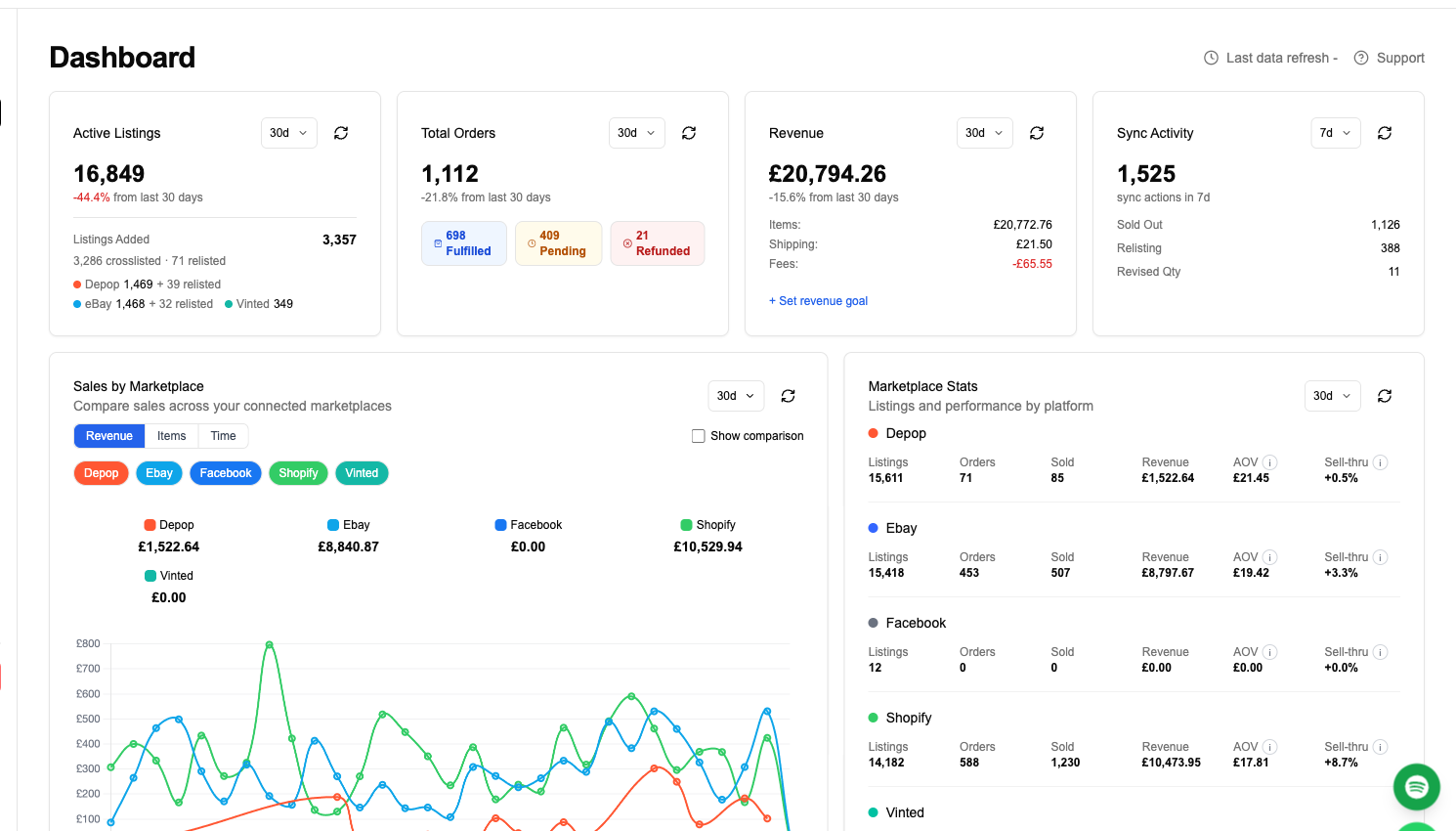
FLUF Connect makes running both practical instead of double the work. List an item once and crosspost it to both your Wix store and your Etsy shop, with inventory kept in sync so a sale on one updates the other and you don’t oversell. You keep Etsy’s ready audience for discovery, use your Wix store to capture branded, repeat and full-catalogue sales that Etsy’s categories won’t allow, and manage everything from one dashboard at /connect. For eligible handmade and vintage, Etsy finds the buyer; for everything else — and for building an owned brand — your Wix store carries it, all from a single catalogue.
FLUF Connect plans start at £9/month (Starter). There is no free plan, but every new account gets a 7-day trial for £1. Every plan includes crosslisting plus inventory and order sync on the channels that support them, so keeping a Wix store and an Etsy shop aligned costs nothing extra within FLUF. Rather than betting your whole business on either a rented marketplace or a store with no audience, you get the strengths of both — instant demand and owned brand — without doubling your listing work.
Sources & verification
- Etsy — Q4/FY2025 results (~86.5M active buyers, down 3.4% YoY)
- Etsy — Fees and payments ($0.20 listing, 6.5% transaction, ~3% + $0.25 processing, Offsite Ads)
- Etsy — What can I sell (handmade, vintage 20+ years, craft supplies only)
- Wix — Plans & pricing (Core from $29/mo to sell online; 2.9% + $0.30 processing)
Fees, plan prices and buyer figures change — always confirm the latest on Wix’s and Etsy’s official pages before deciding.
Related guides
Frequently Asked Questions
It depends on your volume. Etsy has no monthly subscription requirement to start but stacks fees per sale — $0.20 listing, 6.5% transaction, around 3% + $0.25 processing, plus Offsite Ads — so it's cheap at low volume but takes a meaningful slice of every order. Wix charges a flat plan from $29/month (Core) plus 2.9% + $0.30 processing and no marketplace commission, so it gets cheaper per unit as you sell more. The crossover point is the key to the decision.
Yes, in the sense that matters. Etsy is a marketplace with roughly 86.5 million active buyers already shopping there, so you tap existing demand immediately. Wix is a website builder with no built-in shoppers — every visitor to a Wix store comes from SEO, social, email or ads you drive yourself. Etsy gives you an audience you don't own; Wix gives you a store but no audience until you build the traffic.
No. Etsy only allows handmade items you made, genuine vintage that is at least 20 years old, and craft supplies — reselling new, mass-produced goods is against its policy. Wix has no category restrictions and lets you sell any legal product, plus services, digital downloads and subscriptions. If your products fall outside Etsy's handmade/vintage/craft rules, a Wix store is the option that fits.
Wix. On Etsy every shop looks broadly the same, and Etsy owns the customer relationship and data. A Wix store is your own branded website on your own domain, with full design control and ownership of your customer list for email and retargeting. Etsy is better for fast discovery; Wix is better for building a brand you control long term.
Yes, and many growing sellers do. FLUF Connect lets you list an item once and crosspost it to both your Wix store and your Etsy shop, keeping inventory in sync so a sale on one updates the other and you don't oversell. You get Etsy's built-in discovery plus the owned brand and margins of a Wix store, managed from one dashboard. FLUF plans start at £19/month; There is no free plan, but every new account gets a 7-day trial for £1.
Etsy's active-buyer count fell around 3.4% year over year in 2025, its first material contraction, which is a reminder that renting a marketplace audience exposes you to that platform's health and decisions. It remains a large marketplace with tens of millions of buyers, but the trend is a reason many sellers hedge by also building an owned store on Wix rather than relying on Etsy alone.
Sign up for free
Join the community
You're in.
Open your dashboard