Crosslist from Designer Wardrobe to Whatnot — Automatically
Move your Designer Wardrobe designer and contemporary fashion onto Whatnot's fast-growing marketplace in minutes. Titles, photos and prices transfer automatically, and inventory stays in sync.
7 days for £1, then from £9/month.



- Designer Wardrobe: a curated AU and NZ pre-owned designer and contemporary fashion marketplace — 350,000 members, authentication-led, priced in AUD/NZD.
- Whatnot: a fast-growing live-commerce and marketplace platform — roughly US$8 billion in GMV in 2025, with women’s fashion up 223% and fashion buyers placing 12M+ orders a month.
- Fields that transfer automatically: title, description, images, price, quantity and SKU — FLUF Connect builds a Whatnot-ready marketplace listing from your Designer Wardrobe data.
- Inventory sync: when a piece sells on either Designer Wardrobe or Whatnot, FLUF removes it from the other within minutes — no double-selling your one-of-one designer items.
- FLUF lists into Whatnot’s marketplace (static Buy It Now listings) — it does not run live shows for you. You add the live-show option yourself, your inventory stays in sync either way.
- Cost: from £9/month — inventory sync, order sync and bulk tools included on every plan.
Why Sell on Both Designer Wardrobe and Whatnot?
If you have built a following on Designer Wardrobe selling pre-owned designer and contemporary fashion, crosslisting to Whatnot puts those same pieces in front of one of the fastest-growing fashion audiences online — without giving up the curated AU/NZ community you already have. Designer Wardrobe is excellent at trust and local discovery; Whatnot adds reach, urgency and a buyer base that has been growing explosively, especially in women’s fashion. Listing the same inventory on both lets each piece sell to whichever audience values it most.
The two marketplaces pull very different buyers. Designer Wardrobe is a peer-to-peer AU and NZ marketplace built around curation and authentication, and it reported 350,000 members as of September 2025, having launched in Australia in late 2024 and passed one million items sold (Scoop). It operates on a New Zealand site priced in NZD and an Australian site priced in AUD, and that is the extent of its buyer pool (Designer Wardrobe — currency). It is a deliberately local, fashion-literate community — gold for the right buyer, but capped by geography.
Whatnot is the opposite kind of energy. It is a live-commerce and marketplace platform that did roughly US$8 billion in GMV in 2025, more than doubling the prior year, with 20M+ new accounts created and over 80% month-over-month retention. Fashion has been one of its biggest stories: women’s fashion grew 223% and fashion buyers now place more than 12 million orders a month. A buyer who would never browse a curated AU designer feed will happily buy the same dress on Whatnot — often in the moment, driven by community discovery rather than slow browsing.
The case is strongest because the audiences barely overlap. Designer Wardrobe buyers arrive with brand knowledge and patience; Whatnot buyers arrive with urgency and appetite for discovery. Crosslisting the same one-of-one inventory across both means a piece that sat quietly on a local feed can find a motivated buyer on Whatnot — and you keep both prices set to each platform’s fee model.
Who this is for: AU and NZ Designer Wardrobe sellers with pre-owned designer, contemporary and premium vintage fashion who have hit the ceiling of a two-country marketplace and want Whatnot’s scale and momentum — without rebuilding every listing by hand or risking selling the same single piece twice. Because most of your inventory is single-unit, the inventory sync below is the part that makes running both channels safe.
| Designer Wardrobe | Whatnot | |
|---|---|---|
| Active audience | 350,000 members (Sept 2025) | ~US$8B GMV (2025), 20M+ new accounts |
| Primary markets | Australia & New Zealand | US, UK, Germany, France, AU and more |
| Buyer mindset | Brand, condition, authentication, browsing | Urgency, community discovery, live momentum |
| Selling format | Curated fixed-price designer listings | Live shows plus marketplace Buy It Now listings |
| Seller fee | 4.95 under 40; 12.95% on 40+ (max 249) + 3% + 49c processing | 8% commission + 2.9% + $0.30 processing (~11% all-in) |
| Listing currency | NZD (.co.nz) / AUD (.com.au) | Seller’s local currency (USD, GBP, AUD…) |
Fee figures: Designer Wardrobe DW fees, DW card fee, Whatnot fees 2026, Whatnot seller fees.
Designer Wardrobe gives you a curated AU/NZ audience that knows premium labels; Whatnot adds one of the fastest-growing fashion buyer bases anywhere, with women’s fashion up 223% year on year. Crosslisting puts each piece in front of both at once — the local, trust-led demand and the high-energy, discovery-led demand — from a single dashboard.
How to Crosslist from Designer Wardrobe to Whatnot with FLUF Connect
Import your Designer Wardrobe listings into FLUF Connect, connect Whatnot using the FLUF browser extension, and review the items you want to crosslist individually or in bulk.
- Create your FLUF Connect account and open the dashboard at /connect.
- Connect Designer Wardrobe — follow the connection prompts and import your titles, descriptions, photos, prices and categories.
- Connect Whatnot through the FLUF browser extension, which links your Whatnot seller account.
- Import your Designer Wardrobe catalogue — pull in everything, or filter by brand, category or price.
- Review the mapping — FLUF prepares each Whatnot listing from your Designer Wardrobe data and flags the destination category, category-specific attributes and shipping-profile choice for you to confirm.
- Select and crosslist — choose pieces and publish to Whatnot’s marketplace, individually or hundreds at a time.
- Your listings go live on Whatnot as Buy It Now marketplace listings, with images, price and details in place.
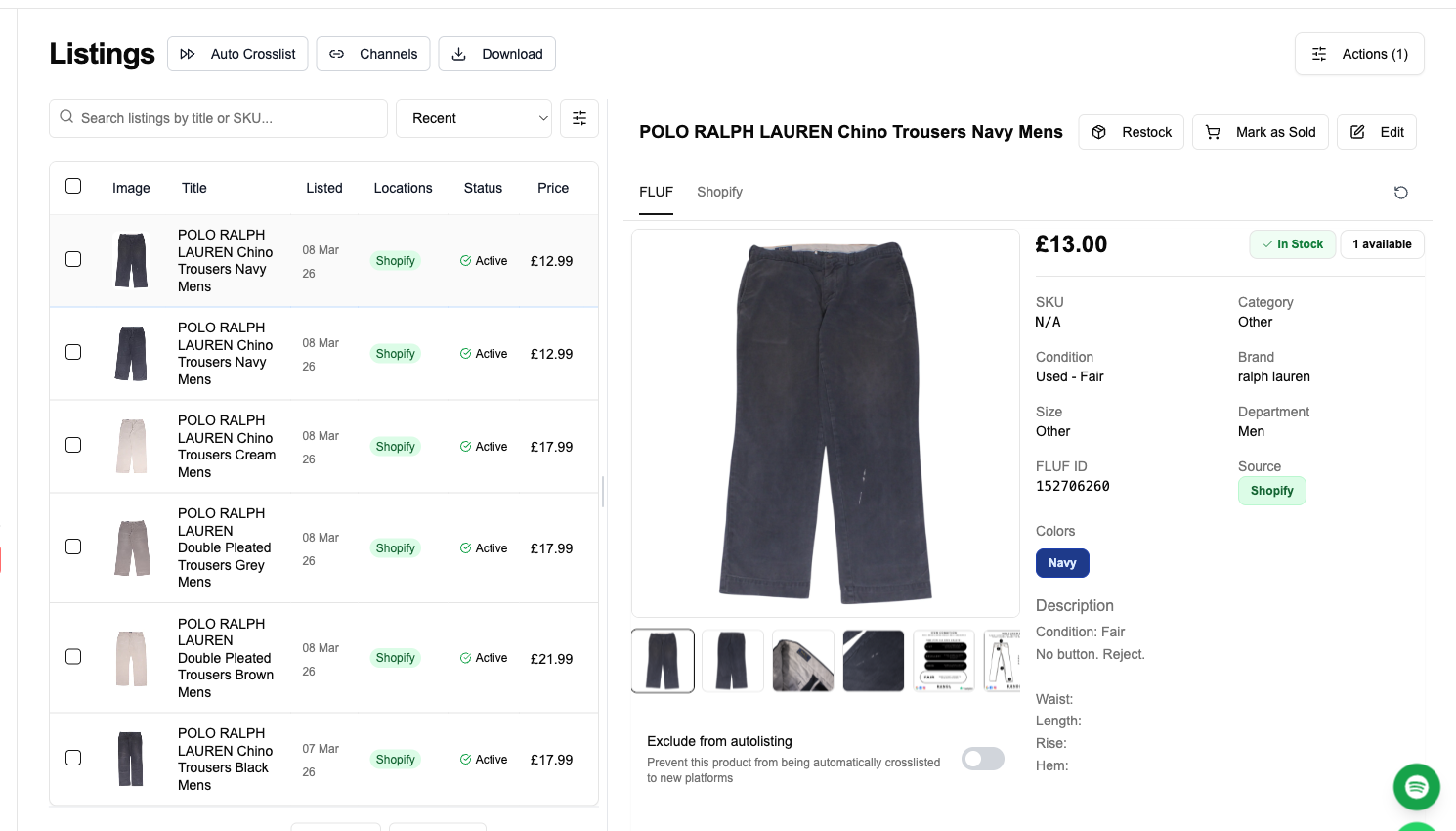
FLUF Connect crosslists Buy It Now listings into Whatnot’s marketplace; you run live shows yourself in the Whatnot app. Review the listing details before publishing. You can crosslist in bulk or set auto-crosslisting rules for qualifying new Designer Wardrobe items.
How FLUF compares to manual crosslisting tools
Generic crosslisting apps do support Whatnot — Vendoo, List Perfectly and Crosslist all name it as a supported channel — but they are built around per-listing or volume-tiered pricing, and their deeper automation often sits behind higher tiers. FLUF Connect bundles crosslisting, inventory sync, order sync and bulk tools into one flat plan. For a Designer Wardrobe seller who wants the listing and the post-listing inventory safety in one place, that is the difference between a copy tool and a selling system. See the crosslisting hub for the full channel matrix.
What Transfers When You Crosslist from Designer Wardrobe to Whatnot?
Designer Wardrobe is fashion-native — it describes items around brand, size, condition and curated categories. Whatnot is a broader marketplace where listings need a category, category-specific attributes and a shipping profile. FLUF Connect carries over the core product data and turns it into a Whatnot-ready draft, then asks you to confirm the destination-specific fields. Think of it as assisted crosslisting rather than a blind one-click mirror.
Field Mapping — Designer Wardrobe to Whatnot
| Designer Wardrobe field | Whatnot field | Transfer | Notes |
|---|---|---|---|
| Title | Title | ✅ Automatic | The core listing title carries across so you are not rewriting the product name. |
| Description | Description | ✅ Automatic | Your source copy is reused and can be tightened for Whatnot’s audience if you want. |
| Photos | Listing photos | ✅ Automatic | FLUF sends your image set through Whatnot’s photo-upload flow. |
| Price | Price | ✅ Automatic | Set to your Whatnot selling currency; sanity-check against Whatnot’s fee model. |
| Quantity | Quantity | ✅ Automatic | Most resale pieces are a single unit, which keeps the linked listings aligned. |
| SKU | SKU | ✅ Automatic | Your internal SKU carries across for matching across channels. |
| Brand | Brand attribute | ⚡ Smart mapped | Pulled from Designer Wardrobe; confirm against Whatnot’s category attributes. |
| Category | Category | ⚡ Smart mapped | Designer Wardrobe’s fashion tree maps to Whatnot’s category taxonomy. |
| Condition | Condition / attribute | ⚡ Mapped | Carried over and checked against the destination category’s requirements. |
| Size / colour | Category attributes | ⚠️ Review recommended | These inform the Whatnot listing but should be confirmed per category. |
| — | Shipping profile | ⚠️ Manual / default | Whatnot requires a shipping profile — set a default once and FLUF applies it across the batch. |
Field references: Designer Wardrobe — how it works, Whatnot — how to list products.
Category Mapping Examples
| Designer Wardrobe category | Whatnot category | Notes |
|---|---|---|
| Womenswear > Dresses | Women’s Fashion > Dresses | Whatnot’s fastest-growing fashion segment; brand and size attributes recommended. |
| Bags & Accessories > Handbags | Women’s Fashion > Bags & Handbags | Confirm brand attribute; high-value pieces benefit from clear condition notes. |
| Shoes > Heels / Sneakers | Women’s or Men’s Fashion > Shoes | Set size attribute and shipping profile before publishing. |
Fields That Need Your Attention
Three friction points are worth knowing before you crosslist a large Designer Wardrobe catalogue:
- Category and attributes. Whatnot’s category choice and category-specific attributes are the part to confirm — FLUF prepares them from your Designer Wardrobe data, but a quick review keeps your listing in the right place and eligible for the right filters.
- Shipping profile. Designer Wardrobe bakes shipping into the listing price (the seller covers postage), while Whatnot uses its own shipping profiles. Set a default profile once in FLUF and it applies across the batch.
- Pricing for two fee models. Designer Wardrobe’s all-in, shipping-included price and Whatnot’s ~11% all-in fee plus separate shipping mean the same target net implies different sticker prices — don’t simply copy the price across.
Inventory Sync Between Designer Wardrobe and Whatnot — What Stays in Sync?
Most Designer Wardrobe inventory is one-of-one. The single biggest risk in selling the same piece on two marketplaces is selling it twice. FLUF Connect prevents that by syncing availability across both channels — both Designer Wardrobe and Whatnot support mark-as-sold, so the delist works in both directions.
| Event | What happens | Timing |
|---|---|---|
| Item sells on Designer Wardrobe | Marked sold / removed from Whatnot automatically | Within minutes |
| Item sells on Whatnot | Marked sold / removed from Designer Wardrobe automatically | Within minutes |
| Price changed in FLUF | Updated on both channels | On next sync |
| Item deleted in FLUF | Delisted from both | Within minutes |
| New Designer Wardrobe listing (auto-rule on) | Crosslisted to Whatnot | Automatically |
Because both Designer Wardrobe and Whatnot report sales back to FLUF, a piece that sells on one is pulled from the other (and any other connected channel) within minutes. You list once and never have to remember to take a sold item down manually.
What to keep in mind: keep the FLUF extension running for Whatnot availability updates. Sync is not instantaneous; check pending sales and listing status in your dashboard.
What doesn’t sync: we keep this honest. Neither Designer Wardrobe nor Whatnot supports automated relisting or offer management through FLUF, so this page does not promise either — those automations are real on other channels (eBay, Vinted, Depop), but not on this pair. And FLUF crosslists into Whatnot’s marketplace as static Buy It Now listings; it does not run live shows for you. Everything that both platforms share — title, description, photos, price, quantity and availability — stays aligned.
Crosslisting from Designer Wardrobe to Whatnot: Before and After FLUF Connect
Without FLUF Connect (manual)
- Open the Designer Wardrobe listing and copy the title and description.
- Download or screenshot every photo.
- Open Whatnot and start a new marketplace listing.
- Re-enter the title and paste the description.
- Upload photos one by one.
- Pick the right Whatnot category from a different taxonomy.
- Fill in the category-specific attributes (brand, size, condition).
- Choose a shipping profile.
- Set the price, accounting for Whatnot’s ~11% all-in fee and separate shipping.
- Publish — then note in a spreadsheet that it’s live on both.
- When it sells, go back to the other platform and mark it sold.
Resellers consistently report manual listing taking around 5–15 minutes per item — before you even account for tracking what’s live where.
With FLUF Connect
- Select the Designer Wardrobe pieces in your FLUF dashboard.
- Click crosslist to Whatnot.
- Confirm the category, attributes and shipping profile.
- Done — availability syncs automatically.
Manual: roughly 15–25 hours of copying, reformatting and tracking. With FLUF Connect: under an hour. That’s most of a working week back to source and photograph instead of retyping listings.
Automation Features for Designer Wardrobe and Whatnot Sellers
Crosslisting is the start. For this particular pair, the automation that earns its keep is everything around keeping both channels accurate — neither Designer Wardrobe nor Whatnot exposes relisting or offer automation through FLUF, so we won’t pretend otherwise. Here’s what genuinely works for a Designer Wardrobe + Whatnot seller.
Cross-channel inventory and order sync
The core automation: when a piece sells on Designer Wardrobe or Whatnot, FLUF marks it sold and removes it from the other within minutes, and records the order so your dashboard reflects sales across both. For one-of-one designer inventory, this is the feature that makes running both channels safe. Learn more on the inventory sync page.
Auto-crosslisting rules
Set a rule once — for example, “every new Designer Wardrobe listing over A$80” — and FLUF crosslists qualifying pieces to Whatnot’s marketplace automatically as you add them, so new inventory reaches Whatnot without extra clicks.
Bulk operations
Bulk crosslist your entire Designer Wardrobe back-catalogue, bulk-adjust prices, and find-and-replace across listings on both channels at once — useful when you want your whole closet on Whatnot in one run.
One dashboard, many channels
The same plan lets you add eBay, Vinted, Depop, Shopify or Etsy alongside Designer Wardrobe and Whatnot, with inventory kept in sync across all of them — and the channels that do support relisting and offers (eBay, Vinted, Depop) get those automations on the same subscription.
| Feature | Designer Wardrobe | Whatnot |
|---|---|---|
| Crosslisting | ✅ | ✅ |
| Inventory sync | ✅ | ✅ |
| Order sync | ✅ | ✅ |
| Mark-as-sold | ✅ | ✅ |
| Auto-relisting | ❌ | ❌ |
| Offer management | ❌ | ❌ |
| Bulk operations | ✅ | ✅ |
What’s different about selling on Whatnot vs Designer Wardrobe
Designer Wardrobe sellers moving onto Whatnot meet a different set of platform mechanics, and knowing them helps your crosslisted pieces actually surface and sell:
- Live shows drive discovery. Whatnot’s main “For You” feed is built around live shows, so Buy It Now marketplace listings typically get less traffic than items shown live (Whatnot — discoverability). Crosslisting publishes the listing; running a show yourself is what supercharges it. FLUF keeps the inventory in sync either way.
- Listings perform best paired with shows. Whatnot reports that sellers who feature at least three Buy It Now items during a live show earn roughly 2x more per hour, with about 40% of sales coming from those listings (Whatnot — Product Spotlight). Your FLUF-crosslisted Buy It Now items are exactly what you feature in a show.
- Flat fee model. Whatnot charges roughly 8% commission plus 2.9% + $0.30 processing — about 11% all-in on a typical fashion item — with no listing fees (Voolist). That is a simpler model than Designer Wardrobe’s tiered success fee, but the bases differ, so price each channel separately.
- Currency. Designer Wardrobe settles in AUD or NZD; Whatnot lists in your seller currency. Set your Whatnot price deliberately rather than copying your Designer Wardrobe figure across.
How Much Does It Cost to Crosslist from Designer Wardrobe to Whatnot?
FLUF Connect charges a flat monthly subscription — there is no per-sale commission on top of each marketplace’s own fees.
| Plan | Monthly | Crosslisted products |
|---|---|---|
| Starter | £9/month | Unlimited |
| Seller | £29/month | Unlimited |
| Pro | £99/month | Unlimited |
| Super Seller | Custom pricing — tell us what you need | Unlimited |
Plans start at £9/month (Starter); There is no free plan, but every new account gets a 7-day trial for £1. Every plan includes crosslisting, inventory sync, order sync and bulk tools across all supported channels — not just Designer Wardrobe and Whatnot — so you can add eBay, Vinted, Depop or Shopify on the same plan. The automations are part of the subscription, not paid add-ons. See the full pricing page.
Start crosslisting from Designer Wardrobe to Whatnot
Move your Designer Wardrobe closet onto Whatnot’s fast-growing fashion audience — and keep both in sync automatically.
Sources & Verification
- Designer Wardrobe members & milestone: Scoop (Sept 2025); Designer Wardrobe — how it works
- Designer Wardrobe fees & currency: DW fees; card fee; currency
- Whatnot GMV & growth: Sacra; Whatnot 2026 trends
- Whatnot fees: Voolist; Whatnot seller fees
- Whatnot listings & discoverability: how to list; discoverability; Product Spotlight
- Manual listing time: Vendoo
Related guides
Frequently Asked Questions
FLUF Connect plans start at £9/month (Starter). There is no free plan, but every new account gets a 7-day trial for £1. Every plan includes crosslisting, inventory sync, order sync and bulk tools across all supported channels, so you can connect more marketplaces than just Designer Wardrobe and Whatnot on the same plan. You still pay each marketplace's own selling fees.
No. FLUF crosslists static Buy It Now listings into Whatnot's marketplace — it does not host live auction shows on your behalf. You run live shows yourself in the Whatnot app whenever you choose. FLUF keeps the underlying inventory published and in sync, so a piece can appear as a Buy It Now listing and feature in a show you host without you risking overselling.
Yes. When a piece sells on Designer Wardrobe it is marked sold and removed from Whatnot automatically, and when it sells on Whatnot it is removed from Designer Wardrobe — both within minutes. Because most Designer Wardrobe inventory is one-of-one, this is the feature that stops you accidentally selling the same item twice.
FLUF carries over title, description, images, price, quantity and SKU automatically, and maps brand, category and condition into Whatnot's structure. Whatnot's category choice, category-specific attributes and shipping profile are flagged for you to confirm before publishing, so it is assisted crosslisting rather than a blind one-click mirror.
Whatnot charges roughly 8% commission in the US, Canada and Australia (6.67% + VAT in the UK and EU) plus a 2.9% + $0.30 payment processing fee, which works out to about 11% all-in on a typical fashion item. There are no listing fees, and fees are the same whether you sell through a live show or a static Buy It Now listing.
Whatnot lists in your seller currency, so set your Whatnot price deliberately rather than copying your AUD or NZD figure straight across. The fee bases and shipping treatment differ too: Designer Wardrobe bakes shipping into the price, while Whatnot uses its own shipping profiles, so price each channel against its own model.
Once both accounts are connected, selecting pieces and crosslisting takes seconds, and listings appear on Whatnot's marketplace within minutes. You can crosslist your whole Designer Wardrobe back-catalogue in a single bulk run rather than one item at a time.
Whatnot requires the FLUF browser extension. Follow the connection prompts for Designer Wardrobe and Whatnot, then manage crosslisting from your FLUF Connect dashboard.
Yes. The same FLUF Connect plan lets you crosslist from Designer Wardrobe to Whatnot, eBay, Vinted, Depop, Shopify and other supported marketplaces simultaneously, with inventory kept in sync across all of them. Channels that support relisting and offers, such as eBay and Vinted, gain those automations on the same subscription.