Crosslist from Facebook Marketplace to Grailed — Stop Selling Designer Gear Local
That Rick Owens jacket getting lowballed on local Facebook Marketplace would sell for more to Grailed's global, brand-literate buyers. Crosslist it and stop leaving money on the table.
7 days for £1, then from £9/month.



TL;DR: If you sell designer or streetwear on Facebook Marketplace, your buyer pool is whoever can drive to you — and they lowball, because local buyers do not know or care what your piece is worth. Grailed is the opposite: a curated marketplace where a global, brand-literate audience recognises the label and pays for it. FLUF Connect crosslists your Marketplace listings to Grailed automatically, and marks an item sold across both when it goes, so you never sell the same piece twice. Stop accepting local lowballs on items collectors would pay full price for. Plans start at £9/month for the Starter plan (unlimited listings); crosslisting is included in every plan.
Selling a genuine designer or streetwear piece on Facebook Marketplace is often a frustrating experience, and the reason is structural. Facebook Marketplace is a local, general-purpose marketplace: your listing is shown mostly to people within driving distance, almost none of whom are looking specifically for what you have, and many of whom will message to offer half your asking price because to them a Rick Owens jacket and a generic coat look the same. That is fine for a sofa or a lawnmower. It is a terrible way to sell something whose value lives entirely in a brand and a story that a casual local buyer does not recognise. Grailed exists precisely for those items — a curated peer-to-peer marketplace for designer, streetwear and archive fashion, with an audience that knows exactly what your piece is and what it trades for. FLUF Connect lets you list to both at once, so the same item that gets lowballed locally simultaneously reaches the buyers who will pay what it is actually worth.
Why local Facebook Marketplace underprices designer gear
The lowball is not bad luck; it is what a local audience does to a brand-dependent item. On Facebook Marketplace, demand for any specific designer piece is thin — in your town there may be a handful of people who recognise the label and almost none who want that exact item in that exact size right now. With thin local demand, the price falls to whatever the nearest casual buyer will pay, which is usually well below market. Grailed inverts the maths. Its demand is deep across a global audience: for any given grail there may be only a few buyers in your city but hundreds worldwide, and Grailed is built to put your listing in front of all of them at once. Its traffic is heavily concentrated among serious buyers — around two-thirds of Grailed’s visits come from the United States, in the 25–34 fashion-enthusiast bracket — and those buyers arrive specifically hunting brands. Grailed’s own 2025 report had Chrome Hearts, Balenciaga, Rick Owens, Supreme and Nike topping its sales (WWD / Footwear News), with individual sales of the rarest pieces running into five figures. That is the gap between a local-radius audience and a global brand-literate one — and it is money you are currently leaving on the table.
Authentication is why Grailed buyers pay more
There is a second reason Grailed prices beat local ones: trust. On Facebook Marketplace a buyer of a designer item has no protection against fakes beyond their own eye, so cautious buyers either avoid high-value designer purchases or price in the risk by offering less. Grailed runs authentication and curation designed to keep counterfeits out, which is exactly why its buyers are willing to pay designer prices to a stranger online (Grailed’s legitimacy and authentication). For an honest seller of genuine product, that bar works entirely in your favour: it removes the fake-risk discount that drags down prices on unverified local platforms, and lets your real piece be valued as the real thing. You provide clear photos and accurate details; the platform’s trust framework does the rest, and the buyer pays accordingly.
How crosslisting from Facebook Marketplace to Grailed works
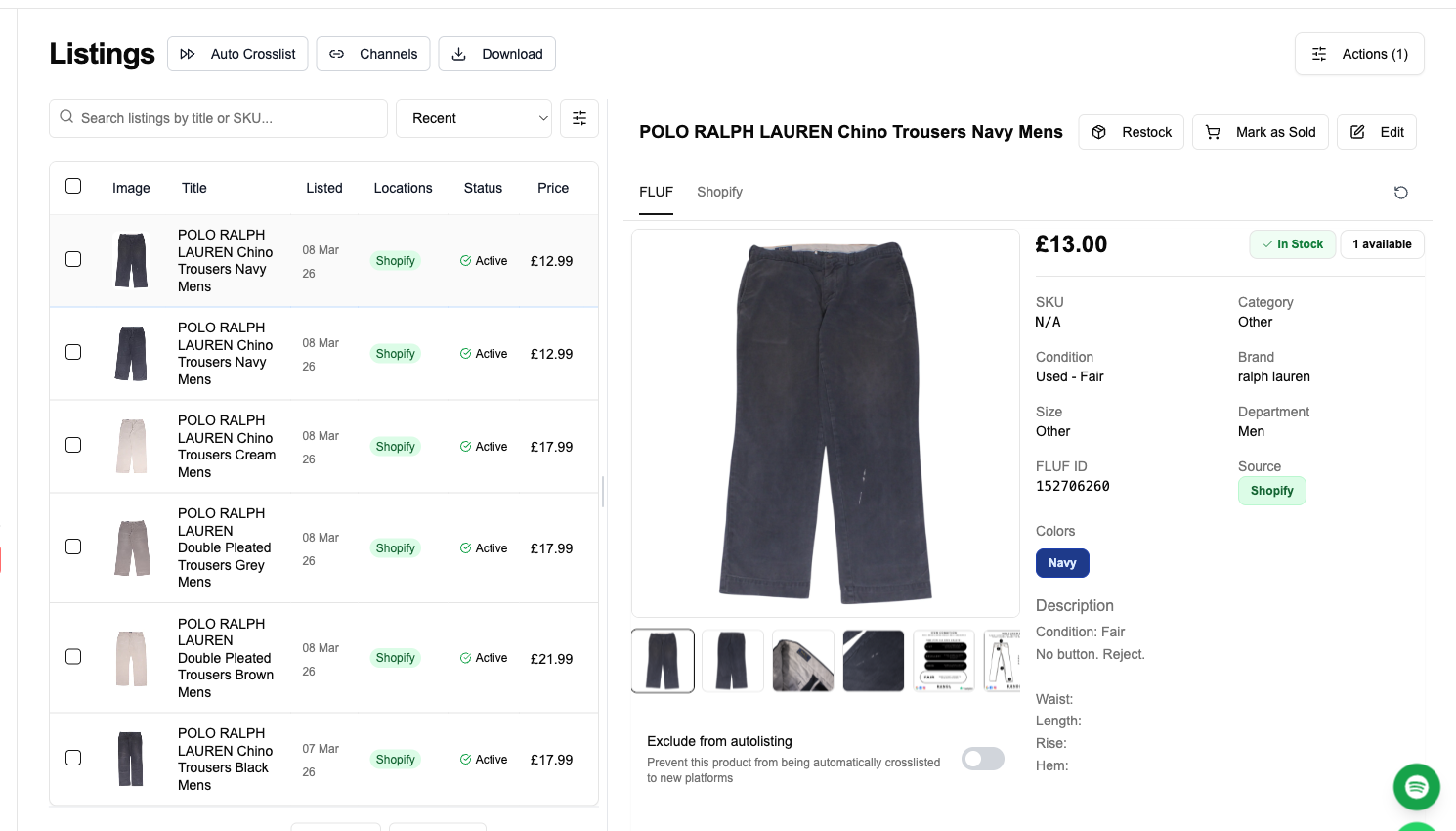
FLUF Connect runs both listings from one place:
- Connect your accounts. Link Facebook Marketplace and Grailed once.
- Pick the items worth crosslisting. Send Grailed the designer, streetwear and archive pieces its audience hunts — not your whole local listing set.
- Publish to both. FLUF carries photos, title, description, size and price across and creates the Grailed listing alongside your Marketplace one.
- Sell once, sold everywhere. When the item sells on either Grailed or Facebook Marketplace, FLUF marks it sold on the other so you never double-sell the same piece.
That sold-status sync is the piece that makes running both safe. Most designer resale items are one-offs — a single jacket, a single pair — so the real risk of listing in two places is selling the same unique item twice and having to disappoint a buyer. FLUF closes that gap automatically, and it is included in every plan, not a paid add-on.
What to crosslist — and what to keep local
Not everything belongs on Grailed, and sending it the wrong items wastes the channel. Grailed is for designer, archive and hyped streetwear — the labels collectors search for, where brand and rarity carry the price. Generic clothing, fast fashion and non-fashion items have no audience there and should stay on Facebook Marketplace, which is genuinely the better venue for bulky, local or non-branded goods that sell on convenience rather than label. The skill is sorting your inventory: the branded, collectible pieces go to Grailed’s global buyers; the everyday and the local-only stay on Marketplace. Because Grailed charges no listing fee — you only pay when an item sells (Grailed seller fees) — there is no cost to testing which of your pieces find a buyer there.
Grailed’s fees versus a local sale
Facebook Marketplace local sales are free, which sounds unbeatable until you account for the price you actually achieve. Grailed charges a commission — 9% on items of $120 and above, 6% (minimum $1.99) under $120, plus payment processing around 3.49% + $0.49 domestically — but it charges that on a price set by a global market that knows what your piece is worth. The honest comparison is not “free versus 9%”; it is “the full local lowball, minus nothing” against “the real market price, minus roughly 12% in fees.” For a piece that sells for half its value locally, the fee on the higher Grailed price is trivial next to the extra you net. For a genuinely common item with no brand premium, the local free sale may win. Knowing which is which — and crosslisting so the market decides — is the whole point.
| Facebook Marketplace | Grailed | |
|---|---|---|
| Reach | Local, driving distance | Global, US-heavy |
| Buyer knowledge | Casual; lowballs brands | Brand-literate; pays for labels |
| Authentication | None — fakes risk discounts price | Curated and authenticated |
| Fees | Free locally | No listing fee; commission on sale |
| Best for | Bulky, local, non-branded goods | Designer, streetwear, archive grails |
Let the market set the price, not the nearest buyer
The deepest shift in moving a piece from Facebook Marketplace to Grailed is who sets the price. On a local platform the price is anchored to whoever happens to be nearby and interested — often one or two casual buyers whose offers have nothing to do with what the item is actually worth, only with what they personally feel like paying today. That is not price discovery; it is whoever shouts a number first. On Grailed, the price is anchored to a global market that has seen the piece before and knows its going rate, because those buyers track sold listings and comparable items obsessively. For a seller, that means you stop guessing and stop accepting the first lowball out of impatience. You can list at a fair market price, see genuine interest from people who understand the item, and accept or counter offers from buyers who are negotiating around real value rather than trying to flip you for a quick local resale. For anything with a brand premium, having the market — rather than your neighbour — decide the price is worth far more than the small commission Grailed takes for providing that market.
Patience pays where a local meet-up pressures you
Local selling runs on urgency. A Facebook Marketplace listing that has sat for a week feels stale, the messages dry up, and the temptation is to drop the price just to be rid of it — selling at a loss to escape the friction. Grailed removes that pressure entirely. Because there is no listing fee, a piece can stay live indefinitely at a fair price while the right buyer, somewhere in the world, finds it. Designer and archive pieces in particular often sell to a specific collector who has been searching for exactly that item in exactly that size, and that buyer might appear in a day or in two months — but when they do, they pay properly. The crosslisting model lets you keep the item listed locally for a fast convenience sale while it simultaneously waits on Grailed for the buyer who values it most, and FLUF’s sold-status sync means whichever sells first cleanly removes the other. You are no longer forced to choose between a quick cheap local sale and a patient full-price one; you run both and take whichever comes through.
Building a seller reputation that compounds
One thing a local sale never gives you is a track record. Every Facebook Marketplace deal is a one-off between strangers, and your tenth sale is no easier than your first. Grailed, like most structured marketplaces, builds seller standing over time: accurate descriptions, honest condition notes, prompt shipping and good communication earn you a reputation that makes future buyers more comfortable paying up. For anyone who sells designer pieces regularly — the reseller, the serial flipper, the enthusiast constantly cycling their wardrobe — that compounding trust is a real asset, turning what was a series of disconnected local transactions into a growing presence buyers recognise. Crosslisting from Facebook Marketplace is how you start building that standing on the platform where it is worth the most, while still using Marketplace for the quick local sales that do not need it.
From cash-in-hand to a global buyer
There is also a practical shift in how the sale happens, and it is mostly an upgrade. A Facebook Marketplace sale is a local meet-up: messaging, arranging a time, cash in hand, the occasional no-show. A Grailed sale is a structured online transaction — the buyer pays through the platform, you ship, and the funds are handled by Grailed rather than negotiated in a car park. For designer pieces, shipping is rarely an obstacle: these are small, valuable, postable items, which is exactly the kind of thing a structured marketplace handles best. You trade the friction of local meet-ups for the reach of a global audience and the reliability of platform payments, and for high-value items that trade is almost always worth making. Keeping Marketplace active for the local, bulky and non-branded items means you get the best of both: local convenience where it helps, global reach where it pays.
Who this is for
This is for anyone selling genuine designer, streetwear or archive fashion on Facebook Marketplace and watching it get lowballed — the reseller flipping grails, the enthusiast clearing a wardrobe of real labels, the local seller who keeps thinking “this is worth more than anyone here will pay.” It usually is, and Grailed is where the people who will pay it are. If your inventory is everyday clothing or non-fashion goods, Marketplace alone is the right tool. But if you hold brand-name pieces that deserve a buyer who knows their value, crosslisting from Facebook Marketplace to Grailed reaches that buyer — and FLUF Connect makes listing to both, safely, a single step.
The reason this is not something most local sellers already do is simply effort: maintaining the same items across two very different platforms by hand, and remembering to pull a listing the moment it sells elsewhere, is more hassle than it seems worth — until a few lowballed grails make the case. Crosslisting removes the hassle. You list once, choose the pieces that belong on Grailed, and let FLUF handle the second listing and the sold-status sync. There is no second app to babysit and no risk of an embarrassing double-sale. What changes is not just where your items appear but whether reaching a better-paying audience is worth your time at all — and once it costs you almost nothing, the answer for designer pieces is clearly yes. The jacket that has been getting £40 offers locally can be in front of the global buyers who pay full price by the end of the same afternoon you list it.
Sources & Verification
- Grailed audience & US traffic skew: Similarweb — grailed.com.
- Grailed top-selling brands & high price ceilings (2025): WWD / Footwear News — Grailed marketplace report.
- Grailed authentication / legitimacy: Is Grailed legit (2026).
- Grailed seller fees: Grailed — What are the fees.
Frequently Asked Questions
Two reasons: audience and trust. Facebook Marketplace shows your item to a thin, local, mostly casual audience that lowballs brands it does not recognise. Grailed puts it in front of a global, brand-literate audience actively hunting designer and streetwear, and its authentication removes the fake-risk discount that drags down prices on unverified platforms — so buyers pay real market prices.
Yes. Most designer resale pieces are one-offs, so the main risk of listing on both Grailed and Facebook Marketplace is a double-sale. FLUF Connect marks an item sold on one platform when it sells on the other, automatically, so you never sell the same unique piece twice. This is included in every plan.
Bulky, local and non-branded goods — furniture, household items, generic clothing — sell better on Facebook Marketplace, where convenience and local pickup matter more than brand. Reserve Grailed for designer, streetwear and archive pieces whose value comes from the label.
Grailed has no listing fee — you only pay on a sale. Commission is 9% on items of $120 and above and 6% (minimum $1.99) under $120, plus payment processing of around 3.49% + $0.49 for domestic US sales. That commission applies to a price set by a global market, which for branded pieces is usually well above a local lowball.
Yes — Grailed is a structured online marketplace where the buyer pays through the platform and you ship the item. Designer pieces are small and postable, so shipping is rarely an obstacle, and you trade the friction of local meet-ups for global reach and platform-handled payments.
FLUF Connect plans start at £9/month on Starter, with Seller at £29/month and Pro at £99/month; every plan is unlimited on listings and marketplaces, and the tiers differ by which automations they include and how often we check your channels for sales. Crosslisting and the sold-status sync are included in every plan, not charged as add-ons.