
Temu to Shopify — Build Your Own Store and Keep Selling Everywhere
Why Temu sellers build their own Shopify store, and how to run your store and marketplaces together with FLUF Connect.



Short version: If you sell on Temu, you don’t own your customers, your pricing or your brand — Temu does. Building your own Shopify store flips that: your domain, your branding, your customer email list, your margin. The smart play isn’t to abandon marketplaces; it’s to make your Shopify store the hub and keep selling across channels. FLUF Connect brings your Temu catalogue into one place and crossposts it to Shopify and other marketplaces, with inventory kept in sync. Plans start at £9/month; There is no free plan, but every new account gets a 7-day trial for £1.
Temu is one of the fastest-growing marketplaces in the world, but for a seller it’s a hard place to build anything lasting. Temu controls the traffic, sets pricing pressure, and keeps the customer relationship. A Shopify store is the opposite: a storefront you own outright. This guide explains why Temu sellers move to owning their store, what Shopify actually gives you, the honest trade-offs around traffic and marketing, the practical mechanics of moving your catalogue across, and how FLUF Connect lets you run both at once instead of choosing between reach and ownership.
Why move from Temu to your own Shopify store?
Temu, owned by PDD Holdings, is an ultra-low-cost cross-border marketplace that launched in the US in late 2022 and now reaches well over a hundred million monthly users in the EU alone. Its seller programs range from fully-managed consignment — where Temu sets the retail price and controls customer service, returns and delivery — to semi-managed and local-seller models. In every version, the platform keeps what makes a marketplace valuable: the traffic, the transaction data, and the customer. There’s no way to build an email list, and listings that don’t meet Temu’s aggressive price thresholds get buried.
That creates four problems your own store solves:
- You don’t control margin. Marketplaces reward the lowest price; a race to the bottom is structural. On your own store you set branded pricing.
- You don’t own the customer. On Shopify you keep customer names, email addresses and purchase history — for retargeting, email marketing and repeat sales.
- You don’t control the brand. Marketplace listings are constrained by formatting rules; your own store presents products exactly how you want.
- You carry platform risk. Suspensions can happen fast and appeals are slow; an owned channel diversifies that risk.
This isn’t a reason to leave marketplaces entirely — they bring volume and discovery you’d otherwise pay for. The recommended posture is to use marketplaces for reach and build the owned store for margin and relationships, then optimise the mix.
What Shopify gives you that Temu can’t
| Temu (marketplace) | Shopify (your store) | |
|---|---|---|
| Traffic | Built-in — but you don’t control it | You drive it (SEO, social, email, ads) |
| Pricing | Algorithm-driven, race to the bottom | You set branded pricing and margin |
| Customer data | Belongs to Temu | Yours — names, emails, purchase history |
| Branding | Constrained listing format | Full control of storefront and domain |
| Cost model | Per-sale commission / price pressure | Predictable monthly subscription |
| Email marketing | Not possible | Built-in (Shopify Email, abandoned-cart recovery) |
Concretely, Shopify gives you a custom domain, full theme and branding control, built-in SEO tools (editable title tags and meta descriptions, image alt text, an auto-generated sitemap and a built-in blog), email capture with Shopify Email (a monthly send allowance is included), and native abandoned-cart recovery — all from one admin that can also push to social and other sales channels. At the time of writing Shopify’s plans start at around $5/month for the entry Starter plan, with Basic around $39/month; using Shopify Payments waives third-party transaction fees on orders. Check shopify.com/pricing for current figures in your region.
The honest trade-off
Be clear-eyed about the catch: your own Shopify store has no built-in audience. Temu hands you shoppers; Shopify hands you a storefront and the job of bringing people to it through SEO, social media, email and ads. That’s doable without paid advertising, but it takes time and consistent marketing. This is exactly why the goal is not to switch off Temu on day one — it’s to keep marketplace volume flowing while you build the owned channel that compounds.
Run your store and your marketplaces from one place. FLUF Connect keeps your catalogue and inventory in sync across Shopify and every channel you sell on.
Moving your catalogue: the practical mechanics
One honest constraint up front: Temu exposes no public product or order API and has no first-party Shopify app, so there’s no one-click “import from Temu” button. Moving your catalogue means rebuilding it in Shopify from your own product data — which is straightforward if you already have your images and details:
- Shopify’s native bulk import is CSV (Products → Import). Only the product Title is strictly required, and there’s an option to overwrite products with matching handles for updates.
- Images go in by public URL — Shopify downloads and re-hosts each one on its own CDN during import, so host them somewhere public first if they aren’t already.
- Reprice for your brand. Temu’s prices rest on razor-thin, reverse-auction economics; on your own store you set a sustainable, branded markup.
- Plan fulfilment. If you used Temu’s fully-managed model, Temu handled logistics; on your own store fulfilment is yours — self-ship, a 3PL, or print-on-demand.
Setting up your store the right way
Building a Shopify store that can actually carry sales takes more than importing products. A sensible first pass covers the foundations that turn browsers into buyers:
- Domain and branding. Connect a custom domain and pick a clean theme — your store should look like a brand, not a marketplace stall.
- Product pages that sell. Rewrite the thin, keyword-stuffed copy typical of marketplace listings into proper product descriptions, with your own photography where you can.
- Payments and shipping. Turn on Shopify Payments to avoid third-party transaction fees, and set clear, realistic shipping options.
- Email capture from day one. Add a sign-up incentive and start collecting addresses immediately — that list is the asset Temu never let you build.
- Basic SEO. Use Shopify’s editable title tags and meta descriptions, add alt text to images, and start a simple blog to earn search traffic over time.
Then plan your traffic. Because a new store has no built-in audience, decide early how you’ll bring people in: organic search and content, social media and short-form video, an email list, and — once you understand your margins — paid ads. The sellers who succeed off-marketplace treat traffic as the core job, not an afterthought.
Common mistakes when leaving a marketplace
A few predictable errors trip up sellers making this move. The first is going all-in too fast — switching off marketplace listings before the store has traction, and losing the volume that funded the transition. The second is carrying marketplace pricing straight across, which leaves no margin to invest in marketing or brand. The third is underestimating the marketing workload and expecting a quiet store to sell itself. The antidote to all three is the same: keep selling on marketplaces while you build, price for a real margin, and run everything from one dashboard so the extra channel doesn’t mean extra hours.
Where FLUF Connect fits
FLUF Connect’s job is to remove the repetitive part of multi-channel selling so your owned store and your marketplaces stay aligned:
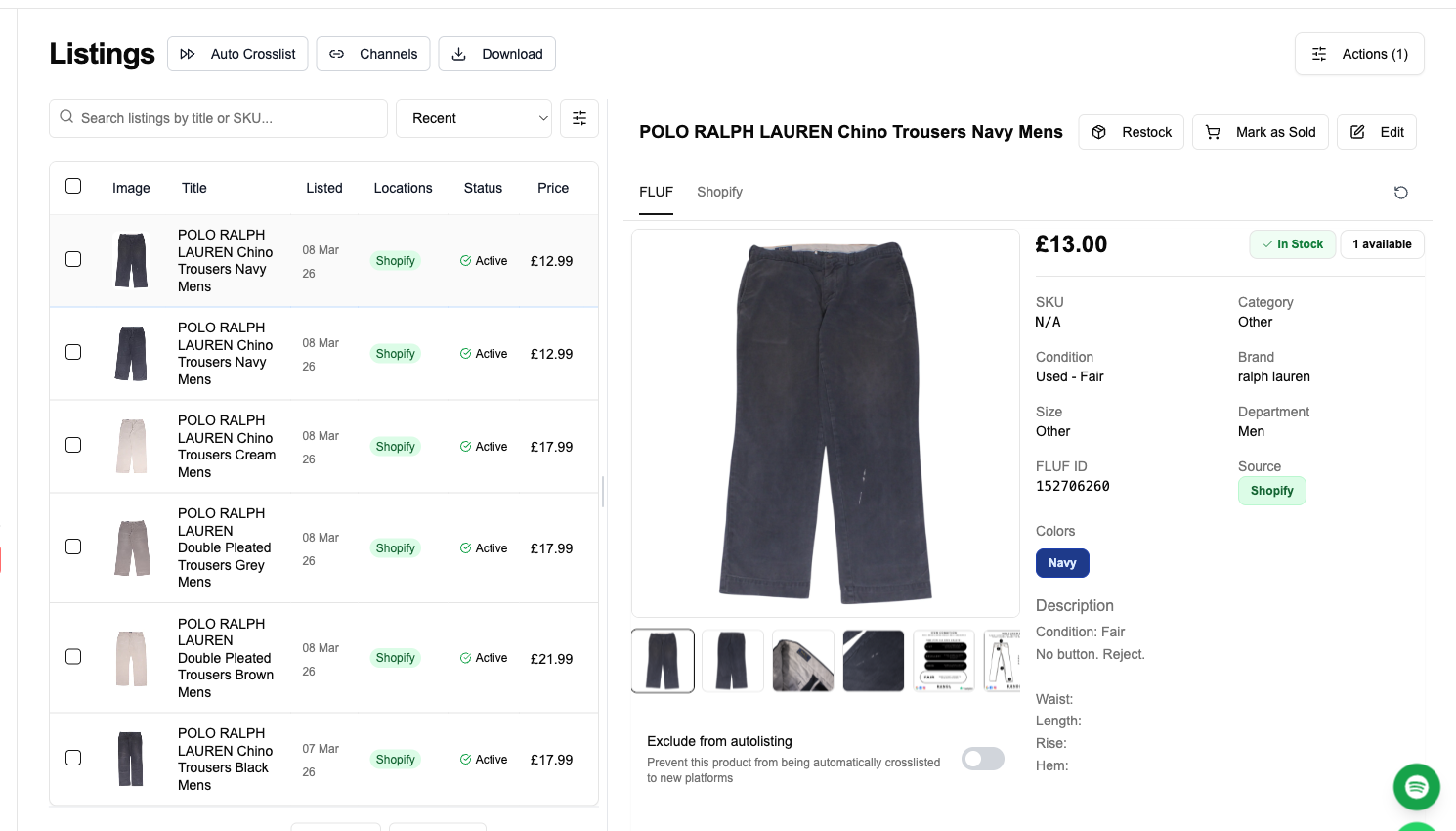
- One catalogue, many channels. Bring your listings into FLUF and crosspost them to your Shopify store and other marketplaces from a single dashboard, instead of rebuilding each listing per platform.
- Inventory and order sync. Shopify is a full FLUF channel with order sync and sold-status handling, so when an item sells in one place it updates across the others and you avoid overselling.
- Shopify as the hub. Treat your store as the home of your catalogue and your customer relationships, with marketplaces as additional reach — exactly the “use both” strategy that protects you from being locked into any one platform.
- Less manual work. Build a listing once and publish it across channels, rather than rekeying every product into every platform by hand — the repetitive task that makes most sellers give up on multi-channel selling.
Crosslisting, inventory sync and automation are included in every FLUF plan, not a paid add-on. Plans start at £9/month (Starter); There is no free plan, but every new account gets a 7-day trial for £1.
Is the monthly cost worth it? For a seller serious about building something lasting, the predictable subscription of a Shopify plan is usually money better spent than the per-sale economics and price pressure of a marketplace — because what you’re buying isn’t just a storefront, it’s ownership of your brand, your margins and your customer list. The break-even isn’t only about fees; it’s about the lifetime value of customers you can email and re-sell to, which a marketplace never lets you reach. That said, the cost only pays back if you drive traffic, so treat the subscription as the price of admission and your marketing effort as the real investment.
It’s worth being realistic about the shape of this transition. Most sellers don’t flip from Temu to Shopify overnight; they build the store quietly, point early traffic at it, learn what their margins and customer acquisition actually look like, and let the owned channel grow alongside their marketplace sales until it can stand on its own. That measured approach is far less risky than betting the whole business on a single launch — and it’s only practical if your catalogue and inventory stay consistent across every place you sell. Keeping one source of truth for products and stock, and syncing it outward to Shopify and the marketplaces, is the operational backbone that makes “sell everywhere, own your store” workable rather than a second full-time job.
Understanding Temu’s model before you decide
It helps to be precise about what kind of seller you are on Temu, because it shapes how much you stand to gain from your own store. Temu’s programs sit on a spectrum. In the fully-managed (consignment) model, you ship inventory to Temu and the platform controls pricing, customer service, returns, packaging and last-mile delivery — you’re effectively a supplier, with little say over how your brand is presented or priced. The semi-managed model, introduced in 2024, lets you hold local inventory and handle delivery while Temu still controls traffic, promotion and after-sales. A local seller program now operates across dozens of markets, opening the platform to US- and EU-based sellers rather than only cross-border ones.
In every version, the trade is the same: Temu provides demand, and in exchange keeps control of the things that build a durable business — the customer relationship, the pricing, and the data. The more managed your setup, the less brand equity you’re building for yourself, and the stronger the case for an owned storefront alongside it.
The 2025 context that pushed sellers to diversify
There’s a timely reason this conversation intensified. In 2025, the long-standing US “de minimis” exemption that let low-value parcels enter duty-free was eliminated — the China-to-US exemption ended on 2 May 2025, with a broader suspension following. Temu responded by shifting US orders to locally based sellers fulfilling from US warehouses and recruiting US sellers, before later resuming some direct-from-China shipping after a trade truce. The episode eroded Temu’s core price advantage and slowed its US growth, and it was a sharp reminder to sellers of how exposed a single-marketplace business is to policy changes entirely outside their control. An owned Shopify store doesn’t make those risks disappear, but it gives you a channel that no marketplace policy can switch off.
What “owning your store” actually buys you
The benefits of a Shopify store are concrete, not abstract:
- A customer list you can market to. Every order on your store gives you a customer email and history. That list is an asset you own — for repeat sales, launches and retargeting — and it’s something a marketplace will never hand over.
- Pricing power. Off the marketplace price war, you set margins that let you reinvest in product, photography and marketing.
- Brand and SEO. Your own domain, storefront design, product pages, blog and editable metadata mean you can rank in search and build recognition that compounds over years.
- Resilience. If a marketplace suspends you or changes its rules, your store keeps trading.
The honest counterweight, again, is traffic: a marketplace lends you an audience, and a store asks you to earn one. That’s why the realistic plan is to keep marketplace volume flowing while your store grows — and to manage all of it from one place so the work doesn’t double.
How to go from Temu to Shopify with FLUF Connect
- Set up your Shopify store — domain, theme and Shopify Payments.
- Build your catalogue in Shopify from your own product data (CSV import, images by URL), repriced for your brand.
- Connect Shopify to FLUF Connect and crosspost your catalogue out to marketplaces.
- Keep everything in sync — inventory and sold status update across channels from one dashboard.
Related guides
- Sell on Shopify — seller guide
- Sell on Temu — seller guide
- Crosslist from Shopify to Temu
- Crosslist from Shopify to eBay
- Crosslist from Temu to eBay
Sources & Verification
Facts were verified against primary and reputable sources in June 2026, including:
- Shopify — plan pricing and CSV product import.
- Temu DSA transparency report — Temu / PDD Holdings background and EU monthly-active figures.
- eMarketer — Temu seller experience and pricing pressure.
- Shopify — marketplace vs your own store.
Frequently Asked Questions
Not directly — Temu has no public product or order API and no first-party Shopify app, so there's no one-click import from Temu. You rebuild your catalogue in Shopify from your own product data (Shopify's CSV import, with images added by URL). FLUF Connect then keeps that catalogue in sync across Shopify and your other marketplaces.
At the time of writing, Shopify's plans start at around $5/month for the entry Starter plan, with Basic around $39/month, and using Shopify Payments waives third-party transaction fees on orders. Check shopify.com/pricing for the current figures in your region.
The usual advice isn't to abandon marketplaces but to add your own store. Marketplaces like Temu bring volume and discovery; a Shopify store gives you margin, branding and ownership of customer data. Run both — use Temu for reach while you build the owned channel that compounds.
No — this is the honest trade-off. Temu hands you shoppers; Shopify hands you a storefront and the job of driving traffic through SEO, social, email and ads. It works, but it takes time and consistent marketing, which is why keeping marketplace sales running matters while you grow your store.
Yes. Shopify is a full FLUF Connect channel with order and inventory sync. Bring your catalogue into FLUF, crosspost it across channels, and when an item sells in one place the stock updates across the others so you don't oversell.