Crosslist from Vinted to WooCommerce — Build a WordPress Store You Own
Graduate from casual Vinted selling to a WooCommerce store on WordPress — own your customers, your brand and everything you sell.
7 days for £1, then from £9/month.



TL;DR: FLUF Connect reads your Vinted listings and rebuilds them inside WooCommerce — the WordPress e-commerce plugin millions of stores run on. Photos, titles, descriptions, prices, sizes and stock transfer automatically, and stock stays in sync so an item never sells twice. This is the graduation path for Vinted sellers who have outgrown wardrobe-clearing and want a real brand on a domain they own — one that can sell anything, not just secondhand fashion, and that captures the customer Vinted keeps for itself. Plans start at £9/month (Starter); the cheapest plan is £9/month.
Vinted is where a lot of sellers start, and for good reason. It is built for clearing a wardrobe: list in seconds, pay nothing to sell, and reach an enormous European audience — the platform reported €10.8 billion in GMV and €1.1 billion in revenue for 2025, operating across more than 26 markets. But the very things that make Vinted a frictionless place to start become limits once you are selling seriously. There is no storefront, no customer list, no analytics, and the catalogue is fenced to pre-owned fashion. A WooCommerce store is the other side of that wall: WooCommerce is the open-source e-commerce plugin for WordPress, powering roughly 6.16 million live sites as of August 2025, and it gives you a branded shop on your own domain where you own the data, the margin and the customer relationship. FLUF Connect is the bridge — the FLUF Connect plugin for WooCommerce that recreates your Vinted catalogue inside WordPress without retyping a single listing.
The direction is the point. Crosslisting from Vinted to WooCommerce is a graduation, not a sideways move: Vinted has been your proving ground, and you are now carrying that catalogue into a store that belongs to you. Where the reverse flow is about borrowing Vinted’s reach, this flow is about building something Vinted structurally cannot give you — ownership.
The Vinted paradox: free to sell, impossible to own
Vinted’s headline advantage is real and worth stating plainly: sellers pay no listing fee and no selling commission — you keep your full asking price, and the buyer pays a separate Buyer Protection fee at checkout instead. For a casual declutterer that is unbeatable. The catch is what that model withholds. Because Vinted takes nothing from you, it gives you nothing to build on: no storefront you control, no email list, no brand, no buyer relationship. Every sale is anonymous and belongs to Vinted. You cannot email a past buyer, cannot retarget, cannot build a collection or a loyalty habit. The platform’s whole design routes the customer back to Vinted, not to you.
That Buyer Protection fee is also a quiet tax on your conversion. Vinted adds it on top of your price — commonly a small fixed amount plus a percentage, varying by country — so the figure your buyer actually pays is always higher than the number you set. On your own WooCommerce store there is no platform-imposed buyer surcharge: you control the checkout, set your own prices and returns policy, and the price the shopper sees is the price you chose. You pay only your payment processor (WooCommerce itself takes a 0% revenue share; processing through WooPayments runs about 1.5%–2.9% depending on country and card). The economics are not “Vinted charges sellers too much” — it does not. They are “Vinted owns the relationship, and a WooCommerce store lets you own it instead.”
Vinted and WooCommerce, side by side
| Vinted | WooCommerce (on WordPress) | |
|---|---|---|
| Seller fees | None — you keep your price | None to the platform; payment processing only (~1.5–2.9%) |
| Buyer-side cost | Buyer Protection fee added on top | No platform surcharge; you set the price |
| Customer relationship | Belongs to Vinted; anonymous | Belongs to you — email, data, repeat orders |
| What you can sell | Pre-owned fashion only | Anything — new lines, bundles, own brand, digital |
| Branding | A profile inside Vinted | Your WordPress theme, domain and checkout |
| Built-in demand | Large European audience | None on day one; you drive traffic |
Sell beyond secondhand — the remit problem
Vinted is dedicated to second-hand goods, and that is a hard ceiling for anyone moving from reselling into making or sourcing product. As one analysis of small brands on the platform put it, a new or original brand on Vinted “risks being positioned worse than luxury second-hand and appearing unprofessional,” and the platform “lacks advanced branding tools or analytics” to study performance (nss magazine, 2025). A WooCommerce store has no such fence. You can sell new product, your own label, bundles, accessories, homeware, digital downloads — any product type, with no category gate and no risk of looking like a pre-owned listing among pre-owned listings. If your ambitions have outgrown the contents of your wardrobe, the remit difference alone is the reason to own a store.
From Vinted followers to a customer list you own
On Vinted you can accumulate followers, but you cannot reach them on your terms — you cannot export them, email them, or move them anywhere. They are an audience Vinted lets you borrow, not one you own. The single biggest shift in moving to a WooCommerce store is that every buyer becomes a contact you keep. When someone checks out on your WordPress store, you have their email (with consent), their order history and the ability to bring them back with a new drop, a discount or a restock notice — none of which Vinted permits. Over a year of selling, that owned list is usually worth more than any single month’s sales, because it turns one-off buyers into a base you can sell to again and again without a platform deciding whether your message is allowed to reach them. Crosslisting from Vinted is how you start converting borrowed reach into an asset that is yours.
How crosslisting from Vinted to WooCommerce works
Because a WooCommerce store is a WordPress site, the whole setup happens in your WordPress admin:
- Install the FLUF Connect plugin from your WordPress admin. Add and activate it like any WordPress plugin — no separate platform, no code.
- Connect your WooCommerce store and your Vinted account. Authorise once; FLUF reads your live Vinted listings.
- Choose what to import. Pull your whole Vinted catalogue or a selection.
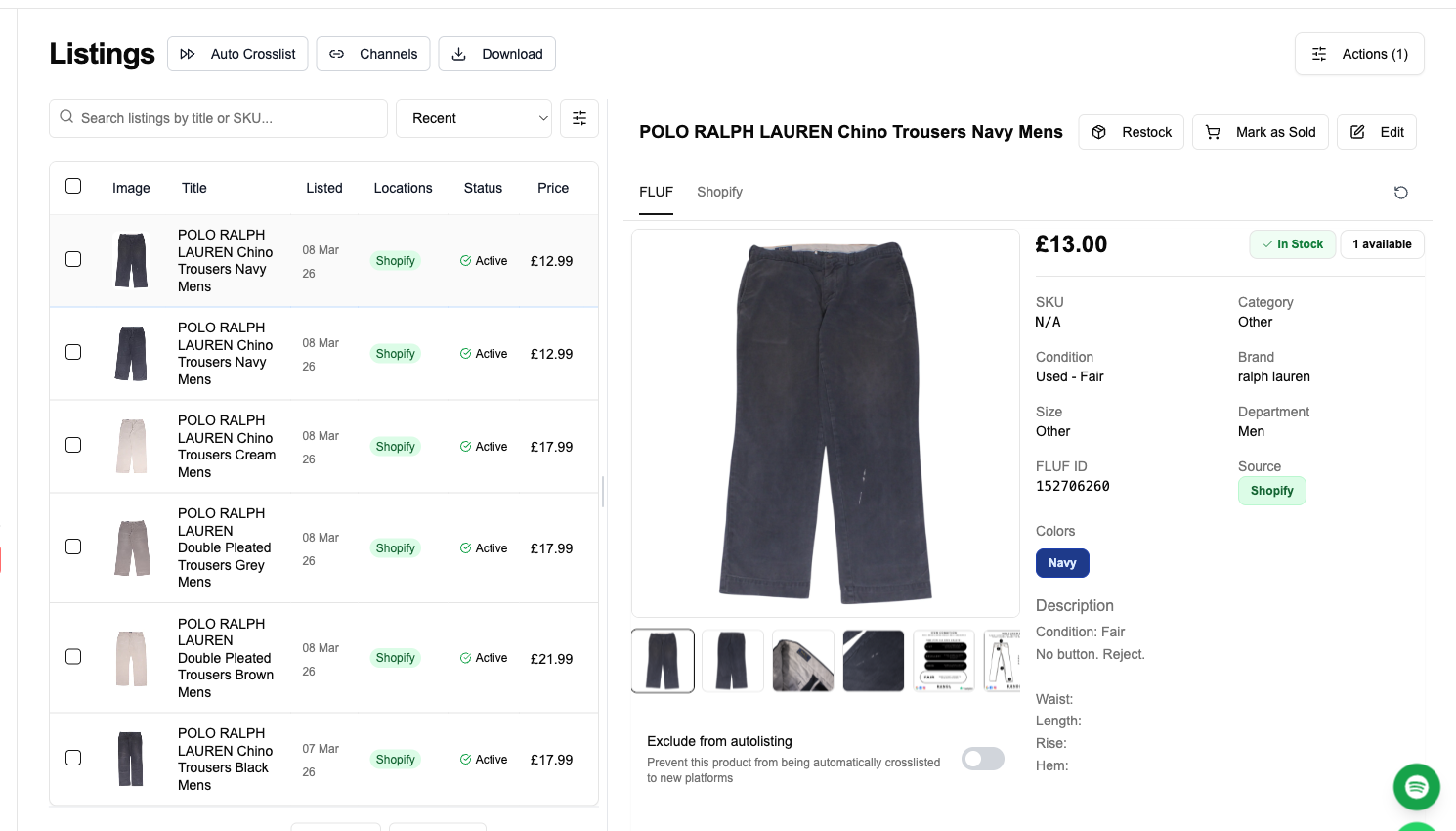
- Review and publish. Each Vinted item appears as a WooCommerce product with photos, title, description, price and size already populated.
Everything that can transfer, does: photos, title, description, price, size, brand, colour and condition. Where a Vinted listing carries attributes like size and brand, FLUF maps them onto WooCommerce product fields and attributes so your store’s filtering and search work properly from day one — and where you want to group items into collections, WooCommerce’s own category and tag system lets you merchandise far beyond Vinted’s flat catalogue.
Inventory and order sync keep both honest
Selling the same item on Vinted and in your WooCommerce store invites the classic oversell: one unit, two live listings, two buyers. FLUF Connect prevents it. Both Vinted and WooCommerce support inventory sync, so when a unit sells on one surface its quantity is decremented on the other, and order data flows through to keep your WordPress store’s stock numbers accurate. You manage one catalogue and FLUF keeps the two storefronts agreeing. This automation — the inventory and order sync that stops oversells — is included in every FLUF Connect plan, not a paid add-on; so are bulk operations and scheduling.
Running one synchronised catalogue is what makes selling in two places practical rather than a second job. Without it, every Vinted sale would mean remembering to adjust the matching WooCommerce product by hand, and every WooCommerce order would mean doing the reverse on Vinted — a reconciliation chore that breaks down the moment volume rises. FLUF removes that chore entirely: your stock figures stay correct across both surfaces on their own, your buyers never hit a sold-out item that should have been pulled, and you spend your time on product and marketing rather than spreadsheet upkeep. It is the difference between bolting a store onto your Vinted operation and genuinely running a two-channel business.
What to check after the import
A Vinted listing and a WooCommerce product are not modelled identically, so a brief review pass in your WordPress admin pays off. Three things reward a look. First, condition and size: Vinted records condition and size as listing attributes; confirm they landed on the matching WooCommerce fields so your store’s filters work, and decide whether condition belongs in the title, an attribute, or the description for your brand. Second, categories: Vinted uses one fixed catalogue tree, whereas WooCommerce lets you design your own — so this is the moment to group items into the collections your store will sell around rather than mirroring Vinted’s structure. Third, descriptions: Vinted copy is usually short and casual; on a WooCommerce store you are writing for Google and for a shopper already on your brand’s page, so the items your sales history flags as best-sellers are worth a richer, more helpful description first. Photos transfer as-is, and you can add more at full resolution without Vinted’s in-app constraints.
The point of the review is not rework — most products are ready as imported — it is to take advantage of the things a real storefront allows that a marketplace listing never did.
When it is time: the business threshold
There is usually a moment that forces the question. Past a certain sales volume or regularity, casual selling becomes a business in the eyes of the tax authorities, and you have to register and operate accordingly — at which point an anonymous profile on a secondhand-fashion app is no longer the right home for what you are doing. That is the natural cue to stand up a proper storefront. A WooCommerce store on WordPress gives you the invoicing, the branding, the analytics and the customer ownership a real business needs, and FLUF Connect lets you populate it instantly from the Vinted catalogue you have already built. The transition stops being daunting when it is one import rather than hundreds of re-listings.
It is worth being clear-eyed about cost at this stage, because “owning a store” sounds expensive and usually is not. WooCommerce core is free, open-source software; the real outlay is modest hosting and a domain — often a few pounds a month to start — plus payment processing only when you actually sell. There is no marketplace commission skimming every order, and FLUF Connect itself starts at £9/month for the Starter plan. Against the value of an owned customer list and the freedom to sell anything, the running cost of a WooCommerce store on WordPress is small — and it is fixed and predictable rather than a percentage that grows with every sale you make.
Driving traffic to your WooCommerce store
Owning a store means owning the job of filling it, and a WooCommerce site does not inherit Vinted’s audience. The honest answer is that you build demand through three levers: email, the asset Vinted never let you keep — every buyer you can reach directly is a sale with no platform between you; SEO, because a WooCommerce store on WordPress can rank in Google under your own domain and compound over time; and social and paid ads pointing at a store you control. This is why most sellers do not quit Vinted the day the store opens. They run both — Vinted keeps surfacing them to its large European base while the WooCommerce store converts the followers and repeat buyers into an owned audience. FLUF keeps both catalogues in sync so running them together is one workflow.
Why a WooCommerce store, not just another marketplace
A fair question: if Vinted has limits, why not simply add another marketplace? Crosslisting to more marketplaces is genuinely valuable for reach — and FLUF supports it — but it does not solve the ownership problem. Every marketplace, by design, keeps the customer, sets the rules, and can change its fees or suspend your account without notice. Adding a second or third marketplace multiplies your reach while leaving you exactly as dependent as you were on Vinted. A WooCommerce store on WordPress is a different category of thing: it is infrastructure you own outright. No one can raise its commission, deprioritise your listings in a feed, or hold your customer list hostage. The mature setup is to use marketplaces like Vinted for what they are best at — putting you in front of new buyers — while a WooCommerce store is the home base where those buyers become yours. The two are complementary, and crosslisting from Vinted to WooCommerce is the first step in building the half you control.
Who this is for
This path suits the Vinted “graduate”: a seller who has moved past clearing their own wardrobe into sourcing, curating or making product, who is bumping against the limits of a secondhand-only app, and who wants to become a brand rather than a profile. If you are still selling the odd item from your closet, Vinted alone is perfect. The moment you start thinking in terms of a business — repeat customers, your own brand, products beyond pre-owned fashion — a WooCommerce store on WordPress is the home for it, and FLUF Connect is how you move in without starting from an empty catalogue.
Sources & Verification
- Vinted scale (€10.8bn GMV, €1.1bn revenue 2025, 26+ markets): Vinted newsroom — 2025 financial results.
- Vinted seller-fee model (no seller fees; buyer pays Buyer Protection fee): Vinted pricelist and Vinted Buyer Protection fee help.
- WooCommerce live-store count: Red Stag, WooCommerce live stores (citing BuiltWith, Aug 2025).
- WooCommerce 0% revenue share + cost model: WooCommerce pricing.
- Limits of selling an own brand on Vinted: nss magazine — small brands on Vinted (2025).
Frequently Asked Questions
Yes. FLUF Connect installs as a plugin on any self-hosted WordPress site running WooCommerce. You add and activate it from your WordPress admin like any other plugin — there is no separate platform or hosting to set up.
No. The import and sync work runs through FLUF Connect against the marketplace APIs in the background, not as front-end load on your WordPress pages, so your WooCommerce store serves shoppers at normal speed.
Yes — that is a core reason to make the move. Vinted is limited to pre-owned fashion, while a WooCommerce store on WordPress can sell any product type: new product, your own brand, bundles, accessories or digital goods, with no category restriction.
Yes. Vinted size and variant information maps onto WooCommerce product fields and attributes, and where a product has multiple variations it can be built as a WooCommerce variable product so each option keeps its own price and stock.
Yes. Both Vinted and WooCommerce support inventory sync in FLUF Connect, so a sale on one decrements stock on the other and prevents overselling the same item. This sync is included in every plan, not a paid add-on.
No. Vinted ratings and followers live inside Vinted and cannot move to an independent store. FLUF transfers your product catalogue — photos, titles, prices and sizes — and keeps stock in sync. Building an audience and reviews on your own WordPress store is part of owning it.
FLUF Connect plans start at £9/month on Starter, with Pro at £29/month and custom Super Seller plans above that; every plan is unlimited on listings and marketplaces, and the tiers differ by which automations they include and how often we check your channels for sales. Automation such as inventory and order sync is included in every plan, not charged separately.