
How to Import Your Depop Listings into FLUF Connect
Depop is where your best photography usually lives — and photographs are the part of a listing that travels unchanged to every other channel.
7 days for £1, then from £9/month.



- Depop is where your best photography usually lives. The platform is browsed visually, so sellers shoot properly for it — and photographs are the part of a listing that travels best to every other channel.
- Connects without the browser extension, unlike Vinted. Nothing has to stay running on your computer.
- Titles and descriptions need widening on the way out. Depop copy is short and conversational by design, which is exactly wrong for eBay’s search.
- Relisting, offers and messaging are all supported on Depop once your items are in — an unusually full feature set.
- One-off stock, so quantity is one. Inventory sync here is about removing an item everywhere the moment it sells, not tracking quantities.
- Natural pairing: Depop for photography and audience, eBay for reach, Vinted for the largest European second-hand base.
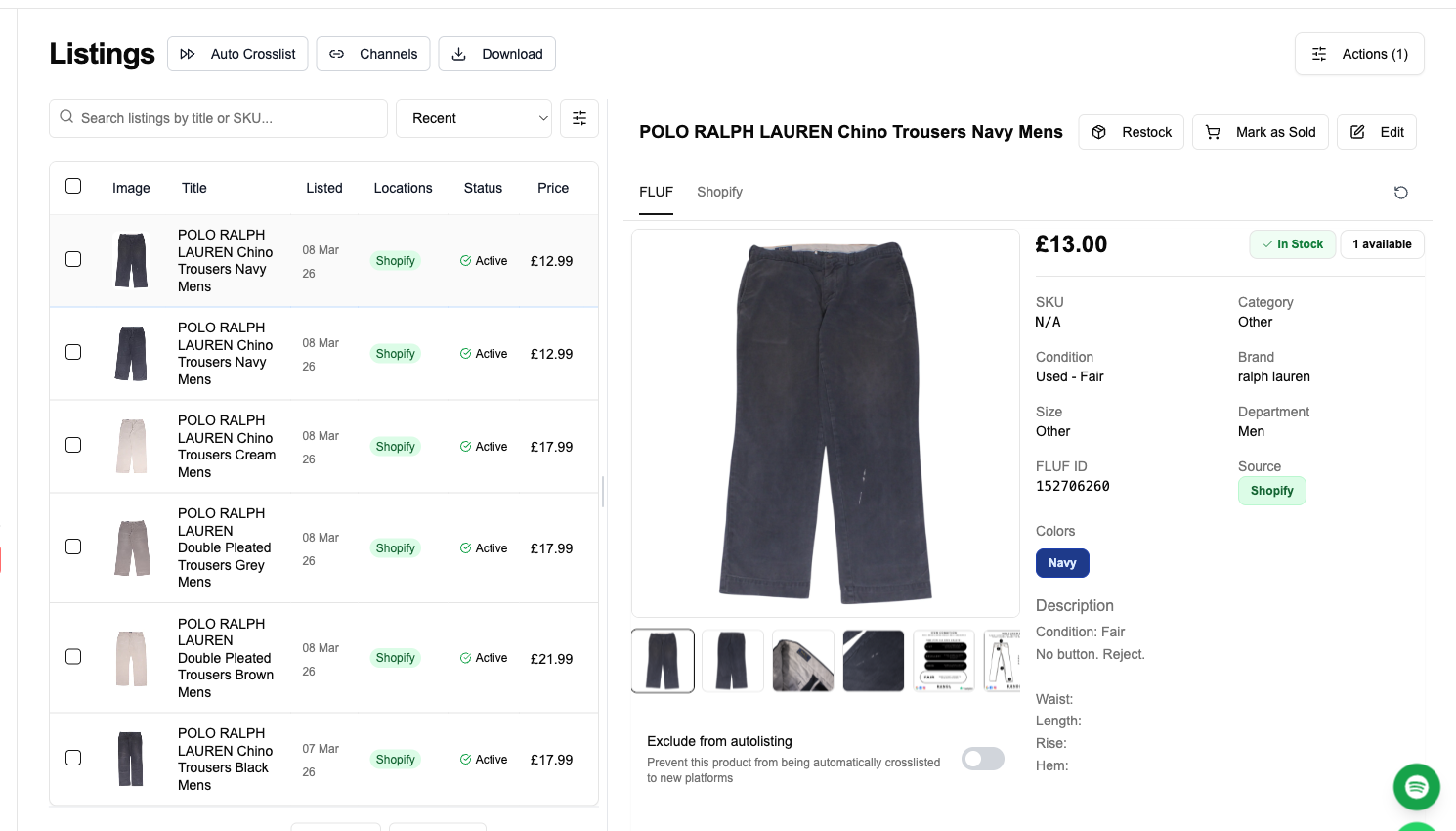
How the connection works
Depop connects through a sign-in flow rather than requiring the FLUF browser extension to be installed and running. That is a meaningful practical difference from Vinted, which does need the extension — with Depop there is nothing that has to stay open on your machine for the connection to hold.
Your live Depop listings are then read in and become your FLUF Connect catalogue. Larger shops fill in progressively, because Depop limits how quickly any tool may read from it and FLUF Connect stays inside those limits deliberately rather than putting your account at risk.
Why Depop is worth importing from first
If you sell second-hand fashion across several platforms, your Depop shop is often the best-photographed catalogue you own, and photographs are the single most portable part of a listing.
Everything else needs adapting between platforms. Titles are written for different search engines. Descriptions follow different conventions. Categories are mapped. Attributes are structured differently everywhere. Photographs are the one component that works unchanged on every destination — and Depop is a platform where good photography is directly rewarded, so sellers invest in it.
That makes a Depop import an unusually strong starting point in the one dimension that is hardest to fix later. You can rewrite a title in seconds; you cannot re-photograph three hundred items.
| Data | Imported | Notes |
|---|---|---|
| Photographs | Yes | The strongest part of a Depop import, and usable everywhere without change. |
| Title | Yes | Short and conversational. Needs widening for eBay — see below. |
| Description | Yes | Often carries genuine detail about fit and condition that is worth keeping. |
| Price | Yes | Pricing rules can adjust per destination afterwards. |
| Brand, size, condition | Where present | Depop holds these as fields, though sellers complete them less consistently than on Vinted. |
| Category | Mapped | Mapped to each destination’s own tree rather than copied. |
| Sold items and reviews | No | These stay on your Depop account. |
The copy problem, in reverse
Importing from eBay gives you titles that are too long and too keyword-dense for social marketplaces. Depop gives you the opposite problem, and it is the more expensive one.
Depop titles are short. Buyers browse a visual feed, filter by brand and size, and the title carries little weight — so a listing might reasonably be called “brown leather jacket” and sell perfectly well. Push that to eBay unchanged and it will be close to invisible, because eBay’s search reads the title above almost everything else and there is nothing in that string to match against. No era, no brand, no size, no material, no style.
Widening is therefore the highest-value edit on a Depop-sourced catalogue. Brand, size, material, era and colour belong in the title for eBay even though they are unnecessary on Depop. Bulk operations will apply patterned changes across thousands of listings at once, which makes this a manageable job rather than a hopeless one.
The same applies to descriptions, less severely. Depop descriptions assume a shared context — the reader is already looking at the photographs and knows the vibe. eBay buyers frequently arrive from a search with none of that context and want measurements, condition detail and specifics.
One-off stock changes what sync means
Depop is a one-off marketplace: each listing is a single item, so quantity is always one. That makes inventory sync a different job from what it does for a store catalogue.
There are no quantities to decrement. The entire job is removal — the moment an item sells on any connected channel, it has to come down everywhere else, quickly. Getting this wrong on one-off stock does not mean a slightly wrong stock figure; it means selling the same jacket twice and having to disappoint a buyer.
This is the core reason crosslisting one-off stock without a tool is risky, and it is worth testing on a small batch before you scale up.
A full automation set once you are in
Depop is among the most completely supported channels in FLUF Connect:
- Relisting — Depop’s feed rewards freshness, so relisting is directly tied to visibility here. Strategies let you prioritise by age, price or category rather than relisting everything blindly.
- Offer management — offers are a normal part of Depop, and handling them automatically removes a real daily job.
- Messaging — buyer conversation is a bigger part of selling on Depop than on most marketplaces.
- Order sync — Depop orders can be centralised for fulfilment alongside your other channels.
All included in every plan rather than sold as paid add-ons — worth checking against any tool that bills Depop relisting separately on top of a subscription.
Sold items, and why your shop looks bigger than your catalogue
Depop keeps sold items visible on your shop page — it is part of how the platform builds social proof, and sellers value it. It also means the number of items on your Depop shop is not the number of products that will appear in FLUF Connect.
An import reads what is live and for sale. Sold items are not live, so they are not read in, and they should not be — crosslisting something you have already sold is exactly the outcome the whole system exists to prevent.
So if your Depop shop shows four hundred items and roughly a hundred and eighty products arrive, that is very likely correct rather than a failed import. The way to check is to compare against your live listings rather than your shop page total.
Running more than one Depop shop
Plenty of sellers run several Depop accounts — one for menswear and one for womenswear, one for a personal wardrobe and one for a business, or separate shops built around different aesthetics because the feed rewards a consistent look.
Each is a separate account and therefore a separate connection. They do not merge into one catalogue by themselves, and that is usually what you want: the shops exist separately because their stock is meant to be presented separately, and collapsing them would undo the reason they were split.
What is worth deciding early is whether both shops crosslist to the same destinations. Two Depop shops feeding the same eBay account is fine and often sensible. Two shops feeding the same Vinted account needs more thought, because the reasons you split them on Depop may well apply there too.
What to fix before your first crosslist
- Check brand and size are populated. Depop lets sellers skip these more readily than Vinted does, and several destinations require them. Filling gaps in bulk beforehand is far quicker than clearing individual failures afterwards.
- Count photographs on each item. Depop accepts a single-image listing; Vinted requires two. If Vinted is a destination, single-photo items will be refused.
- Widen your titles if eBay is a destination — the biggest single lever on a Depop-sourced catalogue.
- Check your prices still stand. Depop stock that has sat a while is often priced from when it was listed. Crosslisting is a good moment to reprice rather than distribute a stale number to four new places.
Where to crosslist a Depop catalogue
Depop’s audience is young, style-led and trend-driven. The channels that complement it are the ones reaching people Depop does not:
- Depop to eBay — much broader age range and far larger reach. The single highest-impact addition for most Depop sellers, provided you widen the titles.
- Depop to Vinted — the largest second-hand fashion audience in Europe, and a channel several competing tools cannot reach at all. Note Vinted’s two-photograph minimum.
- Etsy — worthwhile where your stock is genuinely vintage rather than simply second-hand.
Pricing
Every new account starts with a 7-day trial for £1 with full access. There is no free plan after that; the entry plan is Starter at £9/month, with no cap on how much you list, and relisting and offer management included rather than charged as extras.
| Plan | Monthly | Yearly | You save | Crosslisted products |
|---|---|---|---|---|
| Starter | £9/month | £59/year | 45% | Unlimited |
| Pro | £29/month | £199/year | 42% | Unlimited |
| Super Seller | Custom pricing — tell us what you need | Unlimited | ||
Automatic relisting, offer management, smart pricing and listing boosts are included from Pro upwards. Starter covers unlimited crosslisting, inventory sync, order sync and Instagram posting without them. Accounting integrations are included from Pro upwards. Yearly billing is charged once a year. New accounts get 7 days for £1, then move onto a plan.
Save 42% when you pay yearlyProduct limits count unsold, active products, so items that have sold do not count against your allowance. Full detail is on the pricing page.
Related guides
This page sits in the FLUF Connect guides hub. See importing your listings for every route in, how to crosslist on Depop and how to relist on Depop for the day-to-day, and Depop seller tools for the wider landscape.
Sources & Verification
Last verified: 2026-08-15. Please contact us if any detail here is out of date.
- FLUF Connect Depop channel guide — fees, audience and account detail.
- FLUF Connect integrations page — connection types and per-channel feature support.
- FLUF Connect pricing page — plan prices and annual billing.
Frequently Asked Questions
Connect your Depop account through a sign-in flow. Unlike Vinted, Depop does not require the FLUF browser extension, so nothing has to stay open on your computer for the connection to hold. Your live listings are then read in as your catalogue.
Because your Depop shop is often the best-photographed catalogue you own, and photographs are the single most portable part of a listing. Everything else needs adapting between platforms; images work unchanged everywhere. You can rewrite a title in seconds, but you cannot re-photograph three hundred items.
No, and this is the most expensive thing to fix. Depop titles are short because buyers browse a visual feed and filter by brand and size. Push "brown leather jacket" to eBay unchanged and it will be close to invisible, because eBay's search reads the title above almost everything else. Widening titles is the highest-value edit on a Depop-sourced catalogue.
Depop keeps sold items visible on your shop page as social proof, but an import reads only what is live and for sale. If your shop shows four hundred items and a hundred and eighty products arrive, that is very likely correct. Compare against your live listings rather than your shop page total.
Yes. Each Depop account is a separate connection and they do not merge into one catalogue by themselves, which is usually what you want — the shops exist separately because their stock is meant to be presented separately.
Relisting, offer management, messaging and order sync are all supported, which is an unusually full set. Depop's feed rewards freshness so relisting is directly tied to visibility, and offers are a normal part of how the platform transacts. All are included from Pro upwards rather than sold as paid add-ons.
Check brand and size are populated, since Depop lets sellers skip these more readily than Vinted does and several destinations require them. Count photographs if Vinted is a destination, because Vinted requires two and Depop accepts one. Widen titles if eBay is a destination. And check prices still stand on stock that has sat a while.
There are no quantities to decrement — every Depop listing is a single item. The whole job is removal: the moment an item sells on any connected channel it has to come down everywhere else, quickly. Getting this wrong means selling the same jacket twice.