Crosslist from Tilt to Grailed — Automatically
Grailed never removed its seller commission, gives UK sellers no shipping label, and taxes the postage you charge. Here is what the route from a Tilt live show to a Grailed listing really costs.



- Grailed did not abolish its seller commission. Its live fee page charges the seller 9% at $120 and above, and 6% (minimum $1.99) below $120 for sales on or after 20 May 2026. Guides telling you Grailed is now buyer-funded are describing a model Grailed does not currently publish.
- A UK seller gets no Grailed shipping label. Grailed Labels cover US domestic and Canada-to-US only. Everyone else “purchases their own label and ships with the carrier of their choice” — and because you cannot use a Grailed Label, your commission is charged on the item price plus the postage you charged the buyer.
- Every parcel you send a US buyer is now dutiable. The United States suspended duty-free de minimis treatment for all countries at 12:01am EDT on 29 August 2025. Grailed’s own tariff notice says shipments under $800 no longer qualify.
- Tilt takes 2% plus £0.50. No listing fee, no marketplace commission, no payout fee. Against Grailed’s roughly 14% all-in for a UK seller, the same jacket keeps very different amounts of money depending on where it sells.
- Grailed prices in US dollars only. Tilt charges the buyer in the currency the seller sets, so a UK seller sells in pounds there and in dollars here, carrying the conversion on one side and not the other.
- Grailed deletes what it does not recognise. It publishes a blacklist of roughly 45 watch brands plus Goros and unbranded fine jewellery, and removes listings with no recognised designer. A large slice of Tilt-native stock cannot cross at all.
- Do not run the same item live on both at once. Tilt’s cross-platform sales policy forbids selling, promoting or listing the same item elsewhere while you are live-streaming it, with penalties up to permanent removal.
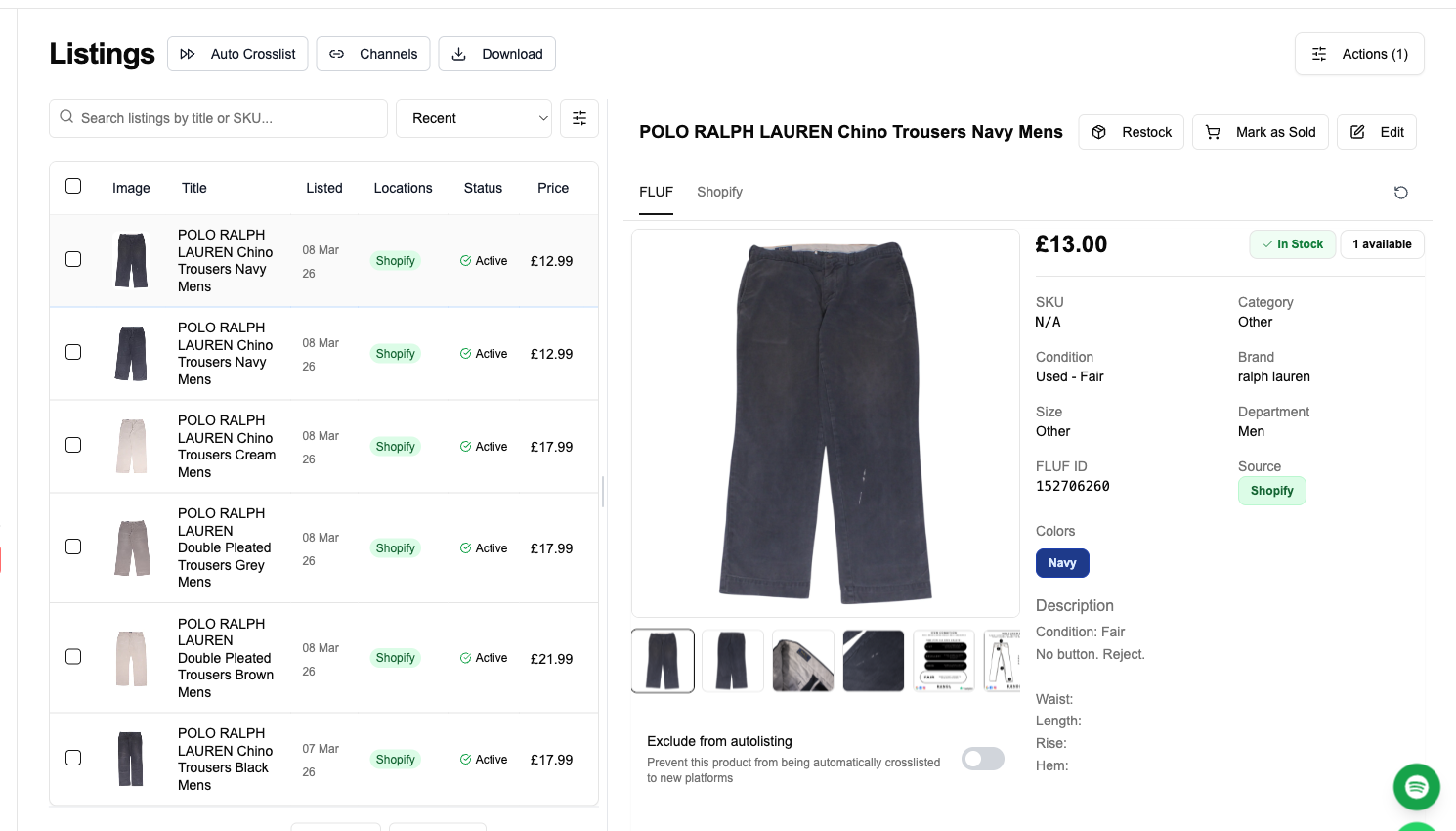
- Cost: FLUF Connect crosslists to 50+ marketplaces from one dashboard. £1 for 7 days, then plans from £9/month (Starter). There is no free plan.
On this page
- Why a Tilt seller looks at Grailed
- The commission Grailed never removed
- No UK label, and what that quietly costs you
- The 29 August 2025 line every UK seller crossed
- What Grailed will simply delete
- Rebuilding a live-auction lot as a Grailed listing
- The overlap rule Tilt actually enforces
- What FLUF Connect syncs, and what it does not
- HMRC, and who reports what
- Sources and verification
- Related guides
Why a Tilt seller looks at Grailed
Tilt is a throughput machine. Its own seller onboarding tells you to bring at least fifteen to twenty items to a show so you do not sell out in ten minutes, and its marketing page claims sale velocity of thirty to forty items an hour. That is a wonderful thing when you have volume. It is a bad fit for the one piece in the rail that is worth four hundred pounds to the right person and eighty pounds to a room of people watching a countdown.
Grailed is the opposite shape. A listing sits there until it sells, or until Grailed auto-deletes it one year after creation. Nobody has to be watching at 8pm on a Tuesday. The buyer who wants your archive piece can find it in March. Grailed’s parent GOAT Group describes a combined membership of over 50 million members across 170 countries, and Grailed prices everything in dollars, which means the American buyer who drives most designer resale demand is quoting in their own currency rather than converting yours.
So the honest reason to add Grailed is not that it is better. It is that the two platforms sell different halves of the same rail. Tilt clears the volume fast and cheap. Grailed waits for the price on the pieces that deserve waiting. The rest of this page is about what that costs, because the gap between the two fee models is wider than almost any guide admits.
The commission Grailed never removed
There is a persistent story that Grailed did away with seller commission and moved its fees onto buyers. Grailed’s own fee page, last updated in June 2026, opens by saying the opposite: “Grailed is free for buyers. Sellers pay a seller commission fee.”
The current structure is tiered. Sales at $120 and above pay 9%. Sales below $120 pay 6%, with a $1.99 minimum, and Grailed’s page dates that reduced tier to sales on or after 20 May 2026. It applies to domestic and international transactions alike.
Payment processing is charged separately and is not folded into the commission. A seller onboarded with Stripe pays 3.49% plus $0.49 on US domestic transactions and 4.99% plus $0.49 on international ones — and a UK seller shipping to a US buyer is the international case. A seller who is in a Stripe-eligible country but has not completed onboarding pays a higher fixed component.
Tilt, meanwhile, publishes a single number. Its seller fees page states 2% plus £0.50 per transaction, describing it as a processing fee, with no marketplace commission, no listing fee, no monthly subscription, no setup fee and no payout fee.
| What you actually pay | Tilt | Grailed (UK seller, US buyer) |
|---|---|---|
| Listing fee | None | None |
| Commission | None | 9% at $120+; 6% (min $1.99) under $120 |
| Processing | 2% + £0.50 combined | 4.99% + $0.49 international |
| Charged on postage too? | No | Yes, when no Grailed Label is used |
| Selling currency | Currency the seller sets | US dollars only |
| Rough all-in on a $150 sale | Around 2.3% | Around 14% |
Grailed does allow a UK VAT-registered business to enter a VAT number in its business registration settings and stop being charged VAT on those fees. That is worth doing on day one if it applies to you, and it does nothing for a private seller.
No UK label, and what that quietly costs you
This is the fact that changes how you price. Grailed’s own article on Grailed Labels restricts them to United States and Puerto Rico domestic movements plus Canada-to-US consignments under $750 and 20lb. Its wording for everyone else is plain: sellers outside the US and Canada purchase their own label and ship with the carrier of their choice.
Then read the commission base on the fee page next to it. Grailed charges commission on the listing price plus buyer-paid shipping where no Grailed Label was used, and on the listing price alone where one was. A UK seller can never be in the second case. So the £12 you charge a US buyer for tracked international postage is itself taxed at 9% before you have posted anything.
Tilt sits the other way round. Its shipping-label flow generates prepaid labels in-app, individually or in bundles, printable on standard or thermal stock, with documented Royal Mail and Evri export paths and drop-off preselected. The label cost is charged to the buyer, and only the difference falls on you if you increase the declared weight after the fact.
The practical consequence for crosslisting is that your Grailed price is not your Tilt price with a currency conversion applied. It has to absorb roughly twelve points of fee spread plus real postage you are buying yourself.
The 29 August 2025 line every UK seller crossed
The United States suspended duty-free de minimis treatment for shipments from all countries at 12:01am EDT on 29 August 2025, under an executive order signed on 30 July 2025, and the suspension was subsequently made indefinite across all modes of transport. The old $800 threshold is gone regardless of value, origin or entry method.
Grailed states this to its own sellers in its tariffs resource: most international shipments to US buyers under $800 no longer qualify for duty-free import and are subject to tariffs and duties. Buyers pay those duties by default, and carriers may chase them for payment after checkout — which is exactly the moment a buyer decides your shop was a mistake.
Two details from that same page matter more than they look. First, duty follows country of manufacture, not country of shipment, and goods made in China or Hong Kong became dutiable at any value on 2 May 2025. A great deal of the streetwear on a UK rail was manufactured in China, and shipping it from Manchester does not change that. Second, Grailed holds the seller responsible for declaring correct country of origin and value, and warns that incorrect declarations can result in the seller refunding the buyer’s duties, payouts being cancelled, or funds being clawed back.
Grailed also runs an optional seller-paid duties programme, in which enrolled sellers ship DDP, carry a “Duties Covered by Seller” badge, and are debited via Stripe for the full amount plus processing fees if they fail to prepay. It buys you a smoother buyer experience at a real and uncapped cost.
What Grailed will simply delete
Tilt’s seller guide describes a fashion-first marketplace covering archive, streetwear, sneakers, vintage, designer, retro sports, activewear, techwear and jewellery, and its marketing page adds toys, collectibles and trading cards. Its prohibited-items policy explicitly permits fine and luxury jewellery, naming Cartier, Tiffany and Bulgari.
Grailed publishes a list of designers that are not allowed: Goros, unbranded fine jewellery, and roughly forty-five watch brands including Rolex, Cartier, Omega, Patek Philippe, Audemars Piguet, Hermès, Chanel and TAG Heuer. Its listing FAQ goes further — custom items and those without designers are subject to removal, and Grailed reserves the right to delete a listing for condition, quality, brand, age or lack of desirability.
So the filter is not stylistic, it is categorical. Watches and unbranded jewellery that sell perfectly well in a Tilt show cannot be listed on Grailed at all. Anything without a recognised designer in the dropdown is at risk. If your brand is genuinely absent rather than banned, Grailed accepts designer requests if you supply the name, a link to the brand’s site or a stockist, and whether they make menswear, womenswear or both.
Womenswear is in scope, and has been since 25 October 2022, when Grailed folded it into the main marketplace a week after GOAT Group announced the acquisition. The older assumption that Grailed is menswear-only is out of date.
Rebuilding a live-auction lot as a Grailed listing
A Tilt lot is a performance. You hold the garment up, you talk about the seam, the countdown does the persuading. A Grailed listing has to do all of that in still images and text, to someone who arrived from a search box.
Grailed sorts every listing into one of four curation buckets — Grails, Hype, Sartorial and Core — and its curation team can move your item between them at its discretion based on designer, price, condition and style. You do not control that placement, but you influence it: an accurate designer, an honest condition and a realistic price are the inputs it reads.
Listings that Grailed considers high-risk go through Grailed Verified, a human review of the listing’s digital content, with machine moderation for everything else. That is a review of your photographs, not a physical inspection, and the team may request more images before the listing goes live. Shoot for it: flat-lay, tag, any flaw, and the detail the brand is known for.
Two mechanics have no Tilt equivalent. Bumping is free but rate-limited to once every seven days for the first thirty days, after which you can only bump by dropping the price by ten per cent or more. And offers behave differently for you than for an American seller: where both buyer and seller are in the EU or UK, Grailed keeps offers non-binding, so accepting one does not complete the sale. On Tilt, a winning bid does.
Fulfilment windows are tighter than they look on both sides. Grailed gives you seven calendar days from purchase to add tracking, or the sale auto-cancels and the buyer is refunded. Tilt’s service level agreement is two working days to fulfil and forty-eight hours to answer a buyer, after which it may refund the order without requiring the goods back.
The overlap rule Tilt actually enforces
Tilt publishes a cross-platform sales policy, and it is the single most important thing on this page for anyone running two channels. While you are live-streaming on Tilt, you must not sell, promote or list the same items on any other platform. Auctions are binding. The stated penalties run from reduced visibility through suspension to permanent removal.
Read carefully, that is a rule about live shows, not about your whole catalogue. The workable pattern is therefore not “everything on both, always”. It is: keep your slow, high-value stock listed on Grailed continuously, and pull an item from Grailed before it enters a Tilt auction, restoring it if it does not sell. That is a delisting discipline, not a listing one, and it is precisely the kind of thing that is unbearable by hand and trivial to automate.
What FLUF Connect syncs, and what it does not
FLUF Connect holds one master record per item and pushes it out to the channels you have connected. For this pair, the two sides have deliberately different capabilities, and it is worth being exact rather than reassuring.
| Capability | Tilt | Grailed |
|---|---|---|
| Create and update listings from FLUF | Yes | Yes, via the FLUF browser extension |
| Mark as sold when it sells elsewhere | Yes | Yes |
| Order sync back into FLUF | Yes | No |
| Automated relisting | No | No |
| Offer management from FLUF | No | No |
In practice that means the sold-out protection works in both directions — sell the jacket in a Tilt show and FLUF can pull the Grailed listing, and sell it on Grailed and the Tilt inventory drops. Tilt orders flow back into your FLUF dashboard; Grailed orders do not, so Grailed remains a place you check for sales rather than a place that reports them to you.
Use the FLUF browser extension for Grailed. FLUF also has iOS and Android apps; check Channels in the mobile app for current marketplace support.
One more Grailed quirk to plan around: listings are deleted a year after creation and editing the price or description does not reset the clock. Grailed’s own workaround is its duplicate-listing tool. If a piece has been sitting for eleven months, that is your reminder to duplicate it rather than lose it.
HMRC, and who reports what
The UK trading allowance is £1,000 of gross trading income per tax year. Above that you must register for Self Assessment by 5 October in the following tax year. You claim the allowance or your actual expenses, not both.
Separately, digital platforms report seller details and income to HMRC, per calendar year, filed by 31 January following, with the first reports covering 2024 due by 31 January 2025. The exemption thresholds are fewer than thirty sales of goods in a calendar year, or under €2,000 received. Being reported does not by itself mean you owe tax.
A trap worth internalising: the platform report runs January to December, and the UK tax year runs 6 April to 5 April, so the two sets of figures will never reconcile on their face. Keep your own records against the tax year.
On Grailed specifically, its DAC7 article names the EU, Canada and China as reporting regimes, and does not name the UK. We are not going to tell you Grailed reports you to HMRC when Grailed does not say so — and it changes nothing about your own obligation either way.
Sources and verification
- Tilt seller fees — the 2% plus £0.50 figure and the absence of listing, commission, subscription and payout fees.
- Tilt payouts — free standard payout five to seven business days after delivery, 1.5% fast, 3% instant.
- Tilt seller availability — sellers based in the United Kingdom, Spain and Italy, and the fifteen-to-twenty-item guidance; and supported countries for the UK, Spain, Poland and Italy buyer markets.
- Tilt cross-platform sales policy and prohibited items.
- Grailed fees — 9% at $120 and above, 6% with a $1.99 minimum below it for sales on or after 20 May 2026, and the commission base including buyer-paid shipping.
- Grailed processing fees — the 4.99% plus $0.49 international rate.
- Grailed Labels — US and Canada-to-US only, everyone else buys their own.
- Grailed on tariffs and the Federal Register notice on the indefinite de minimis suspension.
- Grailed prohibited designers and the listing FAQ covering bumping, curation and removal rights.
- Grailed listing deletion — the one-year rule and the duplicate-listing workaround.
- Grailed offers — non-binding where both parties are in the EU or UK.
- GOAT Group’s acquisition announcement and Grailed’s womenswear launch.
- gov.uk on digital platform reporting and the £1,000 trading allowance.
What we could not verify, and therefore left out. Grailed publishes no photo count or title character limit anywhere in its help centre; the numbers circulating in third-party guides contradict each other, so we have given none. Grailed discloses no ranking or feed mechanics beyond what bumping does. Tilt publishes no photo cap, no platform-wide GMV or monthly active users, no valuation for either funding round, and no statement of what it reports to HMRC. Tilt’s marketing page says sellers are “paid within 7 days” without the after-delivery condition its help desk states, so we have used the help desk. And we found no primary source for the widely repeated claim that Grailed abolished seller commission in favour of buyer-paid fees, so we have not dated it.
Related guides
Frequently Asked Questions
No. Grailed's own fee page, updated in June 2026, opens with “Grailed is free for buyers. Sellers pay a seller commission fee.” The current rates are 9% on sales of $120 and above, and 6% with a $1.99 minimum on sales below $120, that reduced tier applying to sales on or after 20 May 2026. Payment processing is charged separately on top — 4.99% plus $0.49 for an international transaction, which is what a UK seller shipping to a US buyer is. We could find no primary source for the widely repeated claim that Grailed abolished seller commission, so we have not dated it.
No. Grailed Labels cover United States and Puerto Rico domestic movements plus Canada-to-US consignments under $750 and 20lb. Grailed's own wording for everyone else is that sellers outside the US and Canada purchase their own label and ship with the carrier of their choice. This has a hidden cost: Grailed charges commission on the listing price plus buyer-paid shipping where no Grailed Label was used, and on the listing price alone where one was. A UK seller can never be in the second case, so the postage you charge is itself taxed at 9%.
Your buyer does, by default — but you carry real responsibility for it. The United States suspended duty-free de minimis treatment for all countries at 12:01am EDT on 29 August 2025, and the suspension has since been made indefinite. Grailed's own tariffs notice says most international shipments to US buyers under $800 no longer qualify for duty-free import. Duty follows country of manufacture rather than country of shipment, so China-made streetwear posted from Manchester is still dutied as Chinese. Declare origin and value accurately: Grailed warns that incorrect details can mean you refund the buyer's duties, or have payouts cancelled or funds clawed back.
Not while it is live on Tilt. Tilt's cross-platform sales policy forbids selling, promoting or listing the same items on any other platform while you are live-streaming them, with penalties running from reduced visibility to permanent removal, and its auctions are binding. Read carefully, that is a rule about live shows rather than your whole catalogue. The workable pattern is to keep slow, high-value stock listed on Grailed continuously and pull an item before it enters a Tilt auction, restoring it if it does not sell — which is a delisting discipline that automation handles well.
Grailed publishes a list of designers that are not allowed: Goros, unbranded fine jewellery, and roughly 45 watch brands including Rolex, Cartier, Omega, Patek Philippe, Audemars Piguet, Hermès and Chanel. Beyond that, its listing FAQ says custom items and those without a recognised designer are subject to removal, and reserves the right to delete any listing for condition, quality, brand, age or lack of desirability. Tilt explicitly permits fine and luxury jewellery, so watches and unbranded pieces that sell well in a Tilt show cannot cross at all.
Tilt's seller fees page states 2% plus £0.50 per transaction, described as a processing fee, with no marketplace commission, no listing fee, no monthly subscription, no setup fee and no payout fee. Standard payouts are free and arrive five to seven business days after delivery; Fast costs 1.5% and pays the next business day after delivery; Instant costs 3% and pays in around thirty minutes. Tilt's marketing page says sellers are “paid within 7 days” without the after-delivery condition, so we have used the help desk figures.
Tilt's own help desk says sellers must be based in the United Kingdom, Spain or Italy, while its buyer markets are the UK, Spain, Poland and Italy. Longer lists including France, Australia and the United States appear in some places, but no primary Tilt source supports them — US expansion is described as a plan funded by its 2026 round rather than a live market.
Sold-out protection works in both directions. Tilt orders appear in FLUF; Grailed orders do not, so check Grailed directly for sales and keep its FLUF extension active. Neither channel currently supports relisting or offer management in FLUF.
The UK trading allowance is £1,000 of gross trading income a year, above which you register for Self Assessment by 5 October in the following tax year. Digital platforms report seller data to HMRC per calendar year, filed by 31 January following, with a de minimis of fewer than 30 sales of goods or under €2,000 received. Grailed's own DAC7 article names the EU, Canada and China and does not name the UK, so we are not going to tell you it reports you to HMRC when it does not say so. Tilt publishes nothing on the subject. Your own obligation is unaffected either way.