
How to Sell on Temu — The Complete Guide for 2026
Zero commission, 292 million buyers, three seller models. The fastest-growing marketplace for wholesale resellers and brands — now with FLUF Connect crosslisting.



Key Takeaways
- Temu is for new products only — unlike eBay, Depop, or Vinted, you cannot sell secondhand or pre-owned items on Temu. It suits wholesale resellers, brands, and manufacturers.
- Three seller models exist — Fully Managed (Temu controls everything), Semi-Managed (you handle fulfilment), and Local-to-Local (UK/EU-based sellers with local stock).
- Zero commission is possible — many sellers pay no listing or commission fees, though Temu controls pricing in the Fully Managed model, which can squeeze margins.
- 292 million monthly active users — Temu is the fastest-growing marketplace globally with ~$47.5 billion GMV in 2024, making it impossible to ignore as a sales channel.
- Significant seller risks — Temu’s “refund without return” policy can impose penalties up to 5x the order amount, and return rates average 10-20%.
- Use it as one channel among many — FLUF Connect lets you list on Temu alongside eBay, Depop, Vinted, Shopify, and Shopify with synced inventory and orders.
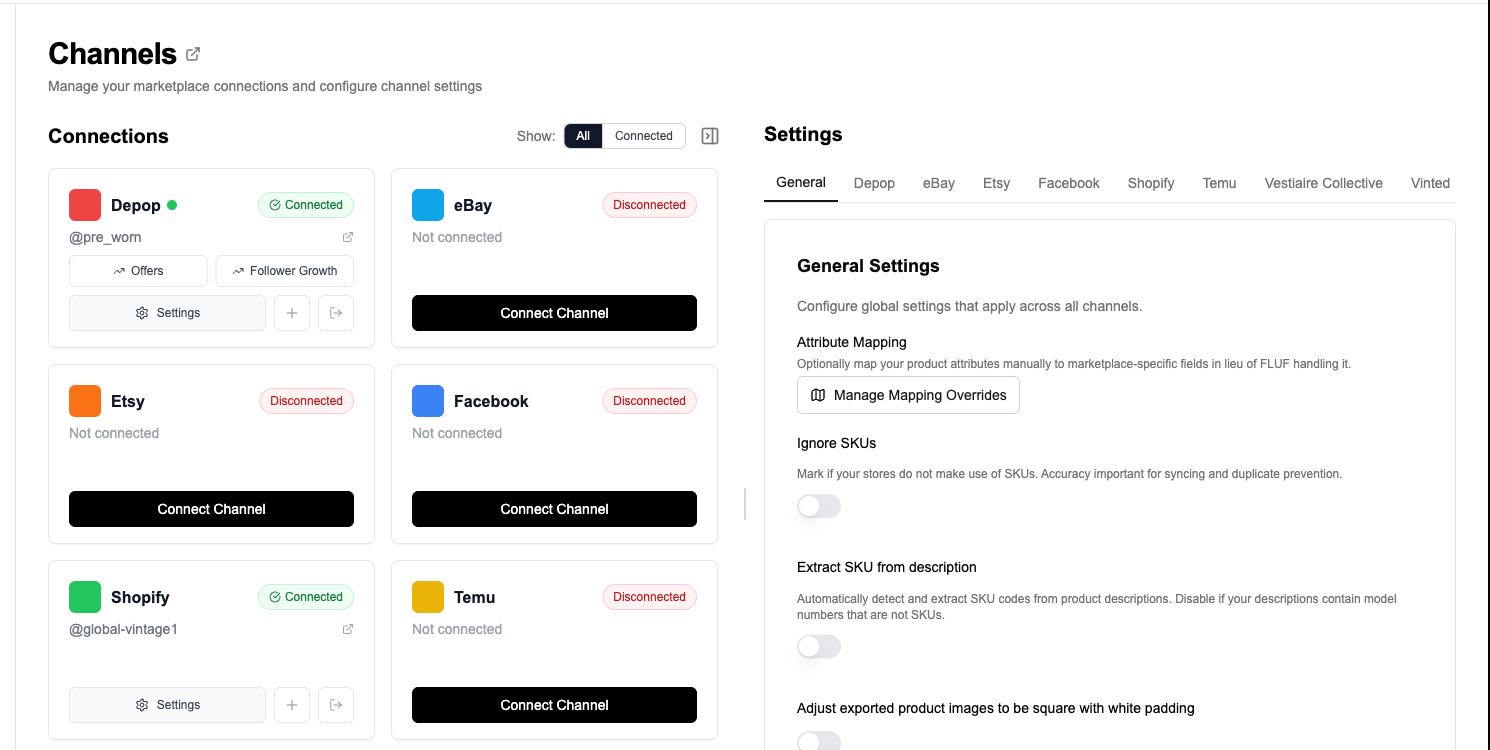
Table of Contents
- What Is Temu?
- Why Sell on Temu in 2026?
- Temu Fees Explained
- How to Set Up Your Temu Seller Account
- How to Create Temu Listings That Actually Sell
- Photography Tips for Temu Sellers
- Shipping and Returns on Temu
- How Does the Temu Algorithm Work?
- Getting Paid and Tax Obligations
- What Sells Best on Temu in 2026?
- Pro Tips from Experienced Temu Sellers
- Common Mistakes New Temu Sellers Make
- Cross-List Your Temu Products to Sell Faster
What Is Temu?
Temu is a global online marketplace owned by PDD Holdings (the parent company behind Pinduoduo, China’s largest agricultural e-commerce platform). Launched in the United States in September 2022, Temu has since expanded to over 90 markets worldwide, including the UK in 2023. It connects manufacturers and wholesale sellers directly with consumers, cutting out traditional retail middlemen to offer products at aggressively low prices.
Unlike peer-to-peer platforms such as Depop or Vinted where individuals sell pre-owned items, Temu is designed exclusively for new products. The platform originally operated a direct-from-manufacturer model where sellers shipped goods to Temu’s Chinese warehouses, and Temu handled everything from pricing to customer service. Since March 2024, it has introduced Semi-Managed and Local-to-Local models that give sellers more control and enable faster delivery from local warehouses.
Temu’s growth has been extraordinary. The platform attracted approximately 292 million monthly active users globally by 2024-2025, with over 416 million mobile app monthly active users. In the UK alone, Temu became the most downloaded shopping app in 2024, with 20 million monthly active buyers. Its gross merchandise value (GMV) surged to roughly $47.5 billion in 2024 — a 239% increase from its ~$15.1 billion GMV in 2023.
For wholesale resellers and brands already selling new products on platforms like eBay or Shopify, Temu represents a massive additional audience. The platform’s emphasis on ultra-competitive pricing means it is not right for everyone, but for sellers who can source products efficiently, the sheer volume of traffic and buyers makes it a compelling channel to add to your multi-platform strategy.
| Detail | Temu |
|---|---|
| Founded | September 2022 (US launch) |
| Parent Company | PDD Holdings (also owns Pinduoduo) |
| Headquarters | Boston, Massachusetts (US); PDD Holdings HQ in Dublin, Ireland |
| Monthly Active Users | ~292 million globally |
| Mobile App MAU | 416 million+ |
| Monthly Website Visits | ~1.82 billion |
| GMV (2024) | ~$47.5 billion (239% growth YoY) |
| Markets | 90+ countries |
| UK Active Buyers | 20 million monthly |
| Product Types | New products only (no secondhand) |
| Seller Models | Fully Managed, Semi-Managed, Local-to-Local |
Why Sell on Temu in 2026?
Temu offers access to one of the fastest-growing buyer pools in e-commerce history. With nearly 292 million monthly active users and over 1.82 billion monthly website visits, the platform delivers an audience scale that rivals Amazon in certain markets. For wholesale resellers and brands selling new products, adding Temu as a sales channel can meaningfully increase revenue without cannibalising sales on other platforms.
Massive, Still-Growing Audience
Temu’s user base continues to expand aggressively. In the UK, the platform accumulated 20 million monthly active buyers and became the most downloaded shopping app in 2024. Across the globe, GMV leapt from ~$15.1 billion in 2023 to ~$47.5 billion in 2024. These are not plateau numbers — the platform is actively recruiting local sellers and expanding its Semi-Managed programme to sustain this growth.
Low Barrier to Entry
Unlike Amazon with its referral fees, FBA fees, and monthly subscription, Temu charges zero registration fees and zero commission for many sellers. The platform makes its money through logistics services, advertising, and by controlling pricing margins in the Fully Managed model. For sellers entering through the Semi-Managed or Local-to-Local models, this fee structure can be significantly more attractive than established marketplaces.
A Complementary Channel, Not a Replacement
Temu works best as one channel within a broader multi-platform selling strategy. The same new products you list on eBay, Shopify can be crosslisted to Temu to capture a different buyer demographic — typically price-conscious shoppers looking for deals. With FLUF Connect, you can manage Temu listings alongside all your other channels from a single dashboard, with synced inventory ensuring you never oversell. Local-to-Local fashion sellers can also push branded apparel to Vinted and Depop for a curated, fashion-led audience that Temu’s price-led algorithm rarely surfaces.
| Factor | Temu | Amazon UK | eBay UK | Depop |
|---|---|---|---|---|
| Registration Fee | Free | From £25/month (Pro) | Free (basic) | Free |
| Commission / Seller Fee | Zero for many sellers | 7-15% referral fee | 10-12.8% final value fee | 10% seller fee |
| Pricing Control | Platform-controlled (Fully Managed) or seller-guided (Semi-Managed) | Seller sets price | Seller sets price | Seller sets price |
| Product Types | New only | New and used | New and used | New and used |
| UK Monthly Buyers | 20 million | ~30 million | ~24 million | ~8 million |
| Fulfilment | Platform-handled or seller-managed | FBA or seller-managed | Seller-managed | Seller-managed |
The Honest Picture
Temu is not without significant challenges. The platform’s pricing strategy targets 60-85% of Amazon’s average prices, which means margins are thin. The Fully Managed model gives sellers minimal pricing control. Return rates average 10-20% (up to 30% for fashion), and Temu’s “refund without return” policy means sellers often absorb total losses on returned goods. Hundreds of sellers protested in Guangzhou in July 2024 over penalty fines. These are real risks that need to be weighed against the opportunity — which is why diversifying across multiple channels is essential.
Temu Fees Explained
Temu’s fee structure is fundamentally different from traditional marketplaces like eBay or Amazon. Rather than charging percentage-based commissions on each sale, Temu’s revenue model revolves around controlling the supply chain, pricing, and logistics. Understanding the three seller models and how Temu makes money from each is critical before you commit inventory.
Model 1: Fully Managed
This is Temu’s original and most common seller model. Under Fully Managed, sellers ship products to Temu’s Chinese warehouses, and Temu takes over from there — handling pricing, marketing, fulfilment, customer service, and returns. There are two sub-models:
- VMI (Vendor-Managed Inventory): You ship bulk inventory to Temu’s warehouse. Temu stores it and ships orders as they come in.
- JIT (Just-In-Time): You manufacture or source products on demand. You have 72 hours to deliver each order to Temu’s warehouse after a sale is confirmed.
Fees: There are no explicit registration, listing, or commission fees. However, Temu controls the retail price. They typically buy from sellers at a low wholesale cost and set the consumer price to generate their margin. Sellers often find their per-unit profit is thin because Temu optimises for the lowest possible consumer price. In practice, Temu’s margin comes from the spread between what they pay you and what they charge the buyer.
Model 2: Semi-Managed (Launched March 2024)
The Semi-Managed model gives sellers significantly more control. You handle warehousing and last-mile delivery from overseas (non-China) locations, while Temu handles traffic, promotion, some pricing guidance, and after-sales support. This model is available in the US, UK, Germany, France, Italy, Netherlands, Spain, Canada, Australia, New Zealand, Japan, and South Korea.
Fees: Again, no explicit commission fees for many sellers. Temu provides subsidies of 20-30% on Semi-Managed products to keep consumer prices competitive. Sellers have more pricing control than in the Fully Managed model, though Temu targets roughly 85% of Amazon’s average price for comparable items (with a range of 70-90%). This model currently accounts for approximately 23% of US GMV and 10-15% of EU GMV.
Model 3: Local-to-Local
The newest model, Local-to-Local, targets US and EU-based sellers with existing local inventory. Temu is actively recruiting sellers in these regions — reportedly hiring around 100 people in the US alone for offline seller recruitment. This model allows for the fastest delivery times (0-2 business days) and gives sellers the most autonomy.
Fees: Fee structures for Local-to-Local are still evolving as Temu scales this programme. Early reports suggest similarly low or zero commission, with Temu monetising through advertising and logistics services rather than per-sale fees.
How Temu Actually Makes Money
If Temu is not charging commission, how does it generate revenue? Three primary ways:
- Pricing control and markup: In the Fully Managed model, Temu buys at wholesale and sells at a markup. The seller’s “fee” is effectively built into the low purchase price Temu offers.
- Logistics services: Temu charges for warehousing, shipping, and fulfilment — especially in the Semi-Managed model where sellers use Temu’s logistics network.
- Advertising and promoted listings: Like eBay’s Promoted Listings and Amazon’s Sponsored Products, Temu offers paid advertising tools that boost product visibility.
Worked Example: Fully Managed vs. Semi-Managed
Product: Wireless earbuds, sourced at £3.50 per unit
Fully Managed: Temu buys from you at £4.20 per unit. Temu sets consumer price at £8.99. Your profit: £0.70 per unit. Temu handles all shipping and returns. If a buyer returns the item, you bear the loss — the goods are typically destroyed, not returned to you.
Semi-Managed: You set your price at £7.64 (85% of Amazon’s £8.99 average). Temu subsidises 25%, so the buyer pays ~£5.73. You ship from a UK warehouse. Shipping cost: ~£1.50. Your profit: £2.64 per unit before returns. You handle fulfilment but have more margin and pricing control.
Key takeaway: Semi-Managed generally offers better margins for sellers who can handle their own logistics, but requires more operational investment and only 15% of merchants currently meet the requirements.
Hidden Costs to Watch
- Return penalties: Temu can impose penalties of up to 5x the order amount on sellers when refund-without-return policies are triggered.
- Capital requirements: You need approximately 3x the value of goods on your Temu shelves as working capital to cover inventory cycles and potential penalties.
- Destroyed returns: In the Fully Managed model, returned goods are typically destroyed rather than shipped back to you. You bear the entire loss.
- Promotional eligibility: You must maintain a return rate below 15% to remain eligible for Temu’s promotional programmes. Fashion and clothing categories average 10-20% returns, with some reaching 30%.
How to Set Up Your Temu Seller Account
Setting up a Temu seller account is straightforward, but the eligibility requirements are stricter than platforms like eBay or Depop. Temu is looking for established businesses, not individual casual sellers. Applications are typically reviewed within one business day.
Step-by-Step Setup
- Visit the Temu Seller Centre: Navigate to seller.temu.com and click “Sign Up” or “Apply Now.” You will need a valid business email address.
- Select your seller model: Choose between Fully Managed, Semi-Managed, or Local-to-Local based on your business setup and location. Semi-Managed and Local-to-Local require you to have warehouse facilities in supported markets.
- Provide business documentation: Upload your business registration certificate, Unique Taxpayer Reference (UTR) number, and entity registration details. Temu requires registration from the UK, France, Germany, Italy, Netherlands, or Spain.
- Submit VAT registration: You must have a valid VAT registration. This is non-negotiable for selling on Temu in the UK and EU.
- Product certifications: If your products require CE or UKCA certifications, have these ready. Temu will reject applications for regulated product categories without proper certification.
- EPR packaging compliance: Ensure you meet Extended Producer Responsibility (EPR) packaging requirements for the markets you plan to sell in.
- Wait for approval: Applications are typically reviewed within one business day. Temu may request additional documentation or ask clarifying questions about your product range.
- Set up your store: Once approved, configure your seller profile, payment details, and shipping settings. Begin uploading your product catalogue.
UK-Specific Requirements
- Entity and VAT registration from the UK (or France, Germany, Italy, Netherlands, Spain)
- Business registration certificate
- Unique Taxpayer Reference (UTR) number
- CE and UKCA certifications for applicable product categories
- EPR packaging compliance documentation
- 20% VAT applies on imported goods
If you are already selling on eBay or Shopify with proper business registration, you likely have most of these documents ready. Once your Temu account is live, you can use FLUF Connect to import your existing product catalogue — whether you are moving listings from Depop to eBay, Shopify to eBay, or any platform to Temu — rather than manually recreating every listing.
Already selling on eBay or Shopify? Import your existing listings to Temu in minutes with FLUF Connect.
How to Create Temu Listings That Actually Sell
Temu’s marketplace is intensely competitive on price, which means your listings need to work harder on every other dimension — title optimisation, description quality, accurate categorisation, and pricing strategy. The platform’s algorithm rewards listings with high click-through rates, strong conversion, and low refund rates, so getting these fundamentals right directly impacts your visibility.
Title Optimisation
Temu’s search algorithm is keyword-driven, similar to Amazon. Your title should front-load the most important keywords that buyers search for, followed by distinguishing features.
Structure: [Product Type] + [Key Feature] + [Material/Specification] + [Use Case/Audience]
Before: “Nice earbuds for sale”
After: “Wireless Bluetooth 5.3 Earbuds with Noise Cancelling – In-Ear Headphones with 30H Battery Life for Sport and Travel”
Keep titles between 80-150 characters. Include specific details like material, size, colour, and technical specifications. Avoid generic superlatives (“best”, “amazing”) — Temu buyers are searching for specific product attributes.
Product Descriptions
Write descriptions that address the buyer’s key questions before they need to ask. Include precise measurements, material composition, compatibility information, and what is included in the package. Use bullet points for scannability.
- Lead with the primary benefit or use case
- Include exact dimensions, weight, and material specifications
- List everything included in the package (buyers on Temu frequently ask about accessories)
- Add care instructions or usage guidelines where relevant
- Mention any certifications (CE, UKCA, RoHS) to build trust
Category Placement
Accurate category placement is essential on Temu. The platform’s algorithm uses your category selection to determine where your product appears in browse and search results. Placing a product in the wrong category reduces visibility and can trigger compliance issues.
Spend time browsing Temu’s category tree for your product type. Look at where your top competitors are listed. If your product could fit multiple categories, choose the one with the highest buyer traffic for your specific item.
Pricing Strategy
Pricing on Temu requires a different mindset from eBay or Shopify. In the Fully Managed model, Temu controls your retail price entirely. In the Semi-Managed model, you have more control but Temu targets approximately 85% of Amazon’s average price for comparable products (with a range of 70-90%).
Key pricing principles:
- Factor in returns: With average return rates of 10-20%, your pricing needs to absorb this cost. A product with a 15% return rate needs 15% higher margins to break even.
- Use time-limited discounts: Temu’s algorithm rewards products offering temporary discounts and coupons. These boost discoverability in promotional sections of the app.
- Monitor competitor pricing: Temu’s algorithm penalises products that are significantly more expensive than comparable listings. Regularly check your category to ensure your pricing remains competitive.
- Account for subsidies: In the Semi-Managed model, Temu provides subsidies of 20-30% on your products. Factor this into your pricing calculations — the buyer pays less than your listed price, but you receive your full amount minus any logistics costs.
Leveraging Crosslisting for Listing Quality
If you have well-optimised listings on eBay or Shopify, you do not need to start from scratch on Temu. FLUF Connect allows you to crosslist existing products to Temu, bringing across your titles, descriptions, images, and product data. You can then refine the Temu-specific details — adjusting pricing, updating category placement, and tweaking titles for Temu’s search algorithm — without rebuilding everything manually. This is particularly valuable when managing hundreds of SKUs across multiple platforms.
Photography Tips for Temu Sellers
Product photography on Temu follows standards similar to Amazon — clean, professional images on white backgrounds are the baseline, with lifestyle and detail shots supporting the main image. The critical difference is that Temu’s audience is extremely price-conscious, so your images need to convey quality and value simultaneously to overcome the “too cheap to be good” perception.
Image Requirements
- Main image: White or light background, product filling 85%+ of the frame. No text overlays, watermarks, or logos on the main image.
- Resolution: Minimum 800×800 pixels; recommended 1200×1200 or higher for zoom functionality.
- Format: JPEG or PNG. Keep file sizes under 5MB.
- Quantity: Upload 5-8 images per listing. Use all available image slots — listings with more images consistently outperform those with fewer.
What to Include in Your Image Set
- Hero shot: Clean product image on white background showing the full product.
- Scale reference: Show the product being held, worn, or placed next to a common object so buyers understand the actual size.
- Detail shots: Close-ups of texture, material quality, stitching, connectors, or any feature that differentiates your product.
- Lifestyle image: The product in use in a real-world context. This drives click-through rates more than any other image type.
- What’s-in-the-box: A flat-lay showing everything included with the product. This reduces “what’s included?” enquiries and sets accurate expectations.
- Infographic: A labelled image showing key dimensions, features, or specifications overlaid on the product photo.
Temu-Specific Tips
Temu’s mobile-first audience (416 million+ mobile app users) means your images must be immediately clear on small screens. Avoid overly complex compositions. Use high contrast and ensure text in infographic images is large enough to read on a phone. Test how your images look on a mobile device before publishing.
If you are crosslisting from eBay or Shopify using FLUF Connect, your existing product images will transfer across. However, it is worth reviewing whether your current images meet Temu’s white-background requirement for the main image, as platforms like eBay are more lenient about main image backgrounds.
Selling new products on multiple platforms? FLUF Connect syncs your inventory across Temu, eBay, Shopify, and more — so you never oversell.
Shipping and Returns on Temu
Shipping and returns are where Temu’s seller experience diverges most dramatically from other marketplaces. The fulfilment model you choose — Fully Managed, Semi-Managed, or Local-to-Local — determines who handles logistics, but in all cases, Temu’s return policies place significant risk on the seller.
Fulfilment by Seller Model
Fully Managed: You ship products to Temu’s Chinese warehouses. From there, Temu handles all order fulfilment, shipping to buyers, and returns processing. You have no control over shipping speed or carrier selection. Delivery times to UK buyers are typically 7-15 days.
Semi-Managed: You store inventory in overseas warehouses (UK, EU, US, etc.) and handle last-mile delivery to buyers. Temu may provide logistics support and partnerships with carriers, but you are responsible for meeting shipping SLAs. Delivery expectations are shorter — typically 3-7 days for UK buyers.
Local-to-Local: UK or EU-based sellers ship directly from local stock. Shipping SLA is 0-2 business days. This model offers the fastest delivery and best buyer experience but requires existing local warehousing and fulfilment infrastructure.
| Seller Model | Who Ships? | Delivery Speed (UK) | Carrier Control | Best For |
|---|---|---|---|---|
| Fully Managed | Temu handles everything | 7-15 days | None — Temu selects carrier | Manufacturers with no overseas logistics |
| Semi-Managed | Seller from overseas warehouse | 3-7 days | Partial — Temu logistics partnerships available | Sellers with UK/EU warehouse access |
| Local-to-Local | Seller from local stock | 0-2 days | Full — seller chooses carrier | UK/EU-based sellers with existing fulfilment |
The Returns Problem
Temu’s return policy is the single biggest risk factor for sellers, and you must understand it before committing inventory to the platform.
- “Refund without return” policy: For many low-value items, Temu refunds the buyer without requiring them to return the product. The seller bears the full cost. The returned goods are not shipped back to you — they are typically destroyed.
- Penalty system: Temu can impose penalties of up to 5x the order amount on sellers for issues deemed to be the seller’s fault (quality complaints, misrepresentation, late shipping). Hundreds of sellers protested in Guangzhou in July 2024 specifically over these penalty fines.
- Average return rates: Across all categories, expect 10-20% returns. Fashion and clothing categories can see return rates up to 30%.
- Promotional eligibility threshold: You must maintain a return rate below 15% to qualify for Temu’s promotional programmes, which are a primary driver of visibility and sales.
Mitigating Return Risk
- Invest in accurate, detailed product descriptions and images to set correct expectations
- Include precise measurements and sizing information for clothing and accessories
- Focus on categories with lower return rates (electronics, home goods) rather than fashion initially
- Monitor your return rate weekly and investigate patterns — if one product is driving returns, fix or remove it
- Use FLUF Connect’s inventory sync to ensure stock levels are accurate across all channels, preventing overselling that leads to cancellations
How Does the Temu Algorithm Work?
Temu’s product ranking algorithm determines which products appear in search results, category pages, and personalised recommendations. Like most marketplace algorithms, it is designed to surface products most likely to result in a completed sale with a satisfied buyer. Understanding how it works lets you optimise your listings for maximum visibility.
Core Ranking Factors
| Ranking Factor | What It Means | How to Optimise |
|---|---|---|
| Click-Through Rate (CTR) | Percentage of buyers who click your listing when they see it in search results | Strong main image, keyword-rich title, competitive price displayed prominently |
| Conversion Rate | Percentage of visitors to your listing who complete a purchase | Detailed descriptions, multiple high-quality images, competitive pricing, complete specifications |
| Customer Satisfaction | Ratings, reviews, and post-purchase feedback scores | Accurate product descriptions, quality control, responsive communication |
| Delivery Speed | How quickly orders reach the buyer | Semi-Managed or Local-to-Local models deliver faster than Fully Managed |
| Refund Rate | Percentage of orders that result in refunds or returns | Accurate images and descriptions, strict quality control, correct sizing information |
| Cancellation Rate | Percentage of orders you cancel before fulfilment | Accurate stock management — use inventory sync to prevent overselling |
| Pricing Competitiveness | How your price compares to similar products on Temu and other platforms | Regular competitor monitoring, strategic use of discounts and coupons |
| Category Accuracy | Whether your product is in the correct category for its type | Thorough category research before listing; review competitor placements |
New Seller Boost
Temu provides a temporary visibility boost for new sellers, similar to eBay’s new listing boost. During this period, your products receive higher placement in search results to help you accumulate initial sales and reviews. Take advantage of this window by ensuring your best-performing products are listed first, with fully optimised titles, descriptions, and images.
Discounts and Coupons
Time-limited discounts and coupon offers are significant ranking signals on Temu. Products with active promotional offers appear in dedicated sections of the app and receive preferential placement in search results. While you should never discount to the point of unprofitability, strategic short-term promotions — especially during the new seller boost period — can establish the sales velocity needed for long-term organic ranking.
Store-Level Performance
Temu evaluates your overall store performance, not just individual listings. Your cancellation rate, refund rate, and average delivery time across all products affect the visibility of every listing in your store. One poorly performing product can drag down the visibility of your entire catalogue. Regularly audit your product range and remove or fix underperformers.
Getting Paid and Tax Obligations
Temu processes payments to sellers on a regular settlement cycle, with the exact timing depending on your seller model and contract terms. Payments are typically made via bank transfer to the account you register during onboarding. Settlement periods vary — Fully Managed sellers often receive payment after the buyer’s return window has closed, while Semi-Managed sellers may receive faster settlements.
UK Tax Obligations
If you are selling on Temu from the UK, you are responsible for the same tax obligations as selling on any other marketplace:
- VAT: You must be VAT-registered to sell on Temu. Standard UK VAT rate is 20%. Temu requires VAT registration documentation as part of the seller application process.
- Income Tax / Corporation Tax: All revenue from Temu sales must be declared to HMRC as business income. If you operate as a sole trader, this is reported on your Self Assessment tax return. Limited companies report via Corporation Tax.
- Import VAT: If you are importing goods into the UK for resale (relevant for Fully Managed sellers sourcing from overseas), 20% VAT applies on imported goods.
- Digital platform reporting: From January 2024, HMRC requires digital platforms to report seller income. Temu will share your earnings data with HMRC automatically.
EU, US, and Australian Considerations
If you sell across multiple Temu markets (the platform operates in 90+ countries), you may have tax obligations in each jurisdiction. EU sellers need to consider One-Stop Shop (OSS) VAT registration for cross-border sales. US sellers must track state sales tax obligations, which vary by state. Australian sellers must register for GST if annual turnover exceeds A$75,000 and charge 10% GST on all domestic sales.
De Minimis Tariff Changes (Critical for Temu Sellers)
A major development affecting Temu sellers: the US ended its de minimis tariff exemption for packages under $800 from China in May 2025. Previously, low-value shipments from Chinese warehouses entered the US duty-free, which was central to Temu’s Fully Managed pricing model. The removal of this exemption means additional customs duties now apply to goods shipped directly from China to US buyers, increasing costs and potentially eroding margins for Fully Managed sellers. This change is one of the driving forces behind Temu’s aggressive push to recruit Semi-Managed and Local-to-Local sellers with stock already in Western countries — goods shipped domestically are unaffected by import tariffs.
Disclaimer: This is general guidance, not tax advice. Consult a qualified accountant for your specific situation. Tax obligations depend on your business structure, location, and the markets you sell into.
Managing tax across multiple channels becomes significantly easier when all your sales data is in one place. FLUF Connect syncs orders from Temu, eBay, Depop, Vinted, and Shopify, giving you a consolidated view of revenue across all platforms for accounting and tax purposes.
What Sells Best on Temu in 2026?
Temu’s top-performing categories are driven by the platform’s core audience: price-conscious buyers looking for everyday products at significant discounts compared to high-street and Amazon pricing. The platform excels in categories where manufacturing scale and direct sourcing create large price advantages.
| Category | Examples | Why It Works on Temu |
|---|---|---|
| Consumer Electronics | Wireless earbuds, phone accessories, chargers, smartwatch bands | High volume, standardised products, huge price gap vs branded alternatives. Wireless earbuds alone sell ~70,000 units/month on Temu. |
| Fashion and Apparel | Women’s clothing, men’s basics, activewear, accessories | Largest category by volume. High return rates (up to 30%) but massive traffic. Requires careful sizing information. |
| Home and Kitchen Gadgets | Storage solutions, kitchen tools, small appliances, organisers | Impulse-buy price points, practical utility, low return rates compared to fashion. |
| Beauty and Personal Care | Skincare tools, makeup brushes, nail art supplies, haircare accessories | High repeat purchase rate, low per-unit cost, strong social media discoverability. |
| Fitness and Outdoor | Resistance bands, yoga mats, camping gadgets, water bottles | Seasonal peaks, growing health-conscious demographic, good margin products. |
| Seasonal Products | Holiday decorations, garden tools, summer accessories, winter warmers | Predictable demand spikes, high volume during peak periods, clearance-friendly. |
What Does Not Work on Temu
Avoid listing products that depend on brand trust, premium positioning, or authenticity verification. Temu’s audience is not looking for luxury or premium products — they want functional items at the lowest possible price. Products with high return risk (complex sizing, fragile items, highly subjective quality) should be approached cautiously given the return penalty structure.
Remember that Temu is for new products only. If you sell pre-owned or vintage items, platforms like Depop, Yaga, or eBay are the appropriate channels. FLUF Connect supports all of these, so you can route new inventory to Temu while listing secondhand stock on peer-to-peer platforms.
Pro Tips from Experienced Temu Sellers
Succeeding on Temu requires a different approach from selling on eBay or Depop. The platform’s unique pricing model, algorithm, and buyer expectations mean that strategies that work elsewhere may not translate directly. Here are practical tips from sellers who have navigated the platform’s challenges.
1. Start with Semi-Managed or Local-to-Local
If you have existing UK or EU warehousing, skip the Fully Managed model. Semi-Managed and Local-to-Local give you more pricing control, faster delivery (which boosts algorithm ranking), and better margins. Only 15% of merchants currently meet Semi-Managed requirements, so qualifying gives you a competitive advantage over the majority of sellers stuck in Fully Managed.
2. Keep Capital Reserves of 3x Your Shelf Value
Between inventory cycles, potential penalty fines, and return losses, you need approximately three times the value of your active Temu inventory as working capital. Do not overextend on Temu — start with a small catalogue and scale once you understand your actual return rates and margin dynamics.
3. Optimise for the New Seller Boost Window
When your account is new, Temu gives your products enhanced visibility. Use this window wisely — launch with your best-performing products (proven sellers from other channels), ensure every listing is fully optimised, and run promotional pricing to maximise sales velocity during the boost period. The organic ranking you build during this window persists after the boost ends.
4. Use Time-Limited Coupons Strategically
Temu’s algorithm rewards products with active promotional offers. Rather than permanently discounting, rotate short-term coupon offers across your product range. This keeps your products appearing in promotional sections of the app without permanently eroding your margins.
5. Monitor Return Rates by Product, Not Just Overall
Your overall store return rate affects the visibility of every listing. Identify which specific products are driving returns and either improve them (better descriptions, images, sizing) or remove them from Temu entirely. A single high-return product can tank the visibility of your entire catalogue.
6. Crosslist to Diversify Risk
Never depend on Temu as your sole sales channel. The platform’s pricing control, penalty system, and evolving policies mean your Temu revenue can fluctuate significantly. Use FLUF Connect to maintain listings on eBay, Shopify, and other platforms simultaneously. If Temu changes its terms or reduces your visibility, you have established sales channels to fall back on.
7. Study Your Category Before Listing
Before listing any product on Temu, spend time browsing the relevant category as a buyer. Note the pricing ranges, listing styles, image quality, and review patterns of top sellers. Reverse-engineer what is working and apply those patterns to your own listings.
8. Invest in “What’s in the Box” Images
Temu buyers are particularly sensitive to feeling misled about what they receive. A flat-lay “what’s in the box” image showing every item included with the product is one of the most effective ways to reduce returns and improve customer satisfaction scores — both of which directly impact your algorithm ranking.
Common Mistakes New Temu Sellers Make
Temu’s unique model catches many experienced sellers off guard. Avoid these common pitfalls that trip up newcomers to the platform.
- Treating Temu like eBay: Temu is not a marketplace where you set your price and wait for buyers. In the Fully Managed model, Temu controls pricing entirely. Even in Semi-Managed, your pricing autonomy is guided by the platform’s targets. Sellers who enter expecting eBay-style control are quickly disappointed.
- Underestimating return costs: Budgeting for 5% returns when the average is 10-20% (and up to 30% for fashion) destroys margins. Always model your profitability with realistic return rate assumptions for your category.
- Ignoring the penalty system: Temu’s penalties of up to 5x the order amount are not theoretical. They are regularly applied. Read the seller terms thoroughly and understand exactly what triggers penalties before you commit inventory.
- Listing too many products too quickly: Start with 10-20 of your best products rather than uploading your entire catalogue. This lets you understand Temu’s dynamics, returns patterns, and margin realities before scaling up.
- Choosing the wrong category: Incorrect categorisation tanks your visibility and can flag compliance issues. Take time to research the correct category placement for each product.
- Not syncing inventory: Selling the same products on Temu and other platforms without inventory sync leads to overselling, cancellations, and penalty risk. Use FLUF Connect to keep stock levels synchronised automatically.
- Overinvesting before proving the model: With capital requirements of ~3x shelf value and unpredictable return rates, going all-in on Temu before you have data on your actual performance is a recipe for cash flow problems.
Cross-List Your Temu Products to Sell Faster
Selling on Temu alone means you are reaching only one audience with one pricing model. The same new products in your Temu catalogue can generate additional sales on eBay, Shopify, and other platforms — each with different buyer demographics and pricing expectations. A wireless earbud listed at £5.73 on Temu might sell for £12.99 on eBay where buyers are less price-sensitive but expect faster shipping.
FLUF Connect is built for exactly this workflow. It connects your Temu account alongside eBay, Depop, Vinted, Shopify, and Facebook Marketplace in a single dashboard. You can crosslist products between any of these platforms, with FLUF Connect handling the title, description, image, and pricing adjustments for each marketplace’s requirements.
What FLUF Connect Does for Temu Sellers
| Feature | What It Does |
|---|---|
| Crosslisting | List Temu products on eBay, Shopify, Depop, Vinted, and Facebook Marketplace — or import listings from those platforms to Temu |
| Inventory Sync | Automatically adjust stock levels across all connected channels when a sale is made on any platform — preventing overselling and cancellations |
| Order Sync | View all orders from Temu, eBay, Depop, Vinted, and Shopify in one unified dashboard for streamlined fulfilment |
| Auto-Relisting | Automatically relist products on supported channels when a listing expires or sells out, maintaining visibility without manual effort |
| Bulk Operations | Edit pricing, descriptions, or images across hundreds of listings simultaneously rather than updating each platform individually |
| Offer Management | Handle price negotiations and offers from buyers across eBay, Depop, and other platforms that support the feature |
The Multi-Channel Advantage
Sellers who list on three or more platforms consistently outperform single-channel sellers on revenue. Each platform attracts different buyer segments:
- Temu: Price-conscious buyers seeking deals on new products
- eBay: The broadest audience — new and used, auction and fixed price, value and premium
- Shopify: Direct-to-consumer with full brand control and zero marketplace fees
- Facebook Marketplace: Local buyers, zero fees, immediate collection
By crosslisting your new product catalogue across these platforms with FLUF Connect, you maximise exposure while using Temu’s massive traffic as one high-volume channel within a diversified strategy. If Temu adjusts its pricing, changes its penalty structure, or alters its terms — your business is protected because revenue flows from multiple sources.
To get started, create a free FLUF Connect account, connect your Temu seller account, and import your first products. You get unlimited listings on the £9/month Starter plan — Check the FLUF Connect pricing page for details on all plans. From there, connect your other selling channels and let FLUF Connect keep everything in sync.
Ready to sell on Temu and beyond? Connect your Temu account to FLUF Connect and crosslist to eBay, Shopify, Depop, Vinted, and Facebook Marketplace from one dashboard.
Want to learn more about selling across multiple platforms? Read our complete guide to selling on multiple platforms, or explore specific marketplace guides for eBay, Depop, and Yaga. New to crosslisting? Our guide on how to crosslist on Depop walks through the fundamentals. If you are switching from another crosslisting tool, see how FLUF Connect compares as a List Perfectly alternative.
More crosslisting guides
Related guide: how to crosslist from Temu to eBay.
New crosslisting guides (May 2026)
- Already selling on Vinted? See our Vinted-to-Temu crosslisting guide for business sellers. Crosslist from Vinted to Temu
Related guide: Temu to Shopify.
Sources & Verification
Last verified: 2026-06-28. Please contact us if any figure is out of date.
- Temu — Wikipedia — US launch (September 2022), expansion to 90+ markets, March 2024 Local Seller Program, and the May 2025 closure of the US de minimis tariff exemption
- PDD Holdings — Wikipedia — ownership of Temu and Pinduoduo, corporate structure / Dublin domicile
- Business of Apps — Temu Revenue and Usage Statistics — ~292M monthly active users, 416M+ mobile-app MAU, ~1.82bn monthly website visits, ~$47.5bn 2024 GMV (vs ~$15.1bn 2023), 20M UK monthly buyers
- Sensor Tower — State of Mobile 2025 — Temu as the most-downloaded shopping app of 2024
- GOV.UK — VAT rates — the 20% standard UK VAT rate
- GOV.UK — Income from online platforms — the digital-platform reporting rules in force from January 2024
Subscribe to seller brief
Choose topics firstFrequently Asked Questions
No. Temu is exclusively for new products. You cannot sell pre-owned, used, or vintage items on the platform. If you sell secondhand goods, platforms like eBay, Depop, and Vinted are the appropriate marketplaces. FLUF Connect lets you manage both new-product channels (Temu, Shopify) and secondhand channels (Depop, Vinted, eBay) from one dashboard.
Temu charges zero registration fees and zero commission for many sellers. In the Fully Managed model, Temu makes its margin by controlling the retail price — buying from sellers at wholesale and selling to consumers at a markup. Semi-Managed sellers have more pricing autonomy. However, hidden costs include return penalties (up to 5x the order amount), return losses on destroyed goods, and capital requirements of approximately 3x your shelf value.
Fully Managed: you ship products to Temu's Chinese warehouses and Temu handles everything from pricing to fulfilment. Semi-Managed: you store inventory in overseas warehouses and handle last-mile delivery, with more pricing control. Local-to-Local: UK or EU-based sellers ship directly from local stock with the fastest delivery times (0-2 business days).
Yes. Temu accepts sellers with business registration and VAT registration from the UK, France, Germany, Italy, Netherlands, or Spain. You will need a business registration certificate, Unique Taxpayer Reference (UTR), and product certifications (CE/UKCA) where applicable. Applications are typically reviewed within one business day.
Consumer electronics (wireless earbuds sell ~70,000 units/month), fashion and apparel (highest volume but also highest return rates at up to 30%), home and kitchen gadgets, beauty and personal care, and fitness products. Products that work best on Temu offer clear value at low price points, with standardised sizing and low return risk.
Yes, and it is strongly recommended. FLUF Connect lets you crosslist products between Temu, eBay, Depop, Vinted, Shopify, Etsy, and Facebook Marketplace with synced inventory to prevent overselling. Selling on multiple platforms protects your business from dependency on any single marketplace's policies or algorithm changes.
Temu offers genuine sales opportunities but carries significant risks. The platform's refund-without-return policy can impose penalties up to 5x the order amount. Return rates average 10-20% across categories. Hundreds of sellers protested in Guangzhou in July 2024 over penalty fines. Enter with realistic expectations, start small, maintain capital reserves, and diversify across multiple selling platforms.
Temu ranks products based on click-through rate (CTR), conversion rate, customer satisfaction scores, delivery speed, refund rates, and pricing competitiveness. Store-level performance also matters — one high-return product can reduce visibility across your entire catalogue. New sellers receive a temporary visibility boost to help accumulate initial sales and reviews.
Yes. FLUF Connect supports Temu as a fully integrated channel. You can crosslist products from Temu to eBay, Shopify, Depop, Vinted, Etsy, and Facebook Marketplace — or import listings from those platforms to Temu. Inventory syncs automatically across all connected channels. From £9/month.
Yes. All Temu sales revenue must be declared to HMRC as business income. You need VAT registration (20% standard rate) to sell on Temu. From January 2024, digital platforms including Temu are required to report seller income to HMRC automatically. Consult a qualified accountant for guidance specific to your situation.