Vinted vs Yaga: Which Is Better for Sellers in 2026?
A side-by-side breakdown of fees, audience, shipping, and seller experience — so you can choose the right second-hand fashion platform (or sell on both).



- Choose Vinted if: you sell in Europe, the UK, or the US and want zero seller fees, integrated shipping labels, and access to 75+ million monthly buyers across 26 countries.
- Choose Yaga if: you sell in South Africa and want zero seller fees, escrow payment protection, and access to 1M+ active users on the country’s fastest-growing fashion resale platform.
- Fees: Both charge zero seller fees. Buyers pay protection fees on both: Vinted 3–8% + fixed fee; Yaga 6.5% + R19.90.
- Audience: Vinted has 75+ million monthly users (Europe-focused). Yaga has 1M+ users (South Africa-focused).
- Geographic reach: These platforms serve completely different markets — Vinted covers Europe and the US, Yaga covers South Africa (expanding into Kenya and MENA). There is zero overlap.
- Best strategy: If you sell to both European and South African buyers, use both platforms to maximise your reach across two continents. Sync inventory with FLUF Connect.
Yaga isn’t only South Africa. The same marketplace also runs in Latvia (shopyaga.lv), Estonia (yaga.ee) and Kenya (yaga.co.ke). FLUF Connect works with whichever country’s Yaga you sell on — using the right currency (ZAR, EUR or KES) and local shipping automatically. See where Yaga operates →
Vinted vs Yaga at a Glance
Vinted and Yaga are both zero-fee second-hand fashion marketplaces with escrow-based buyer protection — but they serve entirely different parts of the world. Vinted dominates Europe with 75+ million monthly users across 26 countries. Yaga is South Africa’s leading preloved fashion platform with over 1 million users and 12 million monthly visits. If you sell second-hand fashion, the question isn’t which is better — it’s which market you want to reach.
Vinted was founded in Vilnius, Lithuania in 2008 by Milda Mitkute and Justas Janauskas. It started as a Lithuanian clothes-swapping platform and grew into Europe’s largest second-hand fashion marketplace, surpassing €10 billion in annual GMV and achieving a $5.4 billion valuation. Yaga was founded in Lithuania in 2016 and expanded to South Africa, where it quickly became the dominant fashion resale platform — reaching a R1 billion annual run rate, with over 6 million items sold and R500 million paid out to sellers. Backed by H&M Group as a strategic investor, Yaga is now expanding into Kenya and the Middle East/North Africa (MENA) region.
| Vinted | Yaga | |
|---|---|---|
| Founded | 2008 (Vilnius, Lithuania) | 2016 (Lithuania; expanded to South Africa) |
| Headquarters | Vilnius, Lithuania / Berlin, Germany | Cape Town, South Africa / Vilnius, Lithuania |
| Active users | 75+ million monthly | 1M+ registered; 700,000+ monthly |
| Top markets | France, UK, Germany, Netherlands, Spain, Italy | South Africa (expanding to Kenya, MENA) |
| Countries | 26 | 1 (South Africa) + Kenya pilot |
| Best for | Fashion, shoes, accessories, kids’ clothes, home goods, electronics | Women’s fashion, shoes, accessories, beauty products |
| Seller fees | None | None |
| Buyer protection fee | 3–8% + fixed fee (paid by buyer) | 6.5% + R19.90 (paid by buyer) |
| Currency | EUR, GBP, USD (varies by market) | ZAR (South African Rand) |
| Mobile app | iOS & Android (dedicated, highly rated) | iOS & Android (4.9/5 App Store) |
| Valuation / Funding | $5.4 billion (2024) | €7.2 million total funding |
Vinted vs Yaga: Feature-by-Feature Comparison
Both Vinted and Yaga are purpose-built for selling preloved fashion, with zero seller fees and escrow-based buyer protection. The feature set differs in maturity and scope — Vinted has had 18 years to build out seller tools, while Yaga is newer but well-adapted to the South African market with local courier integrations and ZAR-native payments.
| Feature | Vinted | Yaga |
|---|---|---|
| Fixed-price listings | Yes | Yes |
| Offer/haggle system | Yes (Make Offer + counter-offers) | Yes (Make Offer button) |
| Built-in messaging | Yes (in-app chat) | Yes (in-app chat) |
| Integrated shipping labels | Yes — buyer selects carrier, prepaid label generated | Yes — integrated with SA couriers (The Courier Guy, PAXI, Pargo, Aramex, PostNet) |
| Buyer protection | Yes — payment held in escrow, 2-day claim window | Yes — payment held in escrow until buyer confirms receipt |
| Seller verification (KYC) | Yes — ID at payout threshold (Mangopay/Vinted Pay) | Yes — business accounts require separate verification |
| Promoted listings | Yes — Item Bump (~£0.75–£5), Closet Spotlight (~£6.95/7 days) | No promoted listing options currently |
| Vacation mode | Yes | No |
| Seller ratings/reviews | Yes — star ratings after each transaction | No public seller rating system |
| Bundle discounts | Yes — seller-set bundle discounts | Yes — combined shipping from 2nd purchase |
| Cross-border selling | Yes — within EU + UK-US pilot | No — South Africa only |
| Photo limit | Up to 20 photos per listing | Up to 10 photos per listing |
| Item categories | Fashion, kids, home goods, electronics, entertainment, sports | Fashion, shoes, accessories, beauty, technology, books |
| Pro/business accounts | Yes (Vinted Pro — requires business registration) | Yes (business entity registration available) |
The most significant feature differences: Vinted offers promoted listings and a public seller rating system, which Yaga lacks. Vinted also supports cross-border selling across 26 countries, while Yaga is limited to domestic South African transactions. On the other hand, Yaga’s integration with South African courier networks (PAXI, Pargo, PostNet parcel lockers) is deeply localised in a way Vinted couldn’t easily replicate.
Listing Experience: Vinted vs Yaga
Both platforms make listing second-hand items quick and straightforward — you can go from photos to live listing in under 5 minutes on either. The experience is similar by design: upload photos, fill in structured fields, set a price, and publish.
Vinted
Vinted’s listing flow is structured and guided. You upload up to 20 photos, select a category, enter brand, size, colour, and condition from dropdown menus, write a title and description, and set your price. The structured fields feed Vinted’s search and filter system — accurate size, brand, and condition data directly affects how easily buyers find your item. The app is mobile-first and optimised for speed. Descriptions don’t need to be elaborate; accurate detail about condition and measurements is what matters most.
Yaga
Yaga’s listing process is similarly structured. You upload up to 10 photos, select a category, enter brand, size, colour, condition, and material from dropdown menus, write a description (which also serves as the listing title), and set your price in ZAR. Yaga supports 19 colour options, 4 condition grades (New, Like New, Good, Fair), and 32 material types. The structured fields help with search — particularly brand, size, and condition. Yaga is also mobile-first, and the app is consistently praised for its clean, intuitive UX.
Which is easier?
Both are beginner-friendly, but for slightly different reasons. Vinted’s larger platform means more documentation, help articles, and community guidance. Yaga’s smaller, more focused platform is less intimidating — as one seller noted, “It is not at all intimidating” — and the South African courier integrations make the shipping side particularly smooth for local sellers. If you’re listing fashion items, the experience is comparable on both.
Fees Compared: How Much Do Vinted and Yaga Actually Cost?
Both Vinted and Yaga operate on the same business model: zero seller fees. Sellers keep 100% of the sale price on both platforms. Revenue comes from a Buyer Protection Fee charged to the buyer at checkout — covering escrow, payment processing, and dispute resolution. Neither platform charges listing fees or monthly subscriptions.
| Fee Type | Vinted | Yaga |
|---|---|---|
| Listing fee | Free | Free |
| Seller commission | None | None |
| Payment processing (seller) | None | None |
| Buyer Protection Fee | 3–8% + £0.30–£0.80 (paid by buyer, UK market) | 6.5% + R19.90 (paid by buyer) |
| Promoted listings | Item Bump: ~£0.75–£5; Closet Spotlight: ~£6.95/7 days | Not available |
| Monthly subscription | None | None |
| Cross-border/currency fee | 1.2–3% (charged by payment processor on international sales) | N/A (domestic only) |
- Vinted (£30 sale, UK): £30.00 − £0.00 seller fees = You keep £30.00. Buyer pays ~£1.50–£3.10 protection fee separately.
- Yaga (R500 sale, South Africa): R500.00 − R0.00 seller fees = You keep R500.00. Buyer pays ~R52.40 protection fee (6.5% + R19.90) separately.
The seller economics are identical on both platforms: you keep everything. The difference is in how the buyer protection fee affects buyer behaviour. On Vinted, the 3–8% buyer fee is relatively modest and well-established — European buyers are accustomed to it. On Yaga, the 6.5% + R19.90 flat fee can make budget items significantly more expensive for buyers. On a R150 item, the buyer pays R179.65 total (nearly 20% more), which can suppress demand for lower-priced items and encourage haggling.
Payout comparison
| Vinted | Yaga | |
|---|---|---|
| Payout method | Vinted Wallet → bank account | Yaga Wallet → bank account |
| Funds available | ~2 days after delivery confirmation | After buyer presses “Goods Received” |
| Bank withdrawal | 2–5 business days | Standard bank transfer timeline |
| Total: sale to bank | ~4–7 days | ~3–7 days (depends on buyer confirmation speed) |
| Minimum payout | None (any amount) | Not publicly specified |
Both platforms use the same model: payment is held in escrow, released to an in-app wallet after the buyer confirms receipt, then withdrawable to your bank account. Payout speed is broadly similar. The key difference is that Vinted auto-confirms after 2 days if the buyer doesn’t respond, while Yaga’s confirmation timing is less publicly documented.
Audience and Demand: Who’s Buying on Vinted vs Yaga?
Vinted and Yaga serve completely non-overlapping geographic markets. Vinted is not available in South Africa, and Yaga is not available in Europe. This means the comparison isn’t about which platform has “better” buyers — it’s about which continent your buyers are on.
| Vinted | Yaga | |
|---|---|---|
| Primary audience | European second-hand fashion buyers (all ages) | South African second-hand fashion buyers (skewing female, 18–35) |
| Monthly active users | 75+ million | 700,000+ monthly visitors; 1M+ registered |
| Top markets | France, UK, Germany, Netherlands, Spain, Italy | South Africa (Cape Town, Johannesburg, Durban, Pretoria) |
| Best-selling categories | Women’s fashion, shoes, kids’ clothes, home goods | Women’s fashion (~68% of listings), shoes, bags, accessories |
| Buyer behaviour | Search by size, brand, style; browse deals; cross-border purchases | Search by brand and category; price-conscious; domestic only |
| Growth trajectory | Mature, profitable, expanding to US | Rapidly growing — R1 billion annual run rate, expanding to Kenya and MENA |
Vinted’s massive European buyer base means your items get exposure to tens of millions of potential buyers across multiple countries. A dress listed in London can sell to a buyer in Paris or Amsterdam. The audience is broad — from budget-conscious students to sustainability-focused professionals — and spans all fashion categories.
Yaga’s audience is smaller but highly engaged within South Africa. The platform has positioned itself as the trusted alternative to Facebook Marketplace and Gumtree for fashion, with the key advantage of escrow-based buyer protection — a significant draw in a market where online fraud is a major concern. Women’s fashion dominates, and the buyer base tends to be price-sensitive. Luxury and premium items generally don’t perform as well on Yaga as everyday fashion at accessible price points.
Both platforms share a common origin story — founded in Lithuania, focused on second-hand fashion, zero seller fees. But their growth paths diverged: Vinted scaled across Europe to become a $5.4 billion company, while Yaga found its niche as South Africa’s answer to the European second-hand fashion platforms that don’t operate there.
Shipping: Vinted vs Yaga
Both platforms offer integrated shipping with prepaid labels and tracked delivery — a significant advantage over platforms like Facebook Marketplace or Gumtree where sellers arrange shipping independently. The shipping experience differs in carrier networks and geographic scope.
| Vinted | Yaga | |
|---|---|---|
| Integrated shipping labels | Yes — automatically generated after sale | Yes — integrated with local couriers |
| Who pays shipping | Buyer | Buyer |
| Carriers (primary market) | InPost, Yodel, Evri, DPD, Royal Mail, DHL Express (UK) | The Courier Guy, PAXI, Pargo, Aramex, PostNet |
| Parcel drop-off points | Yes — InPost lockers, Yodel/Evri drop-off points, Post Office | Yes — PAXI counters (Pick n Pay), Pargo lockers, PostNet outlets |
| International shipping | Yes — across 26 countries | No — domestic South Africa only |
| Ship deadline | 5 business days (extensions available) | Seller-managed (specific deadline not publicly documented) |
| Tracking | Yes — built into the app | Yes — built into the app |
| Combined shipping | Yes (bundle purchases) | Yes (automatic discount from 2nd purchase from same seller) |
Both platforms have solved the shipping problem well for their respective markets. Vinted’s European carrier network gives sellers access to convenient drop-off points across multiple countries, and international shipping means a single listing can reach buyers across 26 markets. Yaga’s South African courier integrations — particularly PAXI (available at Pick n Pay stores), Pargo lockers, and PostNet — make it easy for sellers to ship without visiting a post office, leveraging retail locations that South Africans visit regularly.
The practical difference: Vinted gives you international reach. Yaga gives you deeply localised convenience. If you’re selling from South Africa to South African buyers, Yaga’s courier network is purpose-built for your market. If you want to sell across borders, Vinted is the only option of the two.
What Real Sellers Say About Vinted vs Yaga
Because Vinted and Yaga serve different continents, you won’t find sellers directly comparing the two. But seller sentiment on each platform independently reveals clear patterns about what works and what frustrates on each.
On Yaga’s ease of use
“The app is well-built, I like the UX, easy to navigate and understand where things are. It is not at all intimidating.”
On Yaga as a side hustle
“Great way to support my side hustle and give our items a second life.”
— Yaga seller, Apple App Store review
On Yaga’s payment reliability
“Never had a problem with receiving my money, selling or buying items.”
— Yaga seller, Apple App Store review (long-time user since launch)
On Yaga’s buyer protection costs
“The buyer protection fee immediately makes an item almost R100 more expensive.”
On Vinted’s selling speed
“Budget pieces like $15 jeans and $8 sweaters often sold within days. Non-clothing moved at a glacial pace. phone case listings sat unsold for months.”
— Jason Angle, Vinted seller (Nifty.ai)
The common frustrations
Yaga sellers report occasional payment delays, account suspensions for alleged counterfeit items (even when items are legitimately thrifted), and buyers being put off by the protection fee on lower-priced items. Vinted sellers report lowball offers, buyer-friendly dispute resolution, and commercial seller crackdowns that push high-volume sellers into Pro Seller status requiring business registration. Both platforms’ escrow systems are praised for payment security but criticised for slower payouts compared to direct cash sales.
How to Choose Between Vinted and Yaga
The choice between Vinted and Yaga is primarily determined by geography — where your buyers are. Unlike most marketplace comparisons where both platforms serve the same market, Vinted and Yaga cover completely different continents. This makes the decision straightforward for most sellers.
- Sell to buyers in Europe, the UK, or the US
- Want access to 75+ million monthly active users across 26 countries
- Sell across broad categories (fashion, home goods, electronics, entertainment)
- Want promoted listing tools to boost visibility
- Value cross-border selling — one listing reaching buyers in multiple countries
- Sell to buyers in South Africa
- Want zero fees on the dominant South African preloved fashion platform
- Value escrow-based payment protection in a market where online fraud is a concern
- Sell primarily women’s fashion, shoes, and accessories
- Want deeply integrated local courier options (PAXI at Pick n Pay, Pargo, PostNet)
For sellers who operate across both markets — selling European fashion to South African buyers or vice versa — the answer is use both. A vintage European brand listed on Vinted reaches millions of European buyers, while the same seller can list locally sourced items on Yaga for the South African market. There’s no audience cannibalisation because the platforms don’t overlap geographically.
Why Not Both? Sell on Vinted and Yaga at the Same Time
Vinted and Yaga are naturally complementary — they serve different continents with the same type of product (preloved fashion) and the same business model (zero seller fees). Selling on both gives you access to European and South African buyers simultaneously, with no audience overlap and no risk of competing with yourself across platforms.
The challenge is operational: maintaining listings, managing inventory, and keeping product data consistent across platforms that use different currencies (EUR/GBP vs ZAR), different shipping networks, and different category structures. Doing this manually for dozens or hundreds of items isn’t practical.
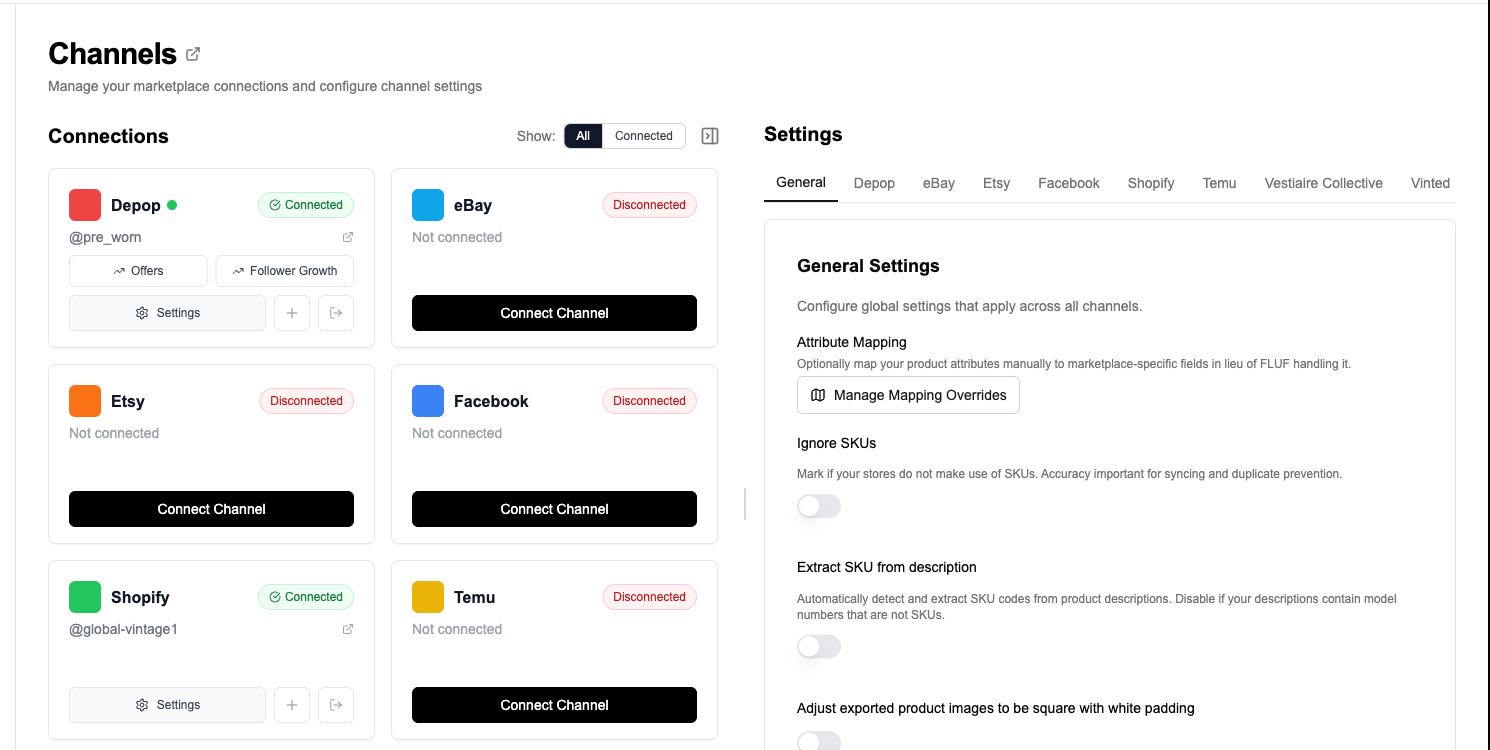
FLUF Connect handles this automatically. It connects Vinted, Yaga, and 7 other marketplaces — including Depop, eBay, Shopify, and Facebook Marketplace — with inventory sync across all of them.
How it works
- Connect your accounts — Link your Vinted and Yaga accounts (plus any other marketplaces) in minutes.
- Crosslist your products — Move listings between platforms individually or in bulk. Descriptions, photos, and product details are mapped automatically.
- Sync automatically — When an item sells on Vinted, FLUF Connect removes it from Yaga and every other channel. No double-selling, no manual updates.
| FLUF Connect Feature | Vinted | Yaga |
|---|---|---|
| Crosslisting | Yes — to/from all channels | Yes — to/from all channels |
| Inventory sync | Yes — real-time | Yes — real-time |
| Auto-relisting | Yes — smart strategies by age, price, category | No |
| Offer management | Yes — automated offers to likers | Yes — auto-accept/counter buyer offers + auto-message likers |
| Order sync | Yes | No |
| Bulk operations | Yes — find & replace, bulk pricing, bulk crosslist | Yes |
Vinted gets full automation support in FLUF Connect — including relisting and offer management, included from Seller upwards. Yaga now gets automated offer management too — FLUF auto-accepts or counters buyer offers in your Yaga inbox, and sends a friendly chat message to anyone who likes your items (Yaga has no built-in way to reach out to likers, so FLUF does it for you). Most competitors don’t support either Vinted or Yaga — FLUF Connect is one of the only crosslisting platforms that supports both.
Pricing: Plans start at £9/month, with no cap on how much you list. See full pricing.
Related Guides
- How to Sell on Vinted: The Complete Guide
- How to Sell on Yaga: The Complete Guide
- Vinted Crosslisting with FLUF Connect
- Crosslisting: The Complete Guide to Selling on Multiple Platforms
- How Inventory Sync Works
- Auto-Relisting: Keep Your Listings Fresh Automatically
- Offer Management Across Marketplaces
- Sell on Tradera — Sweden’s second-hand marketplace, with commission capped at 200 kr
Frequently Asked Questions
It depends entirely on where your buyers are. Vinted is better if you're selling to buyers in Europe or the US — it has 75+ million monthly active users across 26 countries. Yaga is the dominant platform in South Africa with 1M+ users and is the clear choice if you're targeting the South African market. Both charge zero seller fees.
Both platforms charge zero seller fees — you keep 100% of the sale price. The buyer pays a protection fee on both: Vinted charges buyers 3–8% + a fixed fee (varies by market), while Yaga charges buyers 6.5% + R19.90 per order. Neither platform charges listing fees or monthly subscriptions.
Yes. Since Vinted serves Europe and Yaga serves South Africa, selling on both gives you access to completely different buyer pools with no audience overlap. FLUF Connect supports crosslisting between Vinted, Yaga, and 7 other marketplaces with automatic inventory sync.
No. Yaga operates primarily in South Africa (with recent expansion into Kenya and plans for the Middle East and North Africa). It is not available in Europe. Vinted is the dominant second-hand fashion platform in European markets including the UK, France, Germany, and the Netherlands.
No. Vinted does not currently operate in South Africa. Yaga is the leading second-hand fashion marketplace for South African sellers and buyers, often described as 'the Vinted of South Africa.' If you sell to both markets, you'll need both platforms.
Yes. FLUF Connect supports crosslisting between Vinted and Yaga, along with 7 other marketplaces including Depop, eBay, and Shopify. Inventory syncs automatically — when an item sells on one platform, it's removed from the other.
Both use an escrow model with similar timelines. Vinted releases funds to your Vinted Wallet about 2 days after delivery confirmation, then bank withdrawal takes 2–5 business days. Yaga releases funds to your Yaga Wallet after the buyer confirms receipt, with bank withdrawal available thereafter. Total payout time is roughly 4–7 days from sale to bank on both.
Both platforms are strongest for fashion. Vinted has broader categories including home goods, electronics, and entertainment. Yaga is more fashion-focused — clothing, shoes, accessories, and beauty products. On Yaga, women's fashion dominates (approximately 68% of listings), while Vinted has a more balanced category mix across fashion, home, and lifestyle.