Sell on Tradera — The Complete Seller Guide to Sweden’s Second-Hand Marketplace
Free listings up to 500 a month, no fee if it does not sell, and commission capped at 200 kr however much the item goes for. Here is what Tradera costs, how its auctions actually work, and whether you can sell there from outside Sweden.



- Tradera is Sweden’s own second-hand marketplace, and it is bigger than outsiders assume. It turned over SEK 626 million in 2025, up 16%, carries three to four million live listings, and took 395 million site visits in 2024. Around 11.8 million items sold through it in 2025 alone.
- Listing is free for the first 500 items a month. Commission is 10% of the sale price including moms, with a minimum of 3 kr and — the number that matters — a maximum of 200 kr. On a 5,000 kr camera lens you pay 200 kr. Very few marketplaces cap their commission at all.
- You pay nothing if it does not sell, up to that 500-listing threshold. Beyond it an unsold-item fee of 3–10 kr applies per listing.
- Business sellers pay 8% excluding moms, capped at 160 kr — the same economics, quoted the other side of VAT. Shop subscriptions run from 545 to 1,845 kr a month.
- Sellers based outside Sweden are explicitly provided for. Tradera maintains a separate payment agreement for sellers resident or incorporated abroad, paying out through Hyperwallet to a PayPal address or a bank account. No personnummer or BankID appears in those terms.
- Both formats are live: auctions of 3 to 14 days, and fixed-price Köp nu listings that now run 60 days. Combine them and your Köp nu price vanishes the moment somebody bids.
- Buyer protection is paid by the buyer, at 2 kr plus 5% capped at 499 kr, and it has been mandatory on essentially all private sales since 2025. That is a real difference from marketplaces that fund protection out of the seller’s margin.
- What FLUF Connect does here today: connect your Tradera account and import your existing Tradera catalogue so it sits alongside your other channels. Creating and editing Tradera listings from FLUF is not available. 7 days for £1, then from £9/month. There is no free plan.
What is in this guide
- What Tradera is, and who owns it now
- How big it actually is
- What it costs to sell — private sellers
- What it costs — companies and shops
- Auctions, Köp nu, and the difference between them
- Writing a listing that works
- Shipping, and the rule that voids your seller protection
- Getting paid
- Can you sell on Tradera from outside Sweden?
- The rules that catch people out
- How it compares with the rest of Swedish resale
- Is it worth it?
- Tradera and FLUF Connect — what works today
- Sources and verification
- Related guides
What Tradera is, and who owns it now
Tradera is a Swedish online marketplace for second-hand and used goods, founded in Stockholm in 1999 by Daniel Kaplan. It runs both auctions and fixed-price listings, it is Swedish-language and Swedish-law, and it describes itself as Sweden’s largest marketplace for second-hand goods.
Its ownership history is more interesting than most, and it is widely reported wrongly, so it is worth getting straight. eBay bought Tradera in 2006 for SEK 365 million. When eBay and PayPal separated in 2015, Tradera went with PayPal. Then, on 2 December 2021, PayPal sold Tradera to five of its own managers in a management buyout — PayPal had concluded the marketplace was not strategic to it. In October 2022 the Swedish investment firm Ceder Capital took a minority stake through a directed share issue, with management keeping the majority. It remains privately held.
There was a leadership change this year: Erik Grohman became chief executive on 20 April 2026, taking over from Stefan Öberg after thirteen years; Öberg stayed on as a board member and owner. The legal entity behind everything is Tradera Marketplace AB, org.nr 556569-4642, registered in Stockholm.
Two things follow from that history that matter to you as a seller. The first is that Tradera is not a venture-funded land grab being run for growth at any cost — it is a profitable, independently owned business with about sixty employees that paid a SEK 100 million dividend in August 2026. Its fee structure has been stable for years, which is not something you can say about most marketplaces. The second is that it is emphatically a Swedish business rather than a local outpost of an international one, and its policies, its language and its buyer base all reflect that.
How big it actually is
Tradera publishes rather more about itself than most private marketplaces, though not everything, so some of what follows is a range rather than a figure.
| Measure | Latest published figure |
|---|---|
| Revenue | SEK 626 million in 2025, up 16% year on year |
| Live listings | Over 4 million (April 2026); over 3 million (November 2025) |
| Items sold per year | Around 11.8 million in 2025 |
| Cumulative listings | Passed 700 million in November 2025 |
| Cumulative items sold since 1999 | Over 205 million |
| Site visits | 395 million in 2024, up 26% |
| Registered members | Reported between 3.6 million and over 4 million |
| Goods sold (GMV) | Over SEK 3 billion in 2024; over SEK 350 million in October 2025 alone |
Note that revenue and GMV are different things and are often confused when Tradera is compared with its rivals. Tradera’s SEK 626 million is commission income. The value of goods changing hands across the platform is several billion kronor. We come back to this in the competition section, because it is the single most common way Tradera is made to look smaller than it is.
Tradera does not publish a demographic breakdown of its buyers, or a category-by-category split of what sells, and we have not found a credible third-party one. Anyone quoting you precise Tradera buyer demographics is guessing.
What it costs to sell — private sellers
Tradera quotes private-seller prices including moms and business prices excluding moms, which is why you will see both 10% and 8% cited for what is the same commission. Everything in this section is the private-seller, VAT-inclusive schedule from Tradera’s own fee page.
| Charge | Amount | When it applies |
|---|---|---|
| Listing fee | Free for the first 500 listings per calendar month | Always, up to the threshold |
| Commission | 10% of the sale price, minimum 3 kr, maximum 200 kr | Only when the item sells |
| Unsold-item fee | 3 kr or 10 kr per listing | From listing 501 onward in a calendar month |
| Highlight (fetstil) | 15 kr | Optional, charged whether or not it sells |
| Rank up (höj upp) | 45 kr | Optional, charged whether or not it sells |
| Reserve price | 40 kr | Optional, charged whether or not it sells |
| Payment processing | None charged to the seller | — |
| Payout fee | None | — |
| Late-payment reminder | 60 kr | If your balance goes unpaid |
The 200 kr commission cap is the headline. Most marketplaces take a straight percentage with no ceiling, so a high-value sale costs you proportionally the same as a cheap one. On Tradera, commission stops climbing once the sale price passes 2,000 kr. Sell a watch for 12,000 kr and the commission is still 200 kr — about 1.7%. For anyone dealing in cameras, instruments, furniture, collectables or anything else with a high unit price, that cap is the reason to be on the platform at all, and it is why Tradera reads very differently to a furniture dealer than to someone selling t-shirts.
The unsold-item fee is the mirror image. It only starts at listing 501 in a month, so a normal private seller never meets it. It is 3 kr in the collectable and media categories — Antiques, Stamps, Art, Coins, Collectibles, Postcards, Books, DVD, Music and Garden — and 10 kr everywhere else. Charity listings are excluded from the count entirely. Note one detail that catches high-volume sellers: restarted listings and automatic repetitions are billed as new listing periods, so an item you restart twice consumes three of your 500 and can attract the fee three times.
Two smaller charges are worth knowing. A late-payment reminder costs 60 kr, and if a buyer fails to collect a returned item during a dispute there is a 79 kr charge. And there is a live promotion worth checking if you are selling a car: vehicles sold through the “Säljes” contact-the-seller format carry 0% commission, free through 2026 and 2027. Be careful with that one — the same vehicle listed as an auction or a Köp nu item pays the normal 10%, and Swedish motoring press reported sellers being caught out by exactly that distinction.
Private sellers can also subscribe to a shop. Samlarbutik costs 295 kr a month for 10,000 shop listings and is restricted to used goods or collector’s items no longer available new. Miniprisbutik costs 245 kr a month, also for 10,000 listings, and is for items priced at 30 kr or under — it drops the minimum commission on those cheap items but charges 15% on anything priced 31 kr or above, so read it carefully before assuming it is the cheaper option.
What it costs — companies and shops
Business prices are quoted excluding moms and reconcile exactly with the private schedule at Sweden’s 25% VAT rate. Commission is 8% of the sale price, minimum 2.40 kr, maximum 160 kr. The optional upgrades are 12 kr to highlight, 36 kr to rank up and 32 kr for a reserve price. The unsold-item fee is 2.40 kr in the collectable and media categories and 8 kr elsewhere, again from listing 501.
| Shop tier (business) | Per month, excl. moms | Shop listings | Auction / Köp nu listings included |
|---|---|---|---|
| Bas | 0 kr | — | 500 |
| Butik Small | 545 kr | 500 | 500 |
| Butik Medium | 1,145 kr | 2,000 | 500 |
| Butik Large | 1,845 kr | 5,000 | 500 |
| Samlarbutik | 275 kr | 10,000 collectables | 500 |
Commission is the same 8% with a 160 kr cap on every tier, so the subscription buys listing capacity rather than a better rate. There is one restriction that surprises people and it is absolute: shops may only be used by companies selling used or second-hand goods, and new stock may not be sold in a shop. Tradera is a circular marketplace by design, not a general trading platform with a second-hand section. If your business sells new inventory, the shop tiers are not open to you.
One legal consequence of trading as a business rather than a private individual: Swedish consumer law gives the buyer a statutory right of withdrawal (ångerrätt) when they buy from a company. Private-to-private sales carry no such right. That changes your returns exposure materially and should be priced in before you register a company account.
Auctions, Köp nu, and the difference between them
Tradera runs several listing formats and they behave differently enough that choosing wrongly costs you money.
Auctions run for a length you choose, minimum 3 days and maximum 14. Bidding uses a fixed increment ladder rather than free-form bids: 1 kr steps up to 19 kr, 5 kr to 99, 10 kr to 149, 15 kr to 299, 20 kr to 499, 25 kr to 999, 40 kr to 2,499, 50 kr to 2,999, 100 kr to 4,999, 250 kr to 9,999, and 500 kr above that. Bids are binding, and shill bidding suspends both accounts involved.
Fixed price (Köp nu) listings published after 18 March 2026 run for 60 days. You will still find Tradera help pages saying 30 days; those are stale, and the listing-formats page is the current one.
Shop listings, available only to shop subscribers, run until you end them or the stock reaches zero.
You can combine an auction with a Köp nu price, and there is one behaviour to understand before you do: the Köp nu price disappears as soon as anyone places a bid above any reserve you have set. If your Köp nu price is the number you actually want, a single low bid removes the option for everyone else. Sellers who care about a floor price should use a reserve rather than relying on Köp nu to hold the line.
A reserve price is hidden from bidders, costs 40 kr whether or not the item sells, and ends the auction with no winner if nothing reaches it. A buyer whose maximum bid sits below the reserve has it automatically raised to the reserve. Automatic restart is an opt-in upgrade that relists an unsold item up to twice; the restart itself is free, but any paid upgrades are charged again on each restart, and each restart counts as a new listing period.
On Köp nu listings only, buyers can send price offers: a maximum of three per buyer per listing, none more than 25% below your asking price, each valid for 24 hours.
Writing a listing that works
You can attach up to 40 photographs to a listing when you publish from tradera.com or the mobile apps. There is an important caveat that Tradera states itself and that anyone using external tooling needs to know: external seller tools, including Tradera’s own ProLister and third-party integrations, do not yet support 40 images. If you list through anything other than the website or the app, expect a lower ceiling.
Condition is a required, structured field with five values: Oanvänt (completely new and never used, no marks or defects), Mycket gott skick (barely noticeable use, light packaging damage or tiny scratches), Gott använt skick (small scratches or pilling, fully functional, no major damage), Okej använt skick (visible wear and tangible cosmetic flaws, still usable), and Defekt (damaged or non-functioning, for repair or parts). Those Swedish labels are the ones buyers filter on, so grading honestly and precisely is worth more here than a paragraph of prose about how lovely the item is.
Brand, colour, size and material are real structured attributes rather than free text, and Tradera has been automating their entry: it auto-fills attributes from photographs for clothing, and auto-generates titles and descriptions for books, video games and vinyl. Tradera does not publish a maximum title length, a description length limit, or a statement on whether HTML is allowed in descriptions, and we have not found any of those documented anywhere, so we are not going to invent numbers for them.
For bulk work, ProLister is Tradera’s own free browser tool: folders, bulk edits, scheduled batch publishing, bulk handling of active and unsold items, and CSV import. There is also a newer feature that lets you photograph several items at once and have Tradera group them into ready-to-edit drafts, currently on the web and iOS.
Shipping, and the rule that voids your seller protection
Tradera operates its own shipping selector. You choose which carriers to offer, and Tradera books the shipment and issues the label or QR code. The integrated carriers are PostNord (both letterbox and agent delivery), Instabox, DHL, DHL Express and DSV — the last being DB Schenker under its new name. Label-printer support exists for anyone shipping at volume.
Parcels fall into three size bands. Small is 34 by 24 by 7 cm and can go by Instabox, PostNord letterbox, PostNord agent, DSV or DHL. Medium is 60 by 40 by 20 cm, dropping the letterbox option. Large is 120 by 40 by 40 cm, extending to 140 cm with DSV, and only DSV and DHL carry it. Anything over 20 kg has to be arranged outside Tradera altogether.
Shipping prices are not published as a table. Tradera routes you to a calculator and explicitly disclaims the rates, noting that they are set by each carrier and cannot be guaranteed by Tradera. The EU is now the default shipping area, and you can add a packaging markup on top of the carrier price.
Now the part that costs sellers real money. Tradera operates a seller protection scheme, and its central condition is that you shipped tracked and insured to the address the buyer gave. Meet that and Tradera can refund a buyer under buyer protection without the seller being affected — their words. Miss it and you wear the loss. The exceptions are explicit: an item never shipped, packaging guidelines not followed, or a return you accepted. The practical implication is blunt and worth repeating, because it is the single most expensive mistake on this platform: sending something by untracked post or digital stamp to save a few kronor voids your protection on that sale.
Buyers have 30 days from payment to raise a buyer-protection claim, or 120 days if they paid with Klarna.
Getting paid
Tradera’s payment service is called Traderabetalning and your seller balance is the Saldo. Buyers can pay by Swish, card, Klarna, Google Pay or Apple Pay.
Both the payment service and payouts are free to sellers. There is no per-payout charge and no separate card or Swish processing fee taken from you — commission is deducted at the moment of sale and that is the whole of it. Fees are netted off your Saldo, and if the balance is negative at month end Tradera invoices you, with no invoice fee.
Money is not held in escrow until delivery, which surprises sellers who have come from other platforms. Funds arrive in your Saldo according to the payment rail the buyer used: Swish immediately, Trustly after one banking day, Klarna after two, and card, Apple Pay or Google Pay after three. Tradera tells sellers to ship while the payment still shows as incoming, because it is guaranteed. The one thing to wait for is an order sitting at “Betalningen behandlas”, which is a routine random check that normally clears within a day — do not ship until it reads Betald.
You can withdraw at any time, with a limit of one withdrawal per day. Manual payout to Swish arrives in minutes and works around the clock, but it requires a matching personnummer, Swish on your registered mobile number and Mobilt BankID. Bank transfer lands the same day if you start it before 10:00 and the next business day otherwise. Automatic payouts run weekly on Thursdays or monthly on the 25th, taking one to three banking days.
Buyer protection is charged to the buyer, not to you: 2 kr plus 5% of the order value, capped at 499 kr per order. It has been mandatory since 9 April 2025 on orders of 200 kr or more, on all private-seller sales, on all Klarna payments and on foreign business sales, and it can be waived on local collection and on business orders under 200 kr. It does not apply to property, vehicles, or tickets and travel. This matters when you compare Tradera with marketplaces that fund buyer protection out of the seller’s side of the transaction: here, that cost sits with the buyer.
Can you sell on Tradera from outside Sweden?
Yes, and Tradera has written terms specifically for it — which is stronger evidence than most marketplaces offer on this question.
Tradera maintains two parallel payment agreements split by where the seller lives, and its user agreement says so explicitly: which terms apply depends on whether you are resident in Sweden or abroad. Sellers resident or incorporated in Sweden fall under one document, where payments are handled by Tradera Marketplace AB itself as a licensed payment institution supervised by Finansinspektionen. Sellers resident or incorporated outside Sweden fall under a separate agreement for sellers outside Sweden.
What that second document requires is modest: a registered Tradera user account, plus the account details, PayPal email address or bank account required by Hyperwallet. Payouts for foreign sellers run through Hyperwallet rather than through Tradera’s own Saldo rails. Neither agreement mentions a personnummer, an organisationsnummer, BankID or a Swedish bank account as a prerequisite. Both require that the payout account name matches the seller, and both reserve the right to request identity verification.
Two honest caveats. First, personnummer and Mobilt BankID are required for the instant Swish payout route specifically, so some paths through the product are genuinely gated on Swedish identity even though registration is not. Second, and more importantly, Tradera does not publish a list of countries it accepts sellers from. The terms provide for foreign sellers in general; they do not enumerate which countries qualify. If you are outside Sweden and this is a business decision rather than an experiment, confirm your own country with Tradera before building around it.
On shipping outward, the EU is the default area and Tradera’s own English guidance is that selling within the EU is straightforward using Tradera’s shipping, while sales outside the EU require you to arrange shipping yourself, with customs charges possible. Cross-border transactions are subject to currency conversion depending on the buyer’s and seller’s local currencies.
The rules that catch people out
Tradera’s rules index is worth reading properly if you sell at any volume, because several of its prohibitions are about listing practice rather than about what the item is, and those are the ones that catch otherwise careful sellers.
On practice: generic or stock product images are banned outright, so a catalogue photo from a supplier is not acceptable even when it accurately shows the item. Pre-selling and dropshipping are both prohibited — you are expected to have the thing. There are limits on listing multiple identical items. Steering a buyer off the platform to complete a sale is prohibited. So is miscategorisation, and so are misleading titles and item descriptions.
Those five rules together describe a marketplace built around individual second-hand items with their own photographs, and they are the reason a bulk-listing workflow that works fine on a general marketplace can get you into trouble here. If your process involves the same stock photo across many listings, or listing stock you have not yet received, it does not transfer to Tradera.
On prohibited goods, the categories are broadly what you would expect — counterfeits and replicas, weapons, drugs and drug paraphernalia, medicines, explosives and chemicals, pornographic material, offensive items, food, animal and plant-related items including CITES-listed species, uniforms and security items, counterfeit currency and stamps, services and gift cards, software and electronic media. One that is less obvious and does trip people up: used underwear is its own prohibited category.
Tax, and the number everyone gets wrong
Two separate things get conflated constantly here, and conflating them costs people money and sleep.
The first is Swedish tax. Skatteverket’s test for näringsverksamhet is three cumulative criteria — självständighet, vinstsyfte and varaktighet — and it specifically names second-hand sales as normally taxed as inkomst av tjänst rather than as a business, because they lack profit-generating potential. Separately, when you sell your own personal belongings, gains are only reportable above 50,000 kr in a year, per co-owner; you may use a flat 25% of the sale price as your cost base, and tax on the reportable surplus is 30%. There is a carve-out worth knowing: kapitalplaceringstillgångar — precious metals not set in jewellery, art kept in storage, cryptocurrencies — get no 50,000 kr exemption at all.
The second is DAC7 reporting, and it is not a tax. Under rules in force since 1 January 2023, platforms report sellers to Skatteverket. Tradera’s own DAC7 page says it reports sellers who sold more than 29 items or received more than 2,000 euro in a year, sharing identity details, transaction counts and values, the fees it charged, and the payout bank or PayPal account, once a year.
Here is the error to avoid: the DAC7 thresholds are not tax thresholds. Crossing 30 items does not make you a business and does not create a tax bill. It means Tradera tells Skatteverket about you. Equally, staying under them does not exempt you from tax you would otherwise owe. Tradera says as much itself — the reporting changes nothing about your liability. Skatteverket publishes no bright-line “X items a year makes you a trader” rule, and treating the DAC7 numbers as one is the single most common mistake sellers make.
One thing we could not establish: Tradera publishes no numeric trigger at which a private account must become a business account. That trigger is Swedish tax law rather than a Tradera rule, so if you are near it, ask Skatteverket or an accountant rather than a marketplace guide. Note too that once you do trade as a business, Konsumentköplagen binds you from your first consumer sale, cannot be contracted away, and carries at least three years of liability for original defects.
How it compares with the rest of Swedish resale
Sweden has an unusually crowded second-hand market for a country of ten million people, and the comparisons are routinely made badly. Here is the honest version.
Blocket is the giant. Its parent rebranded to Vend Marketplaces in 2025, and the Swedish entity reported net revenue of about SEK 1.30 billion for 2024 — roughly twice Tradera’s. Blocket is classifieds-first: you list, a buyer contacts you, and you settle between yourselves. It has close to universal brand awareness in Sweden. Tradera is a transactional marketplace with auctions, integrated payments, shipping and buyer protection. They overlap on general used goods and diverge completely on how a sale actually completes.
Sellpy, majority owned by H&M, reported passing SEK 2 billion in revenue in its financial year to November 2025, with losses widening to SEK 168 million. Do not read that as Sellpy being three times Tradera’s size. Sellpy is a consignment service that takes your clothes, photographs and sells them for you, and books the whole merchandise value as revenue; Tradera books only its commission. Comparing the two revenue lines compares two different accounting models, not two market shares.
Vinted entered Sweden in October 2022, its first Nordic market. The only Sweden-specific figure Vinted has published is around €39 million of annualised GMV as of the fourth quarter of 2023, with more than a million transactions by Swedish sellers in that quarter. It is concentrated in fashion, and its zero-seller-fee model competes directly for the clothing seller Tradera would otherwise have. It does not compete at all for the camera lens, the vinyl collection or the mid-century chair.
Tise is the Norwegian second-hand app that entered Sweden in 2018, with over 2.5 million registered Nordic users. There is a neat symmetry worth noting: eBay agreed to acquire Tise in September 2025, valuing it at around NOK 1.3 billion. eBay owned Tradera from 2006 to 2015, sold its way out through PayPal, and has now bought back into Nordic consumer-to-consumer resale through a different door.
Plick is a Swedish second-hand fashion app reporting a million registered users, skewing heavily to under-thirties. And Facebook Marketplace is present, as everywhere, though Meta publishes no country-level figures at all, so anyone quoting you a Swedish Marketplace number has made it up.
The strategic read: Tradera’s defensible ground is the long tail of specific, findable, often higher-value objects — collectables, media, tools, cameras, instruments, furniture — where an auction format and a searchable catalogue beat a scrolling feed, and where a 200 kr commission cap beats a percentage. It is squeezed hardest in general fashion, which is precisely where Vinted, Plick, Tise and Sellpy all live.
Is it worth it?
For a Swedish seller with anything other than plain clothing, yes, and the commission cap is most of the reason. There is no listing fee to risk within your first 500 items a month, nothing to pay if the item does not sell, no payment-processing cut, no payout fee, and a hard 200 kr ceiling on what a single sale can cost you. Buyer protection is funded by the buyer. That is a genuinely seller-friendly structure and it is unusual.
The case is weaker if you sell general fashion at low unit prices. There the 3 kr minimum commission is neither here nor there, but you are competing against platforms that charge the seller nothing at all and have the audience for exactly that stock. Selling a 90 kr top on Tradera is possible; it is not where the platform is strong.
It is also worth being clear-eyed about reach. Tradera is a Swedish-language marketplace whose buyer base is overwhelmingly Swedish. Foreign sellers are provided for in the terms, but you would be selling to Sweden from abroad, not using Tradera to reach a European audience. Treat it as a route into one specific, wealthy, high-trust market rather than as an expansion play.
Tradera and FLUF Connect — what works today
We would rather tell you exactly where this stands than imply more than is true.
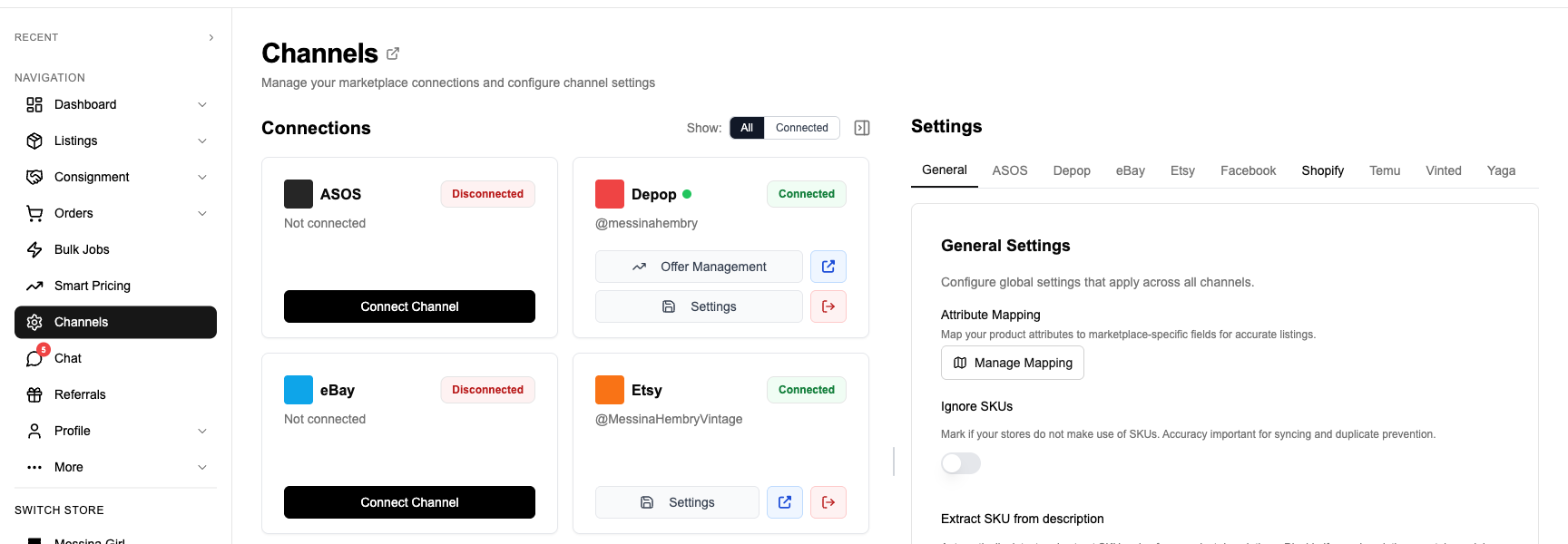
Connect your Tradera account in FLUF Connect to import your existing catalogue. No browser extension is required.
What is switched on today is the read side. You can connect your Tradera account to FLUF and import your existing Tradera catalogue, so your Tradera items appear in the same dashboard as your listings on every other channel you have connected, and you can search across them.
Creating, editing and ending Tradera listings from FLUF Connect are not available. Order sync is also unavailable. Manage those actions directly in Tradera, and remove sold items from other marketplaces manually.
There is also a specific technical reason not to rush it, and it is the same caveat flagged in the listing section above. Tradera’s 40-image ceiling applies to its own website and apps; external seller tools do not yet support it. Any integration writing listings to Tradera has a lower effective image limit than a seller typing the listing in by hand, and that is worth knowing before you move a photograph-heavy catalogue across.
Everything else FLUF does is unaffected. Crosslisting and inventory sync work across the marketplaces FLUF supports on every paid plan, and relisting, offer management and smart pricing are included from Seller upwards. We will update this page when Tradera writes go live.
Sources and verification
- Tradera’s private-seller fee page and the business price list — commission, caps, upgrade prices and shop tiers.
- Tradera on the unsold-item fee — the 500-listing threshold, the category split, and restarts counting as new listing periods.
- Tradera’s shop products and the business FAQ — including the rule that shops may only sell used goods.
- Listing formats, how Köp nu interacts with bidding, reserve prices, the bid ladder and price offers.
- Tradera on the 40-image limit, including the external-tool caveat, and the five condition values.
- Shipping for sellers, the EU shipping area, and seller protection with its tracked-and-insured condition.
- Settlement timing by payment method, manual payouts, and mandatory buyer protection.
- Payment terms for sellers outside Sweden — the Hyperwallet requirement and the absence of any Swedish-identity prerequisite.
- Tradera’s rules index — prohibited goods and prohibited listing practices.
- Tradera’s 2025 results and the change of chief executive, the 700-million-listings release and the 2024 traffic figures.
- The 2021 management buyout from PayPal and Ceder Capital’s 2022 minority investment.
- eBay’s acquisition of Tise — Nordic marketplace context.
What we could not verify, and therefore left out. Tradera’s full-year 2025 GMV, which is not published — only the 2024 figure and a single record month. A single reliable member count: Tradera’s own materials and third-party summaries disagree, so we have given a range. Its 2025 profit, which appears in three conflicting published forms depending on whether the figure is operating or post-tax, so we quote none of them. Maximum title length, description length limits and whether HTML is permitted in descriptions, none of which Tradera documents. The size and depth of the category tree. Buyer demographics and the category mix of what sells, which Tradera does not publish and no credible third party has measured. The threshold at which a private seller must convert to a business account, which Tradera does not publish as a number. Whether Tradera operates a soft close on auctions — its bidding rules are silent on extensions, so we have not claimed either way. And the widely repeated claim that funds are released 48 hours after a buyer confirms delivery, which we could not substantiate and which the settlement-timing page above appears to contradict outright.
Related guides
- Sell on Tise — the Nordic second-hand app
- Sell on Vinted — the complete seller guide
- Sell on eBay — the complete seller guide
- Vinted vs Yaga compared
- All marketplace guides
- All crosslisting routes
- Tradera vs eBay compared
- Crosslist from Tradera to Vinted
- Crosslist from Tradera to Shopify
- Tradera vs Vinted — which one actually pays a Swedish seller more
- Crosslist from Tradera to eBay — reaching buyers outside Sweden
- Crosslist from Tradera to Etsy — which stock actually qualifies
- Crosslist from Tradera to Facebook Marketplace
- Crosslist from Tradera to Depop
- Crosslist from Tradera to Grailed
Subscribe to seller brief
Choose topics firstFrequently Asked Questions
For a private seller, listing is free for the first 500 items a calendar month and commission is 10% of the sale price including moms, with a minimum of 3 kr and a maximum of 200 kr. You pay nothing at all if the item does not sell. There is no payment-processing fee and no payout fee. Optional upgrades cost extra whether or not the item sells: 15 kr to highlight, 45 kr to rank up, 40 kr for a reserve price. Business sellers pay 8% excluding moms with a 160 kr cap, which is the same gross amount quoted the other side of VAT.
Yes, and it is the most important number on the platform. Commission stops climbing once the sale price passes about 2,000 kr, because it is capped at 200 kr including moms for private sellers and 160 kr excluding moms for businesses. Sell a lens for 5,000 kr and you pay 200 kr; sell a watch for 12,000 kr and you still pay 200 kr, which works out at about 1.7%. Very few marketplaces cap commission at all, and it is why Tradera reads completely differently to someone selling cameras, instruments, furniture or collectables than to someone selling low-value clothing.
Yes. Tradera maintains a separate payment agreement specifically for sellers resident or incorporated outside Sweden, and its user agreement says which terms apply depends on where you live. Under those foreign-seller terms you need a registered Tradera account plus the account details, PayPal email address or bank account required by Hyperwallet, which handles payouts for non-Swedish sellers. Neither agreement requires a personnummer, an organisationsnummer, BankID or a Swedish bank account. Two caveats: personnummer and Mobilt BankID are required for the instant Swish payout route specifically, and Tradera does not publish a list of which countries it accepts sellers from, so confirm your own before building a business around it.
Auctions run for a length you choose, from a minimum of 3 days to a maximum of 14. Fixed-price Köp nu listings published after 18 March 2026 run for 60 days — you will still find Tradera help pages saying 30 days, but those are stale. Shop listings, which need a shop subscription, run until you end them or the stock reaches zero. Unsold auctions can be restarted automatically up to twice; the restart itself is free, but any paid upgrades are charged again each time and each restart counts as a new listing period.
Sooner than most people expect, because funds are not held in escrow until delivery. Money reaches your Saldo according to the rail the buyer paid on: immediately for Swish, after one banking day for Trustly, two for Klarna, and three for card, Apple Pay or Google Pay. Tradera tells sellers to ship while the payment still shows as incoming, because it is guaranteed. You can withdraw at any time, once a day; manual payout to Swish arrives in minutes, bank transfer the same day if you start before 10:00. The one thing to wait for is an order reading Betalningen behandlas, which is a routine check that normally clears within a day.
The buyer does. It costs 2 kr plus 5% of the order value, capped at 499 kr per order, and it has been mandatory since 9 April 2025 on orders of 200 kr or more, on all private-seller sales, on all Klarna payments and on foreign business sales. It can be waived on local collection and on business orders under 200 kr, and it does not apply to property, vehicles or tickets and travel. This is a genuine structural difference from marketplaces that fund buyer protection out of the seller's margin.
Not shipping tracked and insured. Tradera's seller protection turns on having shipped tracked and insured to the address the buyer gave; meet that and Tradera can refund a buyer under buyer protection without the seller being affected, in its own words. The explicit exceptions are an item that was never shipped, packaging guidelines that were not followed, or a return you accepted. The practical consequence is worth stating plainly, because it is the most expensive mistake on the platform: posting something by untracked mail or digital stamp to save a few kronor voids your protection on that sale.
No, and this is the most common misunderstanding about selling in Sweden. The 29-items-or-2,000-euro figures come from DAC7, which is a reporting rule: above them, Tradera tells Skatteverket about you once a year, sharing your identity, transaction counts and values and your payout account. It creates no tax and changes no liability, and Tradera says so itself. Whether you are taxed as a business is decided separately by Skatteverket's three tests of independence, profit motive and continuity — and Skatteverket specifically names second-hand selling as normally taxed as employment income rather than business income. Separately, gains on your own personal belongings are only reportable above 50,000 kr a year.
Several of Tradera's rules are about how you list rather than what you list, and they are the ones that catch sellers who work at volume. Generic or stock product images are banned outright, so a supplier photograph is not acceptable even when it accurately shows the item. Pre-selling and dropshipping are both prohibited — you are expected to have the thing. There are limits on listing multiple identical items, steering a buyer off the platform is prohibited, and so are miscategorisation and misleading titles or descriptions. Together those describe a marketplace built around individual second-hand items with their own photographs, which is why a bulk-listing routine that works elsewhere may not transfer.
Not yet. You can connect Tradera and import your existing catalogue into FLUF Connect. Creating, editing and ending Tradera listings, and order sync, are not available. Manage listings and orders in Tradera and remove sold items from your other channels yourself.