Tradera to eBay: crosslist Swedish stock to a global audience
Tradera sells to Sweden; eBay sells across borders. A practical guide to running the same second-hand stock on both — the auction trap, the fees, and what FLUF can and cannot sync across 60+ marketplaces.



- This is a reach argument, not a fee argument. Tradera sells to Swedish buyers; eBay puts the same item in front of buyers in dozens of countries. If your stock is internationally collectable — antiques, watches, vinyl, cameras, vintage clothing — the domestic auction is the smaller of the two audiences you already qualify for.
- eBay does not own Tradera any more. It bought Tradera in April 2006, the business passed to PayPal in the 2015 split, and PayPal sold it in 2021. Two separate accounts, two fee schedules, no shared login and no shared feedback.
- An auction has no price to carry across. Tradera is auction-first, and the Köp nu price vanishes the moment a bid lands. You decide the eBay number yourself.
- Never duplicate a live auction with bids on it. A bid on Tradera is binding; if the eBay copy sells while the auction runs, you owe one item to two buyers.
- Sold-out protection runs in one direction here. FLUF connects Tradera and imports its catalogue, then publishes and syncs on the eBay side. No sale signal comes back from Tradera yet, so a Tradera sale does not pull the eBay listing down for you.
- Tradera charges the seller 10% including moms, capped at 200 kr — contrary to an AI summary currently claiming it has no seller fees. The cap is the interesting part.
- No browser extension is needed to connect Tradera and import your catalogue.
- Through FLUF Connect: one catalogue, 60+ marketplaces, eBay without an open browser. 7 days for £1, then from £9/month. There is no free plan.
Sweden, or the world: the only reason to run both
Run both because Tradera sells to Sweden and eBay sells across borders, and Tradera’s strongest categories are exactly the ones with buyers outside Sweden.
Tradera is a Swedish site with Swedish buyers and very good at being that. It moved roughly 11.8 million items in 2025 and over 205 million since 1999, and has been a 100% second-hand, circular marketplace since 2019. Clothing ranks first by units sold and children’s clothing fourth, according to Tradera’s own category reporting. Alongside that sit antiques, collectables, glass and ceramics, music and cameras.
Now look at that list from outside Sweden. A Gustavsberg vase, a Hasselblad body, a run of Swedish progressive rock on vinyl, a 1970s Fjällräven anorak — each has a buyer in Tokyo, Berlin, Chicago and Sydney who will never see a Tradera listing, because they are not browsing a Swedish auction site. That is the whole argument on this page. It is not that eBay is cheaper. It is that for a large slice of Swedish second-hand stock the domestic audience is the smaller of the two you can reach with the same photographs.
The inverse matters just as much, because it stops you crosslisting indiscriminately. A bag of children’s clothes, a flat-pack bookshelf, a pram, a set of winter tyres — these have no international buyer at a price that survives postage, and they belong on Tradera alone. The filter before you copy anything across is one question: would somebody who does not live in Sweden want this specific thing enough to pay international postage for it? Crosslisting is a targeting decision made item by item, not a volume game.
Is Tradera eBay? No — and here is the timeline
No. eBay used to own Tradera and has not for years. They are separate businesses with separate accounts, fees and logins.
The question keeps appearing in Swedish search — är tradera ebay, äger ebay tradera — and the confusion is fair, because for years the answer was yes. Wikipedia’s account gives the sequence: eBay acquired Tradera in April 2006 for 365 million kronor; when eBay and PayPal separated in 2015, Tradera went with PayPal; and PayPal sold Tradera in 2021, at which point it became a Swedish company again.
Why that matters to you rather than being trivia:
- Your feedback does not travel. A decade of Tradera ratings buys you nothing on eBay. You start there as a new seller, with the selling limits that implies, so plan a first month of small, safe items rather than opening with your best piece.
- Nothing is mirrored. Every eBay listing is one you or a tool put there.
- The fee schedules are unrelated, and neither caps or offsets the other. A Tradera buyer-protection case and an eBay dispute are separate processes with different evidence rules and deadlines.
Auction versus fixed price: the number you have to decide
Tradera is auction-first and eBay has drifted heavily to fixed price, so the shape of this route is: an auction becomes a price, and you choose it.
Tradera’s listing formats are an auction of 3 to 14 days, a fixed “Köp nu” price, or both together — and in that combined format the Köp nu price disappears as soon as a bid is placed. eBay still supports auctions, but its centre of gravity has been fixed-price listings for years, along with the buyer behaviour that goes with them: search, compare, buy, or send an offer.
So there is nothing to copy. An open auction has a starting bid, deliberately low to attract bidding, and possibly a hidden reserve costing 40 kr sold or unsold. Neither is a price. Convert each case like this:
- The listing had a Köp nu price. Use it as a baseline, then add the difference in cost of sale and postage. It was a number you were content to accept immediately — but a number for a Swedish buyer paying Swedish postage.
- The listing had a reserve. The reserve is your floor. Price at or above it, and leave headroom if you will accept offers, because eBay buyers will send one.
- It was a pure open auction with no reserve. You have not stated a price yet, and the starting bid is not one. Price at what you would have been pleased to see the hammer fall at, and expect the listing to sit — a fixed-price listing has none of an auction’s deadline pressure.
- It sold on Tradera before and you are relisting. The realised price is the most useful data point you own — but it is a Swedish price, and for collectable stock the international one is often higher.
The live-auction trap, said plainly
Do not copy a Tradera auction with bids on it onto eBay. If the eBay copy sells, you owe the same single item to two buyers, and one will be disappointed by you rather than by a platform.
A bid on Tradera is binding: once somebody has bid above your reserve that auction will produce a winner, and you cannot quietly withdraw the item because it sold elsewhere. Meanwhile an eBay fixed-price listing can be bought at any second by somebody in another time zone while you are asleep. Put those two facts in the same room and you have a real oversell, with a buyer-protection case at one end and a non-performance defect at the other.
The rule that keeps you safe:
- Crosslist Köp nu listings, not open auctions. Two fixed-price listings can both be pulled down in seconds; an auction cannot.
- If an item is going to auction, keep it to Tradera for that cycle. The auction format is for things whose price you genuinely do not know.
- If a bid lands on a combined listing, treat the eBay copy as urgent. The Köp nu price disappears when the first bid arrives, so a listing that was safe on Monday can be unsafe by Wednesday without you touching it.
- Do not rely on a tool to catch this on this pair. Read the next section before assuming automation covers it. It does not, and we would rather say so than let you find out through a cancelled order.
What FLUF actually does on this pair today
The honest description, because getting it wrong costs money rather than time: FLUF imports your Tradera catalogue, then publishes and syncs on the eBay side. No sale signal comes back from Tradera yet, so sold-out protection on this pair runs in one direction only.
| Capability through FLUF Connect | Tradera | eBay |
|---|---|---|
| Connect the account | Yes; no browser extension needed. | Yes; no browser extension needed. |
| Import your existing catalogue | Yes | Yes |
| Create and edit listings from FLUF | No — writes held closed pending a first verified lifecycle | Yes |
| Order sync back into FLUF | No | Yes |
| Mark as sold when it sells elsewhere | No | Yes |
| Automated relisting | No | Yes |
| Offer management | No | Yes |
| Refunds and fulfilment | No | Yes |
Read the order-sync and mark-as-sold rows together, because they govern how you use this route. If the item sells on eBay, we can act: the order comes back into FLUF, the sale is recorded, and your other connected channels are updated. If it sells on Tradera, we do not find out. There is no order feed from Tradera into FLUF yet, so nothing pulls the eBay listing down. You have to end it yourself, promptly.
That is why the live-auction warning above is written as strongly as it is: the automation that would otherwise catch a duplicate sale is the automation this pair does not have in the Tradera-to-FLUF direction. Anyone telling you a tool makes crosslisting a Tradera auction safe is describing a capability that does not exist here.
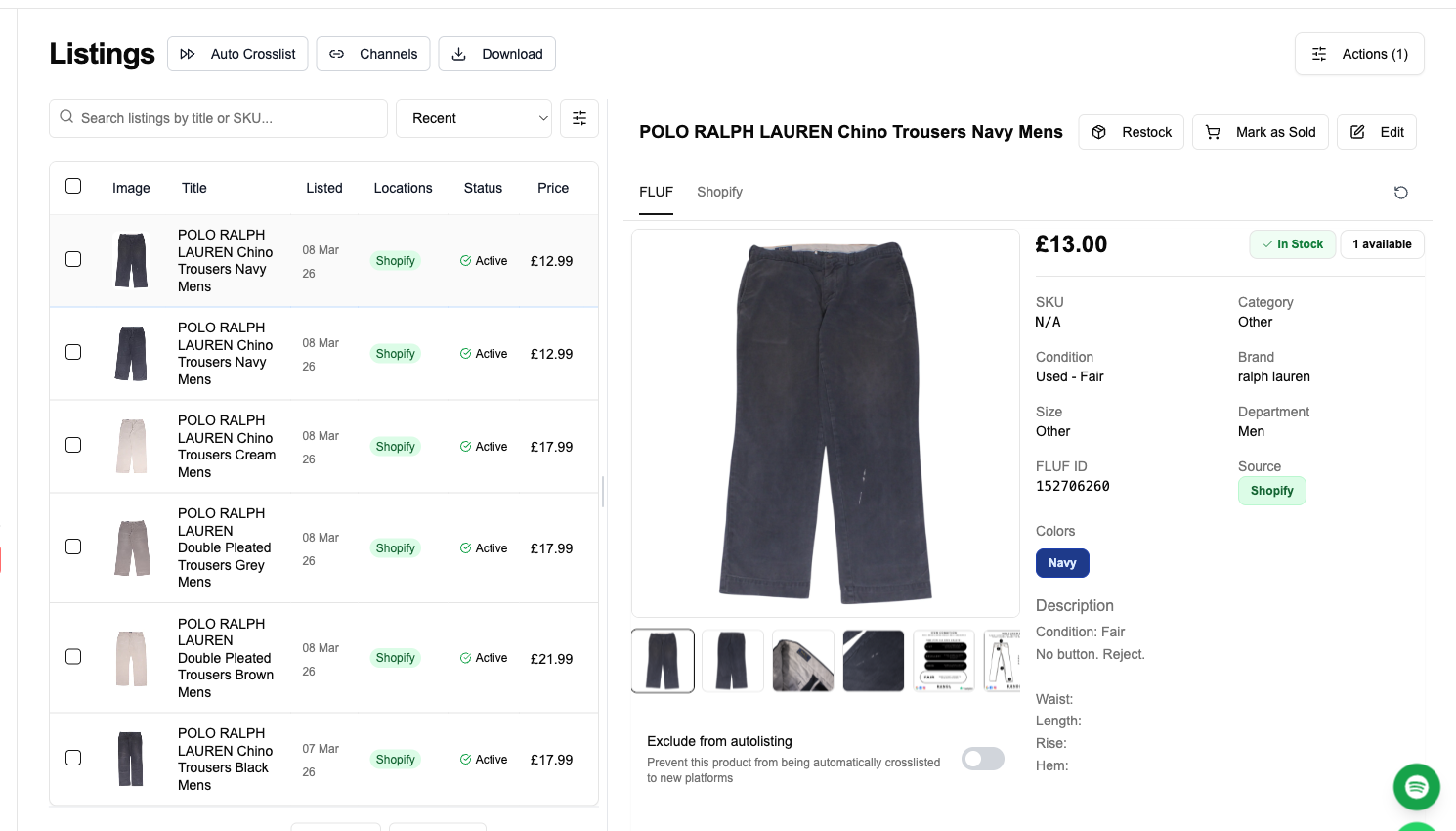
Import Tradera stock with photos, titles and descriptions, then review and publish on eBay. eBay listing, editing, relisting, offers, orders, refunds and fulfilment do not need an open browser. Tradera currently supports connection and catalogue import only; publishing and updates on Tradera are not available.
On plans: crosslisting, inventory sync and order sync are included on every paid plan, while relisting, offer management and smart pricing start at Seller, £29 a month. The entry plan is Starter at £9 a month with unlimited crosslisting. 7 days for £1, then from £9/month. There is no free plan.
What Tradera takes, and why we will not quote you an eBay number
Tradera’s seller fees are published, modest and capped. eBay’s depend on site, plan and category, and we did not verify a European private-seller schedule this run — so there is no European eBay percentage anywhere on this page.
Start with a correction, because a machine is telling people otherwise. A Bing AI summary asserts Tradera is free to list and sell on with no seller fees. That is false. Tradera’s own fee page sets out the real schedule:
| Tradera charge | Amount | When |
|---|---|---|
| Seller commission | 10% including moms, minimum 3 kr, maximum 200 kr | On sale |
| Listing | No charge for the first 500 listings in a period | — |
| Unsold-item fee | 3–10 kr | From the 501st listing in a period |
| Highlight | 15 kr | Charged whether or not it sells |
| Rank up | 45 kr | Charged whether or not it sells |
| Reserve price | 40 kr | Charged whether or not it sells |
| Buyer protection (paid by the buyer) | 2 kr + 5%, capped at 499 kr | Mandatory on private orders from 200 kr |
The number that shapes behaviour is the 200 kr cap. Commission is 10% only up to 2,000 kr of sale price; above that it is a flat 200 kr and the effective rate keeps falling. On a 500 kr item you pay 50 kr, or 10%. On a 5,000 kr item you pay 200 kr, or 4%. On a 20,000 kr item you still pay 200 kr, which is 1%. That means Tradera gets structurally cheaper exactly where your best stock lives, and it is why you should not assume the international listing wins on cost: reach is your argument for eBay, and at high values cost of sale is not. The 2 kr plus 5% buyer protection fee, capped at 499 kr, is mandatory on private orders from 200 kr and paid by your buyer, though it raises the total they see. Vehicles in Tradera’s newer “Säljes” format are commission-free through 2026.
Now eBay, and a boundary we are going to hold. eBay’s fees vary by site, by seller plan and by category, and the differences are not small. The clearest illustration we verified this run is eBay Australia, which restructured on 12 May 2026: an Australia-based seller with AU$25,000 or less in sales over the past 12 months and no Pro plan now pays no final value or transaction fees at all, with the cost moved instead to a buyer-paid Buyer Protection fee. Sellers on a Pro plan there are on an entirely different schedule — eBay Australia’s Pro/Store fee page, in Australian dollars including GST: tiered monthly subscriptions from $0 to $604.95, a fixed order fee of $0.30 to $0.33, and category-banded final value fees.
None of those Australian figures applies to a Swedish seller. They are quoted only to show that two sellers on the same marketplace, in the same category, can be on completely different fee models depending on where they are and which plan they hold. That is why we will not hand you a single “eBay takes X%” figure for Sweden.
Instead, read eBay’s own selling fees help page and then the fee page for the specific eBay site you intend to list on, for your category, because the category band moves the number more than anything else. Then run the arithmetic against the verified Tradera numbers above. Any guide handing you one flat percentage for a European private seller is guessing, and so would we be.
Posting out of Sweden
The moment you list internationally, postage stops being an afterthought and becomes the thing that decides whether the sale is worth having. Domestic Swedish postage on a Tradera sale is cheap and quick; the same parcel to Germany costs more, and to the United States or Japan a great deal more, dominated by weight and by whether it fits a letter format. Three habits follow:
- Weigh and measure before you price. Packed weight and dimensions, then a real quote, then the eBay price. The other order is how you post a 3 kg item priced as 1 kg.
- Let the small heavy things stay domestic. Cast iron, ceramics, tools, vinyl in quantity, anything glass — international postage eats the margin and a Tradera-only listing is simply correct.
- Use tracking on anything you would mind losing. No proof of delivery means you refund.
Two Swedish specifics catch people out. Sales outside the EU need an honest customs declaration — under-declaring to spare a buyer duty is fraud, and it destroys your own claim if the parcel is lost. And your buyer may pay import VAT or duty on arrival. Say so in the listing rather than letting them find out at the door.
Kronor, and eBay’s listing currency
Your Tradera prices are in kronor. Your eBay listing will be in the currency of the eBay site you list on, and the conversion is your decision, not an automatic one.
No exchange rate a tool applies can be right: the rate moves, and the correct price on a second-hand collectable was never a converted price anyway. Converting 1,200 kr to two decimal places produces a listing price that looks computed rather than chosen. Price the eBay listing in its own market instead. Look at what the same item actually realises on the eBay site you are listing on, set your number from that, then sanity-check it against the kronor you would accept at home. If the international price, after fees, postage and conversion, nets less than the Tradera price, that item is not worth crosslisting — and you have learned it before listing rather than after selling.
Connecting Without a Browser Extension
Neither Tradera catalogue import nor the eBay connection requires a browser extension.
Connect Tradera and eBay once in FLUF Connect. You can import Tradera listings and manage the eBay copies without keeping a browser tab open.
In practice: nothing to install, nothing to keep open, and orders arriving on their own. The single asymmetry is the one already covered — the Tradera side is a read today, not a write.
Setting it up, step by step
- Connect Tradera. Follow the prompts in FLUF Connect.
- Import the catalogue. FLUF reads your Tradera listings and builds a master product record for each.
- Connect eBay. Follow the prompts to connect and import your existing eBay listings.
- Filter before you list. Mark the imported items with a real international buyer. This step decides whether the route pays, and no tool can do it for you.
- Exclude anything currently at auction with a bid on it. Non-negotiable — see the trap section above.
- Rewrite for a foreign buyer. English title and description, measurements in centimetres and inches, and any Swedish-specific reference explained rather than assumed.
- Set price and postage deliberately. Market price on the destination site, a real postage quote, and a floor built in.
- Pick the eBay category and fill in item specifics. Category drives both the fee band and the filters buyers use; empty specifics are why listings never appear in filtered search.
- Publish, then watch the first few. Check that postage calculates sensibly to a distant country and that orders land back in FLUF.
- Own the Tradera side manually. Because no sale signal comes back from Tradera yet, make ending the eBay copy part of your routine whenever something sells at home — the same habit as printing the label.
What transfers and what you rewrite
| Field | On Tradera | On eBay | Carries across? |
|---|---|---|---|
| Title | Swedish free text | Keyword-driven, searched globally | Rewrite — a Swedish title finds no international buyer |
| Description | Swedish free text | Free text, often skim-read | Rewrite, and add measurements and flaws |
| Images | Up to 40 from Tradera’s own site and apps | Multiple photos, first image drives the click | Yes — the one thing that transfers cleanly |
| Price | Starting bid, reserve, or Köp nu | One fixed price, offers optional | No — you decide it |
| Currency | Kronor | The listing site’s currency | No — price the destination market |
| Category | Tradera’s tree | eBay’s tree, which sets the fee band | Mapped, then check it |
| Item specifics | Lighter attribute set | Structured, used in search filters | Partly — expect gaps |
| Condition | Tradera’s own values | eBay’s condition values, per category | Mapped — review it |
| Postage | Domestic Swedish options | Domestic and international services | No — set fresh on eBay |
The first row does the most work. A title is not a translation job, it is a search job: an international buyer types a brand, a model, a material and a year, in English, in whatever order their habit dictates. “Fin gammal vas i glas” is a perfectly good Swedish title and an invisible international one. Give the same object its maker, designer, pattern name, rough period and material and it starts appearing in the searches collectors actually run.
Item specifics are the second-hardest row. eBay leans on structured fields far more than Tradera does, and the gaps an imported record leaves are silent — the listing publishes fine and simply never appears when somebody filters by size, era or material. Images are the easy part: Tradera allows up to 40 images on listings published from its own site and apps, and photographs of the actual item are what eBay wants too.
Sources and verification
Every fee, rule and date below was checked against a primary source on 6 September 2026.
- Tradera’s seller fee page — the 10% commission including moms with its 3 kr minimum and 200 kr maximum, the 500-listing threshold and 3–10 kr unsold-item fee, the flat upgrade fees, the 60 kr late-payment fee, and the commission-free “Säljes” vehicle format through 2026.
- Tradera on mandatory buyer protection — 2 kr plus 5%, capped at 499 kr, on private orders from 200 kr.
- Tradera’s listing formats — auctions of 3 to 14 days, the Köp nu fixed price, the combined format, and the Köp nu price disappearing once a bid lands.
- Tradera on images — the 40-image allowance and its restriction to listings published from Tradera’s own site and apps.
- Wikipedia on Tradera — the April 2006 eBay acquisition for 365 million kronor, the transfer to PayPal in the 2015 separation, and PayPal’s 2021 sale returning Tradera to Swedish ownership.
- Tradera’s 25-year report release — the move to a fully circular, second-hand-only marketplace in 2019 and the all-time total above 205 million items.
- Tradera’s record-year release — clothing first and children’s clothing fourth by units sold.
- Tradera’s sustainability reporting — approximately 11.8 million items sold in 2025.
- eBay Australia’s Pro subscription page and its buyer protection fee page — the 12 May 2026 restructure: no final value fees for Australia-based sellers under AU$25,000 in 12-month sales and off a Pro plan, the cost moved to a buyer-paid fee.
- eBay Australia’s Pro/Store selling fees — the subscription tiers, fixed order fee and category-banded final value fees quoted here. Australian Pro sellers only, in Australian dollars.
- eBay’s selling fees help page — where to read the schedule for the eBay site and category you actually sell in.
What we could not verify, and therefore left out. The eBay fee schedule for a European or Swedish private seller. We did not read one this run, so no European eBay percentage appears anywhere on this page, and the only eBay numbers here are explicitly the Australian schedules, in Australian dollars, which do not apply to a Swedish seller and are quoted purely to show how far eBay’s fees vary by site and plan. Also unverified: eBay’s currency conversion charge and payout mechanics for a Swedish seller on a non-Swedish eBay site; any active-buyer figure for either platform, so the reach argument here is made from what each marketplace is rather than from user counts; Tradera’s current owner by name, which Wikipedia does not give; Tradera’s category mix after 2023 and its buyer demographics; and the proportion of Tradera sellers who also list on eBay, for which no survey exists. One process note: our own fact sheet had eBay’s ownership ending in 2014; checking Wikipedia directly gave the 2015 PayPal transfer and 2021 sale, and we published the checked version.
Related guides
- Sell on Tradera — the complete seller guide
- Sell on eBay — the complete seller guide
- Crosslist from Tradera to Vinted
- Crosslist from Tradera to your own Shopify store
- All marketplace guides
- All crosslisting routes
- Crosslist from eBay to Amazon
- Crosslist from Tradera to Facebook Marketplace
- Crosslist from Cardmarket to eBay
- Crosslist from StockX to eBay
Frequently Asked Questions
Not any more. eBay acquired Tradera in April 2006, the business moved to PayPal when eBay and PayPal separated in 2015, and PayPal sold Tradera in 2021, returning it to Swedish ownership. They are separate marketplaces today: separate accounts, separate fees, separate feedback, no shared login. Nothing you list on one appears on the other unless you or a tool put it there.
Reach, not fees. Tradera sells to Swedish buyers, and it is strong in exactly the categories that also have international collectors — antiques, glass and ceramics, cameras, watches, vinyl and vintage clothing. For those items the Swedish audience is the smaller of the two you can reach with the same photographs. For bulky, low-value or purely domestic items such as furniture, prams or winter tyres, international postage eats the sale and Tradera alone is the right answer.
Not safely once it has bids on it. A bid on Tradera is binding, so that auction will produce a winner, and if the eBay copy sells at the same time you owe one physical item to two buyers. Crosslist Köp nu fixed-price listings instead, and keep open auctions to Tradera only. Remember that on a combined listing the Köp nu price disappears the moment the first bid arrives, so a listing that was safe yesterday may not be today.
No, and this is the most important caveat on this route. FLUF supports Tradera for connection and catalogue import only today — there is no order sync back from Tradera, so we receive no sale signal from it. Sold-out protection therefore runs in one direction: if the item sells on eBay we can act across your other channels, but if it sells on Tradera you have to end the eBay listing yourself. Make it part of the same routine as printing the label.
Contrary to an AI summary currently circulating, Tradera is not free for sellers. Commission is 10% including moms, with a 3 kr minimum and a 200 kr maximum. Listing costs nothing for the first 500 listings in a period, after which unsold items cost 3–10 kr. Optional upgrades are flat and charged whether or not the item sells: Highlight 15 kr, rank up 45 kr, reserve price 40 kr. Buyers also pay a mandatory buyer protection fee of 2 kr plus 5%, capped at 499 kr, on private orders from 200 kr.
We will not quote you a figure we have not read. eBay's fees vary by site, by seller plan and by category, and the variation is large: eBay Australia restructured on 12 May 2026 so that Australia-based sellers under AU$25,000 in 12-month sales and not on a Pro plan pay no final value fees at all, with the cost moved to a buyer-paid fee, while Australian Pro sellers remain on a subscription-plus-commission schedule in Australian dollars. Neither applies in Sweden. Read eBay's own fee page for the site you list on, and read it for your category, because the category band moves the number most.
No. Nothing needs installing and no browser tab must stay open. Tradera supports connection and catalogue import; you can create, revise and relist the eBay copies even when your computer is off.
Not mechanically. A converted price is a Swedish price wearing a foreign badge, and it will be wrong within a fortnight as the rate moves. Price the eBay listing in its own market: look at what the same item actually realises on the eBay site you are listing on, set your number from that, then check it against the kronor you would accept at home after fees, international postage and any conversion charge. If the international net is lower, do not crosslist that item.
Crosslisting, inventory sync and order sync are included on every paid plan, starting at Starter, £9 a month, with unlimited crosslisting across 60+ marketplaces. Relisting, offer management and smart pricing — all of which work on the eBay side of this route — start at Pro, £29 a month. There is no free plan; the trial is £1 for 7 days and takes a card.
The title and the description, always. A Swedish title is invisible to an international buyer, so give the item its maker, model, material and period in English, in the words a collector would search. Add measurements in centimetres and inches, name any flaw explicitly, and explain rather than assume any Swedish-specific reference. Price, currency and postage are fresh decisions too. Photographs are the one thing that transfers cleanly.