
Crosslist from Tradera to Shopify — Automatically
Tradera takes 10% and owns the customer. A Shopify store takes no commission and owns nothing but your own traffic problem. Here is exactly what the move costs, what transfers, and which Tradera sellers it actually pays back for.



- This is the one route where you stop renting the audience and start owning it. Tradera brings the buyers; Shopify brings a shopfront that nobody can suspend, reprice or change the fee schedule on.
- If you already pay for a Tradera Butik you are most of the way to a Shopify bill anyway. Tradera’s shop tiers run from 545 to 1,845 kr a month; Shopify’s entry plans sit in a comparable range with no commission on top.
- Shopify takes no commission — only card processing. Tradera takes 10% capped at 200 kr, and your buyer pays a further 2 kr plus 5%.
- Shopify has real variants, up to 2,048 per product. Tradera listings are single items, so the mapping runs the easy way for once: one listing becomes one product.
- Shopify Payments is not available everywhere, and selling in kronor to Swedish buyers depends on your store’s currency setup rather than being automatic.
- An auction has no price to export. Köp nu listings carry a price straight across; open auctions need one supplied.
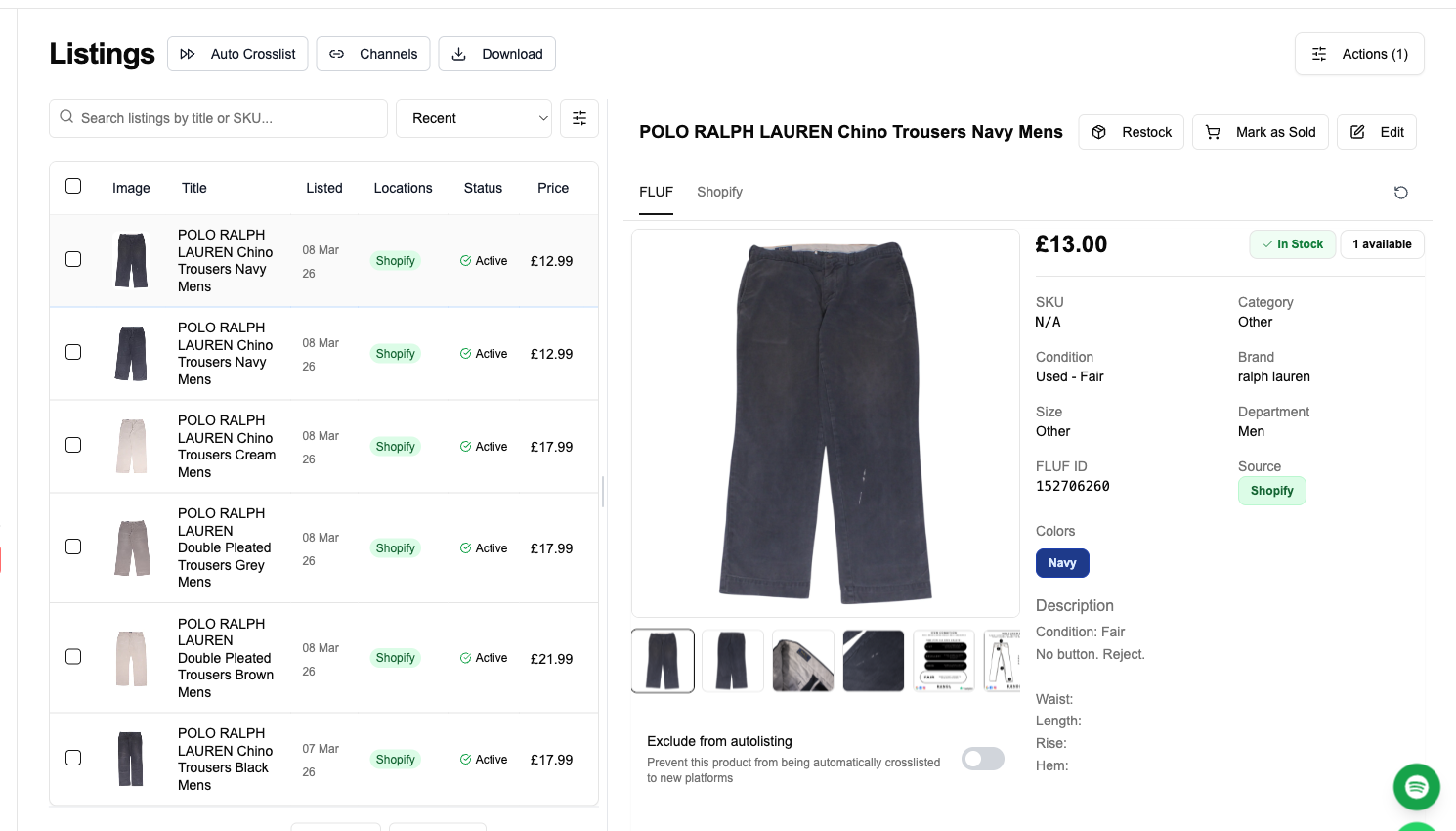
- Shopify is where your Tradera orders can land. FLUF centralises marketplace orders into Shopify, so fulfilment happens in one place instead of per channel.
- Through FLUF Connect today: connect Tradera and import your catalogue, then publish and sync to Shopify. 7 days for £1, then from £9/month. There is no free plan.
On this page
- Why a Tradera seller builds a Shopify store
- What it actually costs, side by side
- How to move a Tradera catalogue onto Shopify
- Field mapping — listing to product
- Prices, kronor and the auction problem
- Stock, and the one-of-one problem Shopify was not built for
- Orders, fulfilment and where the work lands
- What syncs and what does not
- Is it worth it?
- Sources and verification
- Related guides
Why a Tradera seller builds a Shopify store
Not for traffic. Let us be honest about that at the top, because a lot of writing on this subject is not.
Tradera moved roughly 11.8 million items in 2025 and has traded over 205 million since 1999. A new Shopify store, on the day you open it, has no visitors at all. If your problem is that not enough people see your stock, Shopify does not solve it and will not solve it for months.
What Shopify solves is a different set of problems, and they are the ones that eventually matter more to anybody selling seriously:
- The fee stops. Tradera takes 10% of every sale, capped at 200 kr, and charges 3–10 kr for unsold listings past 500 in a period. Shopify charges a subscription and card processing, and takes no cut of the sale. Above a certain volume that inversion is decisive.
- The customer becomes yours. On Tradera the buyer is Tradera’s. On your own store you have an email address, an order history, and permission to write to them again.
- The rules stop changing under you. Tradera made buyer protection mandatory in 2025 and sellers found out when it happened. Nobody can do that to your own storefront.
- Presentation is yours. Tradera allows up to 40 photographs from its own site and apps, but the page around them is Tradera’s. On Shopify the whole page is yours.
The strongest candidate for this route is the seller already paying for a Tradera Butik. If you are spending 545 to 1,845 kr a month on a shop subscription, you have already accepted a fixed monthly cost for a storefront — and you are still paying commission on top of it. Shopify’s entry plans sit in a broadly comparable monthly range and take no commission at all.
What it actually costs, side by side
| Tradera | Shopify | |
|---|---|---|
| Monthly fee | None as a private seller; Butik tiers 545–1,845 kr | A plan subscription, tiered by features |
| Commission on a sale | 10% inc. moms, min 3 kr, max 200 kr | None |
| Card processing | None disclosed to the seller | A per-transaction rate, set by country and plan |
| Third-party gateway | Not applicable | An additional transaction fee if you do not use Shopify Payments |
| Listing fees | Free to 500 a period, then 3–10 kr per unsold listing | None — products are not listings |
| Optional upgrades | Highlight 15 kr, rank up 45 kr, reserve 40 kr, charged sold or unsold | Apps and themes, priced individually |
| Buyer pays | 2 kr + 5%, max 499 kr, mandatory on private orders from 200 kr | Nothing beyond the price and postage you set |
| Traffic included | Yes — this is what you are buying | No |
That last row is the whole trade. You are exchanging a commission for a subscription, and buying traffic for building it.
The arithmetic turns at a volume rather than a price. Because Tradera’s commission is capped at 200 kr, a seller of expensive items pays proportionally very little there — a 12,000 kr sale costs 200 kr, about 1.7% — and has correspondingly less to gain from escaping it. A seller moving many mid-priced items pays the full 10% on each and has a great deal to gain. Counter-intuitively, then, it is the high-volume mid-price seller for whom Shopify pays back fastest, not the dealer in rarities.
One important caveat before you plan around card rates: Shopify Payments is not available in every country, and where it is unavailable you use a third-party gateway and pay Shopify an additional transaction fee on top of that gateway’s own charges. Check your own country against Shopify’s supported list before you model the numbers.
How to move a Tradera catalogue onto Shopify
- Connect Tradera in FLUF Connect. Follow the authorisation prompts. No browser extension is required.
- Import your Tradera catalogue. FLUF reads your existing listings and builds one master product record per item — title, description, images, price and category.
- Connect Shopify. Follow its authorisation prompts. No browser extension is required.
- Decide your collection structure. Tradera’s categories are not Shopify collections and will not become them by themselves. This is the one genuinely manual design decision.
- Resolve prices on auction listings. See the pricing section below.
- Publish. Products are created on Shopify with their images, and appear in your storefront according to your theme and collections.
- Point your orders at Shopify. FLUF can centralise marketplace orders into Shopify so fulfilment happens in one queue.
A large initial Shopify import can take time. Wait for it to finish, then review your products and variants before publishing.
Field mapping — listing to product
This direction is unusually forgiving, because Shopify’s product model is richer than a Tradera listing rather than poorer. Almost nothing has to be discarded; several fields simply have nowhere to come from and need supplying.
| Field | Tradera | Shopify | Transfers? |
|---|---|---|---|
| Title | Listing title | Product title | Yes |
| Description | Listing description | Product description, HTML supported | Yes |
| Images | Up to 40 from Tradera’s own site and apps; fewer through external tools | Product media, many per product | Yes |
| Price | Köp nu price, or none on an open auction | Variant price | Only from a fixed price |
| Category | Tradera’s category tree | Collections — a different concept entirely | No — you design these |
| Variants | None — listings are single items | Up to 2,048 per product | Not needed in this direction |
| Stock | One, by nature | Inventory quantity per variant per location | Yes, as a quantity of one |
| Condition | Five values | No condition field — a webshop assumes new | No — put it in the description or a metafield |
| SKU | Optional reference | Per-variant SKU | Generated if absent |
| Postage | Carrier options by package size | Shipping profiles and rates you configure | No — configured on Shopify |
The two rows that need your attention are category and condition.
Tradera categories are a taxonomy for search on somebody else’s marketplace. Shopify collections are merchandising on your own site — they can be automatic, based on rules, or hand-picked, and there is no reason your storefront should be organised the way Tradera’s is. Treating the import as a chance to design collections properly is worth more than any other single decision here.
Condition is the field with nowhere to go, and it is the one that will cost you if you ignore it. Shopify has no condition field because it was built for retailers selling new goods. You are selling second-hand: Tradera has been a fully circular, second-hand-only marketplace since 2019, so every item you import is used. If your storefront does not say so prominently — in the description, in a metafield surfaced by the theme, in the collection copy — you have built a shop that reads like a retailer and delivers like a charity shop, and the returns will tell you about it.
Prices, kronor and the auction problem
Tradera runs auctions of 3 to 14 days, Köp nu fixed-price listings, and combinations of the two. Shopify has one price per variant and no auction concept at all.
A Köp nu price carries across directly. An open auction has no price to carry — the starting bid is deliberately low to attract bidding and is not what you expect to receive, so importing it as a Shopify price would put your entire catalogue on sale at a fraction of its value. Supply a real price for those items, or import them and set prices before publishing the storefront.
There is a behaviour worth knowing if you keep both channels live. In a combined auction and Köp nu listing, the Köp nu price disappears as soon as anybody bids above your reserve. So an item with a clean fixed price this morning can be a live auction with a binding bidder this afternoon — and you cannot quietly withdraw it because it just sold on your Shopify store. If you run both, keep crosslisted stock on Köp nu or shop listings and reserve open auctions for items you are not selling elsewhere.
On currency: your Tradera prices are in kronor. Whether your Shopify store presents kronor to Swedish buyers depends on your store’s currency and markets configuration, and selling in local currencies depends on your payment provider supporting them. This is configuration, not conversion — decide it before the import rather than repricing a catalogue afterwards.
Stock, and the one-of-one problem Shopify was not built for
Shopify assumes replenishment. Its inventory model is built for a merchant with twelve of a thing who will order more. A second-hand seller has one of everything and will never have another.
Practically that means two settings deserve deliberate attention. First, do not allow overselling: continuing to sell when inventory hits zero is a sensible default for a retailer awaiting a delivery and a guaranteed refund for you. Second, decide what a sold-out product should do — stay visible for the search-engine value or leave the collection — because a storefront that is 80% sold-out items reads as abandoned, and a storefront that hides everything sold loses the accumulated traffic.
The related risk is the double sale, and it is worse on this pair than most because a Tradera bid is binding. Sell the item on Shopify while a Tradera auction is running with a bidder on it and you have committed to two buyers for one object. Sold-out protection through FLUF removes the other listing the moment either side sells, which on an auction platform is doing real work rather than saving you a click.
Orders, fulfilment and where the work lands
This is the part of the pairing that pays for itself soonest, and it is easy to overlook because it is not about listings at all.
Tradera settles by deducting commission at the sale and paying out automatically in one to three banking days, weekly on Thursdays or monthly on the 25th, with a manual payout to Swish arriving close to instantly. That is fine as a money flow. What it does not give you is one place to pick, pack and track from once you are selling in three or four places.
Shopify does. FLUF Connect can centralise marketplace orders into Shopify, so orders from your other channels appear in the same queue as your own storefront’s, get fulfilled with the same labels and workflow, and push tracking back out. For a seller running Tradera plus a store plus anything else, that consolidation is usually a bigger daily saving than the listing automation is.
On shipping reach, note that Tradera now treats the EU as the default shipping region rather than Sweden alone, with non-EU destinations handled through DHL Express. Your Shopify store’s reach is whatever you configure it to be, which for a Swedish second-hand seller is usually worth setting deliberately rather than leaving global by default.
What syncs and what does not
| Capability through FLUF Connect | Tradera | Shopify |
|---|---|---|
| Connect the account | Yes | Yes |
| Import your existing catalogue | Yes | Yes |
| Create and edit listings from FLUF | Not yet — in validation | Yes |
| Inventory sync | Yes | Yes |
| Mark as sold when it sells elsewhere | Yes | Yes |
| Order sync | No | Yes — and it is where other channels’ orders can land |
| Automated relisting | No | Not applicable — products do not expire |
| Offer management | No | Not applicable |
| Browser extension required | No | No |
Be clear on direction: Tradera is a source, not yet a destination. FLUF connects your Tradera account and imports your existing Tradera catalogue so it sits alongside your other channels; creating and editing Tradera listings from FLUF is still in validation and is not switched on. Shopify is fully supported in both directions.
Relisting and offer management do not appear for Shopify because they are marketplace concepts — a Shopify product does not expire and nobody haggles with a storefront. If those features are why you are here, they apply to your marketplace channels, not this one.
Crosslisting and inventory sync are on every FLUF plan; relisting, offer management and smart pricing are included from Growth (£19 a month) upwards. See the plans — 7 days for £1, then from £9/month, then plans from £9 a month.
Is it worth it?
Yes, if you are already paying Tradera a subscription, and probably not yet if you are not.
A Tradera Butik subscriber has already made the decision this page is about — accepting a fixed monthly cost for a storefront — and is still paying 10% on top. Moving that same catalogue onto a store where the commission is zero changes the unit economics of every sale, and the traffic problem is one you were going to have to solve eventually anyway.
A private Tradera seller listing a few dozen items a month is in a different position. Tradera costs you nothing until something sells and then takes a capped cut. A Shopify subscription is due whether you sell anything or not. Until your volume makes the commission larger than the subscription, the marketplace is simply the better deal, and the honest advice is to stay there and revisit.
The middle path most sellers actually take is to run both and let them do different jobs: Tradera for discovery and the long tail, the store for repeat customers, better margins and anything you would rather present properly. That only works if the two never sell the same object twice, which is the problem the automation above exists to solve.
Sources and verification
Every fee, limit and behaviour below was checked against a primary source on 5 September 2026.
- Shopify’s pricing for the plan structure, and Shopify on transaction fees for the additional charge when a third-party gateway is used.
- Shopify Payments supported countries and Shopify on Markets currencies for the local-currency dependency.
- Shopify’s 2,048-variant limit and app compatibility guidance.
- Tradera’s seller fee page — the 10% commission with its 3 kr minimum and 200 kr cap, the 500-listing threshold and the 3–10 kr unsold-listing fee, and the flat-fee upgrades charged sold or unsold.
- Tradera’s business pricing for the 545–1,845 kr Butik subscription tiers.
- Tradera on mandatory buyer protection — 2 kr plus 5%, capped at 499 kr, from 200 kr on private orders.
- Tradera’s listing formats for auction durations and the Köp nu price vanishing once a bid lands; Tradera on the 40-image limit and its external-tool caveat; ProLister for its bulk tooling.
- Tradera’s EU shipping area and its settlement timing and manual payouts.
- Tradera’s sustainability reporting for approximately 11.8 million items in 2025, and its 25-year report for the 2019 move to a fully circular marketplace and the all-time total.
Check current Shopify plan prices and card-processing rates for your country and billing period. Tradera charges its fees in kronor, so confirm any currency conversion before comparing costs.
Related guides
Frequently Asked Questions
Yes. Connect Tradera, import your catalogue, connect Shopify and review the products and images before publishing. Neither channel requires a browser extension. Tradera categories do not automatically become Shopify collections; organise those deliberately. Open auctions need a fixed price before publishing to Shopify.
It depends on volume rather than price. Shopify takes no commission at all — you pay a plan subscription plus card processing — while Tradera takes 10% of each sale with a 3 kr minimum and a 200 kr cap, and charges 3–10 kr for unsold listings past 500 in a period. Because Tradera's commission is capped, a dealer in expensive items pays proportionally little there and gains least from leaving. The seller who gains fastest is the one moving many mid-priced items, paying the full 10% on each. Note too that a Shopify subscription is due whether or not you sell anything.
No, and this is the main gap on this route. Shopify was built for retailers selling new goods, so there is no condition field to receive Tradera's five values. Since Tradera has been a second-hand-only marketplace since 2019, everything you import is used. Surface the condition yourself — in the product description, in a metafield your theme displays, or in the collection copy. A storefront that reads like a retailer but ships used goods generates returns and complaints that are entirely avoidable.
Shopify has no auction concept — one price per variant. A Köp nu fixed price transfers directly. An open auction has no price to transfer: the starting bid is set low to attract bidding and is not what you expect to receive, so importing it would put your catalogue on sale at a fraction of its value. Supply a real price for those items before publishing. Also be careful running both: in a combined auction and Köp nu listing the Köp nu price disappears the moment anyone bids above your reserve, so keep crosslisted stock on Köp nu or shop listings.
That is the risk this pairing exists to manage, and it is sharper than usual because a Tradera bid is binding — sell on Shopify while a Tradera auction is running with a bidder and you have committed the same object to two buyers. FLUF Connect's sold-out protection removes the listing on the other channel the moment either side sells. On Shopify itself, also turn off the setting that allows selling when inventory reaches zero: continuing to sell out of stock is a sensible default for a retailer awaiting a delivery and a guaranteed refund for a second-hand seller with one of everything.
No, and any page telling you otherwise is selling something. Tradera moved roughly 11.8 million items in 2025 and has traded over 205 million since 1999. A new Shopify store has no visitors on day one and will not for months. What Shopify gives you instead is zero commission, ownership of the customer relationship and their email address, a presentation you control, and rules nobody can change under you. If your problem is reach, stay on the marketplace; if your problem is margin, control or repeat custom, build the store.
That depends on your store's currency and markets configuration and on your payment provider supporting the currency, rather than being automatic. It is also worth checking whether Shopify Payments is available in your country at all: where it is not, you use a third-party gateway and Shopify charges an additional transaction fee on top of that gateway's own rate. Settle both questions before importing a catalogue, because it is far easier than repricing everything afterwards.
Both connections support catalogue import, inventory sync and mark-as-sold. Shopify also supports creating and editing listings and centralising marketplace orders for fulfilment. Tradera is currently a source: creating and editing Tradera listings from FLUF Connect are not currently available. Relisting and offer management do not apply to Shopify.