
Whatnot vs eBay: Which Is Better for Sellers in 2026?
A side-by-side comparison of fees, audience, selling format, shipping, and what real sellers think — plus how to sell on both with synced inventory.



- Choose Whatnot if: you sell collectibles (sports cards, TCG, Funko, comics, vintage fashion) and want to move inventory fast through live-stream auctions with a loyal community audience.
- Choose eBay if: you sell across a wide range of categories, want passive 24/7 search-based sales without being on camera, and need the largest global buyer base (135 million active buyers in 190 countries).
- Fees: Whatnot takes ~12% on a £30 UK sale (you keep £26.33). eBay business sellers pay ~14% (you keep £25.34). eBay private sellers pay zero fees.
- Format: Whatnot is live-first — sellers run video auctions on camera. eBay is search-first — listings sit in a global index 24/7.
- Audience: Whatnot buyers spend ~95 min/day in the app but the platform is in 9 countries. eBay has 135 million buyers across 190 countries.
- Best strategy: Sell on both — Whatnot for fast community-driven sales, eBay for steady passive income. Cross-list with FLUF Connect and inventory sync prevents overselling during live shows.
Whatnot vs eBay at a Glance
Whatnot and eBay are both auction-capable marketplaces for resellers, but they operate on fundamentally different models. Whatnot is a live-stream commerce platform where sellers run video auctions in real time and buyers bid from their phones. eBay is a global search-driven marketplace where static listings sit in an index of 2.5 billion items and sell 24 hours a day without the seller being present. If Whatnot is a live auction house, eBay is the world’s largest shop window.
Whatnot launched in 2019 in Los Angeles, originally as a Funko Pop authentication service before pivoting to live-stream selling in 2020. It has since become the largest live-shopping platform in the West, closing a $225 million Series F at an $11.5 billion valuation in October 2025 and generating more than $8 billion in GMV that year. eBay, founded in 1995 in San Jose, is one of the oldest and largest marketplaces on the internet, with 135 million active buyers, $80 billion in annual GMV, and operations in 190 countries.
| Whatnot | eBay | |
|---|---|---|
| Founded | 2019 (live commerce from 2020) | 1995 |
| Headquarters | Marina del Rey, California; London (UK/EU) | San Jose, California |
| Active buyers | 20M+ new accounts in 2025 (MAU not disclosed) | 135 million globally (Q4 2025) |
| GMV (2025) | $8 billion+ (doubled YoY) | ~$80 billion |
| Countries | 9 (US, UK, CA, DE, FR, NL, BE, AT, AU) | 190 |
| Best for | Sports cards, TCG, sneakers, vintage fashion, collectibles | Everything — electronics, fashion, collectibles, motors, industrial |
| Selling format | Live video auctions + Buy It Now | Static listings (auction + BIN), no live video |
| UK seller fees (total) | ~12% on a £30 sale | ~14% (business); 0% (private) |
| Free listings | Unlimited — no listing fees | Up to 1,000/month (private); varies by Store tier |
| Avg. time in app (buyer) | ~95 min/day globally | Not disclosed (search-driven sessions, typically shorter) |
For a deeper dive into each platform individually, read our complete guides: How to Sell on Whatnot and How to Sell on eBay.
Whatnot vs eBay: Feature-by-Feature Comparison
Whatnot and eBay share more features than you might expect — both support auctions, buyer protection, seller ratings, and integrated shipping labels. The critical differences are format (live video vs static), audience reach (niche vs universal), and the seller commitment each demands.
| Feature | Whatnot | eBay |
|---|---|---|
| Live-stream selling | Core format — live video auctions and BIN | Not supported |
| Static/search-based listings | Marketplace BIN (off-stream) — limited discovery | Core format — 2.5 billion live listings indexed |
| Auction format | Live real-time bidding with auto-extend timer | Timed auctions (1–10 days, no live video) |
| Buy It Now | Yes (in-stream and Marketplace) | Yes (core listing type) |
| Offer / Best Offer system | No formal offer system | Yes — Best Offer on fixed-price listings |
| Seller analytics | Basic (show performance, sales history) | Advanced (Terapeak, Seller Hub analytics, traffic sources) |
| Promoted listings / ads | Promote, Boost, Bumps (optional, US/UK/CA) | Promoted Listings Standard + Advanced (2–10%+ ad rate) |
| Integrated shipping labels | Yes — free to seller (USPS, Royal Mail, DPD) | Yes — eBay Delivery / Simple Delivery (Royal Mail, Evri, InPost, DHL) |
| Buyer protection | Whatnot Buyer Protection (INAD, counterfeit, damaged) | eBay Money Back Guarantee (item not received, INAD, faulty) |
| Seller verification / KYC | Application + ID + product video required | ID verification for new sellers; no product video |
| Business accounts | No distinction — all sellers treated equally | Yes — separate fee rates, VAT invoicing, bulk tools |
| International selling | Cross-border within 9 supported countries | 190 countries + Global Shipping Programme |
| Social features (follows, chat) | Strong — follows, live chat, giveaways, tipping | Minimal — saves/watchlist, no social feed |
| Mobile app | Mobile-first (iOS + Android) | Full-featured app (iOS + Android) |
| Authenticity programme | Category-specific policies (sneakers, luxury bags) | Authenticity Guarantee (sneakers, watches, handbags, TCG) |
The standout difference: Whatnot’s live format creates urgency and community that static eBay listings cannot replicate. eBay’s search index and global reach create passive sales at scale that Whatnot cannot match. Each platform’s strength is the other’s weakness.
Listing Experience: Live Shows vs Static Listings
The listing experience on Whatnot and eBay could not be more different. On eBay, you create a listing once and it sits in the search index until it sells or expires. On Whatnot, your “listing” is a live show — you go on camera, run auctions in real time, and interact with buyers who are watching you right now. The comparison is less “which listing flow is faster” and more “which selling model suits your personality and inventory.”
Whatnot: performance-based live selling
You create listing cards (title, photo, starting price, description) for each item, then schedule a live show. When you go live, you present items one by one on camera, running timed auctions that typically resolve in 30–60 seconds. Buyers bid in real time via the app. The listing card feeds into search, but the live show is the primary discovery and conversion surface. Successful Whatnot sellers are entertainers as much as merchants — pacing, personality, and chat engagement determine whether viewers stay and bid.
eBay: search-optimised passive selling
You fill in structured fields — title (80 characters), item specifics, condition, up to 24 photos, description, price, shipping — and publish. The listing enters eBay’s search index and appears when buyers search for matching terms. An eBay listing works while you sleep; a well-optimised listing for a sought-after collectible can sell within hours of posting without any further effort. The skill set is copywriting, photography, and keyword research rather than camera presence.
Time investment per item
A single eBay listing takes 5–15 minutes to create well (photos, title, item specifics, description). On Whatnot, the per-item time is lower — a listing card takes 2–5 minutes — but you also need to run the live show itself, which typically runs 1–3 hours and covers 50–300+ items. The total time commitment per week for a serious Whatnot seller (2–3 shows plus prep and packing) is comparable to managing 100–200 active eBay listings, but the effort is concentrated into intense bursts rather than spread across the week.
Which is easier for beginners?
eBay is dramatically easier to start. You can list your first item in under 10 minutes with no application process and no need to go on camera. Whatnot requires an application (including a product video), identity verification, and a willingness to present live. If you have never sold online before, eBay is the simpler first step. If you are already comfortable on camera from TikTok, YouTube, or in-person selling, Whatnot’s learning curve flattens quickly.
Fees Compared: How Much Do Whatnot and eBay Actually Cost?
Whatnot’s fee structure is simpler and, for most categories, cheaper than eBay. eBay’s fees vary by seller type (private vs business), store subscription tier, category, and whether you use Promoted Listings. The difference matters most for high-volume sellers and for high-value individual items where eBay’s percentage-based fees compound.
| Fee Type | Whatnot (UK) | eBay UK (Business, No Store) |
|---|---|---|
| Listing fee | £0 (unlimited) | £0 (up to 1,000/mo for private; varies by Store tier for business) |
| Seller commission / FVF | 6.67% + VAT (~8%) on item price | 10.9% + VAT (~13.1%) on item + postage (most categories) |
| Payment processing | 2.42% + VAT on total order + £0.25 + VAT per order | Included in FVF (no separate line) |
| Regulatory operating fee | None | 0.42% of total sale amount (incl. VAT) |
| Per-order fixed fee | Included in processing above | 30p per order (40p above £10) |
| Monthly subscription | £0 | £0 (no store) / £4.41–£2,654/mo (store tiers) |
| Promoted listings | Optional (Promote, Boost, Bumps) | Optional (2–10%+ ad rate, charged on sale) |
| International fee | None (within supported countries) | 3% on orders delivered outside the UK |
| High-value cap | Commission only on first $1,500 (select categories) | 3% FVF on the portion above £5,000 |
Category-Specific eBay UK Fees (Business Sellers, excl. VAT)
| Category | eBay FVF (excl. VAT) | Whatnot Commission |
|---|---|---|
| Collectibles / Trading Cards | 10.9% | 8% (US) / 6.67% + VAT (UK) |
| Clothing, Shoes & Accessories | 12.9% | 8% / 6.67% + VAT |
| Electronics & Computers | 11.9% | 5% (US) |
| Coins & Currency | 10.9% | 4% (US) / 4% + VAT (UK) |
| Trainers (above £100) | 8% (special rate) | 8% / 6.67% + VAT |
| Books, Music, DVDs | 9.9% | 8% / 6.67% + VAT |
What You Keep on a £30 Sale
- Whatnot: Commission 6.67% × £30 = £2.00, + VAT = £2.40. Processing 2.42% × £33.50 + £0.25 = £1.06, + VAT = £1.27. Total fees: £3.67. You keep: £26.33.
- eBay (business, no store): FVF ~13.1% × £33.50 = £4.39. Per-order fee: £0.40. Regulatory 0.42% × £33.50 = £0.14. Total fees: £4.93. You keep: £25.07.
- eBay (private seller): Zero seller fees since October 2024. You keep: £30.00 (buyer pays a Buyer Protection fee separately).
On a £30 sale, Whatnot saves a business seller about £1.26 compared to eBay. The gap widens on higher-value items and in categories where eBay’s FVF is 12.9% (fashion). For eBay private sellers, the maths reverses — zero seller fees is unbeatable, but private sellers lose access to business tools and face tighter selling limits.
High-Value Item: Where the Gap Widens
The fee difference is most dramatic on expensive items. Whatnot caps commission at the first $1,500 in categories like Comics, Toys, Trading Cards, and Sports Singles — anything above that sells commission-free. eBay drops to 3% FVF on the portion above £5,000 but still charges on the full amount below that threshold. On a £5,000 graded sports card, a Whatnot seller pays roughly £150–180 in total fees, while an eBay business seller pays approximately £650–700. For high-value collectible dealers, this single difference can swing the platform decision.
Payouts
| Whatnot | eBay | |
|---|---|---|
| Payout method | Bank transfer (GBP for UK) | Bank transfer (Managed Payments) |
| Payout schedule | On request, after delivery confirmed | Daily, weekly, fortnightly, or monthly (configurable) |
| New seller holds | 48-hour hold (US); 96-hour additional (UK/EU) | Up to 14 days while building history |
| Fast-track / early payout | Early Payout Program for established sellers | Fast-track for private sellers with 10+ sales / £150+ history |
| Payout fee | £0 | £0 (2.5% on cross-currency conversions) |
Audience and Demand: Who Is Buying on Whatnot vs eBay?
Whatnot’s audience is deep and narrow — intensely engaged buyers in specific collectible and fashion categories, concentrated in 9 countries. eBay’s audience is broad and global — 135 million active buyers searching for everything from car parts to vintage Pokémon, across 190 countries. The buyer behaviour on each platform is also different in ways that directly affect how you should price and present your inventory.
| Whatnot | eBay | |
|---|---|---|
| Buyer base | 20M+ new accounts in 2025 (MAU undisclosed) | 135 million active buyers (Q4 2025) |
| Enthusiast buyers (high-spend) | High proportion — live commerce self-selects for enthusiasts | 16 million “enthusiast buyers” (6+ purchase days, £800+/year) |
| Primary age group | 18–35 (collectible and fashion community) | 25–54 (broadest demographic spread) |
| Top markets | US, UK, Germany, France | US, UK, Germany, Australia (190 countries total) |
| Best-selling categories | Sports cards, TCG, sneakers, vintage fashion, Funko, beauty | Electronics, fashion, collectibles, motors, home & garden |
| Buyer behaviour | Entertainment-driven — 95 min/day, watching shows, impulse bidding | Search-driven — intent-based, find-and-buy |
| Repeat buyer rate | Very high (>80% month-on-month retention for active audiences) | Moderate — driven by search, less by seller loyalty |
Category Strengths
Whatnot dominates live-auction collectibles: sports card breaks, sealed TCG product openings, Funko lots, and vintage fashion hauls. The live format drives competitive bidding that can push realised prices above comparable eBay sold listings for hyped items. Beauty (+791% YoY), jewellery (+259%), and electronics (+444%) are all growing fast on Whatnot, but these categories are still small compared to eBay’s established volume.
eBay dominates essentially everything else: electronics, general fashion, motors, home and garden, industrial, and the long tail of niche collectibles that depend on search-based discovery. If only three people in the world are searching for a specific obscure vinyl record, they will find it on eBay — they will never find it on a Whatnot live show they did not attend. eBay’s Authenticity Guarantee programme for sneakers (trainers above £100 get a reduced 8% FVF), watches, and handbags also gives it a trust edge in categories where counterfeits are a concern.
Growth Trajectory
Whatnot doubled GMV from roughly $4 billion (2024) to $8 billion+ (2025) and is expanding aggressively into Europe. eBay’s 2025 GMV was approximately $80 billion — 10x Whatnot’s — but eBay’s growth is slower (Q4 2025 GMV up 8% FX-neutral). Whatnot is the faster-growing platform; eBay is the larger, more mature one. Both trends matter depending on your time horizon.
Shipping: Whatnot vs eBay
Both platforms provide integrated shipping labels in the UK, but the mechanics differ. Whatnot is more prescriptive (you must use their label); eBay is more flexible (multiple carrier options, optional Global Shipping Programme for international).
| Whatnot | eBay | |
|---|---|---|
| UK domestic carrier | Royal Mail (Whatnot-provided label only) | Royal Mail, Evri, InPost, DHL (via Simple Delivery or seller choice) |
| International from UK | DPD (Whatnot-provided label) | Global Shipping Programme (ship to UK hub, eBay handles international) or direct via seller |
| Who pays shipping | Buyer (at checkout) | Seller-configurable (free shipping, calculated, flat rate) |
| Label cost to seller | Free — Whatnot provides and funds the label | Discounted labels via eBay Delivery / Packlink; cost deducted from earnings |
| Own label allowed | No — third-party labels void buyer protection | Yes — business sellers can use any carrier |
| Tracking requirement | Automatic (Whatnot-issued labels are pre-tracked) | Recommended (required for seller protection under Money Back Guarantee) |
| Return shipping | Buyer ships return; refund processed on receipt or 48hrs after delivery | Seller or buyer, depending on reason; Money Back Guarantee covers buyer for INAD/faulty |
For UK sellers, the key difference is flexibility. eBay lets you choose your carrier, negotiate your own rates, and offer free shipping (which boosts search ranking). Whatnot removes that choice entirely — you print the Whatnot label and hand it to Royal Mail or DPD. That simplicity is a benefit for sellers who want zero shipping decisions, but a constraint for sellers who have negotiated volume rates with Evri or a fulfilment partner.
eBay’s Global Shipping Programme is a significant advantage for sellers with international demand. You ship domestically to a UK hub, and eBay handles customs, duties, and international delivery. On Whatnot, international shipping is limited to the 9 supported countries and only via Whatnot’s own DPD labels.
What Real Sellers Are Saying About Whatnot vs eBay
The Whatnot-vs-eBay debate is one of the most active conversations in reselling communities. Sellers tend to fall into three camps: eBay loyalists who find live selling exhausting, Whatnot converts who love the speed, and pragmatists who use both. Here is what they are actually saying.
“For most serious resellers, the bulk of their actual income still comes from eBay. That is where steady, search-based sales happen every day in the background, while the excitement around Whatnot continues to grow in the foreground.”
— MyListerHub seller analysis, 2026
“Whatnot is loud, live, and performance-based. eBay is quieter, system-based, and built around searchable listings that can sell at any time of day without you being on camera.”
— Seller comparison, MyListerHub
“Whatnot culture loves the ‘$1 Start’ where sellers start a $50 item at $1 and let the chat bid it up — sometimes going to $60, but sometimes selling for $3.”
— Reseller community discussion
“Fun, but exhausting. You have to be comfortable talking, joking, keeping energy high, planning what to show in what order, and reacting in real-time to comments, trolls, and technical hiccups.”
— Whatnot seller on the live-show format, MyListerHub
“On an $8,000 baseball card, eBay fees total roughly $1,006 versus Whatnot’s $352 — a $654 saving on a single transaction. Whatnot caps commission at the first $1,500 in select categories; eBay does not cap until £5,000.”
— Fee analysis, Nifty.ai
The consensus across communities is clear: eBay is the safer, steadier income stream; Whatnot is the faster, more exciting one. Sellers who treat both as complementary — using eBay for passive search sales and Whatnot for community-driven live sales — consistently report the best overall results. That pattern is exactly why multi-channel tools like FLUF Connect exist.
How to Choose Between Whatnot and eBay
The answer depends on what you sell, how you like to sell, and how much time you can commit. Neither platform is universally better — they serve different seller profiles and different inventory types.
- Sell collectibles, sports cards, TCG, vintage fashion, sneakers, Funko, or jewellery
- Are comfortable on camera and enjoy entertaining an audience
- Want to move large volumes of inventory fast (100–300+ items per show)
- Value community and repeat buyers over one-off transactions
- Sell high-value items where Whatnot’s commission cap saves hundreds per sale
- Sell across many categories including electronics, home, industrial, or niche collectibles
- Prefer passive, search-based sales that work while you sleep
- Need global reach (190 countries vs Whatnot’s 9)
- Want the eBay Authenticity Guarantee programme for sneakers, watches, or handbags
- Sell as a private individual (zero seller fees since October 2024)
- Amazon vs eBay — a catalogue against a listings board
By Seller Type
| Seller Profile | Recommendation |
|---|---|
| Casual seller — clearing out a wardrobe or collection | Start on eBay (private, zero fees, no application needed). Add Whatnot later if you enjoy selling and want to go live. |
| Sports card / TCG dealer | Both. Whatnot for card breaks, sealed product, and community sales. eBay for individual graded singles and search-driven buyers worldwide. |
| Vintage / streetwear reseller | Both. Whatnot for live haul shows and fast turnover. eBay for rare pieces that need a global search audience to find the right buyer. |
| Electronics reseller | eBay primarily. Whatnot’s electronics category is growing but eBay’s structured listings, buyer trust, and search volume dominate. |
| Full-time multi-channel reseller | Both, plus Depop and Vinted for fashion. Use FLUF Connect to sync everything. |
The smartest answer for most resellers is not “Whatnot or eBay” but “Whatnot and eBay” — because each fills the gap the other cannot.
Why Not Both? Sell on Whatnot and eBay at the Same Time
The biggest risk of running Whatnot and eBay simultaneously is overselling: you auction a card on a live Whatnot show at 8pm, and the same card sells on eBay at 8:02pm while you are still on camera. That leads to a cancellation, a defect on your eBay account, and a frustrated buyer on both platforms. The solution is automated inventory sync — and that is exactly what FLUF Connect is built for.
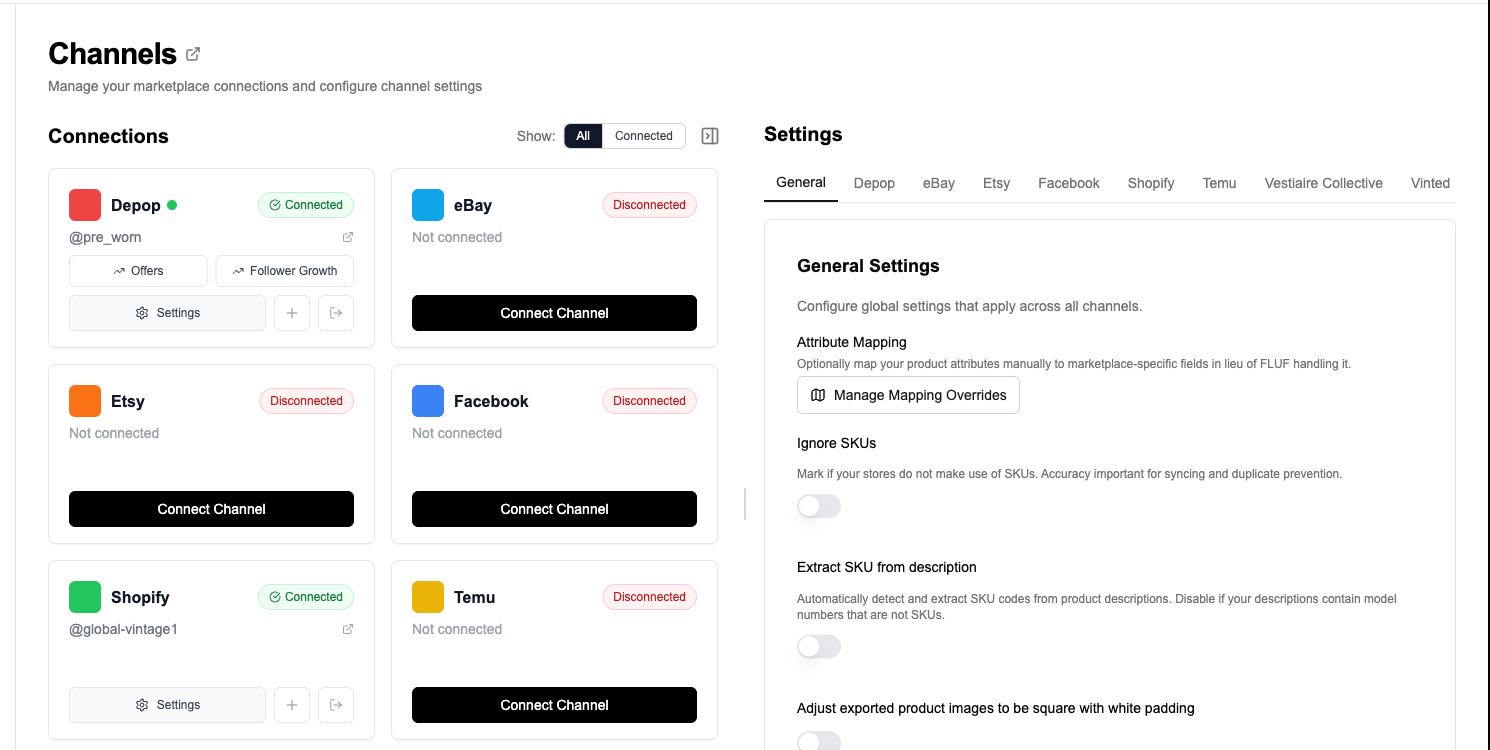
FLUF Connect links your Whatnot and eBay accounts (alongside Depop, Vinted, Shopify, Etsy, and Facebook Marketplace) in a single dashboard. When an item sells on Whatnot during a live show, FLUF Connect automatically delists it from eBay and every other connected channel in real time. When an item sells on eBay overnight while you sleep, it disappears from your Whatnot Marketplace listings before your next show.
How It Works
- Connect: link your Whatnot and eBay accounts to FLUF Connect (takes minutes)
- Crosslist: push your inventory to both platforms — FLUF handles title, description, image, and category mapping
- Sync: when a sale happens on any channel, inventory updates everywhere else automatically
FLUF Connect Features for Whatnot and eBay Sellers
| FLUF Connect Feature | Whatnot | eBay |
|---|---|---|
| Crosslisting | Yes — to/from all connected channels | Yes — to/from all connected channels |
| Inventory sync | Yes — real-time delist on sale | Yes — real-time delist on sale |
| Auto-relisting | Yes | Yes |
| Offer management | N/A (no offer system) | Yes |
| Order sync | Yes | Yes |
| Bulk operations | Yes | Yes |
To get started, create a free FLUF Connect account and connect your Whatnot and eBay accounts. You get unlimited listings on the £9/month Starter plan — see the FLUF Connect pricing page for plans beyond that.
Sell on Whatnot and eBay without the overselling risk. FLUF Connect syncs your inventory in real time so a Whatnot live-show sale instantly delists from eBay — and vice versa.
Frequently Asked Questions: Whatnot vs eBay
Is Whatnot or eBay better for selling sports cards?
Both are strong. Whatnot is better for card breaks, sealed product auctions, and community-driven sales where the live format drives competitive bidding. eBay is better for individual graded singles, search-driven buyers worldwide, and passive 24/7 sales. Most serious card dealers use both.
Which has lower fees, Whatnot or eBay?
Whatnot is cheaper for business sellers in most categories. On a £30 UK sale, Whatnot takes roughly £3.67 (~12%) versus eBay’s £4.93 (~14% for business sellers). eBay private sellers pay zero fees since October 2024, making eBay technically free for casual sellers. Whatnot’s commission cap on high-value items in select categories creates even larger savings on expensive collectibles.
Can I sell on Whatnot and eBay at the same time?
Yes, and most successful resellers do. The critical requirement is inventory sync — FLUF Connect automatically delists items from eBay when they sell on Whatnot (and vice versa) to prevent overselling during live shows.
Do I have to go on camera to sell on Whatnot?
Whatnot supports off-stream Marketplace (Buy It Now) listings, but the live show format is the dominant driver of sales and discovery. eBay requires no camera work at all — listings are entirely photo and text-based.
Which is easier for beginners, Whatnot or eBay?
eBay is easier to start. No application, no video, no camera needed. You can list and sell within 10 minutes. Whatnot requires an application, identity verification, and comfort going live. If you are new to selling online, start on eBay and add Whatnot once you have inventory and confidence.
Does Whatnot or eBay have more buyers?
eBay has 135 million active buyers in 190 countries. Whatnot does not disclose MAU but reported 20 million new accounts in 2025 across 9 countries. eBay has the larger, more global audience; Whatnot has the more engaged, higher-retention audience in its supported categories.
Can I crosslist between Whatnot and eBay automatically?
Yes. FLUF Connect supports both Whatnot and eBay as fully integrated channels. You can crosslist products between them with synced inventory, titles, images, and pricing —
Which platform pays out faster?
eBay offers daily payouts (configurable) with 1–3 business day processing. Whatnot payouts are available after delivery confirmation with a 48-hour hold (US) or additional 96-hour hold (UK/EU). For UK sellers, eBay typically delivers funds faster, though Whatnot’s Early Payout Program narrows the gap for established sellers.
Whatnot vs eBay for selling vintage clothing?
Whatnot is growing fast in women’s fashion and Y2K vintage (+223% YoY in 2025, 12M+ orders/month). eBay has been the established vintage marketplace for decades with a massive search-driven audience. For curated vintage hauls and thrift finds, Whatnot’s live format moves inventory faster. For rare, high-value individual vintage pieces that need a global search audience, eBay is stronger.
Is it worth selling on both Whatnot and eBay?
Yes, for most resellers in collectible and fashion categories. Whatnot gives you fast community-driven sales and live-show energy. eBay gives you steady passive income and the world’s largest buyer base. Together with FLUF Connect handling inventory sync, they cover both the active and passive sides of a reselling business.
Want to learn more? Read our complete guides to selling on Whatnot and selling on eBay, or compare other marketplace combinations like Depop vs Vinted and Etsy vs Shopify. New to crosslisting? See our guide to selling on multiple platforms.
Frequently Asked Questions
Both are strong. Whatnot is better for card breaks, sealed product auctions, and community-driven live sales where competitive bidding drives prices. eBay is better for individual graded singles, search-driven buyers worldwide, and passive 24/7 sales. Most serious card dealers use both with FLUF Connect to sync inventory.
Whatnot is cheaper for business sellers in most categories. On a GBP30 UK sale, Whatnot takes roughly GBP3.67 (around 12 percent) versus eBay around GBP4.93 (around 14 percent for business). eBay private sellers pay zero fees since October 2024. Whatnot commission cap on high-value items in select categories creates even larger savings.
Yes, and most successful resellers do. The critical requirement is inventory sync. FLUF Connect automatically delists items from eBay when they sell on Whatnot and vice versa, preventing overselling during live shows.
Whatnot supports off-stream Marketplace listings, but the live show format is the dominant driver of sales and discovery. eBay requires no camera work. Listings are entirely photo and text-based. If camera work is a dealbreaker, eBay is the better fit.
eBay is easier to start. No application, no video, no camera required. You can list and sell within 10 minutes. Whatnot requires an application, identity verification, a product video, and comfort going live. Start on eBay and add Whatnot once you have inventory and confidence.
eBay has 135 million active buyers in 190 countries. Whatnot reported 20 million new accounts in 2025 across 9 countries but does not disclose monthly active users. eBay has the larger global audience. Whatnot has more engaged, higher-retention buyers in collectible and fashion categories.
Yes. FLUF Connect supports both Whatnot and eBay as fully integrated channels. You can crosslist products between them with synced inventory, titles, images, and pricing adjustments for each platform.
eBay offers configurable daily payouts with 1 to 3 business day processing. Whatnot pays after delivery confirmation with a 48-hour hold for US or additional 96-hour hold for UK and EU sellers. eBay typically delivers funds faster for UK sellers.
Whatnot is growing fast in women's fashion and Y2K vintage with 223 percent year-on-year growth and 12 million plus orders per month. eBay has been the established vintage marketplace for decades with massive global search traffic. For curated hauls and thrift finds, Whatnot moves inventory faster. For rare individual pieces, eBay global audience finds the right buyer.
Yes, for most resellers. Whatnot provides fast community-driven sales and live-show energy. eBay provides steady passive income and global reach. Together with FLUF Connect syncing inventory, they cover the active and passive sides of a reselling business.