Crosslist from Vinted to Marktplaats — Reach the Whole Dutch Market
Reach the Netherlands biggest second-hand audience and sell the non-fashion and bulky items Vinted cannot host — synced so nothing oversells.



TL;DR: Vinted is Europe’s fashion-led resale app — no seller fees, integrated shipping, more than 100 million members — but it is built almost entirely around clothing. Marktplaats is the Netherlands’ dominant general marketplace, with over 8 million unique monthly visitors and around 18.7 million live ads across every category, and it is where Dutch buyers go first for second-hand goods. Crosslisting from Vinted to Marktplaats with FLUF Connect lets a Dutch Vinted seller reach that huge local audience, sell the non-fashion and bulkier items Vinted cannot host, and add local pickup — while inventory sync stops anything selling twice. Plans start at £9/month (Starter); There is no free plan, but every new account gets a 7-day trial for £1.
If you sell on Vinted in the Netherlands, you already know its strengths: no seller fees, a slick app, prepaid shipping labels and a vast pan-European audience for fashion. What Vinted is not is a general marketplace — it is built for clothing, and the moment you have a bike, a piece of furniture, a games console or a buyer who would rather collect locally, Vinted is the wrong tool. That is exactly the gap Marktplaats fills, and for a Dutch seller it is the obvious second channel. This guide explains why crosslisting from Vinted to Marktplaats works, what is different about selling on a Dutch general-classifieds platform, and how FLUF Connect moves your inventory across without doubling your admin or risking an oversell.
Why Crosslist from Vinted to Marktplaats
Vinted is a genuinely strong base to build on. It charges sellers nothing — no listing fee, no commission — while buyers pay a Buyer Protection fee at checkout, and in 2025 it reported €10.8 billion in GMV with the business firmly profitable (Vinted 2025 results). It operates across 20-plus European markets and has been in the Netherlands properly since its 2020 merger with the Dutch platform United Wardrobe (Vinted). But its demand is concentrated in fashion — clothing, shoes and accessories — even as it begins to branch into a few adjacent categories.
Marktplaats is the other half of the Dutch second-hand market. Owned by Adevinta, it is the largest online trading platform in the Netherlands, with over 8 million unique monthly visitors, around 18.7 million live adverts and roughly 350,000 new listings a day across cars, furniture, electronics, tools, baby gear, clothing and essentially everything else (Adevinta). It is one of the most-visited sites in the country and the default place a Dutch buyer searches for anything pre-owned. For a Vinted seller, that is a separate, largely non-overlapping pool of local demand — and crucially it includes the buyers and the categories Vinted simply does not serve.
The case for both is therefore not “Marktplaats instead of Vinted” — it is “Vinted for fashion across Europe, Marktplaats for the Dutch general market and everything that does not fit in a Vinted parcel.” Run together, they cover the whole of what you have to sell. Think of Vinted as your specialist fashion channel with continental reach, and Marktplaats as your general-purpose local shopfront for the Dutch market — two different jobs, done by two marketplaces that happen to draw from the same box of stock in your spare room. The only thing standing between you and using both has historically been the duplicated effort of listing everything twice, which is precisely what crosslisting removes.
Vinted vs Marktplaats at a Glance
| Vinted | Marktplaats | |
|---|---|---|
| Focus | Fashion: clothing, shoes, accessories | General: everything, all categories |
| Audience | 100M+ members across Europe | 8M+ unique monthly visitors, Dutch-first |
| Seller fee | None (buyer pays Buyer Protection) | Free basic listing; optional paid boosts |
| Transaction fees | Buyer-paid protection fee | Buyer-paid (service + buyer protection) |
| Delivery | Integrated prepaid shipping | Local pickup or shipping |
| Bulky items | Not suited | Ideal (furniture, bikes, appliances) |
| Language | Localised per market | Dutch |
What Marktplaats Lets You Sell That Vinted Cannot
This is the heart of the pairing. Vinted’s demand and logistics are built around clothing you can post in a parcel. Marktplaats has no such limit, and that unlocks three things for a Vinted seller:
- Non-fashion inventory. Electronics, homeware, books, tools, toys, baby gear — the things that pile up and have no home on Vinted — all have active Marktplaats categories and Dutch buyers searching them daily.
- Bulky and high-value items. Furniture, bikes, appliances and anything that does not fit a shipping label are Marktplaats staples, sold via local pickup (“ophalen”). These are exactly the items Vinted cannot handle.
- Local buyers who prefer to collect. Plenty of Dutch buyers would rather see an item and pay in person than wait for a parcel. Marktplaats’s local-pickup culture serves them in a way Vinted’s ship-only model does not, and for many sellers it is also the lowest-hassle way to sell — no packing, no posting, no shipping disputes.
Even within fashion, Marktplaats adds reach: it has a large clothing category of its own that competes directly with Vinted in the Netherlands, so the same garment can find a local Dutch buyer on Marktplaats who never opens the Vinted app. You are not splitting one audience in two — you are adding a second, local one. And because Marktplaats buyers skew toward people searching specifically within the Netherlands, the overlap with your existing Vinted buyers is small: a sale on Marktplaats is usually a sale you would not otherwise have made, not one cannibalised from Vinted.
How Fees and Selling Work on Marktplaats
The fee model is genuinely different from Vinted’s, and understanding it avoids surprises. On Marktplaats, placing a basic advert is free for private sellers in most everyday categories; the platform monetises through optional paid visibility upgrades such as “Dagtopper”, which floats your ad to the top of its category, and through its managed transaction layer (Marktplaats features).
Where Marktplaats handles the payment and shipping — its “Direct Kopen” flow — the transaction fees fall on the buyer, not the seller: the buyer pays a buyer-protection charge (a percentage of the price, with a minimum of €0.59 and a maximum of €20) and a small fixed service fee, while using Direct Kopen is free for the seller (Marktplaats Direct Kopen costs). That is structurally similar to Vinted, where the buyer also carries the protection fee — so for a seller moving from Vinted, the good news is that Marktplaats does not impose a flat seller commission on shipped sales the way some marketplaces do. The economics will feel familiar: list at no listing cost, and the platform’s fees sit on the buyer side.
Selling in Dutch: Listings, Pickup and Negotiation
Marktplaats is a Dutch-language marketplace, and its selling culture has its own conventions. Listings are posted via “Plaats advertentie” and written in Dutch; buyers expect to negotiate (“bieden”), and the classic Marktplaats deal is a local pickup arranged through messages. Direct Kopen adds a fixed-price, managed-payment option on top for sellers who want shipping and buyer protection built in, but the bidding-and-collect rhythm remains central to how the platform feels.
For a Vinted seller used to a one-tap app and prepaid labels, the shift is mostly about presentation: a clear Dutch title and description, honest photos, and a decision per item on whether you want local pickup, shipping, or both. None of it is hard, but it is different enough that it pays to lean into the local conventions rather than copy a Vinted listing verbatim. When you crosslist with FLUF Connect, your Vinted item details and photos carry across as the starting point, so you are editing into Marktplaats’s format rather than building each ad from a blank page.
Local Pickup: A Different Way to Sell
Local pickup is the single biggest behavioural difference for a Vinted seller, and it is worth getting comfortable with because it unlocks the items Vinted cannot touch. On Marktplaats, a huge share of deals are arranged as ophalen — the buyer messages, you agree a price, and they come to collect and pay on the spot. There is no parcel, no label, no shipping wait, and for bulky goods that is the only practical way to sell. It also tends to be faster: a local buyer who wants a bookshelf today can have it today.
The trade-off is that local pickup puts the logistics on you. You arrange the meet, handle the cash or transfer, and there is no platform sitting in the middle of a pickup deal the way Vinted’s shipping flow holds a fashion sale together. Sensible habits help — agree the price and time clearly in messages, meet safely, and for higher-value items consider Marktplaats’s Direct Kopen so the payment and buyer protection are handled. Used well, pickup turns the awkward, un-shippable corner of your inventory into some of your easiest sales.
Pricing for the Dutch Local Market
Pricing on Marktplaats has its own logic, distinct from Vinted. Vinted is a pan-European fashion market where buyers compare your item against similar listings across the continent. Marktplaats is a local Dutch market where the comparison set is other Dutch sellers, often nearby, and where negotiation is expected — buyers will bieden (make an offer) rather than pay sticker. The practical advice: research what comparable items are listed at on Marktplaats specifically, price with a little headroom for the haggle, and remember that for pickup items you are saving the buyer a delivery wait, which can support a firmer price.
For bulky and non-fashion goods there is often no Vinted reference price at all, because Vinted does not carry them — Marktplaats becomes your primary market for those items, not a secondary one. That is a good problem: you are reaching demand you previously had no channel for. Crosslisting with FLUF Connect lets you carry your Vinted fashion details across and then set Marktplaats-appropriate prices per item, so each platform reflects its own market rather than a single price copied between two very different audiences.
How FLUF Connect Crosslists Vinted Listings to Marktplaats
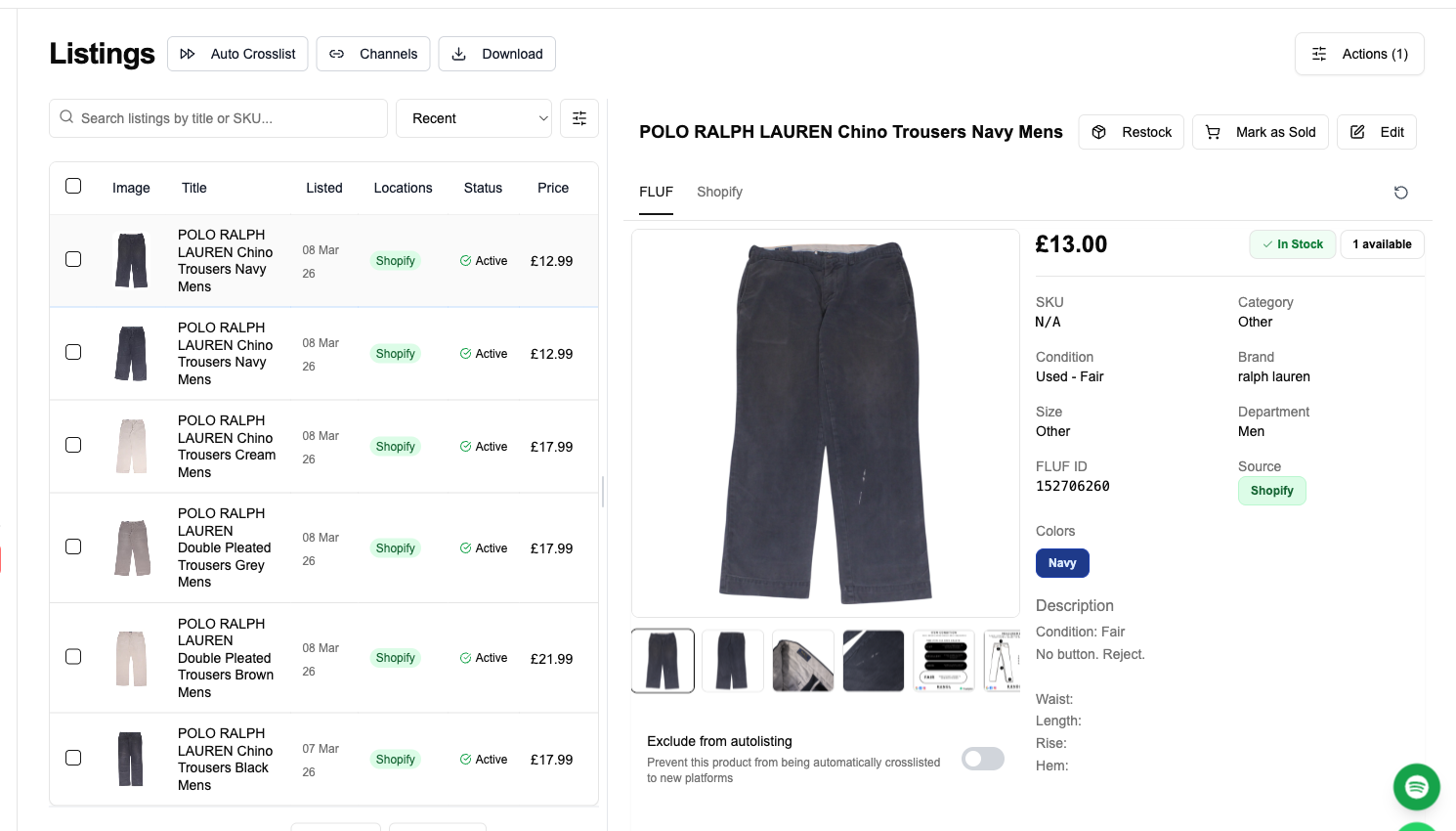
The barrier to running both has always been the manual work and the oversell risk: re-creating every Vinted listing inside Marktplaats, then watching two marketplaces so a one-off item does not sell in both at once. FLUF Connect handles both. You import your Vinted inventory into a single dashboard, choose which items to list on Marktplaats, review the mapped fields, and publish — then FLUF keeps your stock tied together across every connected channel.
FLUF maps your Vinted product data into the Marktplaats format:
| Vinted field | Maps to Marktplaats as |
|---|---|
| Title | Advert title |
| Photos | Advert images |
| Description | Advert description |
| Price | Asking price |
| Category | Mapped to a Marktplaats category |
| Condition | Condition |
To be precise about automation: on Marktplaats, FLUF handles crosslisting, order sync and automatic sold-detection — when an item sells on either platform, FLUF marks it sold across your connected channels so you never sell the same piece twice, and your Marktplaats orders are recorded alongside the rest. On the Vinted side, FLUF additionally supports automated relisting, offer management and order sync, so your fashion listings stay fresh and your offers are handled. You get the automation that matches each platform’s capabilities rather than an overclaimed promise.
How It Works, Step by Step
- Create a FLUF Connect account and connect both Vinted and Marktplaats.
- Import your Vinted inventory so you manage everything from one product view.
- Select the items to list on Marktplaats — your fashion plus the non-fashion and bulky items Vinted cannot host.
- Review the mapped fields — title, photos, price, category — adjust for Dutch and pickup, and publish.
- Let FLUF sync stock so anything that sells on Vinted or Marktplaats is marked sold across both.
Who Benefits Most from This Pairing
Crosslisting Vinted to Marktplaats is built for a particular seller:
- Dutch Vinted sellers who want to reach the country’s biggest second-hand audience without leaving the channel that already works for their fashion.
- Sellers with mixed inventory — clothing plus electronics, homeware or kids’ items — who currently have nowhere on Vinted to put the non-fashion half.
- Anyone clearing a household of furniture, bikes and appliances, where Marktplaats’s local pickup is the only practical route and Vinted is not an option at all.
- High-volume resellers who want a second local channel that draws from the same inventory and is kept in sync automatically.
If you sell exclusively small fashion items and ship everything, Vinted alone may be enough. But the moment your inventory spills outside clothing — or you want the Dutch local buyer Vinted does not reach — Marktplaats is the natural complement, and crosslisting is how you add it without running two separate businesses.
Getting Started on Marktplaats as a Vinted Seller
Setting up on Marktplaats is quick, and most of the learning curve is cultural rather than technical. You create an account, post via “Plaats advertentie”, and decide per item whether you want local pickup, shipping through Direct Kopen, or both. The main adjustments from Vinted are writing your titles and descriptions in Dutch, expecting buyers to negotiate, and being ready to arrange collection for the bigger items. None of that is heavy lifting, but it is different enough that copying a Vinted listing word-for-word is not ideal.
This is where starting from your existing inventory helps. Rather than rebuilding each advert, FLUF Connect brings your Vinted item details and photos across as a base, so your Marktplaats shop launches populated and you spend your time tailoring listings to the local market — not re-entering data. For a seller who already has dozens or hundreds of items on Vinted, that turns “open a second marketplace” from a weekend project into an afternoon, and the inventory stays synced from then on.
Pricing
FLUF Connect plans start at £9/month (Starter). There is no free plan, but every new account gets a 7-day trial for £1. Inventory sync, order sync and bulk operations are included in every plan, not a paid add-on. You can connect Vinted, Marktplaats and every other supported marketplace on any tier; plans differ by how many products you manage. See FLUF pricing.
Reach Every Dutch Buyer, Not Just the Fashion Ones
Vinted gives your clothing a vast, fee-free European audience; Marktplaats gives everything you have a huge local Dutch one, including the non-fashion and bulky items Vinted was never built for. With FLUF Connect you list once, push the right items to Marktplaats, and let inventory sync keep your stock honest across both. Try FLUF Connect and put your inventory in front of the whole Dutch second-hand market, not just the part that fits in a parcel — fashion on Vinted, everything else on Marktplaats, and one synced catalogue behind both.
Sources & Verification
- Vinted 2025 financial results (€10.8bn GMV, no seller fee) — Vinted Newsroom
- Vinted in the Netherlands (United Wardrobe merger) — Vinted overview
- Marktplaats scale (8M+ visitors, 18.7M ads, 350k/day) and ownership — Adevinta
- Marktplaats Direct Kopen costs (buyer-paid fees) — Marktplaats Help
- Marktplaats paid listing features — Marktplaats API docs
- Selling online from the Netherlands: every marketplace you can reach
Related guide: Crosslist from eBay to Marktplaats.
Frequently Asked Questions
Vinted is fashion-led — it is built for clothing you can ship — while Marktplaats is the Netherlands' dominant general marketplace, with over 8 million unique monthly visitors searching every category from furniture to electronics. Crosslisting lets a Dutch Vinted seller reach that huge local audience, sell the non-fashion and bulky items Vinted cannot host, and add local pickup, while keeping their fashion selling on Vinted.
Placing a basic advert on Marktplaats is free for private sellers in most everyday categories. The platform monetises through optional paid visibility upgrades like Dagtopper, and through its managed Direct Kopen flow, where the transaction fees fall on the buyer — a buyer-protection charge (minimum €0.59, maximum €20) and a small fixed service fee. Using Direct Kopen is free for the seller, so the economics feel similar to Vinted's buyer-paid model.
Almost anything outside fashion: electronics, homeware, books, tools, toys and baby gear, plus bulky and high-value items like furniture, bikes and appliances sold via local pickup. Vinted is built around clothing you can post in a parcel; Marktplaats has active categories and Dutch buyers for everything else, including a large clothing category of its own.
Yes. Vinted has been established in the Netherlands since its 2020 merger with the Dutch platform United Wardrobe, and the Netherlands is one of its logistics markets. So a Dutch seller can run Vinted and Marktplaats side by side — Vinted for fashion across Europe, Marktplaats for the local Dutch general market — reaching two largely separate pools of buyers.
No — preventing that is the point of using FLUF. When an item sells, whether on Marktplaats or Vinted, FLUF's sold-detection marks it sold across your connected channels so you never sell the same piece twice. FLUF also records your Marktplaats orders alongside the rest, so your cross-channel sales appear in one place.
On Marktplaats, FLUF handles crosslisting, order sync and automatic sold-detection. On Vinted, FLUF additionally supports automated relisting, offer management and order sync, because Vinted exposes more capabilities. You get the automation that matches each platform rather than an overclaimed promise. Plans start at £9/month (Starter); There is no free plan, but every new account gets a 7-day trial for £1.