Crosslist from eBay to Marktplaats — Reach Dutch Buyers
How to localise your eBay listings into Marktplaats and reach the Netherlands' biggest marketplace with FLUF Connect.



Short version: If you sell on eBay and want to reach Dutch buyers, you need Marktplaats — the Netherlands’ dominant marketplace, with over 8 million monthly visitors and roughly 40 times eBay.nl’s traffic. The catch is that Marktplaats is a Dutch-language platform with no selling commission, iDEAL payments and a strong local-pickup culture, so this is a localisation job, not a copy-paste. FLUF Connect crosslists your eBay catalogue to Marktplaats and maps it to the Dutch category tree automatically. Plans start at £19/month; there is no free plan.
eBay is a global marketplace — but in the Netherlands it barely registers. eBay.nl pulls around 1.4 million visits a month; Marktplaats pulls roughly 40 million. If you’re an eBay seller who wants Dutch demand, the move isn’t “wait for eBay.nl to grow” — it’s to localise your listings into Marktplaats, where Dutch buyers actually shop. This guide explains how, what’s genuinely different about selling in the Netherlands, and how FLUF Connect does the heavy lifting — from the language and currency to the Dutch payment and delivery conventions that decide whether your listing sells or sinks.
Why an eBay seller should add Marktplaats
Marktplaats is the Netherlands’ largest online marketplace for new and second-hand goods. It reports over 8 million unique visitors a month — close to half the Dutch population — with around 18.7 million live ads at any time and roughly 350,000 new listings a day. It holds about 73% of the Dutch online second-hand market. eBay, which actually owned Marktplaats from 2004 until 2021 (it’s now part of Adevinta), never built eBay.nl into a serious competitor — so for a Dutch audience, Marktplaats isn’t an alternative to eBay.nl, it’s the only marketplace that matters.
Crucially, this is the opposite move to a Dutch Marktplaats seller adding eBay to go global. Here you already have global reach on eBay; what you’re missing is local Dutch demand, and that requires localising — Dutch copy, euro pricing, EU sizing and the Netherlands’ own payment and pickup conventions.
eBay vs Marktplaats: what actually changes
| eBay | Marktplaats | |
|---|---|---|
| Selling commission | Business sellers ~10–15% final value fee | None — no commission on a sale |
| Who pays protection | Built into eBay’s model | The buyer pays Kopersbescherming (buyer protection) |
| Language | Your market’s language | Dutch — listings, categories and search are in Dutch |
| Currency | Your market’s currency | Euro (€) |
| Payments | eBay managed payments | iDEAL payment requests; escrow via Online Payment Platform |
| Shipping | Integrated international labels | Verzendservice (PostNL/DHL) or local pickup (“ophalen”) |
| Audience | Global | Netherlands (plus Dutch-speaking Belgium via sister sites) |
Marktplaats fees: there’s no selling commission
This is the headline difference for an eBay business seller used to losing 10–15% per sale: Marktplaats charges no selling commission. Private listings are free in most categories, and using the built-in payment and shipping flow (“Direct Kopen”) costs the seller nothing — the seller receives the full asking price. Instead, the buyer pays Kopersbescherming (buyer protection) of a small percentage of the price (minimum €0.59, maximum €20) plus a €0.40 service fee when the protected flow is used. A few high-value categories are paid to list — a car advertisement costs €34.99, and real estate and jobs carry per-ad fees — and optional visibility boosts are cheap (a bump to the top of a category is around €0.98, a “Dagtopper” pin around €1.41, homepage placement around €3.61). Marktplaats Pro for businesses is pay-per-click, not a flat subscription.
The real work: localising into Dutch
Marktplaats is a Dutch-language platform, and English listings underperform badly — Dutch buyers prefer to read in Dutch even though most speak English, and an English-only title misses the Dutch search vocabulary people actually type. Localising properly means:
- Dutch titles and descriptions. Use the Dutch keyword and brand, plus “maat” (size), “kleur” (colour) and condition. A buyer searches “spijkerbroek”, not “jeans for sale”.
- Euro pricing. Price in €, not £ or $ — and remember Dutch buyers negotiate hard, so leave a little room.
- EU sizing. Convert UK/US clothing and shoe sizes to the EU/Continental scale Dutch buyers expect.
- The right Dutch category. Marktplaats’s category tree (Huis en Inrichting, Kleding, Kinderen en Baby’s, Fietsen en Brommers…) differs from eBay’s and must be mapped, not auto-translated.
Get this right and you also unlock Dutch-speaking Belgium: Marktplaats’s sister sites 2dehands.be and 2ememain.be run on the same platform, so a well-localised Dutch listing reaches Flanders too.
Don’t rebuild every listing by hand. FLUF Connect imports your eBay catalogue and maps it to Marktplaats’s Dutch categories and attributes automatically.
How Dutch buyers pay and receive items
Payment on Marktplaats runs largely through iDEAL, the Netherlands’ dominant bank-transfer method: after agreeing a deal, the seller sends a payment request (“Betaalverzoek”) and the buyer pays via iDEAL, with funds held in escrow through Online Payment Platform until the item is received. Shipping uses Marktplaats’s Verzendservice (PostNL and DHL, or Brenger for large items), and the buyer pays the shipping cost — so you don’t front postage. For furniture, bikes and other bulky goods, local pickup (“ophalen”) is the norm: buyers collect and pay cash. Building these NL-native options into your listings is a big part of why localising beats simply mirroring an eBay listing.
What sells on Marktplaats
The strongest categories are home and furniture, cars and bikes (a distinctly Dutch high-demand category), kids and baby items, branded clothing, designer bags, sneakers and electronics like smartphones, laptops and consoles. Dutch buyers are second-hand-first — a large share would rather buy used than new when a good option exists — which makes Marktplaats a natural home for pre-owned eBay stock priced for the local market.
Why crosslisting tools usually can’t help — and FLUF can
Most Western crosslisting platforms simply don’t support Marktplaats; they’re built around US/UK marketplaces and skip the Netherlands entirely. That leaves international sellers with little tooling for the one marketplace that owns Dutch demand. FLUF Connect is built differently:
- Import once, list to Marktplaats. Pull your eBay listings into FLUF and crosspost them to Marktplaats without rebuilding each one.
- Automatic Dutch category and attribute mapping. FLUF matches your products to Marktplaats’s Dutch category tree and required attributes, so you’re not hand-picking categories in a language you may not read.
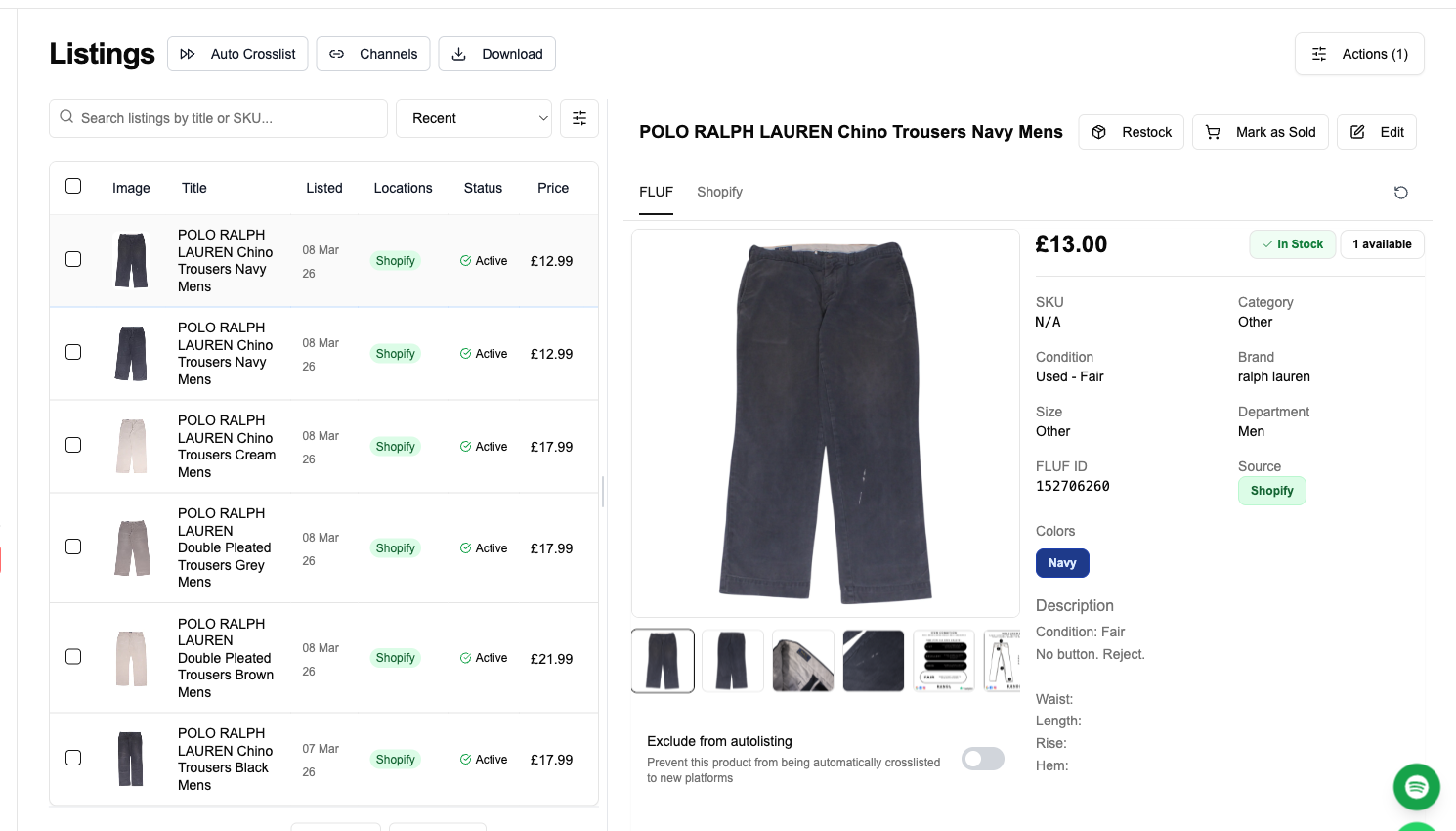
- Inventory sync and sold-elsewhere handling. Marktplaats is a full FLUF channel with order sync and mark-as-sold, so when an item sells on eBay, FLUF can mark it sold on Marktplaats — and vice versa — to prevent double-selling across two marketplaces in different countries.
- One dashboard for both. Manage your eBay and Marktplaats listings, stock and sold status side by side, instead of logging in and out of two unconnected accounts in two languages.
You still provide proper Dutch copy and euro pricing — that local touch is what makes listings convert — but FLUF removes the repetitive mechanics of getting every item onto the platform and keeping stock in sync.
How big is Marktplaats, really?
It’s hard to overstate Marktplaats’s grip on the Dutch market. The platform has been part of Dutch daily life since 1999, and around 40% of Dutch people visit it during a product search. It accounts for roughly 29% of the entire Dutch second-hand market and about 73% of the online second-hand platform market, with more than 18 million second-hand items sold through it in a single recent year. The single most-searched term on the platform is “gratis” — Dutch buyers actively hunt for bargains and give-aways — which tells you a lot about pricing for this audience.
For an eBay seller used to thinking of the Netherlands as “a small eBay market,” that’s the reframe: the Netherlands is not a small market at all — it simply does its second-hand buying somewhere else. Meeting that demand means meeting it on Marktplaats, in Dutch, in euros, on Dutch payment and delivery rails.
Localisation is the difference between selling and silence
The most common mistake international sellers make is treating Marktplaats like a translated version of eBay. It isn’t. A listing that simply mirrors your English eBay copy will usually get very little interest, even though most Dutch buyers speak English well — because they search and shop in Dutch. Real localisation covers four things:
- Language. Write the title and description in Dutch, using the words Dutch buyers actually type. Include synonyms where they exist (a buyer might search “spijkerbroek” or “jeans”), and state brand, size (“maat”), colour (“kleur”) and condition clearly.
- Currency. Price in euros, and leave a little room — haggling is a normal part of the Marktplaats culture.
- Sizing. Convert UK and US clothing and shoe sizes to the EU scale; a “UK 6” shoe reads wrong to a Dutch buyer expecting EU 39.
- Category. Pick the correct Dutch category. The Marktplaats tree doesn’t map one-to-one onto eBay’s, so a careless auto-translation lands items in the wrong place where buyers won’t find them.
This is precisely the repetitive, error-prone work that FLUF Connect’s automatic category and attribute mapping removes — you still supply good Dutch copy, but you don’t hand-navigate a Dutch category tree for every item.
Marktplaats for business sellers
If you sell at any volume, it’s worth knowing how Marktplaats treats businesses. Beyond free private listings, Marktplaats offers a Pro/business proposition that is built around pay-per-click visibility (“Admarkt”) rather than a flat monthly subscription — you bid for placement and pay when buyers click, with budgets that can start small and roll over. That’s a different model from eBay’s percentage-of-sale fees, and for the right catalogue it can be efficient, because you’re paying for attention on the one platform where Dutch buyers concentrate. The practical point for an eBay seller: you don’t need to commit to a big fixed cost to test Marktplaats — you can start with free listings, localise well, and layer on paid visibility only where it pays back.
It’s also worth understanding what Marktplaats is not. It has no built-in international shipping programme, no cross-border payment routing and no customs handling of its own — it’s a national platform. That’s exactly why the direction of this guide matters: you’re bringing global eBay stock into a national Dutch marketplace and adapting it to local rails, not expecting Marktplaats to handle the international side for you. The cross-border logistics remain your responsibility; Marktplaats provides the audience and the local payment and delivery tools once your listing speaks Dutch.
Handling the eBay side and cross-border logistics
Going from a global eBay operation into a national Dutch marketplace flips several practical things you’re used to, and it’s worth planning them before you list. On eBay you may rely on international postage programmes, global shipping arrangements and managed payments that handle currency conversion for you. Marktplaats has none of that built in — it assumes a seller operating within the Netherlands — so the cross-border mechanics become your responsibility:
- Import duties and VAT. If you fulfil from outside the European Union, parcels entering the Netherlands can attract import VAT and, above certain thresholds, customs duty. For lower-value consignments, the EU’s Import One-Stop Shop (IOSS) can simplify VAT collection at the point of sale so your Dutch buyer isn’t surprised by a charge on delivery. Build the landed cost into your euro price.
- Delivery times and tracking. A parcel shipped from another country takes longer than a domestic Dutch sale, and Dutch buyers accustomed to next-day delivery will weigh that. Offer tracked shipping and set honest delivery expectations in the listing.
- Translation workflow. Translating your eBay titles and descriptions into natural Dutch — not word-for-word machine output — is what makes listings discoverable and trustworthy. Keep a glossary of the Dutch category and attribute terms you use most so your listings stay consistent.
- Returns. Decide upfront whether you accept cross-border returns and how; a clear, fair returns line reassures cautious local buyers.
A few concrete localisation examples show the level of detail that pays off. A women’s UK size 6 shoe should be listed as EU maat 39; a men’s UK 9 as EU 43. A jumper is a “trui”, trousers are a “broek”, a coat is a “jas”, and a pushchair — a strong Dutch category — is a “kinderwagen”. Map your eBay department to the matching Marktplaats rubriek (for example, home goods to “Huis en Inrichting”, baby items to “Kinderen en Baby’s”), and lead the title with the brand, the Dutch noun, the maat and the kleur. These small, market-specific touches are precisely what separate a listing that converts from a translated one that stalls — and customs paperwork like an IOSS registration, handled once, keeps the buyer’s checkout free of nasty surprises on arrival.
This is the practical reason the direction of travel matters. You already have the global reach eBay provides; what Marktplaats adds is concentrated Dutch demand, and capturing it means adapting your fulfilment and your copy to a single national market rather than expecting the platform to internationalise on your behalf.
A note on selling cross-border
Selling into the Netherlands from abroad does carry practical considerations: longer delivery times than a domestic Dutch seller, customs paperwork if you ship from outside the EU, and the need to be responsive to messages in Dutch (a translation tool helps). For lower-value items, the maths can favour holding stock closer to your buyers. But for many sellers, the prize — direct access to the marketplace where almost half the country shops second-hand, with no selling commission taken on the sale — is well worth the localisation effort. And because Marktplaats is a full FLUF Connect channel, you manage it alongside eBay rather than as a separate, manual chore.
How to crosslist from eBay to Marktplaats
- Connect eBay and Marktplaats to FLUF Connect.
- Import your eBay listings into FLUF.
- Localise the copy — Dutch titles and descriptions, euro pricing, EU sizes.
- Crosspost to Marktplaats, letting FLUF map categories and attributes, then keep stock in sync from one dashboard.
Crosslisting, inventory sync and automation are included in every FLUF plan, not a paid add-on. Plans start at £19/month (Growth — 1,000 products); there is no free plan.
Understanding the Dutch buyer helps too. Marktplaats shoppers are famously value-conscious — the platform’s single most-searched word is “gratis” (free) — and negotiation is expected rather than rude, so listing a touch above your floor and being open to a reasonable offer is normal practice. They prefer to inspect before buying where they can, which is why local pickup is so entrenched for larger goods, and they trust clear, honest listings with real photos over polished stock imagery. Selling into this market rewards patience and local fluency more than aggressive pricing; a fair price, a Dutch description and a quick reply will usually beat a higher sticker and a slow, English-only listing.
The sellers who do best on Marktplaats treat it as a genuine local market rather than a dumping ground for translated eBay listings. They write in Dutch, price in euros with a little room to haggle, respond quickly to messages, and offer the payment and pickup options Dutch buyers expect. Get those fundamentals right and Marktplaats opens a door that eBay alone simply can’t — direct access to the marketplace where close to half the Netherlands shops second-hand, with no commission taken on the sale. Pair that local fluency with FLUF Connect handling the mechanics, and reaching Dutch buyers stops being a daunting, manual project and becomes just another channel in your dashboard.
Related guides
- Sell on Marktplaats — seller guide
- Sell on eBay — seller guide
- Crosslist from Marktplaats to eBay
- Crosslist from Vinted to Marktplaats
- Crosslist from Marktplaats to Vinted
- Designer Wardrobe to Marktplaats
Sources & Verification
Figures were verified against primary sources in June 2026, including:
- Adevinta — Marktplaats brand profile and scale.
- Marktplaats Help — listing costs and buyer protection costs.
- Similarweb — Marktplaats.nl vs eBay.nl traffic.
- DutchReview — selling second-hand in the Netherlands (localisation).
Related guides
Frequently Asked Questions
No. Marktplaats charges no selling commission — private listings are free in most categories and the seller receives the full asking price. The buyer pays Kopersbescherming (buyer protection) when the protected payment flow is used. A few categories such as cars, real estate and jobs are paid to list, and optional visibility boosts are inexpensive.
In practice, yes. Marktplaats is a Dutch-language platform and English listings underperform badly, because Dutch buyers prefer to read in Dutch and search using Dutch keywords. Localise titles and descriptions into Dutch, price in euros and convert sizes to the EU scale. FLUF Connect maps your products to the correct Dutch categories automatically.
Mostly via iDEAL, the Netherlands' dominant bank-transfer method, through a payment request with funds held in escrow until the item is received. Shipping uses Marktplaats's Verzendservice (PostNL or DHL) with the buyer paying postage, or local pickup ('ophalen') with cash for larger items.
By far. Marktplaats draws roughly 40 million visits a month and holds about 73% of the Dutch online second-hand market, while eBay.nl pulls around 1.4 million. For Dutch buyers, Marktplaats is the marketplace that matters.
Yes. FLUF Connect imports your eBay catalogue and crossposts it to Marktplaats, mapping products to the Dutch category tree and required attributes. Marktplaats is a full FLUF channel with order sync and mark-as-sold, so stock stays in sync and items are marked sold across channels to prevent double-selling.
It can. Marktplaats's sister sites 2dehands.be and 2ememain.be run on the same platform, so a well-localised Dutch listing also reaches Dutch-speaking Belgium (Flanders).