
Crosslist from Depop to ASOS — Move Your Vintage to a 17-Million-Customer Audience
Move your best genuine-vintage Depop pieces in front of ASOS's 17 million mainstream fashion customers — while keeping every item live and selling on Depop.



Key Takeaways
- Source: Depop is a Gen-Z resale app where roughly 90% of active users are under 26 and Y2K, 90s and vintage stock dominate (news.depop.com). FLUF Connect imports your shop via a secure browser extension because Depop has no public listing API.
- Destination: ASOS reaches 17.0 million active customers, with the UK at around 49% and the EU around 33% of revenue, positioned for “fashion-loving 20-somethings” (ASOS PLC Annual Report FY2025).
- Honest curation caveat: ASOS is not an open marketplace. It closed its standalone Marketplace in April 2025 and now curates genuine vintage — acceptance is reviewed by ASOS’s vintage team and is never guaranteed (asosplc.com, 23 Jan 2025).
- Fields that transfer: Photos, description and price import from Depop; FLUF reformats your title to ASOS’s required “Vintage {Brand} {Type} in {Colour}” pattern (max 80 characters) and checks images against ASOS’s portrait JPEG spec.
- Sync behaviour: Inventory and order sync run both ways, and FLUF automatically marks items as sold and delists them on ASOS when they sell elsewhere. Relisting and offer management are not supported on ASOS.
- Cost: Plans start at £9/month (Starter); There is no free plan, but every new account gets a 7-day trial for £1. Depop charges 0% selling fees in the US and UK; ASOS commission is negotiated per partner and not published.
Why crosslist Depop to ASOS
If you sell vintage on Depop, you already have the exact stock that ASOS‘s curated vintage programme is looking for. Depop is a Gen-Z, social, vintage- and Y2K-heavy app: around 90% of its active users are under 26, and Depop itself confirms its audience skews overwhelmingly young (news.depop.com). Independent platform data puts Depop’s user base in the tens of millions, with Gen Z dominating both buying and selling (Business of Apps, 2026). The pieces that move on Depop — Y2K silhouettes, baggy 90s denim, vintage tees, tracksuits and gorpcore — are consistently among the platform’s best sellers (CLOSO, 2026).
That stock profile is the entire reason this pairing works. ASOS sells to 17.0 million active customers, the majority in the UK and EU, and positions itself for “fashion-loving 20-somethings” — young, trend-led shoppers who treat genuine vintage and Y2K as core fashion, not a niche (ASOS PLC Annual Report FY2025). A great vintage Levi’s jacket or a 90s band tee that does well on Depop is precisely what an ASOS curator wants in front of that audience. So this is a natural, high-fit pair: the same kind of item, a much larger mainstream stage.
The strategic win is reach without abandoning your home turf. You don’t migrate off Depop or pause selling there. FLUF Connect lets you take your strongest genuine-vintage Depop pieces and submit them to ASOS as well, keeping every item live and selling on Depop the whole time. If an ASOS curator accepts a piece and it sells there first, FLUF delists it everywhere else automatically. You’re adding a sales channel, not swapping one for another.
There is one honest qualifier that shapes everything below, and it’s worth stating up front rather than burying it: ASOS only accepts genuine vintage, and it curates. The fast fashion and mainstream sportswear that also sell well on Depop will not pass. That’s not a FLUF limitation — it’s ASOS policy — and the rest of this guide is built around making the pieces that do qualify succeed.
The reality check — ASOS is curated vintage (read first)
Before you plan anything, understand what ASOS actually is in 2026, because it is not what it used to be. ASOS closed its standalone ASOS Marketplace — the old open boutique platform — in April 2025 (asosplc.com, 23 Jan 2025). Third-party stock now reaches asos.com through the Mirakl-powered “Partner Fulfils” programme, where approved sellers list on ASOS and fulfil their own orders (mirakl.com — Partner Fulfils). ASOS is therefore not an open marketplace you can simply sign up to and start dumping listings into.
For resellers, the realistic and supported route is genuine vintage, and that route is curated. Items are reviewed by ASOS’s vintage curation team, and acceptance is not guaranteed. You are submitting pieces for human review, not pressing a publish button. A submission can be declined for brand, condition, photography, or simply because it isn’t what the curators want that season. Treat ASOS as an editorial channel: you put forward your best candidates, and some get through.
Two more facts that matter for planning. First, ASOS commission is negotiated per partner and is not public — the old legacy boutique Marketplace figure (around 20%) is historical only and should not be treated as your current rate. Confirm your actual commission with ASOS directly. Second, because ASOS runs on Mirakl’s two-layer catalogue model, a brand-new vintage item often has to be proposed to the catalogue before your listing (the “offer”) can attach to it — more on that in the mapping section.
None of this makes the pairing bad. It makes it precise. ASOS is a genuinely valuable, high-traffic, mainstream channel for the right vintage — you just have to send the right vintage, formatted to spec, and accept that ASOS has the final say. FLUF Connect is built to maximise your hit rate within those rules, not to pretend the rules don’t exist.
How FLUF Connect submits your Depop vintage to ASOS
FLUF Connect handles the entire path from your Depop shop to an ASOS submission, with the curation reality baked into the workflow. Here’s what actually happens under the hood.
Import from Depop. Follow the connection prompts in FLUF Connect and import your photos, descriptions and prices. Review which items qualify for ASOS before submitting.
The vintage curation gate. This is the step that makes the ASOS pairing honest. Before anything is submitted, FLUF runs each candidate item through a multi-stage gate:
- Keyword and brand screening. Genuine-vintage keywords pass. Fast-fashion brands are auto-rejected: Shein, Boohoo, PrettyLittleThing, Zara, H&M, Topshop and ASOS Design will not be submitted.
- Excluded-brand rule. Nike, Adidas and Converse are excluded even when genuinely vintage, in line with ASOS policy. A real vintage Adidas tracksuit that sells on Depop still won’t qualify for ASOS — the gate stops it before it wastes a curation slot.
- Review eligibility. Check that the item meets ASOS’s vintage and presentation requirements before submission. Acceptance is not guaranteed.
- Curated batches to ASOS. The pieces that survive the gate are submitted to ASOS’s vintage curation team in curated batches via the Mirakl connection.
Connect ASOS. Enter the Mirakl API key and Shop ID issued to your approved seller account. New items need ASOS review before they can be published.
The result: you do the curating-and-importing work once in FLUF, and only genuine, in-spec, plausibly-acceptable vintage ever reaches an ASOS curator. That protects your standing with ASOS and saves you from manually re-listing items that were never going to pass.
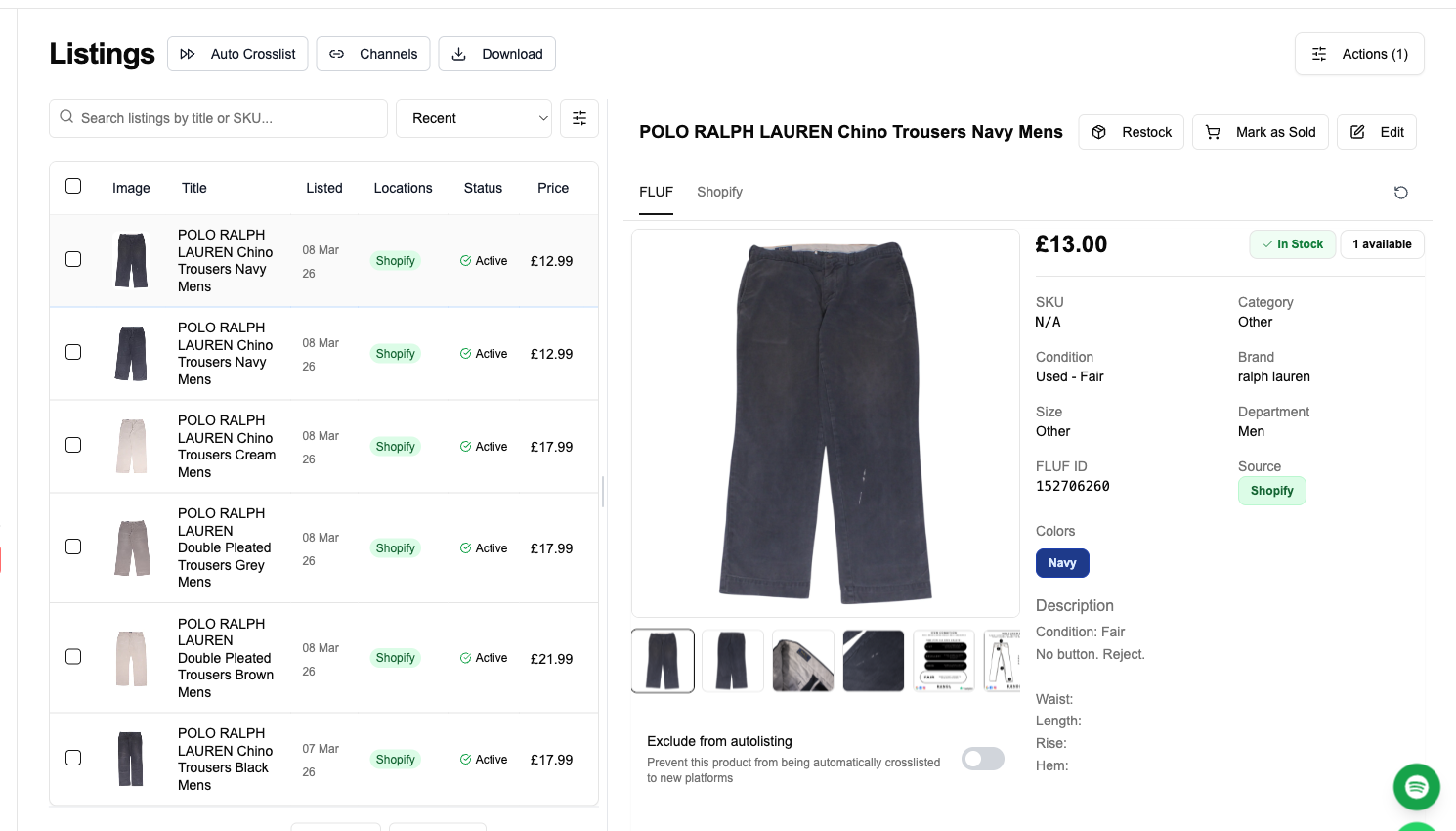
Step by step
- Connect Depop. Install the FLUF Connect browser extension and authenticate with your Depop account. The extension imports your live listings — photos, descriptions and prices — into your FLUF catalogue.
- Connect ASOS. Enter your Mirakl API key and Shop ID after ASOS approves your partner account. FLUF cannot grant ASOS approval.
- Pick your genuine-vintage candidates. In your catalogue, select the Depop pieces you want to put in front of ASOS. Focus on true vintage — the Y2K, 90s and archival pieces that already perform on Depop.
- Review your selection. Submit only items that meet ASOS’s current vintage and brand requirements.
- Review the reformatted listings. FLUF rewrites each title to the ASOS pattern “Vintage {Brand} {Type} in {Colour}” within the 80-character limit and checks your photos against the ASOS image spec. Fix any flagged titles or images.
- Submit curated batches. Approved candidates are submitted to ASOS’s vintage curation team via Mirakl, with product proposals created automatically for items not already in the ASOS catalogue.
- Wait for curation. ASOS reviews and decides. Accepted items go live on asos.com; declined items stay in your catalogue and keep selling on Depop.
- Let sync run. Once an item is live on both, FLUF keeps inventory and orders in sync and auto-delists anywhere it sells.
Field & category mapping
Depop and ASOS describe items very differently. Depop listings are loose and social; ASOS’s Mirakl catalogue is strict and structured. FLUF Connect translates between them, but it helps to know exactly what maps where — especially the vintage title format and the image spec, which ASOS enforces.
| Depop field | ASOS (Mirakl) field | How FLUF handles it |
|---|---|---|
| Listing title | Vintage title — “Vintage {Brand} {Type} in {Colour}” | Rewritten to the exact ASOS pattern, capped at 80 characters; titles over the limit are flagged for you to shorten. |
| Description | Product / offer description | Carried across; you can edit before submission to match ASOS’s tone. |
| Brand (from title/tags) | Catalogue brand attribute | Extracted and used for both the title and the curation-gate brand check (fast-fashion and Nike/Adidas/Converse rules apply here). |
| Item category / type | Mirakl category + product type | Review the ASOS vintage category and title before submission. |
| Colour | Review the colour and title before submission. | Used in the structured attribute and slotted into the title pattern. |
| Photos | Product images — portrait JPEG, ~2116×2700, sRGB, under 3MB, at least 4 | Imported from Depop and checked against the ASOS spec; non-conforming images are flagged before submission. |
| Price | Offer price | Imported as your offer price; you can adjust per channel before submitting. |
| Stock (single item) | Offer quantity | Synced — selling on any channel zeroes stock everywhere via auto-delist. |
| (no equivalent) | Product proposal | For items not yet in the ASOS catalogue, FLUF creates the product proposal so your offer has something to attach to. |
Review the ASOS title and photos before submitting. Check the required vintage title format and photo standards, and correct anything that does not accurately describe your item.
What syncs and what doesn’t
Being honest about channel capabilities matters more than a long feature list, so here’s exactly what FLUF Connect does and doesn’t do on ASOS.
What syncs (yes):
- Crosslisting / submission. FLUF submits your curated vintage to ASOS via Mirakl. (Submission, not guaranteed publication — ASOS curates.)
- Inventory sync. Stock levels stay aligned across Depop, ASOS and every other connected channel.
- Order sync. ASOS sales are pulled back into your FLUF dashboard alongside your other channels.
- Automatic mark-as-sold / delist. When an item sells anywhere — Depop, ASOS, or elsewhere — FLUF marks it sold and delists it on ASOS so you can’t oversell the one-of-a-kind piece.
What doesn’t (no — the channel doesn’t support it):
- Relisting. ASOS does not support relisting through this integration, so FLUF does not offer it on this channel.
- Offer management. ASOS doesn’t support buyer-offer negotiation through the integration, so there’s no offer-management feature on ASOS in FLUF.
If a guide ever tells you ASOS supports automatic relisting or offer haggling through a crosslister, treat it with suspicion — that’s not how the ASOS channel works in 2026. FLUF’s value here is clean submission plus reliable sync, not features the channel can’t deliver.
Before & after workflow
Before FLUF Connect. Getting Depop vintage onto ASOS by hand is genuinely painful. You’d manually re-key each item into ASOS’s Mirakl seller tools, guess at the vintage title format, re-crop and re-export every photo to the portrait JPEG spec, create catalogue product proposals one at a time, and — crucially — you’d waste effort submitting items that were never going to pass curation (every fast-fashion piece and every vintage Nike or Adidas item). Then, when something sold on Depop, you’d have to remember to go and pull it down on ASOS manually, or risk overselling a unique item. Most resellers simply don’t bother, which means their best vintage never reaches ASOS’s 17 million customers at all.
After FLUF Connect. You import your Depop shop once via the extension, select your vintage candidates, and FLUF’s curation gate quietly discards everything that can’t pass — so you only ever spend curation slots on items with a real chance. Titles are reformatted to spec, images are checked, product proposals are created for you, and curated batches go to ASOS. From then on, sync runs itself: sell on Depop and the item disappears from ASOS automatically; sell on ASOS and it disappears from Depop. You spend your time sourcing and photographing great vintage, not re-typing listings or babysitting stock across two very different platforms.
What qualifies (and what won’t)
This is the section to read twice, because it determines whether this pairing is worth setting up for your specific shop.
What qualifies — genuine vintage. ASOS’s curated programme wants authentic vintage and Y2K: think a real 90s band tee, a vintage Levi’s denim jacket, a genuine 2000s leather jacket, archival workwear, retro sportswear from non-excluded brands, true vintage knits and dresses. This is the heart of what already sells on Depop — Y2K, 90s, vintage tees and gorpcore are perennial Depop best-sellers (CLOSO, 2026) — so if your Depop shop is vintage-led, you likely have strong candidates already.
What won’t — fast fashion. Fast-fashion brands are auto-rejected by FLUF’s gate before they ever reach ASOS: Shein, Boohoo, PrettyLittleThing, Zara, H&M, Topshop and ASOS Design. These can be great Depop sellers, but they are not vintage and ASOS won’t curate them in.
What won’t — Nike, Adidas, Converse (even if genuinely vintage). This one surprises people. A truly vintage Nike windbreaker or Adidas tracksuit that’s a hit on Depop is still excluded from ASOS under ASOS policy. FLUF’s gate stops these items so you don’t burn submission effort on something the curators will decline on sight. Keep selling them on Depop — just don’t expect them on ASOS.
The practical takeaway: if a meaningful slice of your Depop shop is genuine vintage outside those excluded brands, the ASOS channel is well worth it. If your shop is mostly fast fashion or sportswear, the eligible subset will be small — and FLUF will tell you that honestly by simply not submitting the items that can’t pass.
Pricing
FLUF Connect pricing is simple and includes the automation that makes this pairing work. Plans start at £9/month (Starter). There is no free plan, but every new account gets a 7-day trial for £1. Automation is included from Seller upwards, not a paid add-on. That means the curation gate, the title and image checks, inventory sync and auto-delist are all part of the plan — not features you unlock separately.
On the channel side, the two cost lines to understand are distinct from FLUF’s fee. Depop: sellers in the US and UK pay 0% selling fees, with buyers paying a marketplace fee of up to about 5% plus a small fixed amount; sellers in the EU, Canada and Australia pay around a 10% selling fee, and payment processing applies in all regions (news.depop.com). ASOS: commission is negotiated per partner and is not published — the historical legacy boutique Marketplace figure of around 20% is not your current rate, so confirm your commission with ASOS directly when you onboard.
Audience reach — the real win
Here’s the worked-through reason this is worth the effort, even with the curation gate in the way. Depop is a brilliant place to sell vintage to Gen Z, but its audience, while large, is concentrated among young resale-native shoppers — around 90% under 26 (news.depop.com). ASOS is a different scale and a different shopper: 17.0 million active customers, heavily UK (~49% of revenue) and EU (~33%), positioned squarely at “fashion-loving 20-somethings” who buy mainstream fashion and treat vintage as part of that wardrobe (ASOS PLC Annual Report FY2025).
So a single great vintage piece — say a 90s leather jacket that’s been sitting in your Depop shop getting a trickle of views — when accepted onto ASOS is suddenly merchandised alongside the new-season fashion that 17 million customers are already browsing. You’re not competing for attention inside a niche vintage feed; you’re appearing in front of a mass mainstream audience that wouldn’t otherwise find you. The genuine-vintage and Y2K stock that defines Depop selling is exactly the trend-led product that audience responds to.
The honest framing is this: you won’t move your whole Depop shop to ASOS, and you shouldn’t try. You move your best genuine-vintage pieces — the ones that pass curation — in front of ASOS’s mainstream audience, while everything keeps selling on Depop in parallel. FLUF Connect does the filtering, formatting and syncing so that the only thing you’re really deciding is which of your vintage gems deserve a shot at 17 million customers.
Related Guides
- Sell on ASOS — channel guide
- Sell on Depop — channel guide
- Crosslist from Vinted to ASOS
- Crosslist from Etsy to ASOS
- Crosslist from Depop to Vinted
Sources & Verification
- ASOS PLC — Annual Report FY2025 and corporate announcement (23 Jan 2025) on closing ASOS Marketplace and Partner Fulfils (17.0m active customers; UK ~49% / EU ~33% of revenue; “fashion-loving 20-somethings”).
- Mirakl — Partner Fulfils marketplace model (Products + Offers two-layer catalogue).
- Depop newsroom — zero selling fees (US & UK) and buyer marketplace fee.
- Business of Apps — Depop revenue and usage statistics (2026).
- CLOSO — best items to sell on Depop in 2026 (Y2K, 90s, vintage tees, gorpcore).
Frequently Asked Questions
No. ASOS only accepts genuine vintage through its curated programme, so only true vintage pieces from your Depop shop are eligible. Fast-fashion brands like Shein, Boohoo, PrettyLittleThing, Zara, H&M, Topshop and ASOS Design are auto-rejected, and Nike, Adidas and Converse are excluded even when genuinely vintage under ASOS policy. FLUF Connect screens every item against these rules before anything is submitted to ASOS.
No. ASOS closed its open Marketplace in April 2025 and now reviews third-party vintage through a curation team, so acceptance is never guaranteed (asosplc.com, 23 Jan 2025). FLUF Connect prepares and submits your vintage items in curated batches, but the final decision to publish on asos.com rests with ASOS. Treat ASOS as a curated submission channel, not a one-click crosslist.
Yes. Once an item is live on both, FLUF Connect keeps stock and order status in sync. When a piece sells — on Depop, ASOS, or any other connected channel — FLUF automatically marks it as sold and delists it on ASOS so you don't oversell. Order sync also pulls ASOS sales back into your dashboard. Relisting and offer management are not supported on ASOS.
Connect Depop in FLUF Connect and import your photos, descriptions and prices. Select genuine vintage items that meet ASOS requirements and review them before submission to ASOS.
Plans start at £9/month (Starter). There is no free plan, but every new account gets a 7-day trial for £1. Automation is included from Seller upwards, not a paid add-on. ASOS commission is negotiated per partner and is not published, so confirm your rate with ASOS directly. Depop charges 0% selling fees in the US and UK, with buyers paying a marketplace fee, while EU, Canada and Australia sellers pay around 10% (news.depop.com).
Depop is a Gen-Z, social resale app where Y2K, 90s, vintage tees and gorpcore dominate — around 90% of active users are under 26 (news.depop.com). That stock profile is exactly what ASOS's curated vintage programme wants. The catch is that only genuine vintage qualifies; the fast-fashion and mainstream sportswear that also sell well on Depop won't pass ASOS curation.
ASOS requires vintage titles in the exact pattern 'Vintage {Brand} {Type} in {Colour}', capped at 80 characters — for example 'Vintage Levi's Denim Jacket in Blue'. FLUF Connect rewrites your Depop title into this structure automatically and flags anything that exceeds the limit, so your submission matches ASOS's spec before it reaches the curation team.
ASOS vintage listings need at least four portrait JPEG images at roughly 2116×2700 pixels, in sRGB colour and under 3MB each. FLUF Connect carries your Depop photos across and checks them against this spec. Sharp, well-lit portrait shots also improve your odds at the curation stage, since acceptance is reviewed by a human team.