
Crosslist from Trade Me to Shopify — Automatically
Populate your own Shopify store from your Trade Me inventory in minutes — photos, prices and variants transfer automatically, and inventory and order sync keep everything aligned.



If you sell on Trade Me, you’re renting space on New Zealand’s biggest marketplace — 6.1 million-plus active members, enormous local reach, but every sale happens on Trade Me’s terms, in Trade Me’s shopfront, with Trade Me owning the customer relationship (Trade Me — Site stats). A Shopify store is the opposite: your own branded website, your domain, your checkout, your customer list, running in more than 175 countries with no marketplace commission taking a slice of each sale (Shopify — comparison). Crosslisting your Trade Me inventory into a Shopify store with FLUF Connect lets you keep Trade Me’s discovery while building an asset you actually own.
This guide explains why Trade Me sellers graduate to a Shopify store, how FLUF Connect imports and crossposts your listings, what transfers automatically, and precisely how the sync behaves between New Zealand’s marketplace and your own e-commerce site.
- Trade Me: New Zealand’s #1 marketplace — huge local discovery, but Trade Me owns the storefront and customer (source)
- Shopify: your own branded store — no marketplace commission, 175+ countries, you own the customer data (source)
- Fields that transfer automatically: title, description, photos, price, variants and condition
- What FLUF automates on Shopify: crossposting, inventory sync, order sync and mark-as-sold
- Trade Me side: connects as a crossposting source; no two-way order sync on Trade Me itself
- Cost: FLUF from £9/month (Starter); Shopify plans from around $39/month. There is no free plan, but every new account gets a 7-day trial for £1.
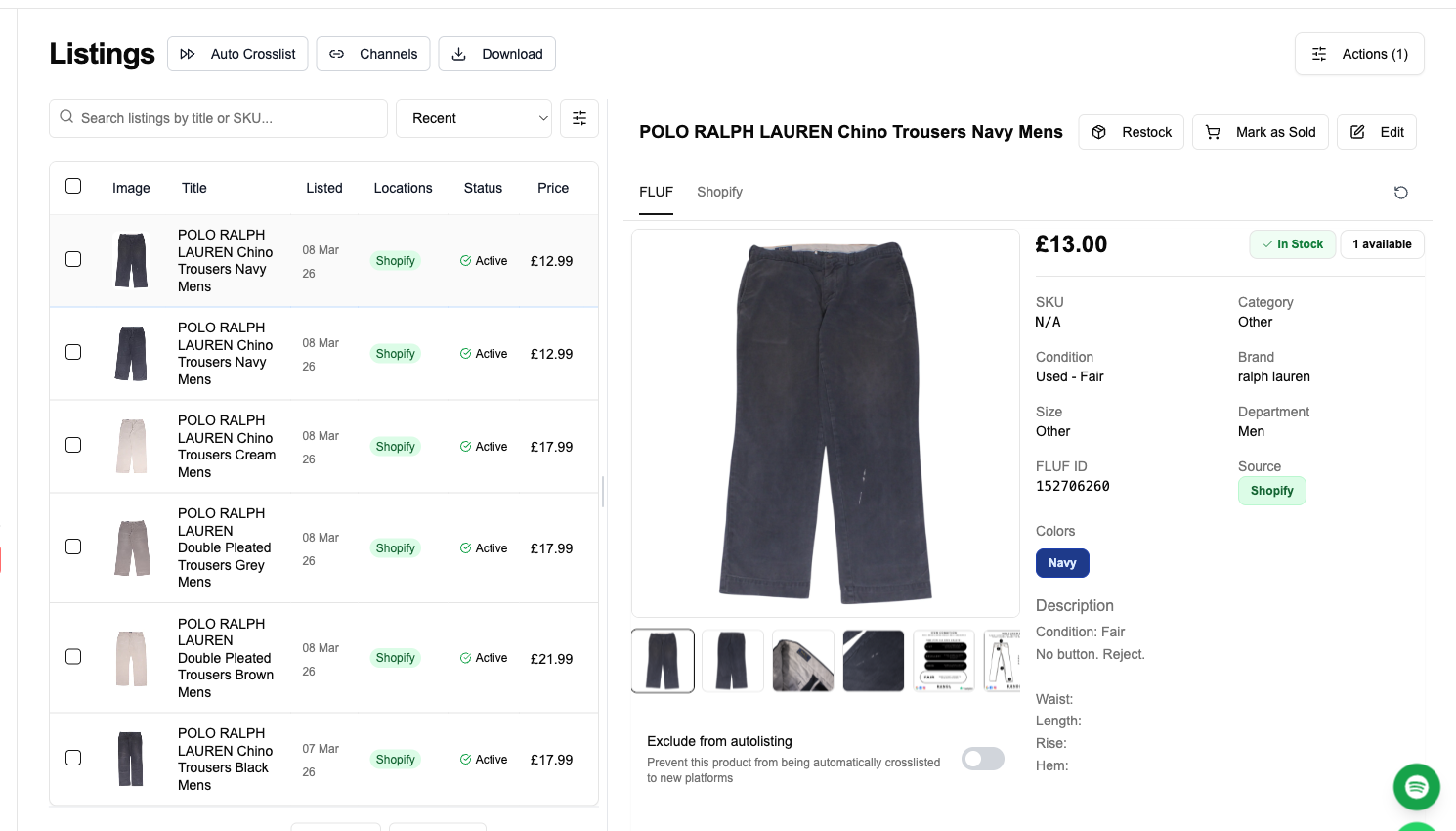
Why crosslist from Trade Me to Shopify
The short answer: Trade Me is where New Zealand buyers discover you; Shopify is where you build a brand you own. A marketplace listing rents you attention but takes a fee and keeps the customer; a Shopify store gives you the domain, the checkout, the email list and the repeat-buyer relationship — with no marketplace commission on each sale. Crosslisting means you don’t have to choose: Trade Me drives discovery and first sales, while your Shopify store compounds into a genuine business asset.
The difference is ownership. On Trade Me, the buyer is Trade Me’s customer — you can’t easily email them, retarget them, or build a brand they remember, and Trade Me takes its cut and sets the rules. Shopify inverts every part of that. It powers millions of independent stores across 175-plus countries, and in 2024 roughly 875 million consumers bought from Shopify-powered stores worldwide — all on merchants’ own branded sites rather than a shared marketplace (Shopify — comparison). On your Shopify store you own the customer list, the data and the domain, which means you can run email, loyalty and retargeting that a marketplace simply doesn’t allow.
The fee structures reflect two different models. Trade Me — even after removing the casual success fee in March 2026 — still applies a 2.19% Ping payment fee, and, more importantly, controls the shopfront (RNZ — Trade Me drops success fee). Shopify charges a monthly subscription (from around $39/month on the Basic plan) plus card processing through Shopify Payments (2.9% + 30¢ on Basic), and takes no marketplace commission on top (Shopify — Pricing). The trade-off is traffic: Shopify gives you the store but not the buyers — you drive that traffic yourself through SEO, social, email and, crucially, the marketplace channels like Trade Me you’re already on.
That last point is the whole strategy. A brand-new Shopify store has no audience; a Trade Me shop has thousands of eyes but no ownership. Run them together and each fixes the other’s weakness — Trade Me feeds you discovery and sales while you’re building your store’s traffic, and your Shopify store gives every Trade Me customer somewhere branded to come back to. Crosslisting with FLUF is what makes running both practical instead of a doubling of your workload.
From Trade Me’s auctions to a fixed-price storefront. Trade Me’s DNA is the auction and the Buy Now listing on a shared New Zealand marketplace, settled through its Ping payment method. A Shopify storefront is a different retail model entirely: fixed-price products merchandised into collections, a branded homepage, discount codes and gift cards, an abandoned-cart flow, and Shopify Payments plus Shop Pay handling checkout for buyers who never leave your domain. You’re no longer one seller among millions on trademe.co.nz — you’re the whole shop. That shift from participating in a marketplace to running a storefront is the real change of gear, and it’s why the move rewards sellers who want to think like a retailer rather than a lister.
The margin case. On a marketplace, every sale carries the platform’s economics and its cap on how much of the customer you keep. On your own store, once a buyer has found you — whether through search, social, a business card in a parcel, or a repeat visit — the sale runs on your terms: no marketplace commission, your own promotions, your own bundles and upsells. For a seller with recognisable, repeatable stock, moving even a portion of repeat business from a marketplace to an owned store meaningfully changes the annual numbers. Trade Me remains brilliant at putting you in front of new buyers; Shopify is where you make the second and third sale to a buyer you’ve already won more profitable.
Owning your customer data. This is the quiet advantage sellers underrate until they have it. A marketplace won’t hand you a customer’s email to nurture, and it won’t let you retarget the browser who didn’t buy. A Shopify store gives you both — an email list you build, abandoned-cart recovery, and the ability to run ads to people who’ve visited before. None of that is possible on a marketplace-only footing. Crosslisting lets you start collecting that owned audience now, using the inventory you’ve already proven on Trade Me, rather than waiting until you’ve built a store from a standing start.
| Trade Me | Shopify | |
|---|---|---|
| What it is | NZ marketplace (rented audience) | Your own branded store (owned asset) |
| Customer relationship | Owned by Trade Me | Owned by you (email, data, retargeting) |
| Reach | New Zealand | 175+ countries — you drive the traffic |
| Fees | 2.19% Ping payment fee (casual) | From ~$39/mo + 2.9% + 30¢ processing; no marketplace commission |
| Best role | Discovery and quick sales | Brand, repeat customers, scale |
How to crosslist from Trade Me to Shopify with FLUF Connect
FLUF Connect holds your inventory once and syncs it across marketplaces and your Shopify store from one dashboard at /connect. Where a Gumtree or Trade Me listing lives on someone else’s site, a Shopify store is a hosted storefront you brand end to end — themes, a homepage, product pages, Shop Pay express checkout, discount codes and gift cards — with Shopify Payments settling cards and an app store to bolt on email, reviews, loyalty and POS as you grow. FLUF’s job is to fill that storefront from your existing catalogue. For the Trade Me to Shopify direction:
- Sign up for FLUF Connect and open /connect.
- Connect Trade Me through the FLUF browser extension, which reads your live Trade Me listings — titles, descriptions, photos, prices and conditions — into your catalogue.
- Connect Shopify so FLUF can create and update products in your store.
- Structure for your store. FLUF pre-fills each Shopify product from your Trade Me data; you organise it into your store’s collections, add any brand copy, and set your retail price.
- Publish a single product or a batch to your Shopify store.
- Sync. Shopify order sync and inventory sync then run automatically inside FLUF, keeping stock aligned across your store and marketplaces.
A Shopify store benefits from a bit more structure than a marketplace listing — collections, consistent product titles, on-brand descriptions — because it’s your shopfront, not a search result in someone else’s. FLUF gets the products in with all their data so the heavy lifting is done; you spend your time on merchandising and brand rather than data entry. That shift in where your effort goes — from typing to selling — is the everyday benefit of crosslisting.
Field & category mapping
- Title & description — carried across; on your own store you can polish these into branded copy without affecting your Trade Me listing.
- Photos — your Trade Me images import into the FLUF catalogue and populate the Shopify product gallery.
- Price — imported and editable per channel; set your Shopify retail price knowing there’s no marketplace commission, only your subscription and card processing.
- Variants — where an item has options (size, colour), FLUF maps them to Shopify’s variant structure so your store product is properly shoppable.
- Condition & brand — carried into product fields and tags you can use to build collections (e.g. “vintage”, “new in”).
- Collections — instead of a marketplace category, you group products into your store’s collections, which is how Shopify shoppers browse.
Because Shopify is your own store rather than a category-driven marketplace, mapping is less about matching a taxonomy and more about organising your catalogue the way you want customers to shop it. FLUF brings every product across with its data intact; you decide the collections, navigation and branding. That’s the point of owning the store — the structure is yours to shape.
Room to grow into Shopify’s ecosystem. A Shopify store isn’t a fixed template — it grows with you. As sales climb you can move from the Basic plan up to Grow or Advanced for lower processing rates and deeper reporting, add Shopify POS to sell in person at markets or a pop-up, and install apps for email, loyalty, reviews, subscriptions and international tax. Shopify Payments handles cards natively, and you can layer on Shop Pay’s accelerated checkout to lift conversion. None of this exists on a classifieds-style marketplace, where your storefront is whatever the platform decides. The upshot is that the store you launch from your Trade Me catalogue today can become a genuinely sophisticated retail operation over time, without ever migrating platforms again.
Driving traffic to your new store. The honest catch with Shopify is that it doesn’t come with buyers — you bring them. That’s exactly why crosslisting rather than migrating is the right move. Your marketplace channels keep generating sales and, importantly, brand awareness: buyers who discover you on Trade Me can be pointed to your store for the rest of your range, for exclusives, or simply to follow the brand. Layer in Google SEO on your product pages, social posts, and an email list built from store customers, and over months the store develops its own traffic engine. Until then, Trade Me and your other marketplaces carry the demand — and because FLUF keeps everything in sync, growing the store never means neglecting the channels paying the bills today.
Building a brand from marketplace stock. Many successful Shopify stores start life as a marketplace shop. The seller proves demand on Trade Me, learns what sells, then uses a Shopify store to capture repeat buyers and higher margins on the same inventory. Crosslisting is the bridge: your proven Trade Me products become your store’s opening catalogue without a re-entry project, and you grow the store’s own traffic over time while Trade Me keeps the sales coming in.
What syncs (and what doesn’t)
On the Shopify side, FLUF runs strong automation. Shopify supports crossposting, real-time inventory sync, order sync and mark-as-sold through FLUF (Shopify channel overview). When an item sells — whether in your store or on another connected channel — FLUF keeps the quantities aligned and can mark the item sold across channels, so you don’t oversell a one-of-a-kind piece between your store and your marketplaces. Because Shopify is your own store, relisting and marketplace-style offers don’t apply there; the automation that matters — stock and orders staying in sync — is fully supported.
On the Trade Me side, sync is one-directional. Trade Me connects as a crossposting source through the browser extension; FLUF does not run two-way order sync on Trade Me itself. A sale on Trade Me won’t automatically decrement your Shopify stock, so for one-of-a-kind items update your store (or mark it sold in FLUF) when it sells on Trade Me. Everything flowing from Shopify and your other connected channels stays synced automatically.
Before & after — a real workflow
Before FLUF. You’ve built a solid Trade Me shop and want your own website. You open Shopify, then rebuild your catalogue from scratch — re-uploading every photo, rewriting every description, setting up variants and collections, item by item. It’s a migration project measured in days or weeks, which is why most sellers keep putting it off and stay marketplace-only.
After FLUF. Your Trade Me catalogue is already imported into FLUF. You select the products, organise them into collections, and publish the batch to your new Shopify store. Your store goes from empty to fully stocked in an afternoon, with photos, prices and variants in place. From then on, inventory and order sync keep your store and marketplaces aligned, and you can start driving traffic to a shopfront you own — while Trade Me keeps selling in the background.
That removal of the migration barrier is the real unlock. The reason so many capable Trade Me sellers never launch a store isn’t that they don’t want one — it’s that rebuilding hundreds of listings by hand is daunting. When the catalogue transfer takes an afternoon instead of a fortnight, launching your own brand stops being a someday project and becomes this week’s.
It also de-risks the decision. Because crosslisting keeps Trade Me running exactly as before, launching a Shopify store isn’t a bet-the-shop move — you’re not leaving your proven channel, you’re adding an owned one alongside it. If the store takes time to build traffic, your marketplace sales are unaffected; if it takes off, you’ve built equity in a brand rather than in someone else’s platform. That asymmetry — little downside, meaningful upside, minimal setup effort — is why crosslisting from a marketplace into your own store is one of the smartest structural moves a growing reseller can make.
Automation features for Trade Me + Shopify
- Inventory sync — keeps stock aligned between your Shopify store and every connected marketplace, preventing overselling one-of-a-kind items.
- Smart pricing — set your Shopify retail price independently of your Trade Me price, reflecting the absence of marketplace commission.
- Order sync — Shopify orders flow into FLUF so your inventory picture stays accurate across channels.
- Relisting and offers — marketplace automations that run on the channels that support them, complementing your owned store.
Automation is included in every FLUF plan, not a paid add-on. For Trade Me + Shopify the key automation is keeping inventory and orders in sync between an owned store and your marketplaces — the thing that makes running both safe. As you add more sales channels, the same catalogue feeds them all, and your Shopify store sits at the centre as the brand hub while marketplaces like Trade Me feed it discovery and demand. Think of Shopify as the home you own and the marketplaces as the streets that send foot traffic to your door — FLUF keeps the shelves in every location stocked from one back room, so you’re never re-counting inventory or risking a double sale.
Choosing a Shopify plan
Shopify bills separately from FLUF, and its plan tiers are worth understanding before you launch. The Basic plan (around $39/month, or about $29 billed annually) is where most Trade Me sellers start — it includes the storefront, unlimited products, Shopify Payments card processing at roughly 2.9% + 30¢, and the core tools to run a shop. As volume grows, the Grow plan (around $105/month) lowers your processing rate and adds deeper reporting, and Advanced (around $399/month) lowers it further for high-turnover stores (Shopify — Pricing). There’s also a lightweight Starter tier for selling through links and social without a full storefront. The key point for a former Trade Me seller: because Shopify takes no marketplace commission, your per-sale cost is essentially just card processing, so as your volume climbs the flat monthly plan is easily outweighed by the fees you’re no longer paying a marketplace. Pick the plan that matches your current volume and move up as you scale — the store and its catalogue come with you.
Pricing
FLUF Connect plans start at £9/month (Starter). There is no free plan, but every new account gets a 7-day trial for £1. Shopify is billed separately by Shopify, from around $39/month on its Basic plan plus card processing. Every FLUF plan includes crosslisting plus the automation set on the channels that support each feature, so keeping your Shopify store and Trade Me in sync costs nothing extra within FLUF. Higher FLUF tiers raise the product cap for larger catalogues. Setup takes about ten minutes: connect Trade Me through the extension, connect Shopify, and publish your first products to your own store — then start pointing your Trade Me buyers to a brand that’s finally yours.
Sources & verification
- Trade Me — Site stats (6.1M+ active members)
- RNZ — Trade Me drops casual success fee (March 2026); Ping 2.19%
- Shopify — you own your brand, customer list and data (175+ countries)
- Shopify — Pricing (Basic ~$39/mo; Shopify Payments 2.9% + 30¢)
Fees and plan prices change — always confirm the latest on Trade Me’s and Shopify’s official pages before pricing.
Related guides
Frequently Asked Questions
Yes. FLUF Connect imports your Trade Me listings through its browser extension and creates products in your Shopify store — titles, descriptions, photos, price and variants included. Instead of rebuilding your catalogue by hand, you organise the imported products into collections and publish, so your store goes from empty to fully stocked in an afternoon.
Trade Me gives you discovery and local buyers but owns the customer relationship and takes a fee. A Shopify store is an asset you own — your domain, checkout, customer list and brand, with no marketplace commission on each sale. Running both means Trade Me drives discovery while your Shopify store captures repeat customers and higher margins on the same inventory.
Not from the Trade Me side. Trade Me connects to FLUF as a crossposting source and does not run two-way order sync in FLUF. Shopify supports full inventory sync and order sync, so sales in your store or on other connected channels stay aligned — but if a one-of-a-kind item sells on Trade Me, update your Shopify stock (or mark it sold in FLUF) to avoid overselling.
Trade Me, after removing the casual success fee in March 2026, still charges a 2.19% Ping payment fee, and it owns the storefront. Shopify charges a monthly subscription (from around $39/month on Basic) plus card processing (2.9% + 30¢ on Basic via Shopify Payments) and takes no marketplace commission. The trade-off is traffic — Shopify gives you the store, and you drive buyers to it, including from Trade Me. Always confirm current pricing on each platform.
Yes. FLUF imports your Trade Me photos, titles, descriptions, prices and — where present — variants such as size and colour, and maps them to Shopify's product and variant structure so your store products are properly shoppable.
FLUF Connect plans start at £9/month on Starter, with Pro at £29/month and custom Super Seller plans above that; every plan is unlimited on listings and marketplaces, and the tiers differ by which automations they include and how often we check your channels for sales. There is no free plan, but every new account gets a 7-day trial for £1. Every FLUF plan includes crosslisting plus inventory and order sync on the channels that support them, so keeping your store and Trade Me aligned costs nothing extra within FLUF.