Crosslist from Trade Me to Poshmark — Automatically
Move your Trade Me fashion to Poshmark in minutes — photos, prices and details transfer automatically, and FLUF can mark items sold when they sell elsewhere.



Selling fashion and lifestyle goods on Trade Me reaches every New Zealand buyer — 6.1 million-plus active members on the country’s biggest marketplace, but none beyond it (Trade Me — Site stats). Poshmark is a social resale marketplace with more than 80 million community members across the US, Canada and Australia, built around sharing, offers and community selling rather than search alone (Poshmark — features and tools). Crosslisting your Trade Me fashion to Poshmark with FLUF Connect puts each piece in front of both audiences from one catalogue — while being clear about what the automation does and doesn’t cover.
This guide explains why Trade Me sellers with fashion should also be on Poshmark, how FLUF Connect imports and crossposts your listings, what transfers automatically, and precisely how the sync behaves between a New Zealand general marketplace and a social resale community.
- Trade Me: New Zealand’s #1 marketplace — general goods, 6.1M+ members, NZ-only (source)
- Poshmark: 80M+ community members across the US, Canada and Australia; social resale (source)
- Fields that transfer automatically: title, description, photos, price, brand and condition
- What FLUF automates on Poshmark: crossposting and mark-as-sold (delist when it sells elsewhere)
- Limited on Poshmark: relisting, offers and order sync aren’t available on the Poshmark side; those run on channels that support them
- Cost: From £9/month (Starter). There is no free plan, but every new account gets a 7-day trial for £1.
On this page
- Why crosslist from Trade Me to Poshmark
- How products move from Trade Me to Poshmark
- Field & category mapping
- What syncs (and what doesn’t)
- Before & after — a real workflow
- Automation features for Trade Me + Poshmark
- Pricing
Why crosslist from Trade Me to Poshmark
The short answer: Trade Me gives you New Zealand’s buyers; Poshmark gives you a large, engaged social resale community across the US, Canada and Australia that shops fashion through sharing, offers and community events. Crosslisting the fashion in your Trade Me shop to Poshmark reaches both audiences from one catalogue — the local marketplace and a very different, community-driven one abroad.
A US-anchored resale culture. Poshmark grew up in the United States and remains anchored there, with sister communities in Canada and Australia, and its whole rhythm reflects that origin: closets, sharing, following, and a reseller culture of “Posh love” and reciprocal shares that has no counterpart on a European-style secondhand app or a New Zealand auction site. Buyers browse by brand and closet as much as by search, and prices reflect a US resale market where recognisable labels carry particular weight. For a Trade Me seller, tapping that culture means learning its conventions — but it also means reaching resale buyers in North America who will never see a New Zealand listing, and who value the convenience of Poshmark’s bundled prepaid-label shipping.
Poshmark works unlike any general marketplace. It reports more than 80 million community members and is built around social selling: sellers and buyers share listings, follow each other, make and accept offers, and shop themed real-time events (Poshmark — features and tools). Sales come as much from social activity — sharing your closet, sending offers to people who’ve liked an item, bundling multiple pieces — as from search. For a Trade Me seller, that’s a fundamentally different route to buyers than New Zealand’s intent-driven marketplace, and it reaches shoppers in some of the largest resale markets in the world.
The audiences barely overlap, which is exactly why crosslisting adds rather than divides. A Trade Me buyer is a New Zealander on a general marketplace; a Poshmark buyer is part of a US, Canadian or Australian fashion-resale community that lives inside the app. The same dress, handbag or pair of shoes can find a local buyer on Trade Me and a community buyer on Poshmark — you’re not splitting demand, you’re stacking a large new audience on top of your home market.
On fees, Poshmark charges a flat $2.95 on sales under $15 and 20% on sales of $15 or more, which includes payment processing and a prepaid shipping label in its home markets (Poshmark — selling fees). Poshmark briefly trialled a lower seller fee in October 2024 but reversed it within weeks after sellers reported a drop in sales, so the classic $2.95/20% structure is what’s live today (TechCrunch — Poshmark reverses fee change). Trade Me, after removing the casual success fee in March 2026, charges sellers only the 2.19% Ping payment fee (RNZ — Trade Me drops success fee). Poshmark’s 20% is higher, but it bundles shipping and payment and reaches a community that pays for the convenience — price your Poshmark listings accordingly.
| Trade Me | Poshmark | |
|---|---|---|
| Members / buyers | 6.1M+ members (NZ) | 80M+ community members (US/CA/AU) |
| How it sells | Search and Buy Now | Social — sharing, offers, bundles, events |
| Strongest categories | General goods | Fashion, accessories, footwear resale |
| Seller fees | 2.19% Ping payment fee (casual) | $2.95 under $15; 20% at $15+ (incl. label & processing) |
| Reach | New Zealand only | US, Canada, Australia |
A community you participate in. Poshmark rewards activity: the sellers who share their closets, send offers to likers and engage with the community tend to sell more. That’s worth knowing before you crosslist, because a Poshmark shop isn’t a set-and-forget listing like a Trade Me auction — it’s a small storefront you tend. Crosslisting with FLUF removes the listing work so the time you do spend on Poshmark goes into the social activity that actually drives its sales.
Posh Parties and livestream selling. Poshmark runs themed real-time shopping events — Posh Parties — throughout the day, where members list and share into a curated feed around a category or brand, and has added Posh Party LIVE, a livestream shopping format where sellers showcase pieces on camera to a watching audience. These community events have no equivalent on a general marketplace or a fashion feed app; they’re a distinctly Poshmark way to surface a closet to motivated buyers. Under Naver’s ownership since 2023, Poshmark has leaned further into this livestream-and-curation model, so a seller who enjoys presenting can build visibility through participation rather than paid promotion. It’s an acquired taste, but for the right seller it’s a genuine, unusual advantage of the platform.
Offers, bundles and repeat buyers. Two Poshmark mechanics reward a larger, well-stocked closet in particular. The first is offers to likers: when someone likes an item, you can send them a private discount, and a meaningful share of Poshmark sales close this way. The second is bundles, where a buyer combines several of your items into one order with combined shipping — so every extra piece you crosspost from Trade Me is another reason for a buyer to add to their cart. A shallow closet can’t do either well; a deep one, fed automatically from your Trade Me catalogue, gives the community more to engage with and more reasons to buy more than one thing at a time.
Plan your shipping before you scale. Poshmark’s frictionless prepaid-label shipping applies within its home markets — the US, Canada and Australia. As a New Zealand-based seller, the practical question is how you fulfil into those markets, whether that’s international postage, a forwarding arrangement, or focusing on the market you can serve most cost-effectively. This is the real trade-off to weigh against Poshmark’s large audience: the community is there, but the cross-border logistics are yours to organise. Start with lightweight, higher-value fashion where postage is a small fraction of the price, prove the channel, and expand from there. FLUF handles the listing and the delist-when-sold; the shipping method is your decision.
How to crosslist from Trade Me to Poshmark with FLUF Connect
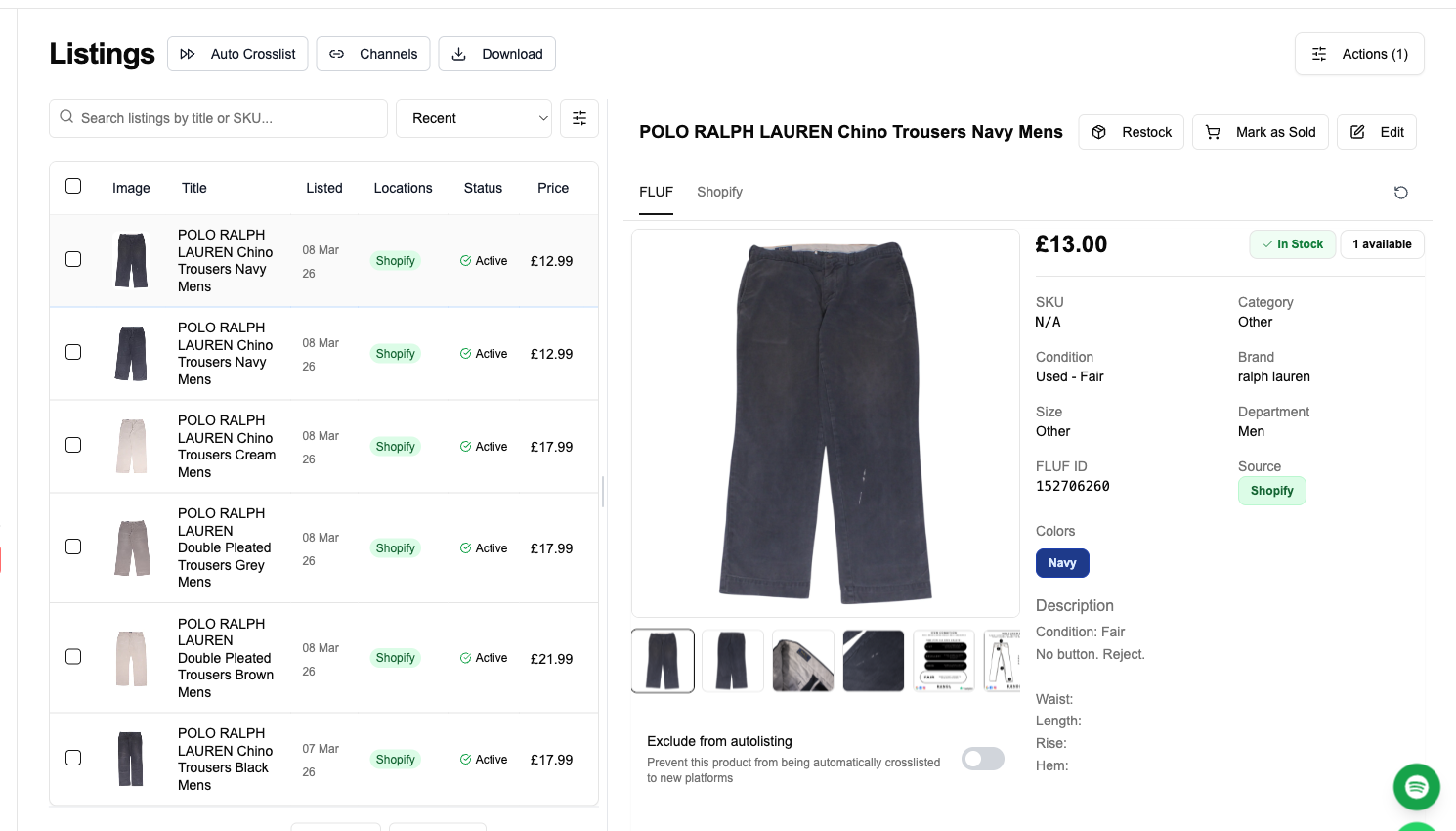
FLUF Connect holds your inventory once and crossposts it to 20+ marketplaces from one dashboard at /connect. For the Trade Me to Poshmark direction:
- Sign up for FLUF Connect and open /connect.
- Connect Trade Me through the FLUF browser extension, which reads your live Trade Me listings into your catalogue.
- Connect Poshmark so FLUF can post to your Poshmark closet.
- Prepare for Poshmark. FLUF pre-fills each Poshmark listing from your Trade Me data; you confirm brand, size, category and condition, and set the price in the buyer’s currency.
- Crosspost a single item or a batch to Poshmark.
- Manage centrally. When an item sells on another connected channel, FLUF can mark it sold on Poshmark so it comes down.
Because Poshmark selling is social, the listing is the starting point rather than the whole job — sharing, offers and community engagement do the rest. FLUF gets your Trade Me items into Poshmark with their details intact, so you can put your energy into the activity that sells on the platform rather than into data entry.
Field & category mapping
- Title & description — carried across from Trade Me; Poshmark descriptions suit brand, size, fit and styling detail.
- Photos — your Trade Me images import and post to Poshmark, an image-led marketplace where the cover shot drives shares and likes.
- Price — imported and editable per channel; set your Poshmark price with the 20% fee (which bundles shipping and processing) in mind.
- Brand & size — mapped to Poshmark’s structured fields, which its buyers use to filter and which its community shopping relies on.
- Condition — mapped to Poshmark’s condition options, with NWT (new with tags) highlighted where it applies.
- Category — Trade Me’s general-goods category is matched to Poshmark’s fashion-led taxonomy.
Poshmark is fashion-first — apparel, shoes, bags, accessories, and increasingly home and beauty — so the mapping is cleanest for wearables. Non-fashion Trade Me listings belong on general marketplaces instead, and FLUF lets you choose which items go to which channels so nothing lands where it doesn’t fit. For fashion resellers with US, Canadian or Australian shipping sorted, Poshmark’s community model is a genuinely different demand source worth tapping. Recognisable brands do especially well, since Poshmark buyers browse and search by label, and accurate brand and size tags are what surface your item in the filtered views the community relies on.
What syncs (and what doesn’t)
Poshmark offers a narrower automation surface in FLUF than a full marketplace API, so it’s important to be clear about the sync behaviour.
What FLUF automates on Poshmark: crossposting your items and marking them sold. When an item sells on another connected channel that FLUF manages, FLUF can mark it sold on Poshmark so the listing comes down — the key protection against selling the same one-off twice across channels. What FLUF does not run on the Poshmark side is automated relisting, offer management or order sync: a sale made on Poshmark isn’t imported into FLUF automatically, so update your other channels yourself (or mark it sold in FLUF) when something sells on Poshmark. Poshmark’s own in-app tools handle its social offers and sharing; FLUF’s role here is getting listings live and keeping them from overselling against your other channels, which for one-of-a-kind fashion is the protection that matters most.
On the Trade Me side, sync is one-directional too. Trade Me connects as a crossposting source; FLUF does not run two-way order sync on Trade Me itself. So for one-of-a-kind fashion, keep the habit of a quick manual check when an item sells on either Trade Me or Poshmark. Crossposting and delist-when-sold-elsewhere are automated; the platform-native selling activity and a light manual reconciliation stay with you. For most fashion sellers that daily glance across channels is a small price for reaching an audience the size of Poshmark’s community.
Before & after — a real workflow
Before FLUF. You list a designer handbag on Trade Me. To reach Poshmark’s community you open the app, re-photograph or re-upload it, retype the description, set brand, size and category, convert the price, and then start sharing it — all before you’ve made a sale. For a whole closet that’s hours of duplicate listing work, which is why many Trade Me sellers never open a Poshmark account.
After FLUF. The handbag is already in your catalogue from the Trade Me import. You open its card, confirm brand and category, set the Poshmark price, and crosspost. A minute of listing work — then your Poshmark time goes into sharing and offers, the activity that actually sells. If it sells on another connected channel, FLUF marks it sold on Poshmark. Your one manual step is updating your other channels if the Poshmark community buys it first.
Across a fashion catalogue, that shifts your effort from re-listing to selling. The items reach a large overseas resale community for a minute of work each, and the social engagement Poshmark rewards is where your time now goes — not into re-keying details you’d already entered on Trade Me.
It’s worth being realistic about the effort Poshmark asks in return for its audience. Unlike a search marketplace where a good listing can sell itself, Poshmark’s algorithm and community favour sellers who show up — sharing daily, responding to offers, and keeping a tidy, active closet. That’s not a downside so much as a different kind of work, and crosslisting is what makes it feasible: by taking the listing burden off your plate, FLUF frees the time that Poshmark’s social model actually rewards. If you enjoy the community side of reselling, Poshmark can become a strong channel; if you don’t, it’s easy to keep it as a lighter-touch outlet for a curated selection of your best pieces.
For sellers already active in the resale world, the appeal is reaching buyers who simply aren’t on Trade Me and never will be — a US, Canadian or Australian community that shops fashion socially inside one app. Crosslisting your Trade Me fashion there is a low-effort way to test that demand, because the listing side costs you almost nothing once FLUF is set up, and you can scale your involvement up or down based on how the channel performs for your particular stock.
Automation features for Trade Me + Poshmark
The automation available for this pair reflects what each platform supports. On Poshmark, FLUF handles crossposting and mark-as-sold; the richer automations below apply to full-marketplace channels you also connect, which is why many sellers run Poshmark alongside one of those:
- Inventory sync — keeps quantities aligned across the channels FLUF manages, and can mark a Poshmark item sold when it goes elsewhere.
- Smart pricing — set an independent Poshmark price that carries its 20% fee, separate from your Trade Me figure.
- Offer management and auto-relisting — available on channels that support them; use these on your marketplace channels to complement Poshmark’s community reach.
Automation is included in every FLUF plan, not a paid add-on. For Trade Me + Poshmark the automation is crossposting and delist-when-sold; the value is reach into a large overseas resale community plus reduced double-handling, rather than end-to-end sync. Sellers who want fuller automation typically pair Poshmark with a full-API marketplace where relisting, offers and order sync all run — and FLUF feeds them all from one catalogue.
Poshmark payouts and buyer protection
Poshmark’s mechanics around money and trust are distinct from an auction marketplace, and worth knowing before you crosspost. When an item sells, Poshmark generates the prepaid label; the buyer has a window (typically up to three days after delivery) to accept the order, after which funds release to your redeemable balance, and if the buyer takes no action acceptance happens automatically. Most sellers see funds a few days after delivery, withdrawable by free direct deposit or by an instant-transfer option for a small fee. Poshmark also mediates disputes under its Posh Protect buyer-protection programme, holding funds until the buyer confirms — protection for buyers that casual sellers often appreciate, since it standardises how problems are handled. For a Trade Me seller used to Ping settling at the point of sale, the delayed acceptance-based payout is the main operational difference to plan cash flow around; it’s not onerous, just different, and it’s part of the trade for reaching Poshmark’s large resale community.
Pricing
FLUF Connect plans start at £9/month (Starter). There is no free plan, but every new account gets a 7-day trial for £1. Poshmark’s own selling fee is charged by Poshmark on each sale. Every FLUF plan includes crosslisting plus the automation set on the channels that support each feature. Higher tiers raise the product cap for larger catalogues. Setup takes about ten minutes: connect Trade Me through the extension, connect Poshmark, and crosspost your first fashion items to reach a new resale community alongside your Trade Me audience. From there, keep adding fashion to your catalogue as you source it, and decide how much of Poshmark’s social selling you want to lean into — the listing groundwork is already handled.
Sources & verification
- Trade Me — Site stats (6.1M+ active members)
- RNZ — Trade Me drops casual success fee (March 2026); Ping 2.19%
- Poshmark — What are the fees for selling ($2.95 under $15; 20% at $15+)
- TechCrunch — Poshmark reverses lower-fee change (Oct 2024)
- Poshmark — features and tools (sharing, offers, bundles, community)
Fees, member figures and market coverage change — always confirm the latest on Poshmark’s and Trade Me’s official pages before pricing and shipping.
Related guides
Frequently Asked Questions
Yes. FLUF Connect imports your Trade Me listings through its browser extension and crossposts them to your Poshmark closet. Title, description, photos, price, brand, size and condition are pre-filled and mapped to Poshmark's fields, so you list once and reach Poshmark's community across the US, Canada and Australia.
On Poshmark, FLUF handles crossposting and mark-as-sold — when an item sells on another connected channel, FLUF can mark it sold on Poshmark so it comes down. Poshmark does not support automated relisting, offer management or order sync in FLUF, so a sale made on Poshmark should be reflected on your other channels manually. Poshmark's own in-app tools handle its social offers and sharing.
Poshmark charges a flat $2.95 on sales under $15 and 20% on sales of $15 or more, which bundles payment processing and a prepaid shipping label in its home markets. Poshmark trialled a lower seller fee in October 2024 but reversed it within weeks, so the $2.95/20% structure is current. Trade Me, after removing the casual success fee in March 2026, charges sellers only the 2.19% Ping payment fee. Price your Poshmark listings with the 20% in mind. Always check current fees.
Poshmark is built around community activity rather than search alone — sellers share their closets, send private offers to people who like an item, bundle multiple pieces into one discounted order, and take part in themed shopping events. Sellers who engage tend to sell more, so a Poshmark closet is a small storefront you tend rather than a set-and-forget listing. FLUF removes the listing work so your Poshmark time goes into that activity.
Fashion — apparel, shoes, bags and accessories, plus some home and beauty. Poshmark is fashion-first, so wearables map cleanest. Keep non-fashion Trade Me goods on general marketplaces instead; FLUF lets you choose which channels each item goes to. Note that you'll need US, Canadian or Australian shipping arranged to serve Poshmark's markets from New Zealand.
FLUF Connect plans start at £9/month on Starter, with Seller at £29/month and Pro at £99/month; every plan is unlimited on listings and marketplaces, and the tiers differ only by how often we check your channels for sales. There is no free plan, but every new account gets a 7-day trial for £1. Every FLUF plan includes crosslisting plus automation on the channels that support each feature; for Poshmark that means crossposting and mark-as-sold, with richer automation available on your full-marketplace channels.