
Poshmark vs Shopify: Which Is Better for Sellers?
A side-by-side breakdown of fees, audience, control and what real sellers think — so you can choose the right platform, or sell on both.



Deciding between Poshmark and Shopify is really a choice between two business models. Poshmark is a social resale marketplace with more than 80 million community members who are already there, shopping fashion through sharing, offers and community events (Poshmark — features and tools). Shopify is the platform behind millions of independent stores across 175-plus countries — your own branded shop, where you own the customer and pay no marketplace commission, but must bring the traffic yourself (Shopify — comparison). This guide compares fees, audience, control and effort side by side, then explains why the smartest answer is often to run both.
- Poshmark is better for: instant access to a built-in fashion-resale community, simple prepaid-label shipping, and social selling with zero fixed cost
- Shopify is better for: owning a branded store, selling any product, keeping your customer data, and much lower per-sale cost at volume
- Fees: Poshmark takes $2.95 under $15 or 20% at $15+ (shipping and processing bundled in); Shopify is a flat plan from $39/month + 2.9% + 30¢ processing, no commission
- Audience: Poshmark has 80M+ community members built in; Shopify has none — you drive your own traffic
- Scope: Poshmark is fashion resale; Shopify sells anything, at any scale
- Our take: run your Shopify store for brand and margin, and Poshmark for its built-in marketplace discovery — crosslist both with FLUF Connect
On this page
- At a glance
- Feature-by-feature
- The selling experience
- Fees and payouts
- Audience and demand
- Control and ownership
- What sellers actually say
- How to make your choice
- Why not both?
At a glance
Poshmark and Shopify aren’t really competitors so much as opposites. Poshmark is a place buyers already are; Shopify is a tool for building a place of your own. On Poshmark you tap an existing community but sell on its terms and pay a commission on every sale. On Shopify you own everything — brand, checkout, customer data — but start with no audience at all. Hold that contrast in mind as we work through the details.
| Poshmark | Shopify | |
|---|---|---|
| What it is | Social resale marketplace | Your own branded online store |
| Built-in buyers | 80M+ community members | None — you drive traffic |
| Cost to sell | $2.95 under $15; 20% at $15+ (incl. label & processing) | From $39/mo + 2.9% + 30¢ processing |
| Marketplace commission | 20% on most sales | None |
| What you can sell | Fashion, accessories, footwear resale | Any product, at any scale |
| Customer data | Owned by Poshmark | Yours (email, retargeting) |
| Shipping | Flat-rate prepaid label | Configurable, multi-carrier — you set it |
| Best for | Fast start, social selling, resale | Brand, control, scale, any niche |
If you want to start selling fashion to real buyers this week with no fixed cost, Poshmark is the faster path. If you want to build a brand you own and keep far more of each sale at volume, Shopify is the stronger foundation. As with most “which is better” questions, the honest answer is that they solve different problems.
A helpful lens is to picture the two extremes of seller. At one end is someone clearing a wardrobe of good-quality fashion who wants sales with the least possible setup and no monthly commitment — Poshmark is almost purpose-built for them, handing over an audience and a shipping label in exchange for a cut. At the other end is someone building a fashion or lifestyle brand they intend to grow for years, who wants their own site, their own customers and margins that improve with scale — Shopify is the obvious home. Most real sellers sit somewhere between these poles, which is exactly why the comparison so often resolves not to “pick one” but to “use each for the part of the business it fits.”
Feature-by-feature
Poshmark’s features revolve around social selling. Members share their own and each other’s listings, follow closets, send private offers to people who’ve liked an item, bundle multiple items into one discounted order, and shop real-time events — Posh Parties and, more recently, Posh Party LIVE livestream shopping (Poshmark — features and tools). These mechanics generate demand from inside the community, which is powerful — but they also mean selling well on Poshmark takes active participation, not just a good listing.
Shopify’s features revolve around building and running a business. You get a fully customisable storefront, your own domain, a configurable checkout, inventory and order management, and an enormous app ecosystem for everything from email marketing to subscriptions to advanced shipping. Crucially, Shopify hands you the customer relationship: you own the email list, you can retarget visitors, and you can run the store exactly how you want (Shopify — comparison). Where Poshmark’s tooling helps you win attention inside a marketplace, Shopify’s tooling helps you build an independent brand.
The effort each set of features demands is very different in character. Poshmark’s social mechanics reward presence — the seller who shares dozens of items a day, sends timely offers, and shows up to parties consistently outsells the one who lists and waits. It’s a people-and-activity game more than a technical one, which suits sellers who enjoy the community and have time to work it. Shopify’s features reward systems thinking — setting up automations, dialling in SEO, building email flows, and analysing what converts. Once configured, much of it runs without daily attention, but getting there is a project. Neither is harder in the abstract; they simply ask for different temperaments and different kinds of time.
It’s also worth noting how each platform handles growth. On Poshmark, scaling means listing and sharing more, and possibly recruiting virtual assistants to keep the sharing cadence up — but you’re always working within Poshmark’s fixed structure and paying its 20%. On Shopify, scaling means investing in marketing and operations that make each additional sale cheaper, adding wholesale or international channels, and building systems that compound. Poshmark scales linearly with your effort; Shopify is built to scale beyond it. For a side hustle, linear is fine; for an ambition to build a real business, the difference becomes decisive over time as volume grows.
The selling experience
Listing on Poshmark is fast: photograph the item, add brand, size, category and price, and it’s live to the community in minutes, with a prepaid shipping label generated automatically when it sells. From there, the work is social — sharing your closet daily, sending offers to likers, and engaging with the community to stay visible. It’s low-friction to start and rewards consistent activity rather than technical setup.
Selling on Shopify begins with building a store, which is a larger up-front task — themes, product pages, navigation, payment and shipping setup — but produces something entirely yours. Once it’s built, adding products is simple, and the ongoing effort shifts from social participation to marketing: SEO, content, email, ads and social media to bring buyers to a site that no one visits by default. Poshmark front-loads community effort; Shopify front-loads build effort and then asks for continuous marketing. Which suits you depends on whether you’d rather work a community or build and market a brand.
Shipping is a good illustration of the trade-off. Poshmark bundles a flat-rate prepaid label into its fee, so shipping is essentially solved for you — the buyer pays a set rate, you print the label, done. That simplicity is a real convenience, especially for casual sellers, though it can be uncompetitive for very light items where a flat rate overcharges. Shopify puts shipping entirely in your hands: you configure carriers, rates, free-shipping thresholds and packaging, which is more work but lets you optimise margins and offer the shipping experience your brand wants. One removes a decision; the other hands you the controls. Sellers who value simplicity lean Poshmark; those who want to fine-tune every cost lean Shopify.
Returns and disputes also feel different. On Poshmark, the platform mediates returns under its own rules, which protects casual sellers from some hassle but means you play by Poshmark’s decisions. On Shopify, you set and enforce your own returns policy, own the customer conversation, and handle disputes through your processor — more responsibility, but also more control over how you treat your customers and protect your brand’s reputation. As with everything else in this comparison, the pattern holds: Poshmark trades control for convenience, Shopify trades convenience for control.
Fees and payouts
This is the decisive difference, and it hinges on volume and margin.
Poshmark charges only when you sell. The fee is a flat $2.95 on sales under $15 and 20% on sales of $15 or more, and that 20% bundles in payment processing and a prepaid shipping label in its home markets (Poshmark — selling fees). There’s no listing fee and no monthly cost. Notably, Poshmark trialled a lower seller fee in October 2024 but reversed it within weeks after sellers reported a drop in sales, so the classic $2.95/20% structure is what’s live today (TechCrunch — Poshmark reverses fee change). The appeal is zero fixed cost — you pay nothing until money comes in — but 20% of every sale is a heavy cut that never shrinks.
Shopify charges a flat subscription plus processing. Plans run from Basic at $39/month (about $29/month billed annually), to Grow at $105/month, to Advanced at $399/month, and you pay card processing through Shopify Payments — 2.9% + 30¢ on Basic — with no marketplace commission on top (Shopify — Pricing). Using a third-party gateway instead of Shopify Payments adds a small transaction fee (2% on Basic, less on higher plans). The appeal is that your per-sale cost is essentially just card processing, no matter how much you sell — so the flat monthly fee is quickly outweighed once you’re doing real volume.
| Cost element | Poshmark | Shopify |
|---|---|---|
| Monthly | $0 | From $39 (Basic) |
| Per listing | None | None |
| Per sale (marketplace) | $2.95 under $15; 20% at $15+ | None |
| Payment processing | Included in the 20% | 2.9% + 30¢ (Basic, Shopify Payments) |
| Shipping | Prepaid flat-rate label included | You configure and pay for it |
The crossover is the entire fee decision. On a $40 item, Poshmark takes $8 (20%); Shopify takes roughly $1.46 in processing (2.9% + 30¢) plus your share of the monthly plan. At a handful of sales a month, Poshmark’s no-fixed-cost model is cheaper and simpler. At dozens or hundreds of sales, Shopify’s flat cost is dramatically cheaper because you keep the 20% Poshmark would have taken on every order. Payouts also differ: Poshmark releases funds a few days after delivery, once the buyer accepts (or the acceptance window lapses), while Shopify pays out through your processor to your own account on a rolling schedule. Confirm current fees and payout timing on each platform before modelling your numbers, since both adjust their rates from time to time.
Audience and demand
Poshmark’s core advantage is its built-in audience. More than 80 million community members across the US, Canada and Australia are already on the platform, browsing and buying fashion socially (Poshmark — features and tools). List an item and it can be seen, shared and bought without you generating any traffic — a genuine head start that a standalone store simply doesn’t have.
Shopify offers no built-in shoppers whatsoever. It powers millions of stores and, in 2024, roughly 875 million consumers bought from Shopify-powered stores worldwide — but all on merchants’ own sites, driven by those merchants’ own marketing (Shopify — comparison). A new Shopify store opens to silence; every visitor comes from SEO, ads, social or email you build. That is the single biggest reason a Shopify store is harder to launch than a Poshmark closet — and the single biggest reason many sellers start on a marketplace before, or alongside, building their own store.
The distinction that matters most is ownership of that demand. Poshmark’s audience is Poshmark’s — you reach them through the app, but you can’t email them, retarget them, or move them to your own channel, and Poshmark controls the rules and the experience. Shopify’s audience, however hard-won, is yours: your email list, your retargeting pixel, your repeat customers. Renting a big audience versus owning a growing one is the trade at the heart of Poshmark versus Shopify.
There’s a strategic dimension here too. Poshmark’s ownership changed in 2023 when Naver acquired it, taking the company private, which is part of why up-to-date standalone metrics are harder to find than they once were. That’s not a knock on Poshmark, but it is a reminder that a marketplace is a business with its own priorities — livestream commerce, AI recommendations, global expansion — and those priorities shape the platform you’re relying on, whether they suit you or not. When you build on a marketplace, you’re a passenger on someone else’s roadmap. When you build a Shopify store, you set your own.
For products with repeat-purchase potential, the owned-audience gap compounds dramatically. If a customer loves your product, on Poshmark you have no reliable way to tell them about your next drop — you hope they follow your closet and happen to see it. On a Shopify store, that customer is on your email list, and reaching them again costs almost nothing. Over a year, a seller who owns their customer relationships can generate repeat revenue that a marketplace-only seller simply cannot access, no matter how good their products are. This is the quiet, cumulative advantage that rarely appears in a head-to-head fee table but often decides which sellers build lasting businesses.
Control and ownership
On Poshmark, you operate within a fixed framework. Every closet works the same way, the fee is set, the shipping is standardised, and the customer belongs to the platform. That uniformity is part of what makes Poshmark easy — there’s little to configure — but it caps how much you can differentiate or build equity in your own brand.
On Shopify, you control essentially everything: branding, storefront design, checkout, pricing, shipping rules, customer data and the full product catalogue. You can build a store that looks and feels like a distinct business, add any product type, and scale into a large operation with wholesale, subscriptions and international selling. The cost of that control is responsibility — nothing runs itself, and traffic is your job — but what you build is an asset you own outright rather than a presence on someone else’s platform. For sellers thinking in years rather than weeks, that ownership is often the deciding factor.
Ownership has a resale value dimension too. A Shopify store with its own domain, brand, traffic and customer list is a business that can be grown, valued and even sold — it’s an asset with equity. A Poshmark closet, however successful, isn’t something you own or can transfer; it’s an account on a platform, and its value evaporates if you stop or if the platform changes. Sellers who treat their selling as a real business, rather than a way to clear a wardrobe, tend to weight this heavily: the hours you put into a Shopify store build something durable, while the hours you put into a Poshmark closet buy sales today but bank no lasting equity.
None of this makes Poshmark’s model wrong — for a great many sellers, “no fixed cost, buyers included, shipping handled, minimal setup” is exactly the right trade, and the lack of ownership genuinely doesn’t matter to them. The point is simply that control and convenience sit at opposite ends of a spectrum, and knowing which end you value is the fastest way to cut through the comparison. If you’d happily trade a slice of every sale to have the platform handle discovery, shipping and disputes, Poshmark is built for you. If you’d rather own the whole thing and are willing to do the work, Shopify is.
What sellers actually say
Sellers who’ve used both tend to describe them in the same complementary terms. Poshmark is praised for how quickly you can start earning and for its engaged community, but criticised for the 20% cut and the constant social effort required to stay visible — plus the frustration of never owning the customer. When Poshmark briefly tried to lower seller fees in 2024 and sales dropped, then reversed the change, it underlined how much sellers’ fortunes ride on decisions they don’t control (TechCrunch — Poshmark reverses fee change).
Shopify sellers value keeping their margin, their brand and their customer list, and the freedom to sell anything and scale — but are honest that traffic is the hard, ongoing work, and that a store is only as good as the marketing behind it. The consensus that emerges is that Poshmark is the better starting and discovery engine for fashion resale, while Shopify is the better owned business, and the sellers who do best use each for its strength instead of asking one to do the other’s job.
How to make your choice
Choose Poshmark if you’re selling fashion, want buyers immediately, prefer no fixed costs, and are happy to engage with a social selling community. It’s the fastest way to start earning from resale without a marketing budget or a store to build.
Choose Shopify if you want a branded store you own, you sell products beyond fashion resale, you’re doing enough volume that a 20% marketplace cut hurts, and you’re ready to drive your own traffic. It’s the stronger foundation for a durable, scalable business.
Choose both if — as many growing sellers do — you want Poshmark’s ready community for discovery and the brand, margin and customer ownership of a Shopify store. They’re complementary, not competing, and the only real barrier to running both has been the double workload of listing and the risk of overselling. That’s precisely what crosslisting removes.
A useful way to frame the decision is to ask what you’re short of today. If you have good fashion inventory but no buyers and no budget to find them, your constraint is demand — start on Poshmark, where the community is waiting. If you’re already selling steadily and the 20% cut, the lack of customer data, or the ceiling on your brand is what’s holding you back, your constraint is ownership — build a Shopify store. And if you’re growing and feel both at once, that’s the moment to run both, letting Poshmark keep feeding you discovery while your Shopify store captures the margin and the customers you keep. Because crosslisting adds a channel rather than forcing a migration, moving along this path costs you almost nothing and never means abandoning what’s already working.
Why not both? Sell on Shopify and Poshmark together
The Poshmark-versus-Shopify choice is a false binary. Poshmark gives you a marketplace audience but takes 20% and owns the customer; Shopify gives you brand, margin and data but no built-in buyers. Run both and each covers the other’s gap — Poshmark drives marketplace discovery you don’t have to build while your Shopify store banks the brand, the higher margins and the repeat customers you own.
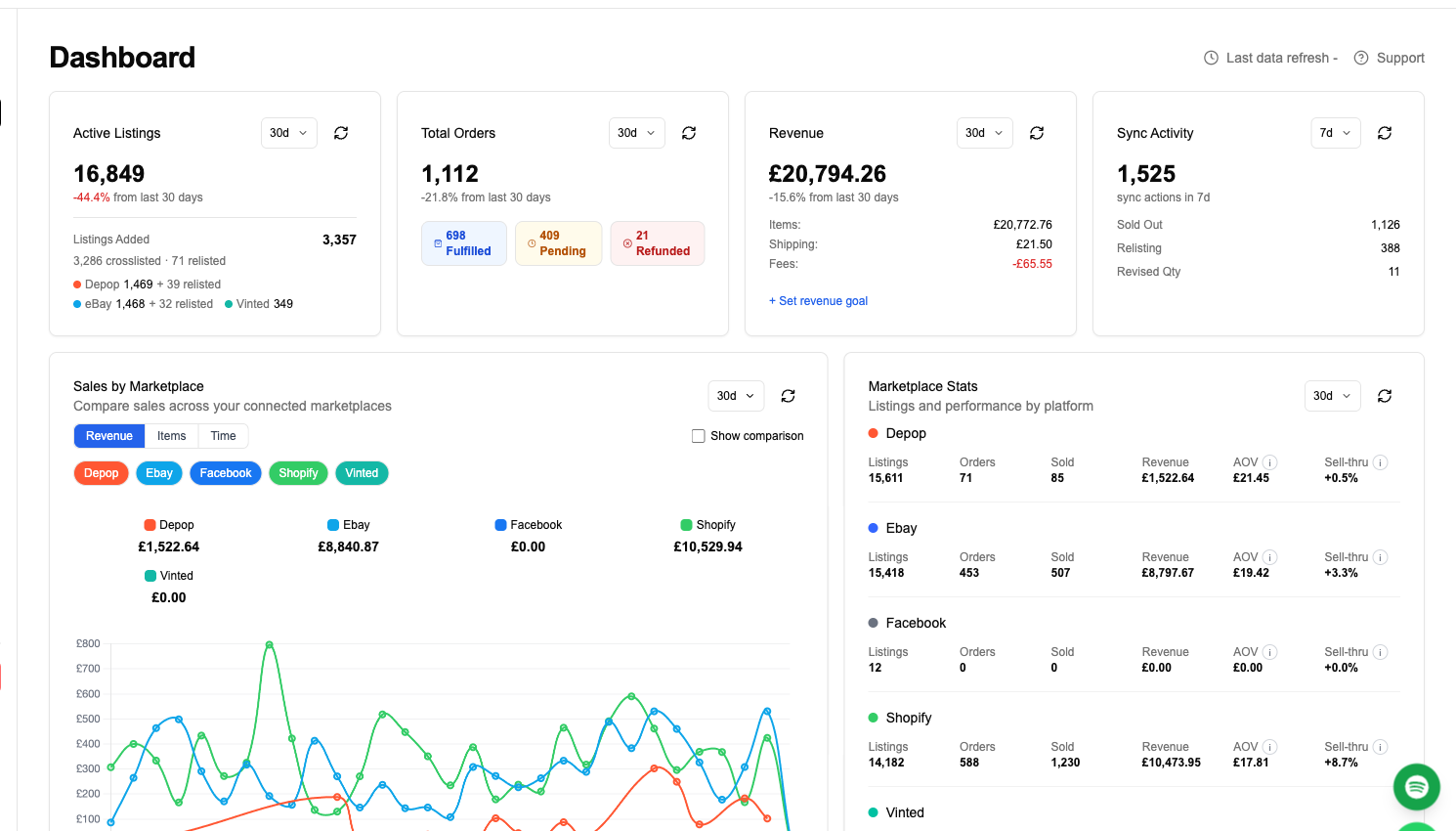
FLUF Connect makes running both practical rather than twice the work. List an item once and crosspost it to both your Shopify store and your Poshmark closet, with inventory kept in sync so a sale on one automatically updates the other — the single most important protection against overselling the same one-of-a-kind piece across channels. Push your high-margin and branded products to your Shopify store where you keep nearly all of the sale, tap Poshmark’s community for surplus and resale inventory that benefits from its ready buyers, and manage everything from one dashboard at /connect. Instead of choosing which economics to live with, you use each channel where its economics win.
FLUF Connect plans start at £9/month (Starter). There is no free plan, but every new account gets a 7-day trial for £1. Every plan includes crosslisting plus inventory and order sync on the channels that support them, so keeping a Shopify store and a Poshmark closet aligned costs nothing extra within FLUF. Rather than betting everything on a marketplace that owns your customer or a store with no audience, you get both — instant discovery and an owned brand — from a single catalogue, without doubling your listing work or risking a double sale.
Sources & verification
- Poshmark — What are the fees for selling ($2.95 under $15; 20% at $15+, incl. label & processing)
- TechCrunch — Poshmark reverses lower-fee change (Oct 2024)
- Poshmark — features and tools (80M+ community; sharing, parties, offers, bundles)
- Shopify — Pricing (Basic from $39/mo; Shopify Payments 2.9% + 30¢)
- Shopify — you own your brand, customer list and data (175+ countries)
Fees, plan prices and member figures change — always confirm the latest on Poshmark’s and Shopify’s official pages before deciding.
Related guides
Frequently Asked Questions
It depends on volume. Poshmark has no fixed cost — it charges $2.95 on sales under $15 and 20% on sales of $15 or more, with shipping and processing bundled in — so it's cheapest at low volume. Shopify charges a flat plan from $39/month plus 2.9% + 30¢ processing and no marketplace commission, so it becomes far cheaper per sale at higher volume, because you keep the 20% Poshmark would take on every order. The crossover point is the key to the decision.
Poshmark gives you a built-in audience of more than 80 million community members immediately; Shopify gives you none. A Shopify store opens to silence, and every visitor comes from SEO, ads, social or email you drive yourself. The trade-off is ownership: Poshmark's audience belongs to Poshmark and you can't email or retarget them, while a Shopify store's audience — however hard-won — is yours to keep and market to again.
Poshmark charges a flat $2.95 on sales under $15 and 20% on sales of $15 or more, which includes payment processing and a prepaid shipping label in its home markets. Poshmark trialled a lower seller fee in October 2024 but reversed it within weeks after sellers reported a drop in sales, so the $2.95/20% structure is what's live today. Always confirm current fees on Poshmark.
Shopify. Every Poshmark closet works within the same fixed framework, and Poshmark owns the customer relationship. A Shopify store is your own branded website on your own domain, with full control of design, checkout, pricing and customer data. Poshmark is better for fast discovery and social resale; Shopify is better for building a distinct, scalable brand you own.
Yes, and many growing sellers do. FLUF Connect lets you list an item once and crosspost it to both your Shopify store and your Poshmark closet, keeping inventory in sync so a sale on one automatically updates the other and you don't oversell. You push high-margin, branded products to Shopify and tap Poshmark's community for resale inventory, all from one dashboard. FLUF plans start at £19/month; There is no free plan, but every new account gets a 7-day trial for £1.
Poshmark is focused on fashion, accessories and footwear resale, with some home and beauty. Shopify lets you sell any product type — new, used, handmade, wholesale, digital, subscriptions — at any scale. If your catalogue extends beyond fashion resale, Shopify is the platform that fits, while Poshmark can still handle the fashion portion of your inventory.